Battery Hyundai Accent 2016 Service Manual
[x] Cancel search | Manufacturer: HYUNDAI, Model Year: 2016, Model line: Accent, Model: Hyundai Accent 2016Pages: 456, PDF Size: 16.41 MB
Page 370 of 456
Maintenance
12
7
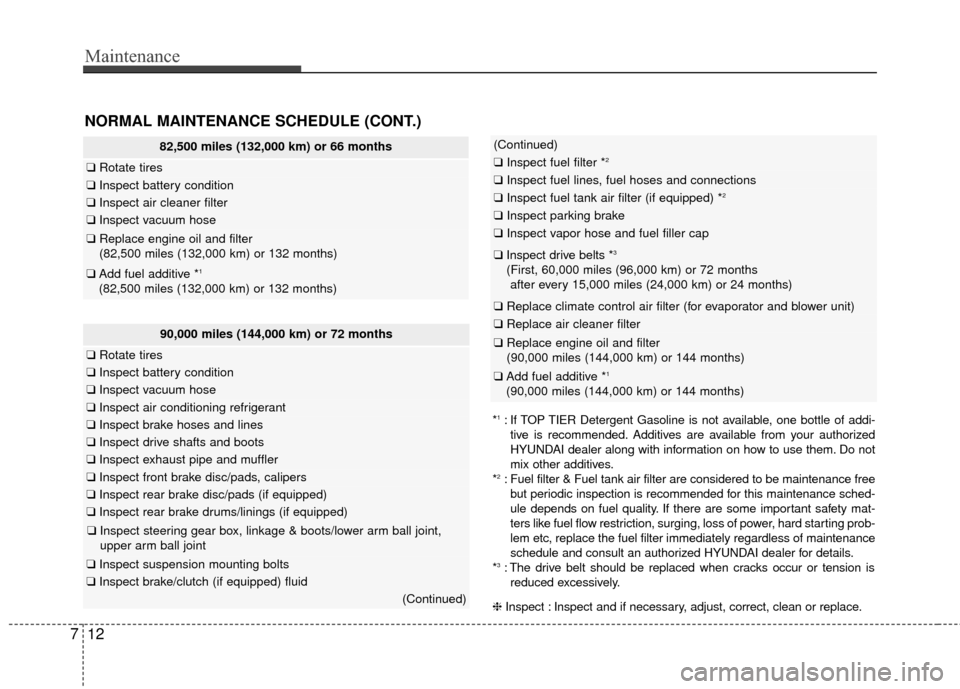
90,000 miles (144,000 km) or 72 months
❑ Rotate tires
❑Inspect battery condition
❑Inspect vacuum hose
❑Inspect air conditioning refrigerant
❑Inspect brake hoses and lines
❑Inspect drive shafts and boots
❑Inspect exhaust pipe and muffler
❑Inspect front brake disc/pads, calipers
❑Inspect rear brake disc/pads (if equipped)
❑Inspect rear brake drums/linings (if equipped)
❑Inspect steering gear box, linkage & boots/lower arm ball joint,
upper arm ball joint
❑ Inspect suspension mounting bolts
❑Inspect brake/clutch (if equipped) fluid
(Continued)
(Continued)
❑Inspect fuel filter *2
❑Inspect fuel lines, fuel hoses and connections
❑Inspect fuel tank air filter (if equipped) *2
❑Inspect parking brake
❑Inspect vapor hose and fuel filler cap
❑Inspect drive belts *3
(First, 60,000 miles (96,000 km) or 72 months
after every 15,000 miles (24,000 km) or 24 months)
❑ Replace climate control air filter (for evaporator and blower unit)
❑Replace air cleaner filter
❑Replace engine oil and filter
(90,000 miles (144,000 km) or 144 months)
❑Add fuel additive *1
(90,000 miles (144,000 km) or 144 months)
NORMAL MAINTENANCE SCHEDULE (CONT.)
82,500 miles (132,000 km) or 66 months
❑ Rotate tires
❑Inspect battery condition
❑Inspect air cleaner filter
❑Inspect vacuum hose
❑Replace engine oil and filter
(82,500 miles (132,000 km) or 132 months)
❑Add fuel additive *1
(82,500 miles (132,000 km) or 132 months)
*1: If TOP TIER Detergent Gasoline is not available, one bottle of addi-
tive is recommended. Additives are available from your authorized
HYUNDAI dealer along with information on how to use them. Do not
mix other additives.
*
2: Fuel filter & Fuel tank air filter are considered to be maintenance free\
but periodic inspection is recommended for this maintenance sched-
ule depends on fuel quality. If there are some important safety mat-
ters like fuel flow restriction, surging, loss of power, hard starting prob-
lem etc, replace the fuel filter immediately regardless of maintenance
schedule and consult an authorized HYUNDAI dealer for details.
*
3: The drive belt should be replaced when cracks occur or tension is reduced excessively.
❈ Inspect : Inspect and if necessary, adjust, correct, clean or replace.
Page 371 of 456
713
Maintenance
NORMAL MAINTENANCE SCHEDULE (CONT.)
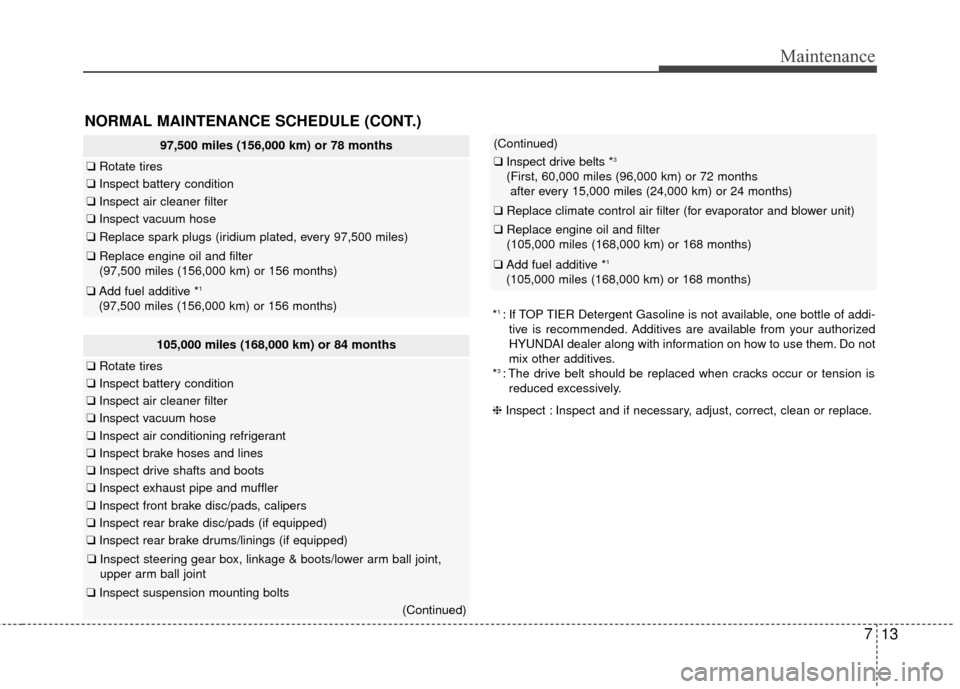
97,500 miles (156,000 km) or 78 months
❑Rotate tires
❑Inspect battery condition
❑Inspect air cleaner filter
❑Inspect vacuum hose
❑ Replace spark plugs (iridium plated, every 97,500 miles)
❑Replace engine oil and filter
(97,500 miles (156,000 km) or 156 months)
❑Add fuel additive *1
(97,500 miles (156,000 km) or 156 months)
105,000 miles (168,000 km) or 84 months
❑ Rotate tires
❑Inspect battery condition
❑Inspect air cleaner filter
❑Inspect vacuum hose
❑Inspect air conditioning refrigerant
❑Inspect brake hoses and lines
❑Inspect drive shafts and boots
❑Inspect exhaust pipe and muffler
❑Inspect front brake disc/pads, calipers
❑Inspect rear brake disc/pads (if equipped)
❑Inspect rear brake drums/linings (if equipped)
❑Inspect steering gear box, linkage & boots/lower arm ball joint,
upper arm ball joint
❑ Inspect suspension mounting bolts
(Continued)
*1 : If TOP TIER Detergent Gasoline is not available, one bottle of addi-
tive is recommended. Additives are available from your authorized
HYUNDAI dealer along with information on how to use them. Do not
mix other additives.
*
3 : The drive belt should be replaced when cracks occur or tension is reduced excessively.
❈ Inspect : Inspect and if necessary, adjust, correct, clean or replace.
(Continued)
❑Inspect drive belts *3
(First, 60,000 miles (96,000 km) or 72 months
after every 15,000 miles (24,000 km) or 24 months)
❑ Replace climate control air filter (for evaporator and blower unit)
❑Replace engine oil and filter
(105,000 miles (168,000 km) or 168 months)
❑Add fuel additive *1
(105,000 miles (168,000 km) or 168 months)
Page 372 of 456
Maintenance
7
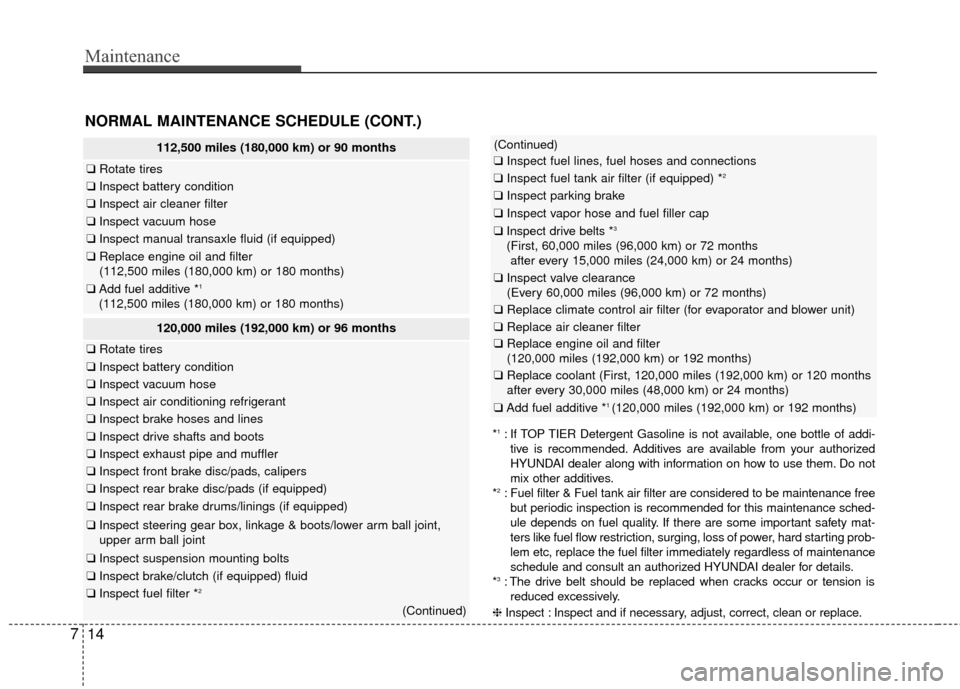
(Continued)
❑Inspect fuel lines, fuel hoses and connections
❑Inspect fuel tank air filter (if equipped) *2
❑Inspect parking brake
❑Inspect vapor hose and fuel filler cap
❑Inspect drive belts *3
(First, 60,000 miles (96,000 km) or 72 months
after every 15,000 miles (24,000 km) or 24 months)
❑ Inspect valve clearance
(Every 60,000 miles (96,000 km) or 72 months)
❑ Replace climate control air filter (for evaporator and blower unit)
❑Replace air cleaner filter
❑Replace engine oil and filter
(120,000 miles (192,000 km) or 192 months)
❑Replace coolant (First, 120,000 miles (192,000 km) or 120 months
after every 30,000 miles (48,000 km) or 24 months)
❑Add fuel additive *1 (120,000 miles (192,000 km) or 192 months)
NORMAL MAINTENANCE SCHEDULE (CONT.)
112,500 miles (180,000 km) or 90 months
❑ Rotate tires
❑Inspect battery condition
❑Inspect air cleaner filter
❑Inspect vacuum hose
❑Inspect manual transaxle fluid (if equipped)
❑Replace engine oil and filter
(112,500 miles (180,000 km) or 180 months)
❑Add fuel additive *1
(112,500 miles (180,000 km) or 180 months)
120,000 miles (192,000 km) or 96 months
❑ Rotate tires
❑Inspect battery condition
❑Inspect vacuum hose
❑Inspect air conditioning refrigerant
❑Inspect brake hoses and lines
❑Inspect drive shafts and boots
❑Inspect exhaust pipe and muffler
❑Inspect front brake disc/pads, calipers
❑Inspect rear brake disc/pads (if equipped)
❑Inspect rear brake drums/linings (if equipped)
❑Inspect steering gear box, linkage & boots/lower arm ball joint,
upper arm ball joint
❑ Inspect suspension mounting bolts
❑Inspect brake/clutch (if equipped) fluid
❑Inspect fuel filter *2
(Continued)
*1: If TOP TIER Detergent Gasoline is not available, one bottle of addi-
tive is recommended. Additives are available from your authorized
HYUNDAI dealer along with information on how to use them. Do not
mix other additives.
*
2: Fuel filter & Fuel tank air filter are considered to be maintenance free\
but periodic inspection is recommended for this maintenance sched-
ule depends on fuel quality. If there are some important safety mat-
ters like fuel flow restriction, surging, loss of power, hard starting prob-
lem etc, replace the fuel filter immediately regardless of maintenance
schedule and consult an authorized HYUNDAI dealer for details.
*
3: The drive belt should be replaced when cracks occur or tension is reduced excessively.
❈ Inspect : Inspect and if necessary, adjust, correct, clean or replace.
14
Page 373 of 456
715
Maintenance
NORMAL MAINTENANCE SCHEDULE (CONT.)
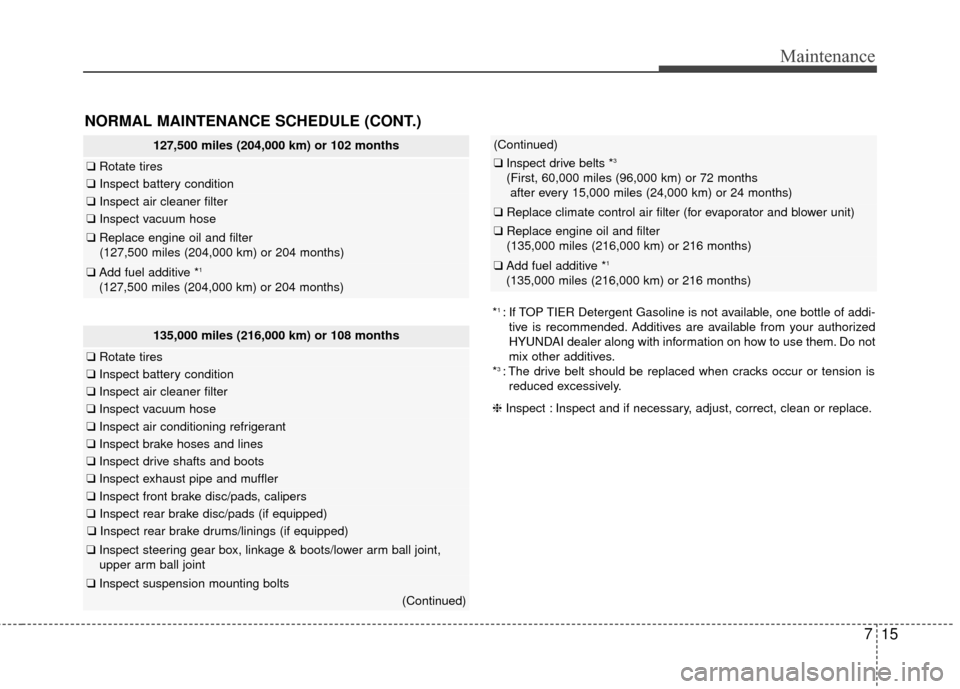
127,500 miles (204,000 km) or 102 months
❑Rotate tires
❑Inspect battery condition
❑Inspect air cleaner filter
❑Inspect vacuum hose
❑Replace engine oil and filter
(127,500 miles (204,000 km) or 204 months)
❑Add fuel additive *1
(127,500 miles (204,000 km) or 204 months)
*1 : If TOP TIER Detergent Gasoline is not available, one bottle of addi-
tive is recommended. Additives are available from your authorized
HYUNDAI dealer along with information on how to use them. Do not
mix other additives.
*
3 : The drive belt should be replaced when cracks occur or tension is reduced excessively.
❈ Inspect : Inspect and if necessary, adjust, correct, clean or replace.
135,000 miles (216,000 km) or 108 months
❑Rotate tires
❑Inspect battery condition
❑Inspect air cleaner filter
❑Inspect vacuum hose
❑Inspect air conditioning refrigerant
❑Inspect brake hoses and lines
❑Inspect drive shafts and boots
❑Inspect exhaust pipe and muffler
❑Inspect front brake disc/pads, calipers
❑Inspect rear brake disc/pads (if equipped)
❑Inspect rear brake drums/linings (if equipped)
❑Inspect steering gear box, linkage & boots/lower arm ball joint,
upper arm ball joint
❑ Inspect suspension mounting bolts
(Continued)
(Continued)
❑Inspect drive belts *3
(First, 60,000 miles (96,000 km) or 72 months
after every 15,000 miles (24,000 km) or 24 months)
❑ Replace climate control air filter (for evaporator and blower unit)
❑Replace engine oil and filter
(135,000 miles (216,000 km) or 216 months)
❑Add fuel additive *1
(135,000 miles (216,000 km) or 216 months)
Page 374 of 456
Maintenance
16
7
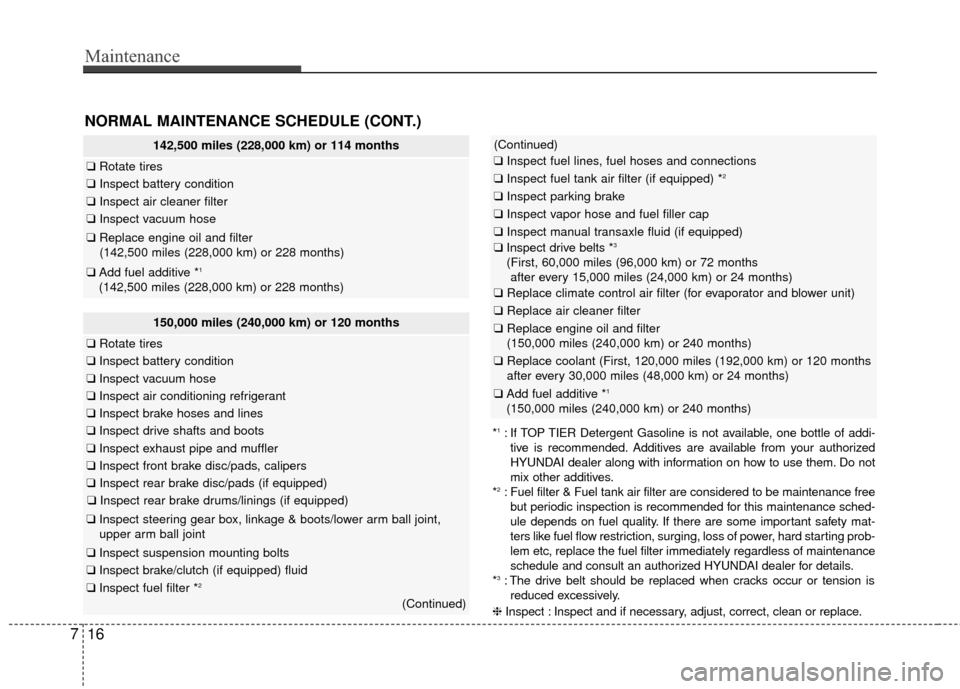
150,000 miles (240,000 km) or 120 months
❑ Rotate tires
❑Inspect battery condition
❑Inspect vacuum hose
❑Inspect air conditioning refrigerant
❑Inspect brake hoses and lines
❑Inspect drive shafts and boots
❑Inspect exhaust pipe and muffler
❑Inspect front brake disc/pads, calipers
❑Inspect rear brake disc/pads (if equipped)
❑Inspect rear brake drums/linings (if equipped)
❑Inspect steering gear box, linkage & boots/lower arm ball joint,
upper arm ball joint
❑ Inspect suspension mounting bolts
❑Inspect brake/clutch (if equipped) fluid
❑Inspect fuel filter *2
(Continued)
(Continued)
❑Inspect fuel lines, fuel hoses and connections
❑Inspect fuel tank air filter (if equipped) *2
❑Inspect parking brake
❑Inspect vapor hose and fuel filler cap
❑Inspect manual transaxle fluid (if equipped)
❑Inspect drive belts *3
(First, 60,000 miles (96,000 km) or 72 months
after every 15,000 miles (24,000 km) or 24 months)
❑ Replace climate control air filter (for evaporator and blower unit)
❑Replace air cleaner filter
❑Replace engine oil and filter
(150,000 miles (240,000 km) or 240 months)
❑Replace coolant (First, 120,000 miles (192,000 km) or 120 months
after every 30,000 miles (48,000 km) or 24 months)
❑Add fuel additive *1
(150,000 miles (240,000 km) or 240 months)
NORMAL MAINTENANCE SCHEDULE (CONT.)
142,500 miles (228,000 km) or 114 months
❑ Rotate tires
❑Inspect battery condition
❑Inspect air cleaner filter
❑Inspect vacuum hose
❑Replace engine oil and filter
(142,500 miles (228,000 km) or 228 months)
❑Add fuel additive *1
(142,500 miles (228,000 km) or 228 months)
*1: If TOP TIER Detergent Gasoline is not available, one bottle of addi-
tive is recommended. Additives are available from your authorized
HYUNDAI dealer along with information on how to use them. Do not
mix other additives.
*
2: Fuel filter & Fuel tank air filter are considered to be maintenance free\
but periodic inspection is recommended for this maintenance sched-
ule depends on fuel quality. If there are some important safety mat-
ters like fuel flow restriction, surging, loss of power, hard starting prob-
lem etc, replace the fuel filter immediately regardless of maintenance
schedule and consult an authorized HYUNDAI dealer for details.
*
3: The drive belt should be replaced when cracks occur or tension is reduced excessively.
❈ Inspect : Inspect and if necessary, adjust, correct, clean or replace.
Page 382 of 456
Maintenance
24
7
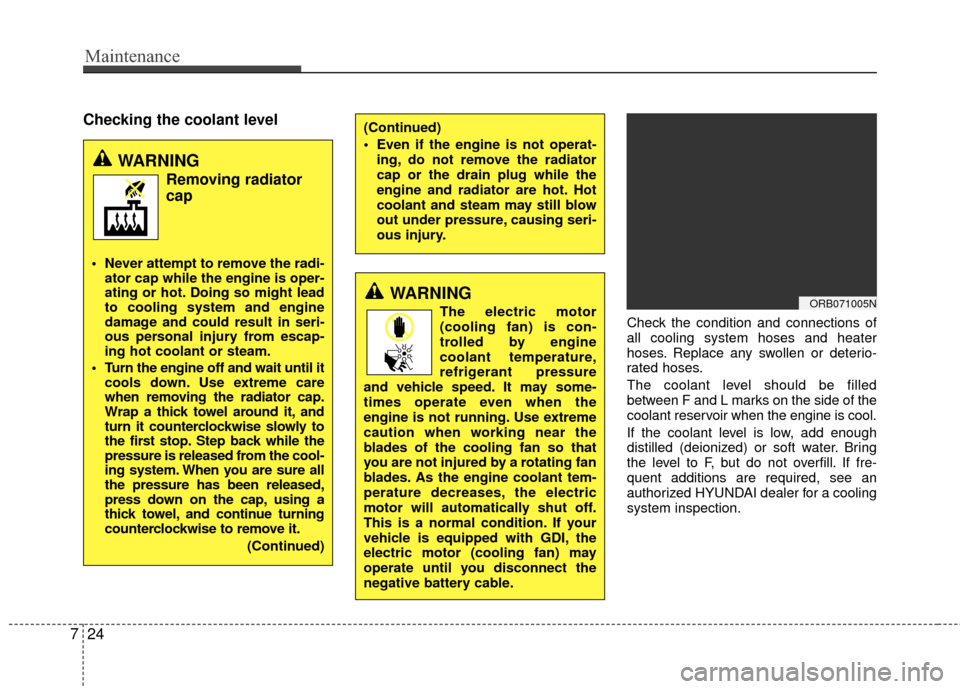
Checking the coolant level
Check the condition and connections of
all cooling system hoses and heater
hoses. Replace any swollen or deterio-
rated hoses.
The coolant level should be filled
between F and L marks on the side of the
coolant reservoir when the engine is cool.
If the coolant level is low, add enough
distilled (deionized) or soft water. Bring
the level to F, but do not overfill. If fre-
quent additions are required, see an
authorized HYUNDAI dealer for a cooling
system inspection.
ORB071005N
(Continued)
Even if the engine is not operat-
ing, do not remove the radiator
cap or the drain plug while the
engine and radiator are hot. Hot
coolant and steam may still blow
out under pressure, causing seri-
ous injury.
WARNING
Removing radiator
cap
Never attempt to remove the radi-ator cap while the engine is oper-
ating or hot. Doing so might lead
to cooling system and engine
damage and could result in seri-
ous personal injury from escap-
ing hot coolant or steam.
Turn the engine off and wait until it cools down. Use extreme care
when removing the radiator cap.
Wrap a thick towel around it, and
turn it counterclockwise slowly to
the first stop. Step back while the
pressure is released from the cool-
ing system. When you are sure all
the pressure has been released,
press down on the cap, using a
thick towel, and continue turning
counterclockwise to remove it.
(Continued)
WARNING
The electric motor
(cooling fan) is con-
trolled by engine
coolant temperature,
refrigerant pressure
and vehicle speed. It may some-
times operate even when the
engine is not running. Use extreme
caution when working near the
blades of the cooling fan so that
you are not injured by a rotating fan
blades. As the engine coolant tem-
perature decreases, the electric
motor will automatically shut off.
This is a normal condition. If your
vehicle is equipped with GDI, the
electric motor (cooling fan) may
operate until you disconnect the
negative battery cable.
Page 392 of 456
Maintenance
34
7
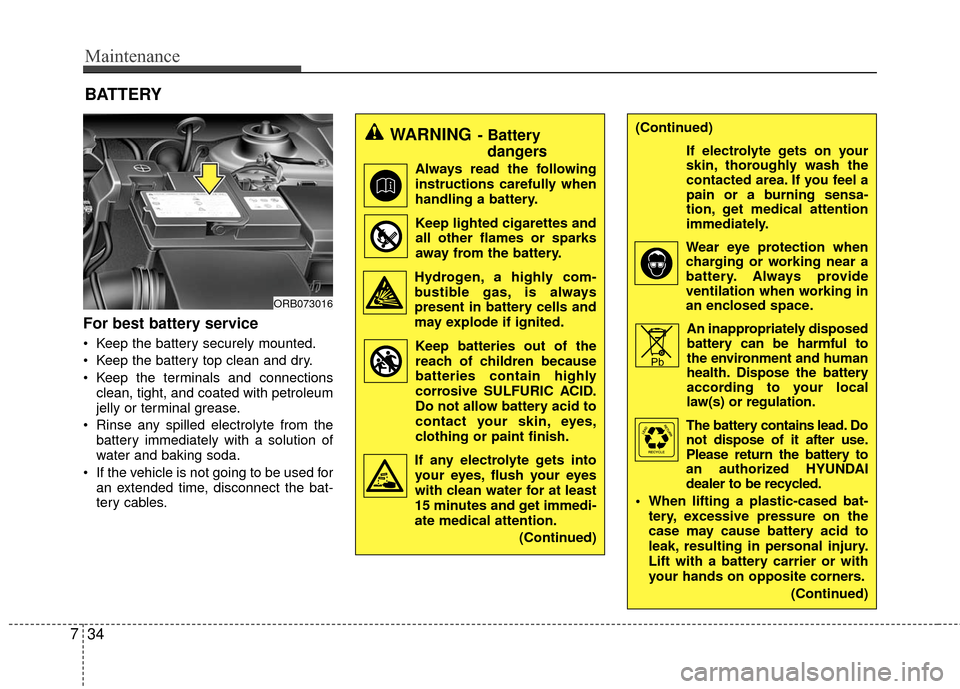
For best battery service
Keep the battery securely mounted.
Keep the battery top clean and dry.
Keep the terminals and connections
clean, tight, and coated with petroleum
jelly or terminal grease.
Rinse any spilled electrolyte from the battery immediately with a solution of
water and baking soda.
If the vehicle is not going to be used for an extended time, disconnect the bat-
tery cables.
BATTERY
WARNING- Battery dangers
Always read the following
instructions carefully when
handling a battery.
Keep lighted cigarettes andall other flames or sparks
away from the battery.
Hydrogen, a highly com- bustible gas, is always
present in battery cells and
may explode if ignited.
Keep batteries out of the
reach of children because
batteries contain highly
corrosive SULFURIC ACID.
Do not allow battery acid to
contact your skin, eyes,
clothing or paint finish.
If any electrolyte gets into your eyes, flush your eyes
with clean water for at least
15 minutes and get immedi-
ate medical attention.
(Continued)
(Continued)
If electrolyte gets on your
skin, thoroughly wash the
contacted area. If you feel a
pain or a burning sensa-
tion, get medical attention
immediately.
Wear eye protection when charging or working near a
battery. Always provide
ventilation when working in
an enclosed space.
An inappropriately disposedbattery can be harmful to
the environment and human
health. Dispose the battery
according to your local
law(s) or regulation.
The battery contains lead. Do
not dispose of it after use.
Please return the battery to
an authorized HYUNDAI
dealer to be recycled.
When lifting a plastic-cased bat- tery, excessive pressure on the
case may cause battery acid to
leak, resulting in personal injury.
Lift with a battery carrier or with
your hands on opposite corners.
(Continued)
Pb
ORB073016
Page 393 of 456
735
Maintenance
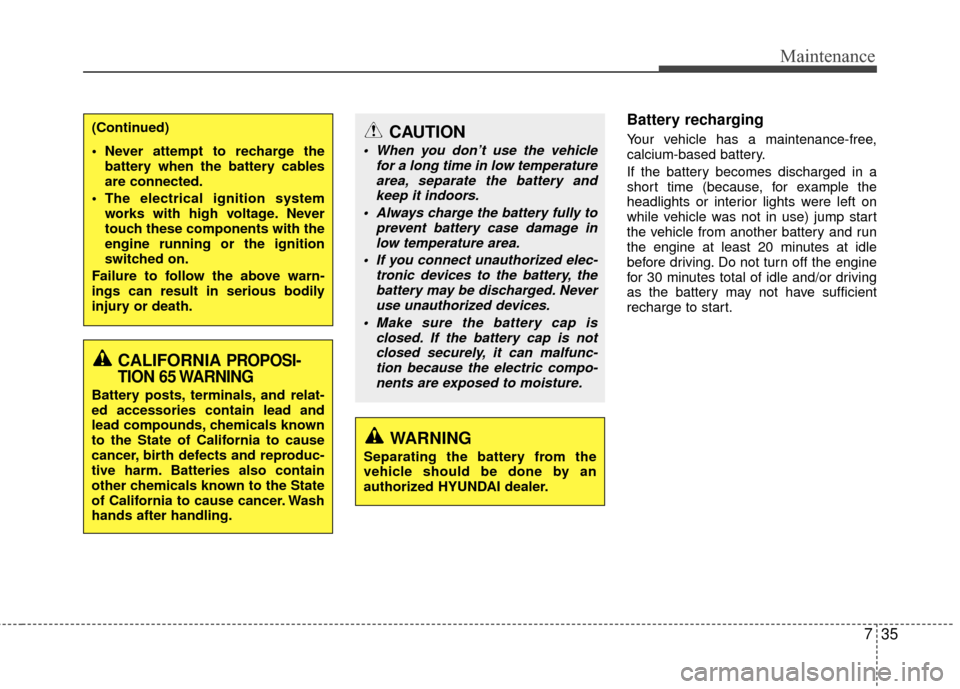
Battery recharging
Your vehicle has a maintenance-free,
calcium-based battery.
If the battery becomes discharged in a
short time (because, for example the
headlights or interior lights were left on
while vehicle was not in use) jump start
the vehicle from another battery and run
the engine at least 20 minutes at idle
before driving. Do not turn off the engine
for 30 minutes total of idle and/or driving
as the battery may not have sufficient
recharge to start.
CALIFORNIA PROPOSI-
TION 65 WARNING
Battery posts, terminals, and relat-
ed accessories contain lead and
lead compounds, chemicals known
to the State of California to cause
cancer, birth defects and reproduc-
tive harm. Batteries also contain
other chemicals known to the State
of California to cause cancer. Wash
hands after handling.
(Continued)
Never attempt to recharge the
battery when the battery cables
are connected.
The electrical ignition system works with high voltage. Never
touch these components with the
engine running or the ignition
switched on.
Failure to follow the above warn-
ings can result in serious bodily
injury or death.CAUTION
When you don’t use the vehicle for a long time in low temperaturearea, separate the battery andkeep it indoors.
Always charge the battery fully to prevent battery case damage inlow temperature area.
If you connect unauthorized elec- tronic devices to the battery, thebattery may be discharged. Never use unauthorized devices.
Make sure the battery cap is closed. If the battery cap is notclosed securely, it can malfunc- tion because the electric compo-nents are exposed to moisture.
WARNING
Separating the battery from the
vehicle should be done by an
authorized HYUNDAI dealer.
Page 394 of 456
Maintenance
36
7
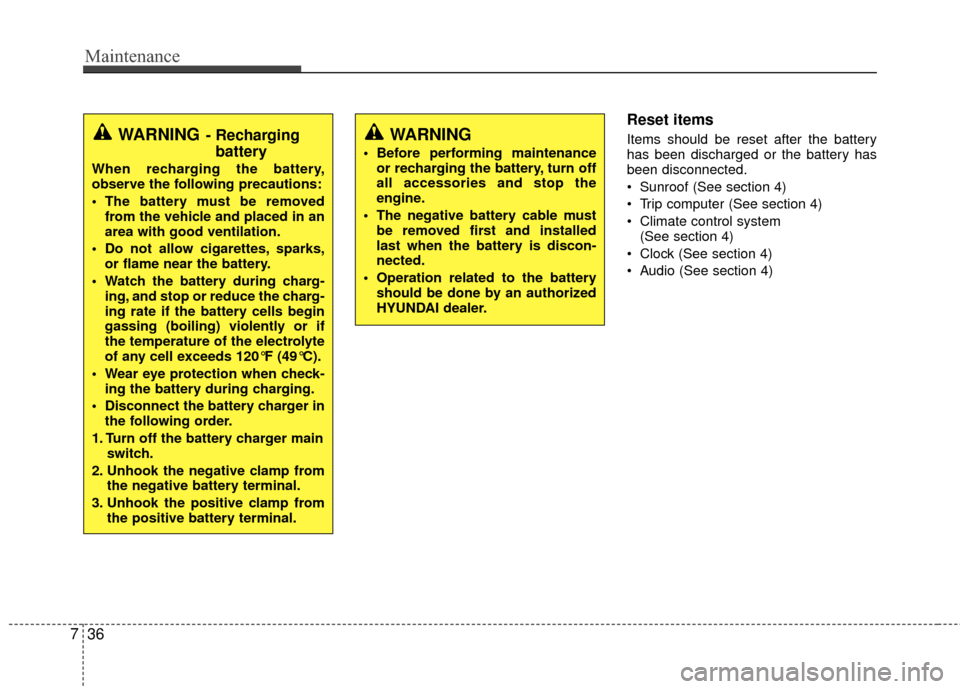
Reset items
Items should be reset after the battery
has been discharged or the battery has
been disconnected.
Sunroof (See section 4)
Trip computer (See section 4)
Climate control system
(See section 4)
Clock (See section 4)
Audio (See section 4)WARNING
Before performing maintenance or recharging the battery, turn off
all accessories and stop the
engine.
The negative battery cable must be removed first and installed
last when the battery is discon-
nected.
Operation related to the battery should be done by an authorized
HYUNDAI dealer.
WARNING- Rechargingbattery
When recharging the battery,
observe the following precautions:
The battery must be removed
from the vehicle and placed in an
area with good ventilation.
Do not allow cigarettes, sparks, or flame near the battery.
Watch the battery during charg- ing, and stop or reduce the charg-
ing rate if the battery cells begin
gassing (boiling) violently or if
the temperature of the electrolyte
of any cell exceeds 120°F (49°C).
Wear eye protection when check- ing the battery during charging.
Disconnect the battery charger in the following order.
1. Turn off the battery charger main switch.
2. Unhook the negative clamp from the negative battery terminal.
3. Unhook the positive clamp from the positive battery terminal.
Page 406 of 456
Maintenance
48
7
Intended Outboard Sidewall: The
side of an asymmetrical tire, that
must always face outward when
mounted on a vehicle.
Kilopascal (kPa): The metric unit for
air pressure.
Light truck (LT) tire: A tire designat-
ed by its manufacturer as primarily
intended for use on lightweight trucks
or multipurpose passenger vehicles.
Load ratings: The maximum load
that a tire is rated to carry for a given
inflation pressure.
Load Index: An assigned number
ranging from 1 to 279 that corre-
sponds to the load carrying capacity
of a tire.
Maximum Inflation Pressure: The
maximum air pressure to which a
cold tire may be inflated. The maxi-
mum air pressure is molded onto the
sidewall.
Maximum Load Rating: The load
rating for a tire at the maximum per-
missible inflation pressure for that
tire. Maximum Loaded Vehicle Weight:
The sum of curb weight; accessory
weight; vehicle capacity weight; and
production options weight.
Normal Occupant Weight:
The
number of occupants a vehicle is
designed to seat multiplied by 150
pounds (68 kg).
Occupant Distribution: Designated
seating positions.
Outward Facing Sidewall: The side
of a asymmetrical tire that has a par-
ticular side that faces outward when
mounted on a vehicle. The outward
facing sidewall bears white lettering
or bears manufacturer, brand, and/or
model name molding that is higher or
deeper than the same moldings on
the inner facing sidewall.
Passenger (P-Metric) Tire: A tire
used on passenger cars and some
light duty trucks and multipurpose
vehicles.
Ply: A layer of rubber-coated parallel
cords Pneumatic tire:
A mechanical
device made of rubber, chemicals,
fabric and steel or other materials,
that, when mounted on an automo-
tive wheel, provides the traction and
contains the gas or fluid that sustains
the load.
Production options weight: The
combined weight of installed regular
production options weighing over 5
lb.(2.3 kg) in excess of the standard
items which they replace, not previ-
ously considered in curb weight or
accessory weight, including heavy
duty brakes, ride levelers, roof rack,
heavy duty battery, and special trim.
Recommended Inflation Pressure:
Vehicle manufacturer's recommend-
ed tire inflation pressure and shown
on the tire placard.
Radial Ply Tire: A pneumatic tire in
which the ply cords that extend to the
beads are laid at 90 degrees to the
centerline of the tread.
Rim: A metal support for a tire and
upon which the tire beads are seat-
ed.
Sidewall: The portion of a tire
between the tread and the bead.