climate control Hyundai Accent 2017 User Guide
[x] Cancel search | Manufacturer: HYUNDAI, Model Year: 2017, Model line: Accent, Model: Hyundai Accent 2017Pages: 380, PDF Size: 12.45 MB
Page 144 of 380
Features of your vehicle
4-70
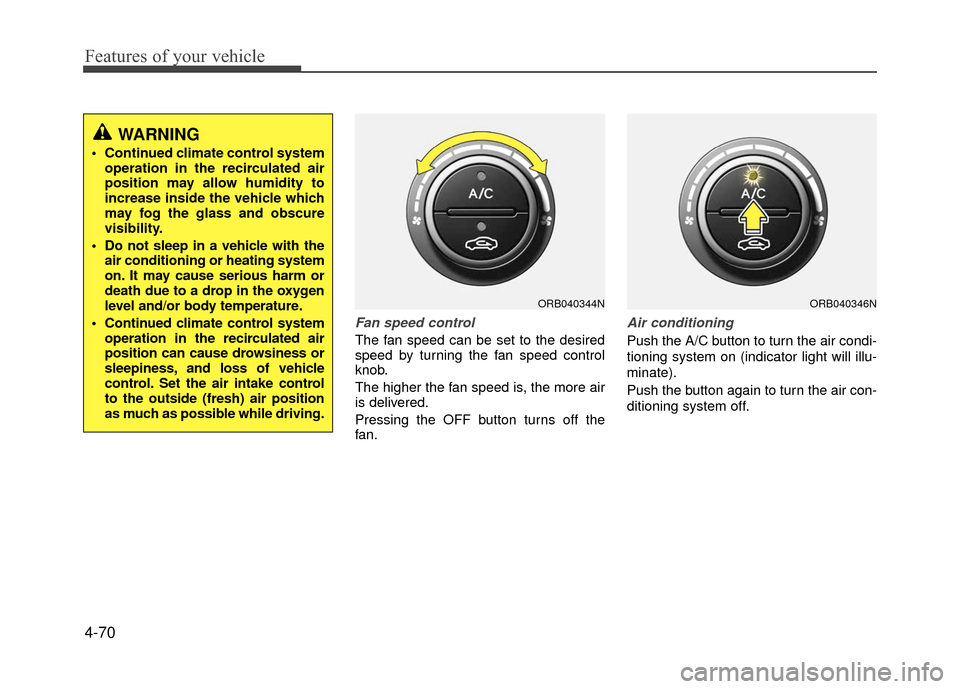
Fan speed control
The fan speed can be set to the desired
speed by turning the fan speed control
knob.
The higher the fan speed is, the more air
is delivered.
Pressing the OFF button turns off the
fan.
Air conditioning
Push the A/C button to turn the air condi-
tioning system on (indicator light will illu-
minate).
Push the button again to turn the air con-
ditioning system off.
WARNING
Continued climate control systemoperation in the recirculated air
position may allow humidity to
increase inside the vehicle which
may fog the glass and obscure
visibility.
Do not sleep in a vehicle with the air conditioning or heating system
on. It may cause serious harm or
death due to a drop in the oxygen
level and/or body temperature.
Continued climate control system operation in the recirculated air
position can cause drowsiness or
sleepiness, and loss of vehicle
control. Set the air intake control
to the outside (fresh) air position
as much as possible while driving.
ORB040344NORB040346N
Page 146 of 380
Features of your vehicle
4-72
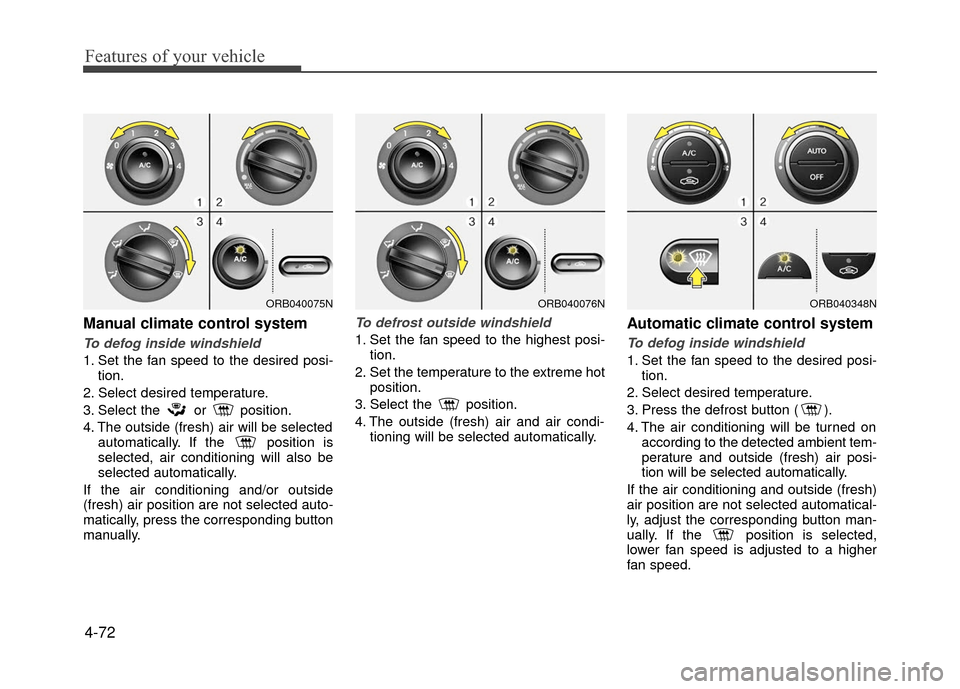
Manual climate control system
To defog inside windshield
1. Set the fan speed to the desired posi-tion.
2. Select desired temperature.
3. Select the or position.
4. The outside (fresh) air will be selected automatically. If the position is
selected, air conditioning will also be
selected automatically.
If the air conditioning and/or outside
(fresh) air position are not selected auto-
matically, press the corresponding button
manually.
To defrost outside windshield
1. Set the fan speed to the highest posi- tion.
2. Set the temperature to the extreme hot position.
3. Select the position.
4. The outside (fresh) air and air condi- tioning will be selected automatically.
Automatic climate control system
To defog inside windshield
1. Set the fan speed to the desired posi-tion.
2. Select desired temperature.
3. Press the defrost button ( ).
4. The air conditioning will be turned on according to the detected ambient tem-
perature and outside (fresh) air posi-
tion will be selected automatically.
If the air conditioning and outside (fresh)
air position are not selected automatical-
ly, adjust the corresponding button man-
ually. If the position is selected,
lower fan speed is adjusted to a higher
fan speed.
ORB040075NORB040348NORB040076N
Page 147 of 380
4-73
Features of your vehicle
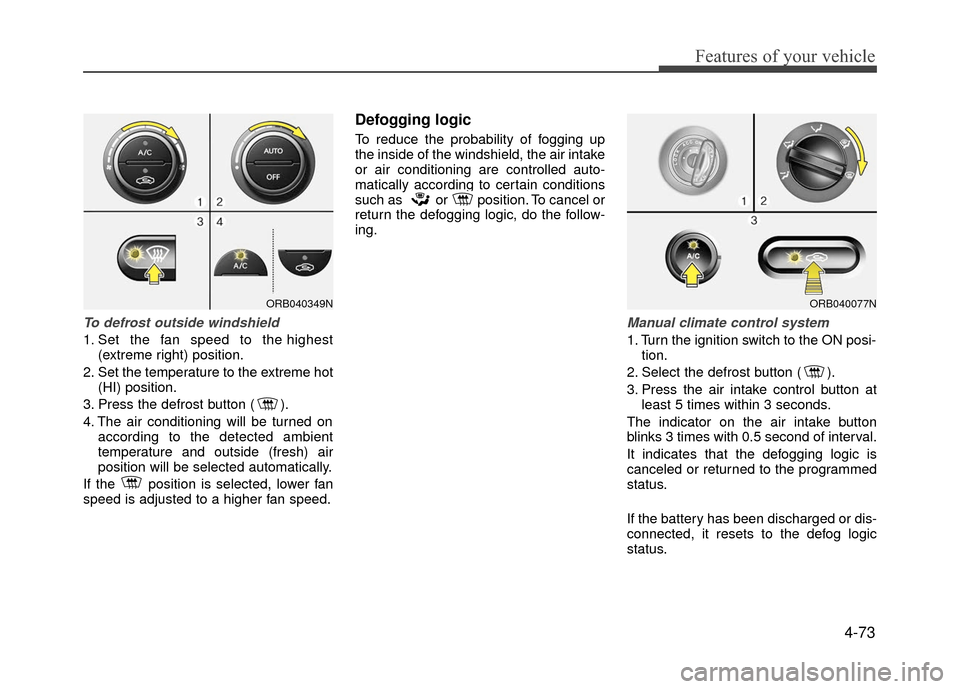
To defrost outside windshield
1. Set the fan speed to the highest(extreme right) position.
2. Set the temperature to the extreme hot (HI) position.
3. Press the defrost button ( ).
4. The air conditioning will be turned on according to the detected ambient
temperature and outside (fresh) air
position will be selected automatically.
If the position is selected, lower fan
speed is adjusted to a higher fan speed.
Defogging logic
To reduce the probability of fogging up
the inside of the windshield, the air intake
or air conditioning are controlled auto-
matically according to certain conditions
such as or position. To cancel or
return the defogging logic, do the follow-
ing.
Manual climate control system
1. Turn the ignition switch to the ON posi- tion.
2. Select the defrost button ( ).
3. Press the air intake control button at least 5 times within 3 seconds.
The indicator on the air intake button
blinks 3 times with 0.5 second of interval.
It indicates that the defogging logic is
canceled or returned to the programmed
status.
If the battery has been discharged or dis-
connected, it resets to the defog logic
status.
ORB040349NORB040077N
Page 148 of 380
Features of your vehicle
4-74
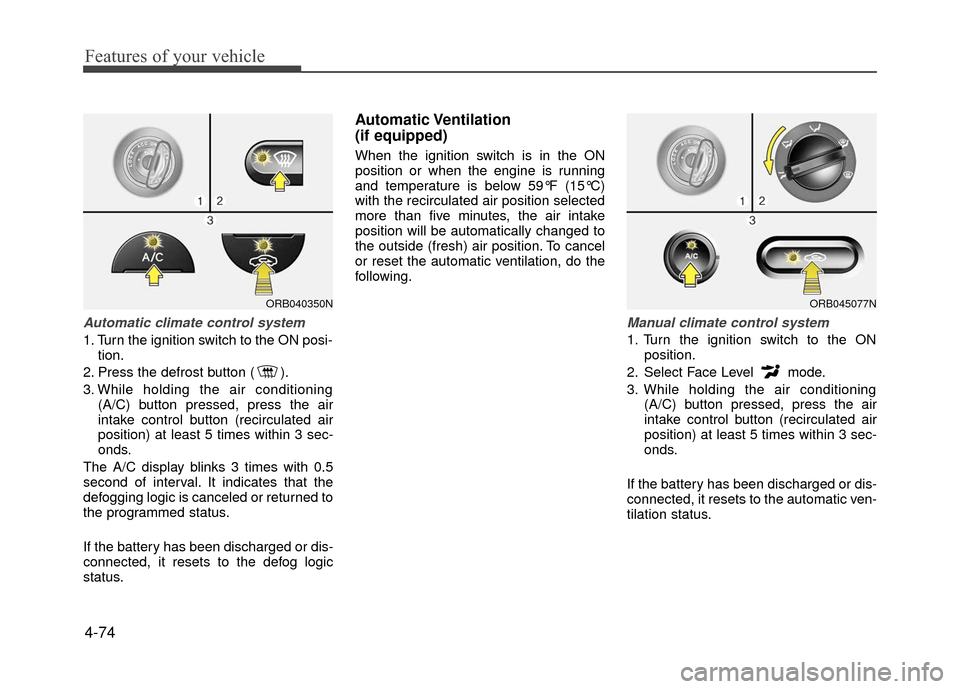
Automatic climate control system
1. Turn the ignition switch to the ON posi-tion.
2. Press the defrost button ( ).
3. While holding the air conditioning (A/C) button pressed, press the air
intake control button (recirculated air
position) at least 5 times within 3 sec-
onds.
The A/C display blinks 3 times with 0.5
second of interval. It indicates that the
defogging logic is canceled or returned to
the programmed status.
If the battery has been discharged or dis-
connected, it resets to the defog logic
status.
Automatic Ventilation
(if equipped)
When the ignition switch is in the ON
position or when the engine is running
and temperature is below 59°F (15°C)
with the recirculated air position selected
more than five minutes, the air intake
position will be automatically changed to
the outside (fresh) air position. To cancel
or reset the automatic ventilation, do the
following.
Manual climate control system
1. Turn the ignition switch to the ON position.
2. Select Face Level mode.
3. While holding the air conditioning (A/C) button pressed, press the air
intake control button (recirculated air
position) at least 5 times within 3 sec-
onds.
If the battery has been discharged or dis-
connected, it resets to the automatic ven-
tilation status.
ORB040350NORB045077N
Page 149 of 380
4-75
Features of your vehicle
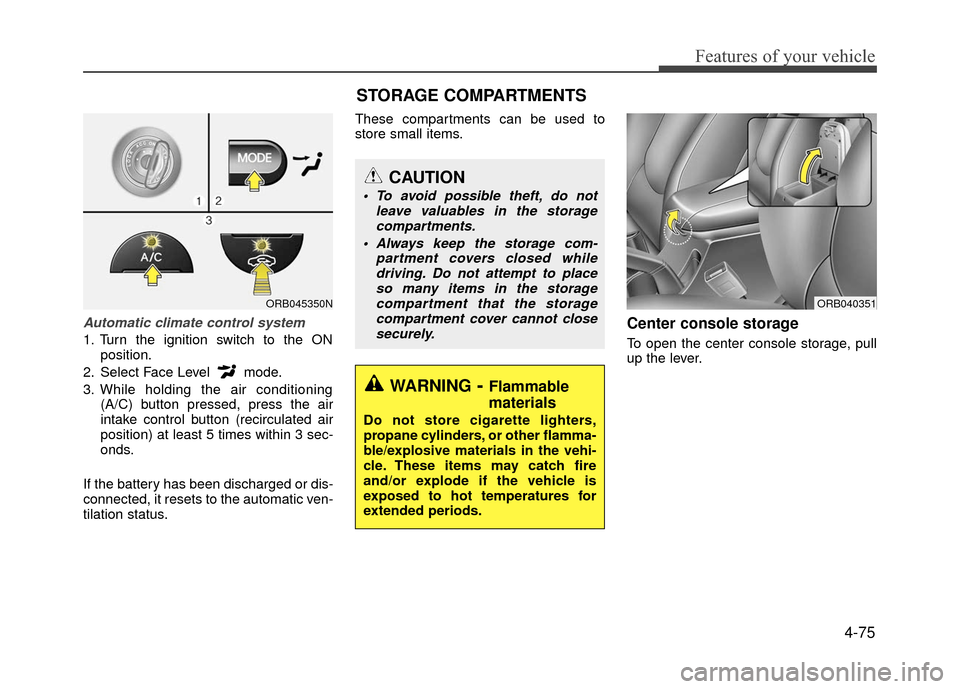
Automatic climate control system
1. Turn the ignition switch to the ONposition.
2. Select Face Level mode.
3. While holding the air conditioning (A/C) button pressed, press the air
intake control button (recirculated air
position) at least 5 times within 3 sec-
onds.
If the battery has been discharged or dis-
connected, it resets to the automatic ven-
tilation status. These compartments can be used to
store small items.
Center console storage
To open the center console storage, pull
up the lever.
ORB045350N
STORAGE COMPARTMENTS
WARNING- Flammable
materials
Do not store cigarette lighters,
propane cylinders, or other flamma-
ble/explosive materials in the vehi-
cle. These items may catch fire
and/or explode if the vehicle is
exposed to hot temperatures for
extended periods.
CAUTION
To avoid possible theft, do not
leave valuables in the storagecompartments.
Always keep the storage com- partment covers closed whiledriving. Do not attempt to placeso many items in the storagecompartment that the storagecompartment cover cannot closesecurely.
ORB040351
Page 284 of 380
7
Engine compartment / 7-2
Maintenance services / 7-3
Owner maintenance / 7-4
Scheduled maintenance service / 7-6
Explanation of scheduled maintenance items / 7-19
Engine oil / 7-21
Engine coolant / 7-22
Brake/clutch fluid / 7-25
Washer fluid / 7-26
Parking brake / 7-26
Air cleaner / 7-27
Climate control air filter / 7-28
Wiper blades / 7-30
Battery / 7-33
Tires and wheels / 7-36
Fuses / 7-50
Light bulbs / 7-60
Appearance care / 7-70
Emission control system / 7-76
California perchlorate notice / 7-78
Maintenance
Page 290 of 380
7-7
Maintenance
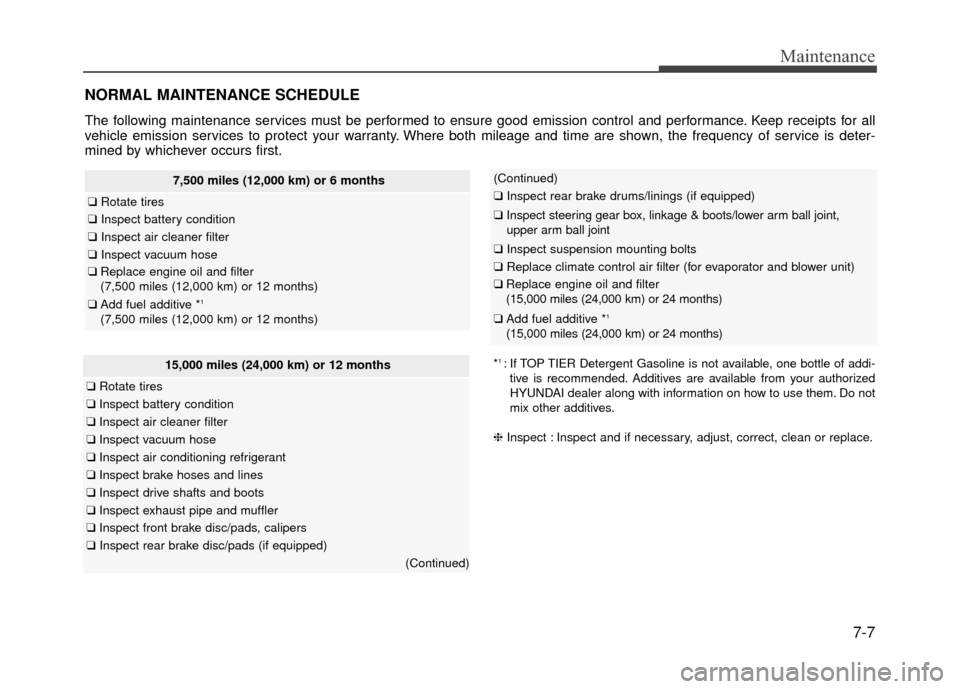
NORMAL MAINTENANCE SCHEDULE
7,500 miles (12,000 km) or 6 months
❑ Rotate tires
❑ Inspect battery condition
❑Inspect air cleaner filter
❑Inspect vacuum hose
❑Replace engine oil and filter
(7,500 miles (12,000 km) or 12 months)
❑Add fuel additive *1
(7,500 miles (12,000 km) or 12 months)
The following maintenance services must be performed to ensure good emission control and performance. Keep receipts for all
vehicle emission services to protect your warranty. Where both mileage and time are shown, the frequency of service is deter-
mined by whichever occurs first.
*1 : If TOP TIER Detergent Gasoline is not available, one bottle of addi-
tive is recommended. Additives are available from your authorized
HYUNDAI dealer along with information on how to use them. Do not
mix other additives.
❈ Inspect : Inspect and if necessary, adjust, correct, clean or replace.15,000 miles (24,000 km) or 12 months
❑ Rotate tires
❑ Inspect battery condition
❑Inspect air cleaner filter
❑Inspect vacuum hose
❑Inspect air conditioning refrigerant
❑Inspect brake hoses and lines
❑Inspect drive shafts and boots
❑Inspect exhaust pipe and muffler
❑Inspect front brake disc/pads, calipers
❑Inspect rear brake disc/pads (if equipped)
(Continued)
(Continued)
❑Inspect rear brake drums/linings (if equipped)
❑Inspect steering gear box, linkage & boots/lower arm ball joint,
upper arm ball joint
❑ Inspect suspension mounting bolts
❑Replace climate control air filter (for evaporator and blower unit)
❑Replace engine oil and filter
(15,000 miles (24,000 km) or 24 months)
❑ Add fuel additive *1
(15,000 miles (24,000 km) or 24 months)
Page 291 of 380
Maintenance
7-8
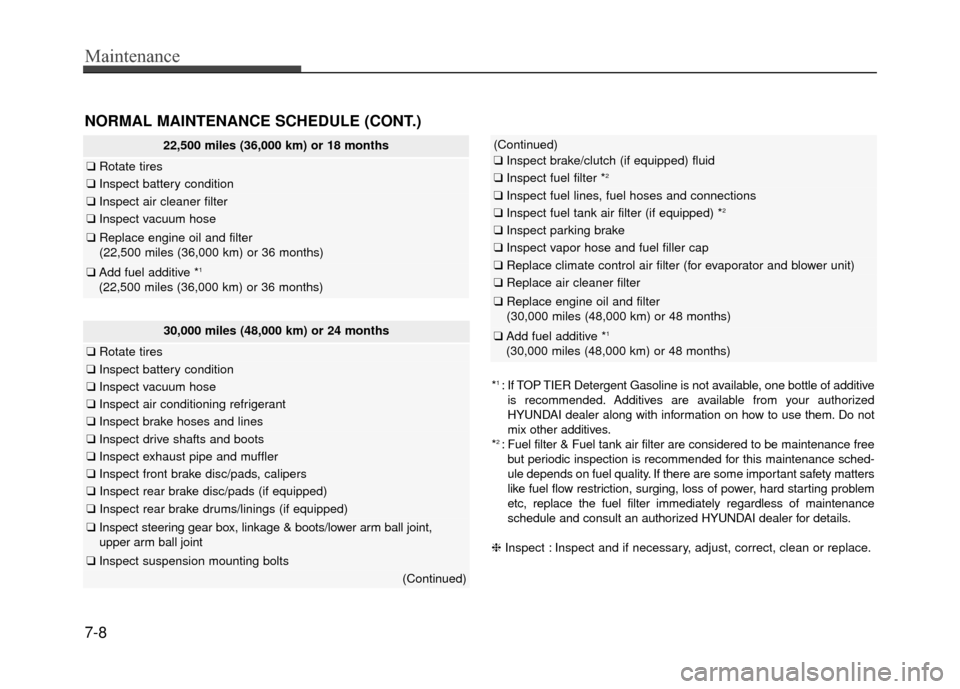
30,000 miles (48,000 km) or 24 months
❑Rotate tires
❑Inspect battery condition
❑Inspect vacuum hose
❑Inspect air conditioning refrigerant
❑Inspect brake hoses and lines
❑Inspect drive shafts and boots
❑Inspect exhaust pipe and muffler
❑Inspect front brake disc/pads, calipers
❑Inspect rear brake disc/pads (if equipped)
❑Inspect rear brake drums/linings (if equipped)
❑Inspect steering gear box, linkage & boots/lower arm ball joint,
upper arm ball joint
❑Inspect suspension mounting bolts
(Continued)
22,500 miles (36,000 km) or 18 months
❑ Rotate tires
❑ Inspect battery condition
❑Inspect air cleaner filter
❑Inspect vacuum hose
❑Replace engine oil and filter
(22,500 miles (36,000 km) or 36 months)
❑Add fuel additive *1
(22,500 miles (36,000 km) or 36 months)
*1 : If TOP TIER Detergent Gasoline is not available, one bottle of additive
is recommended. Additives are available from your authorized
HYUNDAI dealer along with information on how to use them. Do not
mix other additives.
*
2 : Fuel filter & Fuel tank air filter are considered to be maintenance free\
but periodic inspection is recommended for this maintenance sched-
ule depends on fuel quality. If there are some important safety matters
like fuel flow restriction, surging, loss of power, hard starting problem
etc, replace the fuel filter immediately regardless of maintenance
schedule and consult an authorized HYUNDAI dealer for details.
❈ Inspect : Inspect and if necessary, adjust, correct, clean or replace.
NORMAL MAINTENANCE SCHEDULE (CONT.)
(Continued)
❑Inspect brake/clutch (if equipped) fluid
❑Inspect fuel filter *2
❑Inspect fuel lines, fuel hoses and connections
❑Inspect fuel tank air filter (if equipped) *2
❑Inspect parking brake
❑Inspect vapor hose and fuel filler cap
❑ Replace climate control air filter (for evaporator and blower unit)
❑Replace air cleaner filter
❑Replace engine oil and filter
(30,000 miles (48,000 km) or 48 months)
❑Add fuel additive *1
(30,000 miles (48,000 km) or 48 months)
Page 292 of 380
7-9
Maintenance
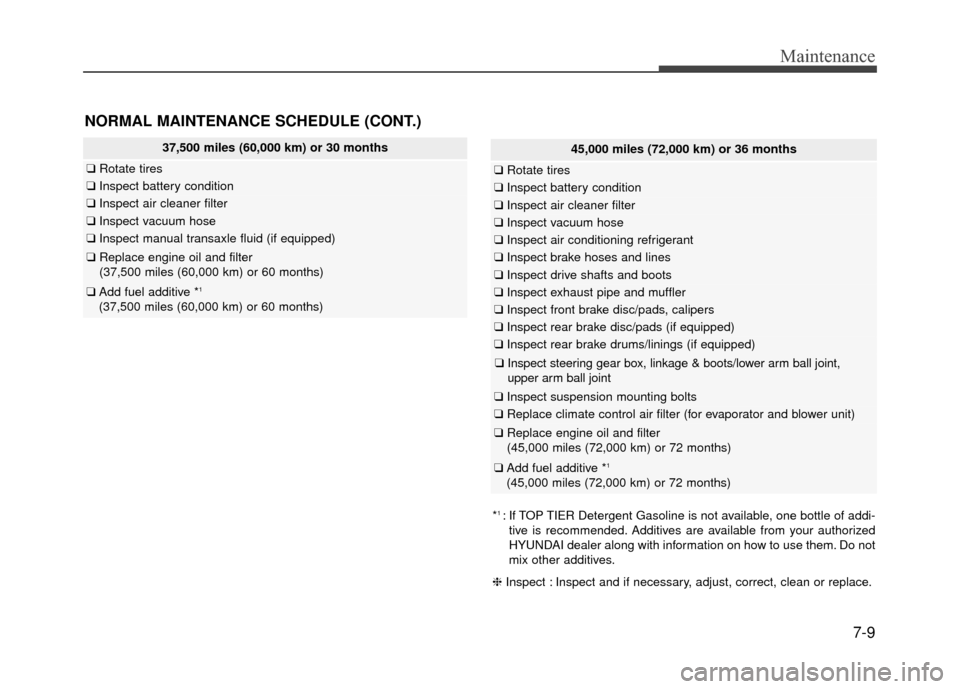
NORMAL MAINTENANCE SCHEDULE (CONT.)
37,500 miles (60,000 km) or 30 months
❑Rotate tires
❑Inspect battery condition
❑Inspect air cleaner filter
❑Inspect vacuum hose
❑Inspect manual transaxle fluid (if equipped)
❑Replace engine oil and filter
(37,500 miles (60,000 km) or 60 months)
❑Add fuel additive *1
(37,500 miles (60,000 km) or 60 months)
45,000 miles (72,000 km) or 36 months
❑ Rotate tires
❑Inspect battery condition
❑ Inspect air cleaner filter
❑Inspect vacuum hose
❑Inspect air conditioning refrigerant
❑Inspect brake hoses and lines
❑Inspect drive shafts and boots
❑Inspect exhaust pipe and muffler
❑Inspect front brake disc/pads, calipers
❑Inspect rear brake disc/pads (if equipped)
❑Inspect rear brake drums/linings (if equipped)
❑Inspect steering gear box, linkage & boots/lower arm ball joint,
upper arm ball joint
❑ Inspect suspension mounting bolts
❑Replace climate control air filter (for evaporator and blower unit)
❑Replace engine oil and filter
(45,000 miles (72,000 km) or 72 months)
❑Add fuel additive *1
(45,000 miles (72,000 km) or 72 months)
*1 : If TOP TIER Detergent Gasoline is not available, one bottle of addi-
tive is recommended. Additives are available from your authorized
HYUNDAI dealer along with information on how to use them. Do not
mix other additives.
❈ Inspect : Inspect and if necessary, adjust, correct, clean or replace.
Page 293 of 380
Maintenance
7-10
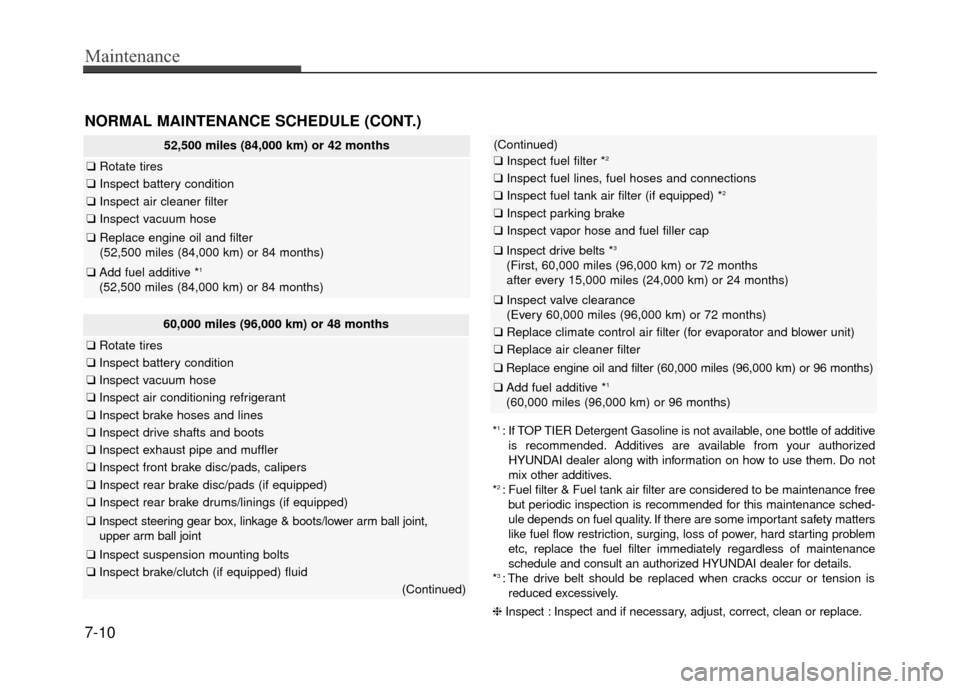
60,000 miles (96,000 km) or 48 months
❑Rotate tires
❑Inspect battery condition
❑Inspect vacuum hose
❑Inspect air conditioning refrigerant
❑Inspect brake hoses and lines
❑Inspect drive shafts and boots
❑Inspect exhaust pipe and muffler
❑Inspect front brake disc/pads, calipers
❑Inspect rear brake disc/pads (if equipped)
❑Inspect rear brake drums/linings (if equipped)
❑Inspect steering gear box, linkage & boots/lower arm ball joint,
upper arm ball joint
❑ Inspect suspension mounting bolts
❑Inspect brake/clutch (if equipped) fluid
(Continued)
(Continued)
❑Inspect fuel filter *2
❑Inspect fuel lines, fuel hoses and connections
❑Inspect fuel tank air filter (if equipped) *2
❑Inspect parking brake
❑Inspect vapor hose and fuel filler cap
❑Inspect drive belts *3
(First, 60,000 miles (96,000 km) or 72 months
after every 15,000 miles (24,000 km) or 24 months)
❑ Inspect valve clearance
(Every 60,000 miles (96,000 km) or 72 months)
❑ Replace climate control air filter (for evaporator and blower unit)
❑Replace air cleaner filter
❑Replace engine oil and filter (60,000 miles (96,000 km) or 96 months)\
❑ Add fuel additive *1
(60,000 miles (96,000 km) or 96 months)
NORMAL MAINTENANCE SCHEDULE (CONT.)
52,500 miles (84,000 km) or 42 months
❑ Rotate tires
❑Inspect battery condition
❑ Inspect air cleaner filter
❑Inspect vacuum hose
❑Replace engine oil and filter
(52,500 miles (84,000 km) or 84 months)
❑Add fuel additive *1
(52,500 miles (84,000 km) or 84 months)
*1 : If TOP TIER Detergent Gasoline is not available, one bottle of additive
is recommended. Additives are available from your authorized
HYUNDAI dealer along with information on how to use them. Do not
mix other additives.
*
2 : Fuel filter & Fuel tank air filter are considered to be maintenance free\
but periodic inspection is recommended for this maintenance sched-
ule depends on fuel quality. If there are some important safety matters
like fuel flow restriction, surging, loss of power, hard starting problem
etc, replace the fuel filter immediately regardless of maintenance
schedule and consult an authorized HYUNDAI dealer for details.
*
3 : The drive belt should be replaced when cracks occur or tension is reduced excessively.
❈ Inspect : Inspect and if necessary, adjust, correct, clean or replace.