air condition Hyundai Accent 2017 Workshop Manual
[x] Cancel search | Manufacturer: HYUNDAI, Model Year: 2017, Model line: Accent, Model: Hyundai Accent 2017Pages: 380, PDF Size: 12.45 MB
Page 308 of 380
7-25
Maintenance
BRAKE/CLUTCH FLUID
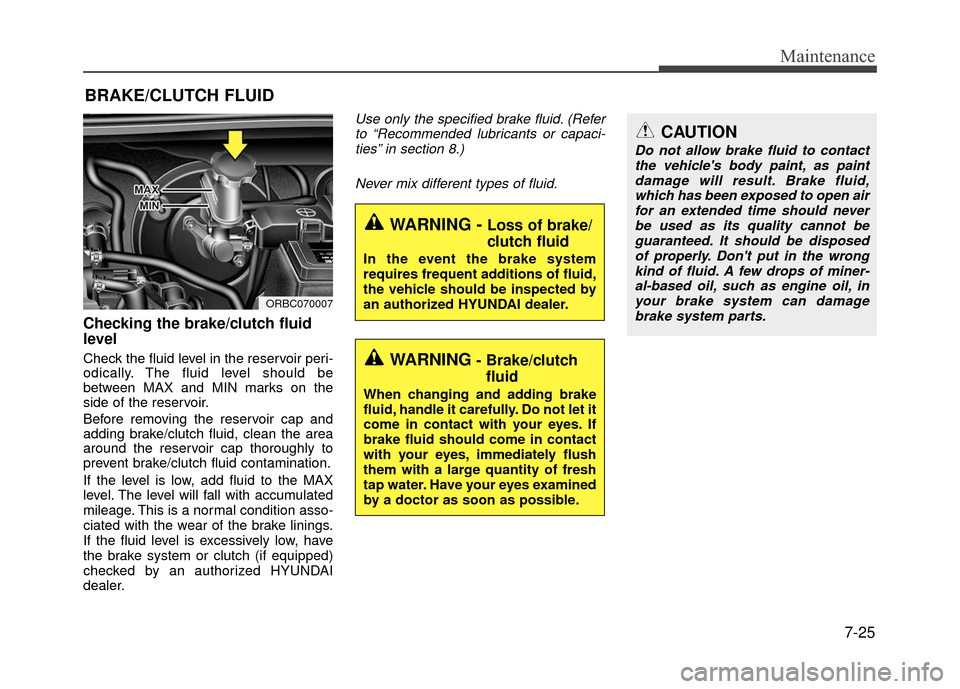
Checking the brake/clutch fluid
level
Check the fluid level in the reservoir peri-
odically. The fluid level should be
between MAX and MIN marks on the
side of the reservoir.
Before removing the reservoir cap and
adding brake/clutch fluid, clean the area
around the reservoir cap thoroughly to
prevent brake/clutch fluid contamination.
If the level is low, add fluid to the MAX
level. The level will fall with accumulated
mileage. This is a normal condition asso-
ciated with the wear of the brake linings.
If the fluid level is excessively low, have
the brake system or clutch (if equipped)
checked by an authorized HYUNDAI
dealer.
Use only the specified brake fluid. (Referto “Recommended lubricants or capaci-ties” in section 8.)
Never mix different types of fluid.
WARNING- Brake/clutch fluid
When changing and adding brake
fluid, handle it carefully. Do not let it
come in contact with your eyes. If
brake fluid should come in contact
with your eyes, immediately flush
them with a large quantity of fresh
tap water. Have your eyes examined
by a doctor as soon as possible.
WARNING - Loss of brake/
clutch fluid
In the event the brake system
requires frequent additions of fluid,
the vehicle should be inspected by
an authorized HYUNDAI dealer.
CAUTION
Do not allow brake fluid to contact
the vehicle's body paint, as paintdamage will result. Brake fluid, which has been exposed to open airfor an extended time should neverbe used as its quality cannot be guaranteed. It should be disposedof properly. Don't put in the wrong kind of fluid. A few drops of miner-al-based oil, such as engine oil, in your brake system can damagebrake system parts.
ORBC070007
Page 321 of 380
Maintenance
7-38
Remove the valve cap from the tire
valve stem. Press the tire gage firm-
ly onto the valve to get a pressure
measurement. If the cold tire inflation
pressure matches the recommended
pressure on the tire and loading
information label, no further adjust-
ment is necessary. If the pressure is
low, add air until you reach the rec-
ommended amount.
If you overfill the tire, release air by
pushing on the metal stem in the
center of the tire valve. Recheck the
tire pressure with the tire gage. Be
sure to put the valve caps back on
the valve stems. They help prevent
leaks by keeping out dirt and mois-
ture.Tire rotation
To equalize tread wear, it is recom-
mended that the tires be rotated
every 7,500 miles (12,000 km) or
sooner if irregular wear develops.
During rotation, check the tires for
correct balance.
When rotating tires, check for uneven
wear and damage. Abnormal wear is
usually caused by incorrect tire pres-
sure, improper wheel alignment, out-
of-balance wheels, severe braking or
severe cornering. Look for bumps or
bulges in the tread or side of tire.
Replace the tire if you find either of
these conditions. Replace the tire if
fabric or cord is visible. After rotation,
be sure to bring the front and rear tire
pressures to specification and check
lug nut tightness.
WARNING
Inspect your tires frequently
for proper inflation as well as
wear and damage. Always use
a tire pressure gauge.
Tires with too much or too little pressure wear unevenly caus-
ing poor handling, loss of vehi-
cle control, and sudden tire
failure leading to accidents,
injuries, and even death. The
recommended cold tire pres-
sure for your vehicle can be
found in this manual and on
the tire label located on the dri-
ver's side center pillar.
Worn tires can cause acci- dents. Replace tires that are
worn, show uneven wear, or
are damaged.
Remember to check the pres- sure of your spare tire.
HYUNDAI recommends that
you check the spare every
time you check the pressure
of the other tires on your vehi-
cle.
Page 327 of 380
Maintenance
7-44
4. Tire ply composition and material
The number of layers or plies of rub-
ber-coated fabric in the tire. Tire man-
ufacturers also must indicate the
materials in the tire, which include
steel, nylon, polyester, and others. The
letter "R" means radial ply construc-
tion; the letter "D" means diagonal or
bias ply construction; and the letter "B"
means belted-bias ply construction.
5. Maximum permissible inflationpressure
This number is the greatest amount
of air pressure that should be put in
the tire. Do not exceed the maximum
permissible inflation pressure. Refer
to the Tire and Loading Information
label for recommended inflation
pressure.
6. Maximum load rating
This number indicates the maximum
load in kilograms and pounds that can
be carried by the tire. When replacing
the tires on the vehicle, always use a
tire that has the same load rating as
the factory installed tire.
7. Uniform tire quality grading
Quality grades can be found where
applicable on the tire sidewall
between tread shoulder and maxi-
mum section width.
For example: TREAD wear 200
TRACTION AA
TEMPERATURE A
Tread wear
The tread wear grade is a compara-
tive rating based on the wear rate of
the tire when tested under controlled
conditions on a specified govern-
ment test course. For example, a tire
graded 150 would wear one-and-a-
half times (1½) as well on the gov-
ernment course as a tire graded 100.
The relative performance of tires
depends upon the actual conditions
of their use, however, and may
depart significantly from the norm
due to variations in driving habits,
service practices and differences in
road characteristics and climate.
These grades are molded on the
side-walls of passenger vehicle tires.
The tires available as standard or
optional equipment on your vehicle
may vary with respect to grade.
Traction - AA, A, B & C
The traction grades, from highest to
lowest, are AA, A, B and C. Those
grades represent the tire’s ability to
stop on wet pavement as measured
under controlled conditions on speci-
fied government test surfaces of
asphalt and concrete. A tire marked C
may have poor traction performance.
WARNING
The traction grade assigned to
this tire is based on straight-
ahead braking traction tests,
and does not include accelera-
tion, cornering, hydroplaning,
or peak traction characteristics.
Page 329 of 380
Maintenance
7-46
Tire terminology and definitions
Air Pressure: The amount of air
inside the tire pressing outward on
the tire. Air pressure is expressed in
pounds per square inch (psi) or kilo-
pascal (kPa).
Accessory Weight: This means the
combined weight of optional acces-
sories. Some examples of optional
accessories are, automatic
transaxle, power seats, and air con-
ditioning.
Aspect Ratio : The relationship of a
tire's height to its width.
Belt: A rubber coated layer of cords
that is located between the plies and
the tread. Cords may be made from
steel or other reinforcing materials.
Bead: The tire bead contains steel
wires wrapped by steel cords that
hold the tire onto the rim.
Bias Ply Tire : A pneumatic tire in
which the plies are laid at alternate
angles less than 90 degrees to the
centerline of the tread. Cold Tire Pressure: The amount of
air pressure in a tire, measured in
pounds per square inch (psi) or kilo-
pascals (kPa) before a tire has built
up heat from driving.
Curb Weight: This means the weight
of a motor vehicle with standard and
optional equipment including the
maximum capacity of fuel, oil and
coolant, but without passengers and
cargo.
DOT Markings: A code molded into
the sidewall of a tire signifying that
the tire is in compliance with the U.S.
Department of Transportation motor
vehicle safety standards. The DOT
code includes the Tire Identification
Number (TIN), an alphanumeric des-
ignator which can also identify the
tire manufacturer, production plant,
brand and date of production.
GVWR: Gross Vehicle Weight Rating
GAWR FRT: Gross Axle Weight
Rating for the Front Axle.
GAWR RR: Gross Axle Weight
Rating for the Rear axle.(Continued)
If the tire is impacted, inspect the tire condition or contact anauthorized HYUNDAI dealer.
To prevent damage to the tire, inspect the tire condition andpressure every 1,800miles(3,000km).
CAUTION
It is not easy to recognize the tire damage with your owneyes. But if there is the slight-est hint of tire damage, eventhough you cannot see the tiredamage with your own eyes,have the tire checked orreplaced because the tiredamage may cause air leak-age from the tire.
If the tire is damaged by driv- ing on a rough road, off road,pothole, manhole, or curbstone, it will not be covered bythe warranty.
You can find out the tire infor- mation on the tire sidewall.
Page 331 of 380
Maintenance
7-48
Speed Rating:An alphanumeric
code assigned to a tire indicating the
maximum speed at which a tire can
operate.
Traction: The friction between the
tire and the road surface. The
amount of grip provided.
Tread: The portion of a tire that
comes into contact with the road.
Treadwear Indicators: Narrow
bands, sometimes called "wear
bars," that show across the tread of a
tire when only 2/32 inch of tread
remains.
UTQGS: Uniform Tire Quality
Grading Standards, a tire information
system that provides consumers with
ratings for a tire's traction, tempera-
ture and treadwear. Ratings are
determined by tire manufacturers
using government testing proce-
dures. The ratings are molded into
the sidewall of the tire.
Vehicle Capacity Weight: The num-
ber of designated seating positions
multiplied by 150 lbs. (68 kg) plus the
rated cargo and luggage load. Vehicle Maximum Load on the
Tire:
Load on an individual tire due
to curb and accessory weight plus
maximum occupant and cargo
weight.
Vehicle Normal Load on the Tire:
Load on an individual tire that is
determined by distributing to each
axle its share of the curb weight,
accessory weight, and normal occu-
pant weight and dviding by 2.
Vehicle Placard: A label permanent-
ly attached to a vehicle showing the
original equipment tire size and rec-
ommended inflation pressure.
All season tires
HYUNDAI specifies all season tires
on some models to provide good
performance for use all year round,
including snowy and icy road condi-
tions. All season tires are identified
by ALL SEASON and/or M+S (Mud
and Snow) on the tire sidewall. Snow
tires have better snow traction than
all season tires and may be more
appropriate in some areas. Summer tires
HYUNDAI specifies summer tires on
some models to provide superior
performance on dry roads. Summer
tire performance is substantially
reduced in snow and ice. Summer
tires do not have the tire traction rat-
ing M+S (Mud and Snow) on the tire
side wall. if you plan to operate your
vehicle in snowy or icy conditions.
HYUNDAI recommends the use of
snow tires or all season tires on all
four wheels.
Snow tires
If you equip your car with snow tires,
they should be the same size and
have the same load capacity as the
original tires. Snow tires should be
installed on all four wheels; other-
wise, poor handling may result.
Snow tires should carry 4 psi (28
kPa) more air pressure than the
pressure recommended for the stan-
dard tires on the tire label on the dri-
ver's side of the center pillar, or up to
the maximum pressure shown on the
tire sidewall, whichever is less.
Page 361 of 380
Operating precautions for catalyticconverters (if equipped)Your vehicle is equipped with a catalytic
converter emission control device.
Therefore, the following precautions
must be observed:
Use only UNLEADED FUEL for gaso- line engines.
Do not operate the vehicle when there are signs of engine malfunction, such
as misfire or a noticeable loss of per-
formance.
Do not misuse or abuse the engine. Examples of misuse are coasting with
the ignition off and descending steep
grades in gear with the ignition off.
Do not operate the engine at high idle speed for extended periods (5 minutes
or more).
Do not modify or tamper with any part of the engine or emission control sys-
tem. All inspections and adjustments
must be made by an authorized
HYUNDAI dealer.
Avoid driving with a extremely low fuel level. Running out of fuel could cause
the engine to misfire, damaging the
catalytic converter.
Failure to observe these precautions
could result in damage to the catalytic
converter and to your vehicle.
Additionally, such actions could void your
warranties. Perchlorate Material-special handling
may apply, See www.dtsc.ca.gov/haz-
ardouswaste/perchlorate.
Notice to California Vehicle Dismantlers:
Perchlorate containing materials, such as
air bag inflators, seatbelt pretensioners
and keyless remote entry batteries, must
be disposed of according to Title 22
California Code of Regulations Section
67384.10 (a).
WARNING- Fire
A hot exhaust system can ignite
flammable items under your vehi-
cle. Do not park, idle, or drive the
vehicle over or near flammable
objects, such as grass, vegeta-
tion, paper, leaves, etc.
The exhaust system and catalytic system are very hot while the
engine is running or immediately
after the engine is turned off. Keep
away from the exhaust system
and catalytic, you may get burned.
Also, do not remove the heat sink
around the exhaust system, do
not seal the bottom of the vehicle
or do not coat the vehicle for cor-
rosion control. It may present a
fire risk under certain conditions.
CALIFORNIA PERCHLORATE
NOTICE
7-78
Maintenance
Page 373 of 380

Index
2I
Active ECO system··················\
··················\
···· ·5-30
Air bag warning label ··················\
··················\
·· ·3-58
Air bag warning light ··················\
··················\
·· ·3-36
Air bags ··················\
··················\
··················\
·3-33
Air bag warning label ··················\
················· ·3-58
Air bag warning light ··················\
················· ·3-36
Curtain air bag ··················\
··················\
······· ·3-50
Driver's and passenger's front air bag ·················3-45
Occupant detection system ··················\
············3-39
Side impact air bag ··················\
··················\
·· ·3-49
SRS components and functions ··················\
······3-36
Air cleaner ··················\
··················\
··············· ·7-27
Antenna (Roof) ··················\
··················\
········· ·4-84
Anti-lock brake system (ABS) ··················\
···········5-18
Appearance care ··················\
··················\
·········7-70
Exterior care ··················\
··················\
········· ·7-70
Interior care ··················\
··················\
·········· ·7-74
Armrest(front) ··················\
··················\
·············3-6
Audio system ··················\
··················\
············ ·4-84
Roof antenna ··················\
··················\
········· ·4-84
Steering wheel audio control ··················\
·········4-85
Automatic climate control system ··················\
·······4-65
Air conditioning ··················\
··················\
····· ·4-70
Automatic heating and air conditioning ···············4-66
Manual heating and air conditioning ··················4-67
Automatic transaxle Manual shift mode ·················5-12
Automatic transaxle ··················\
··················\
···· ·5-10Aux, USB and iPod
®port
··················\
··············· ·4-82
Base curb weight··················\
··················\
·········5-45
Battery ··················\
··················\
··················\
·· ·7-33
Battery saver function ··················\
··················\
·· ·4-44
Before driving ··················\
··················\
············ ·5-3
Bottle holders, see cup holders ··················\
··········4-78
Brake system ··················\
··················\
············ ·5-15
Anti-lock brake system (ABS) ··················\
·······5-18
Electronic stability control (ESC) ··················\
····5-20
Hill-start assist control ··················\
················ ·5-25
Parking brake ··················\
··················\
·········5-16
Power brakes ··················\
··················\
········· ·5-15
Vehicle stability management ··················\
········5-24
Brakes/clutch fluid ··················\
··················\
····· ·7-25
Bulb replacement ··················\
··················\
······· ·7-61
Bulb wattage ··················\
··················\
·············· ·8-2
California perchlorate notice ··················\
·············7-78
Capacities (Lubricants) ··················\
··················\
·· ·8-4
Care Exterior care ··················\
··················\
········· ·7-70
Interior care ··················\
··················\
·········· ·7-74
Tire care ··················\
··················\
·············· ·7-36A
B
C
Page 377 of 380

Index
6I
LabelAir bag warning label ··················\
················· ·3-58
Refrigerant label ··················\
··················\
·······8-8
Tire sidewall labeling ··················\
················· ·7-42
Tire specification and pressure label ··················\
··8-8
Vehicle certification label ··················\
···············8-7
Light bulbs ··················\
··················\
··············· ·7-60
Lighting ··················\
··················\
··················\
·4-44
Battery saver function ··················\
················ ·4-44
Lower anchor ··················\
··················\
············ ·3-31
Lubricants and capacities ··················\
··················\
8-4
Luggage net ··················\
··················\
··············4-77
Maintenance Explanation of scheduled maintenance items ········7-19
Maintenance services ··················\
··················\
··7-3
Maintenance under severe usage conditions ·········7-18
Normal maintenance schedule ··················\
·········7-7
Owner maintenance ··················\
··················\
···7-4
Scheduled maintenance service ··················\
········7-6
Tire maintenance ··················\
··················\
···· ·7-41Maintenance schedule
··················\
··················\
··· ·7-6
Maintenance under severe usage conditions ·········7-18
Normal maintenance schedule ··················\
·········7-7
Maintenance services ··················\
··················\
···· ·7-3
Manual climate control system ··················\
··········4-56
Air conditioning ··················\
··················\
····· ·4-61
Climate control air filter ··················\
···············4-64
Heating and air conditioning ··················\
·········4-57
Manual shift mode ··················\
··················\
······ ·5-12
Manual transaxle ··················\
··················\
········· ·5-7
Memory fuse ··················\
··················\
············ ·7-52
Mirrors ··················\
··················\
··················\
· ·4-26
Day/night rearview mirror ··················\
············4-26
Inside rearview mirror ··················\
················ ·4-26
Side view mirrors ··················\
··················\
··· ·4-27
Multi fuse ··················\
··················\
·················7-53
Occupant detection system ··················\
···············3-39
Odometer ··················\
··················\
················ ·4-33
Oil (Engine) ··················\
··················\
··············7-21
Overheats ··················\
··················\
··················\
·6-6
Owner maintenance ··················\
··················\
······ ·7-4
L
O
M
Page 378 of 380

I7
Index
Parking brake··················\
··················\
············ ·5-16
Parking brake ··················\
··················\
············ ·7-26
Power brakes ··················\
··················\
············ ·5-15
Power outlet ··················\
··················\
··············4-79
Power window lock button ··················\
···············4-16
Pre-tensioner seat belt ··················\
··················\
·· ·3-19
Push starting ··················\
··················\
···············6-5
Rear center belt ··················\
··················\
········· ·3-17
Rear seat ··················\
··················\
··················\
··3-9
Recommended cold tire inflation pressures ··············7-36
Recommended lubricants and capacities ··················\
8-5
Recommended SAE viscosity number ··················\
8-6
Refrigerant label ··················\
··················\
···········8-8
Remote keyless entry ··················\
··················\
·····4-3
Replacement light bulb ··················\
··················\
·7-61
Road warning ··················\
··················\
··············6-2
Rocking the vehicle ··················\
··················\
···· ·5-32
Roof antenna ··················\
··················\
············ ·4-84Scheduled maintenance service
··················\
···········7-6
Maintenance under severe usage conditions ·········7-18
Normal maintenance schedule ··················\
·········7-7
Seat belt warning ··················\
··················\
······· ·3-14
Seat belts ··················\
··················\
················· ·3-13
Rear center belt ··················\
··················\
······ ·3-17
Height adjustment ··················\
··················\
··· ·3-15
Pre-tensioner seat belt ··················\
················ ·3-19
Seat belt - Driver's 3-point system ··················\
···3-15
Seat belt warning ··················\
··················\
···· ·3-14
Seat belts - Front passenger and rear seat ············3-16
Seatback pocket ··················\
··················\
·········· ·3-8
Seating capacity ··················\
··················\
········· ·5-41
Seats ··················\
··················\
··················\
·······3-2
Armrest(front) ··················\
··················\
········· ·3-6
Folding the rear seat ··················\
··················\
·3-11
Front seat adjustment ··················\
··················\
· ·3-5
Headrest(front) ··················\
··················\
·········3-6
Headrest(rear) ··················\
··················\
·········
·3-9
Rear seat ··················\
··················\
··············· ·3-9
Seatback pocket ··················\
··················\
······· ·3-8
Side impact air bag ··················\
··················\
····· ·3-49
Side view mirrors ··················\
··················\
······· ·4-27
Sliding armrest ··················\
··················\
·········· ·4-76
Smooth cornering ··················\
··················\
······· ·5-33
Snow tires ··················\
··················\
·················5-36
PS
R