changing a tire Hyundai Accent 2017 Owner's Manual
[x] Cancel search | Manufacturer: HYUNDAI, Model Year: 2017, Model line: Accent, Model: Hyundai Accent 2017Pages: 380, PDF Size: 12.45 MB
Page 236 of 380
5-33
Driving your vehicle
✽
✽NOTICE
The ESC system should be turned OFF
prior to rocking the vehicle.
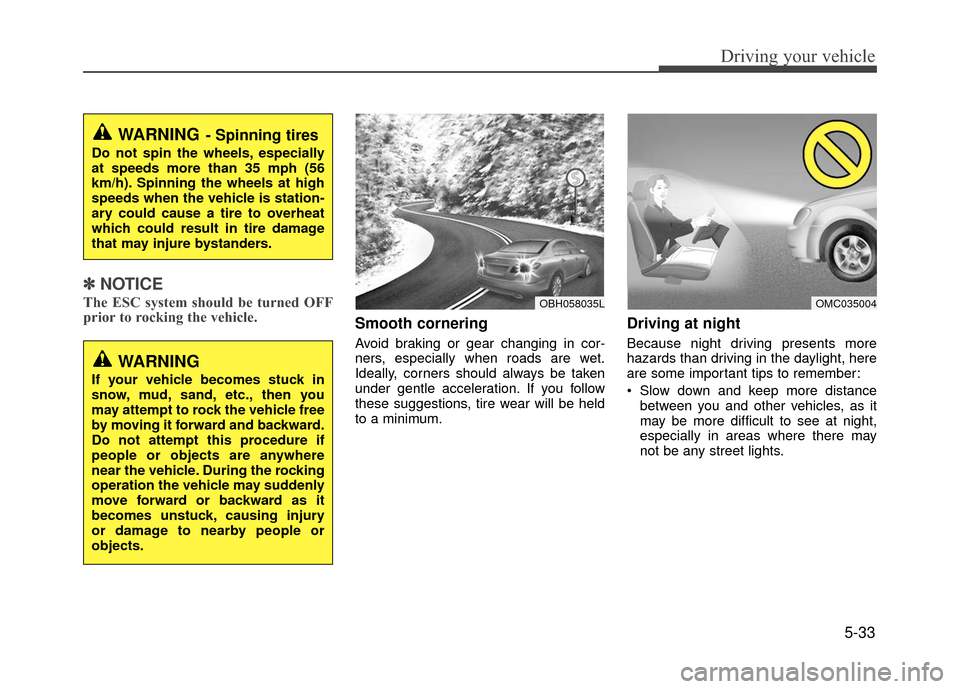
Smooth cornering
Avoid braking or gear changing in cor-
ners, especially when roads are wet.
Ideally, corners should always be taken
under gentle acceleration. If you follow
these suggestions, tire wear will be held
to a minimum.
Driving at night
Because night driving presents more
hazards than driving in the daylight, here
are some important tips to remember:
Slow down and keep more distance
between you and other vehicles, as it
may be more difficult to see at night,
especially in areas where there may
not be any street lights.
WARNING- Spinning tires
Do not spin the wheels, especially
at speeds more than 35 mph (56
km/h). Spinning the wheels at high
speeds when the vehicle is station-
ary could cause a tire to overheat
which could result in tire damage
that may injure bystanders.
OBH058035LOMC035004
WARNING
If your vehicle becomes stuck in
snow, mud, sand, etc., then you
may attempt to rock the vehicle free
by moving it forward and backward.
Do not attempt this procedure if
people or objects are anywhere
near the vehicle. During the rocking
operation the vehicle may suddenly
move forward or backward as it
becomes unstuck, causing injury
or damage to nearby people or
objects.
Page 258 of 380
What to do in an emergency
6-10
Changing a tire with TPMS
If you have a flat tire, the Low Tire
Pressure will come on. Have the flat
tire repaired by an authorized
HYUNDAI dealer as soon as possi-
ble or replace the flat tire with the
spare tire (if equipped).Each wheel is equipped with a tire
pressure sensor mounted inside the
tire behind the valve stem. You must
use TPMS specific wheels. It is rec-
ommended that you always have
your tires serviced by an authorized
HYUNDAI dealer.
Even if you replace the low pressure
tire with the spare tire, the Low Tire
Pressure Telltale will blink or remain
on until the low pressure tire is
repaired and placed on the vehicle.
After you replace the low pressure
tire with the spare tire, the Low Tire
Pressure Telltale may blink or illumi-
nate after driving about 20 minutes
because the TPMS sensor mounted
on the spare wheel is not initiated.
Once the low pressure tire is reinflat-
ed to the recommended pressure
and installed on the vehicle or the
TPMS sensor mounted on the
replaced spare wheel is initiated by
an authorized HYUNDAI dealer, the
TPMS malfunction indicator and the
low tire pressure telltale will extin-
guish within a few minutes of driving.
If the indicator is not extinguished
after a few minutes of driving, please
visit an authorized HYUNDAI dealer.CAUTION
If original mounted tire is
replaced with the spare tire, theTPMS sensor on the replacedspare wheel should be initiatedand the TPMS sensor on theoriginal mounted wheel shouldbe deactivated by a HYUNDAIdealer. If the TPMS sensor on theoriginal mounted wheel locatedin the spare tire carrier still acti-vates, the tire pressure monitor-ing system may not operateproperly. Have the tire with TPMSserviced or replaced by anauthorized hyundai dealer.
CAUTION
Never use a puncture-repairingagent not approved by HYUNDAIto repair and/or inflate a lowpressure tire. The tire sealant notapproved by HYUNDAI may dam-age the tire pressure sensor.
The sealant on the tire pressuresensor and wheel shall be elim-inated when you replace the tirewith a new one.
Page 263 of 380
6-15
What to do in an emergency
Changing a tire with TPMS
If you have a flat tire, the Low Tire
Pressure and Position telltales will
come on. Have the flat tire repaired
by an authorized HYUNDAI dealer
as soon as possible or replace the
flat tire with the spare tire (if
equipped).
The spare tire (if equipped) does not
come with a tire pressure monitoring
sensor. When the low pressure tire or
the flat tire is replaced with the spare
tire, the Low Tire Pressure Telltale
will remain on.Also, the TPMS Malfunction Indicator
will illuminate after blinking for one
minute if the vehicle is driven at
speed above 15.5 mph (25 km/h) for
approximately 20 minutes.
Once the original tire equipped with
a tire pressure monitoring sensor is
reinflated to the recommended pres-
sure and reinstalled on the vehicle,
the Low Tire Pressure Telltale and
TPMS Malfunction Indicator will go
off within a few minutes.
If the indicators do not extinguish
after a few minutes, please visit an
authorized HYUNDAI dealer.
Each wheel is equipped with a tire
pressure sensor mounted inside the
tire behind the valve stem (except for
the spare tire). You must use TPMS
specific wheels. It is recommended
that you always have your tires serv-
iced by an authorized HYUNDAI
dealer as soon as possible.CAUTION
The TPMS malfunction indica-
tor may blink for approximate-ly 1 minute and then remaincontinuously illuminated if thevehicle is moving around elec-tric power supply cables orradio transmitter such as atpolice stations, governmentand public offices, broadcast-ing stations, military installa-tions, airports, or transmittingtowers, etc. This can interferewith normal operation of theTire Pressure MonitoringSystem (TPMS).
The TPMS malfunction indica- tor may blink for approximate-ly 1 minute and then remaincontinuously illuminated if thesnow chains are used or someseparate electronic devicessuch as notebook computer,mobile charger, remote starteror navigation etc., are used inthe vehicle. This can interferewith normal operation of theTire Pressure MonitoringSystem (TPMS).
CAUTION
Never use a puncture-repairingagent not approved by HYUNDAIto repair and/or inflate a lowpressure tire. The tire sealant notapproved by HYUNDAI may dam-age the tire pressure sensor.
The sealant on the tire pressuresensor and wheel shall be elim-inated when you replace the tirewith a new one.
Page 265 of 380
6-17
What to do in an emergency
IF YOU HAVE A FLAT TIRE (WITH SPARE TIRE, IF EQUIPPED)
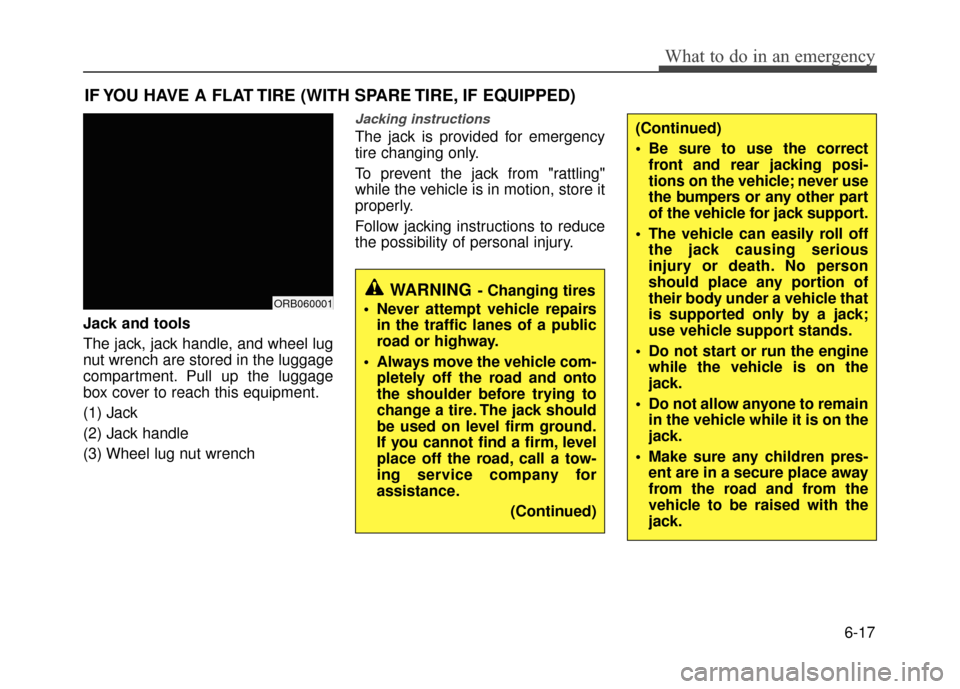
Jack and tools
The jack, jack handle, and wheel lug
nut wrench are stored in the luggage
compartment. Pull up the luggage
box cover to reach this equipment.
(1) Jack
(2) Jack handle
(3) Wheel lug nut wrench
Jacking instructions
The jack is provided for emergency
tire changing only.
To prevent the jack from "rattling"
while the vehicle is in motion, store it
properly.
Follow jacking instructions to reduce
the possibility of personal injury.
WARNING- Changing tires
Never attempt vehicle repairs in the traffic lanes of a public
road or highway.
Always move the vehicle com- pletely off the road and onto
the shoulder before trying to
change a tire. The jack should
be used on level firm ground.
If you cannot find a firm, level
place off the road, call a tow-
ing service company for
assistance.
(Continued)ORB060001
(Continued)
Be sure to use the correctfront and rear jacking posi-
tions on the vehicle; never use
the bumpers or any other part
of the vehicle for jack support.
The vehicle can easily roll off the jack causing serious
injury or death. No person
should place any portion of
their body under a vehicle that
is supported only by a jack;
use vehicle support stands.
Do not start or run the engine while the vehicle is on the
jack.
Do not allow anyone to remain in the vehicle while it is on the
jack.
Make sure any children pres- ent are in a secure place away
from the road and from the
vehicle to be raised with the
jack.
Page 266 of 380
What to do in an emergency
6-18
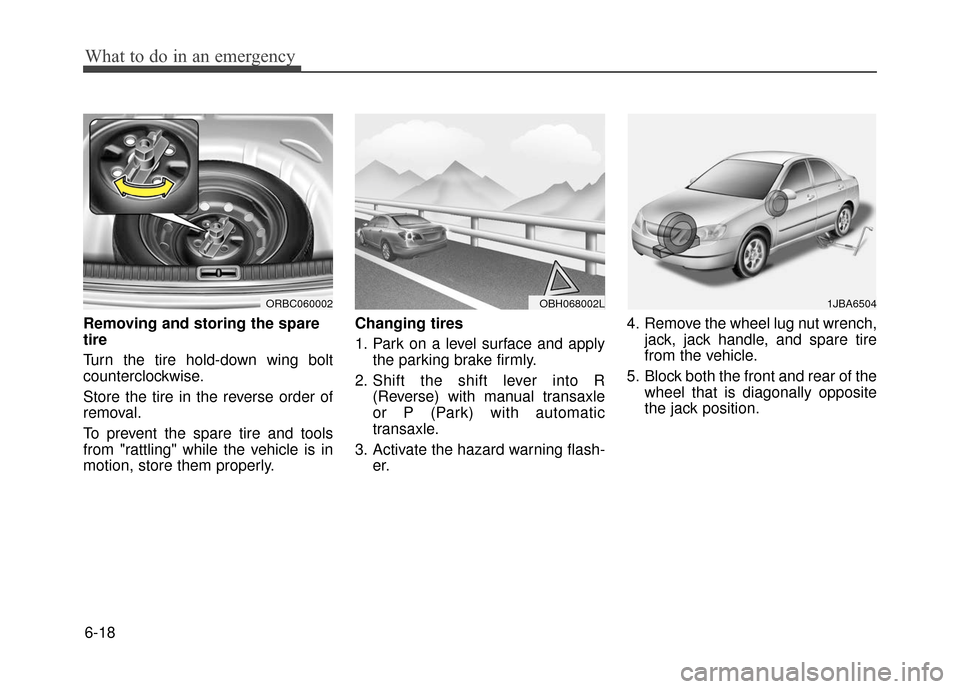
Removing and storing the spare
tire
Turn the tire hold-down wing bolt
counterclockwise.
Store the tire in the reverse order of
removal.
To prevent the spare tire and tools
from "rattling" while the vehicle is in
motion, store them properly.Changing tires
1. Park on a level surface and apply
the parking brake firmly.
2. Shift the shift lever into R (Reverse) with manual transaxle
or P (Park) with automatic
transaxle.
3. Activate the hazard warning flash- er. 4. Remove the wheel lug nut wrench,
jack, jack handle, and spare tire
from the vehicle.
5. Block both the front and rear of the wheel that is diagonally opposite
the jack position.
ORBC060002OBH068002L1JBA6504
Page 267 of 380
6-19
What to do in an emergency
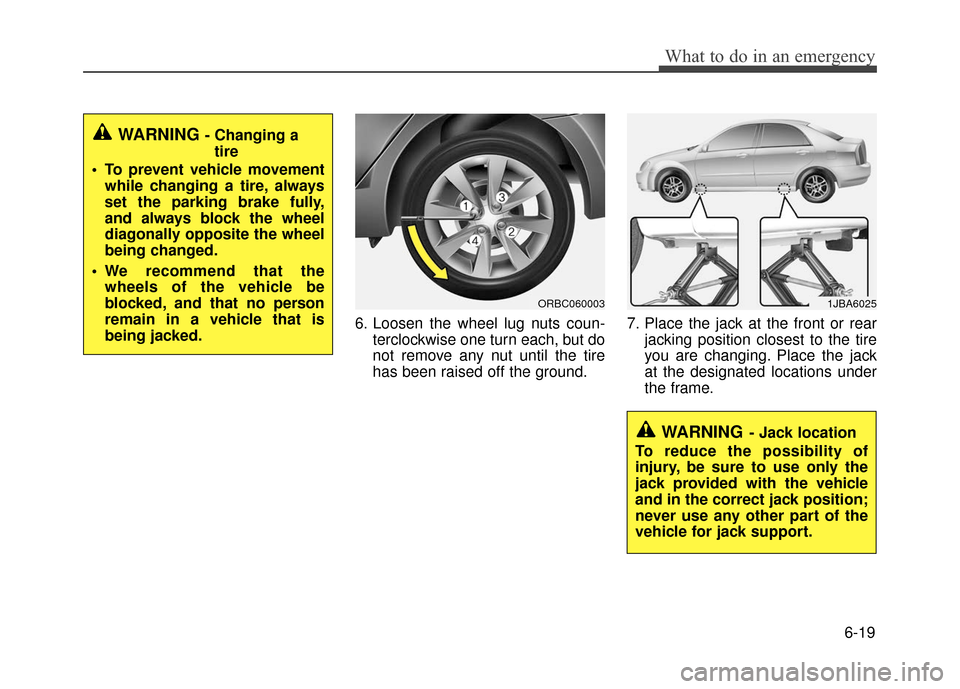
6. Loosen the wheel lug nuts coun-terclockwise one turn each, but do
not remove any nut until the tire
has been raised off the ground. 7. Place the jack at the front or rear
jacking position closest to the tire
you are changing. Place the jack
at the designated locations under
the frame.
WARNING - Changing atire
To prevent vehicle movement while changing a tire, always
set the parking brake fully,
and always block the wheel
diagonally opposite the wheel
being changed.
We recommend that the wheels of the vehicle be
blocked, and that no person
remain in a vehicle that is
being jacked.
ORBC060003
WARNING- Jack location
To reduce the possibility of
injury, be sure to use only the
jack provided with the vehicle
and in the correct jack position;
never use any other part of the
vehicle for jack support.
1JBA6025
Page 269 of 380
6-21
What to do in an emergency
10. To reinstall the wheel, hold it onthe studs, put the wheel nuts on
the studs and tighten them finger
tight. The nuts should be installed
with their tapered small diameter
ends directed inward. Jiggle the
tire to be sure it is completely
seated, then tighten the nuts as
much as possible with your fin-
gers again.
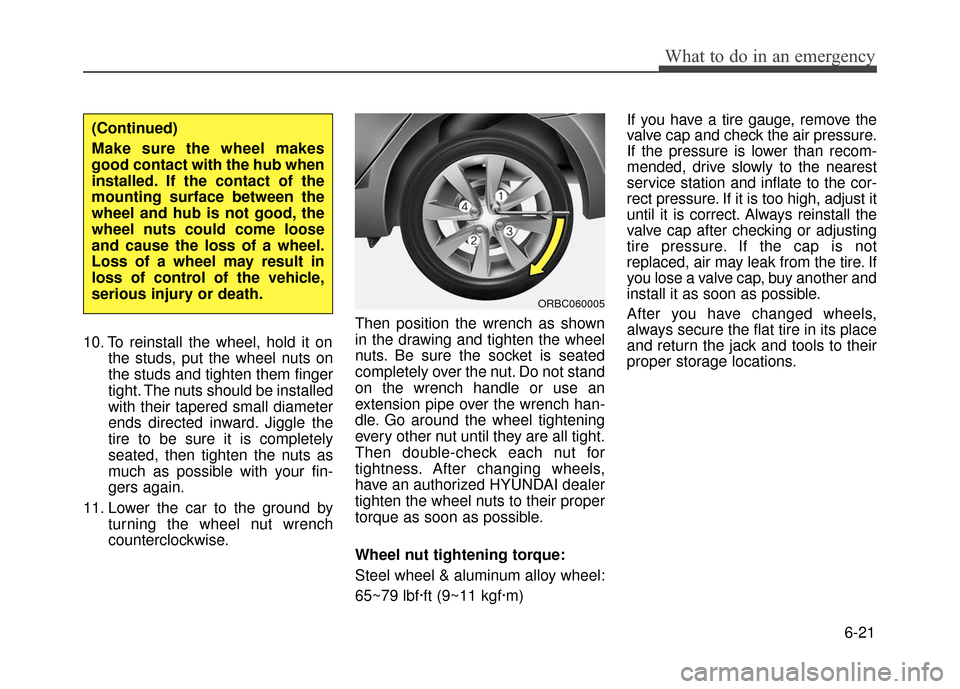
11. Lower the car to the ground by turning the wheel nut wrench
counterclockwise. Then position the wrench as shown
in the drawing and tighten the wheel
nuts. Be sure the socket is seated
completely over the nut. Do not stand
on the wrench handle or use an
extension pipe over the wrench han-
dle. Go around the wheel tightening
every other nut until they are all tight.
Then double-check each nut for
tightness. After changing wheels,
have an authorized HYUNDAI dealer
tighten the wheel nuts to their proper
torque as soon as possible.
Wheel nut tightening torque:
Steel wheel & aluminum alloy wheel:
65~79 lbf·ft (9~11 kgf·m) If you have a tire gauge, remove the
valve cap and check the air pressure.
If the pressure is lower than recom-
mended, drive slowly to the nearest
service station and inflate to the cor-
rect pressure. If it is too high, adjust it
until it is correct. Always reinstall the
valve cap after checking or adjusting
tire pressure. If the cap is not
replaced, air may leak from the tire. If
you lose a valve cap, buy another and
install it as soon as possible.
After you have changed wheels,
always secure the flat tire in its place
and return the jack and tools to their
proper storage locations.
(Continued)
Make sure the wheel makes
good contact with the hub when
installed. If the contact of the
mounting surface between the
wheel and hub is not good, the
wheel nuts could come loose
and cause the loss of a wheel.
Loss of a wheel may result in
loss of control of the vehicle,
serious injury or death.
ORBC060005
Page 374 of 380

I3
Index
Cargo capacity··················\
··················\
·········· ·5-41
Cargo weight ··················\
··················\
············ ·5-45
Center console storage ··················\
··················\
· ·4-75
Central door lock switch ··················\
··················\
·4-8
Certification label ··················\
··················\
······· ·5-43
Certification label ··················\
··················\
·········8-7
Chains Tire chains ··················\
··················\
············ ·5-37
Changing tires ··················\
··················\
··········· ·6-18
Checking tire inflation pressure ··················\
·········7-37
Child restraint system ··················\
··················\
·· ·3-25
Lower anchor ··················\
··················\
·········3-31
Seat belt ··················\
··················\
··············· ·3-26
Tether anchor system ··················\
················· ·3-29
Child-protector rear door lock ··················\
·············4-9
Climate control air filter ··················\
················· ·4-64
Climate control air filter ··················\
················· ·7-28
Clock (Digital) ··················\
··················\
·········· ·4-80
Clothes hanger ··················\
··················\
·········· ·4-80
Combined instrument, see instrument cluster ···········4-29
Compact spare tire ··················\
··················\
······ ·6-22
Compact spare tire replacement ··················\
·········7-41
Coolant ··················\
··················\
··················\
· ·7-22
Cooling fluid, see engine coolant ··················\
·······7-22
Crankcase emission control system ··················\
·····7-75
Cruise control system ··················\
··················\
·· ·5-26
Cup holder ··················\
··················\
··············· ·4-78
Curtain air bag ··················\
··················\
·········· ·3-50Dashboard illumination,
see instrument panel illumination ··················\
····4-30
Dashboard, see instrument cluster ··················\
·······4-29
Defogging (Windshield) ··················\
················· ·4-71
Defogging logic (Windshield) ··················\
···········4-73
Defroster (Rear window) ··················\
················ ·4-55
Defrosting (Windshield) ··················\
················· ·4-71
Digital clock ··················\
··················\
··············4-80
Dimensions ··················\
··················\
·················8-2
Display illumination, see instrument panel illumination
·4-30
Displays, see instrument cluster ··················\
·········4-29
Door locks ··················\
··················\
················· ·4-6
Central door lock switch ··················\
··············· ·4-8
Child-protector rear door lock ··················\
·········4-9
Drinks holders, see cup holders ··················\
·········4-78
Driver's 3-point seat belt ··················\
················· ·3-15
Driver's and passenger's front air bag ··················\
···3-45
Driving at night ··················\
··················\
········· ·5-33
Driving in flooded areas ··················\
················· ·5-34
Driving in the rain ··················\
··················\
······ ·5-34
Economical operation ··················\
··················\
·· ·5-30
Electric power steering ··················\
··················\
· ·4-24
Electronic stability control (ESC) ··················\
·······5-20
D
E
Page 375 of 380

Index
4I
Emergency starting··················\
··················\
········6-4
Jump starting ··················\
··················\
···········6-4
Push starting ··················\
··················\
············6-5
Emergency while driving ··················\
··················\
6-2
Emission control system ··················\
················· ·7-76
Crankcase emission control system ··················\
··7-76
Evaporative emission control System ·················7-76
Exhaust emission control system · · · · · · · ···············7-77
Engine ··················\
··················\
··················\
····8-2
Engine compartment ··················\
··················\
······2-4
Engine coolant ··················\
··················\
·········· ·7-22
Engine number ··················\
··················\
············8-8
Engine oil ··················\
··················\
·················7-21
Engine overheats ··················\
··················\
··········6-6
Engine temperature gauge ··················\
··············· ·4-30
Engine will not start ··················\
··················\
······6-3
Evaporative emission control system ··················\
···7-75
Exhaust emission control system ··················\
········7-76
Explanation of scheduled maintenance items ···········7-19
Exterior care ··················\
··················\
··············7-70
Flat tire (with spare tire) ··················\
················· ·6-17
Jack and tools ··················\
··················\
·········6-17
Changing tires ··················\
··················\
······· ·6-18
Compact spare tire ··················\
··················\
·· ·6-22
Removing and storing the spare tire ··················\
·6-18Flat tire (with tire mobility kit)
··················\
··········6-25
Floor mat anchor(s) ··················\
··················\
···· ·4-81
Fluid Brakes/clutch fluid ··················\
··················\
·· ·7-25
Washer fluid ··················\
··················\
·········· ·7-26
Folding the rear seat ··················\
··················\
·····3-11
Front passenger and rear seat belt ··················\
·······3-15
Front seat adjustment ··················\
··················\
···· ·3-5
Fuel filler lid··················\
··················\
··············4-18
Fuel gauge ··················\
··················\
··············· ·4-32
Fuel requirements ··················\
··················\
·········1-2
Fuses ··················\
··················\
··················\
···· ·7-51
Fuse/relay panel description ··················\
··········7-54
Instrument panel fuse ··················\
················· ·7-51
Memory fuse ··················\
··················\
········· ·7-52
Multi fuse ··················\
··················\
··············7-53
Gauge Engine temperature gauge ··················\
············4-31
Fuel gauge ··················\
··················\
············ ·4-32
GA
W (Gross axle weight) ··················\
··············· ·5-45
GAWR (Gross axle weight rating) ··················\
······5-45
Glove box ··················\
··················\
·················4-76
GVW (Gross vehicle weight) ··················\
············5-45
GVWR (Gross vehicle weight rating) ··················\
··5-45
F
G