radiator HYUNDAI ACCENT 2022 Owners Manual
[x] Cancel search | Manufacturer: HYUNDAI, Model Year: 2022, Model line: ACCENT, Model: HYUNDAI ACCENT 2022Pages: 443, PDF Size: 42.78 MB
Page 17 of 443
1-6
Your vehicle at a glance
E EN
NG
GI
IN
NE
E
C
CO
OM
MP
PA
AR
RT
TM
ME
EN
NT
T
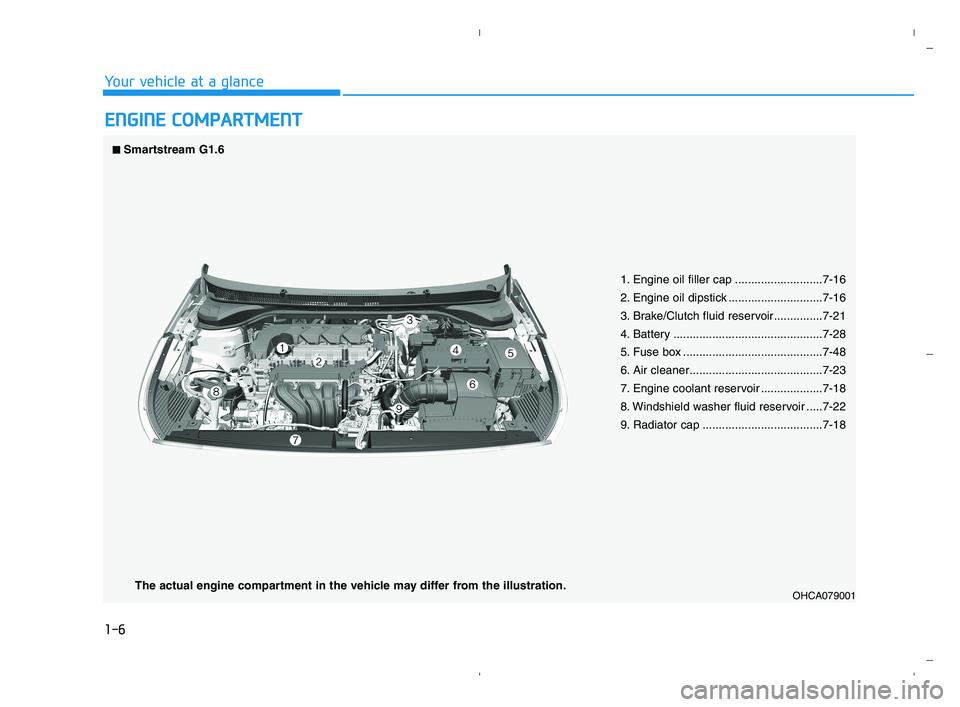
1. Engine oil filler cap ...........................7-16
2. Engine oil dipstick .............................7-16
3. Brake/Clutch fluid reservoir...............7-21
4. Battery ..............................................7-28
5. Fuse box ...........................................7-48
6. Air cleaner.........................................7-23
7. Engine coolant reservoir ...................7-18
8. Windshield washer fluid reservoir .....7-22
9. Radiator cap .....................................7-18
OHCA079001
■ ■Smartstream G1.6
The actual engine compartment in the vehicle may differ from the illustration.
HCa HMA 1.qxp 5/25/2020 10:05 AM Page 6
Page 108 of 443
3-30
Convenient features of your vehicle
Use your interior side view mirror or
direct observation to determine the
actual distance of following vehicles
when changing lanes.
Do not scrape ice off the mirror
face; this may damage the sur-
face of the glass.
If the mirror is jammed with ice,
do not adjust the mirror by
force. Use an approved spray
de-icer (not radiator antifreeze)
spray, or a sponge or soft cloth
with very warm water, or move
the vehicle to a warm place and
allow the ice to melt.
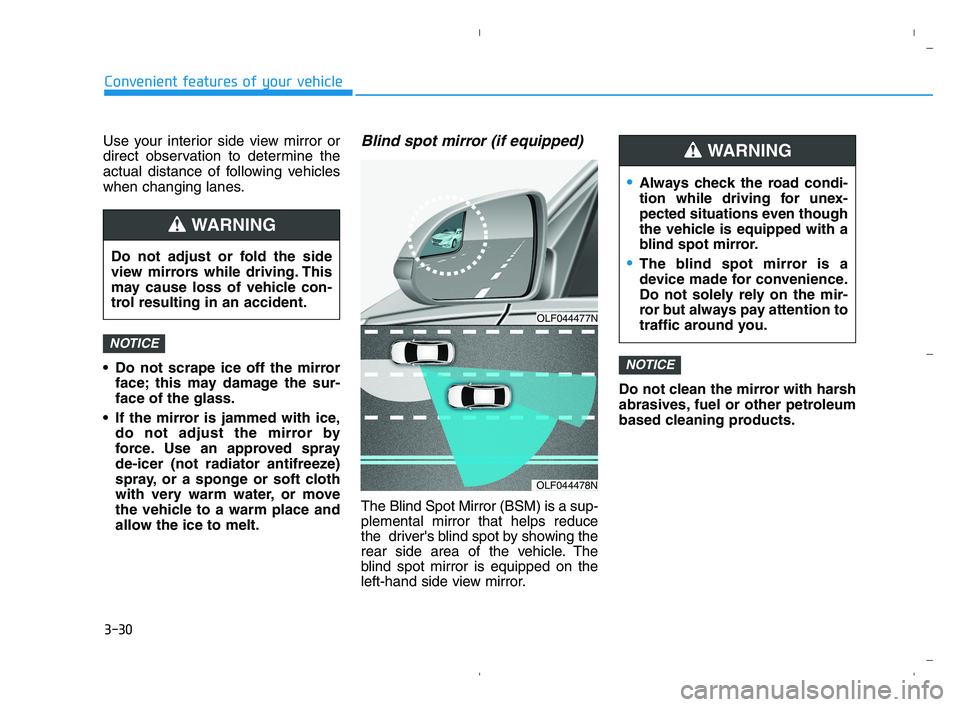
Blind spot mirror (if equipped)
The Blind Spot Mirror (BSM) is a sup-
plemental mirror that helps reduce
the driver's blind spot by showing the
rear side area of the vehicle. The
blind spot mirror is equipped on the
left-hand side view mirror.Do not clean the mirror with harsh
abrasives, fuel or other petroleum
based cleaning products.
NOTICE
NOTICE
Do not adjust or fold the side
view mirrors while driving. This
may cause loss of vehicle con-
trol resulting in an accident.
WARNING
OLF044477N
OLF044478N
Always check the road condi-
tion while driving for unex-
pected situations even though
the vehicle is equipped with a
blind spot mirror.
The blind spot mirror is a
device made for convenience.
Do not solely rely on the mir-
ror but always pay attention to
traffic around you.
WARNING
HCa HMA 3a(~84).qxp 5/25/2020 10:36 AM Page 30
Page 127 of 443
3-49
Convenient features of your vehicle
3
Fuel Filler Door
Opening the fuel filler door
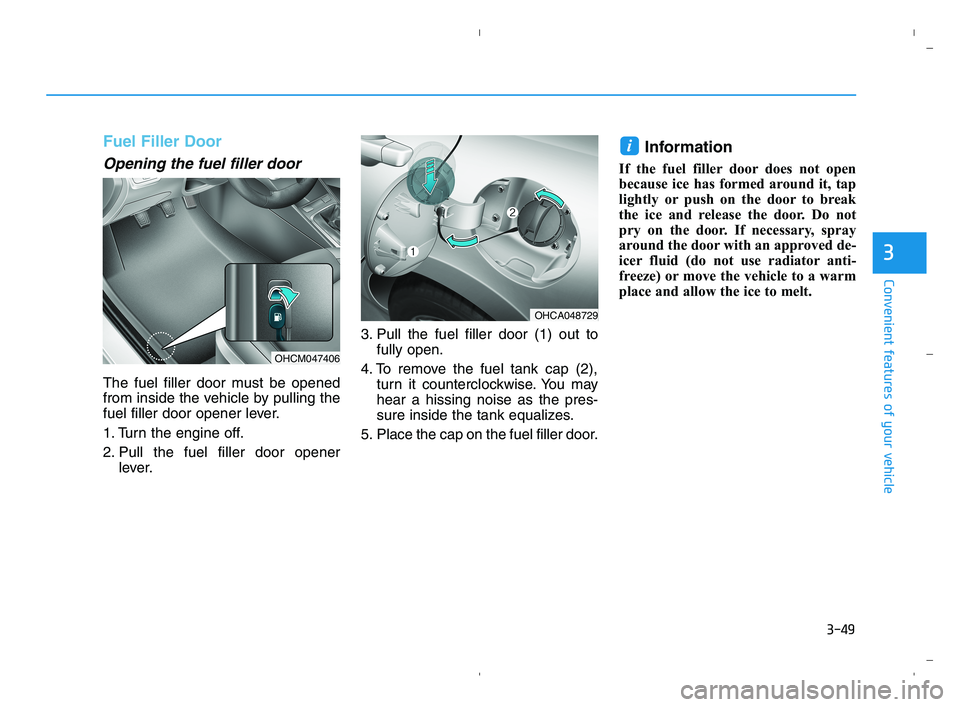
The fuel filler door must be opened
from inside the vehicle by pulling the
fuel filler door opener lever.
1. Turn the engine off.
2. Pull the fuel filler door opener
lever.3. Pull the fuel filler door (1) out to
fully open.
4. To remove the fuel tank cap (2),
turn it counterclockwise. You may
hear a hissing noise as the pres-
sure inside the tank equalizes.
5. Place the cap on the fuel filler door.
Information
If the fuel filler door does not open
because ice has formed around it, tap
lightly or push on the door to break
the ice and release the door. Do not
pry on the door. If necessary, spray
around the door with an approved de-
icer fluid (do not use radiator anti-
freeze) or move the vehicle to a warm
place and allow the ice to melt.
i
OHCM047406
OHCA048729
HCa HMA 3a(~84).qxp 5/25/2020 10:38 AM Page 49
Page 133 of 443
3-55
Convenient features of your vehicle
3
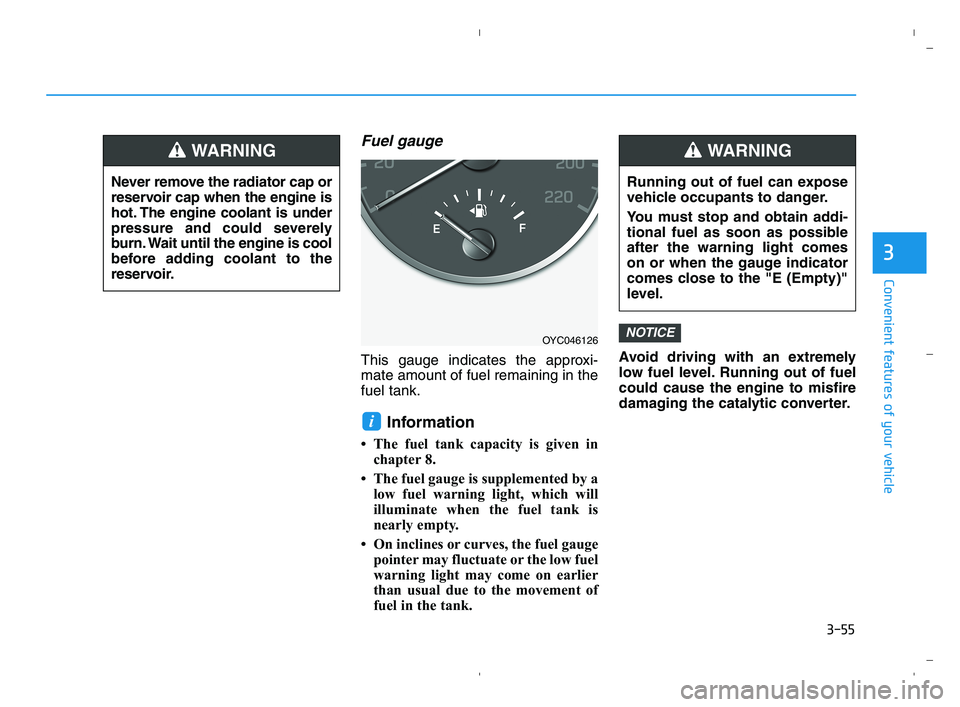
Fuel gauge
This gauge indicates the approxi-
mate amount of fuel remaining in the
fuel tank.
Information
• The fuel tank capacity is given in
chapter 8.
• The fuel gauge is supplemented by a
low fuel warning light, which will
illuminate when the fuel tank is
nearly empty.
• On inclines or curves, the fuel gauge
pointer may fluctuate or the low fuel
warning light may come on earlier
than usual due to the movement of
fuel in the tank.Avoid driving with an extremely
low fuel level. Running out of fuel
could cause the engine to misfire
damaging the catalytic converter.
NOTICE
i
Never remove the radiator cap or
reservoir cap when the engine is
hot. The engine coolant is under
pressure and could severely
burn. Wait until the engine is cool
before adding coolant to the
reservoir.
WARNING
OYC046126
Running out of fuel can expose
vehicle occupants to danger.
You must stop and obtain addi-
tional fuel as soon as possible
after the warning light comes
on or when the gauge indicator
comes close to the "E (Empty)"
level.
WARNING
HCa HMA 3a(~84).qxp 5/25/2020 10:38 AM Page 55
Page 252 of 443
4-45
Infotainment System
4
FCC Warning
This equipment has been tested and found to comply with the limits for a Class B digital device, pursuant to part 15
of the FCC Rules. These limits are designed to provide reasonable protection against harmful interference in a resi-
dential installation.
This equipment generates, uses and can radiate radio frequency energy and, if not installed and used in accordance
with the instructions, may cause harmful interference to radio communications. However, there is no guarantee that
interference will not occur in a particular installation. If this equipment does cause harmful interference to radio or tel-
evision reception, which can be determined by turning the equipment off and on, the user is encouraged to try to cor-
rect the interference by one or more of the following measures:
Reorient or relocate the receiving antenna.
Increase the separation between the equipment and receiver.
Connect the equipment into an outlet on a circuit different from that to which the receiver is connected.
Consult the dealer or an experienced radio/TV technician for help
This device complies with part 15 of the FCC Rules. Operation is subject to the following two conditions: (1) This
device may not cause harmful interference, and (2) this device must accept any interference received, including inter-
ference that may cause undesired operation.
Caution: Any changes or modifications to this device not expressly approved by the party responsible for compliance
could void your authority to operate the equipment.
This equipment complies with FCC radiation exposure limits set forth for an uncontrolled environment.
This equipment should be installed and operated with minimum 20 cm between the radiator and your body. This trans-
mitter must not be collocated or operating in conjunction with any other antenna or transmitter unless authorized to
do so by the FCC.
HCa HMA 4.qxp 5/25/2020 10:59 AM Page 45
Page 322 of 443
6-7
What to do in an emergency
6
4. Check for coolant leaking from the
radiator, hoses or under the vehi-
cle. (If the air conditioning had
been in use, it is normal for cold
water to be draining from it when
you stop.)
5. If engine coolant is leaking out,
stop the engine immediately and
call the nearest authorized
HYUNDAI dealer for assistance.6. If you cannot find the cause of the
overheating, wait until the engine
temperature has returned to nor-
mal. Then, if coolant has been
lost, carefully add coolant to the
reservoir to bring the fluid level in
the reservoir up to the halfway
mark.
7. Proceed with caution, keeping
alert for further signs of overheat-
ing. If overheating happens again,
call an authorized HYUNDAI deal-
er for assistance.
Serious loss of coolant indi-
cates a leak in the cooling sys-
tem and should be checked as
soon as possible by an author-
ized HYUNDAI dealer.
CAUTION
While the engine is running,
keep hands, clothing and tools
away from the moving parts
such as the cooling fan and
drive belt to prevent serious
injury.
WARNING
Your vehicle is
equipped with a
pressurized
coolant reserve
tank. NEVER
remove the
engine coolant
reservoir
tank/radiator cap or the drain
plug while the engine and radia-
tor are HOT. Hot coolant and
steam may blow out under pres-
sure, causing serious injury.
Turn the engine off and wait
until the engine cools down.
Use extreme care when remov-
ing the engine coolant reservoir
tank/radiator cap. Wrap a towel
or thick rag around it, and turn it
counterclockwise slowly to
release some of the pressure
from the system. Step back
while the pressure is released.
When you are sure all the pres-
sure has been released, contin-
ue turning the cap counter-
clockwise to remove it.
WARNING
HCa HMA 6.qxp 5/25/2020 11:03 AM Page 7
Page 342 of 443
7-3
7
Maintenance
E EN
NG
GI
IN
NE
E
C
CO
OM
MP
PA
AR
RT
TM
ME
EN
NT
T
OHCA079001
■
■Smartstream G1.6
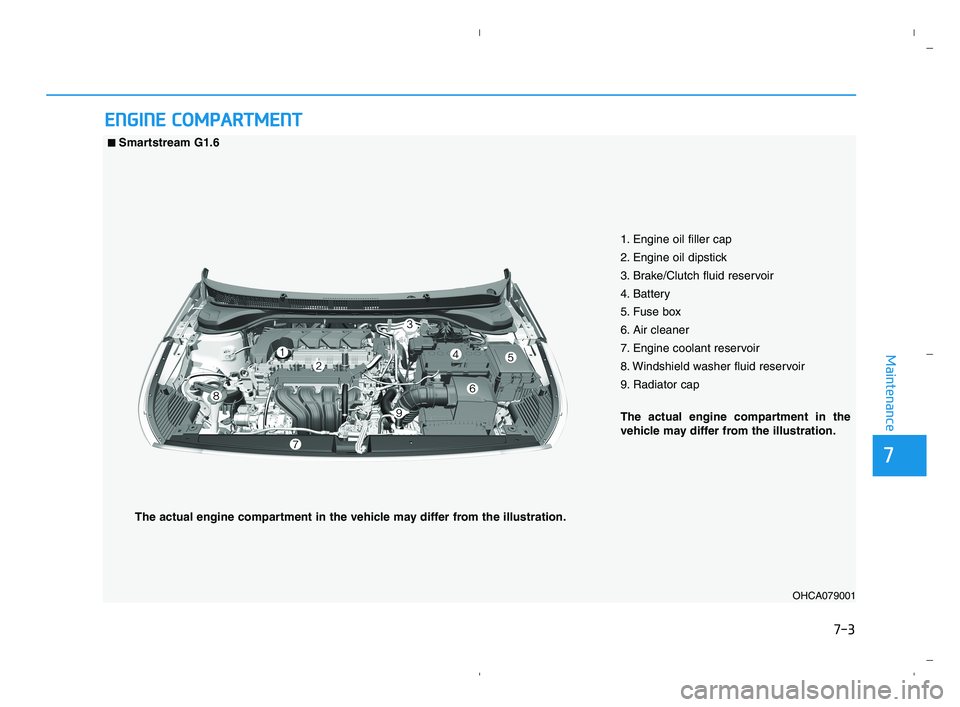
1. Engine oil filler cap
2. Engine oil dipstick
3. Brake/Clutch fluid reservoir
4. Battery
5. Fuse box
6. Air cleaner
7. Engine coolant reservoir
8. Windshield washer fluid reservoir
9. Radiator cap
The actual engine compartment in the
vehicle may differ from the illustration.
The actual engine compartment in the vehicle may differ from the illustration.
HCa HMA 7.qxp 5/25/2020 11:08 AM Page 3
Page 345 of 443
7-6
Maintenance
Owner Maintenance Schedule
When you stop for fuel:
• Check the engine oil level.
Check the coolant level in the
engine coolant reservoir.
Check the windshield washer fluid
level.
Check the for low or under-inflated
tires.
While operating your vehicle:
Note any changes in the sound of
the exhaust or any smell of
exhaust fumes in the vehicle.
Check for vibrations in the steering
wheel. Notice if there is any
increased steering effort or loose-
ness in the steering wheel, or
change in its straight-ahead posi-
tion.
Notice if your vehicle constantly
turns slightly or "pulls" to one side
when traveling on smooth, level
road.
When stopping, listen and check
for unusual sounds, pulling to one
side, increased brake pedal travel
or "hard-to-push" brake pedal.
If any slipping or changes in the
operation of your transmission
occurs, check the transmission
fluid level.
Check the intelligent variable trans-
mission (IVT) P (Park) function.
Check the parking brake.
Check for fluid leaks under your
vehicle (water dripping from the air
conditioning system during or after
use is normal).
At least monthly:
Check coolant level in the engine
coolant reservoir.
Check the operation of all exterior
lights, including the brake lights,
turn signals and hazard warning
flashers.
Check the inflation pressures of all
tires including the spare for tires
that are worn, show uneven wear,
or are damaged.
Check for loose wheel lug nuts.
At least twice a year:
(i.e., every Spring and Autumn)
Check radiator, heater and air con-
ditioning hoses for leaks or dam-
age.
Check windshield washer spray
and wiper operation. Clean wiper
blades with a clean cloth damp-
ened with washer a fluid.
Check headlamp alignment.
Check muffler, exhaust pipes,
shields and clamps.
Check the seat belts for wear and
function. Be careful when checking your
engine coolant level when the
engine is hot. This may result in
coolant being blown out of the
opening and cause serious
burns and other injuries.
WARNING
HCa HMA 7.qxp 6/3/2020 7:40 AM Page 6
Page 353 of 443
7-14
Maintenance
Air Cleaner Filter
A genuine HYUNDAI air cleaner filter
is recommended when the filter is
replaced.
Spark Plugs
Make sure to install new spark plugs
of the correct heat range.
Cooling System
Check cooling system components,
such as radiator, coolant reservoir,
hoses and connections for leakage
and damage. Replace any damaged
parts.
Engine Coolant
The coolant should be changed at
the intervals specified in the mainte-
nance schedule.
Intelligent Variable
Transmission (IVT) Fluid
(if equipped)
Intelligent Variable Transmission
(IVT) Fluid should not be checked
under normal usage conditions. But,
the Intelligent Variable Transmission
(IVT) Fluid should be changed under
severe usage conditions. We recom-
mend that the Intelligent Variable
Transmission (IVT) Fluid changed by
an authorized HYUNDAI dealer
according to the maintenance sched-
ule.
(Refer to "Maintenance Under
Severe Usage Conditions" in this
chapter.)
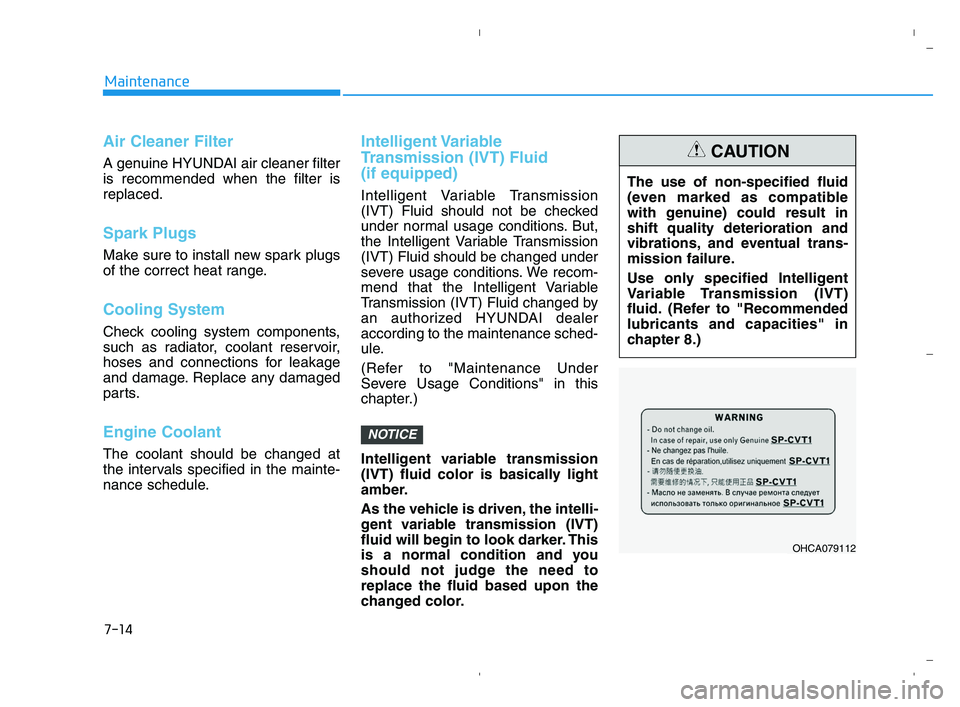
Intelligent variable transmission
(IVT) fluid color is basically light
amber.
As the vehicle is driven, the intelli-
gent variable transmission (IVT)
fluid will begin to look darker. This
is a normal condition and you
should not judge the need to
replace the fluid based upon the
changed color.
NOTICE
The use of non-specified fluid
(even marked as compatible
with genuine) could result in
shift quality deterioration and
vibrations, and eventual trans-
mission failure.
Use only specified Intelligent
Variable Transmission (IVT)
fluid. (Refer to "Recommended
lubricants and capacities" in
chapter 8.)
CAUTION
OHCA079112
HCa HMA 7.qxp 5/25/2020 11:08 AM Page 14
Page 358 of 443
7-19
7
Maintenance
Do not use a solution that contains
more than 60% antifreeze or less
than 35% antifreeze, which would
reduce the effectiveness of the
solution.
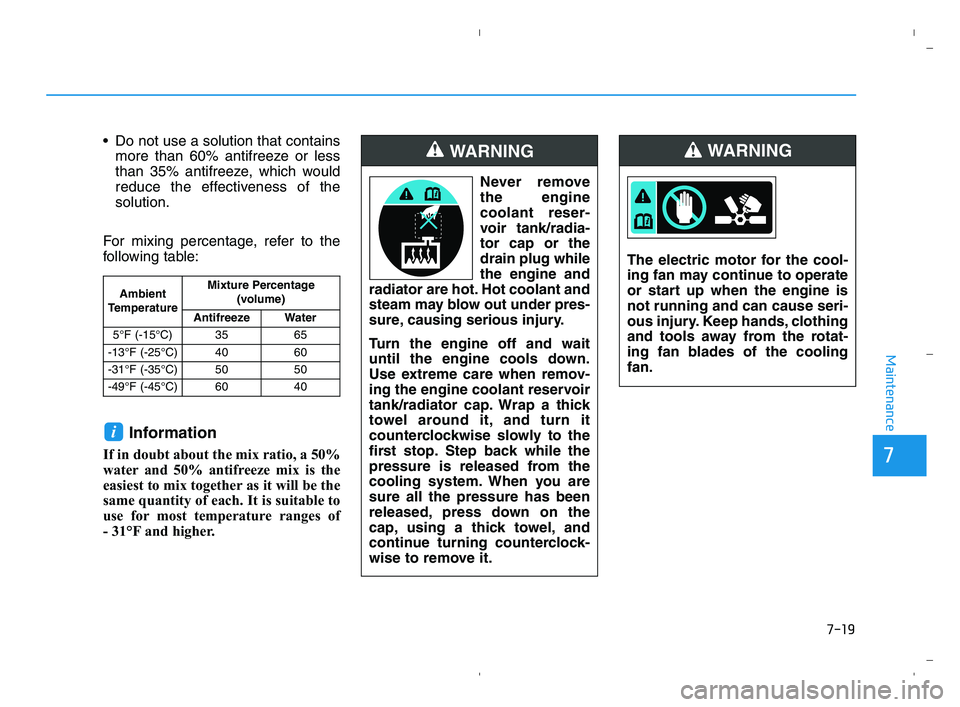
For mixing percentage, refer to the
following table:
Information
If in doubt about the mix ratio, a 50%
water and 50% antifreeze mix is the
easiest to mix together as it will be the
same quantity of each. It is suitable to
use for most temperature ranges of
- 31°F and higher.
i
Ambient
TemperatureMixture Percentage
(volume)
Antifreeze Water
5°F (-15°C) 35 65
-13°F (-25°C) 40 60
-31°F (-35°C) 50 50
-49°F (-45°C) 60 40
Never remove
the engine
coolant reser-
voir tank/radia-
tor cap or the
drain plug while
the engine and
radiator are hot. Hot coolant and
steam may blow out under pres-
sure, causing serious injury.
Turn the engine off and wait
until the engine cools down.
Use extreme care when remov-
ing the engine coolant reservoir
tank/radiator cap. Wrap a thick
towel around it, and turn it
counterclockwise slowly to the
first stop. Step back while the
pressure is released from the
cooling system. When you are
sure all the pressure has been
released, press down on the
cap, using a thick towel, and
continue turning counterclock-
wise to remove it.
WARNING
The electric motor for the cool-
ing fan may continue to operate
or start up when the engine is
not running and can cause seri-
ous injury. Keep hands, clothing
and tools away from the rotat-
ing fan blades of the cooling
fan.
WARNING
HCa HMA 7.qxp 5/25/2020 11:08 AM Page 19