speed on HYUNDAI ACCENT 2023 Repair Manual
[x] Cancel search | Manufacturer: HYUNDAI, Model Year: 2023, Model line: ACCENT, Model: HYUNDAI ACCENT 2023Pages: 443, PDF Size: 42.78 MB
Page 295 of 443
5-43
Driving your vehicle
5
The vehicle drives through a con-
struction area, on an unpaved
road, or above metal materials,
such as a railway
The vehicle drives inside a build-
ing, such as a basement parking
lot
The adverse road conditions cause
excessive vehicle vibrations while
driving
The vehicle in front is moving verti-
cally to the driving direction
The vehicle in front is stopped ver-
tically
The vehicle in front is driving
towards your vehicle or reversing
The sensor recognition changes
suddenly when passing over a
speed bump
The vehicle is under heavy vibra-
tion
The vehicle is on roundabouts.
The radar or sensor cover is bro-
ken
The vehicle is passing a tunnel, toll
gate or partially paved road
The radar or camera sensor recog-
nition is under other limited circum-
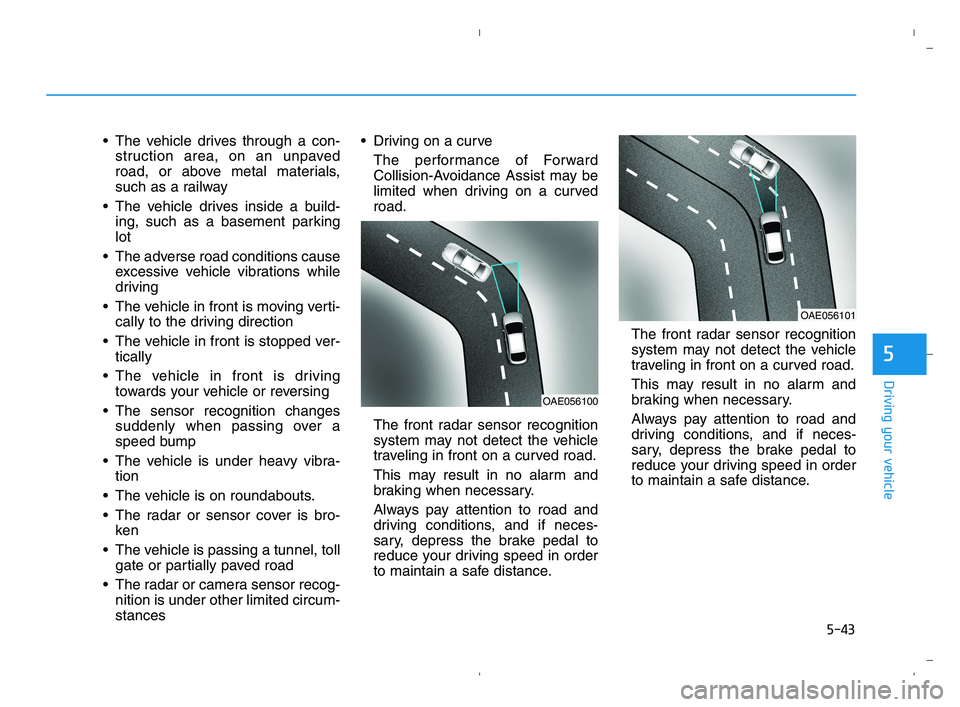
stances Driving on a curve
The performance of Forward
Collision-Avoidance Assist may be
limited when driving on a curved
road.
The front radar sensor recognition
system may not detect the vehicle
traveling in front on a curved road.
This may result in no alarm and
braking when necessary.
Always pay attention to road and
driving conditions, and if neces-
sary, depress the brake pedal to
reduce your driving speed in order
to maintain a safe distance.The front radar sensor recognition
system may not detect the vehicle
traveling in front on a curved road.
This may result in no alarm and
braking when necessary.
Always pay attention to road and
driving conditions, and if neces-
sary, depress the brake pedal to
reduce your driving speed in order
to maintain a safe distance.
OAE056100
OAE056101
HCa HMA 5.QXP 5/25/2020 10:21 AM Page 43
Page 296 of 443
5-44
Driving your vehicle
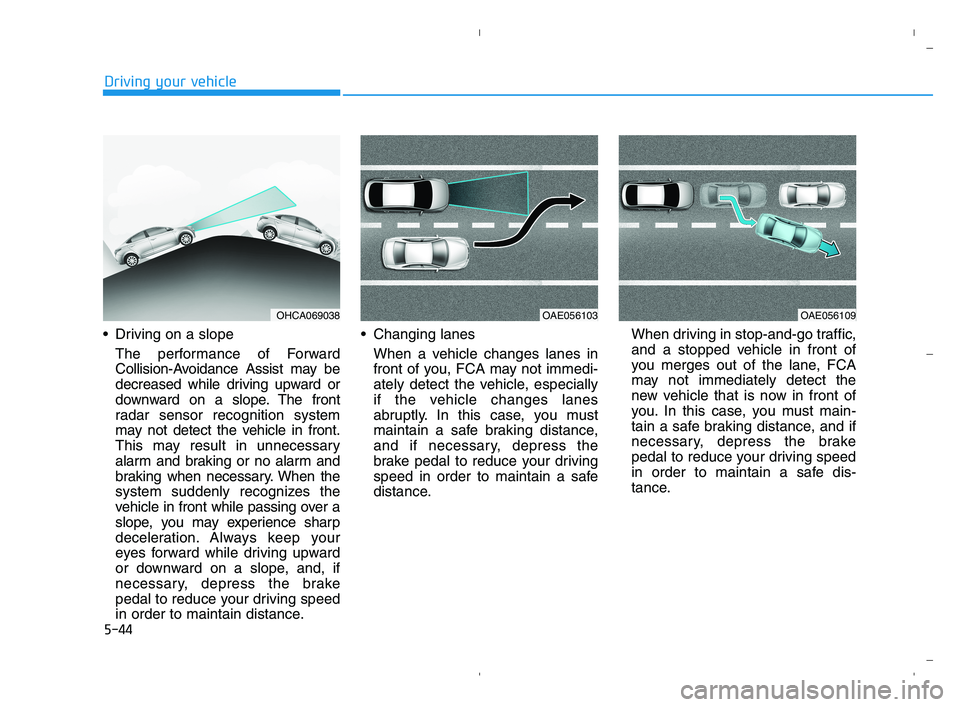
Driving on a slope
The performance of Forward
Collision-Avoidance Assist may be
decreased while driving upward or
downward on a slope. The front
radar sensor recognition system
may not detect the vehicle in front.
This may result in unnecessary
alarm and braking or no alarm and
braking when necessary. When the
system suddenly recognizes the
vehicle in front while passing over a
slope, you may experience sharp
deceleration. Always keep your
eyes forward while driving upward
or downward on a slope, and, if
necessary, depress the brake
pedal to reduce your driving speed
in order to maintain distance. Changing lanes
When a vehicle changes lanes in
front of you, FCA may not immedi-
ately detect the vehicle, especially
if the vehicle changes lanes
abruptly. In this case, you must
maintain a safe braking distance,
and if necessary, depress the
brake pedal to reduce your driving
speed in order to maintain a safe
distance.When driving in stop-and-go traffic,
and a stopped vehicle in front of
you merges out of the lane, FCA
may not immediately detect the
new vehicle that is now in front of
you. In this case, you must main-
tain a safe braking distance, and if
necessary, depress the brake
pedal to reduce your driving speed
in order to maintain a safe dis-
tance.
OHCA069038OAE056103OAE056109
HCa HMA 5.QXP 5/25/2020 10:21 AM Page 44
Page 297 of 443
5-45
Driving your vehicle
5
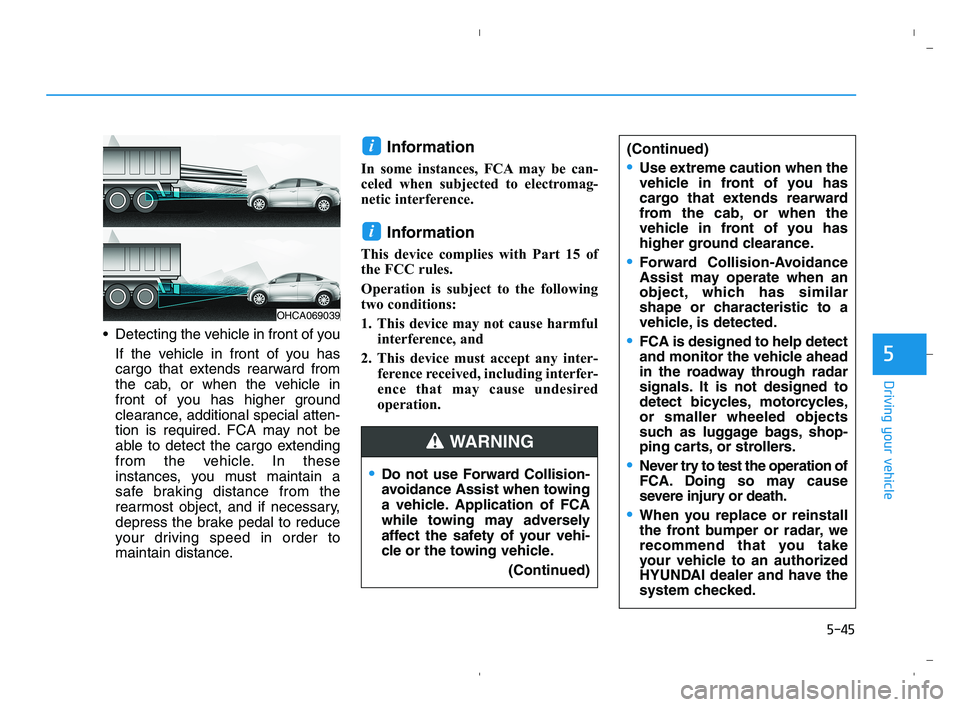
Detecting the vehicle in front of you
If the vehicle in front of you has
cargo that extends rearward from
the cab, or when the vehicle in
front of you has higher ground
clearance, additional special atten-
tion is required. FCA may not be
able to detect the cargo extending
from the vehicle. In these
instances, you must maintain a
safe braking distance from the
rearmost object, and if necessary,
depress the brake pedal to reduce
your driving speed in order to
maintain distance.
Information
In some instances, FCA may be can-
celed when subjected to electromag-
netic interference.
Information
This device complies with Part 15 of
the FCC rules.
Operation is subject to the following
two conditions:
1. This device may not cause harmful
interference, and
2. This device must accept any inter-
ference received, including interfer-
ence that may cause undesired
operation.
i
i
OHCA069039
Do not use Forward Collision-
avoidance Assist when towing
a vehicle. Application of FCA
while towing may adversely
affect the safety of your vehi-
cle or the towing vehicle.
(Continued)
(Continued)
Use extreme caution when the
vehicle in front of you has
cargo that extends rearward
from the cab, or when the
vehicle in front of you has
higher ground clearance.
Forward Collision-Avoidance
Assist may operate when an
object, which has similar
shape or characteristic to a
vehicle, is detected.
FCA is designed to help detect
and monitor the vehicle ahead
in the roadway through radar
signals. It is not designed to
detect bicycles, motorcycles,
or smaller wheeled objects
such as luggage bags, shop-
ping carts, or strollers.
Never try to test the operation of
FCA. Doing so may cause
severe injury or death.
When you replace or reinstall
the front bumper or radar, we
recommend that you take
your vehicle to an authorized
HYUNDAI dealer and have the
system checked.
WARNING
HCa HMA 5.QXP 5/25/2020 10:21 AM Page 45
Page 298 of 443
5-46
Driving your vehicle
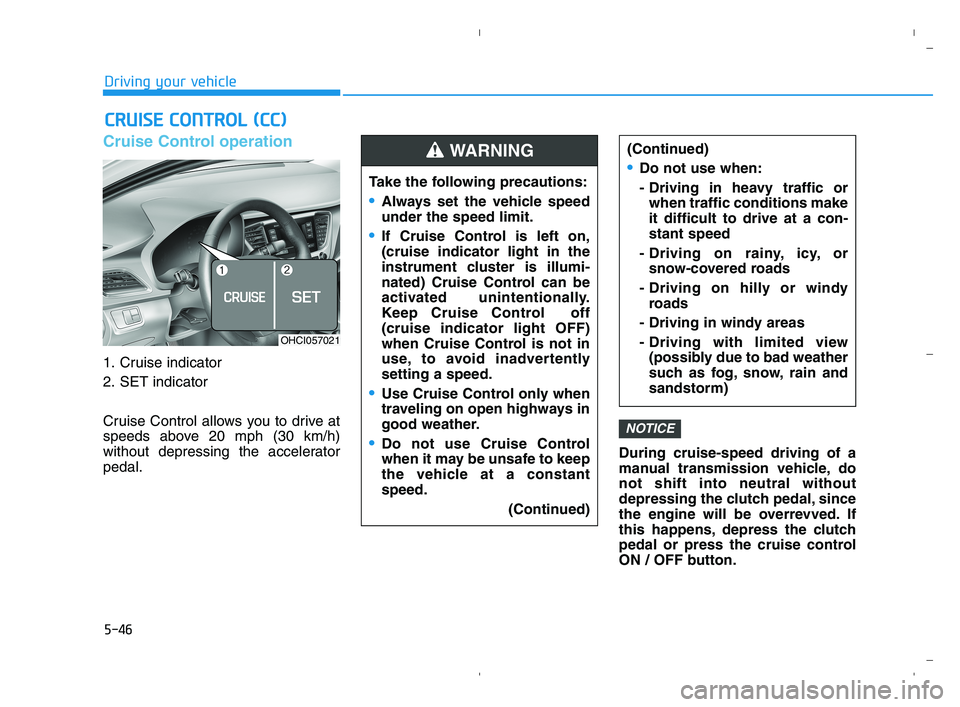
Cruise Control operation
1. Cruise indicator
2. SET indicator
Cruise Control allows you to drive at
speeds above 20 mph (30 km/h)
without depressing the accelerator
pedal.During cruise-speed driving of a
manual transmission vehicle, do
not shift into neutral without
depressing the clutch pedal, since
the engine will be overrevved. If
this happens, depress the clutch
pedal or press the cruise control
ON / OFF button.
NOTICE
C CR
RU
UI
IS
SE
E
C
CO
ON
NT
TR
RO
OL
L
(
(C
CC
C)
)
(Continued)
Do not use when:
- Driving in heavy traffic or
when traffic conditions make
it difficult to drive at a con-
stant speed
- Driving on rainy, icy, or
snow-covered roads
- Driving on hilly or windy
roads
- Driving in windy areas
- Driving with limited view
(possibly due to bad weather
such as fog, snow, rain and
sandstorm)
OHCI057021
Take the following precautions:
Always set the vehicle speed
under the speed limit.
If Cruise Control is left on,
(cruise indicator light in the
instrument cluster is illumi-
nated) Cruise Control can be
activated unintentionally.
Keep Cruise Control off
(cruise indicator light OFF)
when Cruise Control is not in
use, to avoid inadvertently
setting a speed.
Use Cruise Control only when
traveling on open highways in
good weather.
Do not use Cruise Control
when it may be unsafe to keep
the vehicle at a constant
speed.
(Continued)
WARNING
HCa HMA 5.QXP 5/25/2020 10:21 AM Page 46
Page 299 of 443
5-47
Driving your vehicle
5
Information
• During normal cruise control opera-
tion, when the SET switch is activat-
ed or reactivated after applying the
brakes, cruise control will energize
after approximately 3 seconds. This
delay is normal.
• Before activating cruise control
function, the system will check to
verify that the brake switch is oper-
ating normally. Depress the brake
pedal at least once after turning ON
the ignition or starting the engine.
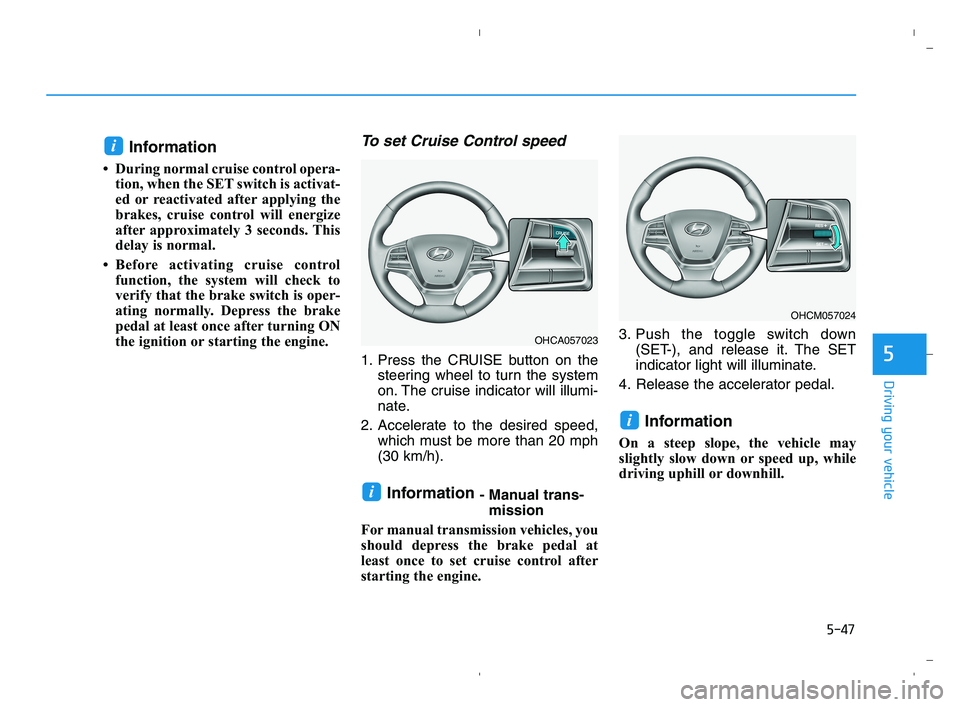
To set Cruise Control speed
1. Press the CRUISE button on the
steering wheel to turn the system
on. The cruise indicator will illumi-
nate.
2. Accelerate to the desired speed,
which must be more than 20 mph
(30 km/h).
Information - Manual trans-
mission
For manual transmission vehicles, you
should depress the brake pedal at
least once to set cruise control after
starting the engine.3. Push the toggle switch down
(SET-), and release it. The SET
indicator light will illuminate.
4. Release the accelerator pedal.
Information
On a steep slope, the vehicle may
slightly slow down or speed up, while
driving uphill or downhill.
i
i
i
OHCA057023
OHCM057024
HCa HMA 5.QXP 5/25/2020 10:21 AM Page 47
Page 300 of 443
5-48
Driving your vehicle
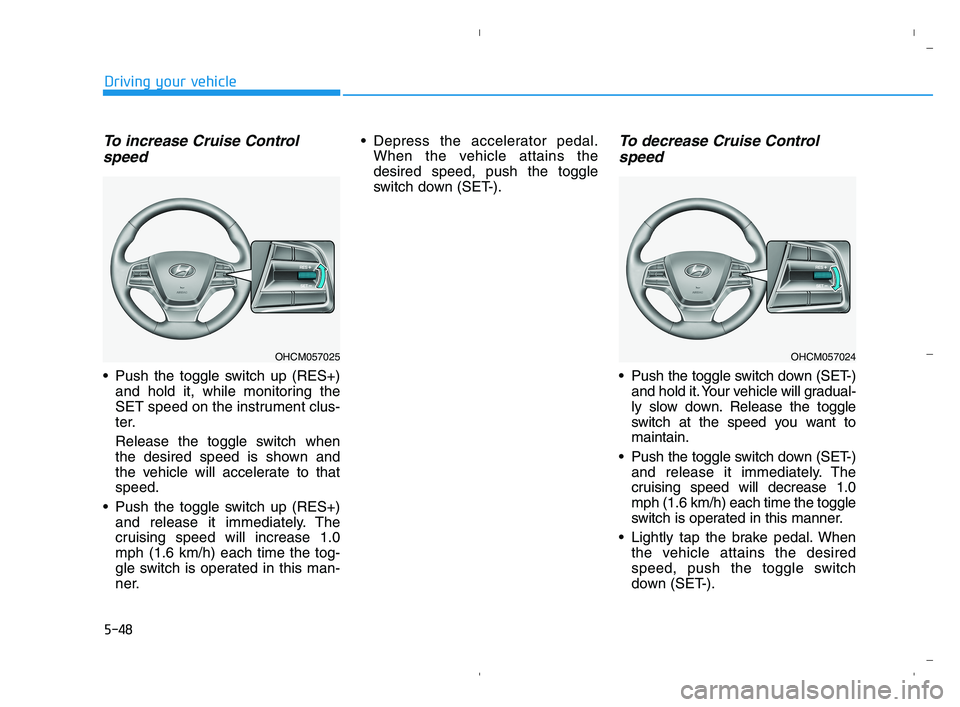
To increase Cruise Control
speed
Push the toggle switch up (RES+)
and hold it, while monitoring the
SET speed on the instrument clus-
ter.
Release the toggle switch when
the desired speed is shown and
the vehicle will accelerate to that
speed.
Push the toggle switch up (RES+)
and release it immediately. The
cruising speed will increase 1.0
mph (1.6 km/h) each time the tog-
gle switch is operated in this man-
ner. Depress the accelerator pedal.
When the vehicle attains the
desired speed, push the toggle
switch down (SET-).
To decrease Cruise Control
speed
Push the toggle switch down (SET-)
and hold it. Your vehicle will gradual-
ly slow down. Release the toggle
switch at the speed you want to
maintain.
Push the toggle switch down (SET-)
and release it immediately. The
cruising speed will decrease 1.0
mph (1.6 km/h) each time the toggle
switch is operated in this manner.
Lightly tap the brake pedal. When
the vehicle attains the desired
speed, push the toggle switch
down (SET-).
OHCM057025OHCM057024
HCa HMA 5.QXP 5/25/2020 10:22 AM Page 48
Page 301 of 443
5-49
Driving your vehicle
5
To temporarily accelerate with
Cruise Control ON
Depress the accelerator pedal. When
you take your foot off the accelerator,
the vehicle will return to the previ-
ously set speed.
If you push the toggle switch down
(SET-) at the increased speed,
Cruise Control will maintain the
increased speed.
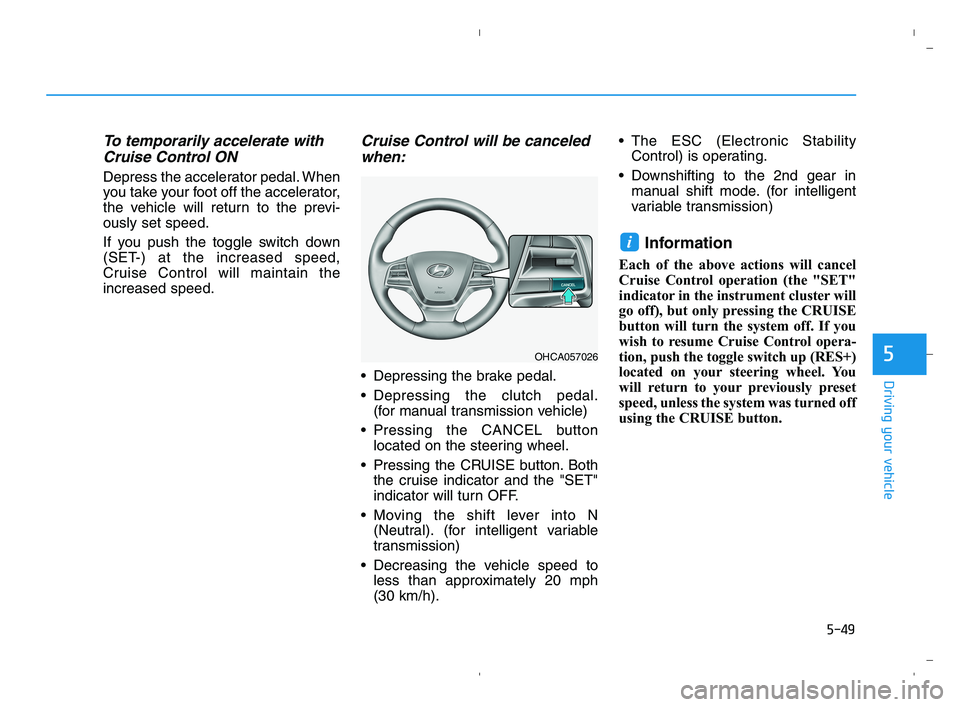
Cruise Control will be canceled
when:
Depressing the brake pedal.
Depressing the clutch pedal.
(for manual transmission vehicle)
Pressing the CANCEL button
located on the steering wheel.
Pressing the CRUISE button. Both
the cruise indicator and the "SET"
indicator will turn OFF.
Moving the shift lever into N
(Neutral). (for intelligent variable
transmission)
Decreasing the vehicle speed to
less than approximately 20 mph
(30 km/h). The ESC (Electronic Stability
Control) is operating.
Downshifting to the 2nd gear in
manual shift mode. (for intelligent
variable transmission)
Information
Each of the above actions will cancel
Cruise Control operation (the "SET"
indicator in the instrument cluster will
go off), but only pressing the CRUISE
button will turn the system off. If you
wish to resume Cruise Control opera-
tion, push the toggle switch up (RES+)
located on your steering wheel. You
will return to your previously preset
speed, unless the system was turned off
using the CRUISE button.
i
OHCA057026
HCa HMA 5.QXP 5/25/2020 10:22 AM Page 49
Page 302 of 443
5-50
Driving your vehicle
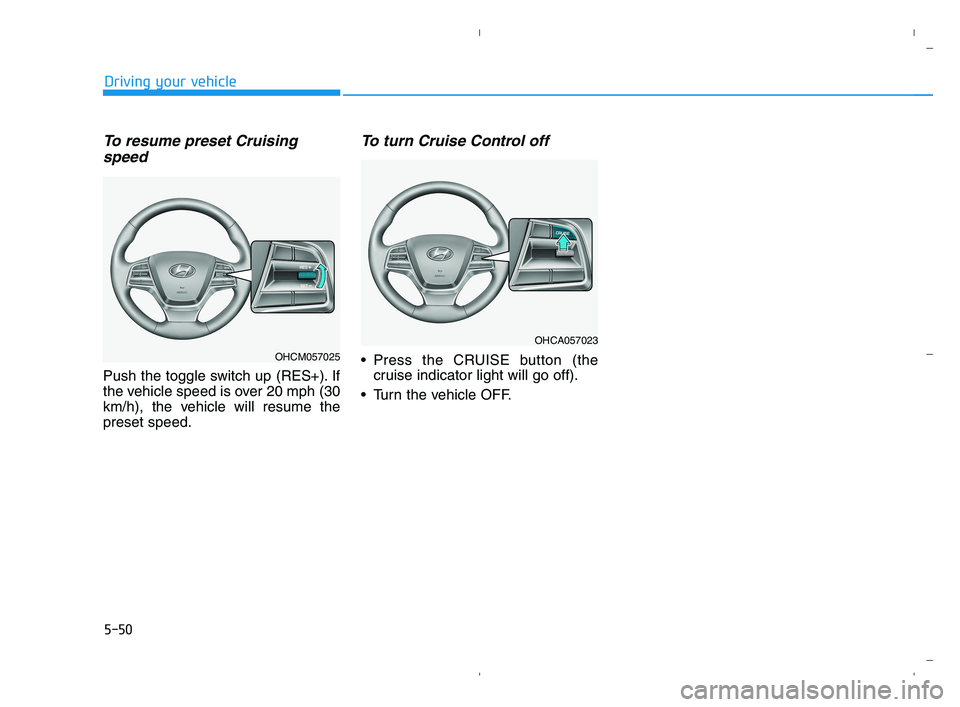
To resume preset Cruising
speed
Push the toggle switch up (RES+). If
the vehicle speed is over 20 mph (30
km/h), the vehicle will resume the
preset speed.
To turn Cruise Control off
Press the CRUISE button (the
cruise indicator light will go off).
Turn the vehicle OFF.OHCM057025
OHCA057023
HCa HMA 5.QXP 5/25/2020 10:22 AM Page 50
Page 303 of 443
5-51
Driving your vehicle
5
Hazardous Driving Conditions
When hazardous driving elements
are encountered such as water,
snow, ice, mud and sand, take the
below suggestions:
Drive cautiously and keep a longer
braking distance.
Avoid abrupt braking or steering.
When your vehicle is stuck in snow,
mud, or sand, use second gear.
Accelerate slowly to avoid unnec-
essary wheel spin.
Put sand, rock salt, tire chains or
other non-slip materials under the
wheels to provide additional trac-
tion while the vehicle becomes
stuck in ice, snow, or mud.
Rocking the Vehicle
If it is necessary to rock the vehicle
to free it from snow, sand, or mud,
first turn the steering wheel right and
left to clear the area around your
front wheels. Then, shift back and
forth between R (Reverse) and a for-
ward gear.
Try to avoid spinning the wheels, and
do not race the engine.
To prevent transmission wear, wait
until the wheels stop spinning before
shifting gears. Release the accelera-
tor pedal while shifting, and press
lightly on the accelerator pedal while
the transmission is in gear. Slowly
spinning the wheels in forward and
reverse directions causes a rocking
motion that may free the vehicle.
S SP
PE
EC
CI
IA
AL
L
D
DR
RI
IV
VI
IN
NG
G
C
CO
ON
ND
DI
IT
TI
IO
ON
NS
S
Downshifting with an intelligent
variable transmission (IVT)
while driving on slippery sur-
faces can cause an accident.
The sudden change in tire
speed could cause the tires to
skid. Be careful when down-
shifting on slippery surfaces.
WARNING
If the vehicle is stuck and
excessive wheel spin occurs,
the temperature in the tires can
increase very quickly. If the tires
become damaged, a tire blow
out or tire explosion can occur.
This condition is dangerous -
you and others may be injured.
Do not attempt this procedure if
people or objects are anywhere
near the vehicle.
If you attempt to free the vehicle,
the vehicle can overheat quickly,
possibly causing an engine
compartment fire or other dam-
age. Try to avoid spinning the
wheels as much as possible to
prevent overheating of either the
tires or the engine. DO NOT
allow the vehicle to spin the
wheels above 35 mph (56 km/h).
WARNING
HCa HMA 5.QXP 5/25/2020 10:22 AM Page 51
Page 305 of 443
5-53
Driving your vehicle
5
Driving too fast through large pud-
dles can affect your brakes. If you
must go through puddles, try to
drive through them slowly.
If you believe your brakes may be
wet, apply them lightly while driv-
ing until normal braking operation
returns.
Hydroplaning
If the road is wet enough and you are
going fast enough, your vehicle may
have little or no contact with the road
surface and actually ride on the
water. The best advice is SLOW
DOWN when the road is wet.
The risk of hydroplaning increas-
es as the depth of tire tread
decreases, refer to "Tire Tread" in
chapter 7.
Driving in Flooded Areas
Avoid driving through flooded areas
unless you are sure the water is no
higher than the bottom of the wheel
hub. Drive through any water slowly.
Allow adequate stopping distance
because brake performance may be
reduced.
After driving through water, dry the
brakes by gently applying them sev-
eral times while the vehicle is moving
slowly.
Highway Driving
Tires
Adjust the tire inflation, as specified.
Under-inflation may overheat or
damage the tires.
Do not install worn-out or damaged
tires, which may reduce traction or
adversely affect vehicle handling.
This could lead to sudden tire failure
that may cause loss of vehicle con-
trol resulting in an accident.
Information
Never over-inflate your tires above the
maximum inflation pressure, as speci-
fied on your tires.
Fuel, engine coolant and engine
oil
Driving at higher speeds on the high-
way consumes more fuel and is less
efficient than driving at a slower,
more moderate speed. Maintain a
moderate speed in order to conserve
fuel when driving on the highway.
Be sure to check both the engine
coolant level and the engine oil
before driving.
Drive belt
A loose or damaged drive belt may
overheat the engine.
i
In a rollover crash, an unbelted
person is significantly more
likely to die than a person wear-
ing a seat belt. Make sure all
passengers are wearing their
seat belts.
WARNING
HCa HMA 5.QXP 5/25/2020 10:22 AM Page 53