engine Hyundai Atos 2002 Owners Manual
[x] Cancel search | Manufacturer: HYUNDAI, Model Year: 2002, Model line: Atos, Model: Hyundai Atos 2002Pages: 249, PDF Size: 3.11 MB
Page 202 of 249
3-1
WHAT TO DO IN AN EMERGENCY
fitted with automatic transaxle ensure that the transaxle selector is at the "P" or"N"position.
2. Check the battery terminals and connec- tions to ensure that these are clean and alsotight.
3. If the ignition warning lamps dim when the engine is cranked and the battery terminalshave been checked, a discharged battery isindicated.
4. Do not attempt to push or tow start the vehicle, refer to "Jump Starting" for informa-tion regarding engine starting when the bat-tery is discharged.
DD020A1-E
IF THE ENGINE WILL NOT START Seek assistance from the nearest Hyundai
dealer with regard to the method of ignition andfuel system diagnosis.
CAUTION: If the engine refuses to start, no attempt
should be made to push or tow start the vehicle. Vehicles with automatic transaxleor fuel injection will not be able to be startedin this manner since no drive is transmittedthrough the automatic transaxle whilst theengine is not running, and in the case of fuelinjected derivatives, the fuel pump will notoperate under tow start conditions. In addi-tion, if the vehicle is equipped with an ex-haust catalyst, damage to the catalyst mayresult if the vehicle is tow started. ZD000A1-E
3. WHAT TO DO IN AN
EMERGENCY
DD020B1-E
IF THE ENGINE CANNOT BE
CRANKED
1. If the vehicle is fitted with manual transaxle ensure that the clutch pedal is depressedwhilst cranking the engine. If the vehicle is ZD020C2-D
If Engine Turns Over Normally but Does Not Start AD020D1-A
If Engine Stalls While Driving
1. Reduce your speed gradually, keeping a straight line. Move cautiously off the road to a safe place.
2. Turn on your emergency flashers.
3. Try starting the engine again. If your vehicle will not start, see “IF THE ENGINE WILL NOT START”
DD030A1-E
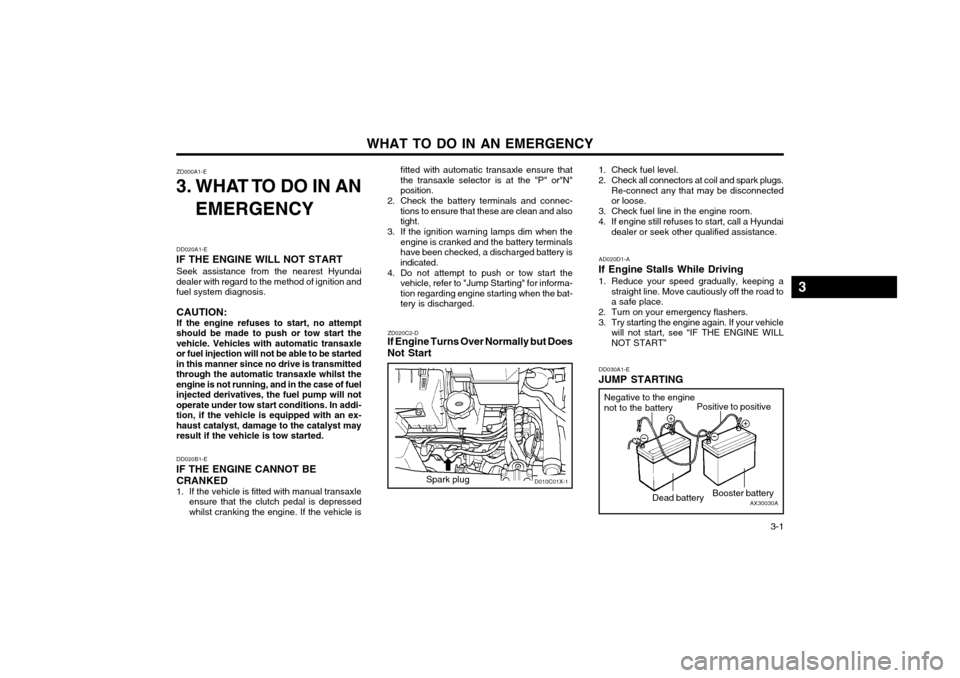
JUMP STARTING
1. Check fuel level.
2. Check all connectors at coil and spark plugs.
Re-connect any that may be disconnected or loose.
3. Check fuel line in the engine room.
4. If engine still refuses to start, call a Hyundai dealer or seek other qualified assistance.
AX30030A
Negative to the enginenot to the battery
Positive to positive
Dead battery Booster battery
D010C01X-1Spark plug
3
Page 203 of 249
WHAT TO DO IN AN EMERGENCY
3-2 3. If coolant is running out under the car or
steam is coming out from under the bonnet stop the engine. Do not open the bonnetuntil the coolant has stopped running or thesteaming has stopped. If there is no visibleloss of coolant and no steam, leave theengine running and check to be sure theengine cooling fan is operating. If the fan isnot running, turn the engine off.
4. Check to see if the water pump drive belt is missing. If it is not missing, check to see thatit is tight. If the drive belt seems to besatisfactory, check for coolant leaking fromthe radiator, hoses or under the car. (If theair conditioner had been in use, it is normalfor cold water to be draining from it).
WARNING: While the engine is running, keep hands andclothing away from moving parts such asthe fan and drive belts to prevent injury.
5. If the water pump drive belt is broken or coolant is leaking out, stop the engine imme-diately and call the nearest Hyundai dealerfor assistance.
WARNING: Do not remove the radiator cap when theengine is hot since steam and boiling watermay be ejected from the radiator resulting inburns or scalding.
CAUTION:
Personal injury and damage to the vehicle
may occur if jump starting is not performedcorrectly. If any doubt exists as to how thisoperation should be performed, seek assis-tance from qualified personnel. WARNING:
Motor vehicle batteries contain sulphuric
acid and emit hydrogen gas. Protective cloth- ing should be worn and care exercised toprevent the acid from coming into contactwith skin or clothing and the vehicle. Nakedlights should not be permitted in the vicinityof the battery. Care should be exercised topreventsparks occurring during connection.If acid accidentally comes into contact withskin or eyes, the affected area should imme-diately be flushed with copious amounts ofwater and medical assistance sought.
1. Ensure that the booster battery is 12 volt type. If the booster battery is installed in another vehicle, ensure that the two vehi-cles are not touching.
2. Turn off all unnecessary electrical equip- ment in both vehicles.
3. Ensure that the engine of the vehicle provid- ing the jump start is running prior to connec-tion of the jump cables.
4. Connect the red jump cable to the positive (+) terminal of the booster battery and theother end to the positive (+) terminal of thedischarged battery. 5. Attach the black jump cable to the negative
(-) terminal of the booster battery, and theother end to a ground point within the enginecompartment of the vehicle with the flat bat-tery. Do not connect to the negative batteryterminal of the flat battery since sparks maybe generated with the subsequent risk ofexplosion.
6. Raise the booster vehicle engine speed to 2,000 r.p.m. and start the engine of thevehicle with the flat battery.
7. Remove jump cables in the reverse order of installation (black cable first).
NOTE: If the jump cable is incorrectly installed, damage to the vehicle electrical system mayoccur, in particular the electronic compo-nents such as the Fuel Injection systemcomputer and the Automatic Transaxle com-puter. The battery must never be discon-nected whilst the engine is running. XD040A1-E
IF THE ENGINE OVERHEATS If the temperature gauge indicates overheating:
1. Pull off the road and stop as soon as it is safe to do so.
2. Place the gear selector lever in "P" (auto- matic), or neutral (manual transaxle, semi- automatic transalxe) and set the parkingbrake. If the air conditioner is on, turn it off.
Page 204 of 249
3-3
WHAT TO DO IN AN EMERGENCY
ZD050B1-E
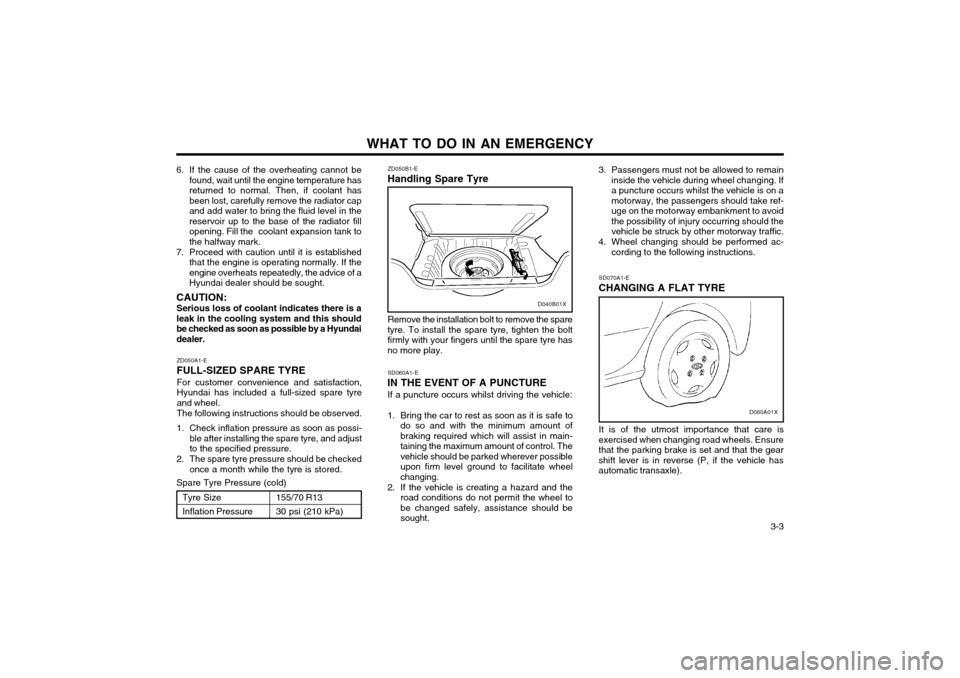
Handling Spare Tyre
6. If the cause of the overheating cannot be
found, wait until the engine temperature has returned to normal. Then, if coolant hasbeen lost, carefully remove the radiator capand add water to bring the fluid level in thereservoir up to the base of the radiator fill
opening. Fill the coolant expansion tank tothe halfway mark.
7. Proceed with caution until it is established that the engine is operating normally. If theengine overheats repeatedly, the advice of aHyundai dealer should be sought.
CAUTION: Serious loss of coolant indicates there is aleak in the cooling system and this shouldbe checked as soon as possible by a Hyundaidealer. 3. Passengers must not be allowed to remain
inside the vehicle during wheel changing. Ifa puncture occurs whilst the vehicle is on amotorway, the passengers should take ref-uge on the motorway embankment to avoidthe possibility of injury occurring should thevehicle be struck by other motorway traffic.
4. Wheel changing should be performed ac- cording to the following instructions.
ZD050A1-E
FULL-SIZED SPARE TYRE For customer convenience and satisfaction,Hyundai has included a full-sized spare tyreand wheel. The following instructions should be observed.
1. Check inflation pressure as soon as possi- ble after installing the spare tyre, and adjust to the specified pressure.
2. The spare tyre pressure should be checked once a month while the tyre is stored.
Spare Tyre Pressure (cold)
D040B01X
Remove the installation bolt to remove the spare
tyre. To install the spare tyre, tighten the bolt firmly with your fingers until the spare tyre hasno more play.
SD060A1-E
IN THE EVENT OF A PUNCTURE
If a puncture occurs whilst driving the vehicle:
1. Bring the car to rest as soon as it is safe to do so and with the minimum amount ofbraking required which will assist in main-taining the maximum amount of control. Thevehicle should be parked wherever possibleupon firm level ground to facilitate wheelchanging.
2. If the vehicle is creating a hazard and the road conditions do not permit the wheel tobe changed safely, assistance should besought. SD070A1-E
CHANGING A FLAT TYRE
D060A01X
It is of the utmost importance that care is
exercised when changing road wheels. Ensure that the parking brake is set and that the gearshift lever is in reverse (P, if the vehicle hasautomatic transaxle).
Tyre Size Inflation Pressure 155/70 R1330 psi (210 kPa)
Page 208 of 249
3-7
WHAT TO DO IN AN EMERGENCY
SD090A1-E
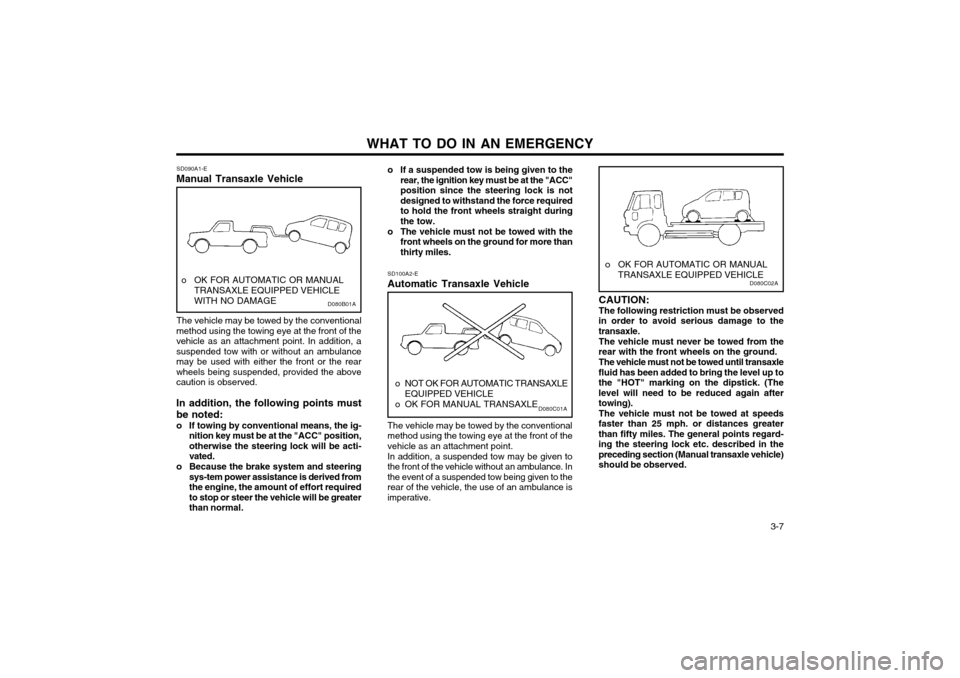
Manual Transaxle Vehicle o If a suspended tow is being given to the
rear, the ignition key must be at the "ACC" position since the steering lock is notdesigned to withstand the force requiredto hold the front wheels straight duringthe tow.
o The vehicle must not be towed with the front wheels on the ground for more thanthirty miles.
D080B01A
o OK FOR AUTOMATIC OR MANUAL
TRANSAXLE EQUIPPED VEHICLE WITH NO DAMAGE
The vehicle may be towed by the conventional
method using the towing eye at the front of the vehicle as an attachment point. In addition, asuspended tow with or without an ambulancemay be used with either the front or the rearwheels being suspended, provided the abovecaution is observed. In addition, the following points must be noted:
o If towing by conventional means, the ig- nition key must be at the "ACC" position, otherwise the steering lock will be acti-vated.
o Because the brake system and steering sys-tem power assistance is derived fromthe engine, the amount of effort requiredto stop or steer the vehicle will be greaterthan normal. SD100A2-E Automatic Transaxle Vehicle
D080C01A
o NOT OK FOR AUTOMATIC TRANSAXLE
EQUIPPED VEHICLE
o OK FOR MANUAL TRANSAXLE
The vehicle may be towed by the conventional method using the towing eye at the front of thevehicle as an attachment point. In addition, a suspended tow may be given to the front of the vehicle without an ambulance. Inthe event of a suspended tow being given to therear of the vehicle, the use of an ambulance isimperative.
D080C02A
o OK FOR AUTOMATIC OR MANUAL TRANSAXLE EQUIPPED VEHICLE
CAUTION: The following restriction must be observed
in order to avoid serious damage to the transaxle.
The vehicle must never be towed from the
rear with the front wheels on the ground.
The vehicle must not be towed until transaxle
fluid has been added to bring the level up tothe "HOT" marking on the dipstick. (Thelevel will need to be reduced again aftertowing). The vehicle must not be towed at speeds
faster than 25 mph. or distances greaterthan fifty miles. The general points regard-ing the steering lock etc. described in thepreceding section (Manual transaxle vehicle)should be observed.
Page 209 of 249
WHAT TO DO IN AN EMERGENCY
3-8 D080D01X-GAT
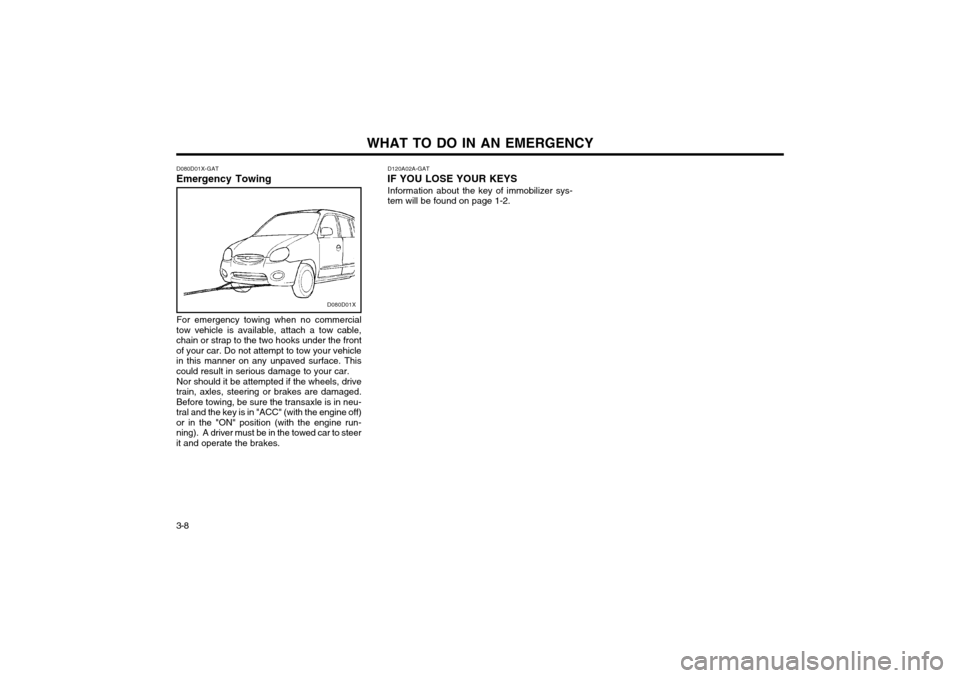
Emergency Towing
D080D01X
For emergency towing when no commercial
tow vehicle is available, attach a tow cable,
chain or strap to the two hooks under the frontof your car. Do not attempt to tow your vehicle
in this manner on any unpaved surface. Thiscould result in serious damage to your car.
Nor should it be attempted if the wheels, drive
train, axles, steering or brakes are damaged.Before towing, be sure the transaxle is in neu-
tral and the key is in "ACC" (with the engine off)or in the "ON" position (with the engine run-ning). A driver must be in the towed car to steer
it and operate the brakes. D120A02A-GAT
IF YOU LOSE YOUR KEYS
Information about the key of immobilizer sys-tem will be found on page 1-2.
Page 212 of 249
VEHICLE MAINTENANCE REQUIREMENTS 5-1
NOTE: The inspection and testing of certain elec-
tronic fuel injection/engine management and automatic transmission control systems re-quire specialised electronic equipment spe-cifically designed for Hyundai vehicles. Theuse of general purpose electrical test equip-ment may result in damage to the controlunit microprocessors. be sure these are equivalent to the quality ofthe original Hyundai parts. Your Service Pass-port provides further information about yourwarranty coverage.
DF020F1-E SERVICE HISTORYIt is important that all scheduled maintenance
services are recorded in the warranty and ser- vice passport to ensure that proof of mainte-nance is available when warranty service isrequired.
DF020A1-E MAINTENANCE AND SERVICING REQUIREMENTS To ensure the continued reliability and safety of
the vehicle, certain routine maintenance opera-tions are required at specific mileage or timeintervals.
It is the responsibility of the vehicle owner to
ensure that the maintenance schedules shownin both this Owners Manual and the Warrantyand Service Passport are adhered to.
The new vehicle warranty may be invalidated if
the routine maintenance operations are notperformed in line with the recommendationsoutlined and the safety and durability of thevehicle adversely affected.
It is recommended that all maintenance opera-
tions with the exception of the daily operatingchecks are entrusted to a Hyundai dealer toensure that the latest repair and maintenanceprocedures and specialized servicing tools areemployed. In addition, the use of genuineHyundai replacement parts will ensure that thevehicle safety and performance will not becompromised. ZF010A1-A
5. VEHICLE MAINTE-
NANCE REQUIRE- MENTS
SF020C1-B Specified Scheduled ProceduresThese are the procedures such as inspections,
adjustments and replacements that are listed in the maintenance charts starting on page 5-2.These procedures must be performed at theintervals shown in the maintenance scheduleto assure that your warranty remains in effect.Although it is strongly recommended that theybe performed by the factory-trained or distribu-tor-trained technicians at your Hyundai dealer,these procedures may be performed at anyqualified service facility.
It is suggested that genuine Hyundai service
parts be used for any required repairs or re-placements. Other parts of equivalent qualitysuch as engine oil, engine coolant, manual orauto transaxle oil, brake fluid and so on whichare not supplied by Hyundai Motor Company orits distributor may be used without affectingyour warranty coverage but you should always
5
Page 213 of 249
VEHICLE MAINTENANCE REQUIREMENTS
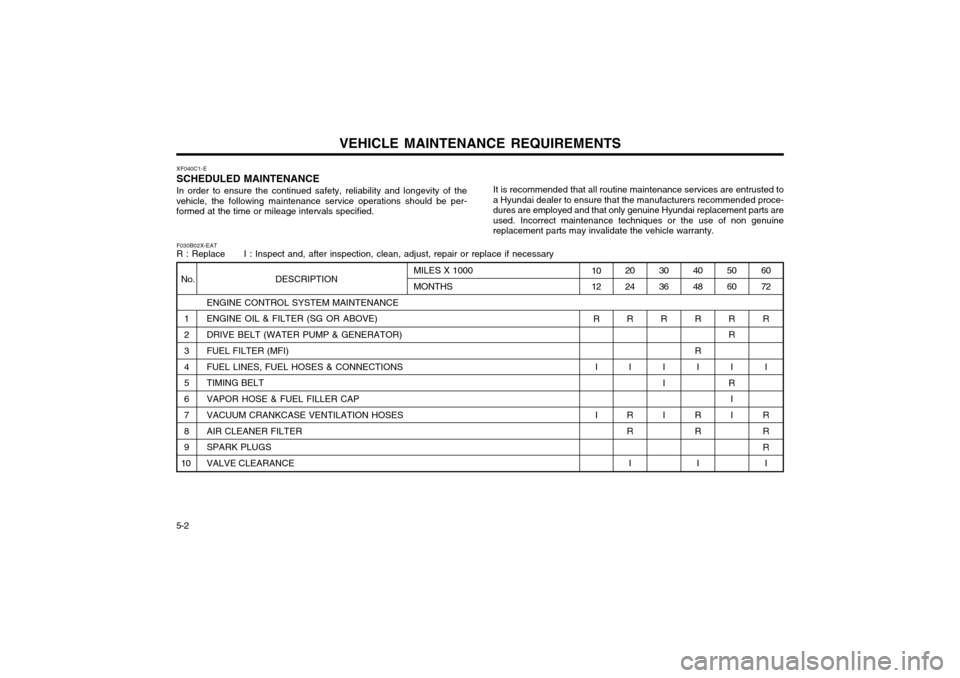
5-2 XF040C1-E SCHEDULED MAINTENANCEIn order to ensure the continued safety, reliability and longevity of the
vehicle, the following maintenance service operations should be per- formed at the time or mileage intervals specified. It is recommended that all routine maintenance services are entrusted to
a Hyundai dealer to ensure that the manufacturers recommended proce-dures are employed and that only genuine Hyundai replacement parts areused. Incorrect maintenance techniques or the use of non genuinereplacement parts may invalidate the vehicle warranty.
F030B02X-EAT R : Replace I : Inspect and, after inspection, clean, adjust, repair or replace if necessary
ENGINE CONTROL SYSTEM MAINTENANCE
1 ENGINE OIL & FILTER (SG OR ABOVE)
2 DRIVE BELT (WATER PUMP & GENERATOR)
3 FUEL FILTER (MFI)
4 FUEL LINES, FUEL HOSES & CONNECTIONS
5 TIMING BELT
6 VAPOR HOSE & FUEL FILLER CAP
7 VACUUM CRANKCASE VENTILATION HOSES
8 AIR CLEANER FILTER
9 SPARK PLUGS
10 VALVE CLEARANCE
No. DESCRIPTION60 72
R
I
R R R I
5060
R R I
R I I
4048
R R I
R R I
1012
R
I I
MILES X 1000 MONTHS30 36
R
II I
20 24
R
I
R R I
Page 214 of 249
VEHICLE MAINTENANCE REQUIREMENTS 5-3
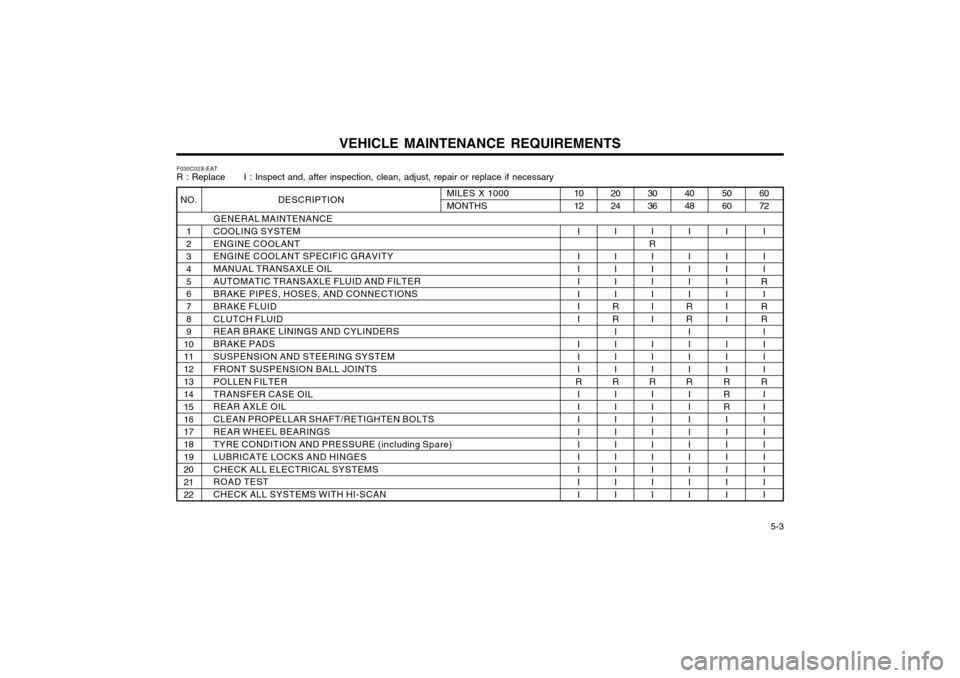
F030C02X-EAT R : Replace I : Inspect and, after inspection, clean, adjust, repair or replace if necessary
DESCRIPTION
GENERAL MAINTENANCE COOLING SYSTEMENGINE COOLANT ENGINE COOLANT SPECIFIC GRAVITY MANUAL TRANSAXLE OILAUTOMATIC TRANSAXLE FLUID AND FILTER BRAKE PIPES, HOSES, AND CONNECTIONS BRAKE FLUIDCLUTCH FLUID REAR BRAKE LININGS AND CYLINDERS BRAKE PADSSUSPENSION AND STEERING SYSTEM FRONT SUSPENSION BALL JOINTS POLLEN FILTERTRANSFER CASE OIL REAR AXLE OIL CLEAN PROPELLAR SHAFT/RETIGHTEN BOLTSREAR WHEEL BEARINGS TYRE CONDITION AND PRESSURE (incl uding Spare)
LUBRICATE LOCKS AND HINGES CHECK ALL ELECTRICAL SYSTEMS ROAD TEST CHECK ALL SYSTEMS WITH HI-SCAN
60 72
I I I
R I
R R
I I II
R
II I II I II I
50 60
I I I II I I I II
RRR III I II I
40 48
I I I II
RR
I I II
R
II I II I II I
30 36
I
R I I II I I I II
R
II I II I II I
20 24
I I I II
RR
I I II
R
II I II I II I
10 12
I I I II I I I II
R
II I II I II I
MILES X 1000 MONTHSNO.
1 2 3 45 6 78 9
1011 1213 14 1516 17 1819 20 2122
Page 215 of 249
VEHICLE MAINTENANCE REQUIREMENTS
5-4 F040A02X-EAT
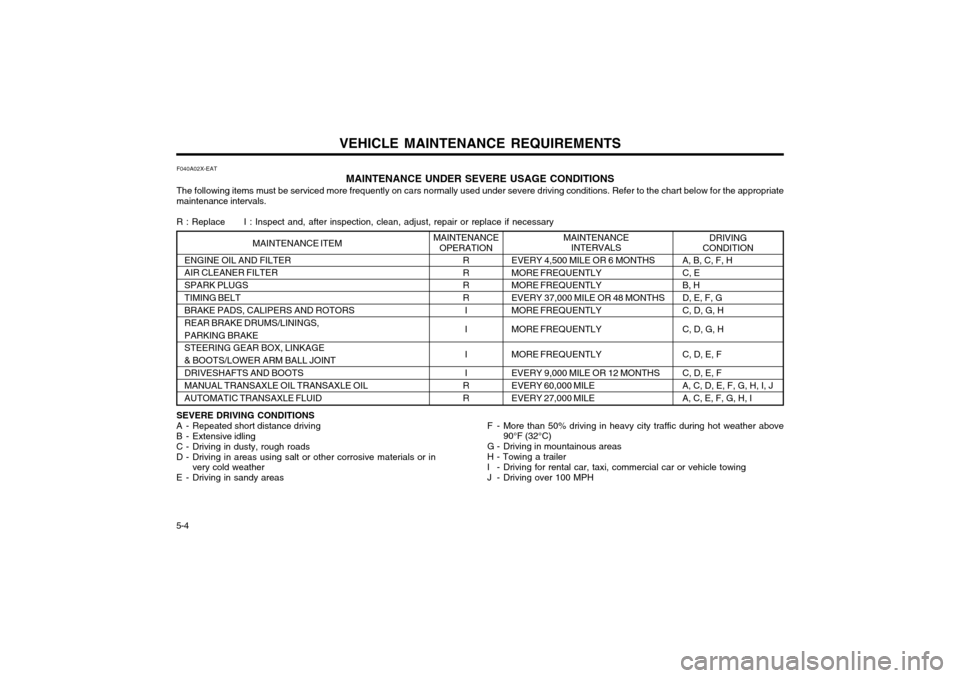
MAINTENANCE UNDER SEVERE USAGE CONDITIONS
The following items must be serviced more frequently on cars normally used under severe driving conditions. Refer to the chart below for the appropriate maintenance intervals. R : Replace I : Inspect and, after inspection, clean, adjust, repair or replace if necessary SEVERE DRIVING CONDITIONS
A - Repeated short distance driving
B - Extensive idling
C - Driving in dusty, rough roads
D - Driving in areas using salt or other corrosive materials or in very cold weather
E - Driving in sandy areas F - More than 50% driving in heavy city traffic during hot weather above
90°F (32°C)
G - Driving in mountainous areasH - Towing a trailer
I - Driving for rental car, taxi, commercial car or vehicle towing
J - Driving over 100 MPH
ENGINE OIL AND FILTER AIR CLEANER FILTER SPARK PLUGSTIMING BELT BRAKE PADS, CALIPERS AND ROTORS REAR BRAKE DRUMS/LININGS,PARKING BRAKE STEERING GEAR BOX, LINKAGE & BOOTS/LOWER ARM BALL JOINTDRIVESHAFTS AND BOOTS MANUAL TRANSAXLE OIL TRANSAXLE OIL AUTOMATIC TRANSAXLE FLUID
DRIVING
CONDITION
MAINTENANCE
INTERVALSMAINTENANCEOPERATION
R R R R
I I I I
R R EVERY 4,500 MILE OR 6 MONTHS MORE FREQUENTLY MORE FREQUENTLY EVERY 37,000 MILE OR 48 MONTHSMORE FREQUENTLY MORE FREQUENTLY MORE FREQUENTLY EVERY 9,000 MILE OR 12 MONTHS EVERY 60,000 MILE EVERY 27,000 MILE
MAINTENANCE ITEM
A, B, C, F, H C, E B, H D, E, F, GC, D, G, H C, D, G, H C, D, E, F C, D, E, F A, C, D, E, F, G, H, I, J A, C, E, F, G, H, I
Page 216 of 249
VEHICLE MAINTENANCE REQUIREMENTS 5-5
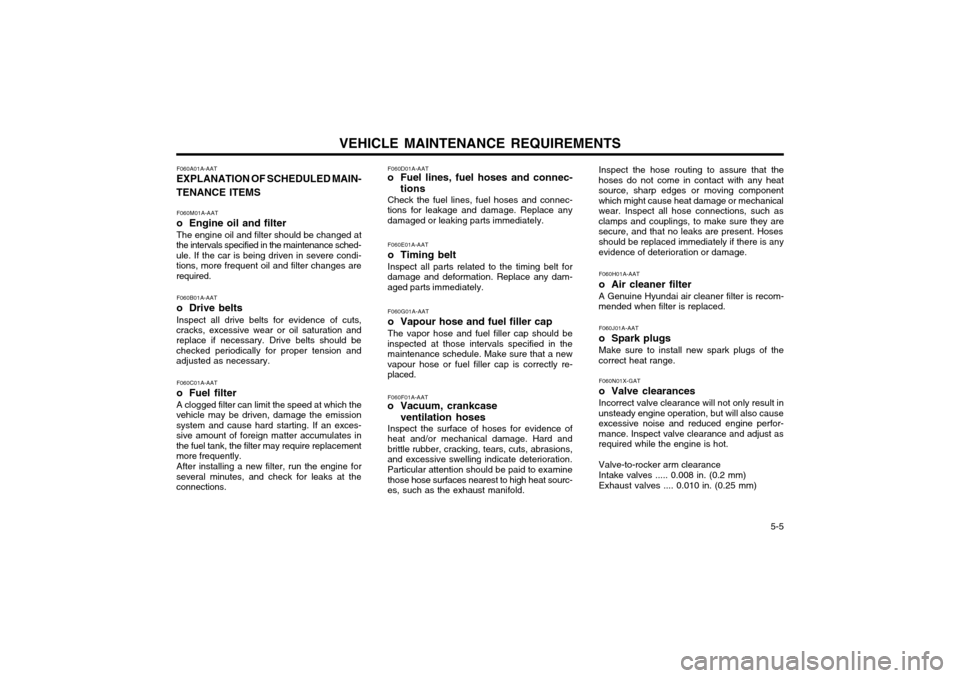
F060A01A-AAT EXPLANATION OF SCHEDULED MAIN-
TENANCE ITEMS
F060M01A-AAT
o Engine oil and filterThe engine oil and filter should be changed at
the intervals specified in the maintenance sched- ule. If the car is being driven in severe condi-tions, more frequent oil and filter changes arerequired.
F060B01A-AAT
o Drive belts Inspect all drive belts for evidence of cuts,
cracks, excessive wear or oil saturation and replace if necessary. Drive belts should be checked periodically for proper tension andadjusted as necessary.
F060C01A-AAT
o Fuel filterA clogged filter can limit the speed at which the
vehicle may be driven, damage the emission system and cause hard starting. If an exces-sive amount of foreign matter accumulates in
the fuel tank, the filter may require replacementmore frequently.
After installing a new filter, run the engine for
several minutes, and check for leaks at theconnections. F060D01A-AAT
o Fuel lines, fuel hoses and connec-
tions
Check the fuel lines, fuel hoses and connec-
tions for leakage and damage. Replace anydamaged or leaking parts immediately.
F060E01A-AAT
o Timing beltInspect all parts related to the timing belt for
damage and deformation. Replace any dam- aged parts immediately.
F060G01A-AAT
o Vapour hose and fuel filler capThe vapor hose and fuel filler cap should be
inspected at those intervals specified in the maintenance schedule. Make sure that a new
vapour hose or fuel filler cap is correctly re-placed.
F060F01A-AAT
o Vacuum, crankcase
ventilation hoses
Inspect the surface of hoses for evidence of
heat and/or mechanical damage. Hard andbrittle rubber, cracking, tears, cuts, abrasions,and excessive swelling indicate deterioration.Particular attention should be paid to examine
those hose surfaces nearest to high heat sourc-
es, such as the exhaust manifold. Inspect the hose routing to assure that the
hoses do not come in contact with any heatsource, sharp edges or moving component
which might cause heat damage or mechanicalwear. Inspect all hose connections, such as
clamps and couplings, to make sure they aresecure, and that no leaks are present. Hoses
should be replaced immediately if there is any
evidence of deterioration or damage.
F060H01A-AAT
o Air cleaner filter A Genuine Hyundai air cleaner filter is recom-
mended when filter is replaced.
F060J01A-AAT
o Spark plugsMake sure to install new spark plugs of the
correct heat range.
F060N01X-GAT
o Valve clearances Incorrect valve clearance will not only result in
unsteady engine operation, but will also cause excessive noise and reduced engine perfor-mance. Inspect valve clearance and adjust asrequired while the engine is hot.
Valve-to-rocker arm clearance Intake valves ..... 0.008 in. (0.2 mm)Exhaust valves .... 0.010 in. (0.25 mm)