engine Hyundai Atos 2002 Repair Manual
[x] Cancel search | Manufacturer: HYUNDAI, Model Year: 2002, Model line: Atos, Model: Hyundai Atos 2002Pages: 249, PDF Size: 3.11 MB
Page 119 of 249
CONSUMER INFORMATION
CONSUMER INFORMATION CONSUMER INFORMATION
CONSUMER INFORMATION
CONSUMER INFORMATION
8-1
I010B01A-AAT
Engine Number
Engine Number Engine Number
Engine Number
Engine Number
8.8.
8.8.
8.
CONSUMER IN-
CONSUMER IN- CONSUMER IN-
CONSUMER IN-
CONSUMER IN-
FORMA
FORMA FORMA
FORMA
FORMA
TION
TION TION
TION
TION
I010A01A-GAT VEHICLE IDENTIFICATION NUMBER
VEHICLE IDENTIFICATION NUMBER VEHICLE IDENTIFICATION NUMBER
VEHICLE IDENTIFICATION NUMBER
VEHICLE IDENTIFICATION NUMBER
(VIN)
(VIN) (VIN)
(VIN)
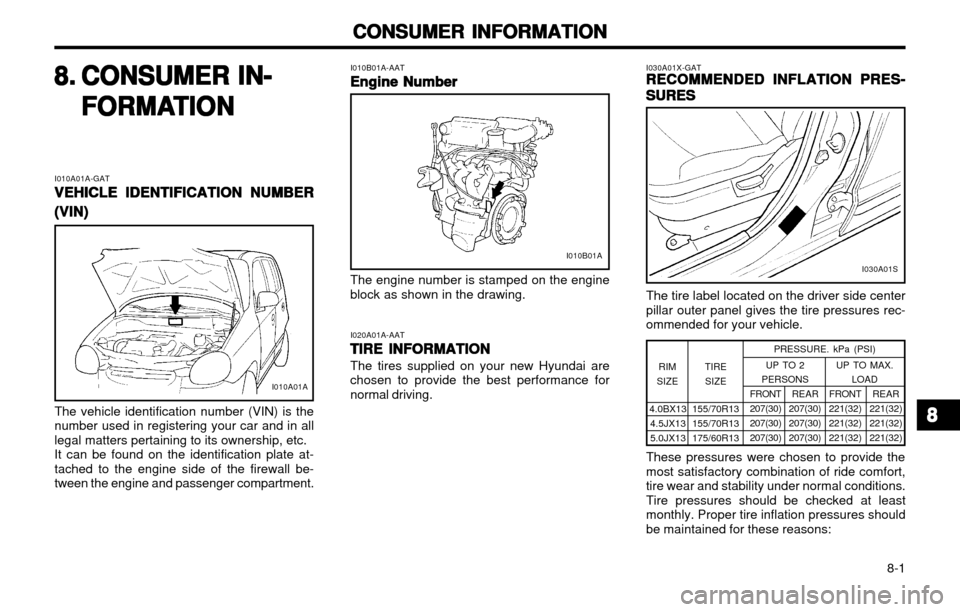
(VIN) The vehicle identification number (VIN) is the number used in registering your car and in alllegal matters pertaining to its ownership, etc.It can be found on the identification plate at-tached to the engine side of the firewall be-tween the engine and passenger compartment. The engine number is stamped on the engineblock as shown in the drawing. I020A01A-AAT
TIRE INFORMATION
TIRE INFORMATION TIRE INFORMATION
TIRE INFORMATION
TIRE INFORMATION The tires supplied on your new Hyundai are chosen to provide the best performance fornormal driving. I030A01X-GAT
RECOMMENDED INFLATION PRES-
RECOMMENDED INFLATION PRES- RECOMMENDED INFLATION PRES-
RECOMMENDED INFLATION PRES-
RECOMMENDED INFLATION PRES-
SURES
SURES SURES
SURES
SURES The tire label located on the driver side center pillar outer panel gives the tire pressures rec-ommended for your vehicle.
I010A01A
I010B01AI030A01S
88
88
84.0BX13
4.5JX13 5.0JX13 TIRE
SIZE PRESSURE. kPa (PSI)
155/70R13155/70R13175/60R13 REAR
207(30)207(30)207(30) FRONT
221(32)221(32) 221(32)
UP TO 2
PERSONS UP TO MAX.
LOAD
REAR
221(32) 221(32) 221(32)
FRONT 207(30)207(30)207(30)
RIM
SIZE
These pressures were chosen to provide the most satisfactory combination of ride comfort,tire wear and stability under normal conditions.Tire pressures should be checked at leastmonthly. Proper tire inflation pressures shouldbe maintained for these reasons:
Page 123 of 249
VEHICLE SPECIFICATIONS
VEHICLE SPECIFICATIONS VEHICLE SPECIFICATIONS
VEHICLE SPECIFICATIONS
VEHICLE SPECIFICATIONS
9-2
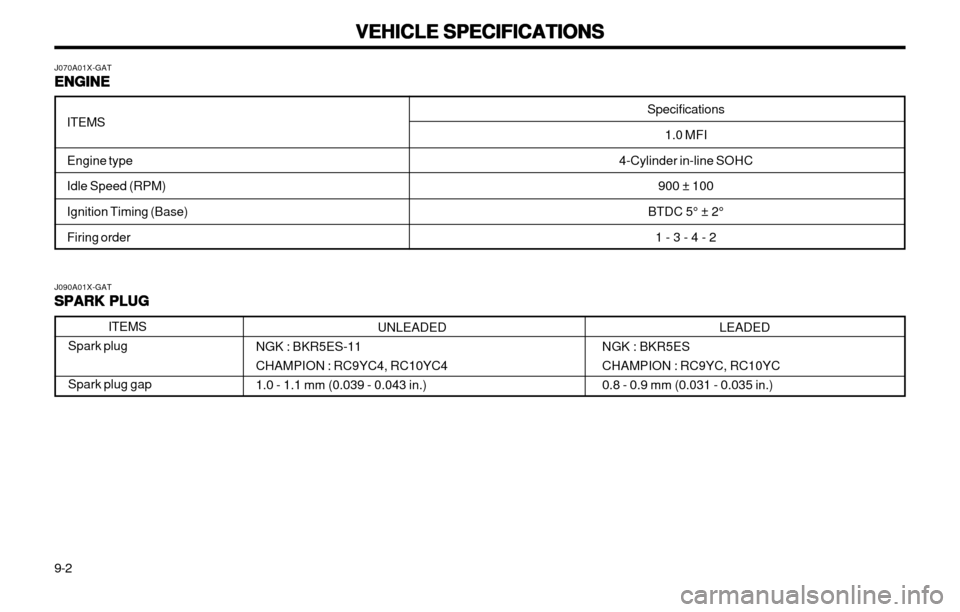
J090A01X-GAT SPARK PLUG
SPARK PLUG SPARK PLUG
SPARK PLUG
SPARK PLUG
ITEMS
Spark plug Spark plug gap
UNLEADED
NGK : BKR5ES-11 CHAMPION : RC9YC4, RC10YC41.0 - 1.1 mm (0.039 - 0.043 in.) LEADED
NGK : BKR5ESCHAMPION : RC9YC, RC10YC0.8 - 0.9 mm (0.031 - 0.035 in.)
J070A01X-GAT
ENGINE
ENGINE ENGINE
ENGINE
ENGINE
ITEMS Engine type Idle Speed (RPM) Ignition Timing (Base) Firing order Specifications
1.0 MFI
4-Cylinder in-line SOHC
900 ± 100
BTDC 5° ± 2° 1 - 3 - 4 - 2
Page 124 of 249
VEHICLE SPECIFICATIONS
VEHICLE SPECIFICATIONS VEHICLE SPECIFICATIONS
VEHICLE SPECIFICATIONS
VEHICLE SPECIFICATIONS
9-3
Oil & Coolant Standard
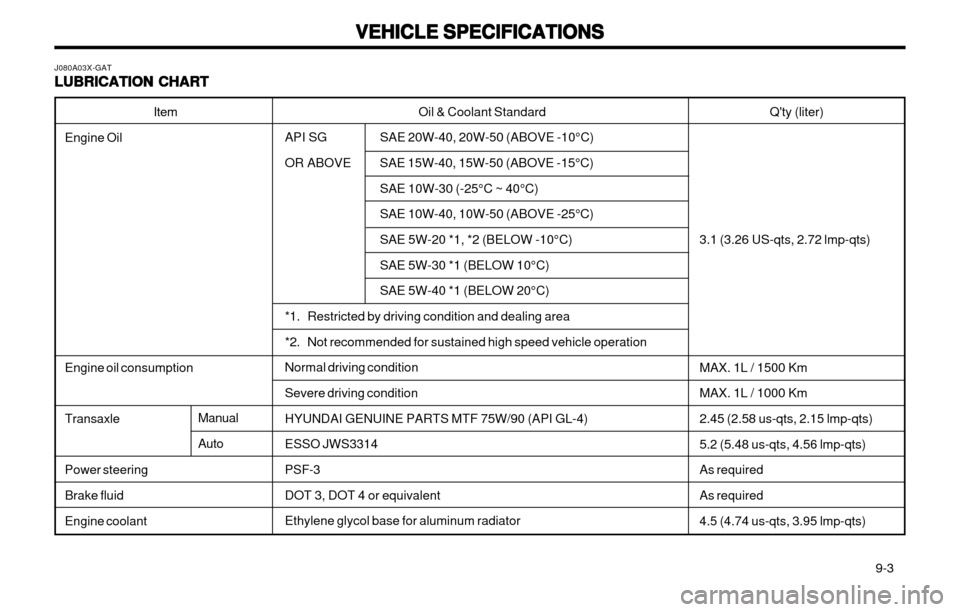
API SG SAE 20W-40, 20W-50 (ABOVE -10°C)
OR ABOVE SAE 15W-40, 15W-50 (ABOVE -15°C) SAE 10W-30 (-25°C ~ 40°C) SAE 10W-40, 10W-50 (ABOVE -25°C) SAE 5W-20 *1, *2 (BELOW -10°C) SAE 5W-30 *1 (BELOW 10°C)SAE 5W-40 *1 (BELOW 20°C)
*1. Restricted by driving condition and dealing area
*2. Not recommended for sustained high speed vehicle operationNormal driving condition Severe driving condition HYUNDAI GENUINE PARTS MTF 75W/90 (API GL-4)ESSO JWS3314 PSF-3 DOT 3, DOT 4 or equivalentEthylene glycol base for aluminum radiator
Item
Engine Oil Engine oil consumption Transaxle Power steering Brake fluid Engine coolant Q'ty (liter)
3.1 (3.26 US-qts, 2.72 lmp-qts) MAX. 1L / 1500 Km MAX. 1L / 1000 Km2.45 (2.58 us-qts, 2.15 lmp-qts) 5.2 (5.48 us-qts, 4.56 lmp-qts) As requiredAs required 4.5 (4.74 us-qts, 3.95 lmp-qts)
J080A03X-GAT LUBRICATION CHART
LUBRICATION CHART LUBRICATION CHART
LUBRICATION CHART
LUBRICATION CHART
Manual Auto
Page 126 of 249
INDEX
INDEX INDEX
INDEX
INDEX
10-2 EE
EE
E
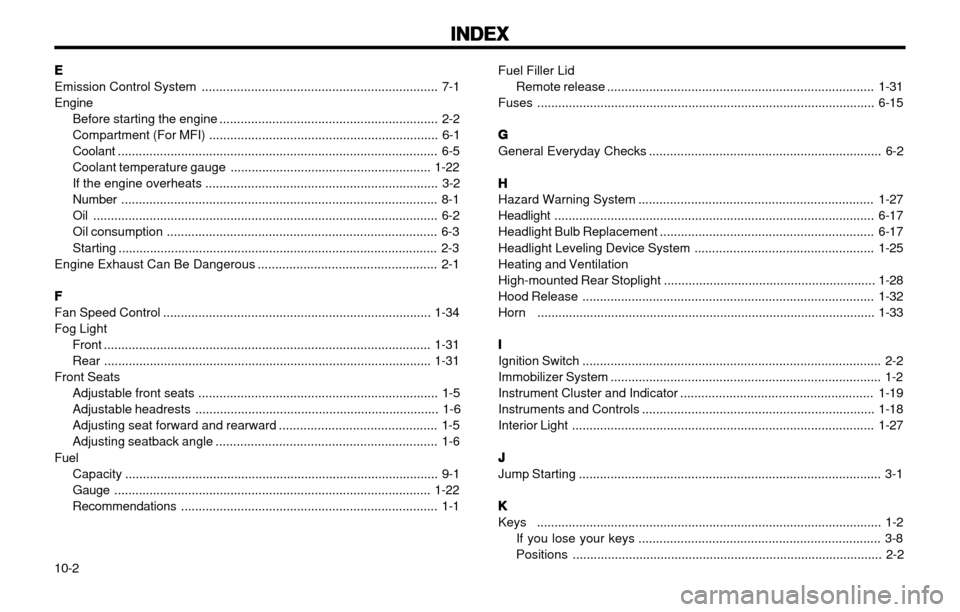
Emission Control System ................................................................... 7-1Engine
Before starting the engine .............................................................. 2-2
Compartment (For MFI) ................................................................. 6-1 Coolant ........................................................................................... 6-5
Coolant temperature gauge ......................................................... 1-22
If the engine overheats .................................................................. 3-2 Number .......................................................................................... 8-1
Oil .................................................................................................. 6-2
Oil consumption ............................................................................. 6-3
Starting ........................................................................................... 2-3
Engine Exhaust Can Be Dangerous ................................................... 2-1
FF
FF
F
Fan Speed Control ............................................................................ 1-34
Fog Light
Front ............................................................................................. 1-31
Rear ............................................................................................. 1-31
Front Seats Adjustable front seats .................................................................... 1-5
Adjustable headrests ..................................................................... 1-6
Adjusting seat forward and rearward ............................................. 1-5
Adjusting seatback angle ............................................................... 1-6
Fuel Capacity ......................................................................................... 9-1Gauge .......................................................................................... 1-22
Recommendations ......................................................................... 1-1 Fuel Filler Lid
Remote release ............................................................................ 1-31
Fuses ................................................................................................ 6-15
GG
GG
G
General Everyday Checks .................................................................. 6-2
HH
HH
H
Hazard Warning System ................................................................... 1-27
Headlight ........................................................................................... 6-17
Headlight Bulb Replacement ............................................................. 6-17
Headlight Leveling Device System ................................................... 1-25
Heating and Ventilation
High-mounted Rear Stoplight ............................................................ 1-28
Hood Release ................................................................................... 1-32
Horn ................................................................................................ 1-33
II
II
I
Ignition Switch ..................................................................................... 2-2
Immobilizer System ............................................................................. 1-2
Instrument Cluster and Indicator ....................................................... 1-19
Instruments and Controls .................................................................. 1-18
Interior Light ...................................................................................... 1-27
JJ
JJ
J
Jump Starting ...................................................................................... 3-1
KK
KK
K
Keys .................................................................................................. 1-2
If you lose your keys ..................................................................... 3-8
Positions ........................................................................................ 2-2
Page 133 of 249
A040A01A-EATFOREWORD
Hyundai Motor Company wish to take this opportunity to thank you for purchasing a Hyundai product and to welcome
you to the ever increasing number of discriminating motorists who drive Hyundai vehicles. The advanced engineering and construction methods employed during both design and production of the Hyundai marque are something ofwhich we are proud, and this commitment to providing a high quality product is supported by a comprehensive aftersales and warranty service of which we are equally proud.
This owners manual will introduce the operating and maintenance requirements for the vehicle and it is recommended
that it is carefully read to ensure that the maximum performance and durability along with safe and satisfactoryoperation are obtained. The recommended routine maintenance servicing along with any running repairs that maybe required should be entrusted to a franchised Hyundai dealer to ensure that only the latest methods and genuineHyundai replacement parts are used for the continued reliability, safety and performance of the vehicle.
Should any question or query exist regarding any aspect of your Hyundai please contact the nearest Hyundai dealer
who will be only too pleased to assist wherever possible.
Note: This owners manual should be considered as part of the vehicle and should be kept in the vehicle at all times
for ease of reference.
In the event of the vehicle being sold please ensure that this manual is left in the vehicle for the reference of the
new owner.
CAUTION: Severe engine and transaxle damage may result from the use of poor quality fuels and lubricants
that do not meet Hyundai specifications. You must always use high quality fuels and lubricants that meet the specifications listed on Page 9-3 in the Vehicle Specifications section of the Owner's Manual.
Copyright 2002 Hyundai Motor Company. All rights reserved. The material in this manual may not be reproduced
in any form without written permission from Hyundai Motor Company.
Page 137 of 249
A100A01L-EAT
Guide to Hyundai Genuine Parts
1. What are Hyundai Genuine Parts? Hyundai Genuine Parts are the same parts used by Hyundai Motor Company to manu-facture vehicles. They are designed andtested for the optimum safety, performance,and reliability to our customers.
2. Why should you use genuine parts? Hyundai Genuine Parts are engineered andbuilt to meet rigid original manufacturing re-quirements. Using imitation, counterfeit orused salvage parts is not covered under the Hyundai New Vehicle Limited Warranty orany other Hyundai warranty. In addition,any damage to or failure of Genuine HyundaiParts caused by the installation or failure ofan imitation, counterfeit or used salvagepart is not covered by Hyundai Motor Com-pany.
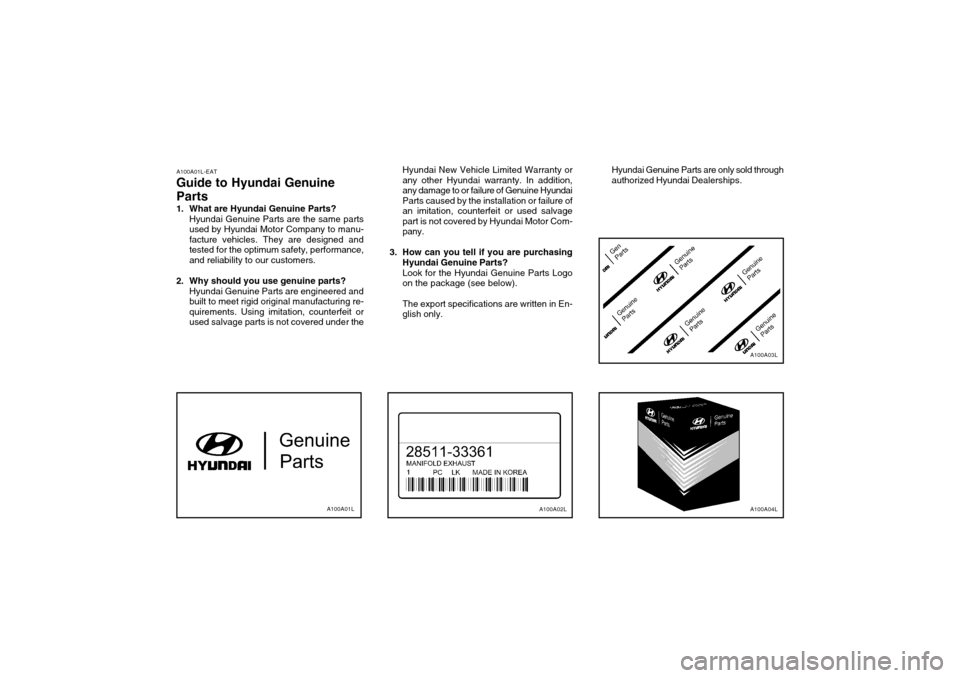
3. How can you tell if you are purchasing Hyundai Genuine Parts? Look for the Hyundai Genuine Parts Logo on the package (see below). The export specifications are written in En- glish only. Hyundai Genuine Parts are only sold throughauthorized Hyundai Dealerships.
A100A01LA100A02LA100A04L
A100A03L
Page 138 of 249
FEATURES OF YOUR HYUNDAI 1-1
ZB000A1-A
1. FEATURES OF
YOUR HYUNDAI cised when charging the vehicle tank from jerry cans or by means of a funnel that the fuel beingused is unleaded.
The use of leaded fuel in this vehicle will result
in irreversible pollution of the catalyst element.Such pollution will prevent correct operation ofthe catalyst and give rise to increased operat-ing temperatures leading to the catalyst ele-ment melting and restricting the exhaust flowalong with an increase in exhaust emissionlevels.
CAUTION: The vehicle warranty will not extend to dam-
age arising from the use of incorrect fuels.
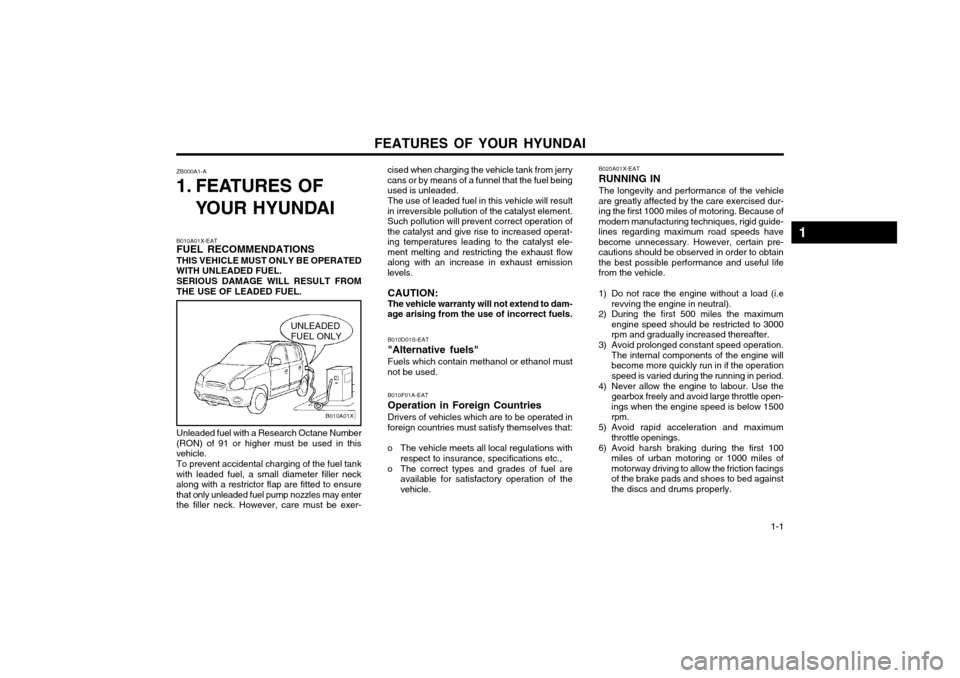
Unleaded fuel with a Research Octane Number
(RON) of 91 or higher must be used in this vehicle.
To prevent accidental charging of the fuel tank
with leaded fuel, a small diameter filler neckalong with a restrictor flap are fitted to ensurethat only unleaded fuel pump nozzles may enterthe filler neck. However, care must be exer-
B010A01X
UNLEADED FUEL ONLY
B010A01X-EAT FUEL RECOMMENDATIONS THIS VEHICLE MUST ONLY BE OPERATED
WITH UNLEADED FUEL.
SERIOUS DAMAGE WILL RESULT FROM
THE USE OF LEADED FUEL. B020A01X-EAT RUNNING INThe longevity and performance of the vehicle
are greatly affected by the care exercised dur- ing the first 1000 miles of motoring. Because ofmodern manufacturing techniques, rigid guide-lines regarding maximum road speeds havebecome unnecessary. However, certain pre-cautions should be observed in order to obtainthe best possible performance and useful lifefrom the vehicle.
1) Do not race the engine without a load (i.e revving the engine in neutral).
2) During the first 500 miles the maximum engine speed should be restricted to 3000 rpm and gradually increased thereafter.
3) Avoid prolonged constant speed operation. The internal components of the engine willbecome more quickly run in if the operationspeed is varied during the running in period.
4) Never allow the engine to labour. Use the gearbox freely and avoid large throttle open-ings when the engine speed is below 1500rpm.
5) Avoid rapid acceleration and maximum throttle openings.
6) Avoid harsh braking during the first 100 miles of urban motoring or 1000 miles ofmotorway driving to allow the friction facingsof the brake pads and shoes to bed againstthe discs and drums properly.
B010D01S-EAT "Alternative fuels"Fuels which contain methanol or ethanol must
not be used.
B010F01A-EATOperation in Foreign CountriesDrivers of vehicles which are to be operated in
foreign countries must satisfy themselves that:
o The vehicle meets all local regulations with respect to insurance, specifications etc.,
o The correct types and grades of fuel are available for satisfactory operation of the vehicle.
1
Page 139 of 249
FEATURES OF YOUR HYUNDAI
1-2
B010E01A-AAT GASOLINES FOR CLEANER AIRTo help contribute to cleaner air, Hyundai rec-
ommends that you use gasolines treated with detergent additives, which help to prevent de-posit formation in the engine. These gasolineswill help the engines run cleaner and the Emis-sion Control System performance.
B880A01A-EAT IMMOBILIZER SYSTEMThe immobilizer system is an anti-theft device,
designed to prevent and deter automobile theft.
B880B03A-GATKeys
B880B01O
All of the locks fitted to the vehicle are operated
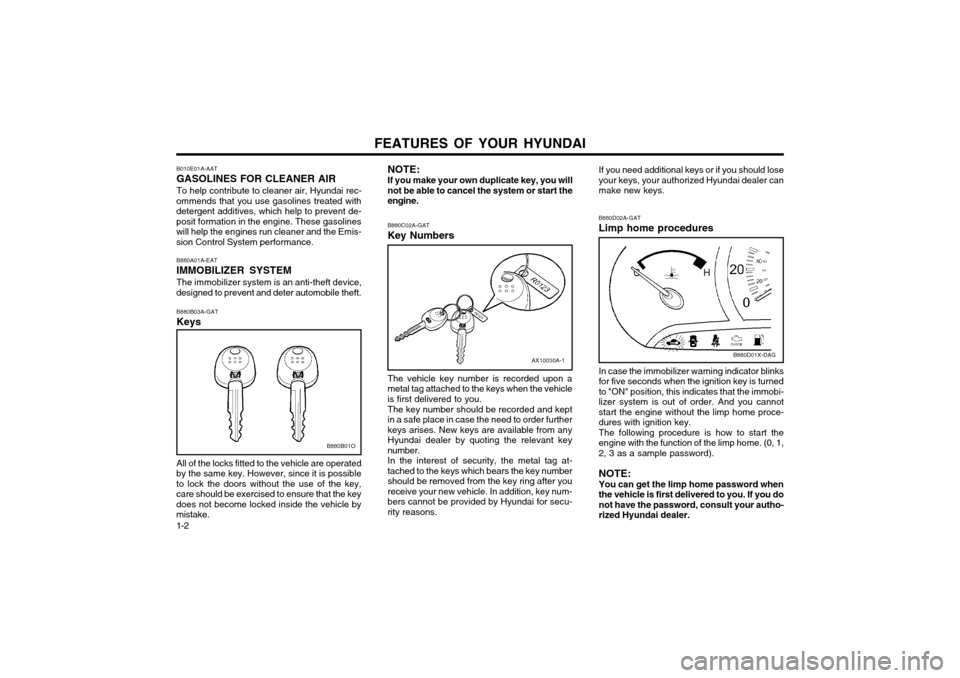
by the same key. However, since it is possible to lock the doors without the use of the key,care should be exercised to ensure that the keydoes not become locked inside the vehicle bymistake. B880C02A-GAT Key Numbers
AX10030A-1
The vehicle key number is recorded upon a metal tag attached to the keys when the vehicleis first delivered to you. The key number should be recorded and kept in a safe place in case the need to order furtherkeys arises. New keys are available from anyHyundai dealer by quoting the relevant keynumber.In the interest of security, the metal tag at-tached to the keys which bears the key numbershould be removed from the key ring after youreceive your new vehicle. In addition, key num-bers cannot be provided by Hyundai for secu-rity reasons.
NOTE: If you make your own duplicate key, you will not be able to cancel the system or start theengine. If you need additional keys or if you should loseyour keys, your authorized Hyundai dealer canmake new keys. B880D02A-GAT Limp home procedures
B880D01X-DAG
In case the immobilizer warning indicator blinks for five seconds when the ignition key is turnedto "ON" position, this indicates that the immobi-lizer system is out of order. And you cannotstart the engine without the limp home proce-dures with ignition key.The following procedure is how to start theengine with the function of the limp home. (0, 1,2, 3 as a sample password). NOTE: You can get the limp home password when the vehicle is first delivered to you. If you donot have the password, consult your autho-rized Hyundai dealer.
Page 140 of 249
FEATURES OF YOUR HYUNDAI 1-3
CAUTION:
o If you fail to try the limp home procedure with the sequence of three times, you have to wait for about one hour to do thelimp home procedure again.
o If you cannot start your engine in spite of limp home procedure, have your vehicletowed by an authorized Hyundai dealer.
1. To set the password you may turn the igni-
tion key "ON" and then turn it "OFF" accord-ing to the digit numbers, then the immobi-lizer indicator will blink along with the opera-tion of the ignition key. For example, turn theignition key once for digit number "1", andtwice for "2", and so on. However, for thedigit number "0", you must turn the ignitionkey for 10 times.
2. Wait for 3~10 seconds.
3. You may set the remaining number of digits by following the same procedures 1 and 2.
4. If all of four digits have been tried success- fully, turn the ignition key "ON" and check that the immobilizer indicator illuminates.From this time, you have to start your enginewithin 30 seconds. If you start your engineafter 30 seconds, your engine will not start.
NOTE: If the engine dies while driving after limp
home procedure, you can start your engine within 8 seconds without limp home proce-dure again.
5. If the immobilizer indicator blinks for five seconds, you have to try the limp home procedure again from the beginning.
After doing the limp home procedure, you have
to consult with your authorized Hyundai dealeras soon as possible. SB040A1-F DOOR LOCKS WARNING:
o Unlocked doors can be dangerous. Before you drive away-especially if there are children in the car-be sure that all thedoors are securely closed and locked, the doors cannot be opened from inside. This helps assure that doors will not beopened accidentally. Also, when com-bined with the proper use of seat belts,locking the doors helps keep occupantsfrom being ejected from the car in caseof an accident.
o Before opening the door, always look for and avoid oncoming traffic.
XV10050E
Unlock Lock
SB040B1-F Locking, unlocking front doors with key
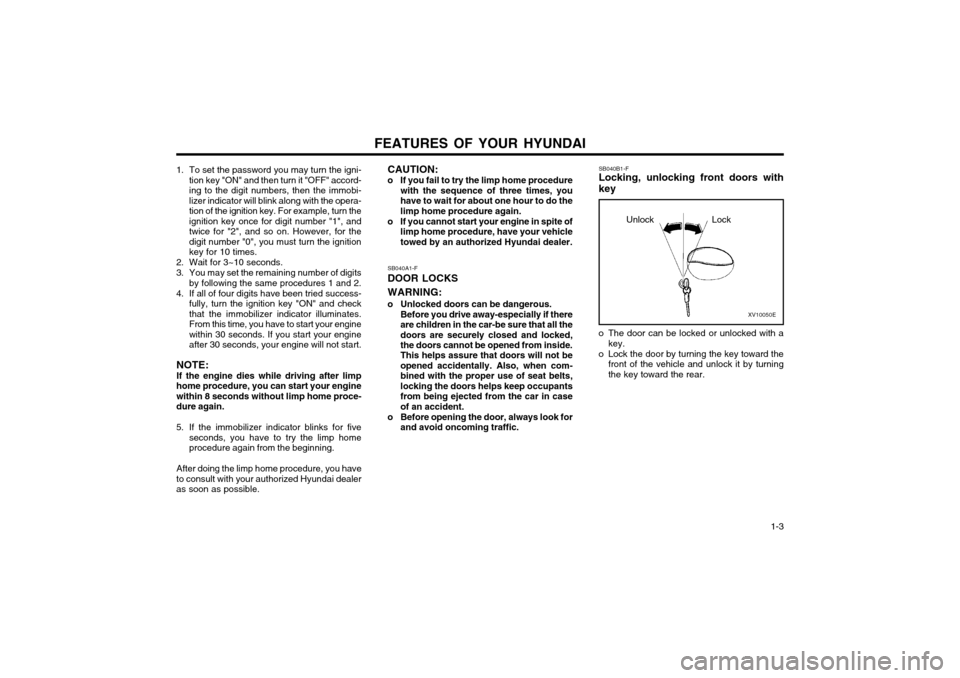
o The door can be locked or unlocked with a key.
o Lock the door by turning the key toward the front of the vehicle and unlock it by turning the key toward the rear.
Page 150 of 249
FEATURES OF YOUR HYUNDAI 1-13
B240C01X
Rear impact
Side impact Rollover
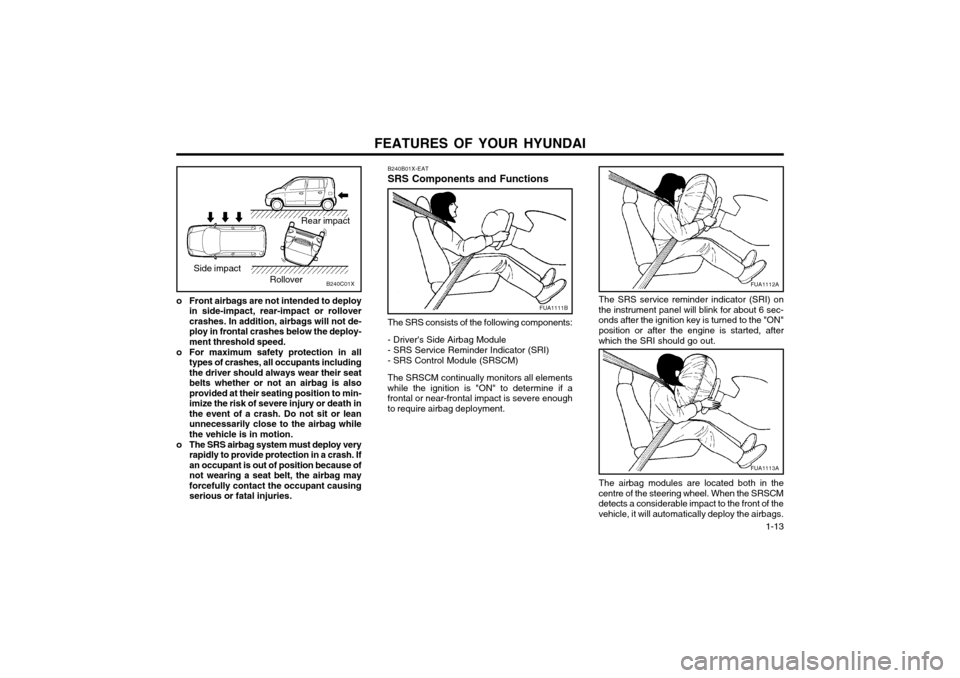
o Front airbags are not intended to deploy in side-impact, rear-impact or rollover crashes. In addition, airbags will not de-ploy in frontal crashes below the deploy-ment threshold speed.
o For maximum safety protection in all types of crashes, all occupants includingthe driver should always wear their seatbelts whether or not an airbag is alsoprovided at their seating position to min-imize the risk of severe injury or death inthe event of a crash. Do not sit or leanunnecessarily close to the airbag whilethe vehicle is in motion.
o The SRS airbag system must deploy very rapidly to provide protection in a crash. Ifan occupant is out of position because ofnot wearing a seat belt, the airbag mayforcefully contact the occupant causingserious or fatal injuries. B240B01X-EAT SRS Components and Functions The SRS consists of the following components: - Driver's Side Airbag Module - SRS Service Reminder Indicator (SRI)- SRS Control Module (SRSCM) The SRSCM continually monitors all elements
while the ignition is "ON" to determine if a frontal or near-frontal impact is severe enough
to require airbag deployment.
FUA1111B The SRS service reminder indicator (SRI) on
the instrument panel will blink for about 6 sec- onds after the ignition key is turned to the "ON"
position or after the engine is started, after
which the SRI should go out.
The airbag modules are located both in the
centre of the steering wheel. When the SRSCMdetects a considerable impact to the front of thevehicle, it will automatically deploy the airbags.
FUA1113A
FUA1112A