ECU Hyundai Atos 2002 User Guide
[x] Cancel search | Manufacturer: HYUNDAI, Model Year: 2002, Model line: Atos, Model: Hyundai Atos 2002Pages: 249, PDF Size: 3.11 MB
Page 84 of 249
WHAT TO DO IN AN EMERGENCY
WHAT TO DO IN AN EMERGENCY WHAT TO DO IN AN EMERGENCY
WHAT TO DO IN AN EMERGENCY
WHAT TO DO IN AN EMERGENCY
3-7
D060J01FC-GAT
After Changing Wheels
After Changing Wheels After Changing Wheels
After Changing Wheels
After Changing Wheels
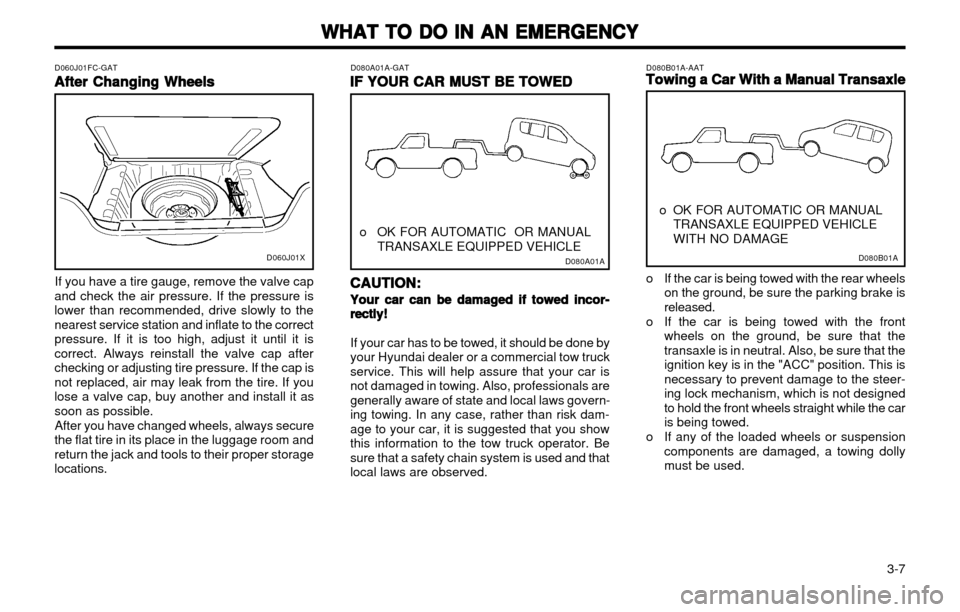
If you have a tire gauge, remove the valve cap
and check the air pressure. If the pressure is lower than recommended, drive slowly to thenearest service station and inflate to the correctpressure. If it is too high, adjust it until it iscorrect. Always reinstall the valve cap afterchecking or adjusting tire pressure. If the cap isnot replaced, air may leak from the tire. If youlose a valve cap, buy another and install it assoon as possible.
After you have changed wheels, always secure
the flat tire in its place in the luggage room andreturn the jack and tools to their proper storagelocations. D080A01A-GAT
IF YOUR CAR MUST BE TOWED
IF YOUR CAR MUST BE TOWED IF YOUR CAR MUST BE TOWED
IF YOUR CAR MUST BE TOWED
IF YOUR CAR MUST BE TOWED D080B01A-AAT
Towing a Car With a Manual Transaxle
Towing a Car With a Manual Transaxle Towing a Car With a Manual Transaxle
Towing a Car With a Manual Transaxle
Towing a Car With a Manual Transaxle
o OK FOR AUTOMATIC OR MANUAL TRANSAXLE EQUIPPED VEHICLE WITH NO DAMAGE
o OK FOR AUTOMATIC OR MANUAL
TRANSAXLE EQUIPPED VEHICLE
CAUTION:
CAUTION: CAUTION:
CAUTION:
CAUTION:
Your car can be damaged if towed incor-
Your car can be damaged if towed incor- Your car can be damaged if towed incor-
Your car can be damaged if towed incor-
Your car can be damaged if towed incor-
rectly!
rectly! rectly!
rectly!
rectly!
If your car has to be towed, it should be done by
your Hyundai dealer or a commercial tow truck service. This will help assure that your car isnot damaged in towing. Also, professionals aregenerally aware of state and local laws govern-ing towing. In any case, rather than risk dam-age to your car, it is suggested that you showthis information to the tow truck operator. Besure that a safety chain system is used and thatlocal laws are observed. o If the car is being towed with the rear wheels
on the ground, be sure the parking brake isreleased.
o If the car is being towed with the front wheels on the ground, be sure that thetransaxle is in neutral. Also, be sure that theignition key is in the "ACC" position. This isnecessary to prevent damage to the steer-ing lock mechanism, which is not designedto hold the front wheels straight while the caris being towed.
o If any of the loaded wheels or suspension components are damaged, a towing dollymust be used.
D080A01AD080B01AD060J01X
Page 94 of 249
VEHICLE MAINTENANCE REQUIREMENTS
VEHICLE MAINTENANCE REQUIREMENTS VEHICLE MAINTENANCE REQUIREMENTS
VEHICLE MAINTENANCE REQUIREMENTS
VEHICLE MAINTENANCE REQUIREMENTS
5-5
F060A01A-AAT
EXPLANATION OF SCHEDULED MAIN-
EXPLANATION OF SCHEDULED MAIN- EXPLANATION OF SCHEDULED MAIN-
EXPLANATION OF SCHEDULED MAIN-
EXPLANATION OF SCHEDULED MAIN-
TENANCE ITEMS
TENANCE ITEMS TENANCE ITEMS
TENANCE ITEMS
TENANCE ITEMS
F060M01A-AAToo
oo
o Engine oil and filter
Engine oil and filter Engine oil and filter
Engine oil and filter
Engine oil and filter
The engine oil and filter should be changed at
the intervals specified in the maintenance sched- ule. If the car is being driven in severe condi-tions, more frequent oil and filter changes arerequired.
F060B01A-AAToo
oo
o
Drive belts
Drive belts Drive belts
Drive belts
Drive belts
Inspect all drive belts for evidence of cuts,
cracks, excessive wear or oil and replace ifnecessary. Drive belts should be checked pe-
riodically for proper tension and adjusted asnecessary.
F060C01A-GAToo
oo
o Fuel filter
Fuel filter Fuel filter
Fuel filter
Fuel filter
A clogged filter can limit the speed at which the
vehicle may be driven, damage the emissionsystem and cause hard starting. If an exces-sive amount of foreign matter accumulates inthe fuel tank, the filter may require replacementmore frequently.
After installing a new filter, run the engine for
several minutes, and check for leaks at theconnections. F060D01A-GAT
oo
oo
o
Fuel lines, fuel hoses and connec-
Fuel lines, fuel hoses and connec- Fuel lines, fuel hoses and connec-
Fuel lines, fuel hoses and connec-
Fuel lines, fuel hoses and connec-
tions
tions tions
tions
tions
Check the fuel lines, fuel hoses and connec-
tions for leakage and damage. Replace anydamaged or leaking parts immediately. Inspect the hose routing to assure that the
hoses do not come in contact with any heatsource, sharp edges or moving componentwhich might cause heat damage or mechanicalwear. Inspect all hose connections, such as
clamps and couplings, to make sure they aresecure, and that no leaks are present. Hoses
should be replaced immediately if there is any
evidence of deterioration or damage.
F060H01A-AAToo
oo
o
Air cleaner filter
Air cleaner filter Air cleaner filter
Air cleaner filter
Air cleaner filter
A Genuine Hyundai air cleaner filter is recom-
mended when filter is replaced.
F060J01A-AAToo
oo
o
Spark plugs
Spark plugs Spark plugs
Spark plugs
Spark plugs
Make sure to install new spark plugs of the
correct heat range.
F060E01A-AAT
oo
oo
o
Timing belt
Timing belt Timing belt
Timing belt
Timing belt
Inspect all parts related to the timing belt for
damage and deformation. Replace any dam-aged parts immediately.
F060G01A-AAToo
oo
o
Vapor hose and fuel filler cap
Vapor hose and fuel filler cap Vapor hose and fuel filler cap
Vapor hose and fuel filler cap
Vapor hose and fuel filler cap
The vapor hose and fuel filler cap should be
inspected at those intervals specified in themaintenance schedule. Make sure that a newvapor hose or fuel filler cap is correctly re-placed.
F060F01A-AATo Vacuum, crankcase ventilation hos-
o Vacuum, crankcase ventilation hos- o Vacuum, crankcase ventilation hos-
o Vacuum, crankcase ventilation hos-
o Vacuum, crankcase ventilation hos-
eses
eses
es
Inspect the surface of hoses for evidence of
heat and/or mechanical damage. Hard and brit-tle rubber, cracking, tears, cuts, abrasions, and
excessive swelling indicate deterioration. Par-ticular attention should be paid to examinethose hose surfaces nearest to high heat sourc-es, such as the exhaust manifold. F060N01X-GAT
oo
oo
o Valve clearances
Valve clearances Valve clearances
Valve clearances
Valve clearances
Incorrect valve clearance will not only result in
unsteady engine operation, but will also causeexcessive noise and reduced engine perfor-
mance. Inspect valve clearance and adjust asrequired while the engine is hot.
Valve-to-rocker arm clearance Intake valves ..... 0.2 mm (0.008 in.)Exhaust valves .... 0.25 mm (0.010 in.)
Page 102 of 249
DO-IT-YOURSELF MAINTENANCE
DO-IT-YOURSELF MAINTENANCE DO-IT-YOURSELF MAINTENANCE
DO-IT-YOURSELF MAINTENANCE
DO-IT-YOURSELF MAINTENANCE
6-6 -15 (5)
-25 (-13) -35 (-31)-45 (-49)
G050B01A-AAT
Recommended Engine Coolant
Recommended Engine Coolant Recommended Engine Coolant
Recommended Engine Coolant
Recommended Engine Coolant
Use a high quality ethylene-glycol coolant in a
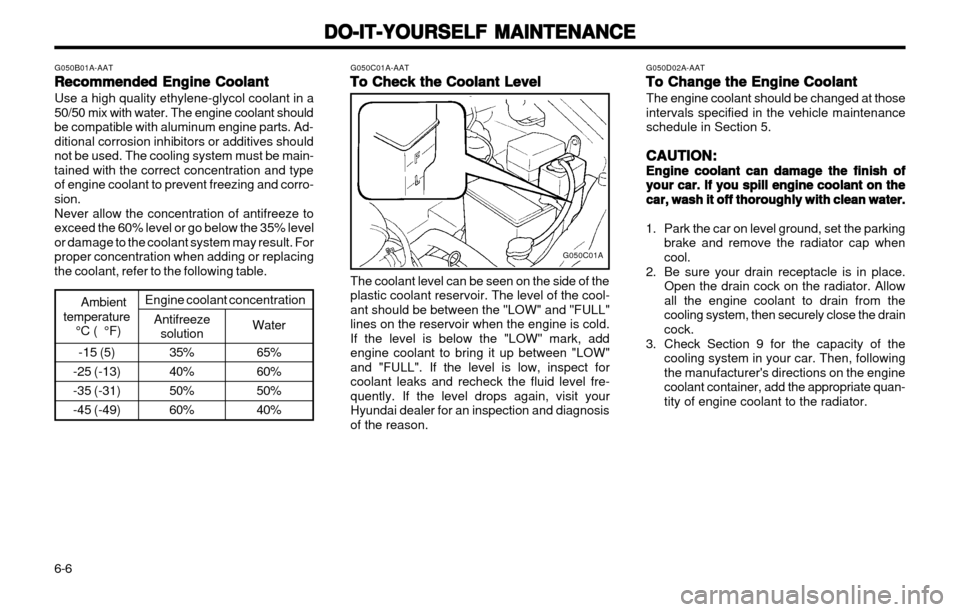
50/50 mix with water. The engine coolant should be compatible with aluminum engine parts. Ad-ditional corrosion inhibitors or additives shouldnot be used. The cooling system must be main-tained with the correct concentration and typeof engine coolant to prevent freezing and corro-sion. Never allow the concentration of antifreeze to exceed the 60% level or go below the 35% levelor damage to the coolant system may result. Forproper concentration when adding or replacingthe coolant, refer to the following table.
35% 40%50%60% G050C01A-AAT
To Check the Coolant Level
To Check the Coolant Level To Check the Coolant Level
To Check the Coolant Level
To Check the Coolant Level
The coolant level can be seen on the side of the plastic coolant reservoir. The level of the cool-ant should be between the "LOW" and "FULL"lines on the reservoir when the engine is cold.If the level is below the "LOW" mark, addengine coolant to bring it up between "LOW"and "FULL". If the level is low, inspect forcoolant leaks and recheck the fluid level fre-quently. If the level drops again, visit yourHyundai dealer for an inspection and diagnosisof the reason. G050D02A-AAT
To Change the Engine Coolant
To Change the Engine Coolant To Change the Engine Coolant
To Change the Engine Coolant
To Change the Engine Coolant
The engine coolant should be changed at thoseintervals specified in the vehicle maintenanceschedule in Section 5.
CAUTION:
CAUTION: CAUTION:
CAUTION:
CAUTION:
Engine coolant can damage the finish of
Engine coolant can damage the finish of Engine coolant can damage the finish of
Engine coolant can damage the finish of
Engine coolant can damage the finish of
your car. If you spill engine coolant on the
your car. If you spill engine coolant on the your car. If you spill engine coolant on the
your car. If you spill engine coolant on the
your car. If you spill engine coolant on the
car, wash it off thoroughly with clean water.
car, wash it off thoroughly with clean water. car, wash it off thoroughly with clean water.
car, wash it off thoroughly with clean water.
car, wash it off thoroughly with clean water.
1. Park the car on level ground, set the parking brake and remove the radiator cap whencool.
2. Be sure your drain receptacle is in place. Open the drain cock on the radiator. Allowall the engine coolant to drain from thecooling system, then securely close the draincock.
3. Check Section 9 for the capacity of the cooling system in your car. Then, followingthe manufacturer's directions on the enginecoolant container, add the appropriate quan-tity of engine coolant to the radiator.
G050C01A
65% 60%50%40%
Water
Antifreeze
solution
Ambient
temperature °C ( °F) Engine coolant concentration
Page 106 of 249
DO-IT-YOURSELF MAINTENANCE
DO-IT-YOURSELF MAINTENANCE DO-IT-YOURSELF MAINTENANCE
DO-IT-YOURSELF MAINTENANCE
DO-IT-YOURSELF MAINTENANCE
6-10 G110A01A-AAT
CHECKING THE TRANSAXLE FLUID
CHECKING THE TRANSAXLE FLUID CHECKING THE TRANSAXLE FLUID
CHECKING THE TRANSAXLE FLUID
CHECKING THE TRANSAXLE FLUID
(AUTOMATIC)
(AUTOMATIC) (AUTOMATIC)
(AUTOMATIC)
(AUTOMATIC)
Transaxle fluid in the automatic transaxle should be checked at those intervals specified in thevehicle maintenance schedule in Section 5. G110B01X-AAT
Recommended Fluid
Recommended Fluid Recommended Fluid
Recommended Fluid
Recommended Fluid Your Hyundai automatic transaxle is specially designed to operate with ESSO JWS3314. Dam-age caused by a nonspecified fluid is not cov-ered by your new vehicle limited warranty. G110C01X-GAT
Transaxle Fluid Capacity
Transaxle Fluid Capacity Transaxle Fluid Capacity
Transaxle Fluid Capacity
Transaxle Fluid Capacity
The fluid capacity of the automatic transaxle is
5.2 liters (5.48 U.S. quarts).
WARNING:
WARNING: WARNING:
WARNING:
WARNING:
The transaxle fluid level should be checked
The transaxle fluid level should be checked The transaxle fluid level should be checked
The transaxle fluid level should be checked
The transaxle fluid level should be checked
when the engine
when the engine when the engine
when the engine
when the engine is at normal operating tem-
is at normal operating tem- is at normal operating tem-
is at normal operating tem-
is at normal operating tem-
perature. This means that the engine, radia-
perature. This means that the engine, radia- perature. This means that the engine, radia-
perature. This means that the engine, radia-
perature. This means that the engine, radia-
tor, tor,
tor, tor,
tor, exhaust system etc., are very hot. Exer-
exhaust system etc., are very hot. Exer- exhaust system etc., are very hot. Exer-
exhaust system etc., are very hot. Exer-
exhaust system etc., are very hot. Exer-
cise great care not to burn yourself
cise great care not to burn yourself cise great care not to burn yourself
cise great care not to burn yourself
cise great care not to burn yourself during
during during
during
during
this procedure.
this procedure. this procedure.
this procedure.
this procedure.
G100A04X-GAT
CHECKING THE TRANSAXLE OIL
CHECKING THE TRANSAXLE OIL CHECKING THE TRANSAXLE OIL
CHECKING THE TRANSAXLE OIL
CHECKING THE TRANSAXLE OIL
(MANUAL)
(MANUAL) (MANUAL)
(MANUAL)
(MANUAL) Transaxle lubricant in the manual and transaxle should be checked at those intervals specified in the vehicle maintenance schedule in Section5.
Recommended Oil
Recommended Oil Recommended Oil
Recommended Oil
Recommended Oil Use only HYUNDAI GENUINE PARTS MTF 75W/90 (API GL-4) in the manual transaxle.
Manual Transaxle Oil Capacity
Manual Transaxle Oil Capacity Manual Transaxle Oil Capacity
Manual Transaxle Oil Capacity
Manual Transaxle Oil Capacity The oil capacity of the manual transaxle is 2.45 liters (2.58 U.S. quarts).
WARNING:
WARNING: WARNING:
WARNING:
WARNING:
It is always better to check the transaxle oil
It is always better to check the transaxle oil It is always better to check the transaxle oil
It is always better to check the transaxle oil
It is always better to check the transaxle oil
level when the
level when the level when the
level when the
level when the engine is cool or cold. If the
engine is cool or cold. If the engine is cool or cold. If the
engine is cool or cold. If the
engine is cool or cold. If the
engine is hot, you should exercise great
engine is hot, you should exercise great engine is hot, you should exercise great
engine is hot, you should exercise great
engine is hot, you should exercise great
caution
caution caution
caution
caution to avoid burning yourself on hot
to avoid burning yourself on hot to avoid burning yourself on hot
to avoid burning yourself on hot
to avoid burning yourself on hot
engine or exhaust parts.
engine or exhaust parts. engine or exhaust parts.
engine or exhaust parts.
engine or exhaust parts. G100B01A-AAT
To check the Manual Transaxle Fluid
To check the Manual Transaxle Fluid To check the Manual Transaxle Fluid
To check the Manual Transaxle Fluid
To check the Manual Transaxle Fluid
Level
Level Level
Level
Level
SSA6100B
Park the car on level ground with the engine off.
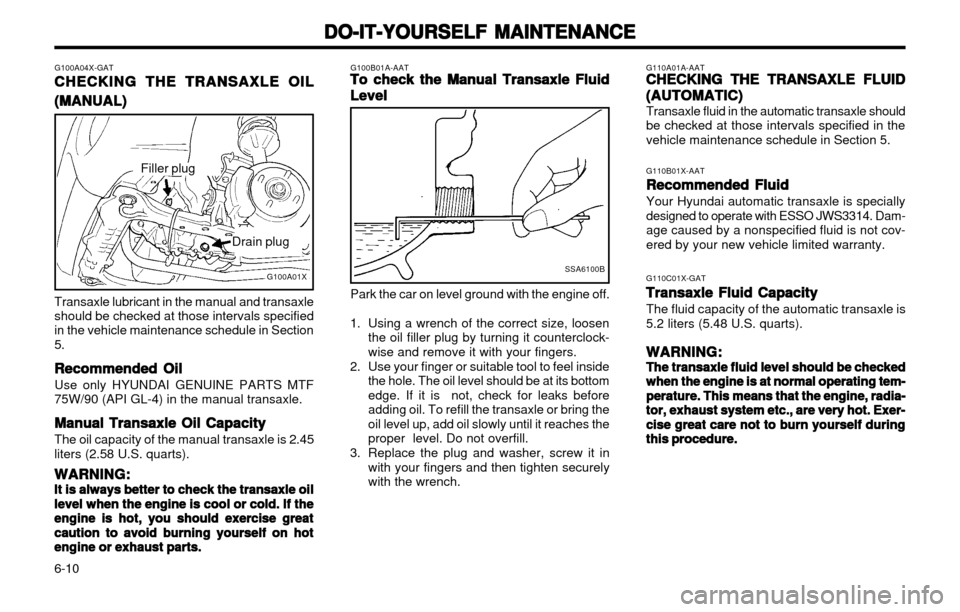
1. Using a wrench of the correct size, loosen the oil filler plug by turning it counterclock- wise and remove it with your fingers.
2. Use your finger or suitable tool to feel inside the hole. The oil level should be at its bottomedge. If it is not, check for leaks beforeadding oil. To refill the transaxle or bring theoil level up, add oil slowly until it reaches theproper level. Do not overfill.
3. Replace the plug and washer, screw it in with your fingers and then tighten securelywith the wrench.
G100A01X
Filler plug
Drain plug
Page 139 of 249
FEATURES OF YOUR HYUNDAI
1-2
B010E01A-AAT GASOLINES FOR CLEANER AIRTo help contribute to cleaner air, Hyundai rec-
ommends that you use gasolines treated with detergent additives, which help to prevent de-posit formation in the engine. These gasolineswill help the engines run cleaner and the Emis-sion Control System performance.
B880A01A-EAT IMMOBILIZER SYSTEMThe immobilizer system is an anti-theft device,
designed to prevent and deter automobile theft.
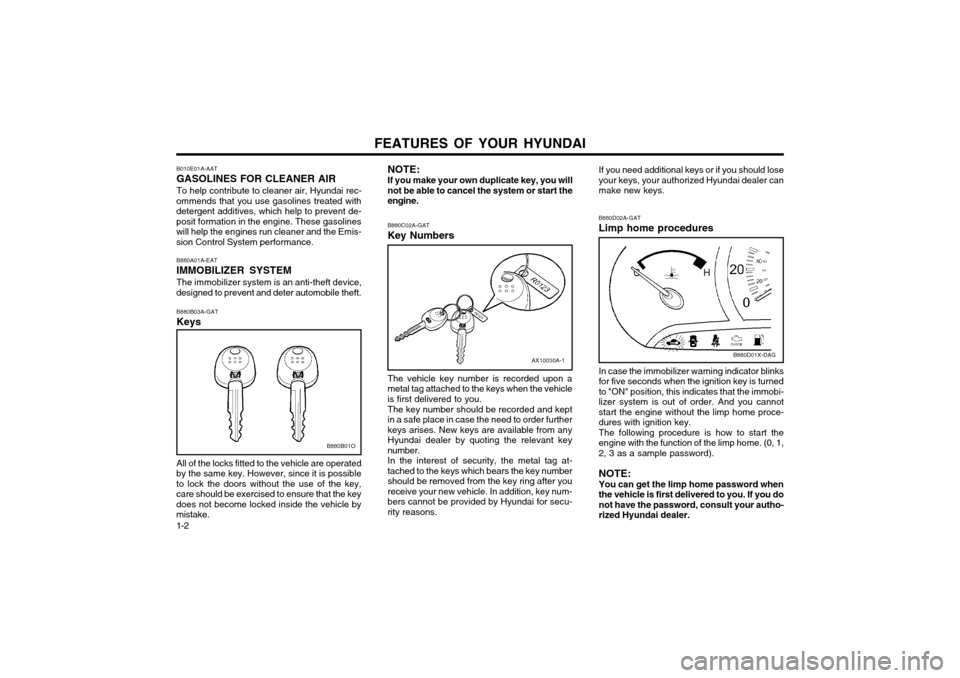
B880B03A-GATKeys
B880B01O
All of the locks fitted to the vehicle are operated
by the same key. However, since it is possible to lock the doors without the use of the key,care should be exercised to ensure that the keydoes not become locked inside the vehicle bymistake. B880C02A-GAT Key Numbers
AX10030A-1
The vehicle key number is recorded upon a metal tag attached to the keys when the vehicleis first delivered to you. The key number should be recorded and kept in a safe place in case the need to order furtherkeys arises. New keys are available from anyHyundai dealer by quoting the relevant keynumber.In the interest of security, the metal tag at-tached to the keys which bears the key numbershould be removed from the key ring after youreceive your new vehicle. In addition, key num-bers cannot be provided by Hyundai for secu-rity reasons.
NOTE: If you make your own duplicate key, you will not be able to cancel the system or start theengine. If you need additional keys or if you should loseyour keys, your authorized Hyundai dealer canmake new keys. B880D02A-GAT Limp home procedures
B880D01X-DAG
In case the immobilizer warning indicator blinks for five seconds when the ignition key is turnedto "ON" position, this indicates that the immobi-lizer system is out of order. And you cannotstart the engine without the limp home proce-dures with ignition key.The following procedure is how to start theengine with the function of the limp home. (0, 1,2, 3 as a sample password). NOTE: You can get the limp home password when the vehicle is first delivered to you. If you donot have the password, consult your autho-rized Hyundai dealer.
Page 140 of 249
FEATURES OF YOUR HYUNDAI 1-3
CAUTION:
o If you fail to try the limp home procedure with the sequence of three times, you have to wait for about one hour to do thelimp home procedure again.
o If you cannot start your engine in spite of limp home procedure, have your vehicletowed by an authorized Hyundai dealer.
1. To set the password you may turn the igni-
tion key "ON" and then turn it "OFF" accord-ing to the digit numbers, then the immobi-lizer indicator will blink along with the opera-tion of the ignition key. For example, turn theignition key once for digit number "1", andtwice for "2", and so on. However, for thedigit number "0", you must turn the ignitionkey for 10 times.
2. Wait for 3~10 seconds.
3. You may set the remaining number of digits by following the same procedures 1 and 2.
4. If all of four digits have been tried success- fully, turn the ignition key "ON" and check that the immobilizer indicator illuminates.From this time, you have to start your enginewithin 30 seconds. If you start your engineafter 30 seconds, your engine will not start.
NOTE: If the engine dies while driving after limp
home procedure, you can start your engine within 8 seconds without limp home proce-dure again.
5. If the immobilizer indicator blinks for five seconds, you have to try the limp home procedure again from the beginning.
After doing the limp home procedure, you have
to consult with your authorized Hyundai dealeras soon as possible. SB040A1-F DOOR LOCKS WARNING:
o Unlocked doors can be dangerous. Before you drive away-especially if there are children in the car-be sure that all thedoors are securely closed and locked, the doors cannot be opened from inside. This helps assure that doors will not beopened accidentally. Also, when com-bined with the proper use of seat belts,locking the doors helps keep occupantsfrom being ejected from the car in caseof an accident.
o Before opening the door, always look for and avoid oncoming traffic.
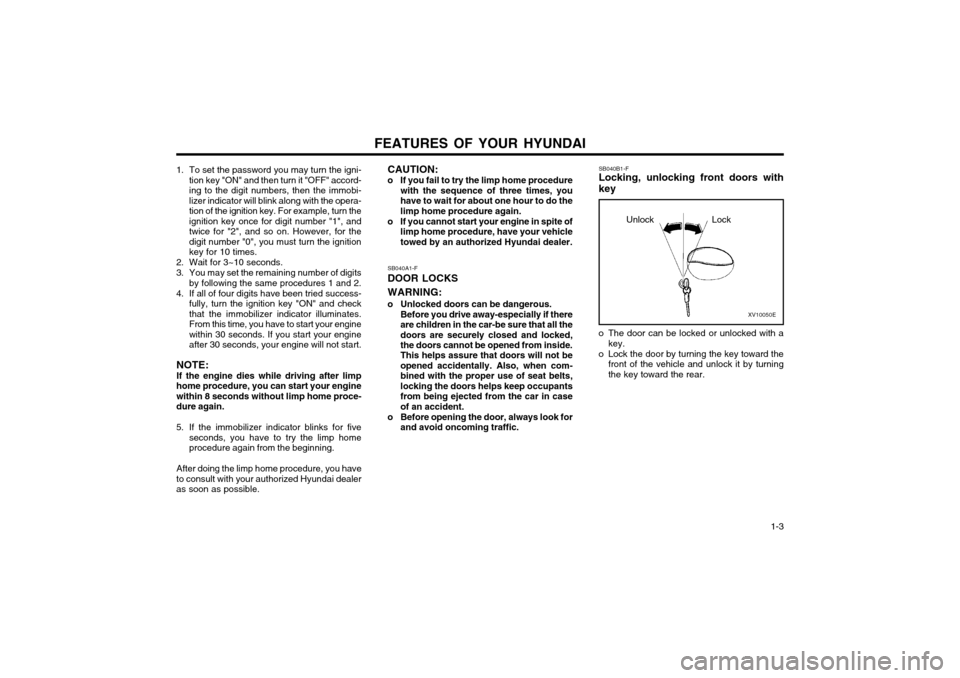
XV10050E
Unlock Lock
SB040B1-F Locking, unlocking front doors with key
o The door can be locked or unlocked with a key.
o Lock the door by turning the key toward the front of the vehicle and unlock it by turning the key toward the rear.
Page 144 of 249
FEATURES OF YOUR HYUNDAI 1-7
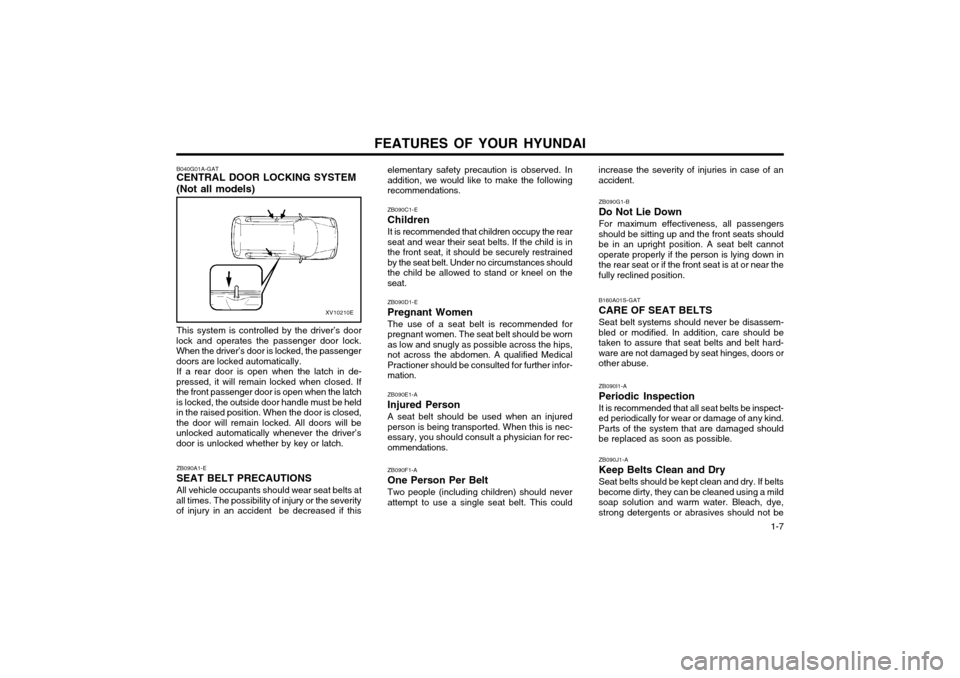
B040G01A-GAT CENTRAL DOOR LOCKING SYSTEM (Not all models)
XV10210E
This system is controlled by the driver’s door
lock and operates the passenger door lock. When the driver’s door is locked, the passengerdoors are locked automatically. If a rear door is open when the latch in de-
pressed, it will remain locked when closed. Ifthe front passenger door is open when the latchis locked, the outside door handle must be heldin the raised position. When the door is closed,the door will remain locked. All doors will beunlocked automatically whenever the driver’sdoor is unlocked whether by key or latch.
ZB090A1-E SEAT BELT PRECAUTIONSAll vehicle occupants should wear seat belts at
all times. The possibility of injury or the severity of injury in an accident be decreased if this elementary safety precaution is observed. Inaddition, we would like to make the followingrecommendations. ZB090C1-E ChildrenIt is recommended that children occupy the rear seat and wear their seat belts. If the child is inthe front seat, it should be securely restrainedby the seat belt. Under no circumstances shouldthe child be allowed to stand or kneel on theseat. ZB090D1-E Pregnant WomenThe use of a seat belt is recommended for pregnant women. The seat belt should be wornas low and snugly as possible across the hips,not across the abdomen. A qualified MedicalPractioner should be consulted for further infor-mation. ZB090E1-A Injured PersonA seat belt should be used when an injured person is being transported. When this is nec-essary, you should consult a physician for rec-ommendations. ZB090F1-A One Person Per BeltTwo people (including children) should never attempt to use a single seat belt. This could
increase the severity of injuries in case of anaccident.
ZB090G1-B Do Not Lie DownFor maximum effectiveness, all passengers
should be sitting up and the front seats should be in an upright position. A seat belt cannotoperate properly if the person is lying down inthe rear seat or if the front seat is at or near thefully reclined position.
B160A01S-GAT CARE OF SEAT BELTSSeat belt systems should never be disassem-
bled or modified. In addition, care should be taken to assure that seat belts and belt hard-
ware are not damaged by seat hinges, doors orother abuse.
ZB090I1-A Periodic InspectionIt is recommended that all seat belts be inspect-
ed periodically for wear or damage of any kind. Parts of the system that are damaged shouldbe replaced as soon as possible.
ZB090J1-A Keep Belts Clean and Dry Seat belts should be kept clean and dry. If belts
become dirty, they can be cleaned using a mild soap solution and warm water. Bleach, dye,strong detergents or abrasives should not be
Page 147 of 249
FEATURES OF YOUR HYUNDAI
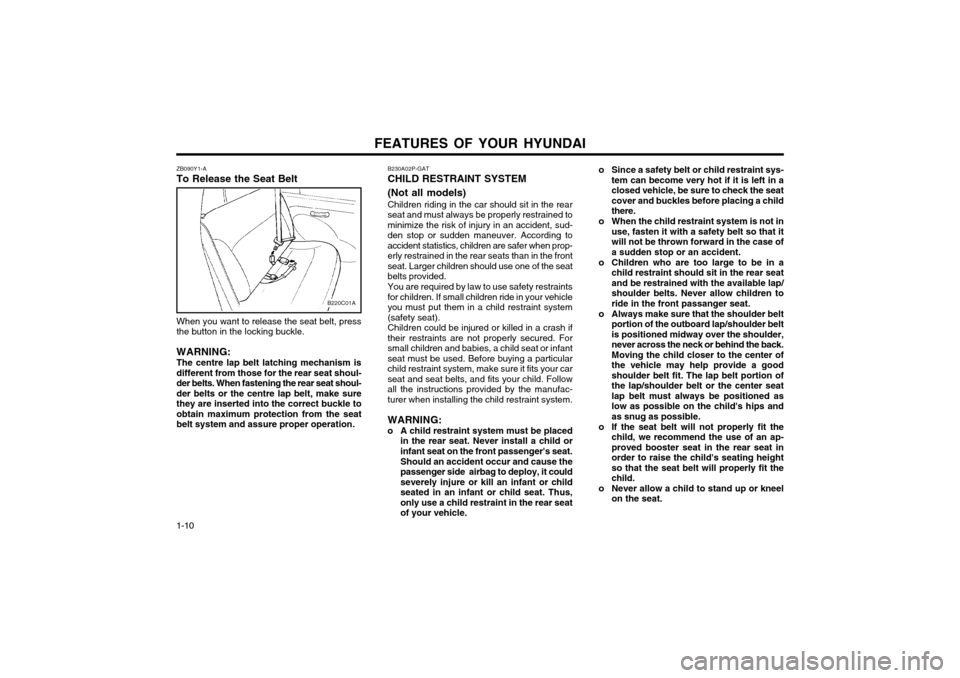
1-10 ZB090Y1-A To Release the Seat Belt
B220C01A
When you want to release the seat belt, press the button in the locking buckle. WARNING: The centre lap belt latching mechanism is different from those for the rear seat shoul-der belts. When fastening the rear seat shoul-der belts or the centre lap belt, make surethey are inserted into the correct buckle toobtain maximum protection from the seatbelt system and assure proper operation. B230A02P-GAT CHILD RESTRAINT SYSTEM (Not all models) Children riding in the car should sit in the rear seat and must always be properly restrained tominimize the risk of injury in an accident, sud-den stop or sudden maneuver. According toaccident statistics, children are safer when prop-erly restrained in the rear seats than in the frontseat. Larger children should use one of the seatbelts provided. You are required by law to use safety restraints for children. If small children ride in your vehicleyou must put them in a child restraint system(safety seat).Children could be injured or killed in a crash iftheir restraints are not properly secured. Forsmall children and babies, a child seat or infantseat must be used. Before buying a particularchild restraint system, make sure it fits your carseat and seat belts, and fits your child. Followall the instructions provided by the manufac-turer when installing the child restraint system. WARNING:
o A child restraint system must be placed in the rear seat. Never install a child or infant seat on the front passenger's seat. Should an accident occur and cause the passenger side airbag to deploy, it couldseverely injure or kill an infant or childseated in an infant or child seat. Thus,only use a child restraint in the rear seatof your vehicle. o Since a safety belt or child restraint sys-
tem can become very hot if it is left in aclosed vehicle, be sure to check the seatcover and buckles before placing a childthere.
o When the child restraint system is not in use, fasten it with a safety belt so that itwill not be thrown forward in the case ofa sudden stop or an accident.
o Children who are too large to be in a child restraint should sit in the rear seatand be restrained with the available lap/shoulder belts. Never allow children toride in the front passanger seat.
o Always make sure that the shoulder belt portion of the outboard lap/shoulder beltis positioned midway over the shoulder,never across the neck or behind the back.Moving the child closer to the center ofthe vehicle may help provide a goodshoulder belt fit. The lap belt portion ofthe lap/shoulder belt or the center seatlap belt must always be positioned aslow as possible on the child's hips andas snug as possible.
o If the seat belt will not properly fit the child, we recommend the use of an ap-proved booster seat in the rear seat inorder to raise the child's seating heightso that the seat belt will properly fit thechild.
o Never allow a child to stand up or kneel on the seat.
Page 148 of 249
FEATURES OF YOUR HYUNDAI 1-11
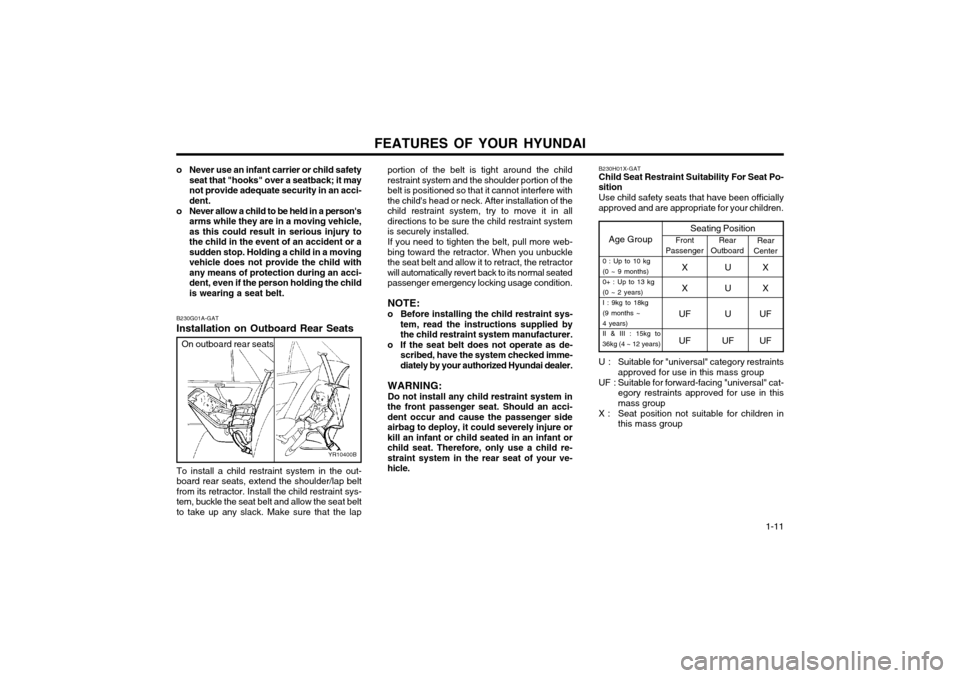
B230G01A-GAT Installation on Outboard Rear Seats
YR10400B
To install a child restraint system in the out- board rear seats, extend the shoulder/lap beltfrom its retractor. Install the child restraint sys-tem, buckle the seat belt and allow the seat beltto take up any slack. Make sure that the lap
On outboard rear seats
o Never use an infant carrier or child safety
seat that "hooks" over a seatback; it may not provide adequate security in an acci-dent.
o Never allow a child to be held in a person's arms while they are in a moving vehicle,as this could result in serious injury tothe child in the event of an accident or asudden stop. Holding a child in a movingvehicle does not provide the child withany means of protection during an acci-dent, even if the person holding the childis wearing a seat belt. portion of the belt is tight around the childrestraint system and the shoulder portion of thebelt is positioned so that it cannot interfere withthe child's head or neck. After installation of thechild restraint system, try to move it in alldirections to be sure the child restraint systemis securely installed.
If you need to tighten the belt, pull more web-
bing toward the retractor. When you unbucklethe seat belt and allow it to retract, the retractorwill automatically revert back to its normal seatedpassenger emergency locking usage condition.
NOTE:
o Before installing the child restraint sys- tem, read the instructions supplied bythe child restraint system manufacturer.
o If the seat belt does not operate as de- scribed, have the system checked imme-diately by your authorized Hyundai dealer.
WARNING: Do not install any child restraint system in
the front passenger seat. Should an acci- dent occur and cause the passenger sideairbag to deploy, it could severely injure orkill an infant or child seated in an infant orchild seat. Therefore, only use a child re-straint system in the rear seat of your ve-hicle.
Age Group Seating PositionFront
Passenger Rear
Outboard Rear
Center
0 : Up to 10 kg (0 ~ 9 months) 0+ : Up to 13 kg(0 ~ 2 years)I : 9kg to 18kg(9 months ~4 years) II & III : 15kg to
36kg (4 ~ 12 years)XUX
XUX
UF U UF
UF UF UF
B230H01X-GAT Child Seat Restraint Suitability For Seat Po-
sition
Use child safety seats that have been officially
approved and are appropriate for your children.
U : Suitable for "universal" category restraints approved for use in this mass group
UF : Suitable for forward-facing "universal" cat- egory restraints approved for use in this mass group
X : Seat position not suitable for children in this mass group
Page 165 of 249
FEATURES OF YOUR HYUNDAI
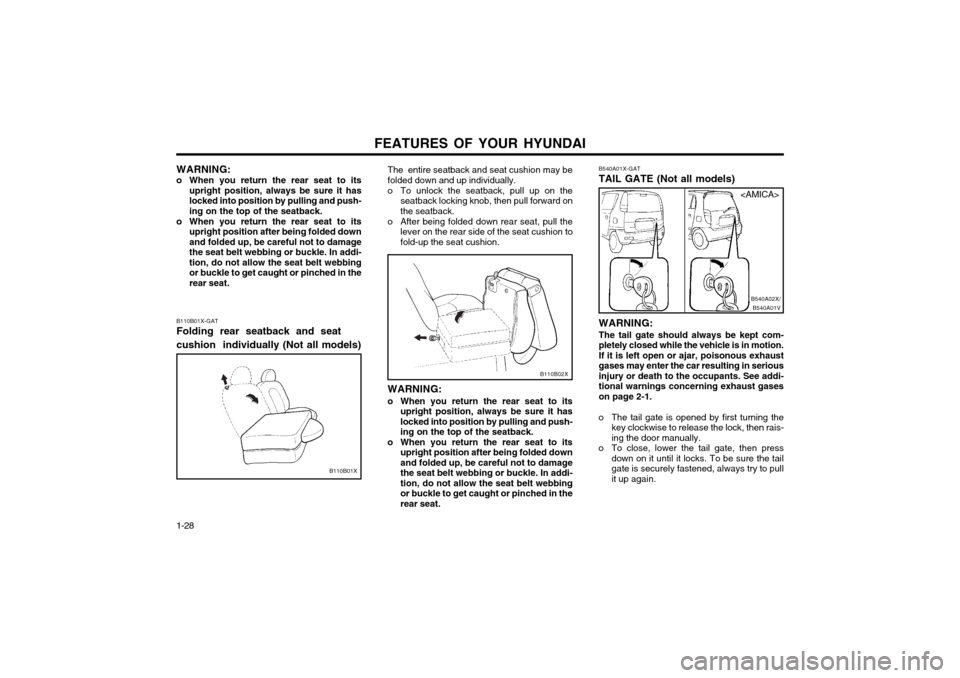
1-28 B540A01X-GAT TAIL GATE (Not all models) WARNING: The tail gate should always be kept com-
pletely closed while the vehicle is in motion.If it is left open or ajar, poisonous exhaust
gases may enter the car resulting in seriousinjury or death to the occupants. See addi-tional warnings concerning exhaust gaseson page 2-1.
o The tail gate is opened by first turning the key clockwise to release the lock, then rais-ing the door manually.
o To close, lower the tail gate, then press down on it until it locks. To be sure the tailgate is securely fastened, always try to pull
it up again.
B540A01VB540A02X/
B110B02X
The entire seatback and seat cushion may be folded down and up individually.
o To unlock the seatback, pull up on the
seatback locking knob, then pull forward on the seatback.
o After being folded down rear seat, pull the lever on the rear side of the seat cushion tofold-up the seat cushion.
WARNING:
o When you return the rear seat to its upright position, always be sure it haslocked into position by pulling and push-ing on the top of the seatback.
o When you return the rear seat to its upright position after being folded downand folded up, be careful not to damagethe seat belt webbing or buckle. In addi-tion, do not allow the seat belt webbingor buckle to get caught or pinched in therear seat.
B110B01X-GAT Folding rear seatback and seat cushion individually (Not all models)
B110B01X WARNING:
o When you return the rear seat to its upright position, always be sure it has locked into position by pulling and push-ing on the top of the seatback.
o When you return the rear seat to its upright position after being folded downand folded up, be careful not to damagethe seat belt webbing or buckle. In addi-tion, do not allow the seat belt webbingor buckle to get caught or pinched in therear seat.