battery Hyundai Atos 2002 User Guide
[x] Cancel search | Manufacturer: HYUNDAI, Model Year: 2002, Model line: Atos, Model: Hyundai Atos 2002Pages: 249, PDF Size: 3.11 MB
Page 110 of 249
DO-IT-YOURSELF MAINTENANCE
DO-IT-YOURSELF MAINTENANCE DO-IT-YOURSELF MAINTENANCE
DO-IT-YOURSELF MAINTENANCE
DO-IT-YOURSELF MAINTENANCE
6-14 G200A01A-AAT
CHECKING AND REPLACING
CHECKING AND REPLACING CHECKING AND REPLACING
CHECKING AND REPLACING
CHECKING AND REPLACING
FUSES
FUSES FUSES
FUSES
FUSES
Replacing a Fusible Link
Replacing a Fusible Link Replacing a Fusible Link
Replacing a Fusible Link
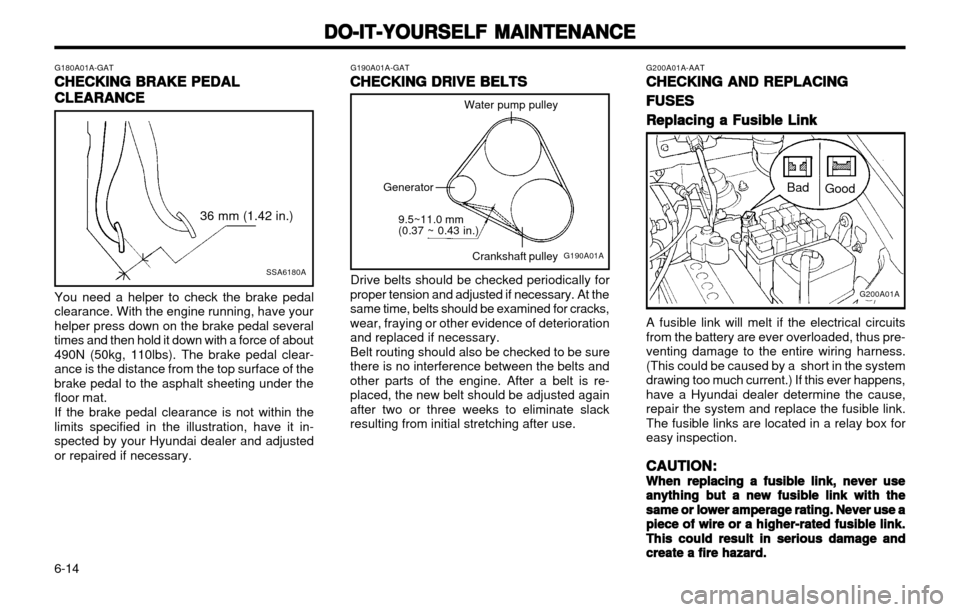
Replacing a Fusible Link A fusible link will melt if the electrical circuits from the battery are ever overloaded, thus pre-venting damage to the entire wiring harness.(This could be caused by a short in the systemdrawing too much current.) If this ever happens,have a Hyundai dealer determine the cause,repair the system and replace the fusible link.The fusible links are located in a relay box foreasy inspection.
CAUTION:
CAUTION: CAUTION:
CAUTION:
CAUTION:
When replacing a fusible link, never use
When replacing a fusible link, never use When replacing a fusible link, never use
When replacing a fusible link, never use
When replacing a fusible link, never use
anything but a new fusible link with the
anything but a new fusible link with the anything but a new fusible link with the
anything but a new fusible link with the
anything but a new fusible link with the
same or lower amperage rating. Never use a
same or lower amperage rating. Never use a same or lower amperage rating. Never use a
same or lower amperage rating. Never use a
same or lower amperage rating. Never use a
piece of wire or a higher-rated fusible link.
piece of wire or a higher-rated fusible link. piece of wire or a higher-rated fusible link.
piece of wire or a higher-rated fusible link.
piece of wire or a higher-rated fusible link.
This could result in serious damage and
This could result in serious damage and This could result in serious damage and
This could result in serious damage and
This could result in serious damage and
create a fire hazard.
create a fire hazard. create a fire hazard.
create a fire hazard.
create a fire hazard.
G200A01A
Bad
Good
G180A01A-GAT
CHECKING BRAKE PEDAL
CHECKING BRAKE PEDAL CHECKING BRAKE PEDAL
CHECKING BRAKE PEDAL
CHECKING BRAKE PEDAL
CLEARANCE
CLEARANCE CLEARANCE
CLEARANCE
CLEARANCE
SSA6180A
36 mm (1.42 in.)
You need a helper to check the brake pedal clearance. With the engine running, have yourhelper press down on the brake pedal severaltimes and then hold it down with a force of about490N (50kg, 110lbs). The brake pedal clear-ance is the distance from the top surface of thebrake pedal to the asphalt sheeting under thefloor mat. If the brake pedal clearance is not within the limits specified in the illustration, have it in-spected by your Hyundai dealer and adjustedor repaired if necessary.
G190A01A-GAT CHECKING DRIVE BELTS
CHECKING DRIVE BELTS CHECKING DRIVE BELTS
CHECKING DRIVE BELTS
CHECKING DRIVE BELTS
Water pump pulley
Crankshaft pulley
Drive belts should be checked periodically for
proper tension and adjusted if necessary. At the same time, belts should be examined for cracks,wear, fraying or other evidence of deteriorationand replaced if necessary. Belt routing should also be checked to be sure
there is no interference between the belts andother parts of the engine. After a belt is re-placed, the new belt should be adjusted againafter two or three weeks to eliminate slackresulting from initial stretching after use.
G190A01A
9.5~11.0 mm (0.37 ~ 0.43 in.)
Generator
Page 111 of 249
DO-IT-YOURSELF MAINTENANCE
DO-IT-YOURSELF MAINTENANCE DO-IT-YOURSELF MAINTENANCE
DO-IT-YOURSELF MAINTENANCE
DO-IT-YOURSELF MAINTENANCE
6-15
CAUTION:
CAUTION: CAUTION:
CAUTION:
CAUTION:
A burned-out fuse indicates that there is a
A burned-out fuse indicates that there is a A burned-out fuse indicates that there is a
A burned-out fuse indicates that there is a
A burned-out fuse indicates that there is a problem in the electrical circuit. If you re-
problem in the electrical circuit. If you re- problem in the electrical circuit. If you re-
problem in the electrical circuit. If you re-
problem in the electrical circuit. If you re-
place a fuse and it blows as soon as the
place a fuse and it blows as soon as the place a fuse and it blows as soon as the
place a fuse and it blows as soon as the
place a fuse and it blows as soon as the
accessory is turned on, the problem is seri-
accessory is turned on, the problem is seri- accessory is turned on, the problem is seri-
accessory is turned on, the problem is seri-
accessory is turned on, the problem is seri-
ous and should be referred to a Hyundai
ous and should be referred to a Hyundai ous and should be referred to a Hyundai
ous and should be referred to a Hyundai
ous and should be referred to a Hyundai
dealer for diagnosis and repair. Never re-
dealer for diagnosis and repair. Never re- dealer for diagnosis and repair. Never re-
dealer for diagnosis and repair. Never re-
dealer for diagnosis and repair. Never re-
place a fuse with anything except a fuse
place a fuse with anything except a fuse place a fuse with anything except a fuse
place a fuse with anything except a fuse
place a fuse with anything except a fuse
with the same or a lower amperage rating. A
with the same or a lower amperage rating. A with the same or a lower amperage rating. A
with the same or a lower amperage rating. A
with the same or a lower amperage rating. A
higher capacity fuse could cause damage
higher capacity fuse could cause damage higher capacity fuse could cause damage
higher capacity fuse could cause damage
higher capacity fuse could cause damage
and create a fire hazard.
and create a fire hazard. and create a fire hazard.
and create a fire hazard.
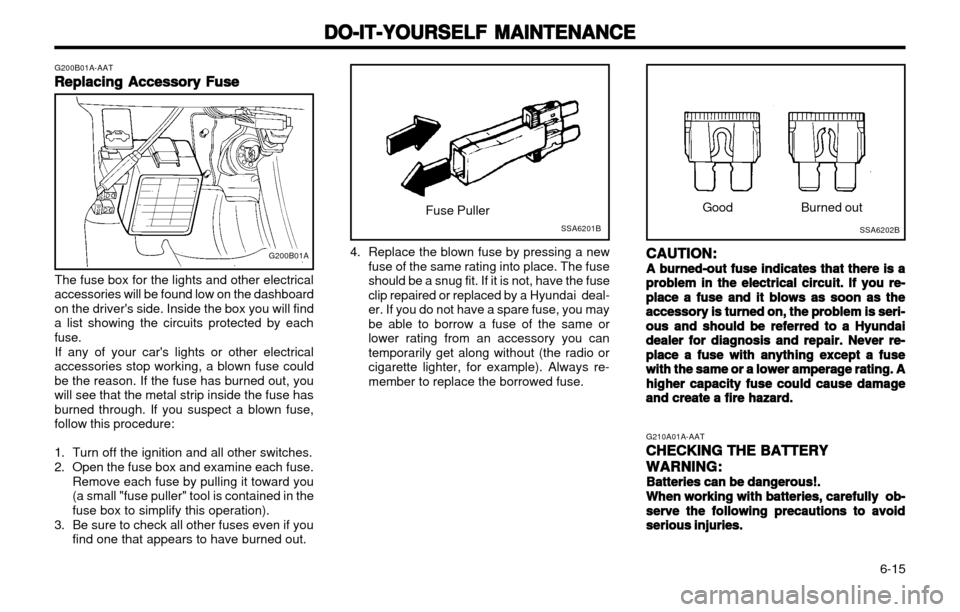
and create a fire hazard. Good
Burned out
4. Replace the blown fuse by pressing a new fuse of the same rating into place. The fuse should be a snug fit. If it is not, have the fuseclip repaired or replaced by a Hyundai deal-er. If you do not have a spare fuse, you maybe able to borrow a fuse of the same orlower rating from an accessory you cantemporarily get along without (the radio orcigarette lighter, for example). Always re-member to replace the borrowed fuse.
G200B01A-AAT
Replacing Accessory Fuse
Replacing Accessory Fuse Replacing Accessory Fuse
Replacing Accessory Fuse
Replacing Accessory Fuse
The fuse box for the lights and other electrical
accessories will be found low on the dashboardon the driver's side. Inside the box you will finda list showing the circuits protected by eachfuse.
If any of your car's lights or other electrical
accessories stop working, a blown fuse couldbe the reason. If the fuse has burned out, youwill see that the metal strip inside the fuse hasburned through. If you suspect a blown fuse,follow this procedure:
1. Turn off the ignition and all other switches.
2. Open the fuse box and examine each fuse. Remove each fuse by pulling it toward you (a small "fuse puller" tool is contained in thefuse box to simplify this operation).
3. Be sure to check all other fuses even if you find one that appears to have burned out.
G200B01A
SSA6201BSSA6202B
Fuse Puller
G210A01A-AATCHECKING THE BATTERY
CHECKING THE BATTERY CHECKING THE BATTERY
CHECKING THE BATTERY
CHECKING THE BATTERY
WARNING:
WARNING: WARNING:
WARNING:
WARNING:
Batteries can be dangerous!.
Batteries can be dangerous!. Batteries can be dangerous!.
Batteries can be dangerous!.
Batteries can be dangerous!.
When working with batteries, carefully ob-
When working with batteries, carefully ob- When working with batteries, carefully ob-
When working with batteries, carefully ob-
When working with batteries, carefully ob-
serve the following precautions to avoid
serve the following precautions to avoid serve the following precautions to avoid
serve the following precautions to avoid
serve the following precautions to avoid
serious injuries.
serious injuries. serious injuries.
serious injuries.
serious injuries.
Page 112 of 249
DO-IT-YOURSELF MAINTENANCE
DO-IT-YOURSELF MAINTENANCE DO-IT-YOURSELF MAINTENANCE
DO-IT-YOURSELF MAINTENANCE
DO-IT-YOURSELF MAINTENANCE
6-16
G230A03A-GAT POWER STEERING FLUID LEVEL
POWER STEERING FLUID LEVEL POWER STEERING FLUID LEVEL
POWER STEERING FLUID LEVEL
POWER STEERING FLUID LEVEL
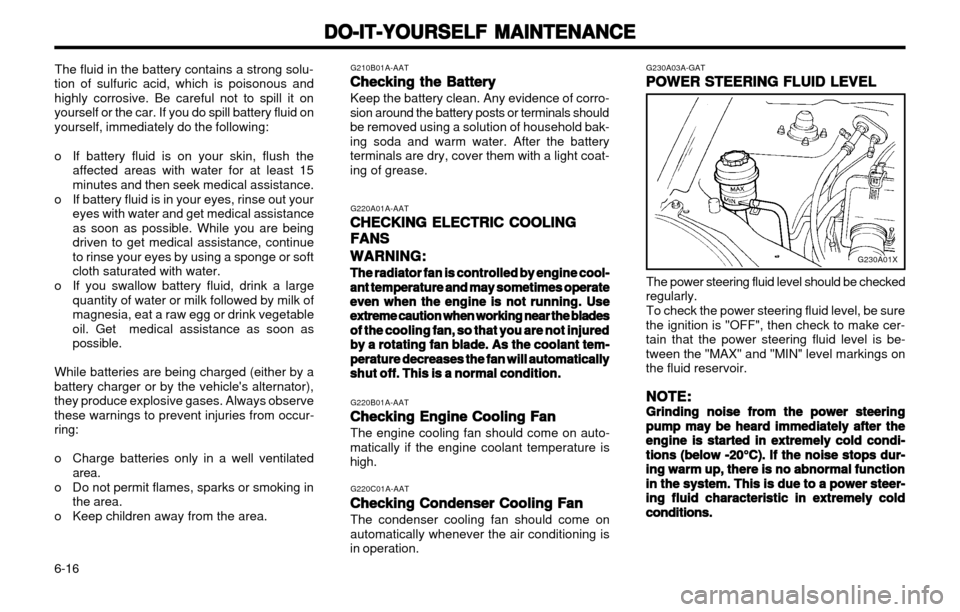
The power steering fluid level should be checked
regularly.
To check the power steering fluid level, be sure
the ignition is "OFF", then check to make cer- tain that the power steering fluid level is be-tween the "MAX" and "MIN" level markings onthe fluid reservoir.
NOTE:
NOTE: NOTE:
NOTE:
NOTE:
Grinding noise from the power steering
Grinding noise from the power steering Grinding noise from the power steering
Grinding noise from the power steering
Grinding noise from the power steering pump may be heard immediately after the
pump may be heard immediately after the pump may be heard immediately after the
pump may be heard immediately after the
pump may be heard immediately after the
engine is started in extremely cold condi-
engine is started in extremely cold condi- engine is started in extremely cold condi-
engine is started in extremely cold condi-
engine is started in extremely cold condi-
tions (below
tions (below tions (below
tions (below
tions (below
-20°C). If the noise stops dur-
-20°C). If the noise stops dur- -20°C). If the noise stops dur-
-20°C). If the noise stops dur-
-20°C). If the noise stops dur-
ing warm up, there is no abnormal function
ing warm up, there is no abnormal function ing warm up, there is no abnormal function
ing warm up, there is no abnormal function
ing warm up, there is no abnormal function
in the system. This is due to a power steer-
in the system. This is due to a power steer- in the system. This is due to a power steer-
in the system. This is due to a power steer-
in the system. This is due to a power steer-
ing fluid characteristic in extremely cold
ing fluid characteristic in extremely cold ing fluid characteristic in extremely cold
ing fluid characteristic in extremely cold
ing fluid characteristic in extremely cold
conditions.
conditions. conditions.
conditions.
conditions.
G230A01X
The fluid in the battery contains a strong solu-
tion of sulfuric acid, which is poisonous and highly corrosive. Be careful not to spill it onyourself or the car. If you do spill battery fluid onyourself, immediately do the following:
o If battery fluid is on your skin, flush the affected areas with water for at least 15 minutes and then seek medical assistance.
o If battery fluid is in your eyes, rinse out your eyes with water and get medical assistanceas soon as possible. While you are beingdriven to get medical assistance, continueto rinse your eyes by using a sponge or softcloth saturated with water.
o If you swallow battery fluid, drink a large quantity of water or milk followed by milk ofmagnesia, eat a raw egg or drink vegetableoil. Get medical assistance as soon aspossible.
While batteries are being charged (either by abattery charger or by the vehicle's alternator),they produce explosive gases. Always observethese warnings to prevent injuries from occur-ring:
o Charge batteries only in a well ventilated area.
o Do not permit flames, sparks or smoking in the area.
o Keep children away from the area. G210B01A-AAT
Checking the Battery
Checking the Battery Checking the Battery
Checking the Battery
Checking the Battery
Keep the battery clean. Any evidence of corro-
sion around the battery posts or terminals should be removed using a solution of household bak-ing soda and warm water. After the batteryterminals are dry, cover them with a light coat-ing of grease.
G220A01A-AATCHECKING ELECTRIC COOLING
CHECKING ELECTRIC COOLING CHECKING ELECTRIC COOLING
CHECKING ELECTRIC COOLING
CHECKING ELECTRIC COOLING
FANS
FANS FANS
FANS
FANS
WARNING:
WARNING: WARNING:
WARNING:
WARNING:
The radiator fan is controlled by engine cool-
The radiator fan is controlled by engine cool- The radiator fan is controlled by engine cool-
The radiator fan is controlled by engine cool-
The radiator fan is controlled by engine cool-
ant temperature and may sometimes operate
ant temperature and may sometimes operate ant temperature and may sometimes operate
ant temperature and may sometimes operate
ant temperature and may sometimes operate
even when the engine is not running. Use
even when the engine is not running. Use even when the engine is not running. Use
even when the engine is not running. Use
even when the engine is not running. Use
extreme caution when working near the blades
extreme caution when working near the blades extreme caution when working near the blades
extreme caution when working near the blades
extreme caution when working near the blades
of the cooling fan, so that you are not injured
of the cooling fan, so that you are not injured of the cooling fan, so that you are not injured
of the cooling fan, so that you are not injured
of the cooling fan, so that you are not injured
by a rotating fan blade. As the coolant tem-
by a rotating fan blade. As the coolant tem- by a rotating fan blade. As the coolant tem-
by a rotating fan blade. As the coolant tem-
by a rotating fan blade. As the coolant tem-
perature decreases the fan will automatically
perature decreases the fan will automatically perature decreases the fan will automatically
perature decreases the fan will automatically
perature decreases the fan will automatically
shut off. This is a normal condition.
shut off. This is a normal condition. shut off. This is a normal condition.
shut off. This is a normal condition.
shut off. This is a normal condition.
G220B01A-AATChecking Engine Cooling Fan
Checking Engine Cooling Fan Checking Engine Cooling Fan
Checking Engine Cooling Fan
Checking Engine Cooling Fan
The engine cooling fan should come on auto-
matically if the engine coolant temperature ishigh.
G220C01A-AATChecking Condenser Cooling Fan
Checking Condenser Cooling Fan Checking Condenser Cooling Fan
Checking Condenser Cooling Fan
Checking Condenser Cooling Fan
The condenser cooling fan should come on
automatically whenever the air conditioning isin operation.
Page 122 of 249
VEHICLE SPECIFICATIONS
VEHICLE SPECIFICATIONS VEHICLE SPECIFICATIONS
VEHICLE SPECIFICATIONS
VEHICLE SPECIFICATIONS
9-1
9.9.
9.9.
9.
VEHICLE SPECIFICA
VEHICLE SPECIFICA VEHICLE SPECIFICA
VEHICLE SPECIFICA
VEHICLE SPECIFICA
TIONS
TIONS TIONS
TIONS
TIONS
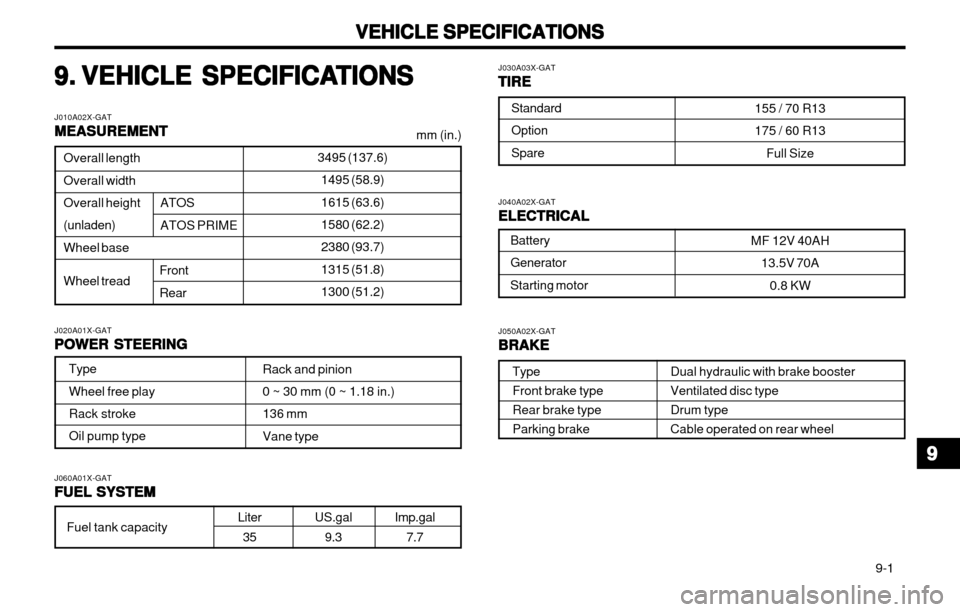
J010A02X-GAT MEASUREMENT
MEASUREMENT MEASUREMENT
MEASUREMENT
MEASUREMENT
mm (in.)
J020A01X-GAT POWER STEERING
POWER STEERING POWER STEERING
POWER STEERING
POWER STEERING
Imp.gal
7.7Liter35 US.gal
9.3
J060A01X-GAT
FUEL SYSTEM
FUEL SYSTEM FUEL SYSTEM
FUEL SYSTEM
FUEL SYSTEM J040A02X-GAT
ELECTRICAL
ELECTRICAL ELECTRICAL
ELECTRICAL
ELECTRICAL J050A02X-GAT
BRAKE
BRAKE BRAKE
BRAKE
BRAKE
Dual hydraulic with brake booster Ventilated disc typeDrum typeCable operated on rear wheel
J030A03X-GAT
TIRE
TIRE TIRE
TIRE
TIRE
3495 (137.6)
1495 (58.9) 1615 (63.6) 1580 (62.2) 2380 (93.7)1315 (51.8) 1300 (51.2)Overall length Overall widthOverall height (unladen) Wheel base Wheel tread
Front Rear
ATOS ATOS PRIME
Type Wheel free play Rack stroke Oil pump type Rack and pinion 0 ~ 30 mm (0 ~ 1.18 in.) 136 mmVane type
Standard Option Spare
155 / 70 R13175 / 60 R13
Full Size
Battery Generator Starting motor MF 12V 40AH
13.5V 70A
0.8 KW
Fuel tank capacity Type Front brake typeRear brake typeParking brake
99
99
9
Page 125 of 249
INDEX
INDEX INDEX
INDEX
INDEX
10-1
Catalytic Converter .................................................................... 7-1 ~ 7-2
Child-Protector Rear Door Lock ......................................................... 1-5
Cigarette Lighter ................................................................................
1-26
Clock ................................................................................................ 1-26
Clutch Pedal freeplay ........................................................................ 6-13
Combination Light Daytime running lights ................................................................. 1-23
Headlight flasher .......................................................................... 1-24
Headlight switch ........................................................................... 1-23
High-beam switch ........................................................................ 1-24
Lane change signal ...................................................................... 1-23
Turn signal operation ................................................................... 1-23
Compact Disk Player Operation (H922M) ........................................ 1-49
Cooling Fans ..................................................................................... 6-16
Corrosion Protection Cleaning the interior ....................................................................... 4-3
Protecting your Hyundai from corrosion ........................................ 4-1
Washing and waxing ...................................................................... 4-2
DD
DD
D
Defroster ........................................................................................... 1-38
Door Central door locking system .......................................................... 1-7
Door locks ...................................................................................... 1-4
Locking, unlocking front doors with a key ..................................... 1-4
Drive Belts ............................................................................... 6-12, 6-14 Driving Economical driving ......................................................................... 2-9
Smooth cornering ........................................................................... 2-9
Winter driving ................................................................................. 2-9
ZK000A1-G
10. INDEX
10. INDEX 10. INDEX
10. INDEX
10. INDEX
AA
AA
A
Air bag .................................................................................... 1-13 ~ 1-17
Air Cleaner Filter ................................................................................. 6-9Air Conditioning
Care ............................................................................................. 6-12
Operation ..................................................................................... 1-38
Antenna ............................................................................................. 1-54
Ashtray .............................................................................................. 1-27
Audio Fault Code .............................................................................. 1-51
BB
BB
B
Battery ...................................................................................... 2-10, 6-16
Bi-Level Heating ................................................................................ 1-36
Brake Anti-lock system ............................................................................ 2-8
Checking the brakes .................................................................... 6-11
Fluid .................................................................................. 6-11 ~ 6-12
Pedal clearance ........................................................................... 6-14
Pedal freeplay .............................................................................. 6-13
Practices ............................................................................... 2-7 ~ 2-8
Breaking-In your New Hyundai ........................................................... 1-1
CC
CC
C
Care of Cassette Tapes ................................................................... 1-52
Cassette Tape Player Operation (H900A) ............................. 1-44 ~ 1-46
1010
1010
10
Page 151 of 249
FEATURES OF YOUR HYUNDAI
1-14 B240C01X-EAT SRS CareThe SRS is virtually maintenance-free and so there are no parts you can safely service byyourself. The entire SRS system must be in-spected by an authorized Hyundai dealer in 10years after the date that the car was manufac-ture. Any work on the airbag system, such as remov- ing, installing, repairing, or any work on thesteering wheel must be performed by a quali-fied Hyundai technician. Improper handling of the airbag system may result in serious personal injury. WARNING:
o Modification to SRS components or wir- ing, including the addition of any kind of badges to the pad cover or modifica-tions to the body structure, can adverse-ly affect SRS performance and lead topossible injury.
o For cleaning the horn pad, use only a soft, dry cloth or one which has beenmoistened with plain water. Solvents orcleaners could adversely affect the airbagcover and proper deployment of the sys-tem.
o No objects should be placed over or near the label identifying the airbag on thesteering wheel and instrument panel,because any such object could causeharm if the vehicle is in a crash severeenough to cause the airbag to inflate.
WARNING:
o When the SRS is activated, there may be
a loud noise and fine dust will be re- leased through out the vehicle. Theseconditions are normal and are not haz-ardous. However, the fine dust generat-ed during airbag deployment may causeskin irritation. Be sure to wash your handsand face thoroughly with lukewarm wa-ter and a mild soap after an accident inwhich the airbags were deployed.
o The SRS can function only when the ignition key is in the "ON" position. If theSRS SRI does not come on, or continu-ously remains on, after flashing for about6 seconds when the ignition key is turnedto the "ON" position, or after the engineis started, or comes on while driving, theSRS is not working properly. If this oc-curs, have your vehicle immediately in-spected by your Hyundai dealer.
o Before you replace a fuse or disconnect a battery terminal, turn the ignition key tothe "LOCK" position or remove the igni-tion key. Never remove or replace the airbag related fuse(s) when the ignition keyis in the "ON" position. Failure to heedthis warning will cause the SRS SRI toilluminate.
Upon deployment, tear seams molded directly
into the pad covers will separate under pres-sure from the expansion of the airbags. Furtheropening of the covers then allows full inflation ofthe airbags.
A fully inflated airbag in combination with a
properly worn seat belt slows the driver's for-ward motion, thus reducing the
risk of head and chest injury. After complete inflation, the airbag immediately
starts deflating, enabling the driver to maintain forward visibility.
CAUTION: When installing a container of liquid air
fresherer inside a vehicle, do not place it near the instrument cluster nor on the in-strument panel pad surface. If there is anyleakage from the air fresherer onto theseareas (instrument cluster, instrument panelpad or air ventilator), it may damage theseparts. If the liquid from the air freshererdoes leak onto these areas, wash them withwater immediately.
Page 157 of 249
FEATURES OF YOUR HYUNDAI
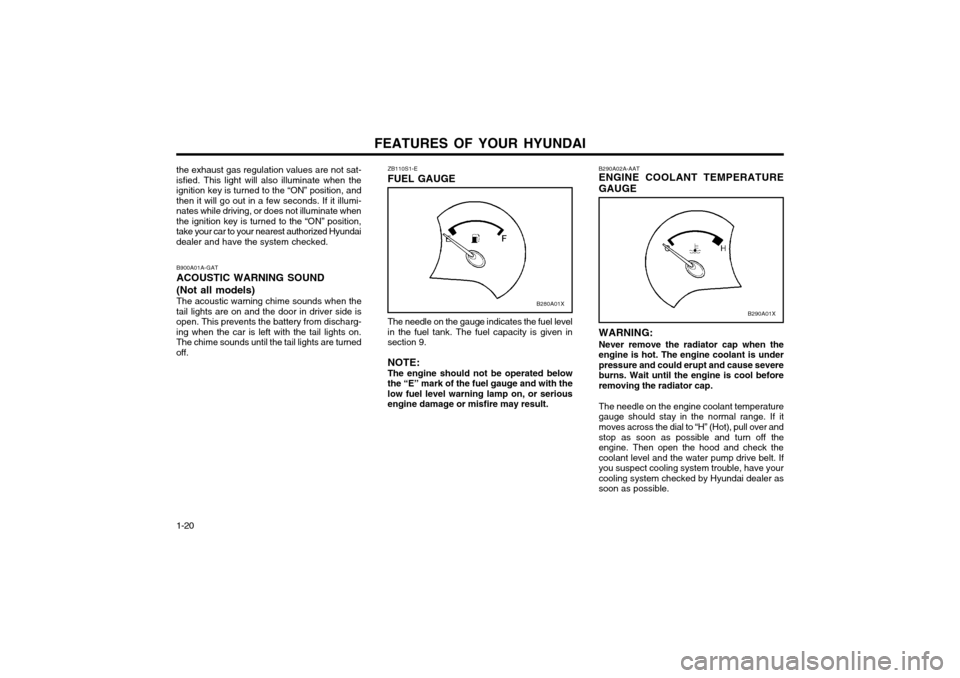
1-20 WARNING: Never remove the radiator cap when the engine is hot. The engine coolant is underpressure and could erupt and cause severeburns. Wait until the engine is cool beforeremoving the radiator cap. The needle on the engine coolant temperature
gauge should stay in the normal range. If itmoves across the dial to “H” (Hot), pull over and stop as soon as possible and turn off the engine. Then open the hood and check thecoolant level and the water pump drive belt. If
you suspect cooling system trouble, have yourcooling system checked by Hyundai dealer assoon as possible.
The needle on the gauge indicates the fuel levelin the fuel tank. The fuel capacity is given insection 9. NOTE: The engine should not be operated below the “E” mark of the fuel gauge and with thelow fuel level warning lamp on, or seriousengine damage or misfire may result. B290A02A-AAT ENGINE COOLANT TEMPERATURE GAUGE
ZB110S1-E FUEL GAUGE
B900A01A-GATACOUSTIC WARNING SOUND (Not all models) The acoustic warning chime sounds when the
tail lights are on and the door in driver side is open. This prevents the battery from discharg-ing when the car is left with the tail lights on.The chime sounds until the tail lights are turnedoff.
the exhaust gas regulation values are not sat-isfied. This light will also illuminate when theignition key is turned to the “ON” position, andthen it will go out in a few seconds. If it illumi-nates while driving, or does not illuminate whenthe ignition key is turned to the “ON” position,take your car to your nearest authorized Hyundaidealer and have the system checked.
B280A01XB290A01X
Page 185 of 249
FEATURES OF YOUR HYUNDAI
1-48 B922F01X-GAT 1. STOP
o Insert the CD to start CD playback, during the radio operation.
o Press the button to stop CD playback and to change the source to Radio.
2. FF/REWWhile the disc is playing, press and hold FF
button to quickly move forward until you reach the desired section of the track and vice versa.
3. TRACK UP/DOWN
o The desired track on the disc currently being played can be selected using the track num-ber.
o Pressing the button once increases the track number by one and pressing the button decreases it.
4. REPEAT
o To repeat the music you are listening to, press the RPT button and to cancel musicrepeat, press again.
FM/AM
5. EJECT Button When the EJECT button is pressed with the CD loaded, the CD is ejected. NOTE:
o To assure proper operation of the unit, keep the vehicle interior temperature with- in a normal range by using the vehicle’sair conditioning or heating system.
o When replacing the fuse, replace it with a fuse having the correct capacity.
o The preset station frequencies are all erased when the car battery is discon-nected. Therefore, all data will have to beset again if this should occur.
o Do not add any oil to the rotating parts.
o This equipment is designed to be used only in a 12 volt DC battery system with negative ground.
o This unit is made of precision parts. Do not attempt to disassemble or adjust anyparts.
o When driving your vehicle, be sure to keep the volume of the unit set lowenough to allow you to hear sounds com-ing from the outside.
o Do not expose this equipment (including the speakers and tape) to water or exces-sive moisture.
Page 191 of 249
DRIVING YOUR HYUNDAI
2- 2 C020A01A-EAT
BEFORE STARTING THE ENGINE
Before you start the engine, you should always:
o Look around the vehicle to be sure there are no flat tyres, puddles of oil or water or other indications of possible trouble.
o After entering the car, check to be sure the parking brake is engaged.
o Check that all windows, and lights are clean.
o Check that the interior and exterior mirrors are clean and in position.
o Check your seat, seatback and headrestraint to be sure they are in their proper positions.
o Lock all the doors.
o Fasten your seat belt and be sure that all other occupants have fastened theirs.
o Turn off all lights and accessories that are not needed.
o When you turn the ignition switch to "ON", check that all appropriate warning lights are operating and that you have sufficient fuel.
o Check the operation of warning lights and all bulbs when key is in the "ON" position. o To start the engine, insert the ignition key
and turn it to the "START" position. Releaseit as soon as the engine starts. Do not hold
the key in the "START" position for morethan 15 seconds.
NOTE: For safety, the engine will not start if the
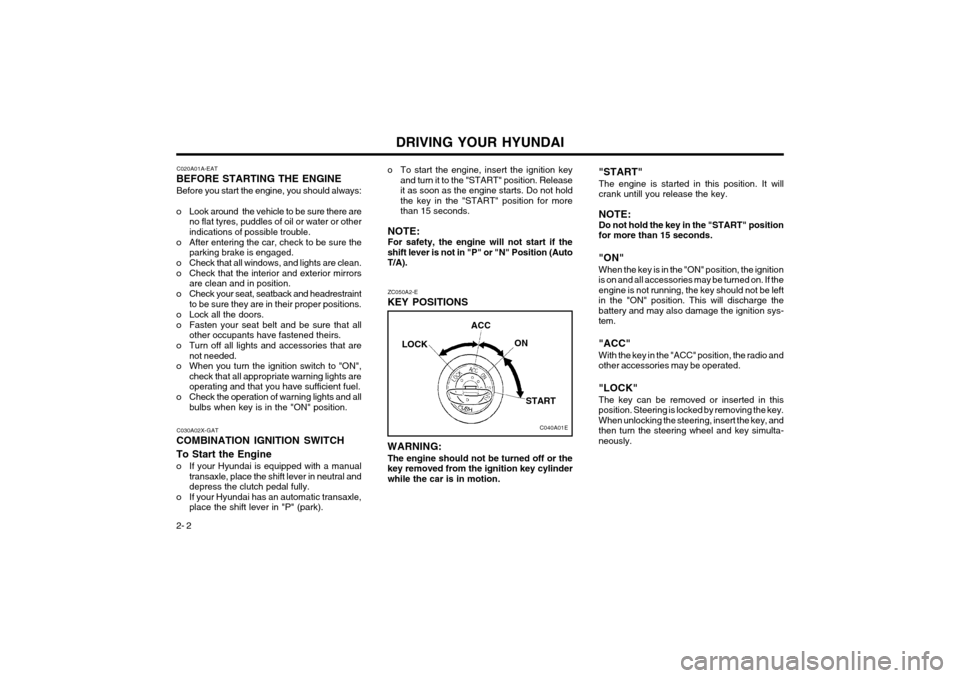
shift lever is not in "P" or "N" Position (AutoT/A). ZC050A2-E
KEY POSITIONS "START"
The engine is started in this position. It will crank untill you release the key. NOTE: Do not hold the key in the "START" position for more than 15 seconds.
"ON" When the key is in the "ON" position, the ignition is on and all accessories may be turned on. If theengine is not running, the key should not be leftin the "ON" position. This will discharge thebattery and may also damage the ignition sys-tem. "ACC" With the key in the "ACC" position, the radio and other accessories may be operated. "LOCK" The key can be removed or inserted in this position. Steering is locked by removing the key.When unlocking the steering, insert the key, andthen turn the steering wheel and key simulta-neously.
C040A01E
LOCK
ACC
ON
STARTC030A02X-GAT
COMBINATION IGNITION SWITCH To Start the Engine
o If your Hyundai is equipped with a manual transaxle, place the shift lever in neutral and depress the clutch pedal fully.
o If your Hyundai has an automatic transaxle, place the shift lever in "P" (park). WARNING:
The engine should not be turned off or thekey removed from the ignition key cylinderwhile the car is in motion.
Page 198 of 249
DRIVING YOUR HYUNDAI 2- 9
ZC170C1-E
Anti-freeze/Corrosion inhibitor The cooling system must always contain an
Ethylene-Glycol based anti-freeze solution. The system is filled during manufacture with solu-tion of the correct strength which should bechecked before the onset of winter and adjust-ed or changed as required.
NOTE: The anti-freeze solution contains a corro-
sion inhibitor to prevent degradation of the aluminum castings contained within theengine. Therefore, never, drain the systemand refill with water only.
In addition, anti-freeze solution must ALWAYS
be used in vehicles fitted with air conditioning,to prevent the heater matrix from freezing andsubsequently bursting with the refrigeration sys-tem in use. ZC170B1-E
Electrical System
Winter conditions impose severe demands upon
vehicle electrical systems, particularly the charg-ing circuit. The battery condition and perfor-mance along with the alternator performanceand drive belt condition should be checked priorto the onset of winter.
o Don’t "lug" or "over-rev" the engine. Lugging
is driving too slowly in too high a gearresulting in the engine bucking. If this hap-pens to you, shift to a lower gear. Over-revving is racing the engine beyond its safe limit. This can be avoided by shifting atthe recommended speeds.
o Use your air conditioning sparingly. The air conditioning system is operated by the en-gine power so your fuel economy is reducedwhen you use it.
SC160A1-F
SMOOTH CORNERING Avoid braking or gear changing in corners,
especially when roads are wet. Ideally, cornersshould always be taken under gentle accelera-tion. If you follow these suggestions, tire wearwill be held to a minimum.
SC170A1-E
WINTER MOTORING The onset of winter conditions subject motor
vehicles to greater operating demands. There-fore, the following suggestions will assist inmaintaining peak performance and reliabilityduring these periods: ZC170D1-E
Door Locks
Should the door lock mechanism become fro-
zen, a proprietary lock de-icer should be used.Alternatively, warming the door key may thawthe door lock. However, the key should behandled carefully to avoid burning the fingers.
Never attempt to thaw a frozen door lock using
hot water, since the water will eventually freezeand compound the problem.
NOTE:The proper temperature for using the immo-
bilizer key is from -40°F to 176°F(from -40°Cto 80°C). If you heat the immobilizer keyover 176°F(80°C) to open the frozen lock, itmay cause damage to the transponder in itshead.
ZC170E1-E
Windscreen Washers & Wipers The windscreen washer bottle should be filled
with a solution of water and a proprietary winterscreen wash additive. The windscreen wipersshould not be used it the blades are frozen tothe windscreen or if they are covered withsnow, before this is removed.
NOTE: Never allow undiluted screen washer fluid
additive to spill upon the paintwork or use engine coolant anti-freeze since damage tothe paintwork may result.