light Hyundai Atos 2002 User Guide
[x] Cancel search | Manufacturer: HYUNDAI, Model Year: 2002, Model line: Atos, Model: Hyundai Atos 2002Pages: 249, PDF Size: 3.11 MB
Page 37 of 249
FEATURES OF YOUR HYUNDAI
FEATURES OF YOUR HYUNDAI FEATURES OF YOUR HYUNDAI
FEATURES OF YOUR HYUNDAI
FEATURES OF YOUR HYUNDAI
1- 28
B550A01FB550A01V
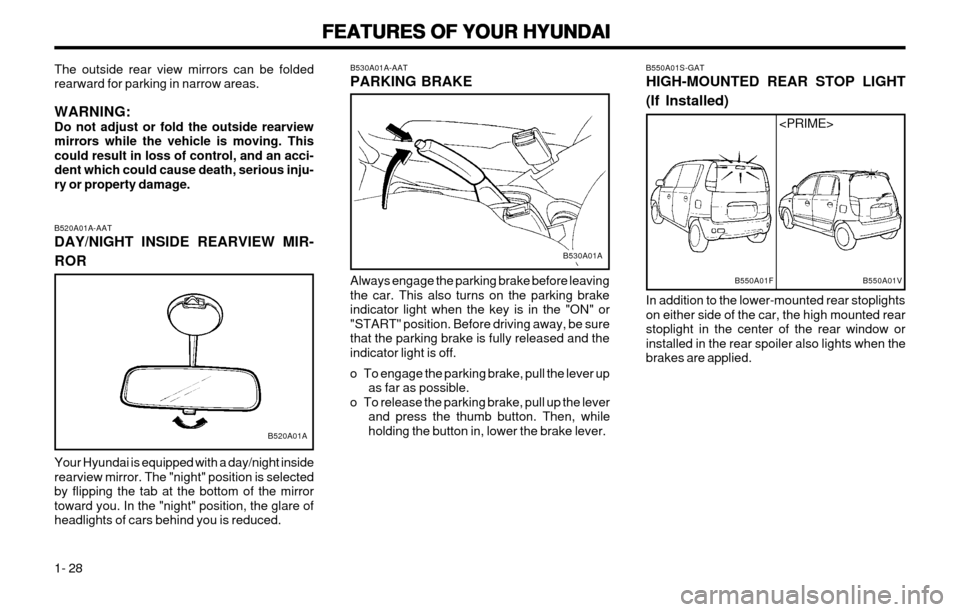
B550A01S-GAT HIGH-MOUNTED REAR STOP LIGHT (If Installed) In addition to the lower-mounted rear stoplights on either side of the car, the high mounted rearstoplight in the center of the rear window orinstalled in the rear spoiler also lights when thebrakes are applied.
Always engage the parking brake before leavingthe car. This also turns on the parking brakeindicator light when the key is in the "ON" or"START" position. Before driving away, be surethat the parking brake is fully released and theindicator light is off.
o To engage the parking brake, pull the lever up
as far as possible.
o To release the parking brake, pull up the lever and press the thumb button. Then, while holding the button in, lower the brake lever.
B530A01A-AAT PARKING BRAKE
B530A01A
B520A01A-AAT DAY/NIGHT INSIDE REARVIEW MIR- ROR Your Hyundai is equipped with a day/night inside rearview mirror. The "night" position is selectedby flipping the tab at the bottom of the mirrortoward you. In the "night" position, the glare ofheadlights of cars behind you is reduced.
The outside rear view mirrors can be foldedrearward for parking in narrow areas. WARNING: Do not adjust or fold the outside rearviewmirrors while the vehicle is moving. Thiscould result in loss of control, and an acci-dent which could cause death, serious inju-ry or property damage.
B520A01A
Page 40 of 249
FEATURES OF YOUR HYUNDAI
FEATURES OF YOUR HYUNDAI FEATURES OF YOUR HYUNDAI
FEATURES OF YOUR HYUNDAI
FEATURES OF YOUR HYUNDAI
1- 31
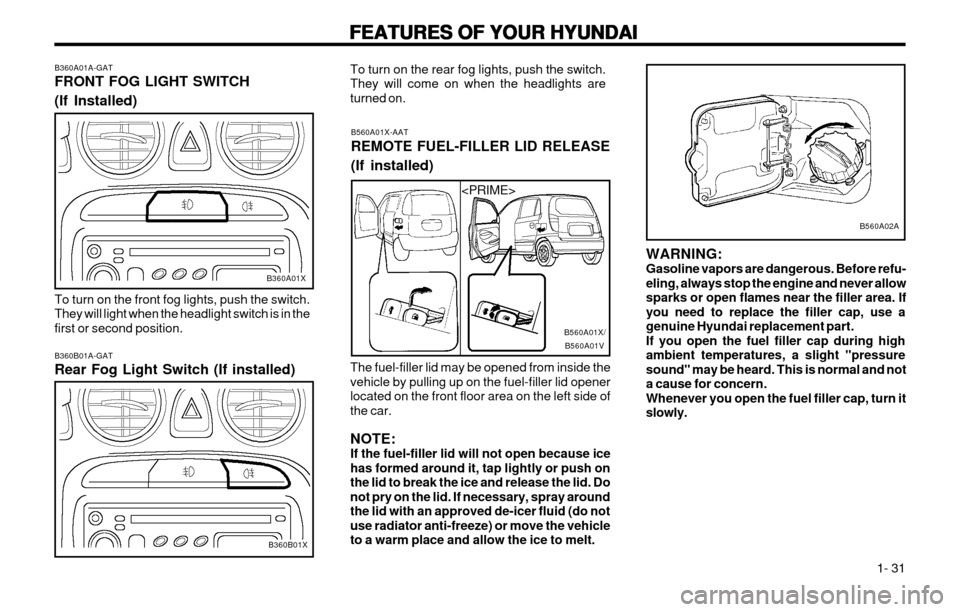
B560A01X-AAT REMOTE FUEL-FILLER LID RELEASE (If installed)
The fuel-filler lid may be opened from inside the vehicle by pulling up on the fuel-filler lid openerlocated on the front floor area on the left side ofthe car. NOTE: If the fuel-filler lid will not open because icehas formed around it, tap lightly or push onthe lid to break the ice and release the lid. Donot pry on the lid. If necessary, spray around
the lid with an approved de-icer fluid (do notuse radiator anti-freeze) or move the vehicleto a warm place and allow the ice to melt.
To turn on the rear fog lights, push the switch.They will come on when the headlights areturned on.
B560A01V
B560A01X/
B360A01A-GAT FRONT FOG LIGHT SWITCH (If Installed) To turn on the front fog lights, push the switch. They will light when the headlight switch is in thefirst or second position. B360B01A-GAT Rear Fog Light Switch (If installed)
B360A01X
B360B01X WARNING: Gasoline vapors are dangerous. Before refu-
eling, always stop the engine and never allowsparks or open flames near the filler area. Ifyou need to replace the filler cap, use agenuine Hyundai replacement part.If you open the fuel filler cap during highambient temperatures, a slight "pressuresound" may be heard. This is normal and nota cause for concern.Whenever you open the fuel filler cap, turn itslowly.
B560A02A
Page 61 of 249
FEATURES OF YOUR HYUNDAI
FEATURES OF YOUR HYUNDAI FEATURES OF YOUR HYUNDAI
FEATURES OF YOUR HYUNDAI
FEATURES OF YOUR HYUNDAI
1- 52
B850A01F-AAT CARE OF DISC Proper Handling
YL11240B
YL11250B
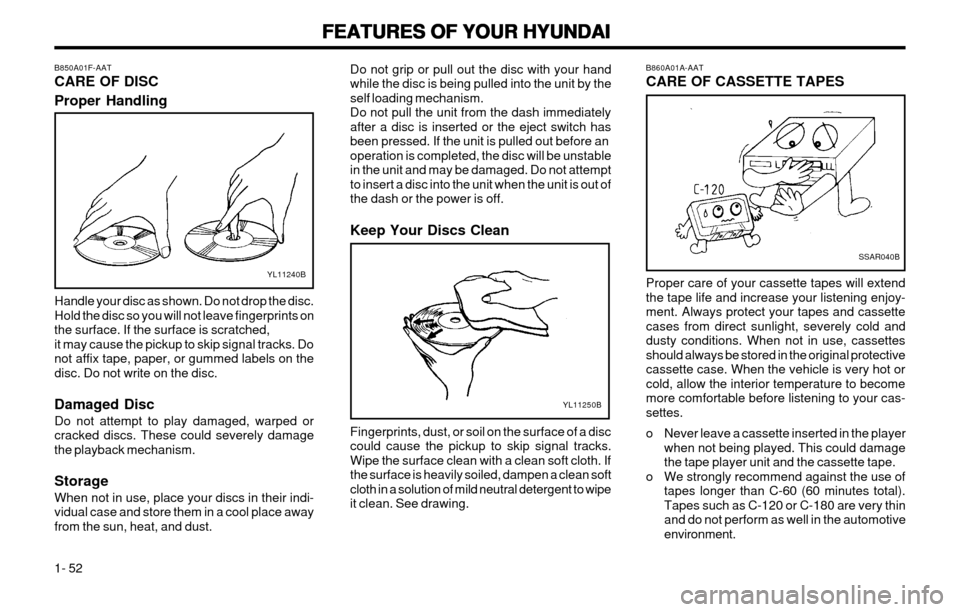
Handle your disc as shown. Do not drop the disc. Hold the disc so you will not leave fingerprints onthe surface. If the surface is scratched,it may cause the pickup to skip signal tracks. Donot affix tape, paper, or gummed labels on thedisc. Do not write on the disc. Damaged Disc Do not attempt to play damaged, warped or cracked discs. These could severely damagethe playback mechanism. Storage When not in use, place your discs in their indi- vidual case and store them in a cool place awayfrom the sun, heat, and dust.
Do not grip or pull out the disc with your handwhile the disc is being pulled into the unit by theself loading mechanism.Do not pull the unit from the dash immediatelyafter a disc is inserted or the eject switch hasbeen pressed. If the unit is pulled out before anoperation is completed, the disc will be unstablein the unit and may be damaged. Do not attemptto insert a disc into the unit when the unit is out ofthe dash or the power is off. Keep Your Discs Clean Fingerprints, dust, or soil on the surface of a disc could cause the pickup to skip signal tracks.Wipe the surface clean with a clean soft cloth. Ifthe surface is heavily soiled, dampen a clean softcloth in a solution of mild neutral detergent to wipeit clean. See drawing.
B860A01A-AAT CARE OF CASSETTE TAPES
SSAR040B
Proper care of your cassette tapes will extend the tape life and increase your listening enjoy-ment. Always protect your tapes and cassettecases from direct sunlight, severely cold anddusty conditions. When not in use, cassettesshould always be stored in the original protectivecassette case. When the vehicle is very hot orcold, allow the interior temperature to becomemore comfortable before listening to your cas-settes.
o Never leave a cassette inserted in the player
when not being played. This could damage the tape player unit and the cassette tape.
o We strongly recommend against the use of tapes longer than C-60 (60 minutes total).Tapes such as C-120 or C-180 are very thinand do not perform as well in the automotiveenvironment.
Page 65 of 249
DRIVING YOUR HYUNDAI
DRIVING YOUR HYUNDAI DRIVING YOUR HYUNDAI
DRIVING YOUR HYUNDAI
DRIVING YOUR HYUNDAI
2- 2 C020A01A-AAT
BEFORE STARTING THE ENGINE
BEFORE STARTING THE ENGINE BEFORE STARTING THE ENGINE
BEFORE STARTING THE ENGINE
BEFORE STARTING THE ENGINE
Before you start the engine, you should always:
1. Look around the vehicle to be sure there are no flat tires, puddles of oil, water or other indications of possible trouble.
2. After entering the car, check to be sure the parking brake is engaged.
3. Check that all windows, and lights are clean.
4. Check that the interior and exterior mirrors are clean and in position.
5. Check your seat, seatback and headrest to be sure they are in their proper positions.
6. Lock all the doors.
7. Fasten your seat belt and be sure that all other occupants have fastened theirs.
8. Turn off all lights and accessories that are not needed.
9. When you turn the ignition switch to "ON", check that all appropriate warning lights are operating and that you have sufficient fuel.
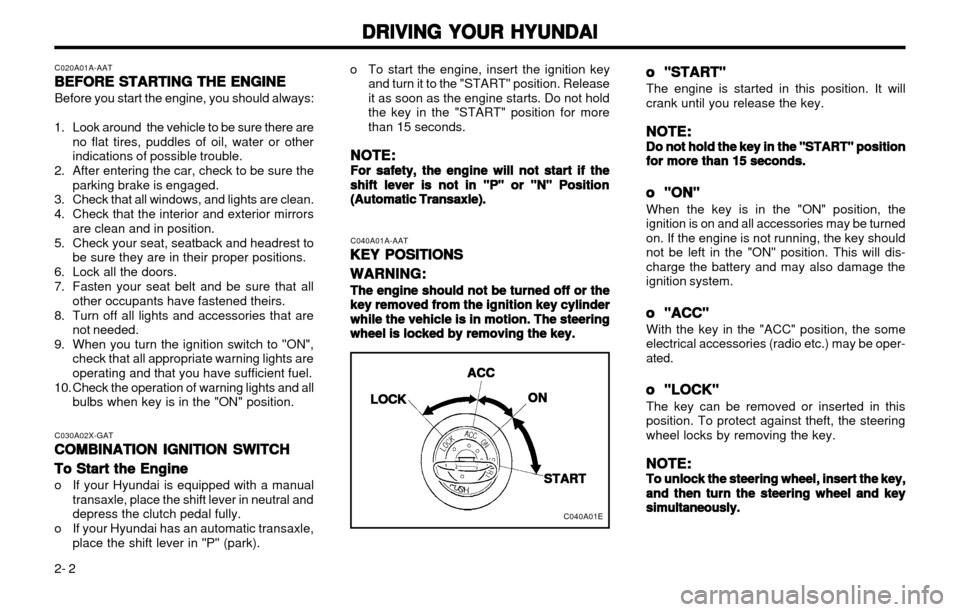
10. Check the operation of warning lights and all bulbs when key is in the "ON" position. o To start the engine, insert the ignition key
and turn it to the "START" position. Releaseit as soon as the engine starts. Do not hold
the key in the "START" position for morethan 15 seconds.
NOTE:
NOTE: NOTE:
NOTE:
NOTE:
For safety, the engine will not start if the
For safety, the engine will not start if the For safety, the engine will not start if the
For safety, the engine will not start if the
For safety, the engine will not start if the
shift lever is not
shift lever is not shift lever is not
shift lever is not
shift lever is not in "P" or "N" Position
in "P" or "N" Position in "P" or "N" Position
in "P" or "N" Position
in "P" or "N" Position
(Automatic Transaxle).
(Automatic Transaxle). (Automatic Transaxle).
(Automatic Transaxle).
(Automatic Transaxle). C040A01A-AAT
KEY POSITIONS
KEY POSITIONS KEY POSITIONS
KEY POSITIONS
KEY POSITIONS
WARNING:
WARNING: WARNING:
WARNING:
WARNING:
The engine should not be turned off or the
The engine should not be turned off or the The engine should not be turned off or the
The engine should not be turned off or the
The engine should not be turned off or the
key removed from
key removed from key removed from
key removed from
key removed from the ignition key cylinder
the ignition key cylinder the ignition key cylinder
the ignition key cylinder
the ignition key cylinder
while the vehicle is in motion. The steering
while the vehicle is in motion. The steering while the vehicle is in motion. The steering
while the vehicle is in motion. The steering
while the vehicle is in motion. The steering
wheel
wheel wheel
wheel
wheel is locked by removing the key.
is locked by removing the key. is locked by removing the key.
is locked by removing the key.
is locked by removing the key. oo
oo
o "START"
"START" "START"
"START"
"START"
The engine is started in this position. It will crank until you release the key.
NOTE:
NOTE: NOTE:
NOTE:
NOTE:
Do not hold the key in the "START" position
Do not hold the key in the "START" position Do not hold the key in the "START" position
Do not hold the key in the "START" position
Do not hold the key in the "START" position
for more than 15 seconds.
for more than 15 seconds. for more than 15 seconds.
for more than 15 seconds.
for more than 15 seconds.
oo
oo
o
"ON"
"ON" "ON"
"ON"
"ON"
When the key is in the "ON" position, the
ignition is on and all accessories may be turnedon. If the engine is not running, the key shouldnot be left in the "ON" position. This will dis-
charge the battery and may also damage theignition system.
oo
oo
o "ACC"
"ACC" "ACC"
"ACC"
"ACC"
With the key in the "ACC" position, the some
electrical accessories (radio etc.) may be oper-ated.
oo
oo
o "LOCK"
"LOCK" "LOCK"
"LOCK"
"LOCK"
The key can be removed or inserted in thisposition. To protect against theft, the steeringwheel locks by removing the key.
NOTE:
NOTE: NOTE:
NOTE:
NOTE:
To unlock the steering wheel, insert the key,
To unlock the steering wheel, insert the key, To unlock the steering wheel, insert the key,
To unlock the steering wheel, insert the key,
To unlock the steering wheel, insert the key,
and then turn the
and then turn the and then turn the
and then turn the
and then turn the
steering wheel and key
steering wheel and key steering wheel and key
steering wheel and key
steering wheel and key
simultaneously.
simultaneously. simultaneously.
simultaneously.
simultaneously.
C030A02X-GAT
COMBINATION IGNITION SWITCH
COMBINATION IGNITION SWITCH COMBINATION IGNITION SWITCH
COMBINATION IGNITION SWITCH
COMBINATION IGNITION SWITCH
To Start the Engine
To Start the Engine To Start the Engine
To Start the Engine
To Start the Engine
o If your Hyundai is equipped with a manual
transaxle, place the shift lever in neutral and depress the clutch pedal fully.
o If your Hyundai has an automatic transaxle, place the shift lever in "P" (park).
C040A01E
LOCK
LOCK LOCK
LOCK
LOCK ACC
ACC ACC
ACC
ACC
ONON
ONON
ON
START
START START
START
START
Page 66 of 249
DRIVING YOUR HYUNDAI
DRIVING YOUR HYUNDAI DRIVING YOUR HYUNDAI
DRIVING YOUR HYUNDAI
DRIVING YOUR HYUNDAI
2- 3
C050A01X-GAT
STARTING
STARTING STARTING
STARTING
STARTING
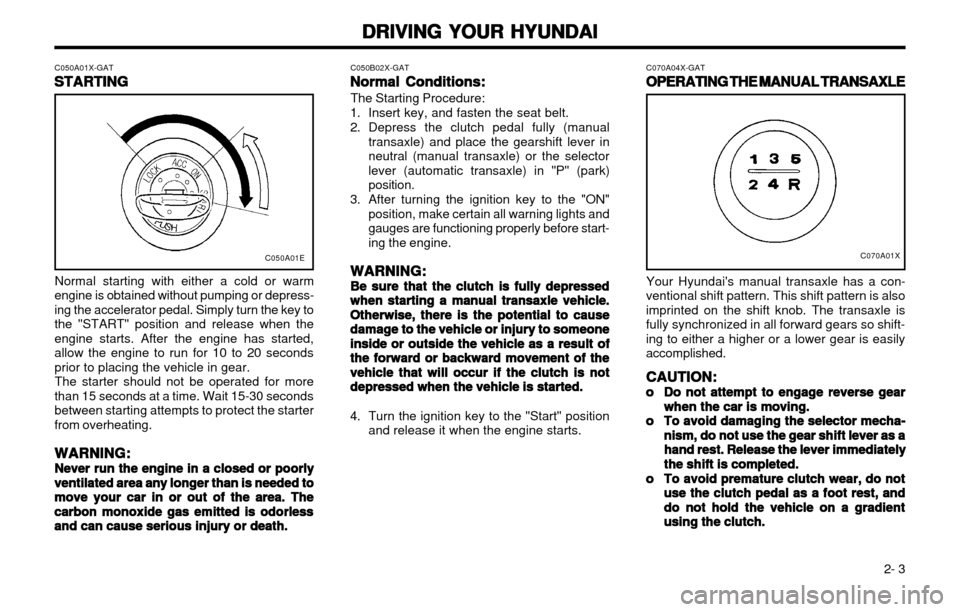
Normal starting with either a cold or warm
engine is obtained without pumping or depress-
ing the accelerator pedal. Simply turn the key tothe "START" position and release when theengine starts. After the engine has started,allow the engine to run for 10 to 20 secondsprior to placing the vehicle in gear. The starter should not be operated for more
than 15 seconds at a time. Wait 15-30 secondsbetween starting attempts to protect the starterfrom overheating.
WARNING:
WARNING: WARNING:
WARNING:
WARNING:
Never run the engine in a closed or poorly
Never run the engine in a closed or poorly Never run the engine in a closed or poorly
Never run the engine in a closed or poorly
Never run the engine in a closed or poorly ventilated area
ventilated area ventilated area
ventilated area
ventilated area any longer than is needed to
any longer than is needed to any longer than is needed to
any longer than is needed to
any longer than is needed to
move your car in or out of the area. The
move your car in or out of the area. The move your car in or out of the area. The
move your car in or out of the area. The
move your car in or out of the area. The
carbon
carbon carbon
carbon
carbon monoxide gas emitted is odorless
monoxide gas emitted is odorless monoxide gas emitted is odorless
monoxide gas emitted is odorless
monoxide gas emitted is odorless
and can cause serious injury or death.
and can cause serious injury or death. and can cause serious injury or death.
and can cause serious injury or death.
and can cause serious injury or death. C050B02X-GAT
Normal Conditions:
Normal Conditions: Normal Conditions:
Normal Conditions:
Normal Conditions:
The Starting Procedure:
1. Insert key, and fasten the seat belt.
2. Depress the clutch pedal fully (manual transaxle) and place the gearshift lever in neutral (manual transaxle) or the selectorlever (automatic transaxle) in "P" (park)position.
3. After turning the ignition key to the "ON" position, make certain all warning lights andgauges are functioning properly before start-
ing the engine.
WARNING:
WARNING: WARNING:
WARNING:
WARNING:
Be sure that the clutch is fully depressed
Be sure that the clutch is fully depressed Be sure that the clutch is fully depressed
Be sure that the clutch is fully depressed
Be sure that the clutch is fully depressed when starting a
when starting a when starting a
when starting a
when starting a manual transaxle vehicle.
manual transaxle vehicle. manual transaxle vehicle.
manual transaxle vehicle.
manual transaxle vehicle.
Otherwise, there is the potential to cause
Otherwise, there is the potential to cause Otherwise, there is the potential to cause
Otherwise, there is the potential to cause
Otherwise, there is the potential to cause
damage
damage damage
damage
damage to the vehicle or injury to someone
to the vehicle or injury to someone to the vehicle or injury to someone
to the vehicle or injury to someone
to the vehicle or injury to someone
inside or outside the vehicle as a result
inside or outside the vehicle as a result inside or outside the vehicle as a result
inside or outside the vehicle as a result
inside or outside the vehicle as a result ofof
ofof
of
the forward or backward movement of the
the forward or backward movement of the the forward or backward movement of the
the forward or backward movement of the
the forward or backward movement of the
vehicle that will occur if the
vehicle that will occur if the vehicle that will occur if the
vehicle that will occur if the
vehicle that will occur if the clutch is not
clutch is not clutch is not
clutch is not
clutch is not
depressed when the vehicle is started.
depressed when the vehicle is started. depressed when the vehicle is started.
depressed when the vehicle is started.
depressed when the vehicle is started.
4. Turn the ignition key to the "Start" position
and release it when the engine starts. C070A04X-GAT
OPERATING THE MANUAL TRANSAXLE
OPERATING THE MANUAL TRANSAXLE OPERATING THE MANUAL TRANSAXLE
OPERATING THE MANUAL TRANSAXLE
OPERATING THE MANUAL TRANSAXLE
C070A01X
Your Hyundai's manual transaxle has a con-
ventional shift pattern. This shift pattern is also imprinted on the shift knob. The transaxle isfully synchronized in all forward gears so shift-
ing to either a higher or a lower gear is easilyaccomplished.
CAUTION:
CAUTION: CAUTION:
CAUTION:
CAUTION:
oo
oo
o Do not attempt to engage reverse gear
Do not attempt to engage reverse gear Do not attempt to engage reverse gear
Do not attempt to engage reverse gear
Do not attempt to engage reverse gear
when the
when the when the
when the
when the car is moving.
car is moving. car is moving.
car is moving.
car is moving.
oo
oo
o To avoid damaging the selector mecha-
To avoid damaging the selector mecha- To avoid damaging the selector mecha-
To avoid damaging the selector mecha-
To avoid damaging the selector mecha-
nism, do not use the gear
nism, do not use the gear nism, do not use the gear
nism, do not use the gear
nism, do not use the gear shift lever as a
shift lever as a shift lever as a
shift lever as a
shift lever as a
hand rest. Release the lever immediately
hand rest. Release the lever immediately hand rest. Release the lever immediately
hand rest. Release the lever immediately
hand rest. Release the lever immediately
the shift is completed.
the shift is completed. the shift is completed.
the shift is completed.
the shift is completed.
oo
oo
o To avoid premature clutch wear, do not
To avoid premature clutch wear, do not To avoid premature clutch wear, do not
To avoid premature clutch wear, do not
To avoid premature clutch wear, do not
use the clutch pedal as
use the clutch pedal as use the clutch pedal as
use the clutch pedal as
use the clutch pedal as
a foot rest, and
a foot rest, and a foot rest, and
a foot rest, and
a foot rest, and
do not hold the vehicle on a gradient
do not hold the vehicle on a gradient do not hold the vehicle on a gradient
do not hold the vehicle on a gradient
do not hold the vehicle on a gradient
using the clutch.
using the clutch. using the clutch.
using the clutch.
using the clutch.
C050A01E
Page 70 of 249

DRIVING YOUR HYUNDAI
DRIVING YOUR HYUNDAI DRIVING YOUR HYUNDAI
DRIVING YOUR HYUNDAI
DRIVING YOUR HYUNDAI
2- 7
C130A01A-AAT
GOOD BRAKING PRACTICES
GOOD BRAKING PRACTICES GOOD BRAKING PRACTICES
GOOD BRAKING PRACTICES
GOOD BRAKING PRACTICES
WARNING:
WARNING: WARNING:
WARNING:
WARNING:
Do not allow passengers to sit on the cargo
Do not allow passengers to sit on the cargo Do not allow passengers to sit on the cargo
Do not allow passengers to sit on the cargo
Do not allow passengers to sit on the cargo
area while the
area while the area while the
area while the
area while the car is moving as this is not a
car is moving as this is not a car is moving as this is not a
car is moving as this is not a
car is moving as this is not a
proper seating position and no seat belts
proper seating position and no seat belts proper seating position and no seat belts
proper seating position and no seat belts
proper seating position and no seat belts
are are
are are
are available for use when the seat back is
available for use when the seat back is available for use when the seat back is
available for use when the seat back is
available for use when the seat back is
folded down. This could result in
folded down. This could result in folded down. This could result in
folded down. This could result in
folded down. This could result in serious
serious serious
serious
serious
injury or death in case of an accident or a
injury or death in case of an accident or a injury or death in case of an accident or a
injury or death in case of an accident or a
injury or death in case of an accident or a
sudden stop. Objects should
sudden stop. Objects should sudden stop. Objects should
sudden stop. Objects should
sudden stop. Objects should not extend
not extend not extend
not extend
not extend
higher than the top of the front seats. This
higher than the top of the front seats. This higher than the top of the front seats. This
higher than the top of the front seats. This
higher than the top of the front seats. This
could allow cargo
could allow cargo could allow cargo
could allow cargo
could allow cargo
to slide forward and cause
to slide forward and cause to slide forward and cause
to slide forward and cause
to slide forward and cause
injury or damage during sudden stops.
injury or damage during sudden stops. injury or damage during sudden stops.
injury or damage during sudden stops.
injury or damage during sudden stops.
o After being parked, check to be sure the parking brake is not engaged and that the parking brake indicator light is out beforedriving away.
o Driving through water may get the brakes wet. They can also get wet when the car iswashed. Wet brakes can be dangerous!
Your car will not stop as quickly if the brakesare wet and it may also pull to one side. Todry the brakes, apply the brakes lightly untilthe braking action returns to normal, takingcare to keep the car under control at alltimes. If the braking action does not return tonormal, stop as soon as it is safe to do soand call your Hyundai dealer for assistance.
o Don't coast down hills with the car out of gear. This is extremely hazardous. Keep thecar in gear at all times, use the brakes toslow down, then shift to a lower gear so thatengine braking will help you maintain a safespeed.
o Exercise extreme caution when driving on a
slippery surface. Be especially careful whenbraking, accelerating or shifting gears. On aslippery surface, an abrupt change in ve-hicle speed can cause the drive wheels tolose traction and the vehicle to go out ofcontrol.
o Turn the overdrive switch on for good fuel economy and smooth driving. If engine brak-ing is needed in the "D" range or if repeatedupshifting and downshifting between 3rd and4th gear is needed when climbing a gentleslope, it is recommended that the overdriveswitch be turned off. Turn the overdriveswitch back on immediately afterward.
CAUTION:
CAUTION: CAUTION:
CAUTION:
CAUTION:
oo
oo
o The risk of rollover is greatly increased if
The risk of rollover is greatly increased if The risk of rollover is greatly increased if
The risk of rollover is greatly increased if
The risk of rollover is greatly increased if
you lose control of your vehicle at high-
you lose control of your vehicle at high- you lose control of your vehicle at high-
you lose control of your vehicle at high-
you lose control of your vehicle at high-
way speeds.
way speeds. way speeds.
way speeds.
way speeds.
oo
oo
o Loss of control often occurs if two or
Loss of control often occurs if two or Loss of control often occurs if two or
Loss of control often occurs if two or
Loss of control often occurs if two or
more wheels drop off the roadway and
more wheels drop off the roadway and more wheels drop off the roadway and
more wheels drop off the roadway and
more wheels drop off the roadway and
the driver oversteers to reenter the road-
the driver oversteers to reenter the road- the driver oversteers to reenter the road-
the driver oversteers to reenter the road-
the driver oversteers to reenter the road-
way.
way. way.
way.
way.
oo
oo
o In the event your vehicle leaves the road-
In the event your vehicle leaves the road- In the event your vehicle leaves the road-
In the event your vehicle leaves the road-
In the event your vehicle leaves the road-
way, do not steer sharply. Instead, slow
way, do not steer sharply. Instead, slow way, do not steer sharply. Instead, slow
way, do not steer sharply. Instead, slow
way, do not steer sharply. Instead, slow
down before pulling back into the travel
down before pulling back into the travel down before pulling back into the travel
down before pulling back into the travel
down before pulling back into the travel
lanes.
lanes. lanes.
lanes.
lanes.
oo
oo
o In a collision crash, on unbelted person
In a collision crash, on unbelted person In a collision crash, on unbelted person
In a collision crash, on unbelted person
In a collision crash, on unbelted person
is significantly more likely to die than a
is significantly more likely to die than a is significantly more likely to die than a
is significantly more likely to die than a
is significantly more likely to die than a
person wearing a seatbelt.
person wearing a seatbelt. person wearing a seatbelt.
person wearing a seatbelt.
person wearing a seatbelt.
C090N02A-AAT
Good Driving Practices
Good Driving Practices Good Driving Practices
Good Driving Practices
Good Driving Practices
o Never move the gear selector lever from "P"
or "N" to any other position with the acceler- ator pedal depressed.
o Never move the gear selector lever into "P" when the vehicle is in motion.
o Be sure the car is completely stopped be- fore you attempt to shift into "R".
o Never take the car out of gear and coast down a hill. This may be extremely hazard-ous. Always leave the car in gear whenmoving.
o Do not "ride" the brakes. This can cause them to overheat and malfunction. Instead,when you are driving down a long hill, slowdown and shift to a lower gear. When you dothis, engine braking will help slow the car.
o Slow down before shifting to a lower gear. Otherwise, the lower gear may not be en-gaged.
o Always use the parking brake. Do not de- pend on placing the transaxle in "P" to keepthe car from moving.
drive switch is turned off, the transaxle will notupshift to the overdrive gear. For normal driv-ing, the selector lever should be left in the "D"position and the overdrive switch turned on.
If you need to accelerate rapidly, press the
accelerator pedal all the way to the floor. Thetransaxle will automatically shift to a lower gear,depending on the vehicle speed and load.
Page 71 of 249
DRIVING YOUR HYUNDAI
DRIVING YOUR HYUNDAI DRIVING YOUR HYUNDAI
DRIVING YOUR HYUNDAI
DRIVING YOUR HYUNDAI
2- 8 WARNING:
WARNING: WARNING:
WARNING:
WARNING:
Your ABS will not prevent accidents due to
Your ABS will not prevent accidents due to Your ABS will not prevent accidents due to
Your ABS will not prevent accidents due to
Your ABS will not prevent accidents due to improper or dangerous
improper or dangerous improper or dangerous
improper or dangerous
improper or dangerous
driving maneuvers.
driving maneuvers. driving maneuvers.
driving maneuvers.
driving maneuvers.
Even though vehicle control is improved
Even though vehicle control is improved Even though vehicle control is improved
Even though vehicle control is improved
Even though vehicle control is improved
during emergency
during emergency during emergency
during emergency
during emergency
braking, always maintain
braking, always maintain braking, always maintain
braking, always maintain
braking, always maintain
a safe distance between you and objects
a safe distance between you and objects a safe distance between you and objects
a safe distance between you and objects
a safe distance between you and objects
ahead. Vehicle
ahead. Vehicle ahead. Vehicle
ahead. Vehicle
ahead. Vehicle
speeds should always be
speeds should always be speeds should always be
speeds should always be
speeds should always be
reduced during extreme road conditions.
reduced during extreme road conditions. reduced during extreme road conditions.
reduced during extreme road conditions.
reduced during extreme road conditions.
The braking distance for cars equipped with
The braking distance for cars equipped with The braking distance for cars equipped with
The braking distance for cars equipped with
The braking distance for cars equipped withan anti-lock braking system
an anti-lock braking system an anti-lock braking system
an anti-lock braking system
an anti-lock braking system may be longer
may be longer may be longer
may be longer
may be longer
than for those without it in the following
than for those without it in the following than for those without it in the following
than for those without it in the following
than for those without it in the following
road conditions.
road conditions. road conditions.
road conditions.
road conditions.
oo
oo
o Driving on rough, gravel or snow-cov-
Driving on rough, gravel or snow-cov- Driving on rough, gravel or snow-cov-
Driving on rough, gravel or snow-cov-
Driving on rough, gravel or snow-cov-
ered roads.
ered roads. ered roads.
ered roads.
ered roads.
oo
oo
o Driving with tire chains installed.
Driving with tire chains installed. Driving with tire chains installed.
Driving with tire chains installed.
Driving with tire chains installed.
oo
oo
o Driving on roads where the road surface
Driving on roads where the road surface Driving on roads where the road surface
Driving on roads where the road surface
Driving on roads where the road surface
is pitted or has different
is pitted or has different is pitted or has different
is pitted or has different
is pitted or has different surface height.
surface height. surface height.
surface height.
surface height.
During these conditions the vehicle
During these conditions the vehicle During these conditions the vehicle
During these conditions the vehicle
During these conditions the vehicle should
should should
should
should
be driven at reduced speeds. The safety
be driven at reduced speeds. The safety be driven at reduced speeds. The safety
be driven at reduced speeds. The safety
be driven at reduced speeds. The safety
features
features features
features
features of an ABS equipped vehicle should
of an ABS equipped vehicle should of an ABS equipped vehicle should
of an ABS equipped vehicle should
of an ABS equipped vehicle should
not be tested by high speed driving or cor-
not be tested by high speed driving or cor- not be tested by high speed driving or cor-
not be tested by high speed driving or cor-
not be tested by high speed driving or cor-
nering.
nering. nering.
nering.
nering. This could endanger the safety of
This could endanger the safety of This could endanger the safety of
This could endanger the safety of
This could endanger the safety of
yourself or others.
yourself or others. yourself or others.
yourself or others.
yourself or others.
C120A02A-AAT
ANTI-LOCK BRAKE SYSTEM
ANTI-LOCK BRAKE SYSTEM ANTI-LOCK BRAKE SYSTEM
ANTI-LOCK BRAKE SYSTEM
ANTI-LOCK BRAKE SYSTEM
(If installed)
(If installed) (If installed)
(If installed)
(If installed)
The Anti-Lock Brake System (ABS) is designed
to prevent wheel lock-up during sudden braking or on hazardous road surfaces. The ABS con-
trol module monitors the wheel speed and con-trols the pressure applied to each brake. Thus,in emergency situations or on slick roads, ABSwill increase vehicle control during braking.
NOTE:
NOTE: NOTE:
NOTE:
NOTE:
During ABS operation, a slight pulsation
During ABS operation, a slight pulsation During ABS operation, a slight pulsation
During ABS operation, a slight pulsation
During ABS operation, a slight pulsation may be felt in the brake
may be felt in the brake may be felt in the brake
may be felt in the brake
may be felt in the brake
pedal when the
pedal when the pedal when the
pedal when the
pedal when the
brakes are applied. Also, a noise may be
brakes are applied. Also, a noise may be brakes are applied. Also, a noise may be
brakes are applied. Also, a noise may be
brakes are applied. Also, a noise may be
heard in the engine
heard in the engine heard in the engine
heard in the engine
heard in the engine
compartment while brak-
compartment while brak- compartment while brak-
compartment while brak-
compartment while brak-
ing. These conditions are normal and indi-
ing. These conditions are normal and indi- ing. These conditions are normal and indi-
ing. These conditions are normal and indi-
ing. These conditions are normal and indi-
cate that the
cate that the cate that the
cate that the
cate that the
anti-lock brake system is func-
anti-lock brake system is func- anti-lock brake system is func-
anti-lock brake system is func-
anti-lock brake system is func-
tioning properly.
tioning properly. tioning properly.
tioning properly.
tioning properly. put the gear selector lever in "P" (automatic) or in first or reverse gear (manual transaxle)and block the rear wheels so the car cannotroll. Then release the parking brake.
o Do not hold the vehicle on the upgrade with the accelerator pedal. This can cause thetransaxle to overheat. Always use the brake
pedal or parking brake.
o Don't "ride" the brake pedal. Resting your
foot on the brake pedal while driving can bedangerous because it can result in the brakesoverheating and losing their effectiveness. Italso increases the wear of the brake compo-nents.
o If a tire goes flat while you are driving, apply the brakes gently and keep the car pointedstraight ahead while you slow down. Whenyou are moving slowly enough for it to be
safe to do so, pull off the road and stop in asafe place.
o If your car is equipped with an automatic transaxle, don't let your car creep forward.To avoid creeping forward, keep your foot
on the brake pedal when the car is stopped.
o Use caution when parking on a hill. Engage the parking brake and place the gear selec-tor lever in "P" (automatic transaxle) or in
first or reverse gear (manual transaxle). Ifyour car is facing downhill, turn the frontwheels into the curb to help keep the carfrom rolling. If your car is facing uphill, turnthe front wheels away from the curb to helpkeep the car from rolling. If there is no curb
or if it is required by other conditions to keepthe car from rolling, block the wheels.
o Under some conditions your parking brake can freeze in the engaged position. This ismost likely to happen when there is an
accumulation of snow or ice around or nearthe rear brakes or if the brakes are wet. If
there is a risk that the parking brake may
freeze, apply it only temporarily while you
Page 72 of 249
DRIVING YOUR HYUNDAI
DRIVING YOUR HYUNDAI DRIVING YOUR HYUNDAI
DRIVING YOUR HYUNDAI
DRIVING YOUR HYUNDAI
2- 9
resulting in the engine bucking. If this hap- pens, shift to a lower gear. Over-revving isracing the engine beyond its safe limit. Thiscan be avoided by shifting at the recom-mended speeds.
o Use your air conditioning sparingly. The air conditioning system is operated by enginepower so your fuel economy is reducedwhen you use it.
C150A01A-AAT SMOOTH CORNERING
SMOOTH CORNERING SMOOTH CORNERING
SMOOTH CORNERING
SMOOTH CORNERING
Avoid braking or gear changing in corners,
especially when roads are wet. Ideally, cornersshould always be taken under gentle accelera-tion. If you follow these suggestions, tire wearwill be held to a minimum.
C160A01A-AATWINTER DRIVING
WINTER DRIVING WINTER DRIVING
WINTER DRIVING
WINTER DRIVING
The more severe weather conditions of winter
result in greater wear and other problems. Tominimize the problems of winter driving, youshould follow these suggestions:
C160B01A-GATSnowy or Icy Conditions
Snowy or Icy Conditions Snowy or Icy Conditions
Snowy or Icy Conditions
Snowy or Icy Conditions
To drive your vehicle in deep snow, it may be
necessary to use snow tires or to install tirechains on your tires. If snow tires are needed,
it is necessary to select tires equivalent in size
and type to the original equipment tires.
o Be sure that the wheels are aligned correct-
ly. Improper alignment can result from hittingcurbs or driving too fast over irregular sur-faces. Poor alignment causes faster tirewear and may also result in other problemsas well as greater fuel consumption.
o Keep your car in good condition. For better fuel economy and reduced maintenancecosts, maintain your car in accordance withthe maintenance schedule in Section 5. Ifyou drive your car in severe conditions,more frequent maintenance is required (seeSection 5 for details).
o Keep your car clean. For maximum service, your Hyundai should be kept clean and freeof corrosive materials. It is especially impor-tant that mud, dirt, ice, etc. not be allowed toaccumulate on the underside of the car. Thisextra weight can result in increased fuelconsumption and also contribute to corro-sion.
o Travel lightly. Don't carry unnecessary weight in your car. Weight reduces fuel economy.
o Don't let the engine idle longer than neces- sary. If you are waiting (and not in traffic),turn off your engine and restart only whenyou're ready to go.
o Remember, your Hyundai does not require extended warm-up. As soon as the engine isrunning smoothly, you can drive away. Invery cold weather, however, give your en-gine a slightly longer warm-up period.
o Don't "lug" or "over-rev" the engine. Lugging is driving too slowly in too high a gear
C140A01A-AAT
DRIVING FOR ECONOMY
DRIVING FOR ECONOMY DRIVING FOR ECONOMY
DRIVING FOR ECONOMY
DRIVING FOR ECONOMY
You can save fuel and get more kilometers from
your car if you follow these suggestions:
o Drive smoothly. Accelerate at a moderate rate. Don't make "jack-rabbit" starts or full- throttle shifts and maintain a steady cruisingspeed. Don't race between stoplights. Try toadjust your speed to that of the other trafficso you don't have to change speeds unnec-essarily. Avoid heavy traffic whenever pos-sible. Always maintain a safe distance fromother vehicles so you can avoid unneces-sary braking. This also reduces brake wear.
o Drive at a moderate speed. The faster you drive, the more fuel your car uses. Driving ata moderate speed, especially on the high-way, is one of the most effective ways toreduce fuel consumption.
o Don't "ride" the brake or clutch pedal. This can increase fuel consumption and alsoincrease wear on these components. In ad-dition, driving with your foot resting on thebrake pedal may cause the brakes to over-heat, which reduces their effectiveness andmay lead to more serious consequences.
o Take care of your tires. Keep them inflated to the recommended pressure. Incorrect in-flation, either too much or too little, results inunnecessary tire wear. Check the tire pres-sures at least once a month.
Page 74 of 249
DRIVING YOUR HYUNDAI
DRIVING YOUR HYUNDAI DRIVING YOUR HYUNDAI
DRIVING YOUR HYUNDAI
DRIVING YOUR HYUNDAI
2- 11
C190A01A-GAT
TRAILER OR VEHICLE TOWING
TRAILER OR VEHICLE TOWING TRAILER OR VEHICLE TOWING
TRAILER OR VEHICLE TOWING
TRAILER OR VEHICLE TOWING
If you are considering towing with your car, you
should first check with your Province Depart- ment of Motor Vehicles to determine their legal
requirements. Since laws vary from province to province the
requirements for towing trailers, cars, or other types of vehicles or apparatus may differ. Askyour Hyundai dealer for further details beforetowing.
CAUTION:
CAUTION: CAUTION:
CAUTION:
CAUTION:
Do not do any towing with your car during
Do not do any towing with your car during Do not do any towing with your car during
Do not do any towing with your car during
Do not do any towing with your car during its first 2,000 km (1,200 miles) in order to
its first 2,000 km (1,200 miles) in order to its first 2,000 km (1,200 miles) in order to
its first 2,000 km (1,200 miles) in order to
its first 2,000 km (1,200 miles) in order to
allow the engine to properly break in. Fail-
allow the engine to properly break in. Fail- allow the engine to properly break in. Fail-
allow the engine to properly break in. Fail-
allow the engine to properly break in. Fail-
ure to heed this caution may result in seri-
ure to heed this caution may result in seri- ure to heed this caution may result in seri-
ure to heed this caution may result in seri-
ure to heed this caution may result in seri-
ous engine or transaxle damage.
ous engine or transaxle damage. ous engine or transaxle damage.
ous engine or transaxle damage.
ous engine or transaxle damage.
C190B01S-AATTrailer Hitches
Trailer Hitches Trailer Hitches
Trailer Hitches
Trailer Hitches
Select the proper hitch and ball combination,
making sure that it's location is compatible with that of the trailer or vehicle being towed.
Use a quality non-equalizing hitch which distrib-
utes the tongue load uniformly throughout thechassis.
The hitch should be bolted securely to the car
and installed by a qualified technician. DO NOTUSE A HITCH DESIGNED FOR TEMPORARYINSTALLATION AND NEVER USE ONE THATATTACHES ONLY TO THE BUMPER.
C170A01A-AAT
HIGHER SPEED MOTORING
HIGHER SPEED MOTORING HIGHER SPEED MOTORING
HIGHER SPEED MOTORING
HIGHER SPEED MOTORING
Pre-Trip Inspections
Pre-Trip Inspections Pre-Trip Inspections
Pre-Trip Inspections
Pre-Trip Inspections 1. Tires:
Adjust the tire inflation pressures to specifica-
tion driving. Low tire inflation pressures will result in overheating and possible failure of thetires.
Avoid using worn or damaged tires which may
result in reduced traction or tire failure.
NOTE:
NOTE: NOTE:
NOTE:
NOTE:
Never exceed the maximum tire inflation
Never exceed the maximum tire inflation Never exceed the maximum tire inflation
Never exceed the maximum tire inflation
Never exceed the maximum tire inflation pressure shown on the tires.
pressure shown on the tires. pressure shown on the tires.
pressure shown on the tires.
pressure shown on the tires.
2. Fuel, engine coolant and engine oil:High speed travel consumes 1.5 times more
fuel than urban motoring. Do not forget to check both engine coolant and engine oil. 3. Drive belt:
A loose or damaged drive belt may result in
overheating of the engine.
C180A01A-AATUSE OF LIGHTS
USE OF LIGHTS USE OF LIGHTS
USE OF LIGHTS
USE OF LIGHTS
Check your lights regularly for correct operation
and always keep them clean. When driving during the day in conditions of poor visibility, itis helpful to drive with headlights on low beam.This enables you to be seen as well as to see.
rarily while you put the gear selector lever in"P" (automatic transaxle) or in first or reversegear (manual transaxle) and block the rearwheels so the car cannot roll. Then release theparking brake.
C160J01A-AATDon't Let Ice and Snow Accumulate
Don't Let Ice and Snow Accumulate Don't Let Ice and Snow Accumulate
Don't Let Ice and Snow Accumulate
Don't Let Ice and Snow Accumulate
Underneath
Underneath Underneath
Underneath
Underneath
Under some conditions, snow and ice can build
up under the fenders and interfere with thesteering. When driving in severe winter condi-tions where this may happen, you should peri-odically check underneath the car to be surethe movement of the front wheels and thesteering components are not obstructed.
C160K01A-AATCarry Emergency Equipment
Carry Emergency Equipment Carry Emergency Equipment
Carry Emergency Equipment
Carry Emergency Equipment
Depending on the severity of the weather where
you drive your car, you should carry appropri-ate emergency equipment. Some of the itemsyou may want to carry include tire chains, towstraps or chains, flashlight, emergency flares,sand, a shovel, jumper cables, a windowscraper, gloves, ground cloth, coveralls, a blan-ket, etc.
Page 76 of 249
DRIVING YOUR HYUNDAI
DRIVING YOUR HYUNDAI DRIVING YOUR HYUNDAI
DRIVING YOUR HYUNDAI
DRIVING YOUR HYUNDAI
2- 13
4. To maintain engine braking efficiency andelectrical charging performance, do not use fifth gear (manual transaxle) or overdrive(automatic transaxle).
5. Always secure items in the trailer to prevent load shift while driving.
6. Check the condition and air pressure of all tires on the trailer and your car. Low tirepressure can seriously affect the handling.Also check the spare tire.
7. The vehicle/trailer combination is more af- fected by crosswind and buffeting. When being passed by a large vehicle, keep a constant speed and steer straight ahead.If there is too much wind buffeting slowdown to get out of the other vehicle's airturbulence.
8. When parking your car and trailer, especial- ly on a hill, be sure to follow all the normalprecautions. Turn your front wheel into thecurb, set the parking brake firmly, and putthe transaxle in 1st or Reverse (manual) orPark (automatic). In addition, place wheelchocks at each of the trailer's tires.
9. If the trailer has electric brakes, start your vehicle and trailer moving, and then applythe trailer brake controller by hand to besure the brakes are working. This lets youcheck your electrical connection at the sametime.
10. During your trip, check occasionally to be sure that the load is secure, and that thelights and any trailer brakes are still working.
WARNING:
WARNING: WARNING:
WARNING:
WARNING:
oo
oo
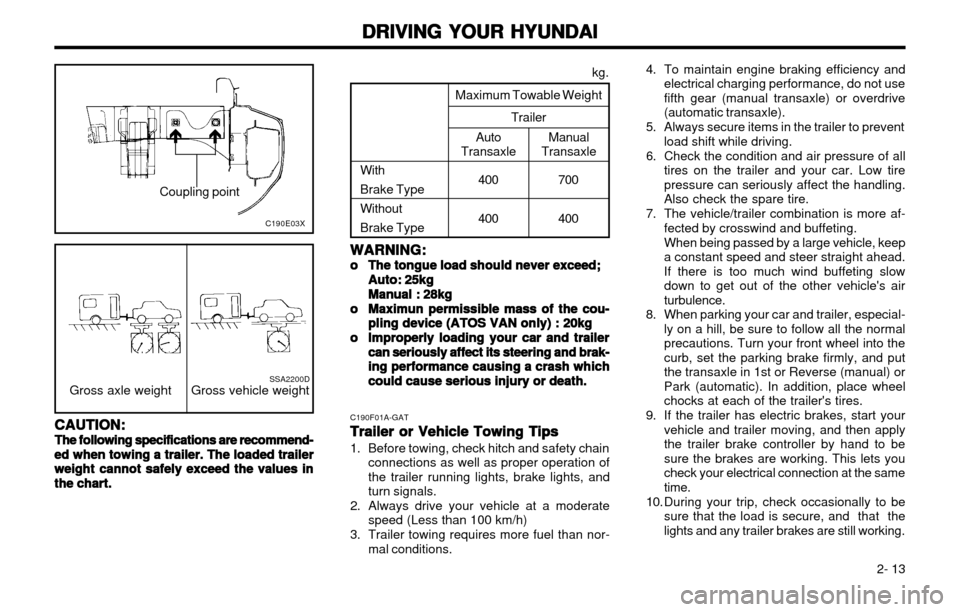
o The tongue load should never exceed;
The tongue load should never exceed; The tongue load should never exceed;
The tongue load should never exceed;
The tongue load should never exceed;
Auto: 25kg
Auto: 25kg Auto: 25kg
Auto: 25kg
Auto: 25kg
Manual : 28kg
Manual : 28kg Manual : 28kg
Manual : 28kg
Manual : 28kg
oo
oo
o Maximun permissible mass of the cou-
Maximun permissible mass of the cou- Maximun permissible mass of the cou-
Maximun permissible mass of the cou-
Maximun permissible mass of the cou-
pling device (ATOS VAN only) : 20kg
pling device (ATOS VAN only) : 20kg pling device (ATOS VAN only) : 20kg
pling device (ATOS VAN only) : 20kg
pling device (ATOS VAN only) : 20kg
oo
oo
o Improperly loading your car and trailer
Improperly loading your car and trailer Improperly loading your car and trailer
Improperly loading your car and trailer
Improperly loading your car and trailer
can seriously affect its steering and brak-
can seriously affect its steering and brak- can seriously affect its steering and brak-
can seriously affect its steering and brak-
can seriously affect its steering and brak-
ing performance causing a crash which
ing performance causing a crash which ing performance causing a crash which
ing performance causing a crash which
ing performance causing a crash which
could cause serious injury or death.
could cause serious injury or death. could cause serious injury or death.
could cause serious injury or death.
could cause serious injury or death. kg.
Maximum Towable Weight Trailer
Manual
TransaxleAuto
Transaxle
With Brake TypeWithoutBrake Type 400 400
C190F01A-GAT
Trailer or Vehicle Towing Tips
Trailer or Vehicle Towing Tips Trailer or Vehicle Towing Tips
Trailer or Vehicle Towing Tips
Trailer or Vehicle Towing Tips
1. Before towing, check hitch and safety chain
connections as well as proper operation of the trailer running lights, brake lights, andturn signals.
2. Always drive your vehicle at a moderate speed (Less than 100 km/h)
3. Trailer towing requires more fuel than nor- mal conditions.
Gross axle weight Gross vehicle weightSSA2200D
CAUTION:
CAUTION: CAUTION:
CAUTION:
CAUTION:
The following specifications are recommend-
The following specifications are recommend- The following specifications are recommend-
The following specifications are recommend-
The following specifications are recommend- ed when towing a
ed when towing a ed when towing a
ed when towing a
ed when towing a trailer. The loaded trailer
trailer. The loaded trailer trailer. The loaded trailer
trailer. The loaded trailer
trailer. The loaded trailer
weight cannot safely exceed the values in
weight cannot safely exceed the values in weight cannot safely exceed the values in
weight cannot safely exceed the values in
weight cannot safely exceed the values in
the the
the the
the chart.
chart. chart.
chart.
chart. Coupling point
C190E03X
700 400