light Hyundai Atos 2002 Workshop Manual
[x] Cancel search | Manufacturer: HYUNDAI, Model Year: 2002, Model line: Atos, Model: Hyundai Atos 2002Pages: 249, PDF Size: 3.11 MB
Page 191 of 249
DRIVING YOUR HYUNDAI
2- 2 C020A01A-EAT
BEFORE STARTING THE ENGINE
Before you start the engine, you should always:
o Look around the vehicle to be sure there are no flat tyres, puddles of oil or water or other indications of possible trouble.
o After entering the car, check to be sure the parking brake is engaged.
o Check that all windows, and lights are clean.
o Check that the interior and exterior mirrors are clean and in position.
o Check your seat, seatback and headrestraint to be sure they are in their proper positions.
o Lock all the doors.
o Fasten your seat belt and be sure that all other occupants have fastened theirs.
o Turn off all lights and accessories that are not needed.
o When you turn the ignition switch to "ON", check that all appropriate warning lights are operating and that you have sufficient fuel.
o Check the operation of warning lights and all bulbs when key is in the "ON" position. o To start the engine, insert the ignition key
and turn it to the "START" position. Releaseit as soon as the engine starts. Do not hold
the key in the "START" position for morethan 15 seconds.
NOTE: For safety, the engine will not start if the
shift lever is not in "P" or "N" Position (AutoT/A). ZC050A2-E
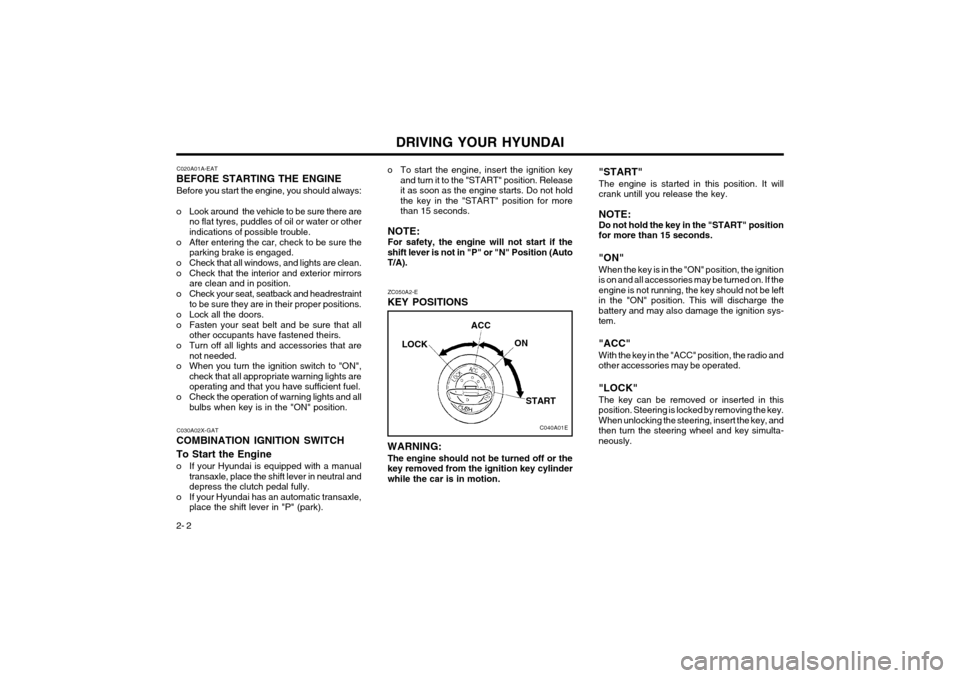
KEY POSITIONS "START"
The engine is started in this position. It will crank untill you release the key. NOTE: Do not hold the key in the "START" position for more than 15 seconds.
"ON" When the key is in the "ON" position, the ignition is on and all accessories may be turned on. If theengine is not running, the key should not be leftin the "ON" position. This will discharge thebattery and may also damage the ignition sys-tem. "ACC" With the key in the "ACC" position, the radio and other accessories may be operated. "LOCK" The key can be removed or inserted in this position. Steering is locked by removing the key.When unlocking the steering, insert the key, andthen turn the steering wheel and key simulta-neously.
C040A01E
LOCK
ACC
ON
STARTC030A02X-GAT
COMBINATION IGNITION SWITCH To Start the Engine
o If your Hyundai is equipped with a manual transaxle, place the shift lever in neutral and depress the clutch pedal fully.
o If your Hyundai has an automatic transaxle, place the shift lever in "P" (park). WARNING:
The engine should not be turned off or thekey removed from the ignition key cylinderwhile the car is in motion.
Page 192 of 249
DRIVING YOUR HYUNDAI 2- 3
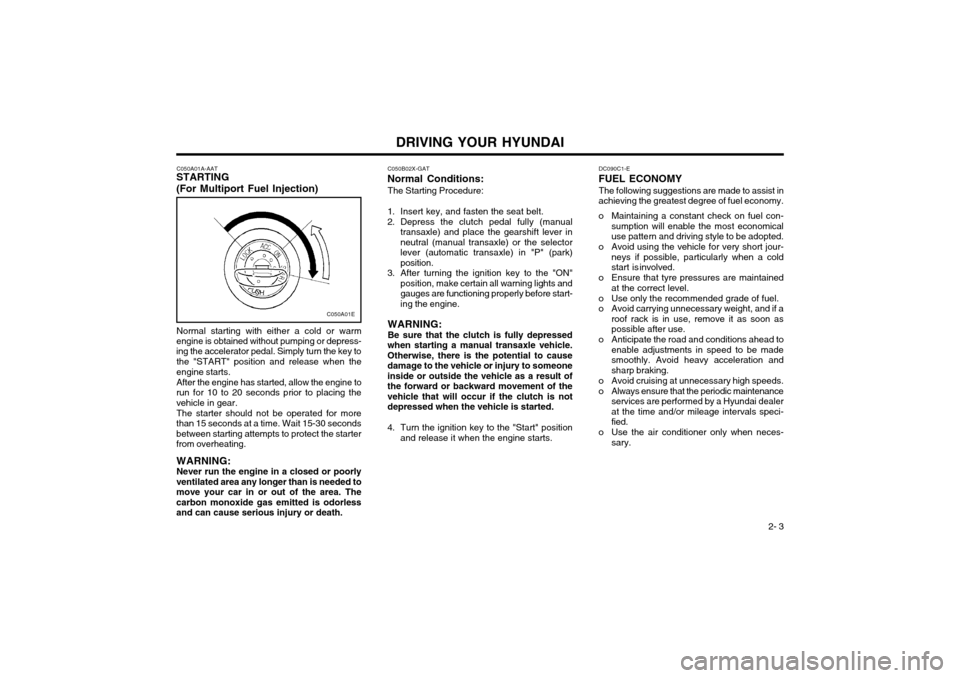
C050A01A-AAT
STARTING (For Multiport Fuel Injection)
Normal starting with either a cold or warm
engine is obtained without pumping or depress- ing the accelerator pedal. Simply turn the key to
the "START" position and release when the
engine starts.
After the engine has started, allow the engine to
run for 10 to 20 seconds prior to placing thevehicle in gear.
The starter should not be operated for more
than 15 seconds at a time. Wait 15-30 secondsbetween starting attempts to protect the starterfrom overheating.
WARNING:Never run the engine in a closed or poorly
ventilated area any longer than is needed tomove your car in or out of the area. Thecarbon monoxide gas emitted is odorlessand can cause serious injury or death. C050B02X-GAT
Normal Conditions:
The Starting Procedure:
1. Insert key, and fasten the seat belt.
2. Depress the clutch pedal fully (manual transaxle) and place the gearshift lever in neutral (manual transaxle) or the selectorlever (automatic transaxle) in "P" (park)position.
3. After turning the ignition key to the "ON" position, make certain all warning lights andgauges are functioning properly before start-
ing the engine.
WARNING: Be sure that the clutch is fully depressed
when starting a manual transaxle vehicle. Otherwise, there is the potential to cause
damage to the vehicle or injury to someoneinside or outside the vehicle as a result ofthe forward or backward movement of the
vehicle that will occur if the clutch is notdepressed when the vehicle is started.
4. Turn the ignition key to the "Start" position and release it when the engine starts. DC090C1-E
FUEL ECONOMY
The following suggestions are made to assist in
achieving the greatest degree of fuel economy.
o Maintaining a constant check on fuel con- sumption will enable the most economical use pattern and driving style to be adopted.
o Avoid using the vehicle for very short jour- neys if possible, particularly when a coldstart is involved.
o Ensure that tyre pressures are maintained at the correct level.
o Use only the recommended grade of fuel.
o Avoid carrying unnecessary weight, and if a roof rack is in use, remove it as soon aspossible after use.
o Anticipate the road and conditions ahead to enable adjustments in speed to be madesmoothly. Avoid heavy acceleration andsharp braking.
o Avoid cruising at unnecessary high speeds.
o Always ensure that the periodic maintenance services are performed by a Hyundai dealer at the time and/or mileage intervals speci-fied.
o Use the air conditioner only when neces- sary.
C050A01E
Page 195 of 249
DRIVING YOUR HYUNDAI
2- 6 C090I01E-EAT
CAUTION:
o Shift into "R" and "P" only when the vehicle has completely stopped.
o Do not accelerate the engine in the re- verse or any of the forward positions
with the brakes applied.
o Always apply the footbrake when shift- ing from "P" or "N", to "R", "D", "2" or "L".
o Do not use the "P" (Park) position in place of the parking brake. Always setthe park-ing brake, shift the transaxleinto "P" (Park) and turn off the ignitionwhen you leave the vehicle, even mo-mentarily. Never leave the vehicle unat-tended whilst the engine is running.
C090H01E-EAT
NOTE:
o The brake pedal should be depressed when shifting from NEUTRAL to a for- ward or reverse gear.
o The brake pedal fully depressed in order to move the shift lever from the "P"(Park) position to any of the other posi-tions.
o It is always possible to shift from "R", "N", "D", "2", "L" position.
C090P01X-DAG
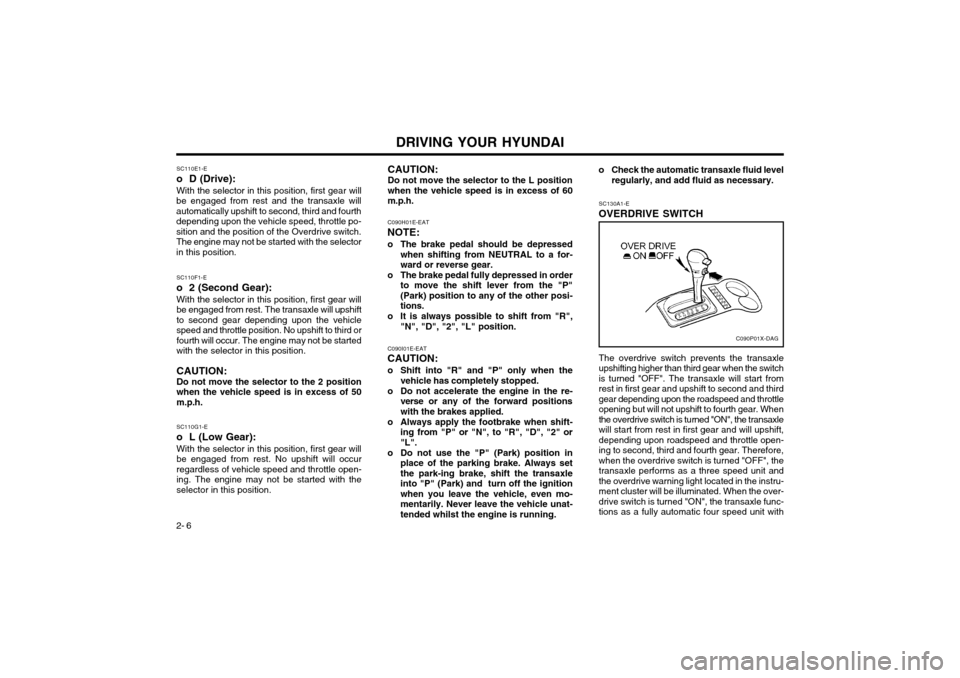
SC130A1-E
OVERDRIVE SWITCH
SC110E1-E
o D (Drive):
With the selector in this position, first gear will
be engaged from rest and the transaxle will automatically upshift to second, third and fourthdepending upon the vehicle speed, throttle po-sition and the position of the Overdrive switch.The engine may not be started with the selectorin this position.
SC110G1-E
o L (Low Gear): With the selector in this position, first gear willbe engaged from rest. No upshift will occurregardless of vehicle speed and throttle open-ing. The engine may not be started with theselector in this position.
SC110F1-E
o 2 (Second Gear): With the selector in this position, first gear willbe engaged from rest. The transaxle will upshiftto second gear depending upon the vehiclespeed and throttle position. No upshift to third orfourth will occur. The engine may not be startedwith the selector in this position. CAUTION: Do not move the selector to the 2 positionwhen the vehicle speed is in excess of 50m.p.h. CAUTION: Do not move the selector to the L position when the vehicle speed is in excess of 60m.p.h.
o Check the automatic transaxle fluid level
regularly, and add fluid as necessary.
The overdrive switch prevents the transaxleupshifting higher than third gear when the switchis turned "OFF". The transaxle will start fromrest in first gear and upshift to second and thirdgear depending upon the roadspeed and throttleopening but will not upshift to fourth gear. Whenthe overdrive switch is turned "ON", the transaxlewill start from rest in first gear and will upshift,depending upon roadspeed and throttle open-ing to second, third and fourth gear. Therefore,when the overdrive switch is turned "OFF", thetransaxle performs as a three speed unit andthe overdrive warning light located in the instru-ment cluster will be illuminated. When the over-drive switch is turned "ON", the transaxle func-tions as a fully automatic four speed unit with
Page 196 of 249
DRIVING YOUR HYUNDAI 2- 7
o Ensure that the overdrive switch is at the
"ON" position for maximum economy.
o If rapid acceleration is required, fully de- press the accelerator pedal. In this condi- tion, the kickdown mechanism will be oper-ated and the transaxle will automaticallydownshift according to the vehicle speed.
o Do not depress the accelerator pedal with the brakes applied and the selector at the"R" "D" "2" or "L" position.
o Turn the overdrive switch on for good fuel economy and smooth driving. But if enginebraking is needed in the "D" range or ifrepeated upshifting and downshifting be-tween the 3rd and 4th gear is needed whenclimbing a gentle slope, it is recommendedthat the overdrive switch be turned off. Turnthe overdrive switch back on immediatelyafterward.
the maximum fuel economy potential of thevehicle being realized.
SC140A1-E
EFFECTIVE BRAKING Braking system performance and friction mate-
rial life are greatly affected by the driving styleadopted. The following suggestions are madeto assist in achieving the best results from thebraking system.
o Anticipate the road and conditions ahead in order that heavy braking may be avoided.
o When descending long gradients, use the engine to assist in retarding the vehicle to minimize the possibility of brake fade occur-ring.
ZC120D1-E
General Operating Instructions
o The button in the selector handle must be depressed before the selector can be moved.
o The engine may only be started when the selector is at position "P" or "N".
o Ensure that the footbrake is firmly applied when shifting from "P" or "N" to "D", "2" or "L" and vice versa.
o Always engage the parking brake when the vehicle is unattended, never use the "P"position in place of the parking brake.
o Under normal circumstances, the selector should be placed in the "D" position and thetransaxle allowed to select the most idealratio for the circumstances. In this positionmaximum fuel economy will be achieved.
o When descending steep gradients where engine braking is required, the selectorshould be placed at the "2" or "L" positiondepending upon the vehicle speed.
o When ascending steep gradients and using large throttle openings, the transaxle mayrepeatedly change between two adjacentratios. This is a normal characteristic andmay be prevented by selecting "2" or "L"depending upon the vehicle speed.
o Never move the selector to or from the "P" or "N" position with the accelerator de-pressed. o When trailer towing, ensure that the trailer
brakes function correctly and use enginebrak-ing to assist the vehicle braking system.
o Use only genuine Hyundai replacement brake pads and shoes to ensure consistentfriction characteristics and wear rates.
o After driving through deep water (e.g. fording), the brakes may become wet andperformance reduced. Always check brakeefficiency after emerging from the water anddry the brakes by lightly depressing thebrake pedal several times whilst driving slow-ly.
o Apply the parking brake only when the vehi- cle is at rest.
o Since the power assistance provided by the brake servo is derived from the engine,coast-ing with the engine turned off or tow-ing of the vehicle with the engine turned offwill result in greatly increased pedal pres-sures being re-quired to stop the vehicle.
o Do not hold the vehicle on the upgrade with the accelerator pedal. This can cause thetransmission to overheat. Always use thebrake pedal or parking brake.
YC250A1-A
ANTI-LOCK BRAKE SYSTEM
(Not all models) The Anti-Lock Brake System (ABS) is designed
to prevent wheel lock-up during sudden braking or on hazardous road surfaces. The ABS con-trol module monitors the wheel speed and con-trols the pressure applied to each brake. Thus,
Page 197 of 249
DRIVING YOUR HYUNDAI
2- 8 in emergency situations or on slick roads, ABS will increase vehicle control during braking. NOTE: During ABS operation, a slight pulsation may be felt in the brake pedal when thebrakes are applied. Also, a noise may beheard in the engine compartment while brak-ing. These conditions are normal and indi-cate that the anti-lock brake system is func-tioning properly. WARNING: Your ABS will not prevent accidents due to improper or dangerous driving maneuvers.Even though vehicle control is improvedduring emergency braking, always maintaina safe distance between you and objectsahead. Vehicle speeds should always bereduced during extreme road conditions.The braking distance for cars equipped withan anti-lock braking system may be longerthan for those without it in the followingroad conditions.
o Driving on rough, gravel or snow-cov- ered roads.
o Driving with tire chains installed.
o Driving on roads where the road surface is pitted or has different surface height.
These roads should be driven at reduced speeds. The safety features of an ABSequipped vehicle should not be tested by high speed driving or cornering. This couldendanger the safety of yourself or others.
unnecessary tire wear. Check the tire pres-sures at least once a month.
o Be sure that the wheels are aligned cor- rectly. Improper alignment can result fromhitting curbs or driving too fast over irregularsurfaces. Poor alignment causes faster tirewear and may also result in other problemsas well as greater fuel consumption.
o Keep your car in good condition. For better fuel economy and reduced maintenancecosts, maintain your car in accordance withthe maintenance schedule in Section 5. Ifyou drive your car in severe conditions,more frequent maintenance is required (seeSection 5 for details).
o Keep your car clean. For maximum service, your car should be kept clean and free ofcorrosive materials. It is especially impor-tant that mud, dirt, ice, etc. not be allowed toaccumulate on the underside of the car. Thisextra weight can result in increased fuelconsumption and also contribute to corro-sion.
o Travel lightly. Don’t carry unnecessary weight in your car. Weight is an enemy of good fueleconomy.
o Don’t let the engine idle longer than neces- sary. If you are waiting (and not in traffic),turn off your engine and restart only whenyou’re ready to go.
o Remember, your car does not require ex- tended warm-up. As soon as the engine isrunning smoothly, you can drive away. Invery cold weather, however, give your en-gine a slightly longer warm-up period.
SC150A1-F
DRIVING FOR ECONOMY You can save fuel and get more miles from yourcar if you follow these suggestions:
o Drive smoothly. Accelerate at a moderate rate. Don’t make "jack-rabbit" starts or full-throttle shifts and maintain a steady cruisingspeed. Don’t race between stoplights. Try toadjust your speed to that of the other trafficso you don’t have to change speeds unnec-essarily. Avoid heavy traffic whenever possible. Al- ways maintain a safe distance from othervehicles so you can avoid unnecessary brak-ing. This also reduces brake wear.
o Drive at a moderate speed. The faster you drive, the more fuel your car uses. Driving ata moderate speed, especially on the high-way, is one of the most effective ways toreduce fuel consumption.
o Don’t "ride" the brake or clutch pedal. This can increase fuel consumption and alsoincrease wear on these components. In ad-dition, driving with your foot resting on thebrake pedal may cause the brakes to over-heat, which reduces their effectiveness andmay lead to more serious consequences.
o Take care of your tires. Keep them inflated to the recommended pressure. Incorrect infla-tion, either too much or too little, results in
Page 201 of 249
DRIVING YOUR HYUNDAI
2- 12 15. If you have to stop while going uphill, do not
hold the vehicle in place by pressing on the accelerator. This can cause the automatictransaxle to overheat. Use the parking brakeor footbrake.
NOTE: When towing, check transaxle fluid more frequently. CAUTION: If overheating should occur when towing,
(temperature gauge reads near red zone),taking the following action may reduce oreliminate the problem.
1. Turn off the air conditioner.
2. Reduce highway speed.
3. Select a lower gear when going uphill.
4. While in stop and go traffic, place the gear selection in park or neutral and idle theengine at a higher speed.
being passed by a large vehicle, keep aconstant speed and steer straight ahead. If there is too much wind buffeting, slow
down to get out of the other vehicle's airturbulence.
8. When parking your car and trailer, especial- ly on a hill, be sure to follow all the normalprecautions. Turn your front wheel into thecurb, set the parking brake firmly, and putthe transaxle in 1st or Reverse (manual) orPark (automatic). In addition, place wheelchocks at each of the trailer's tyres.
9. If the trailer has electric brakes, start your vehicle and trailer moving, and then applythe trailer brake controller by hand to be
sure the brakes are working. This lets you
check your electrical connection at the sametime.
10. During your trip, check occasionally to be sure that the load is secure, and that thelights and any trailer brakes are still working.
11. Avoid jerky starts, sudden acceleration or sudden stops.
12. Avoid sharp turns and rapid lane changes.
13. Avoid holding the brake pedal down too long or too frequently. This could cause the brakes to overheat, resulting in reduced brakingefficiency.
14. When going down a hill, shift into a lower gear and use the engine braking effect.When ascending a long grade, downshift thetransaxle to a lower gear and reduce speedto reduce chances of engine overloading
and or overheating.
WARNING:
o The tongue load should never exceed;
Auto Transaxle : 55.1 lb Manual Transaxle 9: 61.7 lb
o Maximun permissible mass of the cou- pling device (ATOS VAN only) : 44 lb
o Improperly loading your car and trailer can serious affect its steering and brak- ing performance causing a crash in which
you may be seriously injured or killed.
YC200E1-A
Trailer or Vehicle Towing Tips
1. Before towing, check hitch and safety chain connections as well as proper operation of the trailer running lights, brake lights, andturn signals.
2. Always drive your vehicle at a moderate speed (Less than 62 MPH).
3. Trailer towing requires more fuel than nor- mal conditions.
4. To maintain engine braking efficiency and electrical charging performance, do not usefifth gear (manual transaxle) or overdrive(automatic transaxle).
5. Always secure items in the trailer to prevent load shift while driving.
6. Check the condition and air pressure of all tires on the trailer and your car. Low tyrepressure can seriously affect the handling.Also check the spare tyre.
7. The vehicle/trailer combination is more af- fected by crosswind and buffeting. When
Page 203 of 249
WHAT TO DO IN AN EMERGENCY
3-2 3. If coolant is running out under the car or
steam is coming out from under the bonnet stop the engine. Do not open the bonnetuntil the coolant has stopped running or thesteaming has stopped. If there is no visibleloss of coolant and no steam, leave theengine running and check to be sure theengine cooling fan is operating. If the fan isnot running, turn the engine off.
4. Check to see if the water pump drive belt is missing. If it is not missing, check to see thatit is tight. If the drive belt seems to besatisfactory, check for coolant leaking fromthe radiator, hoses or under the car. (If theair conditioner had been in use, it is normalfor cold water to be draining from it).
WARNING: While the engine is running, keep hands andclothing away from moving parts such asthe fan and drive belts to prevent injury.
5. If the water pump drive belt is broken or coolant is leaking out, stop the engine imme-diately and call the nearest Hyundai dealerfor assistance.
WARNING: Do not remove the radiator cap when theengine is hot since steam and boiling watermay be ejected from the radiator resulting inburns or scalding.
CAUTION:
Personal injury and damage to the vehicle
may occur if jump starting is not performedcorrectly. If any doubt exists as to how thisoperation should be performed, seek assis-tance from qualified personnel. WARNING:
Motor vehicle batteries contain sulphuric
acid and emit hydrogen gas. Protective cloth- ing should be worn and care exercised toprevent the acid from coming into contactwith skin or clothing and the vehicle. Nakedlights should not be permitted in the vicinityof the battery. Care should be exercised topreventsparks occurring during connection.If acid accidentally comes into contact withskin or eyes, the affected area should imme-diately be flushed with copious amounts ofwater and medical assistance sought.
1. Ensure that the booster battery is 12 volt type. If the booster battery is installed in another vehicle, ensure that the two vehi-cles are not touching.
2. Turn off all unnecessary electrical equip- ment in both vehicles.
3. Ensure that the engine of the vehicle provid- ing the jump start is running prior to connec-tion of the jump cables.
4. Connect the red jump cable to the positive (+) terminal of the booster battery and theother end to the positive (+) terminal of thedischarged battery. 5. Attach the black jump cable to the negative
(-) terminal of the booster battery, and theother end to a ground point within the enginecompartment of the vehicle with the flat bat-tery. Do not connect to the negative batteryterminal of the flat battery since sparks maybe generated with the subsequent risk ofexplosion.
6. Raise the booster vehicle engine speed to 2,000 r.p.m. and start the engine of thevehicle with the flat battery.
7. Remove jump cables in the reverse order of installation (black cable first).
NOTE: If the jump cable is incorrectly installed, damage to the vehicle electrical system mayoccur, in particular the electronic compo-nents such as the Fuel Injection systemcomputer and the Automatic Transaxle com-puter. The battery must never be discon-nected whilst the engine is running. XD040A1-E
IF THE ENGINE OVERHEATS If the temperature gauge indicates overheating:
1. Pull off the road and stop as soon as it is safe to do so.
2. Place the gear selector lever in "P" (auto- matic), or neutral (manual transaxle, semi- automatic transalxe) and set the parkingbrake. If the air conditioner is on, turn it off.
Page 205 of 249
WHAT TO DO IN AN EMERGENCY
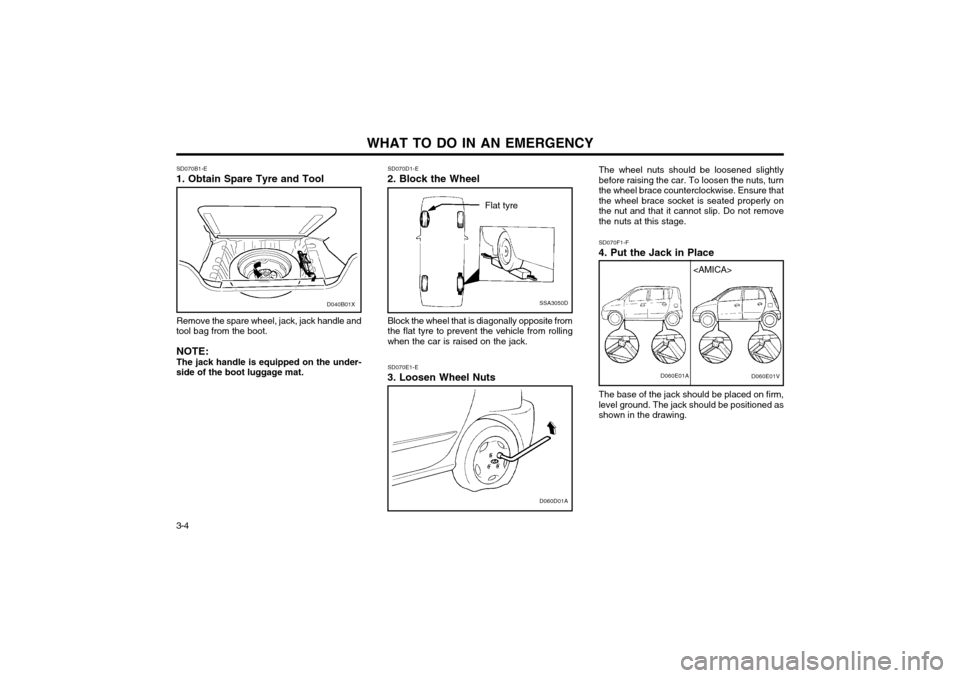
3-4 SD070B1-E
1. Obtain Spare Tyre and Tool
Remove the spare wheel, jack, jack handle and
tool bag from the boot.
NOTE: The jack handle is equipped on the under-
side of the boot luggage mat.
SSA3050D
Flat tyre
SD070D1-E
2. Block the Wheel
Block the wheel that is diagonally opposite from the flat tyre to prevent the vehicle from rollingwhen the car is raised on the jack.
D060D01A
SD070E1-E
3. Loosen Wheel Nuts The wheel nuts should be loosened slightly before raising the car. To loosen the nuts, turnthe wheel brace counterclockwise. Ensure thatthe wheel brace socket is seated properly onthe nut and that it cannot slip. Do not removethe nuts at this stage. SD070F1-F
4. Put the Jack in Place
The base of the jack should be placed on firm, level ground. The jack should be positioned asshown in the drawing.D060E01A
D040B01X
Page 210 of 249
CORROSION PREVENTION & APPEARANCE CARE 4-1
moved. Should any damage to or deterioration of the underbody coating be apparent, the ad-vice of a Hyundai dealer regarding the use of acompatible repair material should be sought.
NOTE: The underbody should never be steam
cleaned since the underbody coating may be removed by this process.
During the interim period between power wash-
ing the underbody, the more vulnerable areassuch as wheelarches should be hosed off,particularly during the winter season to preventprolonged contact of road salt with the body. Ensure that the various drain points located at
bottom of the door panels are kept clear, toprevent water becoming trapped within the cavi-ties. Wherever possible, the parking of thevehicle in a confined, poorly ventilated location(e.g.) garage should be avoided when the vehi-cle is wet or covered with snow or ice. Underthese conditions, the internal cavities of thevehicle will remain damp for long periods oftime which encourage corrosion. Parking thevehicle where good ventilation exists is prefer-able.
ZE020B1-E
Underbody Coatings Every Hyundai passenger car receives a full
underbody and cavity injection treatment duringproduction. In order that this treatment mayretain maximum effectiveness, it is recommend-ed that the underbody receives a power washand a thorough inspection after each winterseason. In so doing any accumulations of mud,which act as moisture traps and combine withroad salts to accelerate corrosion, will be re-
ZE000A1-E
4. CORROSION PRE-
VENTION & AP- PEARANCE CARE
ZE020A1-E
APPEARANCE CARE In using the most advanced design and con-
struction practices, every Hyundai is built to retain its original factory finish for many years.However, long term durability is also greatlydependant upon maintaining the various pro-tection systems and coatings used in manufac- ture since constant exposure to the elements will eventually result in their breakdown andloss of effectiveness. The following sugges-tions are made to assist in the maintenance ofthe vehicle bodywork.
ZE020C1-E
Interior During the winter period, it is possible that the
carpet within the passenger compartment maybecome wet. The carpet should not be allowedto remain in this condition for prolonged periods JE050A1-E
VALETING
Regular cleaning of the exterior paintwork serves
two important functios. Firstly, the removal ofabrasive dirt and contaminants will maintain thelustre of the paintwork and will preventdiscolouration and dulling due to prolonged con-tact.
Secondly, the presence of damage through
impact or abrasion will be apparent allowingearly rectification to be made thus preventingcorrosion from becoming established andspreading beneath the paint film. To avoid "wa-ter spotting" the vehicle should not be washedin direct sunlight particularly in the case ofvehicles having dark body colours. The heatfrom the sun rays is absorbed by the paint filmincreasing the surface temperature. This actioncauses water used for washing to evaporatequickly leaving behind the deposits from thewater and the shampoo used. Use only a shampoo intended for the purpose
and ensure that the body work is thoroughlywetted to soften the dirt film prior to attemptingto remove this.
After removing the dirt film with a soft sponge,
the body work should be thoroughly rinsed andthen dried with a good quality ch mois leather toprevent streaking or spotting of the paint work.
since the carpet may begin to create mustysmells and promote internal corrosion of thefloorpan.
4
Page 211 of 249
CORROSION PREVENTION & APPEARANCE CARE
4-2 Household detergents, solvents and abrasive
cleaning materials should not be used in order ot avoid damaging the paint film.
Plastic wheel covers should be cleaned using a
sponge and water. Cast alloy wheels should becleaned using a mild soap or neutral detergent.Abrasive compounds must not be used since inthe event of these damaging the lacquer coat-ing, oxidisation of the aluminium wheel willoccur, spoiling the appearance.
The use of an a toothbrush will facilitate clean-
ing between the wheel "spokes". JE080A1-E
BUMPER MAINTENANCE
The special material from which the bumpersare manufactured warrants special attention topreserve the appearance of thebumpers. Avoidcontact with battery electrolyte or brake fluidand ensure that accidental spillages are imme-diately flushed with water. Do not use abrasive cleaning materials which may damage the bumpers. Avoid subjecting the bumpers to high tempera- tures such as may be encountered in high bakepaing ovens.
JE060A1-E
STAIN/SPOT REMOVAL Should tree sap, dead insects or tar prove to be
difficult to remove from the paint film, turpentineor a proprietary paint cutting compound may beused. Ensure that the area to be cleaned is notrubbed intensively to prevent breaking throughthe colour coat and exposing the under coat.
JE070A1-E
POLISHING The exterior paint work should be polished with
a proprietary wax polish when water no longercollects in bead form on the paint work. Theinstructions of the product manufacturer shouldbe adhered to. JE090A1-E
ACCIDENT REPAIRS In the event of the body work sustaining dam-age, the following points should be noted priorto repairs being undertaken. If body panels are replaced or repaired, anti corrosion treatment must be applied to therepair area. The product used must be compat-ible with those used in manufacture. It is recom-mended that repairs are entrusted to a Hyundaidealer to ensure that replacement parts usedare of the same high quality as those used inmanufacture of the vehicle and that the correctrepair methods and materials will ensure ade-quate levels of corrosion protection and thecontinued validity of the Anti Perforation War-ranty. JE100A1-E
SEAT BELTS
Seat belts should be cleaned only with a mildsoap solution. Strong detergents, solvens orbleaches may damage the belt webbing andtherefore reduce the effectiveness of the belt.Belts which display signs of fraying, wear of cutshould be replaced. JE110A1-E
INTERIOR VALETING
The soft trim and carpets should be maintained with the regular use of a vacuum cleaner. Heavysoiling should be removed with a dry cleaningagent recommended for this purpose followingthe instructions of the product manufacturer.Paint thinner, solvents or other such cleaningmaterials should not be used since damage tothe upholstery may result. JE120A1-E
WINDOWS
A proprietary glass cleaner should be used to clean the inside of the windows. However, therear heated windscreen must only be cleanedusing a light horizontal cleaning action. Careshould be exercised to avoid the use of abra-sive cleaners or contact with items of jewellerywhich may damage the heating elements.