air condition Hyundai Atos 2002 Owner's Guide
[x] Cancel search | Manufacturer: HYUNDAI, Model Year: 2002, Model line: Atos, Model: Hyundai Atos 2002Pages: 249, PDF Size: 3.11 MB
Page 108 of 249
DO-IT-YOURSELF MAINTENANCE
DO-IT-YOURSELF MAINTENANCE DO-IT-YOURSELF MAINTENANCE
DO-IT-YOURSELF MAINTENANCE
DO-IT-YOURSELF MAINTENANCE
6-12 G140B01A-AAT
Checking the Air Conditioning Opera-
Checking the Air Conditioning Opera- Checking the Air Conditioning Opera-
Checking the Air Conditioning Opera-
Checking the Air Conditioning Opera-
tion
tion tion
tion
tion
1. Start the engine and let it run at a fast idle for
several minutes with the air conditioning set at the maximum cold setting.
2. If the air coming out of the in-dash vents is not cold, have the air conditioning systeminspected by your Hyundai dealer.
CAUTION:
CAUTION: CAUTION:
CAUTION:
CAUTION:
Running the air conditioning system for ex-
Running the air conditioning system for ex- Running the air conditioning system for ex-
Running the air conditioning system for ex-
Running the air conditioning system for ex-
tended periods of time with a low refrigerant
tended periods of time with a low refrigerant tended periods of time with a low refrigerant
tended periods of time with a low refrigerant
tended periods of time with a low refrigerant
level may damage the compressor.
level may damage the compressor. level may damage the compressor.
level may damage the compressor.
level may damage the compressor.
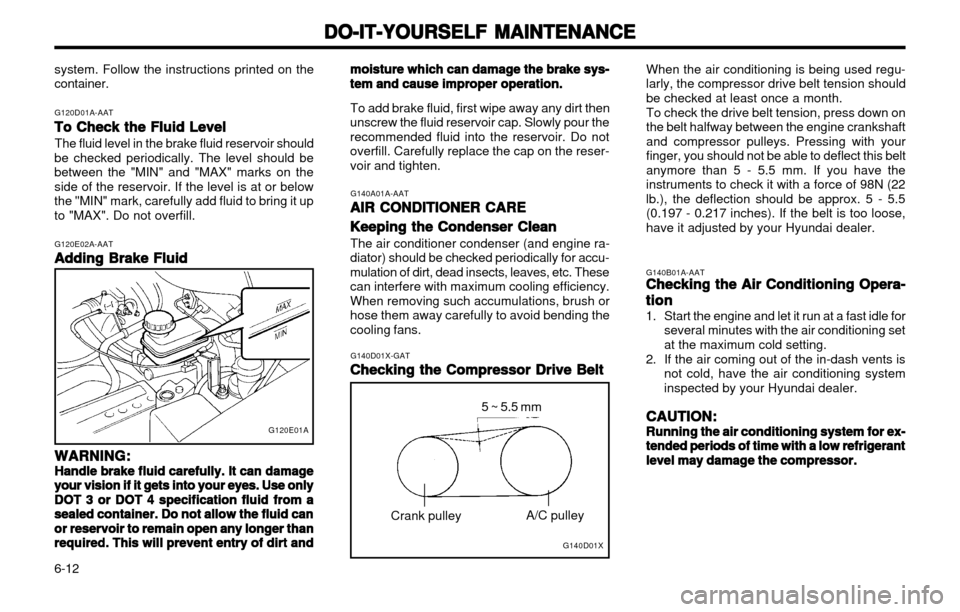
When the air conditioning is being used regu-larly, the compressor drive belt tension shouldbe checked at least once a month. To check the drive belt tension, press down on the belt halfway between the engine crankshaftand compressor pulleys. Pressing with yourfinger, you should not be able to deflect this belt
anymore than 5 - 5.5 mm. If you have theinstruments to check it with a force of 98N (22lb.), the deflection should be approx. 5 - 5.5(0.197 - 0.217 inches). If the belt is too loose,have it adjusted by your Hyundai dealer.
G120D01A-AAT
To Check the Fluid Level
To Check the Fluid Level To Check the Fluid Level
To Check the Fluid Level
To Check the Fluid Level
The fluid level in the brake fluid reservoir should
be checked periodically. The level should bebetween the "MIN" and "MAX" marks on theside of the reservoir. If the level is at or belowthe "MIN" mark, carefully add fluid to bring it upto "MAX". Do not overfill.
G120E02A-AATAdding Brake Fluid
Adding Brake Fluid Adding Brake Fluid
Adding Brake Fluid
Adding Brake Fluid
WARNING:
WARNING: WARNING:
WARNING:
WARNING:
Handle brake fluid carefully. It can damage
Handle brake fluid carefully. It can damage Handle brake fluid carefully. It can damage
Handle brake fluid carefully. It can damage
Handle brake fluid carefully. It can damage your vision if it gets into your eyes. Use only
your vision if it gets into your eyes. Use only your vision if it gets into your eyes. Use only
your vision if it gets into your eyes. Use only
your vision if it gets into your eyes. Use only
DOT 3 or DOT 4 specification fluid from a
DOT 3 or DOT 4 specification fluid from a DOT 3 or DOT 4 specification fluid from a
DOT 3 or DOT 4 specification fluid from a
DOT 3 or DOT 4 specification fluid from a
sealed container. Do not allow the fluid can
sealed container. Do not allow the fluid can sealed container. Do not allow the fluid can
sealed container. Do not allow the fluid can
sealed container. Do not allow the fluid can
or reservoir to remain open any longer than
or reservoir to remain open any longer than or reservoir to remain open any longer than
or reservoir to remain open any longer than
or reservoir to remain open any longer than
required. This will prevent entry of dirt and
required. This will prevent entry of dirt and required. This will prevent entry of dirt and
required. This will prevent entry of dirt and
required. This will prevent entry of dirt and moisture which can damage the brake sys-
moisture which can damage the brake sys- moisture which can damage the brake sys-
moisture which can damage the brake sys-
moisture which can damage the brake sys-
tem and cause improper operation.
tem and cause improper operation. tem and cause improper operation.
tem and cause improper operation.
tem and cause improper operation.
To add brake fluid, first wipe away any dirt then
unscrew the fluid reservoir cap. Slowly pour the recommended fluid into the reservoir. Do notoverfill. Carefully replace the cap on the reser-voir and tighten.
G120E01A
G140A01A-AAT
AIR CONDITIONER CARE
AIR CONDITIONER CARE AIR CONDITIONER CARE
AIR CONDITIONER CARE
AIR CONDITIONER CARE
Keeping the Condenser Clean
Keeping the Condenser Clean Keeping the Condenser Clean
Keeping the Condenser Clean
Keeping the Condenser Clean
The air conditioner condenser (and engine ra-
diator) should be checked periodically for accu- mulation of dirt, dead insects, leaves, etc. Thesecan interfere with maximum cooling efficiency.When removing such accumulations, brush orhose them away carefully to avoid bending thecooling fans.
G140D01X-GATChecking the Compressor Drive Belt
Checking the Compressor Drive Belt Checking the Compressor Drive Belt
Checking the Compressor Drive Belt
Checking the Compressor Drive Belt
A/C pulley
Crank pulley
G140D01X
5 ~ 5.5 mm
system. Follow the instructions printed on the container.
Page 109 of 249
DO-IT-YOURSELF MAINTENANCE
DO-IT-YOURSELF MAINTENANCE DO-IT-YOURSELF MAINTENANCE
DO-IT-YOURSELF MAINTENANCE
DO-IT-YOURSELF MAINTENANCE
6-13
G170A01A-GAT
CHECKING BRAKE PEDAL
CHECKING BRAKE PEDAL CHECKING BRAKE PEDAL
CHECKING BRAKE PEDAL
CHECKING BRAKE PEDAL
FREEPLAY
FREEPLAY FREEPLAY
FREEPLAY
FREEPLAY
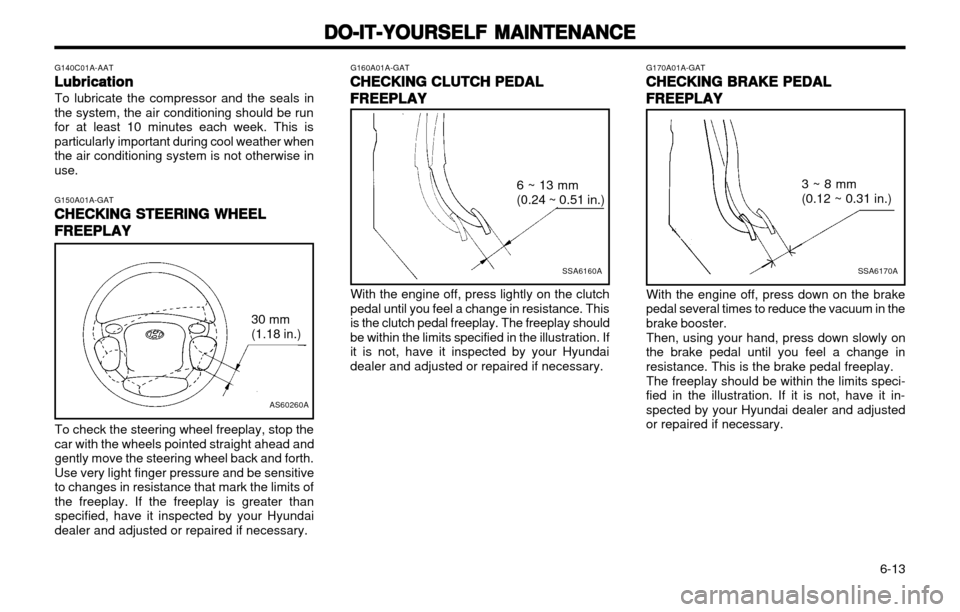
To check the steering wheel freeplay, stop the car with the wheels pointed straight ahead andgently move the steering wheel back and forth.Use very light finger pressure and be sensitiveto changes in resistance that mark the limits ofthe freeplay. If the freeplay is greater thanspecified, have it inspected by your Hyundaidealer and adjusted or repaired if necessary. G160A01A-GAT
CHECKING CLUTCH PEDAL
CHECKING CLUTCH PEDAL CHECKING CLUTCH PEDAL
CHECKING CLUTCH PEDAL
CHECKING CLUTCH PEDAL
FREEPLAY
FREEPLAY FREEPLAY
FREEPLAY
FREEPLAY
SSA6160A
6 ~ 13 mm (0.24 ~ 0.51 in.)
With the engine off, press lightly on the clutch
pedal until you feel a change in resistance. This is the clutch pedal freeplay. The freeplay shouldbe within the limits specified in the illustration. Ifit is not, have it inspected by your Hyundaidealer and adjusted or repaired if necessary.
SSA6170A
3 ~ 8 mm (0.12 ~ 0.31 in.)
With the engine off, press down on the brake
pedal several times to reduce the vacuum in the brake booster.
Then, using your hand, press down slowly on
the brake pedal until you feel a change inresistance. This is the brake pedal freeplay.
The freeplay should be within the limits speci-
fied in the illustration. If it is not, have it in-spected by your Hyundai dealer and adjustedor repaired if necessary.
G140C01A-AAT
Lubrication
Lubrication Lubrication
Lubrication
Lubrication
To lubricate the compressor and the seals in
the system, the air conditioning should be run for at least 10 minutes each week. This isparticularly important during cool weather whenthe air conditioning system is not otherwise inuse.
G150A01A-GATCHECKING STEERING WHEEL
CHECKING STEERING WHEEL CHECKING STEERING WHEEL
CHECKING STEERING WHEEL
CHECKING STEERING WHEEL
FREEPLAY
FREEPLAY FREEPLAY
FREEPLAY
FREEPLAY
AS60260A
30 mm (1.18 in.)
Page 112 of 249
DO-IT-YOURSELF MAINTENANCE
DO-IT-YOURSELF MAINTENANCE DO-IT-YOURSELF MAINTENANCE
DO-IT-YOURSELF MAINTENANCE
DO-IT-YOURSELF MAINTENANCE
6-16
G230A03A-GAT POWER STEERING FLUID LEVEL
POWER STEERING FLUID LEVEL POWER STEERING FLUID LEVEL
POWER STEERING FLUID LEVEL
POWER STEERING FLUID LEVEL
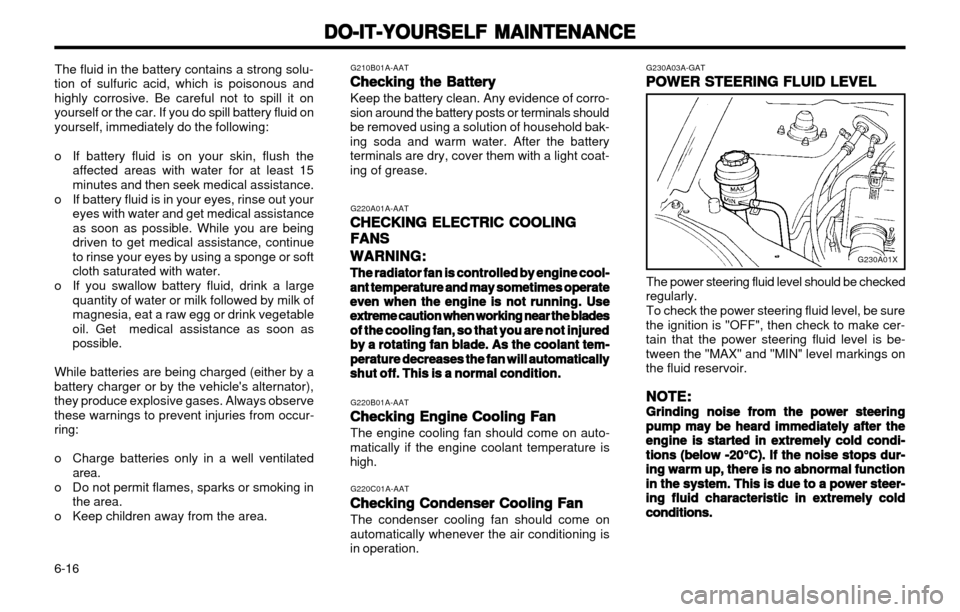
The power steering fluid level should be checked
regularly.
To check the power steering fluid level, be sure
the ignition is "OFF", then check to make cer- tain that the power steering fluid level is be-tween the "MAX" and "MIN" level markings onthe fluid reservoir.
NOTE:
NOTE: NOTE:
NOTE:
NOTE:
Grinding noise from the power steering
Grinding noise from the power steering Grinding noise from the power steering
Grinding noise from the power steering
Grinding noise from the power steering pump may be heard immediately after the
pump may be heard immediately after the pump may be heard immediately after the
pump may be heard immediately after the
pump may be heard immediately after the
engine is started in extremely cold condi-
engine is started in extremely cold condi- engine is started in extremely cold condi-
engine is started in extremely cold condi-
engine is started in extremely cold condi-
tions (below
tions (below tions (below
tions (below
tions (below
-20°C). If the noise stops dur-
-20°C). If the noise stops dur- -20°C). If the noise stops dur-
-20°C). If the noise stops dur-
-20°C). If the noise stops dur-
ing warm up, there is no abnormal function
ing warm up, there is no abnormal function ing warm up, there is no abnormal function
ing warm up, there is no abnormal function
ing warm up, there is no abnormal function
in the system. This is due to a power steer-
in the system. This is due to a power steer- in the system. This is due to a power steer-
in the system. This is due to a power steer-
in the system. This is due to a power steer-
ing fluid characteristic in extremely cold
ing fluid characteristic in extremely cold ing fluid characteristic in extremely cold
ing fluid characteristic in extremely cold
ing fluid characteristic in extremely cold
conditions.
conditions. conditions.
conditions.
conditions.
G230A01X
The fluid in the battery contains a strong solu-
tion of sulfuric acid, which is poisonous and highly corrosive. Be careful not to spill it onyourself or the car. If you do spill battery fluid onyourself, immediately do the following:
o If battery fluid is on your skin, flush the affected areas with water for at least 15 minutes and then seek medical assistance.
o If battery fluid is in your eyes, rinse out your eyes with water and get medical assistanceas soon as possible. While you are beingdriven to get medical assistance, continueto rinse your eyes by using a sponge or softcloth saturated with water.
o If you swallow battery fluid, drink a large quantity of water or milk followed by milk ofmagnesia, eat a raw egg or drink vegetableoil. Get medical assistance as soon aspossible.
While batteries are being charged (either by abattery charger or by the vehicle's alternator),they produce explosive gases. Always observethese warnings to prevent injuries from occur-ring:
o Charge batteries only in a well ventilated area.
o Do not permit flames, sparks or smoking in the area.
o Keep children away from the area. G210B01A-AAT
Checking the Battery
Checking the Battery Checking the Battery
Checking the Battery
Checking the Battery
Keep the battery clean. Any evidence of corro-
sion around the battery posts or terminals should be removed using a solution of household bak-ing soda and warm water. After the batteryterminals are dry, cover them with a light coat-ing of grease.
G220A01A-AATCHECKING ELECTRIC COOLING
CHECKING ELECTRIC COOLING CHECKING ELECTRIC COOLING
CHECKING ELECTRIC COOLING
CHECKING ELECTRIC COOLING
FANS
FANS FANS
FANS
FANS
WARNING:
WARNING: WARNING:
WARNING:
WARNING:
The radiator fan is controlled by engine cool-
The radiator fan is controlled by engine cool- The radiator fan is controlled by engine cool-
The radiator fan is controlled by engine cool-
The radiator fan is controlled by engine cool-
ant temperature and may sometimes operate
ant temperature and may sometimes operate ant temperature and may sometimes operate
ant temperature and may sometimes operate
ant temperature and may sometimes operate
even when the engine is not running. Use
even when the engine is not running. Use even when the engine is not running. Use
even when the engine is not running. Use
even when the engine is not running. Use
extreme caution when working near the blades
extreme caution when working near the blades extreme caution when working near the blades
extreme caution when working near the blades
extreme caution when working near the blades
of the cooling fan, so that you are not injured
of the cooling fan, so that you are not injured of the cooling fan, so that you are not injured
of the cooling fan, so that you are not injured
of the cooling fan, so that you are not injured
by a rotating fan blade. As the coolant tem-
by a rotating fan blade. As the coolant tem- by a rotating fan blade. As the coolant tem-
by a rotating fan blade. As the coolant tem-
by a rotating fan blade. As the coolant tem-
perature decreases the fan will automatically
perature decreases the fan will automatically perature decreases the fan will automatically
perature decreases the fan will automatically
perature decreases the fan will automatically
shut off. This is a normal condition.
shut off. This is a normal condition. shut off. This is a normal condition.
shut off. This is a normal condition.
shut off. This is a normal condition.
G220B01A-AATChecking Engine Cooling Fan
Checking Engine Cooling Fan Checking Engine Cooling Fan
Checking Engine Cooling Fan
Checking Engine Cooling Fan
The engine cooling fan should come on auto-
matically if the engine coolant temperature ishigh.
G220C01A-AATChecking Condenser Cooling Fan
Checking Condenser Cooling Fan Checking Condenser Cooling Fan
Checking Condenser Cooling Fan
Checking Condenser Cooling Fan
The condenser cooling fan should come on
automatically whenever the air conditioning isin operation.
Page 125 of 249
INDEX
INDEX INDEX
INDEX
INDEX
10-1
Catalytic Converter .................................................................... 7-1 ~ 7-2
Child-Protector Rear Door Lock ......................................................... 1-5
Cigarette Lighter ................................................................................
1-26
Clock ................................................................................................ 1-26
Clutch Pedal freeplay ........................................................................ 6-13
Combination Light Daytime running lights ................................................................. 1-23
Headlight flasher .......................................................................... 1-24
Headlight switch ........................................................................... 1-23
High-beam switch ........................................................................ 1-24
Lane change signal ...................................................................... 1-23
Turn signal operation ................................................................... 1-23
Compact Disk Player Operation (H922M) ........................................ 1-49
Cooling Fans ..................................................................................... 6-16
Corrosion Protection Cleaning the interior ....................................................................... 4-3
Protecting your Hyundai from corrosion ........................................ 4-1
Washing and waxing ...................................................................... 4-2
DD
DD
D
Defroster ........................................................................................... 1-38
Door Central door locking system .......................................................... 1-7
Door locks ...................................................................................... 1-4
Locking, unlocking front doors with a key ..................................... 1-4
Drive Belts ............................................................................... 6-12, 6-14 Driving Economical driving ......................................................................... 2-9
Smooth cornering ........................................................................... 2-9
Winter driving ................................................................................. 2-9
ZK000A1-G
10. INDEX
10. INDEX 10. INDEX
10. INDEX
10. INDEX
AA
AA
A
Air bag .................................................................................... 1-13 ~ 1-17
Air Cleaner Filter ................................................................................. 6-9Air Conditioning
Care ............................................................................................. 6-12
Operation ..................................................................................... 1-38
Antenna ............................................................................................. 1-54
Ashtray .............................................................................................. 1-27
Audio Fault Code .............................................................................. 1-51
BB
BB
B
Battery ...................................................................................... 2-10, 6-16
Bi-Level Heating ................................................................................ 1-36
Brake Anti-lock system ............................................................................ 2-8
Checking the brakes .................................................................... 6-11
Fluid .................................................................................. 6-11 ~ 6-12
Pedal clearance ........................................................................... 6-14
Pedal freeplay .............................................................................. 6-13
Practices ............................................................................... 2-7 ~ 2-8
Breaking-In your New Hyundai ........................................................... 1-1
CC
CC
C
Care of Cassette Tapes ................................................................... 1-52
Cassette Tape Player Operation (H900A) ............................. 1-44 ~ 1-46
1010
1010
10
Page 132 of 249
A020A01A-EATResponsibilty For Maintenance
It is the responsibility of the vehicle owner/driver to ensure that all routine maintenance services are undertaken in line with the recommendations specifiedin Section 5 of this manual. In addition, in order to ensure continued validity ofthe new vehicle warranty and safe operation of the vehicle, non scheduledmaintenance/running repairs should be undertaken at the earliest availableopportunity. Under severe operating conditions, more frequent maintenance isrequired. Details of the maintenance schedule for such conditions are also givenin section 5.It is recommended that all maintenance operations and repairs are entrusted toa franchised Hyundai dealer to ensure that the latest repair methods, specializedtooling and genuine Hyundai parts are used to ensure the continued reliabilityand safety of the vehicle.
Page 148 of 249
FEATURES OF YOUR HYUNDAI 1-11
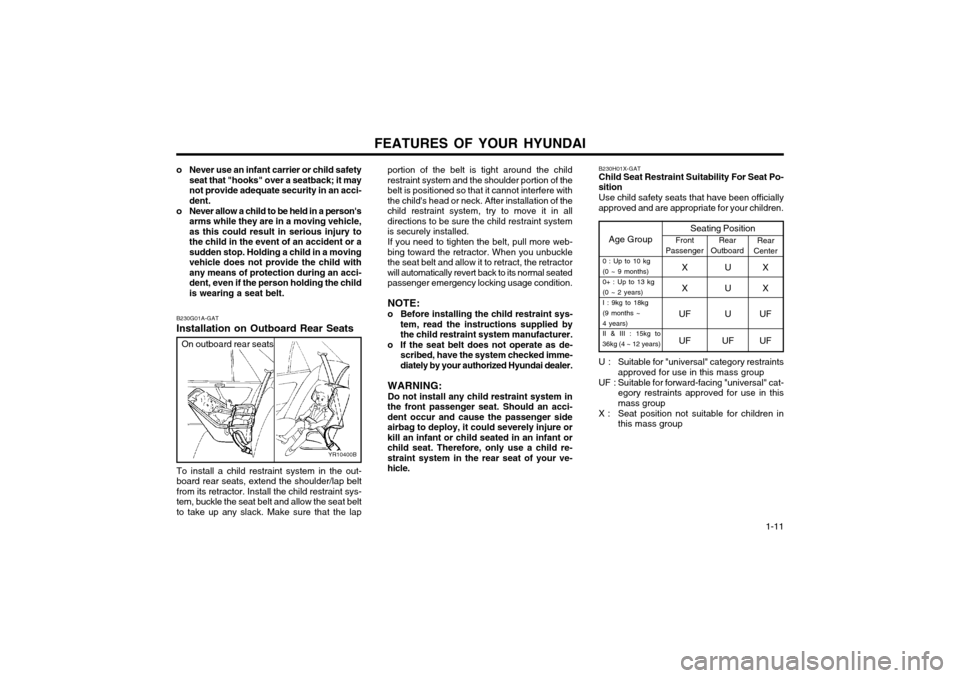
B230G01A-GAT Installation on Outboard Rear Seats
YR10400B
To install a child restraint system in the out- board rear seats, extend the shoulder/lap beltfrom its retractor. Install the child restraint sys-tem, buckle the seat belt and allow the seat beltto take up any slack. Make sure that the lap
On outboard rear seats
o Never use an infant carrier or child safety
seat that "hooks" over a seatback; it may not provide adequate security in an acci-dent.
o Never allow a child to be held in a person's arms while they are in a moving vehicle,as this could result in serious injury tothe child in the event of an accident or asudden stop. Holding a child in a movingvehicle does not provide the child withany means of protection during an acci-dent, even if the person holding the childis wearing a seat belt. portion of the belt is tight around the childrestraint system and the shoulder portion of thebelt is positioned so that it cannot interfere withthe child's head or neck. After installation of thechild restraint system, try to move it in alldirections to be sure the child restraint systemis securely installed.
If you need to tighten the belt, pull more web-
bing toward the retractor. When you unbucklethe seat belt and allow it to retract, the retractorwill automatically revert back to its normal seatedpassenger emergency locking usage condition.
NOTE:
o Before installing the child restraint sys- tem, read the instructions supplied bythe child restraint system manufacturer.
o If the seat belt does not operate as de- scribed, have the system checked imme-diately by your authorized Hyundai dealer.
WARNING: Do not install any child restraint system in
the front passenger seat. Should an acci- dent occur and cause the passenger sideairbag to deploy, it could severely injure orkill an infant or child seated in an infant orchild seat. Therefore, only use a child re-straint system in the rear seat of your ve-hicle.
Age Group Seating PositionFront
Passenger Rear
Outboard Rear
Center
0 : Up to 10 kg (0 ~ 9 months) 0+ : Up to 13 kg(0 ~ 2 years)I : 9kg to 18kg(9 months ~4 years) II & III : 15kg to
36kg (4 ~ 12 years)XUX
XUX
UF U UF
UF UF UF
B230H01X-GAT Child Seat Restraint Suitability For Seat Po-
sition
Use child safety seats that have been officially
approved and are appropriate for your children.
U : Suitable for "universal" category restraints approved for use in this mass group
UF : Suitable for forward-facing "universal" cat- egory restraints approved for use in this mass group
X : Seat position not suitable for children in this mass group
Page 149 of 249
FEATURES OF YOUR HYUNDAI
1-12 NOTE: Be sure to read information about the SRS on the labels provided on the backside ofthe sun visor and in the glove box. WARNING:
o As its name implies, the SRS is designed
to work with, and be supplemental to, the driver's and the passenger's three pointseat belt systems and is not a substitutefor them. Therefore your seat belts mustbe worn at all times while the vehicle is inmotion. In addition, the airbags deployonly in certain frontal impact conditionssevere enough to likely cause significantinjury to the vehicle occupants.
o The SRS is designed to deploy the airbags only when an impact is sufficiently se-vere and when the impact angle is lessthan 30° from the forward longitudinalaxis of the vehicle and will not deploy inside, rear or rollover impacts. Additional-ly, the airbags will only deploy once. Thus, seat belts must be worn at all times.
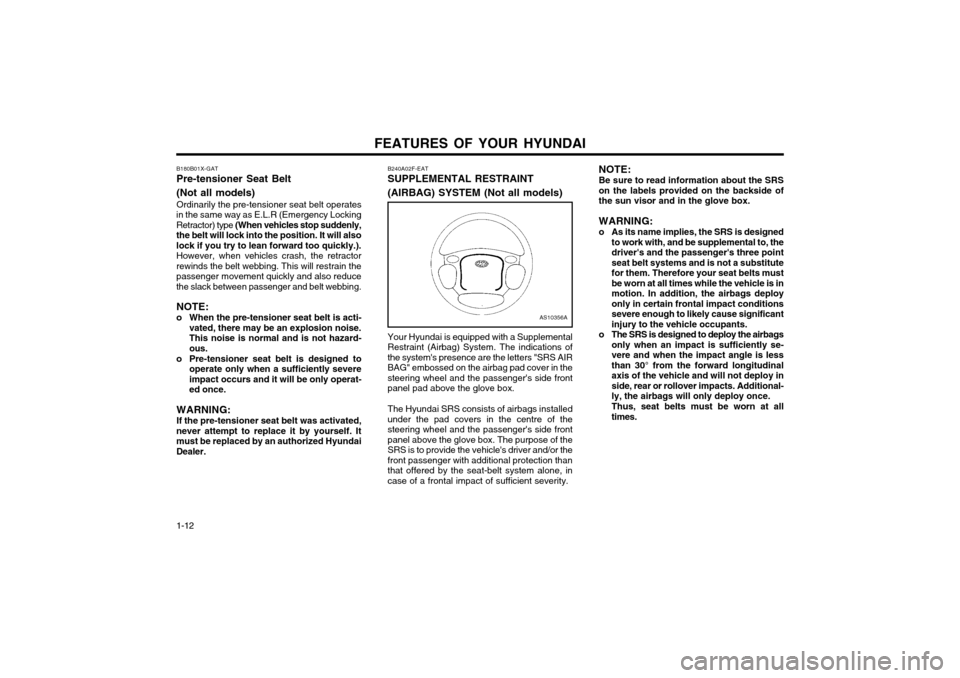
B240A02F-EAT SUPPLEMENTAL RESTRAINT (AIRBAG) SYSTEM (Not all models) Your Hyundai is equipped with a Supplemental Restraint (Airbag) System. The indications ofthe system's presence are the letters "SRS AIRBAG" embossed on the airbag pad cover in thesteering wheel and the passenger's side frontpanel pad above the glove box. The Hyundai SRS consists of airbags installed under the pad covers in the centre of thesteering wheel and the passenger's side frontpanel above the glove box. The purpose of theSRS is to provide the vehicle's driver and/or thefront passenger with additional protection thanthat offered by the seat-belt system alone, incase of a frontal impact of sufficient severity.
AS10356A
B180B01X-GAT Pre-tensioner Seat Belt (Not all models) Ordinarily the pre-tensioner seat belt operates
in the same way as E.L.R (Emergency Locking Retractor) type (When vehicles stop suddenly,
the belt will lock into the position. It will alsolock if you try to lean forward too quickly.).
However, when vehicles crash, the retractorrewinds the belt webbing. This will restrain thepassenger movement quickly and also reducethe slack between passenger and belt webbing.
NOTE:
o When the pre-tensioner seat belt is acti- vated, there may be an explosion noise.This noise is normal and is not hazard-ous.
o Pre-tensioner seat belt is designed to operate only when a sufficiently severeimpact occurs and it will be only operat-ed once.
WARNING: If the pre-tensioner seat belt was activated,
never attempt to replace it by yourself. It must be replaced by an authorized HyundaiDealer.
Page 151 of 249
FEATURES OF YOUR HYUNDAI
1-14 B240C01X-EAT SRS CareThe SRS is virtually maintenance-free and so there are no parts you can safely service byyourself. The entire SRS system must be in-spected by an authorized Hyundai dealer in 10years after the date that the car was manufac-ture. Any work on the airbag system, such as remov- ing, installing, repairing, or any work on thesteering wheel must be performed by a quali-fied Hyundai technician. Improper handling of the airbag system may result in serious personal injury. WARNING:
o Modification to SRS components or wir- ing, including the addition of any kind of badges to the pad cover or modifica-tions to the body structure, can adverse-ly affect SRS performance and lead topossible injury.
o For cleaning the horn pad, use only a soft, dry cloth or one which has beenmoistened with plain water. Solvents orcleaners could adversely affect the airbagcover and proper deployment of the sys-tem.
o No objects should be placed over or near the label identifying the airbag on thesteering wheel and instrument panel,because any such object could causeharm if the vehicle is in a crash severeenough to cause the airbag to inflate.
WARNING:
o When the SRS is activated, there may be
a loud noise and fine dust will be re- leased through out the vehicle. Theseconditions are normal and are not haz-ardous. However, the fine dust generat-ed during airbag deployment may causeskin irritation. Be sure to wash your handsand face thoroughly with lukewarm wa-ter and a mild soap after an accident inwhich the airbags were deployed.
o The SRS can function only when the ignition key is in the "ON" position. If theSRS SRI does not come on, or continu-ously remains on, after flashing for about6 seconds when the ignition key is turnedto the "ON" position, or after the engineis started, or comes on while driving, theSRS is not working properly. If this oc-curs, have your vehicle immediately in-spected by your Hyundai dealer.
o Before you replace a fuse or disconnect a battery terminal, turn the ignition key tothe "LOCK" position or remove the igni-tion key. Never remove or replace the airbag related fuse(s) when the ignition keyis in the "ON" position. Failure to heedthis warning will cause the SRS SRI toilluminate.
Upon deployment, tear seams molded directly
into the pad covers will separate under pres-sure from the expansion of the airbags. Furtheropening of the covers then allows full inflation ofthe airbags.
A fully inflated airbag in combination with a
properly worn seat belt slows the driver's for-ward motion, thus reducing the
risk of head and chest injury. After complete inflation, the airbag immediately
starts deflating, enabling the driver to maintain forward visibility.
CAUTION: When installing a container of liquid air
fresherer inside a vehicle, do not place it near the instrument cluster nor on the in-strument panel pad surface. If there is anyleakage from the air fresherer onto theseareas (instrument cluster, instrument panelpad or air ventilator), it may damage theseparts. If the liquid from the air freshererdoes leak onto these areas, wash them withwater immediately.
Page 153 of 249
FEATURES OF YOUR HYUNDAI
1-16
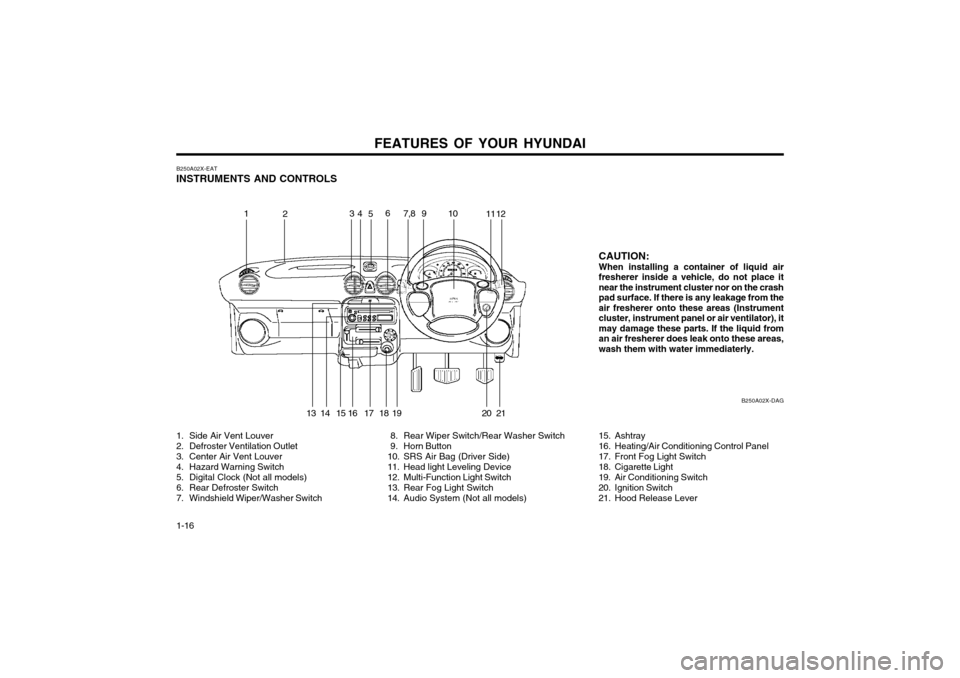
B250A02X-EAT INSTRUMENTS AND CONTROLS
1. Side Air Vent Louver
2. Defroster Ventilation Outlet
3. Center Air Vent Louver
4. Hazard Warning Switch
5. Digital Clock (Not all models)
6. Rear Defroster Switch
7. Windshield Wiper/Washer Switch 8. Rear Wiper Switch/Rear Washer Switch
9. Horn Button
10. SRS Air Bag (Driver Side)
11. Head light Leveling Device
12. Multi-Function Light Switch
13. Rear Fog Light Switch
14. Audio System (Not all models)15. Ashtray
16. Heating/Air Conditioning Control Panel
17. Front Fog Light Switch
18. Cigarette Light
19. Air Conditioning Switch
20. Ignition Switch
21. Hood Release LeverB250A02X-DAG
CAUTION: When installing a container of liquid airfresherer inside a vehicle, do not place it
near the instrument cluster nor on the crash
pad surface. If there is any leakage from theair fresherer onto these areas (Instrument
cluster, instrument panel or air ventilator), it
may damage these parts. If the liquid froman air fresherer does leak onto these areas,
wash them with water immediaterly.
1
2 34
5 9
7,8
6
1011 12
14 15 16 17 19 18 21 20
13
Page 170 of 249
FEATURES OF YOUR HYUNDAI 1-33
B670C02A-AAT Air Intake Control
B670C03A-DAG
This is used to select fresh outside air or
recirculation inside air.
Fresh Recirculation
With the " " mode selected, air enters the
vehicle from outside and is heated or cooled according to the other functions selected.
With the " " mode selected, air from within
the passenger compartment is drawn throughthe heating system and heated or cooled ac-cording to the other functions selected.
NOTE:It should be noted that prolonged operation
of the heating system in " " mode will giverise to misting of the windshield and sidewindows and the air within the passenger
compartment becoming stale. In addition prolonged use of the air conditioning withthe " " mode selected may result in theair within the passenger compartment be-coming excessively dry.
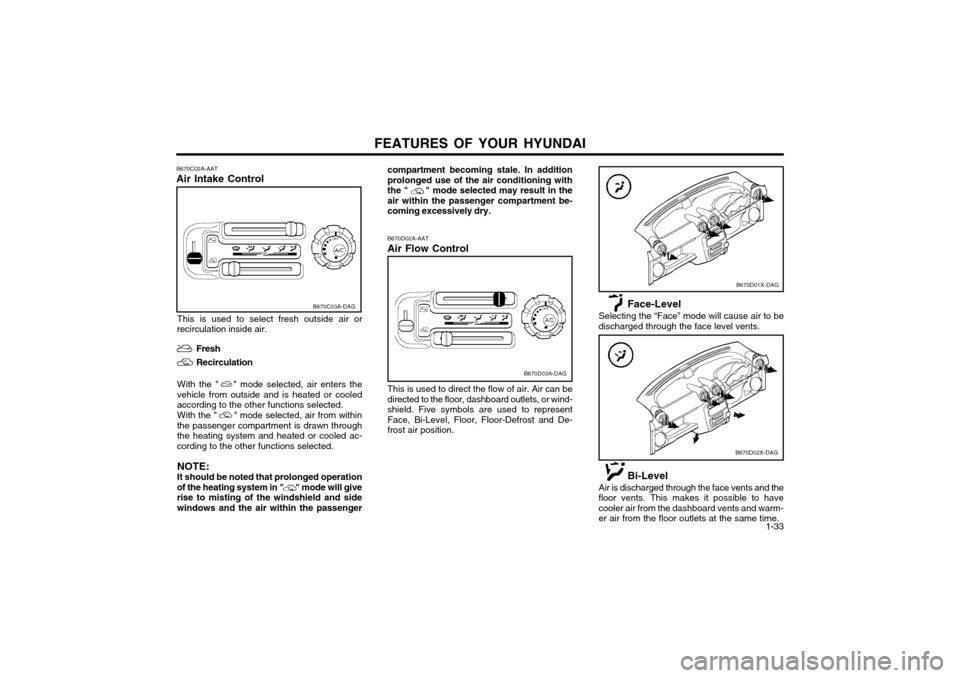
B670D02A-AAT Air Flow Control
B670D03A-DAG
This is used to direct the flow of air. Air can be directed to the floor, dashboard outlets, or wind-
shield. Five symbols are used to representFace, Bi-Level, Floor, Floor-Defrost and De-frost air position.
B670D01X-DAG
B670D02X-DAG
Face-Level
Selecting the “Face” mode will cause air to be
discharged through the face level vents.
Bi-Level
Air is discharged through the face vents and the
floor vents. This makes it possible to have cooler air from the dashboard vents and warm-
er air from the floor outlets at the same time.