maintenance schedule Hyundai Atos 2002 Owner's Manual
[x] Cancel search | Manufacturer: HYUNDAI, Model Year: 2002, Model line: Atos, Model: Hyundai Atos 2002Pages: 249, PDF Size: 3.11 MB
Page 72 of 249
DRIVING YOUR HYUNDAI
DRIVING YOUR HYUNDAI DRIVING YOUR HYUNDAI
DRIVING YOUR HYUNDAI
DRIVING YOUR HYUNDAI
2- 9
resulting in the engine bucking. If this hap- pens, shift to a lower gear. Over-revving isracing the engine beyond its safe limit. Thiscan be avoided by shifting at the recom-mended speeds.
o Use your air conditioning sparingly. The air conditioning system is operated by enginepower so your fuel economy is reducedwhen you use it.
C150A01A-AAT SMOOTH CORNERING
SMOOTH CORNERING SMOOTH CORNERING
SMOOTH CORNERING
SMOOTH CORNERING
Avoid braking or gear changing in corners,
especially when roads are wet. Ideally, cornersshould always be taken under gentle accelera-tion. If you follow these suggestions, tire wearwill be held to a minimum.
C160A01A-AATWINTER DRIVING
WINTER DRIVING WINTER DRIVING
WINTER DRIVING
WINTER DRIVING
The more severe weather conditions of winter
result in greater wear and other problems. Tominimize the problems of winter driving, youshould follow these suggestions:
C160B01A-GATSnowy or Icy Conditions
Snowy or Icy Conditions Snowy or Icy Conditions
Snowy or Icy Conditions
Snowy or Icy Conditions
To drive your vehicle in deep snow, it may be
necessary to use snow tires or to install tirechains on your tires. If snow tires are needed,
it is necessary to select tires equivalent in size
and type to the original equipment tires.
o Be sure that the wheels are aligned correct-
ly. Improper alignment can result from hittingcurbs or driving too fast over irregular sur-faces. Poor alignment causes faster tirewear and may also result in other problemsas well as greater fuel consumption.
o Keep your car in good condition. For better fuel economy and reduced maintenancecosts, maintain your car in accordance withthe maintenance schedule in Section 5. Ifyou drive your car in severe conditions,more frequent maintenance is required (seeSection 5 for details).
o Keep your car clean. For maximum service, your Hyundai should be kept clean and freeof corrosive materials. It is especially impor-tant that mud, dirt, ice, etc. not be allowed toaccumulate on the underside of the car. Thisextra weight can result in increased fuelconsumption and also contribute to corro-sion.
o Travel lightly. Don't carry unnecessary weight in your car. Weight reduces fuel economy.
o Don't let the engine idle longer than neces- sary. If you are waiting (and not in traffic),turn off your engine and restart only whenyou're ready to go.
o Remember, your Hyundai does not require extended warm-up. As soon as the engine isrunning smoothly, you can drive away. Invery cold weather, however, give your en-gine a slightly longer warm-up period.
o Don't "lug" or "over-rev" the engine. Lugging is driving too slowly in too high a gear
C140A01A-AAT
DRIVING FOR ECONOMY
DRIVING FOR ECONOMY DRIVING FOR ECONOMY
DRIVING FOR ECONOMY
DRIVING FOR ECONOMY
You can save fuel and get more kilometers from
your car if you follow these suggestions:
o Drive smoothly. Accelerate at a moderate rate. Don't make "jack-rabbit" starts or full- throttle shifts and maintain a steady cruisingspeed. Don't race between stoplights. Try toadjust your speed to that of the other trafficso you don't have to change speeds unnec-essarily. Avoid heavy traffic whenever pos-sible. Always maintain a safe distance fromother vehicles so you can avoid unneces-sary braking. This also reduces brake wear.
o Drive at a moderate speed. The faster you drive, the more fuel your car uses. Driving ata moderate speed, especially on the high-way, is one of the most effective ways toreduce fuel consumption.
o Don't "ride" the brake or clutch pedal. This can increase fuel consumption and alsoincrease wear on these components. In ad-dition, driving with your foot resting on thebrake pedal may cause the brakes to over-heat, which reduces their effectiveness andmay lead to more serious consequences.
o Take care of your tires. Keep them inflated to the recommended pressure. Incorrect in-flation, either too much or too little, results inunnecessary tire wear. Check the tire pres-sures at least once a month.
Page 90 of 249
VEHICLE MAINTENANCE REQUIREMENTS
VEHICLE MAINTENANCE REQUIREMENTS VEHICLE MAINTENANCE REQUIREMENTS
VEHICLE MAINTENANCE REQUIREMENTS
VEHICLE MAINTENANCE REQUIREMENTS
5-1
5.5.
5.5.
5.
VEHICLE MAINTE-
VEHICLE MAINTE- VEHICLE MAINTE-
VEHICLE MAINTE-
VEHICLE MAINTE-
NANCE REQ
NANCE REQ NANCE REQ
NANCE REQ
NANCE REQ
UIRE-
UIRE- UIRE-
UIRE-
UIRE-
MENTS
MENTS MENTS
MENTS
MENTS
F010A01A-GAT MAINTENANCE INTERVALS
MAINTENANCE INTERVALS MAINTENANCE INTERVALS
MAINTENANCE INTERVALS
MAINTENANCE INTERVALS
Service requirements
Service requirements Service requirements
Service requirements
Service requirements
To assure that you receive the greatest number
of kilometers of satisfying operation from your Hyundai, certain maintenance procedures must
be performed. Although careful design and en-
gineering have reduced these to a minimum,those that are required are of the utmost impor-tance. It is your responsibility to have these mainte-
nance procedures performed to comply with theterms of the warranties covering your newHyundai. The Service Passport supplied withyour new vehicle provides further information
about these warranties. F010B01A-AAT
Maintenance Requirements
Maintenance Requirements Maintenance Requirements
Maintenance Requirements
Maintenance Requirements
The maintenance required for your Hyundai
can be divided into three main areas:
o Specified scheduled procedures
o General everyday checks
o Do-it-yourself maintenance F010C01A-GAT
Specified Scheduled Procedures
Specified Scheduled Procedures Specified Scheduled Procedures
Specified Scheduled Procedures
Specified Scheduled Procedures
These are the procedures such as inspections,
adjustments and replacements that are listed in the maintenance charts starting on page 5-2.These procedures must be performed at theintervals shown in the maintenance schedule to
assure that your warranty remains in effect.Although it is strongly recommended that they
be performed by the factory-trained or distribu-tor-trained technicians at your Hyundai dealer,
these procedures may be performed at any
qualified service facility.
It is suggested that genuine Hyundai service
parts be used for any required repairs or re-placements. Other parts of equivalent quality
such as engine oil, engine coolant, manual orauto transaxle oil, brake fluid and so on which
are not supplied by Hyundai Motor Company or
its distributor may be used without affectingyour warranty coverage but you should always
be sure these are equivalent to the quality of theoriginal Hyundai parts. Your Service Passport
provides further information about your warran-ty coverage. F010E01A-AAT
Do-It-Yourself Maintenance
Do-It-Yourself Maintenance Do-It-Yourself Maintenance
Do-It-Yourself Maintenance
Do-It-Yourself Maintenance
If you are mechanically inclined, own a few
tools that are required and want to take the timeto do so, you can inspect and service a number
of items. For more information about doing ityourself, see Section 6.
F010F01A-AATA Few Tips
A Few Tips A Few Tips
A Few Tips
A Few Tips
o Whenever you have your Hyundai serviced,
keep copies of the service records in your
glovebox. This will help ensure that you candocument that the required procedures have
been performed to keep your warranties ineffect. This is especially important when
service is not performed by an authorizedHyundai dealer.
o If you choose to do your own maintenance and repairs, you may find it helpful to havean official Hyundai Shop Manual. A copy of
this publication may be purchased at yourHyundai dealer's parts department.
F020A02X-GAT SCHEDULED MAINTENANCE RE-
SCHEDULED MAINTENANCE RE- SCHEDULED MAINTENANCE RE-
SCHEDULED MAINTENANCE RE-
SCHEDULED MAINTENANCE RE-
QUIREMENTS
QUIREMENTS QUIREMENTS
QUIREMENTS
QUIREMENTS
Inspection should be performed any time a
malfunction is experienced or suspected. Re-ceipts for all emission control system services
should be retained to demonstrate compliancewith conditions of the emissions system war-ranty. For severe usage maintenance require-ments, see page 5-4 of this section.
F010D01A-AAT
General Checks
General Checks General Checks
General Checks
General Checks
These are the regular checks you should per-
form when you drive your Hyundai or you fill thefuel tank. A list of these items will be found onpage 6-2.
55
55
5
Page 91 of 249
VEHICLE MAINTENANCE REQUIREMENTS
VEHICLE MAINTENANCE REQUIREMENTS VEHICLE MAINTENANCE REQUIREMENTS
VEHICLE MAINTENANCE REQUIREMENTS
VEHICLE MAINTENANCE REQUIREMENTS
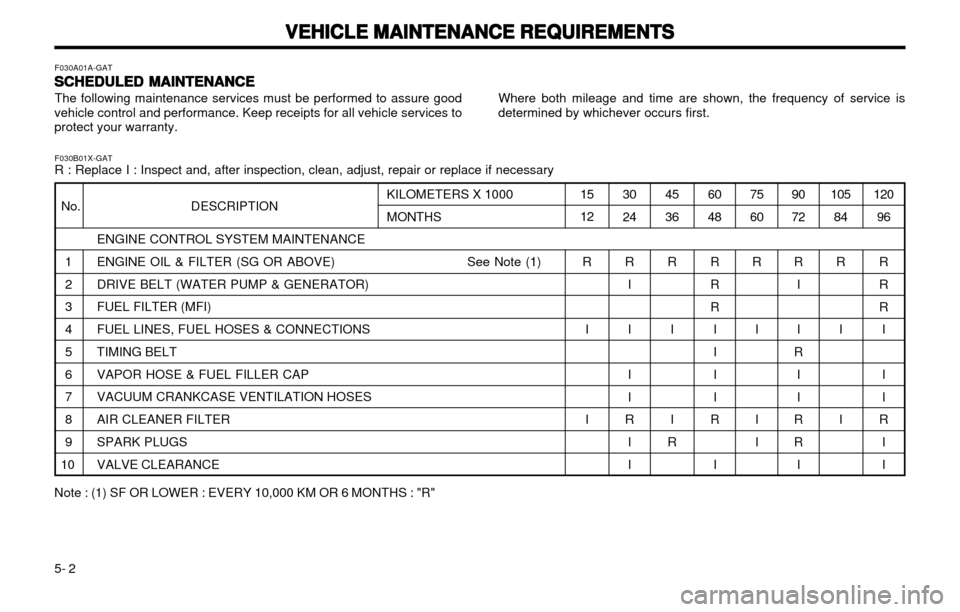
5- 2 ENGINE CONTROL SYSTEM MAINTENANCE
1 ENGINE OIL & FILTER (SG OR ABOVE) See Note (1)
2 DRIVE BELT (WATER PUMP & GENERATOR)
3 FUEL FILTER (MFI)
4 FUEL LINES, FUEL HOSES & CONNECTIONS
5 TIMING BELT
6 VAPOR HOSE & FUEL FILLER CAP
7 VACUUM CRANKCASE VENTILATION HOSES
8 AIR CLEANER FILTER
9 SPARK PLUGS
10 VALVE CLEARANCE
F030A01A-GAT
SCHEDULED MAINTENANCE
SCHEDULED MAINTENANCE SCHEDULED MAINTENANCE
SCHEDULED MAINTENANCE
SCHEDULED MAINTENANCE
The following maintenance services must be performed to assure good
vehicle control and performance. Keep receipts for all vehicle services to protect your warranty. Where both mileage and time are shown, the frequency of service is
determined by whichever occurs first.
No. DESCRIPTION105
84
R
I I 120
96
R R R I I I
R
I I
90 72
R I I
R I I
RR I
7560
R
I I I
6048
R R R II I I
R
I
4536
R
I I
R
30 24
R I II I
R
I I
1512
R
I I
KILOMETERS X 1000 MONTHS
F030B01X-GAT R : Replace I : Inspect and, after inspection, clean, adjust, repair or replace if necessary
Note : (1) SF OR LOWER : EVERY 10,000 KM OR 6 MONTHS : "R"
Page 94 of 249
VEHICLE MAINTENANCE REQUIREMENTS
VEHICLE MAINTENANCE REQUIREMENTS VEHICLE MAINTENANCE REQUIREMENTS
VEHICLE MAINTENANCE REQUIREMENTS
VEHICLE MAINTENANCE REQUIREMENTS
5-5
F060A01A-AAT
EXPLANATION OF SCHEDULED MAIN-
EXPLANATION OF SCHEDULED MAIN- EXPLANATION OF SCHEDULED MAIN-
EXPLANATION OF SCHEDULED MAIN-
EXPLANATION OF SCHEDULED MAIN-
TENANCE ITEMS
TENANCE ITEMS TENANCE ITEMS
TENANCE ITEMS
TENANCE ITEMS
F060M01A-AAToo
oo
o Engine oil and filter
Engine oil and filter Engine oil and filter
Engine oil and filter
Engine oil and filter
The engine oil and filter should be changed at
the intervals specified in the maintenance sched- ule. If the car is being driven in severe condi-tions, more frequent oil and filter changes arerequired.
F060B01A-AAToo
oo
o
Drive belts
Drive belts Drive belts
Drive belts
Drive belts
Inspect all drive belts for evidence of cuts,
cracks, excessive wear or oil and replace ifnecessary. Drive belts should be checked pe-
riodically for proper tension and adjusted asnecessary.
F060C01A-GAToo
oo
o Fuel filter
Fuel filter Fuel filter
Fuel filter
Fuel filter
A clogged filter can limit the speed at which the
vehicle may be driven, damage the emissionsystem and cause hard starting. If an exces-sive amount of foreign matter accumulates inthe fuel tank, the filter may require replacementmore frequently.
After installing a new filter, run the engine for
several minutes, and check for leaks at theconnections. F060D01A-GAT
oo
oo
o
Fuel lines, fuel hoses and connec-
Fuel lines, fuel hoses and connec- Fuel lines, fuel hoses and connec-
Fuel lines, fuel hoses and connec-
Fuel lines, fuel hoses and connec-
tions
tions tions
tions
tions
Check the fuel lines, fuel hoses and connec-
tions for leakage and damage. Replace anydamaged or leaking parts immediately. Inspect the hose routing to assure that the
hoses do not come in contact with any heatsource, sharp edges or moving componentwhich might cause heat damage or mechanicalwear. Inspect all hose connections, such as
clamps and couplings, to make sure they aresecure, and that no leaks are present. Hoses
should be replaced immediately if there is any
evidence of deterioration or damage.
F060H01A-AAToo
oo
o
Air cleaner filter
Air cleaner filter Air cleaner filter
Air cleaner filter
Air cleaner filter
A Genuine Hyundai air cleaner filter is recom-
mended when filter is replaced.
F060J01A-AAToo
oo
o
Spark plugs
Spark plugs Spark plugs
Spark plugs
Spark plugs
Make sure to install new spark plugs of the
correct heat range.
F060E01A-AAT
oo
oo
o
Timing belt
Timing belt Timing belt
Timing belt
Timing belt
Inspect all parts related to the timing belt for
damage and deformation. Replace any dam-aged parts immediately.
F060G01A-AAToo
oo
o
Vapor hose and fuel filler cap
Vapor hose and fuel filler cap Vapor hose and fuel filler cap
Vapor hose and fuel filler cap
Vapor hose and fuel filler cap
The vapor hose and fuel filler cap should be
inspected at those intervals specified in themaintenance schedule. Make sure that a newvapor hose or fuel filler cap is correctly re-placed.
F060F01A-AATo Vacuum, crankcase ventilation hos-
o Vacuum, crankcase ventilation hos- o Vacuum, crankcase ventilation hos-
o Vacuum, crankcase ventilation hos-
o Vacuum, crankcase ventilation hos-
eses
eses
es
Inspect the surface of hoses for evidence of
heat and/or mechanical damage. Hard and brit-tle rubber, cracking, tears, cuts, abrasions, and
excessive swelling indicate deterioration. Par-ticular attention should be paid to examinethose hose surfaces nearest to high heat sourc-es, such as the exhaust manifold. F060N01X-GAT
oo
oo
o Valve clearances
Valve clearances Valve clearances
Valve clearances
Valve clearances
Incorrect valve clearance will not only result in
unsteady engine operation, but will also causeexcessive noise and reduced engine perfor-
mance. Inspect valve clearance and adjust asrequired while the engine is hot.
Valve-to-rocker arm clearance Intake valves ..... 0.2 mm (0.008 in.)Exhaust valves .... 0.25 mm (0.010 in.)
Page 95 of 249
VEHICLE MAINTENANCE REQUIREMENTS
VEHICLE MAINTENANCE REQUIREMENTS VEHICLE MAINTENANCE REQUIREMENTS
VEHICLE MAINTENANCE REQUIREMENTS
VEHICLE MAINTENANCE REQUIREMENTS
5- 6 F070B01A-GAT
oo
oo
o Cooling System
Cooling System Cooling System
Cooling System
Cooling System
Check the cooling system part, such as radia-
tor, coolant reservoir, hoses and connections for leakage and damage. Replace any dam-aged parts.
F070C01A-AAToo
oo
o
Engine coolant
Engine coolant Engine coolant
Engine coolant
Engine coolant
The coolant should be changed at the
intervals specified in the maintenance sched-ule.
F070D02X-GAToo
oo
o Manual transaxle oil
Manual transaxle oil Manual transaxle oil
Manual transaxle oil
Manual transaxle oil
Inspect the manual transaxle oil according to
the maintenance schedule.
NOTE:
NOTE: NOTE:
NOTE:
NOTE:
If the oil level is low, check for possible
If the oil level is low, check for possible If the oil level is low, check for possible
If the oil level is low, check for possible
If the oil level is low, check for possible leaks before adding oil. Do not overfill.
leaks before adding oil. Do not overfill. leaks before adding oil. Do not overfill.
leaks before adding oil. Do not overfill.
leaks before adding oil. Do not overfill.
F070E01X-GAToo
oo
o
Automatic transaxle fluid
Automatic transaxle fluid Automatic transaxle fluid
Automatic transaxle fluid
Automatic transaxle fluid
The fluid level should be in the "HOT" range of
the dipstick, after the engine and transaxle are at normal operating temperature. Check theAutomatic Transaxle Fluid level with the engine
running and the transaxle in neutral, with theparking brake properly applied. Use ESSO JWS-3314 when adding or changing fluid. F070F01A-AAT
oo
oo
o Brake hoses and lines
Brake hoses and lines Brake hoses and lines
Brake hoses and lines
Brake hoses and lines
Visually check for proper installation, chafing,
cracks, deterioration and any leakage. Replaceany deteriorated or damaged parts immediate-ly. F070G01A-AAT
oo
oo
o Brake fluid
Brake fluid Brake fluid
Brake fluid
Brake fluid
Check brake fluid level in the brake fluid reser- voir. The level should be between "MIN" and"MAX" marks on the side of the reservoir. Use only hydraulic brake fluid conforming to DOT 3 or DOT 4. F070H01A-AAT oo
oo
o
Rear brake drums/linings, parking
Rear brake drums/linings, parking Rear brake drums/linings, parking
Rear brake drums/linings, parking
Rear brake drums/linings, parking
brake
brake brake
brake
brake
Check the rear brake drums and linings for
scoring, burning, leaking fluid, broken parts,and excessive wear. Inspect the parking brake
system including the parking brake lever andcables. For detailed service procedures, referto the Shop Manual. F070J01A-AAT
oo
oo
o
Brake pads, calipers and rotors
Brake pads, calipers and rotors Brake pads, calipers and rotors
Brake pads, calipers and rotors
Brake pads, calipers and rotors
Check the pads for excessive wear, discs for
run out and wear, and calipers for fluid leakage. F070L01A-AAT
oo
oo
o Suspension mounting bolts
Suspension mounting bolts Suspension mounting bolts
Suspension mounting bolts
Suspension mounting bolts
Check the suspension connections for loose-ness or damage. Retighten to the specifiedtorque.
F070K01A-AAT
oo
oo
o Exhaust pipe and muffler
Exhaust pipe and muffler Exhaust pipe and muffler
Exhaust pipe and muffler
Exhaust pipe and muffler
Visually inspect the exhaust pipes, muffler andhangers for cracks, deterioration, or damage.Start the engine and listen carefully for any
exhaust gas leakage. Tighten connections orreplace parts as necessary. F070M01A-AAT oo
oo
o
Steering gear box, linkage & boots/
Steering gear box, linkage & boots/ Steering gear box, linkage & boots/
Steering gear box, linkage & boots/
Steering gear box, linkage & boots/
lower
lower lower
lower
lower arm ball joint
arm ball joint arm ball joint
arm ball joint
arm ball joint
With the vehicle stopped and engine off, check for excessive free-play in the steering wheel.Check the linkage for bends or damage. Check
the dust boots and ball joints for deterioration,
cracks, or damage. Replace any damaged parts. F070N01A-AAT oo
oo
o Power steering pump, belt and
Power steering pump, belt and Power steering pump, belt and
Power steering pump, belt and
Power steering pump, belt and
hoses
hoses hoses
hoses
hoses
Check the power steering pump and hoses for leakage and damage. Replace any damaged orleaking parts immediately. Inspect the powersteering belt for evidence of cuts, cracks, ex-
cessive wear, oiliness and proper tension. Re-place or adjust it if necessary.
Page 100 of 249
DO-IT-YOURSELF MAINTENANCE
DO-IT-YOURSELF MAINTENANCE DO-IT-YOURSELF MAINTENANCE
DO-IT-YOURSELF MAINTENANCE
DO-IT-YOURSELF MAINTENANCE
6-4 G040A03X-GAT
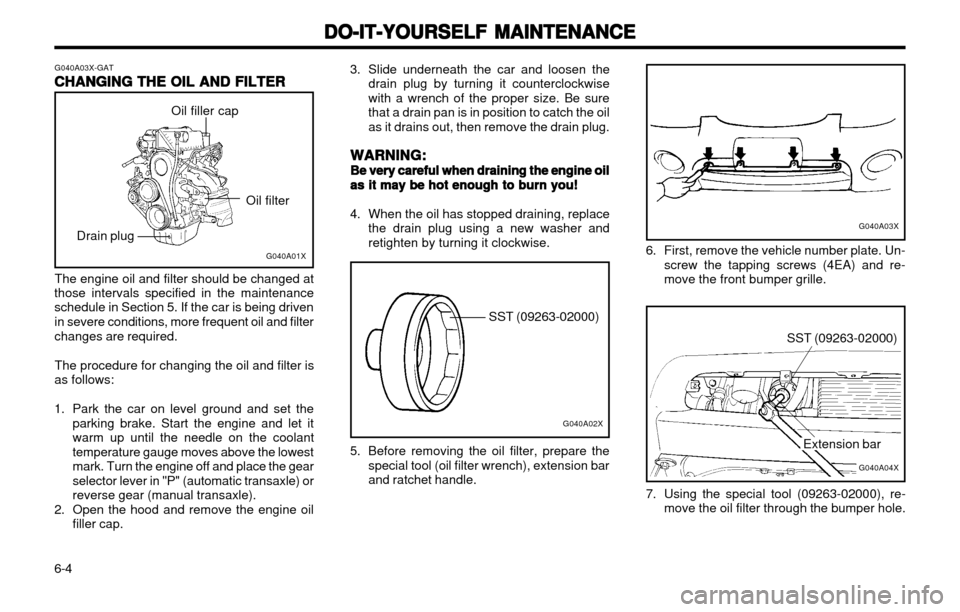
CHANGING THE OIL AND FILTER
CHANGING THE OIL AND FILTER CHANGING THE OIL AND FILTER
CHANGING THE OIL AND FILTER
CHANGING THE OIL AND FILTER 3. Slide underneath the car and loosen the
drain plug by turning it counterclockwise with a wrench of the proper size. Be surethat a drain pan is in position to catch the oilas it drains out, then remove the drain plug.
WARNING:
WARNING: WARNING:
WARNING:
WARNING:
Be very careful when draining the engine oil
Be very careful when draining the engine oil Be very careful when draining the engine oil
Be very careful when draining the engine oil
Be very careful when draining the engine oil
as it may be hot
as it may be hot as it may be hot
as it may be hot
as it may be hot enough to burn you!
enough to burn you! enough to burn you!
enough to burn you!
enough to burn you!
4. When the oil has stopped draining, replace the drain plug using a new washer andretighten by turning it clockwise. 6. First, remove the vehicle number plate. Un-
screw the tapping screws (4EA) and re-move the front bumper grille.
Oil filler cap
Oil filter
Drain plug
The engine oil and filter should be changed at
those intervals specified in the maintenance schedule in Section 5. If the car is being driven
in severe conditions, more frequent oil and filter
changes are required.
The procedure for changing the oil and filter is
as follows:
1. Park the car on level ground and set the parking brake. Start the engine and let it warm up until the needle on the coolanttemperature gauge moves above the lowest
mark. Turn the engine off and place the gearselector lever in "P" (automatic transaxle) orreverse gear (manual transaxle).
2. Open the hood and remove the engine oil filler cap.
G040A01X
G040A02X
SST (09263-02000)
5. Before removing the oil filter, prepare the special tool (oil filter wrench), extension bar and ratchet handle.
G040A03X
SST (09263-02000)
G040A04X
Extension bar
7. Using the special tool (09263-02000), re- move the oil filter through the bumper hole.
Page 102 of 249
DO-IT-YOURSELF MAINTENANCE
DO-IT-YOURSELF MAINTENANCE DO-IT-YOURSELF MAINTENANCE
DO-IT-YOURSELF MAINTENANCE
DO-IT-YOURSELF MAINTENANCE
6-6 -15 (5)
-25 (-13) -35 (-31)-45 (-49)
G050B01A-AAT
Recommended Engine Coolant
Recommended Engine Coolant Recommended Engine Coolant
Recommended Engine Coolant
Recommended Engine Coolant
Use a high quality ethylene-glycol coolant in a
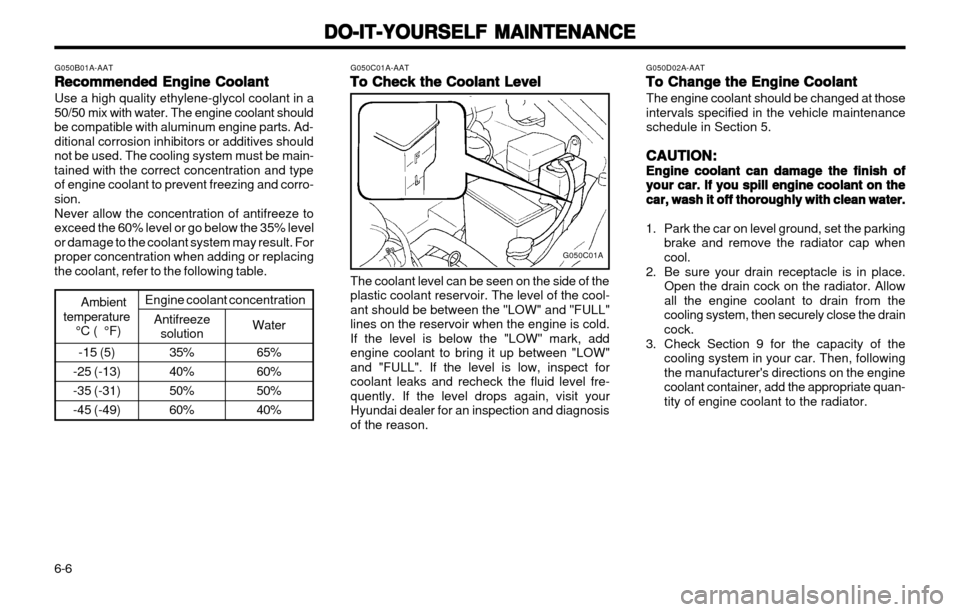
50/50 mix with water. The engine coolant should be compatible with aluminum engine parts. Ad-ditional corrosion inhibitors or additives shouldnot be used. The cooling system must be main-tained with the correct concentration and typeof engine coolant to prevent freezing and corro-sion. Never allow the concentration of antifreeze to exceed the 60% level or go below the 35% levelor damage to the coolant system may result. Forproper concentration when adding or replacingthe coolant, refer to the following table.
35% 40%50%60% G050C01A-AAT
To Check the Coolant Level
To Check the Coolant Level To Check the Coolant Level
To Check the Coolant Level
To Check the Coolant Level
The coolant level can be seen on the side of the plastic coolant reservoir. The level of the cool-ant should be between the "LOW" and "FULL"lines on the reservoir when the engine is cold.If the level is below the "LOW" mark, addengine coolant to bring it up between "LOW"and "FULL". If the level is low, inspect forcoolant leaks and recheck the fluid level fre-quently. If the level drops again, visit yourHyundai dealer for an inspection and diagnosisof the reason. G050D02A-AAT
To Change the Engine Coolant
To Change the Engine Coolant To Change the Engine Coolant
To Change the Engine Coolant
To Change the Engine Coolant
The engine coolant should be changed at thoseintervals specified in the vehicle maintenanceschedule in Section 5.
CAUTION:
CAUTION: CAUTION:
CAUTION:
CAUTION:
Engine coolant can damage the finish of
Engine coolant can damage the finish of Engine coolant can damage the finish of
Engine coolant can damage the finish of
Engine coolant can damage the finish of
your car. If you spill engine coolant on the
your car. If you spill engine coolant on the your car. If you spill engine coolant on the
your car. If you spill engine coolant on the
your car. If you spill engine coolant on the
car, wash it off thoroughly with clean water.
car, wash it off thoroughly with clean water. car, wash it off thoroughly with clean water.
car, wash it off thoroughly with clean water.
car, wash it off thoroughly with clean water.
1. Park the car on level ground, set the parking brake and remove the radiator cap whencool.
2. Be sure your drain receptacle is in place. Open the drain cock on the radiator. Allowall the engine coolant to drain from thecooling system, then securely close the draincock.
3. Check Section 9 for the capacity of the cooling system in your car. Then, followingthe manufacturer's directions on the enginecoolant container, add the appropriate quan-tity of engine coolant to the radiator.
G050C01A
65% 60%50%40%
Water
Antifreeze
solution
Ambient
temperature °C ( °F) Engine coolant concentration
Page 103 of 249
DO-IT-YOURSELF MAINTENANCE
DO-IT-YOURSELF MAINTENANCE DO-IT-YOURSELF MAINTENANCE
DO-IT-YOURSELF MAINTENANCE
DO-IT-YOURSELF MAINTENANCE
6-7
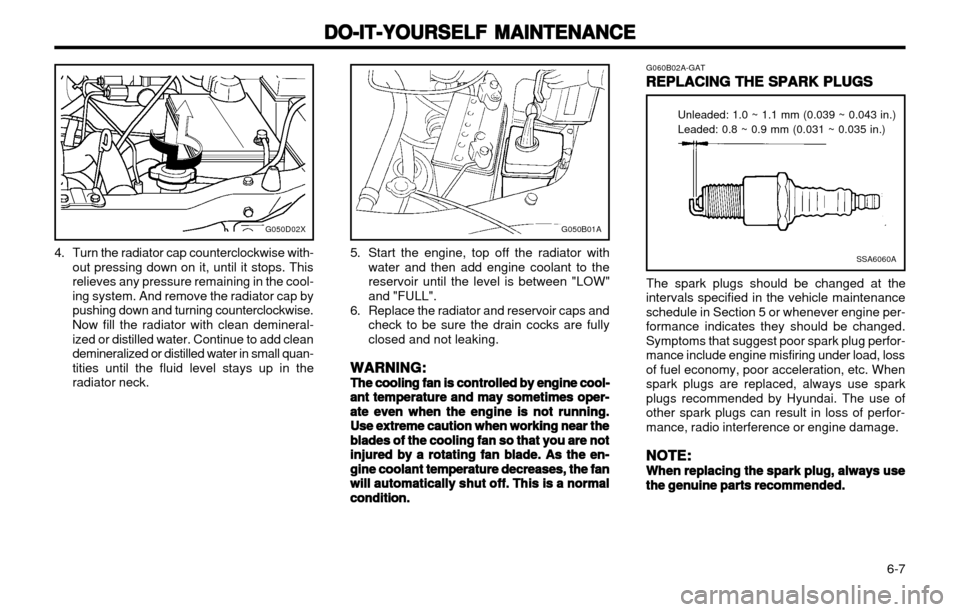
4. Turn the radiator cap counterclockwise with-out pressing down on it, until it stops. This relieves any pressure remaining in the cool-ing system. And remove the radiator cap bypushing down and turning counterclockwise. Now fill the radiator with clean demineral- ized or distilled water. Continue to add cleandemineralized or distilled water in small quan-tities until the fluid level stays up in theradiator neck.SSA6060A
Unleaded: 1.0 ~ 1.1 mm (0.039 ~ 0.043 in.) Leaded: 0.8 ~ 0.9 mm (0.031 ~ 0.035 in.)
G060B02A-GAT
REPLACING THE SPARK PLUGS
REPLACING THE SPARK PLUGS REPLACING THE SPARK PLUGS
REPLACING THE SPARK PLUGS
REPLACING THE SPARK PLUGS
The spark plugs should be changed at the
intervals specified in the vehicle maintenance schedule in Section 5 or whenever engine per-formance indicates they should be changed.Symptoms that suggest poor spark plug perfor-mance include engine misfiring under load, lossof fuel economy, poor acceleration, etc. Whenspark plugs are replaced, always use sparkplugs recommended by Hyundai. The use ofother spark plugs can result in loss of perfor-mance, radio interference or engine damage.
NOTE:
NOTE: NOTE:
NOTE:
NOTE:
When replacing the spark plug, always use
When replacing the spark plug, always use When replacing the spark plug, always use
When replacing the spark plug, always use
When replacing the spark plug, always use the genuine parts recommended.
the genuine parts recommended. the genuine parts recommended.
the genuine parts recommended.
the genuine parts recommended.
G050D02X
5. Start the engine, top off the radiator with
water and then add engine coolant to the reservoir until the level is between "LOW"and "FULL".
6. Replace the radiator and reservoir caps and check to be sure the drain cocks are fullyclosed and not leaking.
WARNING:
WARNING: WARNING:
WARNING:
WARNING:
The cooling fan is controlled by engine cool-
The cooling fan is controlled by engine cool- The cooling fan is controlled by engine cool-
The cooling fan is controlled by engine cool-
The cooling fan is controlled by engine cool- ant temperature and may sometimes oper-
ant temperature and may sometimes oper- ant temperature and may sometimes oper-
ant temperature and may sometimes oper-
ant temperature and may sometimes oper-
ate even when the engine is not running.
ate even when the engine is not running. ate even when the engine is not running.
ate even when the engine is not running.
ate even when the engine is not running.
Use extreme caution when working near the
Use extreme caution when working near the Use extreme caution when working near the
Use extreme caution when working near the
Use extreme caution when working near the
blades of the cooling fan so that you are not
blades of the cooling fan so that you are not blades of the cooling fan so that you are not
blades of the cooling fan so that you are not
blades of the cooling fan so that you are not
injured by a rotating fan blade. As the en-
injured by a rotating fan blade. As the en- injured by a rotating fan blade. As the en-
injured by a rotating fan blade. As the en-
injured by a rotating fan blade. As the en-
gine coolant temperature decreases, the fan
gine coolant temperature decreases, the fan gine coolant temperature decreases, the fan
gine coolant temperature decreases, the fan
gine coolant temperature decreases, the fan
will automatically shut off. This is a normal
will automatically shut off. This is a normal will automatically shut off. This is a normal
will automatically shut off. This is a normal
will automatically shut off. This is a normal
condition.
condition. condition.
condition.
condition.
G050B01A
Page 106 of 249
DO-IT-YOURSELF MAINTENANCE
DO-IT-YOURSELF MAINTENANCE DO-IT-YOURSELF MAINTENANCE
DO-IT-YOURSELF MAINTENANCE
DO-IT-YOURSELF MAINTENANCE
6-10 G110A01A-AAT
CHECKING THE TRANSAXLE FLUID
CHECKING THE TRANSAXLE FLUID CHECKING THE TRANSAXLE FLUID
CHECKING THE TRANSAXLE FLUID
CHECKING THE TRANSAXLE FLUID
(AUTOMATIC)
(AUTOMATIC) (AUTOMATIC)
(AUTOMATIC)
(AUTOMATIC)
Transaxle fluid in the automatic transaxle should be checked at those intervals specified in thevehicle maintenance schedule in Section 5. G110B01X-AAT
Recommended Fluid
Recommended Fluid Recommended Fluid
Recommended Fluid
Recommended Fluid Your Hyundai automatic transaxle is specially designed to operate with ESSO JWS3314. Dam-age caused by a nonspecified fluid is not cov-ered by your new vehicle limited warranty. G110C01X-GAT
Transaxle Fluid Capacity
Transaxle Fluid Capacity Transaxle Fluid Capacity
Transaxle Fluid Capacity
Transaxle Fluid Capacity
The fluid capacity of the automatic transaxle is
5.2 liters (5.48 U.S. quarts).
WARNING:
WARNING: WARNING:
WARNING:
WARNING:
The transaxle fluid level should be checked
The transaxle fluid level should be checked The transaxle fluid level should be checked
The transaxle fluid level should be checked
The transaxle fluid level should be checked
when the engine
when the engine when the engine
when the engine
when the engine is at normal operating tem-
is at normal operating tem- is at normal operating tem-
is at normal operating tem-
is at normal operating tem-
perature. This means that the engine, radia-
perature. This means that the engine, radia- perature. This means that the engine, radia-
perature. This means that the engine, radia-
perature. This means that the engine, radia-
tor, tor,
tor, tor,
tor, exhaust system etc., are very hot. Exer-
exhaust system etc., are very hot. Exer- exhaust system etc., are very hot. Exer-
exhaust system etc., are very hot. Exer-
exhaust system etc., are very hot. Exer-
cise great care not to burn yourself
cise great care not to burn yourself cise great care not to burn yourself
cise great care not to burn yourself
cise great care not to burn yourself during
during during
during
during
this procedure.
this procedure. this procedure.
this procedure.
this procedure.
G100A04X-GAT
CHECKING THE TRANSAXLE OIL
CHECKING THE TRANSAXLE OIL CHECKING THE TRANSAXLE OIL
CHECKING THE TRANSAXLE OIL
CHECKING THE TRANSAXLE OIL
(MANUAL)
(MANUAL) (MANUAL)
(MANUAL)
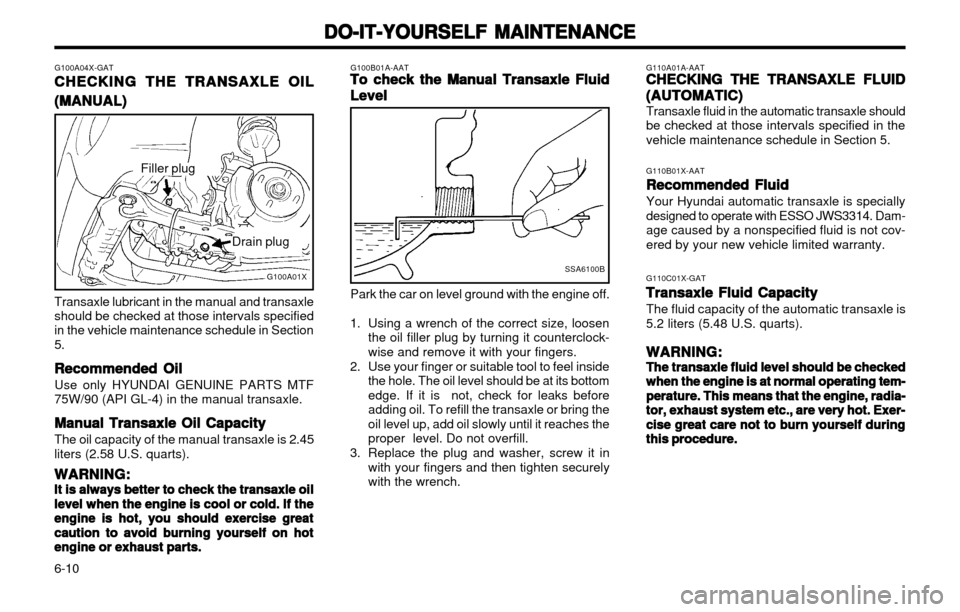
(MANUAL) Transaxle lubricant in the manual and transaxle should be checked at those intervals specified in the vehicle maintenance schedule in Section5.
Recommended Oil
Recommended Oil Recommended Oil
Recommended Oil
Recommended Oil Use only HYUNDAI GENUINE PARTS MTF 75W/90 (API GL-4) in the manual transaxle.
Manual Transaxle Oil Capacity
Manual Transaxle Oil Capacity Manual Transaxle Oil Capacity
Manual Transaxle Oil Capacity
Manual Transaxle Oil Capacity The oil capacity of the manual transaxle is 2.45 liters (2.58 U.S. quarts).
WARNING:
WARNING: WARNING:
WARNING:
WARNING:
It is always better to check the transaxle oil
It is always better to check the transaxle oil It is always better to check the transaxle oil
It is always better to check the transaxle oil
It is always better to check the transaxle oil
level when the
level when the level when the
level when the
level when the engine is cool or cold. If the
engine is cool or cold. If the engine is cool or cold. If the
engine is cool or cold. If the
engine is cool or cold. If the
engine is hot, you should exercise great
engine is hot, you should exercise great engine is hot, you should exercise great
engine is hot, you should exercise great
engine is hot, you should exercise great
caution
caution caution
caution
caution to avoid burning yourself on hot
to avoid burning yourself on hot to avoid burning yourself on hot
to avoid burning yourself on hot
to avoid burning yourself on hot
engine or exhaust parts.
engine or exhaust parts. engine or exhaust parts.
engine or exhaust parts.
engine or exhaust parts. G100B01A-AAT
To check the Manual Transaxle Fluid
To check the Manual Transaxle Fluid To check the Manual Transaxle Fluid
To check the Manual Transaxle Fluid
To check the Manual Transaxle Fluid
Level
Level Level
Level
Level
SSA6100B
Park the car on level ground with the engine off.
1. Using a wrench of the correct size, loosen the oil filler plug by turning it counterclock- wise and remove it with your fingers.
2. Use your finger or suitable tool to feel inside the hole. The oil level should be at its bottomedge. If it is not, check for leaks beforeadding oil. To refill the transaxle or bring theoil level up, add oil slowly until it reaches theproper level. Do not overfill.
3. Replace the plug and washer, screw it in with your fingers and then tighten securelywith the wrench.
G100A01X
Filler plug
Drain plug
Page 107 of 249
DO-IT-YOURSELF MAINTENANCE
DO-IT-YOURSELF MAINTENANCE DO-IT-YOURSELF MAINTENANCE
DO-IT-YOURSELF MAINTENANCE
DO-IT-YOURSELF MAINTENANCE
6-11
WARNING:
WARNING: WARNING:
WARNING:
WARNING:
The cooling fan is controlled by engine cool-
The cooling fan is controlled by engine cool- The cooling fan is controlled by engine cool-
The cooling fan is controlled by engine cool-
The cooling fan is controlled by engine cool- ant temperature and may sometimes oper-
ant temperature and may sometimes oper- ant temperature and may sometimes oper-
ant temperature and may sometimes oper-
ant temperature and may sometimes oper-
ate even when the engine is not running.
ate even when the engine is not running. ate even when the engine is not running.
ate even when the engine is not running.
ate even when the engine is not running.
Use extreme caution when working near the
Use extreme caution when working near the Use extreme caution when working near the
Use extreme caution when working near the
Use extreme caution when working near the
blades of the cooling fan, so that you are not
blades of the cooling fan, so that you are not blades of the cooling fan, so that you are not
blades of the cooling fan, so that you are not
blades of the cooling fan, so that you are not
injured by a rotating fan blade. As the en-
injured by a rotating fan blade. As the en- injured by a rotating fan blade. As the en-
injured by a rotating fan blade. As the en-
injured by a rotating fan blade. As the en-
gine coolant temperature decreases, the fan
gine coolant temperature decreases, the fan gine coolant temperature decreases, the fan
gine coolant temperature decreases, the fan
gine coolant temperature decreases, the fan
will automatically shut off. This is a normal
will automatically shut off. This is a normal will automatically shut off. This is a normal
will automatically shut off. This is a normal
will automatically shut off. This is a normal
condition.
condition. condition.
condition.
condition.
G120C02A-AATRecommended Brake Fluid
Recommended Brake Fluid Recommended Brake Fluid
Recommended Brake Fluid
Recommended Brake Fluid
Use only hydraulic brake fluid conforming to
DOT 3 or DOT 4 specifications in your braking G120A01A-AAT
CHECKING THE BRAKES
CHECKING THE BRAKES CHECKING THE BRAKES
CHECKING THE BRAKES
CHECKING THE BRAKES
CAUTION:
CAUTION: CAUTION:
CAUTION:
CAUTION:
Because brakes are essential to the safe
Because brakes are essential to the safe Because brakes are essential to the safe
Because brakes are essential to the safe
Because brakes are essential to the safeoperation of the car, it is suggested that
operation of the car, it is suggested that operation of the car, it is suggested that
operation of the car, it is suggested that
operation of the car, it is suggested that
they be checked and inspected by your
they be checked and inspected by your they be checked and inspected by your
they be checked and inspected by your
they be checked and inspected by your
Hyundai dealer. The brakes should be
Hyundai dealer. The brakes should be Hyundai dealer. The brakes should be
Hyundai dealer. The brakes should be
Hyundai dealer. The brakes should be
checked and inspected for wear at those
checked and inspected for wear at those checked and inspected for wear at those
checked and inspected for wear at those
checked and inspected for wear at those
intervals specified in the vehicle mainte-
intervals specified in the vehicle mainte- intervals specified in the vehicle mainte-
intervals specified in the vehicle mainte-
intervals specified in the vehicle mainte-
nance schedule in Section 5.
nance schedule in Section 5. nance schedule in Section 5.
nance schedule in Section 5.
nance schedule in Section 5.
G120B01A-AATChecking the Brake Fluid Level
Checking the Brake Fluid Level Checking the Brake Fluid Level
Checking the Brake Fluid Level
Checking the Brake Fluid Level
WARNING:
WARNING: WARNING:
WARNING:
WARNING:
Use caution when handling brake fluid. It
Use caution when handling brake fluid. It Use caution when handling brake fluid. It
Use caution when handling brake fluid. It
Use caution when handling brake fluid. Itcan damage your vision if it gets into your
can damage your vision if it gets into your can damage your vision if it gets into your
can damage your vision if it gets into your
can damage your vision if it gets into your
eyes. It will also damage your vehicle's paint
eyes. It will also damage your vehicle's paint eyes. It will also damage your vehicle's paint
eyes. It will also damage your vehicle's paint
eyes. It will also damage your vehicle's paint
if spilled on it and not removed immediately.
if spilled on it and not removed immediately. if spilled on it and not removed immediately.
if spilled on it and not removed immediately.
if spilled on it and not removed immediately.
G110D02A-GAT
To Check the Automatic Transaxle Fluid
To Check the Automatic Transaxle Fluid To Check the Automatic Transaxle Fluid
To Check the Automatic Transaxle Fluid
To Check the Automatic Transaxle Fluid
Level
Level Level
Level
Level
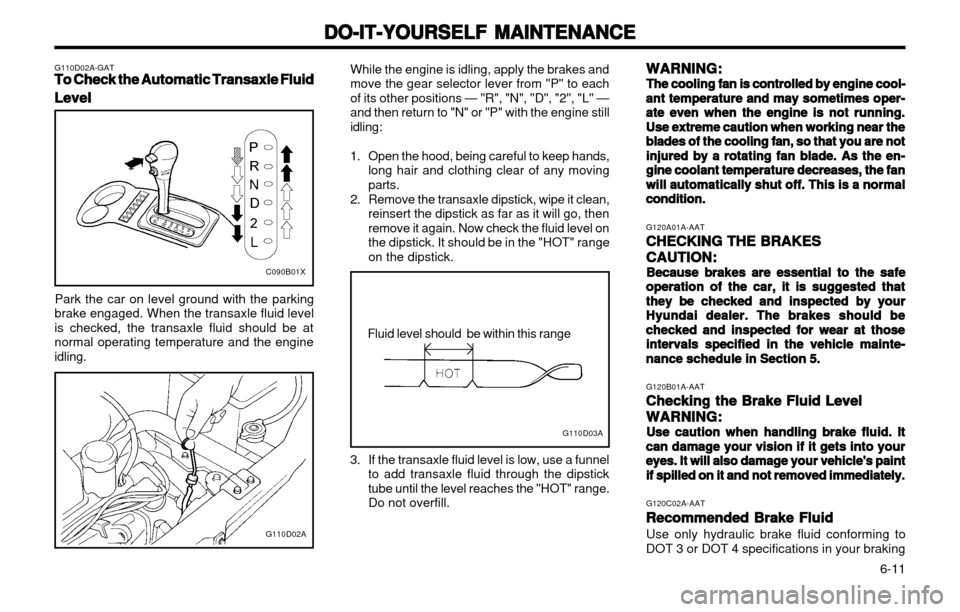
Park the car on level ground with the parking
brake engaged. When the transaxle fluid level is checked, the transaxle fluid should be atnormal operating temperature and the engineidling. While the engine is idling, apply the brakes andmove the gear selector lever from "P" to eachof its other positions — "R", "N", "D", "2", "L" —and then return to "N" or "P" with the engine stillidling:
1. Open the hood, being careful to keep hands,
long hair and clothing clear of any moving parts.
2. Remove the transaxle dipstick, wipe it clean, reinsert the dipstick as far as it will go, thenremove it again. Now check the fluid level onthe dipstick. It should be in the "HOT" rangeon the dipstick.
Fluid level should be within this range
3. If the transaxle fluid level is low, use a funnel to add transaxle fluid through the dipsticktube until the level reaches the "HOT" range.Do not overfill.
C090B01X
G110D02A
G110D03A