service Hyundai Atos 2002 Owner's Manual
[x] Cancel search | Manufacturer: HYUNDAI, Model Year: 2002, Model line: Atos, Model: Hyundai Atos 2002Pages: 249, PDF Size: 3.11 MB
Page 4 of 249
A040A01A-AATFOREWORD
FOREWORD FOREWORD
FOREWORD
FOREWORD
Thank you for choosing Hyundai. We are pleased to welcome you to the growing number of discriminating people who drive Hyundais. The advanced engineering and high-quality construction of each Hyundai we build is something of which we're very proud. Your Owner's Manual will introduce you to the features and operation of your new Hyundai. It is suggested that you read it carefully since the information it contains can contribute greatly to the satisfaction you receive from your new car. The manufacturer also recommends that all service and maintenance on your car be performed by an authorized Hyundai dealer. Hyundai dealers are prepared to provide high-quality service, maintenance and any other assistance that may be required.
A050A06A-AAT HYUNDAI MOTOR COMPANY
HYUNDAI MOTOR COMPANY HYUNDAI MOTOR COMPANY
HYUNDAI MOTOR COMPANY
HYUNDAI MOTOR COMPANY
Note:
Note: Note:
Note:
Note: Because future owners will also need the information included in this manual, if you sell this Hyundai,
please leave the manual in the vehicle for their use. Thank you.
CAUTION: Severe engine and transaxle damage may result from the use of poor quality fuels and
CAUTION: Severe engine and transaxle damage may result from the use of poor quality fuels and CAUTION: Severe engine and transaxle damage may result from the use of poor quality fuels and
CAUTION: Severe engine and transaxle damage may result from the use of poor quality fuels and
CAUTION: Severe engine and transaxle damage may result from the use of poor quality fuels and
lubricants that do not meet Hyundai specifications. You must always use high quality fuels and
lubricants that do not meet Hyundai specifications. You must always use high quality fuels and lubricants that do not meet Hyundai specifications. You must always use high quality fuels and
lubricants that do not meet Hyundai specifications. You must always use high quality fuels and
lubricants that do not meet Hyundai specifications. You must always use high quality fuels and
lubricants that meet the specifications listed on Page 9-3 in the Vehicle Specifications section of
lubricants that meet the specifications listed on Page 9-3 in the Vehicle Specifications section of lubricants that meet the specifications listed on Page 9-3 in the Vehicle Specifications section of
lubricants that meet the specifications listed on Page 9-3 in the Vehicle Specifications section of
lubricants that meet the specifications listed on Page 9-3 in the Vehicle Specifications section of
the Owner's Manual.
the Owner's Manual. the Owner's Manual.
the Owner's Manual.
the Owner's Manual.
Copyright 2002 Hyundai Motor Company. All rights reserved. No part of this publication may be
reproduced, stored in any retrieval system or transmitted in any form or by any means without the priorwritten permission of Hyundai Motor Company.
Page 10 of 249
FEATURES OF YOUR HYUNDAI
FEATURES OF YOUR HYUNDAI FEATURES OF YOUR HYUNDAI
FEATURES OF YOUR HYUNDAI
FEATURES OF YOUR HYUNDAI
1- 1
1. FEATURES OF
YOUR HYUNDAI
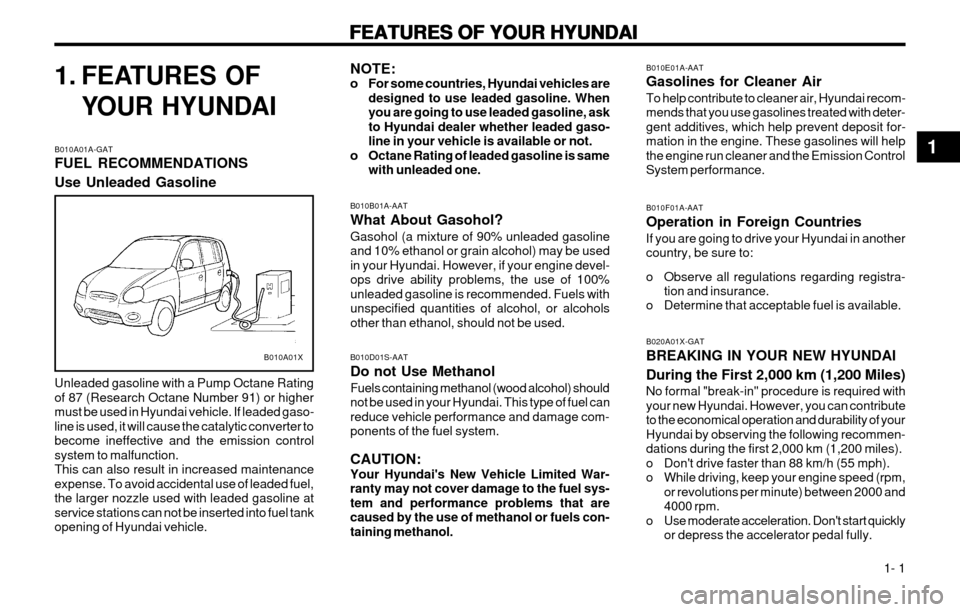
B010A01A-GAT FUEL RECOMMENDATIONS Use Unleaded Gasoline Unleaded gasoline with a Pump Octane Rating of 87 (Research Octane Number 91) or highermust be used in Hyundai vehicle. If leaded gaso-line is used, it will cause the catalytic converter tobecome ineffective and the emission controlsystem to malfunction.This can also result in increased maintenanceexpense. To avoid accidental use of leaded fuel,the larger nozzle used with leaded gasoline atservice stations can not be inserted into fuel tankopening of Hyundai vehicle. NOTE:
o For some countries, Hyundai vehicles are
designed to use leaded gasoline. Whenyou are going to use leaded gasoline, askto Hyundai dealer whether leaded gaso-line in your vehicle is available or not.
o Octane Rating of leaded gasoline is same with unleaded one.
B010B01A-AAT What About Gasohol? Gasohol (a mixture of 90% unleaded gasoline and 10% ethanol or grain alcohol) may be usedin your Hyundai. However, if your engine devel-ops drive ability problems, the use of 100%unleaded gasoline is recommended. Fuels withunspecified quantities of alcohol, or alcoholsother than ethanol, should not be used. B010D01S-AAT Do not Use Methanol Fuels containing methanol (wood alcohol) should not be used in your Hyundai. This type of fuel canreduce vehicle performance and damage com-ponents of the fuel system. CAUTION: Your Hyundai's New Vehicle Limited War-ranty may not cover damage to the fuel sys-tem and performance problems that arecaused by the use of methanol or fuels con-taining methanol. B010E01A-AAT Gasolines for Cleaner AirTo help contribute to cleaner air, Hyundai recom- mends that you use gasolines treated with deter-gent additives, which help prevent deposit for-mation in the engine. These gasolines will helpthe engine run cleaner and the Emission ControlSystem performance. B010F01A-AAT Operation in Foreign Countries If you are going to drive your Hyundai in another country, be sure to:
o Observe all regulations regarding registra-
tion and insurance.
o Determine that acceptable fuel is available. B020A01X-GAT BREAKING IN YOUR NEW HYUNDAI During the First 2,000 km (1,200 Miles) No formal "break-in" procedure is required with your new Hyundai. However, you can contributeto the economical operation and durability of yourHyundai by observing the following recommen-
dations during the first 2,000 km (1,200 miles).
o Don't drive faster than 88 km/h (55 mph).
o While driving, keep your engine speed (rpm,
or revolutions per minute) between 2000 and4000 rpm.
o Use moderate acceleration. Don't start quickly or depress the accelerator pedal fully.
B010A01X
1
Page 24 of 249
FEATURES OF YOUR HYUNDAI
FEATURES OF YOUR HYUNDAI FEATURES OF YOUR HYUNDAI
FEATURES OF YOUR HYUNDAI
FEATURES OF YOUR HYUNDAI
1- 15
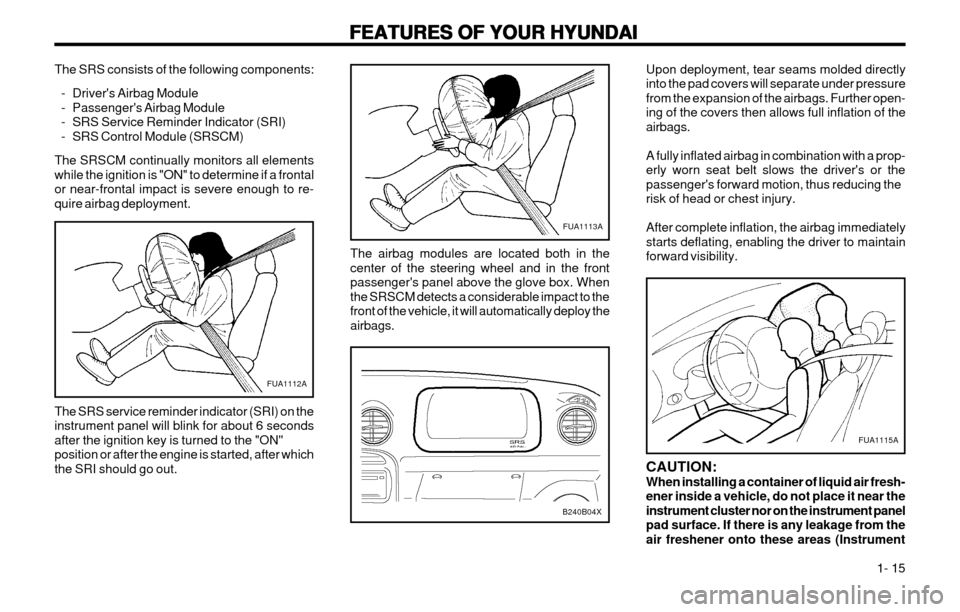
The SRS service reminder indicator (SRI) on the instrument panel will blink for about 6 secondsafter the ignition key is turned to the "ON"position or after the engine is started, after whichthe SRI should go out. The airbag modules are located both in thecenter of the steering wheel and in the frontpassenger's panel above the glove box. Whenthe SRSCM detects a considerable impact to thefront of the vehicle, it will automatically deploy theairbags.
The SRS consists of the following components:
- Driver's Airbag Module
- Passenger's Airbag Module
- SRS Service Reminder Indicator (SRI)
- SRS Control Module (SRSCM)
The SRSCM continually monitors all elementswhile the ignition is "ON" to determine if a frontalor near-frontal impact is severe enough to re-quire airbag deployment. Upon deployment, tear seams molded directlyinto the pad covers will separate under pressurefrom the expansion of the airbags. Further open-ing of the covers then allows full inflation of theairbags. A fully inflated airbag in combination with a prop- erly worn seat belt slows the driver's or thepassenger's forward motion, thus reducing therisk of head or chest injury. After complete inflation, the airbag immediately starts deflating, enabling the driver to maintainforward visibility. CAUTION: When installing a container of liquid air fresh-ener inside a vehicle, do not place it near theinstrument cluster nor on the instrument panelpad surface. If there is any leakage from theair freshener onto these areas (Instrument
FUA1112A
FUA1113A
B240B04X
FUA1115A
Page 25 of 249
FEATURES OF YOUR HYUNDAI
FEATURES OF YOUR HYUNDAI FEATURES OF YOUR HYUNDAI
FEATURES OF YOUR HYUNDAI
FEATURES OF YOUR HYUNDAI
1- 16 to the body structure, can adversely affect SRS performance and lead to possibleinjury.
o For cleaning the airbag pad covers, use only a soft, dry cloth or one which hasbeen moistened with plain water. Solventsor cleaners could adversely affect theairbag covers and proper deployment ofthe system.
o No objects should be placed over or near the airbag modules on the steering wheel,instrument panel, and the front passen-ger's panel above the glove box, becauseany such object could cause harm if thevehicle is in a crash severe enough tocause the airbags to inflate.
o If the airbags inflate, they must be re- placed by an authorized Hyundai dealer.
o Do not tamper with or disconnect SRS wiring, or other components of the SRSsystem. Doing so could result in injury,due to accidental firing of the airbags orby rendering the SRS inoperative.
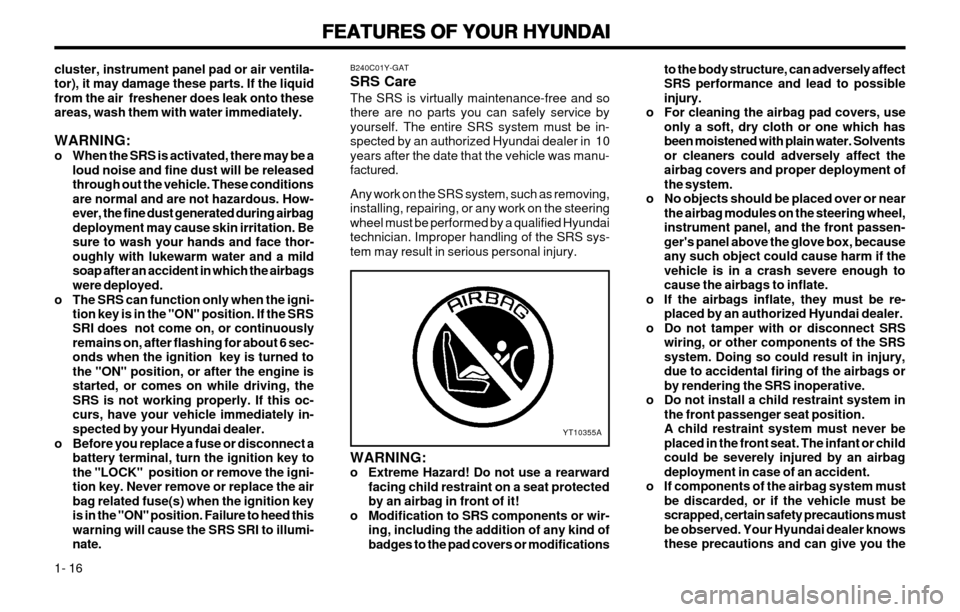
o Do not install a child restraint system in the front passenger seat position.A child restraint system must never beplaced in the front seat. The infant or childcould be severely injured by an airbagdeployment in case of an accident.
o If components of the airbag system must be discarded, or if the vehicle must bescrapped, certain safety precautions mustbe observed. Your Hyundai dealer knowsthese precautions and can give you the
YT10355A
cluster, instrument panel pad or air ventila- tor), it may damage these parts. If the liquidfrom the air freshener does leak onto theseareas, wash them with water immediately. WARNING:
o When the SRS is activated, there may be a loud noise and fine dust will be released through out the vehicle. These conditionsare normal and are not hazardous. How-ever, the fine dust generated during airbagdeployment may cause skin irritation. Besure to wash your hands and face thor-oughly with lukewarm water and a mildsoap after an accident in which the airbagswere deployed.
o The SRS can function only when the igni- tion key is in the "ON" position. If the SRSSRI does not come on, or continuouslyremains on, after flashing for about 6 sec-onds when the ignition key is turned tothe "ON" position, or after the engine isstarted, or comes on while driving, theSRS is not working properly. If this oc-curs, have your vehicle immediately in-spected by your Hyundai dealer.
o Before you replace a fuse or disconnect a battery terminal, turn the ignition key tothe "LOCK" position or remove the igni-tion key. Never remove or replace the airbag related fuse(s) when the ignition keyis in the "ON" position. Failure to heed thiswarning will cause the SRS SRI to illumi-nate. B240C01Y-GAT SRS CareThe SRS is virtually maintenance-free and so there are no parts you can safely service byyourself. The entire SRS system must be in-spected by an authorized Hyundai dealer in 10years after the date that the vehicle was manu-factured. Any work on the SRS system, such as removing, installing, repairing, or any work on the steeringwheel must be performed by a qualified Hyundaitechnician. Improper handling of the SRS sys-tem may result in serious personal injury. WARNING:
o Extreme Hazard! Do not use a rearward
facing child restraint on a seat protectedby an airbag in front of it!
o Modification to SRS components or wir- ing, including the addition of any kind ofbadges to the pad covers or modifications
Page 28 of 249
FEATURES OF YOUR HYUNDAI
FEATURES OF YOUR HYUNDAI FEATURES OF YOUR HYUNDAI
FEATURES OF YOUR HYUNDAI
FEATURES OF YOUR HYUNDAI
1- 19
B260B01X-GAT
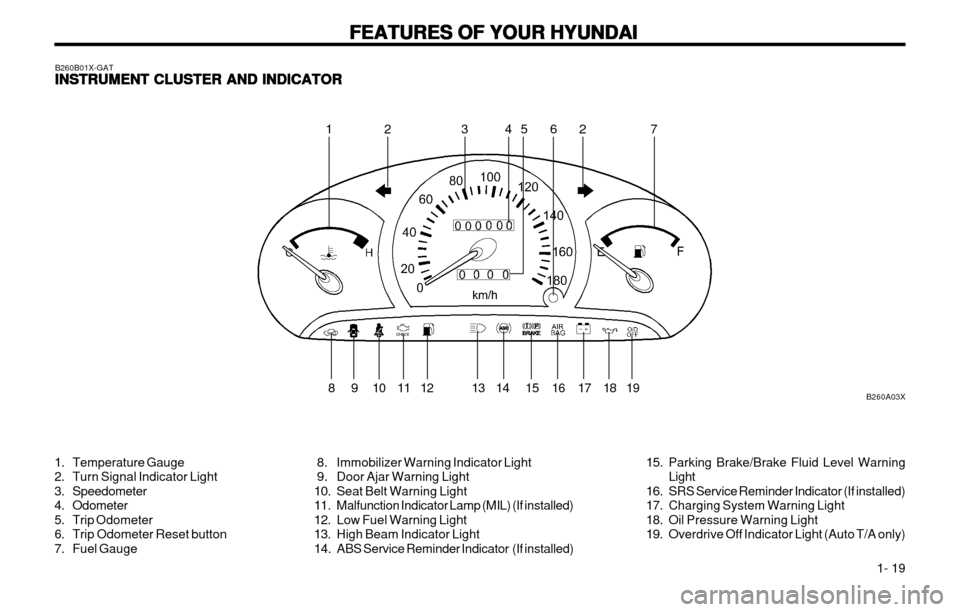
INSTRUMENT CLUSTER AND INDICATOR
INSTRUMENT CLUSTER AND INDICATOR INSTRUMENT CLUSTER AND INDICATOR
INSTRUMENT CLUSTER AND INDICATOR
INSTRUMENT CLUSTER AND INDICATOR
1. Temperature Gauge
2. Turn Signal Indicator Light
3. Speedometer
4. Odometer
5. Trip Odometer
6. Trip Odometer Reset button
7. Fuel Gauge 8. Immobilizer Warning Indicator Light
9. Door Ajar Warning Light
10. Seat Belt Warning Light
11. Malfunction Indicator Lamp (MIL) (If installed)
12. Low Fuel Warning Light
13. High Beam Indicator Light
14. ABS Service Reminder Indicator (If installed) 15. Parking Brake/Brake Fluid Level Warning
Light
16. SRS Service Reminder Indicator (If installed)
17. Charging System Warning Light
18. Oil Pressure Warning Light
19. Overdrive Off Indicator Light (Auto T/A only)
13 56
981011 12 13B260A03X
2427
141516171819
Page 29 of 249
FEATURES OF YOUR HYUNDAI
FEATURES OF YOUR HYUNDAI FEATURES OF YOUR HYUNDAI
FEATURES OF YOUR HYUNDAI
FEATURES OF YOUR HYUNDAI
1- 20
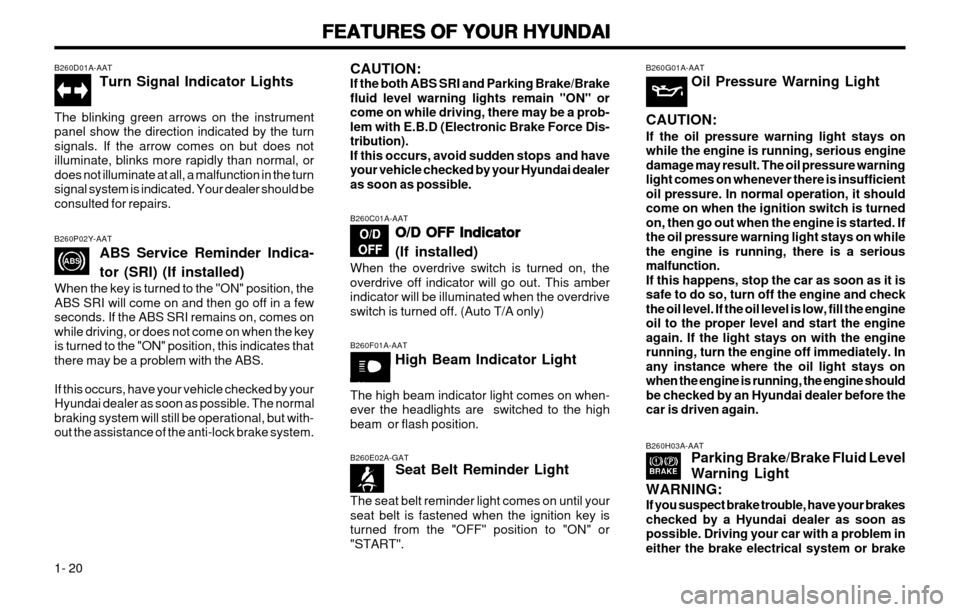
B260P02Y-AAT ABS Service Reminder Indica- tor (SRI) (If installed)
When the key is turned to the "ON" position, the ABS SRI will come on and then go off in a fewseconds. If the ABS SRI remains on, comes onwhile driving, or does not come on when the keyis turned to the "ON" position, this indicates thatthere may be a problem with the ABS. If this occurs, have your vehicle checked by your Hyundai dealer as soon as possible. The normalbraking system will still be operational, but with-out the assistance of the anti-lock brake system.
B260D01A-AAT
Turn Signal Indicator Lights
The blinking green arrows on the instrumentpanel show the direction indicated by the turnsignals. If the arrow comes on but does notilluminate, blinks more rapidly than normal, ordoes not illuminate at all, a malfunction in the turnsignal system is indicated. Your dealer should beconsulted for repairs. B260G01A-AAT
Oil Pressure Warning Light
CAUTION: If the oil pressure warning light stays on while the engine is running, serious enginedamage may result. The oil pressure warninglight comes on whenever there is insufficientoil pressure. In normal operation, it shouldcome on when the ignition switch is turnedon, then go out when the engine is started. Ifthe oil pressure warning light stays on whilethe engine is running, there is a seriousmalfunction.If this happens, stop the car as soon as it issafe to do so, turn off the engine and checkthe oil level. If the oil level is low, fill the engineoil to the proper level and start the engineagain. If the light stays on with the enginerunning, turn the engine off immediately. Inany instance where the oil light stays onwhen the engine is running, the engine shouldbe checked by an Hyundai dealer before thecar is driven again.
B260E02A-GAT Seat Belt Reminder Light
The seat belt reminder light comes on until your seat belt is fastened when the ignition key isturned from the "OFF" position to "ON" or"START".B260H03A-AAT Parking Brake/Brake Fluid Level Warning Light
WARNING: If you suspect brake trouble, have your brakes checked by a Hyundai dealer as soon aspossible. Driving your car with a problem ineither the brake electrical system or brake
B260F01A-AAT High Beam Indicator Light
The high beam indicator light comes on when- ever the headlights are switched to the highbeam or flash position.
B260C01A-AAT O/D OFF Indicator
O/D OFF Indicator O/D OFF Indicator
O/D OFF Indicator
O/D OFF Indicator (If installed)
When the overdrive switch is turned on, the overdrive off indicator will go out. This amberindicator will be illuminated when the overdriveswitch is turned off. (Auto T/A only)
CAUTION: If the both ABS SRI and Parking Brake/Brakefluid level warning lights remain "ON" orcome on while driving, there may be a prob-lem with E.B.D (Electronic Brake Force Dis-tribution).If this occurs, avoid sudden stops and haveyour vehicle checked by your Hyundai dealeras soon as possible.
Page 30 of 249
FEATURES OF YOUR HYUNDAI
FEATURES OF YOUR HYUNDAI FEATURES OF YOUR HYUNDAI
FEATURES OF YOUR HYUNDAI
FEATURES OF YOUR HYUNDAI
1- 21
B270A01A-AAT BRAKE PAD WEAR WARNING SOUND The front disc brake pads have wear indicators that should make a high-pitched squealing orscraping noise when new pads are needed. Thesound may come and go or be heard all the timewhen the vehicle is moving. It may also be heard
B260M01A-AAT
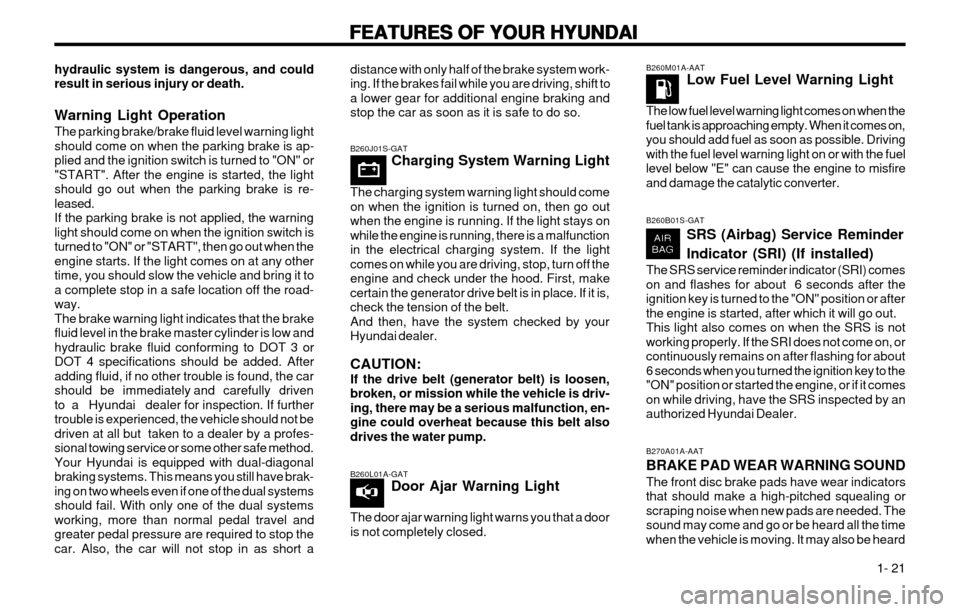
Low Fuel Level Warning Light
The low fuel level warning light comes on when thefuel tank is approaching empty. When it comes on,you should add fuel as soon as possible. Drivingwith the fuel level warning light on or with the fuellevel below "E" can cause the engine to misfireand damage the catalytic converter.
hydraulic system is dangerous, and could result in serious injury or death. Warning Light Operation The parking brake/brake fluid level warning light should come on when the parking brake is ap-plied and the ignition switch is turned to "ON" or"START". After the engine is started, the lightshould go out when the parking brake is re-leased.If the parking brake is not applied, the warninglight should come on when the ignition switch isturned to "ON" or "START", then go out when theengine starts. If the light comes on at any othertime, you should slow the vehicle and bring it toa complete stop in a safe location off the road-way.The brake warning light indicates that the brakefluid level in the brake master cylinder is low andhydraulic brake fluid conforming to DOT 3 orDOT 4 specifications should be added. Afteradding fluid, if no other trouble is found, the carshould be immediately and carefully drivento a Hyundai dealer for inspection. If furthertrouble is experienced, the vehicle should not bedriven at all but taken to a dealer by a profes-sional towing service or some other safe method.Your Hyundai is equipped with dual-diagonalbraking systems. This means you still have brak-ing on two wheels even if one of the dual systemsshould fail. With only one of the dual systemsworking, more than normal pedal travel andgreater pedal pressure are required to stop thecar. Also, the car will not stop in as short a B260J01S-GAT
Charging System Warning Light
The charging system warning light should comeon when the ignition is turned on, then go outwhen the engine is running. If the light stays onwhile the engine is running, there is a malfunctionin the electrical charging system. If the lightcomes on while you are driving, stop, turn off theengine and check under the hood. First, makecertain the generator drive belt is in place. If it is,check the tension of the belt.And then, have the system checked by yourHyundai dealer. CAUTION: If the drive belt (generator belt) is loosen,broken, or mission while the vehicle is driv-ing, there may be a serious malfunction, en-gine could overheat because this belt alsodrives the water pump.
B260L01A-GAT Door Ajar Warning Light
The door ajar warning light warns you that a door is not completely closed.
B260B01S-GAT SRS (Airbag) Service Reminder Indicator (SRI) (If installed)
The SRS service reminder indicator (SRI) comes on and flashes for about 6 seconds after theignition key is turned to the "ON" position or afterthe engine is started, after which it will go out.This light also comes on when the SRS is notworking properly. If the SRI does not come on, orcontinuously remains on after flashing for about6 seconds when you turned the ignition key to the"ON" position or started the engine, or if it comeson while driving, have the SRS inspected by anauthorized Hyundai Dealer.
distance with only half of the brake system work- ing. If the brakes fail while you are driving, shift toa lower gear for additional engine braking andstop the car as soon as it is safe to do so.
Page 42 of 249
FEATURES OF YOUR HYUNDAI
FEATURES OF YOUR HYUNDAI FEATURES OF YOUR HYUNDAI
FEATURES OF YOUR HYUNDAI
FEATURES OF YOUR HYUNDAI
1- 33
o Always drive your vehicle at a moderate
speed.
o To use the roof rails as a roof rack, you must fit the roof rails with two or more crossrails or equivalent.
WARNING:
o In case of hectical steering movements or bad fixation the luggage can fall from thevehicle and injure persons or property.Make sure that the luggage is properlyfixed and avoid sudden movement
(e.g.dashing start, fast turningmanoeuvres, hard cornering, sudden brak-ing) Check frequently whether the roofrack is properly fastened.
o Voluminous, large, long or flat objects can change the aerodynamic drag of vehicleor can suddenly been lifted by the wind.The driver could lose control of the carand provoke an accident and injuries. For
this reason, drive at reduced speed whenyou transport such objects.
o The maximum load limit of the roof rack including luggage load is 30 kg.
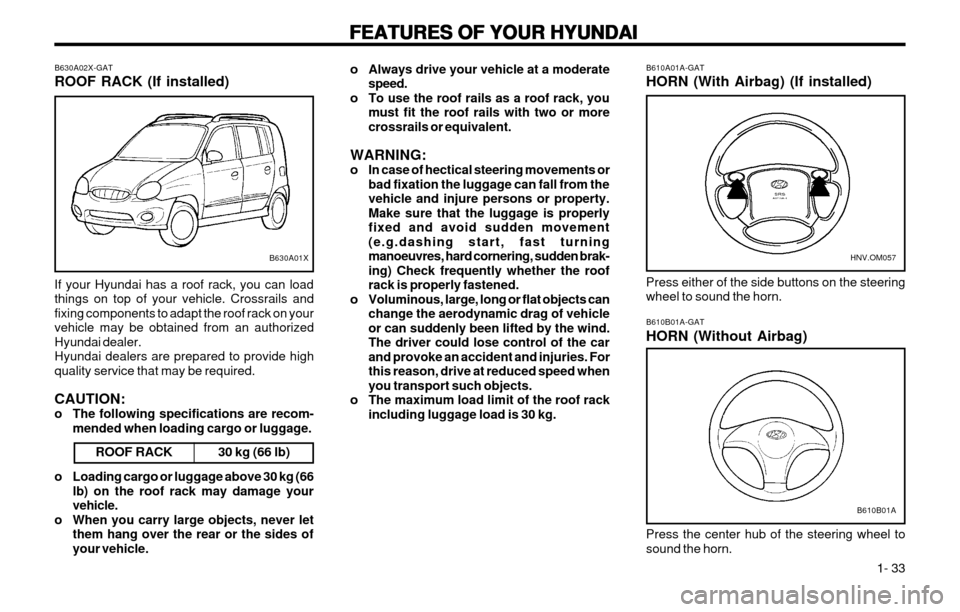
B630A02X-GAT ROOF RACK (If installed)
ROOF RACK
If your Hyundai has a roof rack, you can load things on top of your vehicle. Crossrails andfixing components to adapt the roof rack on yourvehicle may be obtained from an authorizedHyundai dealer.Hyundai dealers are prepared to provide highquality service that may be required. CAUTION:
o The following specifications are recom-mended when loading cargo or luggage.
30 kg (66 lb)
B630A01X
o Loading cargo or luggage above 30 kg (66lb) on the roof rack may damage your vehicle.
o When you carry large objects, never let them hang over the rear or the sides ofyour vehicle. B610B01A-GAT HORN (Without Airbag) Press the center hub of the steering wheel to sound the horn.
B610B01A
B610A01A-GAT HORN (With Airbag) (If installed) Press either of the side buttons on the steering wheel to sound the horn.
HNV.OM057
Page 72 of 249
DRIVING YOUR HYUNDAI
DRIVING YOUR HYUNDAI DRIVING YOUR HYUNDAI
DRIVING YOUR HYUNDAI
DRIVING YOUR HYUNDAI
2- 9
resulting in the engine bucking. If this hap- pens, shift to a lower gear. Over-revving isracing the engine beyond its safe limit. Thiscan be avoided by shifting at the recom-mended speeds.
o Use your air conditioning sparingly. The air conditioning system is operated by enginepower so your fuel economy is reducedwhen you use it.
C150A01A-AAT SMOOTH CORNERING
SMOOTH CORNERING SMOOTH CORNERING
SMOOTH CORNERING
SMOOTH CORNERING
Avoid braking or gear changing in corners,
especially when roads are wet. Ideally, cornersshould always be taken under gentle accelera-tion. If you follow these suggestions, tire wearwill be held to a minimum.
C160A01A-AATWINTER DRIVING
WINTER DRIVING WINTER DRIVING
WINTER DRIVING
WINTER DRIVING
The more severe weather conditions of winter
result in greater wear and other problems. Tominimize the problems of winter driving, youshould follow these suggestions:
C160B01A-GATSnowy or Icy Conditions
Snowy or Icy Conditions Snowy or Icy Conditions
Snowy or Icy Conditions
Snowy or Icy Conditions
To drive your vehicle in deep snow, it may be
necessary to use snow tires or to install tirechains on your tires. If snow tires are needed,
it is necessary to select tires equivalent in size
and type to the original equipment tires.
o Be sure that the wheels are aligned correct-
ly. Improper alignment can result from hittingcurbs or driving too fast over irregular sur-faces. Poor alignment causes faster tirewear and may also result in other problemsas well as greater fuel consumption.
o Keep your car in good condition. For better fuel economy and reduced maintenancecosts, maintain your car in accordance withthe maintenance schedule in Section 5. Ifyou drive your car in severe conditions,more frequent maintenance is required (seeSection 5 for details).
o Keep your car clean. For maximum service, your Hyundai should be kept clean and freeof corrosive materials. It is especially impor-tant that mud, dirt, ice, etc. not be allowed toaccumulate on the underside of the car. Thisextra weight can result in increased fuelconsumption and also contribute to corro-sion.
o Travel lightly. Don't carry unnecessary weight in your car. Weight reduces fuel economy.
o Don't let the engine idle longer than neces- sary. If you are waiting (and not in traffic),turn off your engine and restart only whenyou're ready to go.
o Remember, your Hyundai does not require extended warm-up. As soon as the engine isrunning smoothly, you can drive away. Invery cold weather, however, give your en-gine a slightly longer warm-up period.
o Don't "lug" or "over-rev" the engine. Lugging is driving too slowly in too high a gear
C140A01A-AAT
DRIVING FOR ECONOMY
DRIVING FOR ECONOMY DRIVING FOR ECONOMY
DRIVING FOR ECONOMY
DRIVING FOR ECONOMY
You can save fuel and get more kilometers from
your car if you follow these suggestions:
o Drive smoothly. Accelerate at a moderate rate. Don't make "jack-rabbit" starts or full- throttle shifts and maintain a steady cruisingspeed. Don't race between stoplights. Try toadjust your speed to that of the other trafficso you don't have to change speeds unnec-essarily. Avoid heavy traffic whenever pos-sible. Always maintain a safe distance fromother vehicles so you can avoid unneces-sary braking. This also reduces brake wear.
o Drive at a moderate speed. The faster you drive, the more fuel your car uses. Driving ata moderate speed, especially on the high-way, is one of the most effective ways toreduce fuel consumption.
o Don't "ride" the brake or clutch pedal. This can increase fuel consumption and alsoincrease wear on these components. In ad-dition, driving with your foot resting on thebrake pedal may cause the brakes to over-heat, which reduces their effectiveness andmay lead to more serious consequences.
o Take care of your tires. Keep them inflated to the recommended pressure. Incorrect in-flation, either too much or too little, results inunnecessary tire wear. Check the tire pres-sures at least once a month.
Page 73 of 249
DRIVING YOUR HYUNDAI
DRIVING YOUR HYUNDAI DRIVING YOUR HYUNDAI
DRIVING YOUR HYUNDAI
DRIVING YOUR HYUNDAI
2- 10 ice. If the lock is frozen internally, you may be able to thaw it out by using a heated key.Handle the heated key with care to avoid burn-ing your fingers.
NOTE:
NOTE: NOTE:
NOTE:
NOTE:
The proper temperature for using the immo-
The proper temperature for using the immo- The proper temperature for using the immo-
The proper temperature for using the immo-
The proper temperature for using the immo-
bilizer key is from -40°C to 80°C. If you heat
bilizer key is from -40°C to 80°C. If you heat bilizer key is from -40°C to 80°C. If you heat
bilizer key is from -40°C to 80°C. If you heat
bilizer key is from -40°C to 80°C. If you heat
the immobilizer key over 80°C to open the
the immobilizer key over 80°C to open the the immobilizer key over 80°C to open the
the immobilizer key over 80°C to open the
the immobilizer key over 80°C to open the
frozen lock,
frozen lock, frozen lock,
frozen lock,
frozen lock, it may cause damage to the
it may cause damage to the it may cause damage to the
it may cause damage to the
it may cause damage to the
transponder in its head.
transponder in its head. transponder in its head.
transponder in its head.
transponder in its head. C160H01A-AAT
Use Approved Anti-Freeze in Window
Use Approved Anti-Freeze in Window Use Approved Anti-Freeze in Window
Use Approved Anti-Freeze in Window
Use Approved Anti-Freeze in Window
Washer System
Washer System Washer System
Washer System
Washer System
To keep the water in the window washer sys- tem from freezing, add an approved anti-freezesolution in accordance with instructions on thecontainer. Window washer anti-freeze is avail-able from Hyundai dealers and most auto partsoutlets. Do not use engine coolant or othertypes of anti-freeze as these may damage thefinish. C160I01X-GAT
Don't Let Your Parking Brake Freeze
Don't Let Your Parking Brake Freeze Don't Let Your Parking Brake Freeze
Don't Let Your Parking Brake Freeze
Don't Let Your Parking Brake Freeze
Under some conditions your parking brake can freeze in the engaged position. This is mostlikely to happen when there is an accumulationof snow or ice around or near the rear brakes orif the brakes are wet. If there is a risk theparking brake may freeze, apply it only tempo-
C160F01A-AAT
Check Spark Plugs and Ignition
Check Spark Plugs and Ignition Check Spark Plugs and Ignition
Check Spark Plugs and Ignition
Check Spark Plugs and Ignition
System
System System
System
System
Inspect your spark plugs as described in Sec-tion 6 and replace them if necessary. Alsocheck all ignition wiring and components to besure they are not cracked, worn or damaged inany way.
C160D01A-AAT
Check Battery and Cables
Check Battery and Cables Check Battery and Cables
Check Battery and Cables
Check Battery and Cables
Winter puts additional burdens on the batterysystem. Visually inspect the battery and cablesas described in Section 6. The level of chargein your battery can be checked by your Hyundaidealer or a service station. C160E01A-AATChange to "Winter Weight" Oil if
Change to "Winter Weight" Oil if Change to "Winter Weight" Oil if
Change to "Winter Weight" Oil if
Change to "Winter Weight" Oil if
Necessary
Necessary Necessary
Necessary
Necessary
In some climates it is recommended that a lower viscosity "winter weight" oil be used dur-ing cold weather. See Section 9 for recommen-dations. If you aren't sure what weight oil youshould use, consult your Hyundai dealer. C160G01A-GAT
To Keep Locks from Freezing
To Keep Locks from Freezing To Keep Locks from Freezing
To Keep Locks from Freezing
To Keep Locks from Freezing
To keep the locks from freezing, squirt an approved de-icer fluid or glycerine into the keyopening. If a lock is covered with ice, squirt itwith an approved de-icing fluid to remove the
Failure to do so may adversely affect the safety
and handling of your car. Speeding, rapid accel-eration, sudden brake applications, and sharpturns are potentially very hazardous practices.During deceleration, use engine braking to thefullest extent. Sudden brake applications onsnowy or icy roads may cause skids to occur.
You need to keep sufficient distance betweenthe vehicle in front and your vehicle. Also, applythe brake gently.
It should be noted that installing tire chains on
the tire will provide a greater driving force, butwill not prevent side skids.
NOTE:
NOTE: NOTE:
NOTE:
NOTE:
Tire chains are not legal in all provinces.
Tire chains are not legal in all provinces. Tire chains are not legal in all provinces.
Tire chains are not legal in all provinces.
Tire chains are not legal in all provinces. Check
Check Check
Check
Check province laws before fitting tire
province laws before fitting tire province laws before fitting tire
province laws before fitting tire
province laws before fitting tire
chains.
chains. chains.
chains.
chains.
C160C01A-AATUse High Quality Ethylene Glycol
Use High Quality Ethylene Glycol Use High Quality Ethylene Glycol
Use High Quality Ethylene Glycol
Use High Quality Ethylene Glycol
Coolant
Coolant Coolant
Coolant
Coolant
Your Hyundai is delivered with high quality
ethylene glycol coolant in the cooling system. It is the only type of coolant that should be usedbecause it helps prevent corrosion in the cool-ing system, lubricates the water pump andprevents freezing. Be sure to replace or replen-ish your coolant in accordance with the main-tenance schedule in Section 5. Before winter,have your coolant tested to assure that itsfreezing point is sufficient for the temperaturesanticipated during the winter.