tow Hyundai Atos 2003 User Guide
[x] Cancel search | Manufacturer: HYUNDAI, Model Year: 2003, Model line: Atos, Model: Hyundai Atos 2003Pages: 127, PDF Size: 1.55 MB
Page 48 of 127
FEATURES OF YOUR HYUNDAI
1- 40
Ionosphere
SSAR011A
AM reception
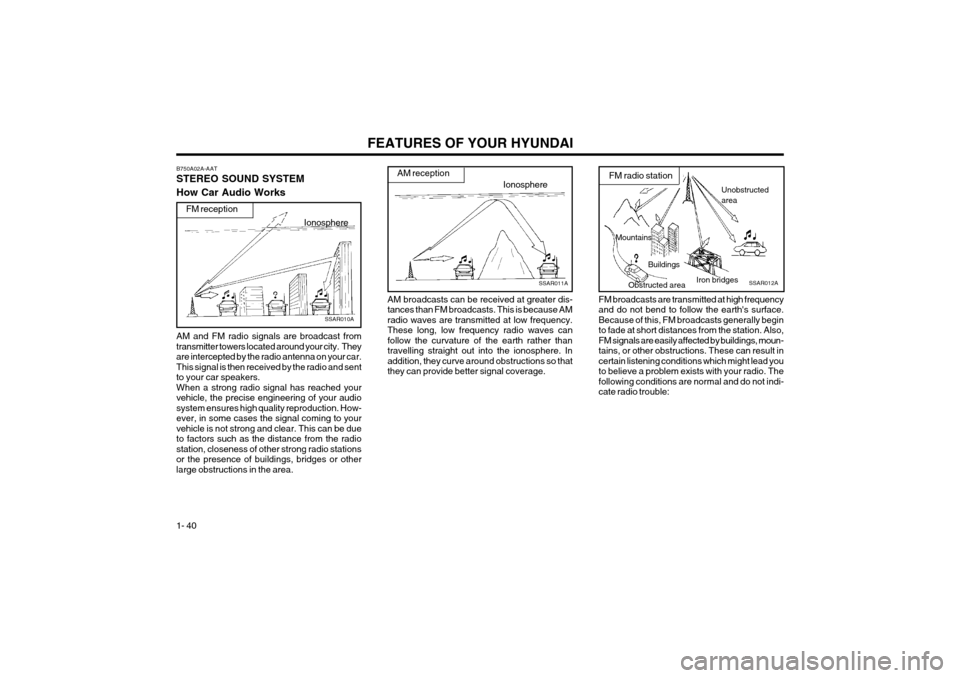
AM broadcasts can be received at greater dis- tances than FM broadcasts. This is because AMradio waves are transmitted at low frequency.These long, low frequency radio waves canfollow the curvature of the earth rather thantravelling straight out into the ionosphere. Inaddition, they curve around obstructions so thatthey can provide better signal coverage.
B750A02A-AAT STEREO SOUND SYSTEM How Car Audio Works
Ionosphere
FM reception
SSAR010A
AM and FM radio signals are broadcast from transmitter towers located around your city. Theyare intercepted by the radio antenna on your car.This signal is then received by the radio and sentto your car speakers.When a strong radio signal has reached yourvehicle, the precise engineering of your audiosystem ensures high quality reproduction. How-ever, in some cases the signal coming to yourvehicle is not strong and clear. This can be dueto factors such as the distance from the radiostation, closeness of other strong radio stationsor the presence of buildings, bridges or otherlarge obstructions in the area. FM broadcasts are transmitted at high frequencyand do not bend to follow the earth's surface.Because of this, FM broadcasts generally beginto fade at short distances from the station. Also,FM signals are easily affected by buildings, moun-tains, or other obstructions. These can result incertain listening conditions which might lead youto believe a problem exists with your radio. Thefollowing conditions are normal and do not indi-cate radio trouble:
Mountains
Buildings
Obstructed area Iron bridges
Unobstructed area
FM radio station
SSAR012A
Page 73 of 127

DRIVING YOUR HYUNDAI 2- 11
C190A01A-GAT
TRAILER OR VEHICLE TOWING
If you are considering towing with your car, you
should first check with your Province Depart- ment of Motor Vehicles to determine their legal
requirements. Since laws vary from province to province the
requirements for towing trailers, cars, or other types of vehicles or apparatus may differ. Askyour Hyundai dealer for further details beforetowing.
CAUTION: Do not do any towing with your car during
its first 2,000 km (1,200 miles) in order to allow the engine to properly break in. Fail-ure to heed this caution may result in seri-ous engine or transaxle damage.
C190B01S-AAT
Trailer Hitches Select the proper hitch and ball combination,
making sure that it's location is compatible withthat of the trailer or vehicle being towed.
Use a quality non-equalizing hitch which distrib-
utes the tongue load uniformly throughout thechassis.
The hitch should be bolted securely to the car
and installed by a qualified technician. DO NOTUSE A HITCH DESIGNED FOR TEMPORARYINSTALLATION AND NEVER USE ONE THATATTACHES ONLY TO THE BUMPER.
C170A01A-AAT
HIGHER SPEED MOTORING Pre-Trip Inspections 1. Tires: Adjust the tire inflation pressures to specifica-
tion driving. Low tire inflation pressures will result in overheating and possible failure of thetires.
Avoid using worn or damaged tires which may
result in reduced traction or tire failure.
NOTE: Never exceed the maximum tire inflation
pressure shown on the tires.
2. Fuel, engine coolant and engine oil:High speed travel consumes 1.5 times more
fuel than urban motoring. Do not forget to check both engine coolant and engine oil. 3. Drive belt:
A loose or damaged drive belt may result in
overheating of the engine.
C180A01A-AAT
USE OF LIGHTS Check your lights regularly for correct operation
and always keep them clean. When driving during the day in conditions of poor visibility, itis helpful to drive with headlights on low beam.This enables you to be seen as well as to see.
rarily while you put the gear selector lever in"P" (automatic transaxle) or in first or reversegear (manual transaxle) and block the rearwheels so the car cannot roll. Then release theparking brake.
C160J01A-AAT
Don't Let Ice and Snow Accumulate Underneath
Under some conditions, snow and ice can build
up under the fenders and interfere with the steering. When driving in severe winter condi-tions where this may happen, you should peri-odically check underneath the car to be surethe movement of the front wheels and thesteering components are not obstructed.
C160K01A-AAT
Carry Emergency Equipment
Depending on the severity of the weather where
you drive your car, you should carry appropri-ate emergency equipment. Some of the itemsyou may want to carry include tire chains, towstraps or chains, flashlight, emergency flares,sand, a shovel, jumper cables, a windowscraper, gloves, ground cloth, coveralls, a blan-ket, etc.
Page 74 of 127

DRIVING YOUR HYUNDAI
2- 12 NOTE:
1. Never load the trailer with more weight in the back than in the front. About 60% of the trailer load should be in the front halfon the trailer and the remaining 40% inthe rear.
2. The total gross vehicle weight with trailer must not exceed the Gross Vehicle WeightRating (GVWR) shown on the vehicle iden-tification plate (see page 8-1). The totalgross vehicle weight is the combinedweight of the vehicle, driver, all passen-
gers and their luggage, cargo, hitch, trailertongue load and other optional equip-ment.
3. The front or rear axle weight must not exceed the Gross Axle Weight Rating(GAWR) shown on the vehicle identifica-tion plate (see page 8-1). It is possiblethat your towing package does not ex-ceed the GVWR but exceeds the GAWR.Improper trailer loading and/or too muchluggage in the trunk can overload therear axle. Redistribute the load and checkthe axle weight again.
4. The maximum permissible overhang of the coupling point is 570 mm.(ATOS VAN : 568mm)
C190D01A-GAT
Safety Chains
Should the hitch connection between your car
and the trailer or vehicle you are towing fail, thetrailer or vehicle could wander dangerouslyacross other lanes of traffic and ultimately col-lide with another vehicle. To eliminate this po-tentially dangerous situation, safety chains, at-tached between your car and the trailer ortowed vehicle, are required in most provinces.
C190E04X-GAT
Trailer Weight Limit
Tongue load Total trailer weightSSA2200B
Tongue loads can be increased or decreased
by redistributing the load in the trailer. This can be verified by checking the total weight of the
loaded trailer and then checking the load on thetongue.
C190C01X-GAT
Trailer Brakes
If your trailer is equipped with a braking system,
make sure it conforms to federal and/or localregulations and that it is properly installed andoperating correctly.
NOTE: If you tow a trailer or vehicle, your car will
require more frequent maintenance due to the additional load. See "Maintenance Un-
der Severe Usage Conditions" on page 5-4.
CAUTION:
o Never connect a trailer brake system di- rectly to the vehicle brake system.
o When towing a trailer on steep grades (in excess of 12%) pay close attention to theengine coolant temperature gauge toensure the engine does not overheat. Ifthe needle of the coolant temperaturegauge moves across the dial towards"H" (HOT), pull over and stop as soon as
it is safe to do so, and allow the engine toidle until it cools down. You may proceed
once the engine has cooled sufficiently.
Page 75 of 127

DRIVING YOUR HYUNDAI 2- 13
4. To maintain engine braking efficiency andelectrical charging performance, do not use fifth gear (manual transaxle) or overdrive(automatic transaxle).
5. Always secure items in the trailer to prevent load shift while driving.
6. Check the condition and air pressure of all tires on the trailer and your car. Low tirepressure can seriously affect the handling.Also check the spare tire.
7. The vehicle/trailer combination is more af- fected by crosswind and buffeting. When being passed by a large vehicle, keep a constant speed and steer straight ahead.If there is too much wind buffeting slowdown to get out of the other vehicle's airturbulence.
8. When parking your car and trailer, especial- ly on a hill, be sure to follow all the normalprecautions. Turn your front wheel into thecurb, set the parking brake firmly, and putthe transaxle in 1st or Reverse (manual) orPark (automatic). In addition, place wheelchocks at each of the trailer's tires.
9. If the trailer has electric brakes, start your vehicle and trailer moving, and then applythe trailer brake controller by hand to besure the brakes are working. This lets youcheck your electrical connection at the sametime.
10. During your trip, check occasionally to be sure that the load is secure, and that thelights and any trailer brakes are still working.
WARNING:
o The tongue load should never exceed;
Auto: 25kgManual : 28kg
o Maximun permissible mass of the cou- pling device (ATOS VAN only) : 20kg
o Improperly loading your car and trailer can seriously affect its steering and brak- ing performance causing a crash whichcould cause serious injury or death. kg.
Maximum Towable Weight Trailer
Manual
TransaxleAuto
Transaxle
With Brake TypeWithoutBrake Type 400 400
C190F01A-GAT Trailer or Vehicle Towing Tips
1. Before towing, check hitch and safety chain
connections as well as proper operation of the trailer running lights, brake lights, andturn signals.
2. Always drive your vehicle at a moderate speed (Less than 100 km/h)
3. Trailer towing requires more fuel than nor- mal conditions.
Gross axle weight Gross vehicle weightSSA2200D
CAUTION: The following specifications are recommend-
ed when towing a trailer. The loaded trailer weight cannot safely exceed the values inthe chart. Coupling point
C190E03X
ÏÏ
ÏÏ
Ï
ÏÏ
ÏÏ
Ï
700 400
Page 76 of 127

DRIVING YOUR HYUNDAI
2- 14
11. Avoid jerky starts, sudden acceleration or
sudden stops.
12. Avoid sharp turns and rapid lane changes.
13. Avoid holding the brake pedal down too long or too frequently. This could cause the brakes to overheat, resulting in reduced brakingefficiency.
14. When going down a hill, shift into a lower gear and use the engine braking effect. When ascending a long grade, downshift the transaxle to a lower gear and reduce speedto reduce chances of engine overloadingand/or overheating.
15. If you have to stop while going uphill, do not hold the vehicle in place by pressing on theaccelerator. This can cause the automatictransaxle to overheat. Use the parking brakeor footbrake.
NOTE: When towing check transaxle fluid more
frequently.
CAUTION: If overheating should occur when towing,
(temperature gauge reads near red zone),taking the following action may reduce oreliminate the problem. 1. Turn off the air conditioner.
2. Reduce highway speed.
3. Select a lower gear when going uphill.
4. While in stop and go traffic, place the gear
selector in park or neutral and idle the en- gine at a higher speed.
Page 83 of 127

WHAT TO DO IN AN EMERGENCY 3-7
D060J01FC-GAT
After Changing Wheels
If you have a tire gauge, remove the valve cap
and check the air pressure. If the pressure is lower than recommended, drive slowly to thenearest service station and inflate to the correctpressure. If it is too high, adjust it until it iscorrect. Always reinstall the valve cap afterchecking or adjusting tire pressure. If the cap isnot replaced, air may leak from the tire. If youlose a valve cap, buy another and install it assoon as possible.
After you have changed wheels, always secure
the flat tire in its place in the luggage room andreturn the jack and tools to their proper storagelocations. D080A01A-GAT
IF YOUR CAR MUST BE TOWED D080B01A-AAT
Towing a Car With a Manual Transaxle
o OK FOR AUTOMATIC OR MANUAL TRANSAXLE EQUIPPED VEHICLE WITH NO DAMAGE
o OK FOR AUTOMATIC OR MANUAL
TRANSAXLE EQUIPPED VEHICLE
CAUTION: Your car can be damaged if towed incor- rectly! If your car has to be towed, it should be done by
your Hyundai dealer or a commercial tow truckservice. This will help assure that your car isnot damaged in towing. Also, professionals aregenerally aware of state and local laws govern-ing towing. In any case, rather than risk dam-age to your car, it is suggested that you showthis information to the tow truck operator. Besure that a safety chain system is used and thatlocal laws are observed. o If the car is being towed with the rear wheels
on the ground, be sure the parking brake isreleased.
o If the car is being towed with the front wheels on the ground, be sure that thetransaxle is in neutral. Also, be sure that theignition key is in the "ACC" position. This isnecessary to prevent damage to the steer-ing lock mechanism, which is not designedto hold the front wheels straight while the caris being towed.
o If any of the loaded wheels or suspension components are damaged, a towing dollymust be used.
D080A01AD080B01AD060J01X
Page 84 of 127

WHAT TO DO IN AN EMERGENCY
3-8 D080C02A-GAT
Towing a Car With Automatic Transaxle
o NOT OK FOR AUTOMATIC TRANSAXLE EQUIPPED VEHICLE
o OK FOR MANUAL TRANSAXLE
CAUTION: A car with an automatic transaxle should
never be towed from the rear with the front wheels on the ground. This can cause seri-ous damage to the transaxle. If the car mustbe towed from the rear, a towing dolly mustbe used under the front wheels.
If the car is being towed with the rear wheels on
the ground, be sure the parking brake is re-leased. D080D02X-GAT
Emergency Towing For emergency towing when no commercialtow vehicle is available, attach a tow cable,chain or strap to the two hooks under the frontof your car. Do not attempt to tow your vehiclein this manner on any unpaved surface. Thiscould result in serious damage to your car. Nor should it be attempted if the wheels, drive train, axles, steering or brakes are damaged.Before towing, be sure the transaxle is in neu-tral and the key is in "ACC" (with the engine off)or in the "ON" position (with the engine run-ning). A driver must be in the towed car to steerit and operate the brakes. CAUTION: If the car is being towed with all four wheels on the ground, it can be towed only from thefront. Be sure that the transaxle is in neutral.Do not tow at speeds greater than 50 km/h(30 mph) and for more than 25 km (15 miles).Be sure the steering is unlocked by placingthe key in the "ACC" position. A driver mustbe in the towed vehicle to operate the steer-ing and brakes.
o OK FOR AUTOMATIC OR MANUAL
TRANSAXLE EQUIPPED VEHICLE
D080C01A
D080C02A
D080D01X
D120A01A-GAT
IF YOU LOSE YOUR KEYS If you lose your keys, many Hyundai dealers can make you a new key if you have your keynumber. If you lock the keys inside your car andyou cannot obtain a new key, many Hyundaidealers can use special tools to open the doorfor you. Information about the key of immobilizer sys- tem (If installed) will be found on page 1-2.
NOTE: Before towing, check the level of the transaxle fluid. If it is below the "HOT" rangeon the dipstick, add fluid. If you cannot addfluid, a towing dolly must be used.
Page 92 of 127

VEHICLE MAINTENANCE REQUIREMENTS
5- 4 ENGINE OIL AND FILTER AIR CLEANER FILTER SPARK PLUGSTIMING BELT BRAKE PADS, CALIPERS AND ROTORS REAR BRAKE DRUMS/LININGS,PARKING BRAKE STEERING GEAR BOX, LINKAGE & BOOTS/LOWER ARM BALL JOINTDRIVESHAFTS AND BOOTS MANUAL TRANSAXLE OIL AUTOMATIC TRANSAXLEFLUID
European community OnlyExcept European community
MAINTENANCE UNDER SEVERE USAGE CONDITIONS
The following items must be serviced more frequently on cars normally used under severe driving conditions. Refer to the chart below for the appropriate maintenance intervals. R : Replace I : Inspect and, after inspection, clean, adjust, repair or replace if necessary
F040A05X-GAT
DRIVING
CONDITION
MAINTENANCE
INTERVALSMAINTENANCEOPERATION
R R R R
I I I I
R R EVERY 7,500 KM OR 6 MONTHS MORE FREQUENTLY MORE FREQUENTLY EVERY 60,000 KM OR 48 MONTHSMORE FREQUENTLY MORE FREQUENTLY MORE FREQUENTLY EVERY 15,000 KM OR 12 MONTHS EVERY 100,000 KM EVERY 45,000 KM EVERY 40,000 KM
MAINTENANCE ITEM
A, B, C, F, HC, E B, H D, E, F, GC, D, G, H C, D, G, H C, D, E, F C, D, E, F A, C, D, E, F, G, H, I, J A, C, E, F, G, H, I
SEVERE DRIVING CONDITIONS
A - Repeated short distance driving
B - Extensive idling
C - Driving in dusty, rough roads
D - Driving in areas using salt or other corrosive materials or in very cold weather
E - Driving in sandy areas F - More than 50% driving in heavy city traffic during hot weather
above 32°C (90°F)
G - Driving in mountainous areas
H - Towing a trailer
I - Driving for patrol car, taxi, commercial car or vehicle towing
J - Driving over 170 km/h
Page 110 of 127

DO-IT-YOURSELF MAINTENANCE 6-15
CAUTION: A burned-out fuse indicates that there is a
problem in the electrical circuit. If you re- place a fuse and it blows as soon as theaccessory is turned on, the problem is seri-ous and should be referred to a Hyundaidealer for diagnosis and repair. Never re-place a fuse with anything except a fusewith the same or a lower amperage rating. Ahigher capacity fuse could cause damageand create a fire hazard. Good
Burned out
4. Replace the blown fuse by pressing a new fuse of the same rating into place. The fuseshould be a snug fit. If it is not, have the fuseclip repaired or replaced by a Hyundai deal-er. If you do not have a spare fuse, you maybe able to borrow a fuse of the same orlower rating from an accessory you cantemporarily get along without (the radio orcigarette lighter, for example). Always re-member to replace the borrowed fuse.
G200B01A-AAT
Replacing Accessory Fuse
The fuse box for the lights and other electrical
accessories will be found low on the dashboardon the driver's side. Inside the box you will finda list showing the circuits protected by eachfuse.
If any of your car's lights or other electrical
accessories stop working, a blown fuse couldbe the reason. If the fuse has burned out, youwill see that the metal strip inside the fuse hasburned through. If you suspect a blown fuse,follow this procedure:
1. Turn off the ignition and all other switches.
2. Open the fuse box and examine each fuse. Remove each fuse by pulling it toward you (a small "fuse puller" tool is contained in thefuse box to simplify this operation).
3. Be sure to check all other fuses even if you find one that appears to have burned out.
G200B01A
SSA6201BSSA6202B
Fuse Puller
G210A01A-AAT
CHECKING THE BATTERY
WARNING: Batteries can be dangerous!.When working with batteries, carefully ob- serve the following precautions to avoidserious injuries.
Page 127 of 127

INDEX
10-4
Towing
Emergency ..................................................................................... 3-8
If your car must be towed ............................................................. 3-7
Trailer or vehicle t owing .............................................................. 2-11
Transaxle
Automatic ....................................................................................... 2-5
Automatic transaxle fluid checking ................................... 6-10 ~ 6-11
Manual transaxle oil checking ................... .................................... 6-9
V Vehicle Identificat ion Number (VIN) .................................................... 8-1
Ventilation Center ventilator ........................................................................... 1-37
Side ventilator .............................................................................. 1-37
W
Warning Lights ....................................................................... 1-20 ~ 1-22
Windows
Manual ........................................................................................... 1-6
Power ............................................................................................. 1-7
Windshield Wiper and Washer ......................................................... 1-24
Windshield Wiper Blades .................................................................... 6-9