maintenance Hyundai Atos 2003 Owner's Guide
[x] Cancel search | Manufacturer: HYUNDAI, Model Year: 2003, Model line: Atos, Model: Hyundai Atos 2003Pages: 127, PDF Size: 1.55 MB
Page 110 of 127
DO-IT-YOURSELF MAINTENANCE 6-15
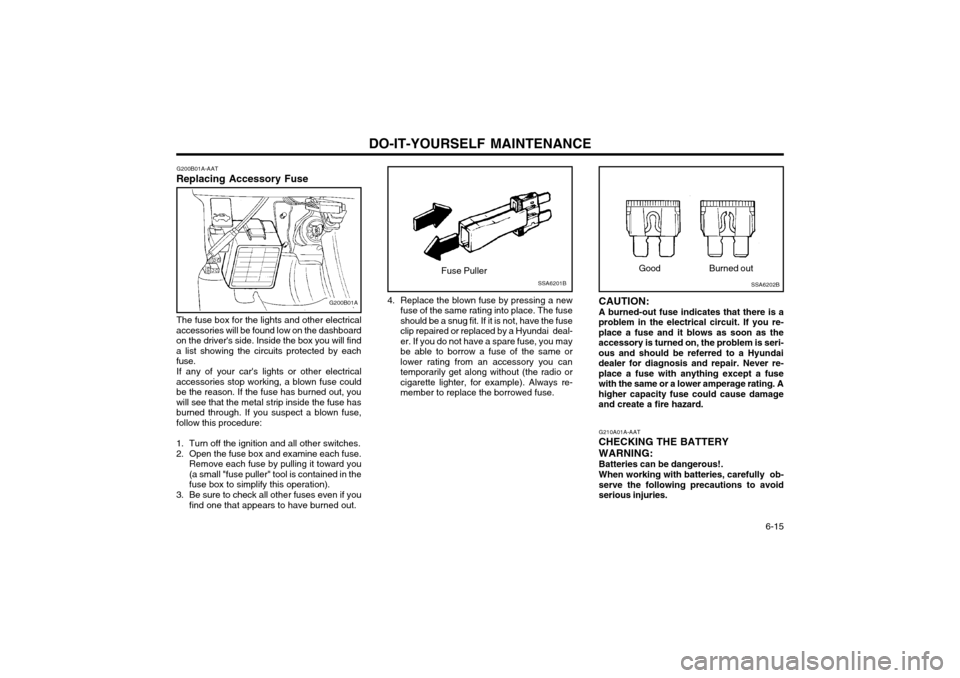
CAUTION: A burned-out fuse indicates that there is a
problem in the electrical circuit. If you re- place a fuse and it blows as soon as theaccessory is turned on, the problem is seri-ous and should be referred to a Hyundaidealer for diagnosis and repair. Never re-place a fuse with anything except a fusewith the same or a lower amperage rating. Ahigher capacity fuse could cause damageand create a fire hazard. Good
Burned out
4. Replace the blown fuse by pressing a new fuse of the same rating into place. The fuseshould be a snug fit. If it is not, have the fuseclip repaired or replaced by a Hyundai deal-er. If you do not have a spare fuse, you maybe able to borrow a fuse of the same orlower rating from an accessory you cantemporarily get along without (the radio orcigarette lighter, for example). Always re-member to replace the borrowed fuse.
G200B01A-AAT
Replacing Accessory Fuse
The fuse box for the lights and other electrical
accessories will be found low on the dashboardon the driver's side. Inside the box you will finda list showing the circuits protected by eachfuse.
If any of your car's lights or other electrical
accessories stop working, a blown fuse couldbe the reason. If the fuse has burned out, youwill see that the metal strip inside the fuse hasburned through. If you suspect a blown fuse,follow this procedure:
1. Turn off the ignition and all other switches.
2. Open the fuse box and examine each fuse. Remove each fuse by pulling it toward you (a small "fuse puller" tool is contained in thefuse box to simplify this operation).
3. Be sure to check all other fuses even if you find one that appears to have burned out.
G200B01A
SSA6201BSSA6202B
Fuse Puller
G210A01A-AAT
CHECKING THE BATTERY
WARNING: Batteries can be dangerous!.When working with batteries, carefully ob- serve the following precautions to avoidserious injuries.
Page 111 of 127

DO-IT-YOURSELF MAINTENANCE
6-16
G230A03A-GAT
POWER STEERING FLUID LEVEL
The power steering fluid level should be checked
regularly.
To check the power steering fluid level, be sure
the ignition is "OFF", then check to make cer- tain that the power steering fluid level is be-tween the "MAX" and "MIN" level markings onthe fluid reservoir.
NOTE: Grinding noise from the power steering
pump may be heard immediately after the engine is started in extremely cold condi-
tions (below -20°C). If the noise stops dur-ing warm up, there is no abnormal functionin the system. This is due to a power steer-ing fluid characteristic in extremely coldconditions.
G230A01X
The fluid in the battery contains a strong solu-
tion of sulfuric acid, which is poisonous and highly corrosive. Be careful not to spill it onyourself or the car. If you do spill battery fluid onyourself, immediately do the following:
o If battery fluid is on your skin, flush the affected areas with water for at least 15 minutes and then seek medical assistance.
o If battery fluid is in your eyes, rinse out your eyes with water and get medical assistanceas soon as possible. While you are beingdriven to get medical assistance, continueto rinse your eyes by using a sponge or softcloth saturated with water.
o If you swallow battery fluid, drink a large quantity of water or milk followed by milk ofmagnesia, eat a raw egg or drink vegetableoil. Get medical assistance as soon aspossible.
While batteries are being charged (either by abattery charger or by the vehicle's alternator),they produce explosive gases. Always observethese warnings to prevent injuries from occur-ring:
o Charge batteries only in a well ventilated area.
o Do not permit flames, sparks or smoking in the area.
o Keep children away from the area. G210B01A-AAT
Checking the Battery
Keep the battery clean. Any evidence of corro-
sion around the battery posts or terminals should be removed using a solution of household bak-ing soda and warm water. After the batteryterminals are dry, cover them with a light coat-ing of grease.
G220A01A-AAT
CHECKING ELECTRIC COOLING
FANS
WARNING: The radiator fan is controlled by engine cool- ant temperature and may sometimes operateeven when the engine is not running. Use extreme caution when working near the blades of the cooling fan, so that you are not injuredby a rotating fan blade. As the coolant tem-perature decreases the fan will automaticallyshut off. This is a normal condition.
G220B01A-AAT
Checking Engine Cooling Fan The engine cooling fan should come on auto-
matically if the engine coolant temperature ishigh.
G220C01A-AAT
Checking Condenser Cooling Fan The condenser cooling fan should come on
automatically whenever the air conditioning isin operation.
Page 112 of 127

DO-IT-YOURSELF MAINTENANCE 6-17
G270A02X-GAT
HEADLIGHT BULB
Replacement instructions:
1. Allow the bulb to cool. Wear eye protection.
2. Always grasp the bulb by its base, avoid touching the glass.
3. Disconnect the connector, then remove the dust cover.
4. Push the bulb spring for removing the head- light bulb.
5. Remove the headlight bulb. If the bulb is burned out, replace it with the same watt- age.
6. Installation is the reverse order of the re- moval.
7. Use the protective cap and carton to promptly dispose of the old bulb.
8. Check for proper headlight aim. WARNING: The halogen bulb contains gas under pres-
sure and if impacted could shatter, and re- sulting in flying fragments. Always wear eye
protection when servicing the bulb. Protectthe bulb against abrasions or scratches andagainst liquids when lighted. Turn the bulbon only when installed in a headlight. Re-place the headlight if damaged or cracked.
Keep the bulb out of the reach of childrenand dispose of the used bulb with care. G290A02X-GAT HEADLIGHT AIMING ADJUSTMENT Before performing aiming adjustment, make sure of the following.
1. Keep all tires inflated to the correct pres- sure.
2. Place the vehicle on level ground and press the front bumper & rear bumper down sev- eral times. Place the vehicle at a distance of3,000 mm (118 in.) from the test wall.
3. See that the vehicle is unloaded (except for full levels of coolant, engine oil and fuel, andspare tire, jack, and tools). Have the driveror equivalent weight placed in driver's seat.
Recommended Fluid
Use PSF-3 type fluid. NOTE: Do not start the engine when the power
steering oil reservoir is empty.
G240A01A-AAT
POWER STEERING HOSES
It is suggested that you check the power steer-
ing hose connections for fluid leakage at those intervals specified in the vehicle maintenanceschedule in Section 5.
The power steering hoses should be replaced if
there is severe surface cracking, pulling, scuff-ing or worn spots. Deterioration of the hosecould cause premature failure.
G260A03A-AAT
REPLACING HEADLIGHT BULBS Before attempting to replace a headlight bulb,
be sure the switch is turned to the "OFF"position.
The next paragraph shows how to reach head-
light bulbs so they may be changed. Be sure toreplace the burned-out bulb with one of thesame number and wattage rating.
CAUTION: Keep the lamps out of contact with petro-
leum product, such as oil, gasoline, etc.
G270A01X
Page 113 of 127
DO-IT-YOURSELF MAINTENANCE
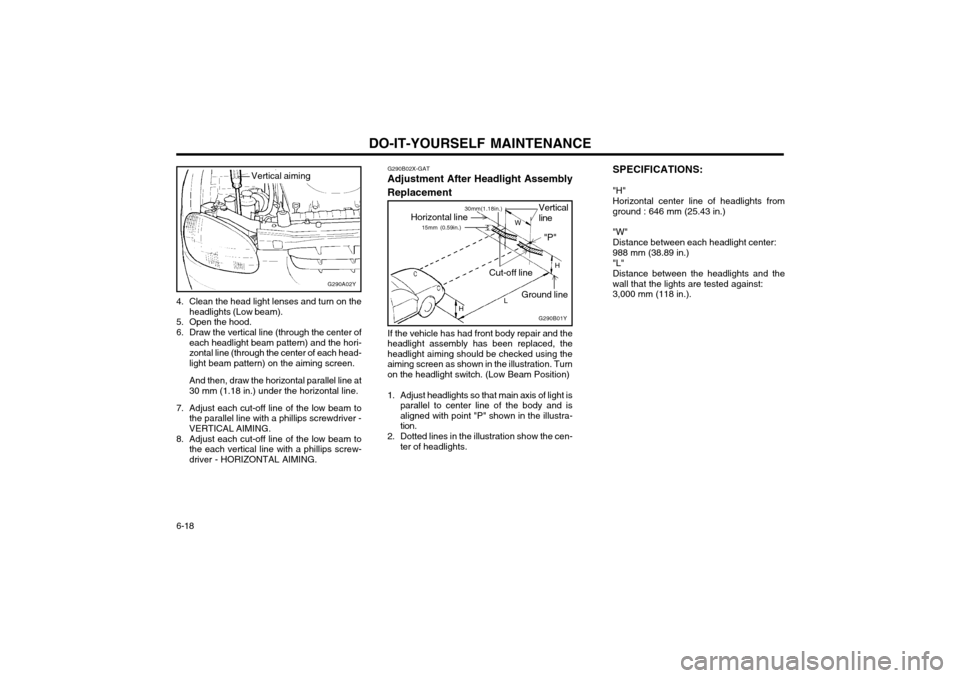
6-18 SPECIFICATIONS: "H" Horizontal center line of headlights from ground : 646 mm (25.43 in.) "W" Distance between each headlight center:988 mm (38.89 in.)"L"Distance between the headlights and the wall that the lights are tested against:3,000 mm (118 in.).
4. Clean the head light lenses and turn on the
headlights (Low beam).
5. Open the hood.
6. Draw the vertical line (through the center of each headlight beam pattern) and the hori- zontal line (through the center of each head-light beam pattern) on the aiming screen. And then, draw the horizontal parallel line at 30 mm (1.18 in.) under the horizontal line.
7. Adjust each cut-off line of the low beam to the parallel line with a phillips screwdriver -VERTICAL AIMING.
8. Adjust each cut-off line of the low beam to the each vertical line with a phillips screw-driver - HORIZONTAL AIMING.
G290A02Y
Vertical aiming G290B02X-GAT
Adjustment After Headlight Assembly Replacement
G290B01Y
Vertical line
Cut-off line Ground line
Horizontal line
LW
H
H "P"
15mm (0.59in.)30mm(1.18in.)
If the vehicle has had front body repair and the
headlight assembly has been replaced, the headlight aiming should be checked using the
aiming screen as shown in the illustration. Turnon the headlight switch. (Low Beam Position)
1. Adjust headlights so that main axis of light is parallel to center line of the body and is aligned with point "P" shown in the illustra-tion.
2. Dotted lines in the illustration show the cen- ter of headlights.
Page 114 of 127

DO-IT-YOURSELF MAINTENANCE 6-19
G280A01X-GAT
(ATOS)
G280A02X
61179
14325108
Part Name
Front Fog Light HeadlightFront Position LightFront Turn Signal LightSide-Repeater Light (If installed) Interior Light High Mounted Rear Stop Light (If Installed)
No.
12345 6 7 Wattage
55
60/55 5
21 5 8
21 No.
8 9
1011 Wattage
55
21 21
21/5 21Part Name
Luggage Compartment Light License Plate LightRear Fog LightRear Combination LightTurn Signal Light Stop/Tail Light Back-up Light
Page 115 of 127

DO-IT-YOURSELF MAINTENANCE
6-20
G280A02V-GAT (ATOS PRIME)
Part Name
Front Fog Light HeadlightFront Position LightFront Turn Signal LightSide-Repeater Light (If installed) Interior Light High Mounted Rear Stop Light (If Installed)
No.
12345 6 7 Wattage
55
60/55 5
21 5 8
2.6 No.
8 9
1011 Wattage
55
21 21
21/5
21Part Name
Luggage Compartment Light License Plate LightRear Fog LightRear Combination LightTurn Signal Light Stop/Tail Light Back-up Light
G280A03V
6119
14325108
7
Page 116 of 127

EMISSION CONTROL SYSTEMS 7-1
7. EMISSION CON-
TROL SYSTEMS
H010A01A-GAT
EMISSION CONTROL SYSTEM (If Installed)
Your Hyundai is equipped with an emission
control system to meet all requirements of the Emission prohibition rules of your province. There are three emission control systems which
are as follows.
1) Crankcase emission control system
2) Evaporative emission control system
3) Exhaust emission control system In order to assure the proper function of the
emission control systems, it is recommended that you have your car inspected and main-tained by an authorized Hyundai dealer in ac-cordance with the maintenance schedule in thismanual. the crankcase through the air intake hose.Inside the crankcase, the fresh air mixes withblow-by gases, which then pass through thePCV valve and into the induction system.
H010C02A-GAT
2. Evaporative Emission Control
System (If installed)
The Evaporative Emission Control System is
designed to prevent fuel vapors from escapinginto the atmosphere. Canister
While the engine is inoperative, fuel vapors
generated inside the fuel tank are absorbed and stored in the onboard canister. When the en-gine is running, the fuel vapors absorbed in thecanister are drawn into the induction systemthrough
the purge control solenoid valve.
Purge Control Solenoid Valve The purge control solenoid valve is controlled
by the ECM; when the engine coolant temper-ature is low, and during idling, it closes, so thatevaporated fuel is not taken into the engine.After engine warm-up, during ordinary driving, itopens so as to introduce evaporated fuel to theengine.
H010B01A-AAT
1. Crankcase Emission Control Sys-
tem
The Positive Crankcase Ventilation System is
employed to prevent air pollution caused byblow-by gases being emitted from the crank-case. This system supplies fresh filtered air to H010D01A-AAT
3. Exhaust Emission Control System
The exhaust emission control system is a high-
ly effective system which controls exhaust emis-sion while maintaining good vehicle perfor-mance.
H020A01A-GAT
CATALYTIC CONVERTER (If Installed)
The catalytic converter is part of the exhaust
emission control system. It's purpose is to re-move certain engine emission products from
the engine's exhaust. It looks something like amuffler and is located underneath the car in theexhaust system. Catalytic Converter
H020A01A
7
Page 126 of 127

INDEX10-3
Adjustable height
........................................................................... 1-9
Adjusting your seat belt ............. ..................................................1-10
Care of seat belts .......................................................................... 1-8
Precautions .................................................................................... 1-7
Spark Plugs ............................................................................... 6-7 ~ 6-8
Speedometer ..................................................................................... 1-22
Starting Procedure .............................................................................. 2-3 Steering Wheel Free play ................................................................. 6-13
Stereo Radio Operation (H922M) .......................................... 1-47 ~ 1-48
Stereo Radio Operation (HMR90) .................... ..................... 1-42 ~ 1-43
Stereo Sound System ............................................................ 1-40 ~ 1-41 Sun Visor .......................................................................................... 1-32
T Tail Gate Open ............................................................................................ 1-30
Remote release ............................................................................ 1-30
Tires
Balancing ....................................................................................... 8-3
Chains ............................................................................................ 8-2
Changing a flat tire ........................................................................ 3-4
If you have a f lat tire ...................................................................... 3-3
Information ..................................................................................... 8-1
Pressure ........................................................................................ 8-1
Replacement .................................................................................. 8-3
Rotation .......................................................................................... 8-2
Snow tires ...................................................................................... 8-2
Spare tire ....................................................................................... 3-3Traction .......................................................................................... 8-3
MMaintenance Intervals
Explanation of scheduled maintenance items ...................... 5-5 ~ 5-7
Maintenance under severe usage conditions ................................ 5-4
Scheduled maintenance ................................................................. 5-2
Service requirements ..................................................................... 5-1
Mirrors Day-night inside rearview ................................. ...........................1-28
Outside rear view ........................................................................ 1-27
O Odometer .......................................................................................... 1-23
P Parking Brake ................................................................................... 1-28
Power Steering Fluid Level .................................................... 6-16 ~ 6-17
Pretensioner Seat Belt ...................................................................... 1-13
RRear Seat Fold down .................................................................................... 1-29
Rear Window Defroster Switch ......................................................... 1-26
Rear Window Wiper and Washer ..................................................... 1-25
Roof Ra ck ......................................................................................... 1-33
SSeat Belts 2-Point static type ............................................................. 1-10 ~ 1-11
3-Point type ......................................................................... 1-9 ~ 1-10