airbag Hyundai Atos 2003 Owner's Manual
[x] Cancel search | Manufacturer: HYUNDAI, Model Year: 2003, Model line: Atos, Model: Hyundai Atos 2003Pages: 127, PDF Size: 1.55 MB
Page 14 of 127

FEATURES OF YOUR HYUNDAI
1- 6 To raise or lower the window, turn the window regulator handle clockwise or counterclockwise. WARNING: When opening or closing the windows, makesure your passenger's arms, hands and bodyare safely out of the way.
B050A01A-AAT WINDOW GLASS
B050A01A
B080D02A-AAT Adjustable Headrests (If installed) Headrests are designed to help reduce the risk of neck injuries.To raise the headrest, pull it up. To lower it, pushit down while pressing the lock knob. WARNING:
o For maximum effectiveness in case of an
accident the headrest should be adjustedso the top of the headrest is at the sameheight as the top of the occupant's ears.For this reason, the use of a cushion thatholds the body away from the seatback isnot recommended.
o Do not operate vehicle with the headrests removed as severe injury to an occupantmay occur in the event of an accident.B080D01A
Lock knob
The seat belt cannot provide full pretection to an occupant if the seat back is reclined.
Headrests may provide protection againstneck injuries when properly adjusted.
B080C01A-AAT Adjusting Seatback Angle To recline the seatback, lean forward to take your weight off it, then pull up on the recliner controllever at the outside edge of the seat. Now leanback until the desired seatback angle is achieved.To lock the seatback into position, release therecliner control lever. WARNING: To minimize risk of severe injury in the eventof a collision or a sudden stop, both the driverand passenger seatbacks should always bein an upright position while the vehicle is inmotion. The protection provided by the seatbelts and airbags may be reduced signifi-cantly when the seatbacks are reclined. Thereis greater risk that the driver and passengerwill slide under the belt which may result inserious injury if a crash occurs when theseatbacks are reclined.
B080C01A
Page 19 of 127

FEATURES OF YOUR HYUNDAI 1- 11
B230A02P-GAT CHILD RESTRAINT SYSTEM (If installed) Children riding in the car should sit in the rear seat and must always be restrained to minimizethe risk of injury in an accident, sudden stop orsudden maneuver. According to accident statis-tics, children are safer when properly restrainedin the rear seats than in the front seat. Largerchildren should use one of the seat belts pro-vided.You are required by law to use safety restraintsfor children. If small children ride in your vehicleyou must put them in a child restraint system(safety seat).Children could be injured in a crash if theirrestraints are not properly secured. For smallchildren and babies, a child seat or infant seatmust be used. Before buying a particular childrestraint system, make sure it fits your car seatand seat belts, and fits your child. Follow all theinstructions provided by the manufacturer wheninstalling the child restraint system. WARNING:
o A child restraint system must be placed in
the rear seat. Never install a child or infantseat on the front passenger's seat.Should an accident occur and cause thepassenger side airbag to deploy, it couldseverely injure or kill an infant or childseated in an infant or child seat. Thus, onlyuse a child restraint in the rear seat of yourvehicle.
B220C01A-AAT To Release the Seat Belt When you want to release the seat belt, press the button in the locking buckle. WARNING: The center lap belt latching mechanism isdifferent from those for the rear seat shoul-der belts. When fastening the rear seat shoul-der belts or the center lap belt, make surethey are inserted into the correct buckle toobtain maximum protection from the seatbelt system and assure proper operation.
B220B01A-AAT Adjusting Your Seat Belt
SSA1090T
With a 2-point static type seat belt, the length must be adjusted manually so it fits snugly aroundyour body. Fasten the belt and pull on the looseend to tighten. The belt should be placed as lowas possible on your hips, not on your waist. If thebelt is too high, it could increase the possibility ofyour being injured in an accident. Correct
Shorten Too highB220C01A
Page 20 of 127
FEATURES OF YOUR HYUNDAI
1- 12 After installation of the child restraint system, try to move it in all directions to be sure the childrestraint system is securely installed.If you need to tighten the belt, pull more webbingtoward the retractor. When you unbuckle theseat belt and allow it to retract, the retractor willautomatically revert back to its normal seatedpassenger emergency locking usage condition. NOTE:
o Before installing the child restraint sys-
tem, read the instructions supplied by thechild restraint system manufacturer.
o If the seat belt does not operate as de- scribed, have the system checked imme-diately by your authorized Hyundai dealer.
WARNING:Do not install any child restraint system in thefront passenger seat. Should an accidentoccur and cause the passenger side airbagto deploy, it could severely injure or kill aninfant or child seated in an infant or childseat. Therefore, only use a child restraintsystem in the rear seat of your vehicle.
o Since a safety belt or child restraint sys-
tem can become very hot if it is left in aclosed vehicle, be sure to check the seatcover and buckles before placing a childthere.
o When the child restraint system is not in use, fasten it with a safety belt so that itwill not be thrown forward in the case of asudden stop or an accident.
o Children who are too large to be in a child restraint should sit in the rear seat and berestrained with the available lap/shoulderbelts. Never allow children to ride in thefront passenger seat.
o Always make sure that the shoulder belt portion of the outboard lap/shoulder beltis positioned midway over the shoulder,never across the neck. Moving the childcloser to the center of the vehicle may helpprovide a good shoulder belt fit. The lapbelt portion of the lap/shoulder belt or thecenter seat lap belt must always be posi-tioned as low as possible on the child'ships and as snug as possible.
o If the seat belt will not properly fit the child, we recommend the use of an ap-proved booster seat in the rear seat inorder to raise the child's seating height sothat the seat belt will properly fit the child.
o Never allow a child to stand up or kneel on the seat.
o Never use an infant carrier or child safety seat that "hooks" over a seatback; it may not provide adequate security in an acci-dent.
o Never allow a child to be held in a person's arms while they are in a moving vehicle, asthis could result in serious injury to thechild in the event of an accident or asudden stop. Holding a child in a movingvehicle does not provide the child withany means of protection during an acci-dent, even if the person holding the childis wearing a seat belt.
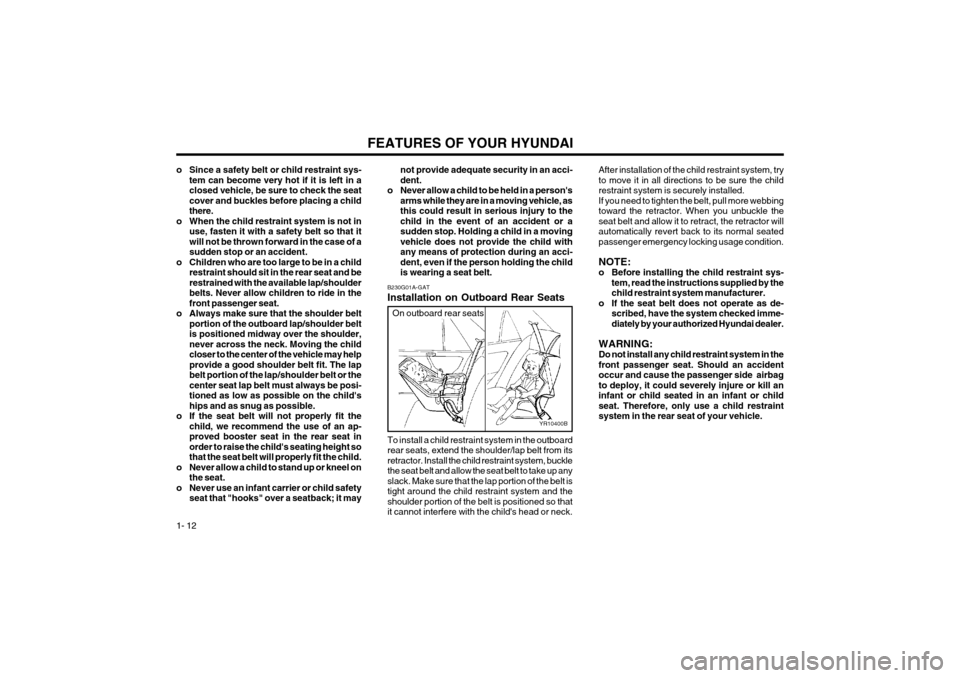
B230G01A-GAT Installation on Outboard Rear Seats
YR10400B
To install a child restraint system in the outboard rear seats, extend the shoulder/lap belt from itsretractor. Install the child restraint system, bucklethe seat belt and allow the seat belt to take up anyslack. Make sure that the lap portion of the belt istight around the child restraint system and theshoulder portion of the belt is positioned so thatit cannot interfere with the child's head or neck.
On outboard rear seats
Page 21 of 127

FEATURES OF YOUR HYUNDAI 1- 13
B240A03F-AAT SUPPLEMENTAL RESTRAINT (AIRBAG) SYSTEM (If installed)
AS10356A
Your Hyundai is equipped with a Supplemental Restraint (Airbag) System. The indications of thesystem's presence are the letters "SRS AIRBAG"embossed on the airbag pad cover in the steeringwheel and the passenger's side front panel padabove the glove box. The Hyundai SRS consists of airbags installed under the pad covers in the center of the steeringwheel and the passenger's side front panel abovethe glove box. The purpose of the SRS is toprovide the vehicle's driver and the front passen-ger with additional protection when used to-gether with the seat belt, in case of a frontalimpact. NOTE: Be sure to read information about the SRS onthe labels provided on the backside of thesun visor and in the glove box.
B180B01X-GAT Pre-tensioner Seat Belt (If installed)Ordinarily the pre-tensioner seat belt operates in the same way as E.L.R (Emergency LockingRetractor) type (When vehicles stop suddenly,
the belt will lock into the position. It will alsolock if you try to lean forward too quickly.) .
However, when vehicles crash, the retractorrewinds the belt webbing. This will restrain thepassenger movement quickly and also reducethe slack between passenger and belt webbing. NOTE:
o When the pre-tensioner seat belt is acti- vated, there may be an explosion noise.This noise is normal and is not hazardous.
o Pre-tensioner seat belt is designed to op- erate only when a sufficiently severe im-pact occurs and it will be only operatedonce.
WARNING:If the pre-tensioner seat belt was activated,never attempt to replace it by yourself. It mustbe replaced by an authorized Hyundai Dealer.
Age Group Seating PositionFront
Passenger Rear
Outboard Rear
Center
0 : Up to 10 kg (0 ~ 9 months)0+ : Up to 13 kg(0 ~ 2 years)I : 9kg to 18kg(9 months ~4 years)II & III : 15kg to 36kg(4 ~ 12 years)XUX
XUX
UF U UF
UF UF UF
U : Suitable for "universal" category restraints approved for use in this mass group
UF : Suitable for forward-facing "universal" cat- egory restraints approved for use in this mass group
X : Seat position not suitable for children in this mass group
B230H01X-GAT Child Seat Restraint Suitability For Seat Po- sitionUse child safety seats that have been officiallyapproved and are appropriate for your children.
Page 22 of 127

FEATURES OF YOUR HYUNDAI
1- 14 B240B03A-AAT SRS Components and Functions
o For maximum safety protection in all types
of crashes, all occupants including the driver should always wear their seat beltswhether or not an airbag is also providedat their seating position to minimize therisk of severe injury or death in the eventof a crash. Do not sit or lean unnecessarilyclose to the airbag while the vehicle is inmotion.
o The SRS airbag system must deploy very rapidly to provide protection in a crash. Ifan occupant is out of position because ofnot wearing a seat belt, the airbag mayforcefully contact the occupant causingserious or fatal injuries.
B240C01X
WARNING:
o As its name implies, the SRS is designed
to work with, and be supplemental to, thedriver's and the passenger's three pointseat belt systems and is not a substitutefor them. Therefore, your seat belts mustbe worn at all times while the vehicle is inmotion. The airbags deploy only in certainfrontal impact conditions severe enoughto likely cause significant injury to thevehicle occupants.
o The SRS is designed to deploy the airbags only when an impact is sufficiently severeand when the impact angle is less than 30°from the forward longitudinal axis of thevehicle and will not deploy in side, rear orrollover impacts. Additionally, the airbagswill only deploy once. Thus, seat beltsmust be worn at all times.
Rear impact
Side impact Rollover
o Front airbags are not intended to deploy in side-impact, rear-impact or rollover crashes. In addition, airbags will not de-ploy in frontal crashes below the deploy-ment threshold speed.
o The driver should sit back as far as possi- ble while still maintaining control of thevehicle. If you are sitting too close to theairbag, it can cause death or serious injurywhen it inflates.
o No objects should be placed over or near the airbag modules on the steering wheel,instrument panel, and the front passen-ger's panel above the glove box, becauseany such object could cause harm if thevehicle is in a crash severe enough tocause the airbags to deploy.
o If the airbags deploy, they must be re- placed by an authorized Hyundai dealer.
o Do not tamper with or disconnect SRS wiring, or other components of the SRSsystem. Doing so could result in injury,due to accidental firing of the airbags orby rendering the SRS inoperative.
o Do not install a child restraint system in the front passenger seat position. A childrestraint system must never be placed inthe front seat. The infant or child could beseverely injured or killed by an airbagdeployment in case of an accident.Do not allow children to ride in the frontpassenger seat. If also children(teenagersand older) must ride in the front seat,make sure they are always properly beltedand that the seat is moved back as far aspossible.FUA1111B
Page 23 of 127

FEATURES OF YOUR HYUNDAI 1- 15
The SRS service reminder indicator (SRI) on the instrument panel will blink for about 6 secondsafter the ignition key is turned to the "ON"position or after the engine is started, after whichthe SRI should go out. The airbag modules are located both in thecenter of the steering wheel and in the frontpassenger's panel above the glove box. Whenthe SRSCM detects a considerable impact to thefront of the vehicle, it will automatically deploy theairbags.
The SRS consists of the following components:
- Driver's Airbag Module
- Passenger's Airbag Module
- SRS Service Reminder Indicator (SRI)
- SRS Control Module (SRSCM)
The SRSCM continually monitors all elementswhile the ignition is "ON" to determine if a frontalor near-frontal impact is severe enough to re-quire airbag deployment. Upon deployment, tear seams molded directlyinto the pad covers will separate under pressurefrom the expansion of the airbags. Further open-ing of the covers then allows full inflation of theairbags. A fully inflated airbag in combination with a prop- erly worn seat belt slows the driver's or thepassenger's forward motion, thus reducing therisk of head or chest injury. After complete inflation, the airbag immediately starts deflating, enabling the driver to maintainforward visibility. CAUTION: When installing a container of liquid air fresh-ener inside a vehicle, do not place it near theinstrument cluster nor on the instrument panelpad surface. If there is any leakage from theair freshener onto these areas (Instrument
FUA1112A
FUA1113A
B240B04X
FUA1115A
Page 24 of 127

FEATURES OF YOUR HYUNDAI
1- 16 to the body structure, can adversely affect SRS performance and lead to possibleinjury.
o For cleaning the airbag pad covers, use only a soft, dry cloth or one which hasbeen moistened with plain water. Solventsor cleaners could adversely affect theairbag covers and proper deployment ofthe system.
o No objects should be placed over or near the airbag modules on the steering wheel,instrument panel, and the front passen-ger's panel above the glove box, becauseany such object could cause harm if thevehicle is in a crash severe enough tocause the airbags to inflate.
o If the airbags inflate, they must be re- placed by an authorized Hyundai dealer.
o Do not tamper with or disconnect SRS wiring, or other components of the SRSsystem. Doing so could result in injury,due to accidental firing of the airbags orby rendering the SRS inoperative.
o Do not install a child restraint system in the front passenger seat position.A child restraint system must never beplaced in the front seat. The infant or childcould be severely injured by an airbagdeployment in case of an accident.
o If components of the airbag system must be discarded, or if the vehicle must bescrapped, certain safety precautions mustbe observed. Your Hyundai dealer knowsthese precautions and can give you the
YT10355A
cluster, instrument panel pad or air ventila- tor), it may damage these parts. If the liquidfrom the air freshener does leak onto theseareas, wash them with water immediately. WARNING:
o When the SRS is activated, there may be a loud noise and fine dust will be released through out the vehicle. These conditionsare normal and are not hazardous. How-ever, the fine dust generated during airbagdeployment may cause skin irritation. Besure to wash your hands and face thor-oughly with lukewarm water and a mildsoap after an accident in which the airbagswere deployed.
o The SRS can function only when the igni- tion key is in the "ON" position. If the SRSSRI does not come on, or continuouslyremains on, after flashing for about 6 sec-onds when the ignition key is turned tothe "ON" position, or after the engine isstarted, or comes on while driving, theSRS is not working properly. If this oc-curs, have your vehicle immediately in-spected by your Hyundai dealer.
o Before you replace a fuse or disconnect a battery terminal, turn the ignition key tothe "LOCK" position or remove the igni-tion key. Never remove or replace the airbag related fuse(s) when the ignition keyis in the "ON" position. Failure to heed thiswarning will cause the SRS SRI to illumi-nate. B240C01Y-GAT SRS CareThe SRS is virtually maintenance-free and so there are no parts you can safely service byyourself. The entire SRS system must be in-spected by an authorized Hyundai dealer in 10years after the date that the vehicle was manu-factured. Any work on the SRS system, such as removing, installing, repairing, or any work on the steeringwheel must be performed by a qualified Hyundaitechnician. Improper handling of the SRS sys-tem may result in serious personal injury. WARNING:
o Extreme Hazard! Do not use a rearward
facing child restraint on a seat protectedby an airbag in front of it!
o Modification to SRS components or wir- ing, including the addition of any kind ofbadges to the pad covers or modifications
Page 26 of 127

FEATURES OF YOUR HYUNDAI
1- 18
B250A02X-GAT INSTRUMENTS AND CONTROLS
1. Multi-Function Light Switch
2. Headlight Leveling Device (If installed)
3. Horn Button
4. Driver's Airbag (If installed)
5. Windshield Wiper/Washer Switch
6. Rear Wiper Switch/Rear Washer Switch (If installed)
7. Rear Defroster Switch 8. Center Air Vent Louver
9. Digital Clock (If installed)
10. Hazard Warning Switch
11. Defroster Ventilation Outlet
12. Front Fog Light Switch (If installed)
13. Rear Fog Light Switch (If installed)
14. Passenger's Airbag (If installed)
15. Side Air Vent Louver16. Hood Release Lever
17. Ignition Switch and Keys
18. Air Conditioning Switch
19. Cigarette Light
20. Ashtray
21. Heating/Air Conditioning Control Panel
22. Audio System
CAUTION:When installing a container of liquid air fresh-ener inside a vehicle, do not place it near theinstrument cluster nor on the instrument panelpad surface. If there is any leakage from theair freshener onto these areas (Instrumentcluster, instrument panel pad or air ventila-tor), it may damage these parts. If the liquidfrom the air freshener does leak onto theseareas, wash them with water immediately.
15
1 3 4 5,6 11 12 13 14
16 17 18 19 20 21 22 27389
8
10
B250A02X
Page 29 of 127

FEATURES OF YOUR HYUNDAI 1- 21
B270A01A-AAT BRAKE PAD WEAR WARNING SOUND The front disc brake pads have wear indicators that should make a high-pitched squealing orscraping noise when new pads are needed. Thesound may come and go or be heard all the timewhen the vehicle is moving. It may also be heard
B260M01A-AAT
Low Fuel Level Warning Light
The low fuel level warning light comes on when thefuel tank is approaching empty. When it comes on,you should add fuel as soon as possible. Drivingwith the fuel level warning light on or with the fuellevel below "E" can cause the engine to misfireand damage the catalytic converter.
hydraulic system is dangerous, and could result in serious injury or death. Warning Light Operation The parking brake/brake fluid level warning light should come on when the parking brake is ap-plied and the ignition switch is turned to "ON" or"START". After the engine is started, the lightshould go out when the parking brake is re-leased.If the parking brake is not applied, the warninglight should come on when the ignition switch isturned to "ON" or "START", then go out when theengine starts. If the light comes on at any othertime, you should slow the vehicle and bring it toa complete stop in a safe location off the road-way.The brake warning light indicates that the brakefluid level in the brake master cylinder is low andhydraulic brake fluid conforming to DOT 3 orDOT 4 specifications should be added. Afteradding fluid, if no other trouble is found, the carshould be immediately and carefully drivento a Hyundai dealer for inspection. If furthertrouble is experienced, the vehicle should not bedriven at all but taken to a dealer by a profes-sional towing service or some other safe method.Your Hyundai is equipped with dual-diagonalbraking systems. This means you still have brak-ing on two wheels even if one of the dual systemsshould fail. With only one of the dual systemsworking, more than normal pedal travel andgreater pedal pressure are required to stop thecar. Also, the car will not stop in as short a B260J01S-GAT
Charging System Warning Light
The charging system warning light should comeon when the ignition is turned on, then go outwhen the engine is running. If the light stays onwhile the engine is running, there is a malfunctionin the electrical charging system. If the lightcomes on while you are driving, stop, turn off theengine and check under the hood. First, makecertain the generator drive belt is in place. If it is,check the tension of the belt.And then, have the system checked by yourHyundai dealer. CAUTION: If the drive belt (generator belt) is loosen,broken, or mission while the vehicle is driv-ing, there may be a serious malfunction, en-gine could overheat because this belt alsodrives the water pump.
B260L01A-GAT Door Ajar Warning Light
The door ajar warning light warns you that a door is not completely closed.
B260B01S-GAT SRS (Airbag) Service Reminder Indicator (SRI) (If installed)
The SRS service reminder indicator (SRI) comes on and flashes for about 6 seconds after theignition key is turned to the "ON" position or afterthe engine is started, after which it will go out.This light also comes on when the SRS is notworking properly. If the SRI does not come on, orcontinuously remains on after flashing for about6 seconds when you turned the ignition key to the"ON" position or started the engine, or if it comeson while driving, have the SRS inspected by anauthorized Hyundai Dealer.
distance with only half of the brake system work- ing. If the brakes fail while you are driving, shift toa lower gear for additional engine braking andstop the car as soon as it is safe to do so.
Page 41 of 127

FEATURES OF YOUR HYUNDAI 1- 33
o Always drive your vehicle at a moderate
speed.
o To use the roof rails as a roof rack, you must fit the roof rails with two or more crossrails or equivalent.
WARNING:
o In case of hectical steering movements or bad fixation the luggage can fall from thevehicle and injure persons or property.Make sure that the luggage is properlyfixed and avoid sudden movement
(e.g.dashing start, fast turningmanoeuvres, hard cornering, sudden brak-ing) Check frequently whether the roofrack is properly fastened.
o Voluminous, large, long or flat objects can change the aerodynamic drag of vehicleor can suddenly been lifted by the wind.The driver could lose control of the carand provoke an accident and injuries. For
this reason, drive at reduced speed whenyou transport such objects.
o The maximum load limit of the roof rack including luggage load is 30 kg.
B630A02X-GAT ROOF RACK (If installed)
ROOF RACK
If your Hyundai has a roof rack, you can load things on top of your vehicle. Crossrails andfixing components to adapt the roof rack on yourvehicle may be obtained from an authorizedHyundai dealer.Hyundai dealers are prepared to provide highquality service that may be required. CAUTION:
o The following specifications are recom-mended when loading cargo or luggage.
30 kg (66 lb)
B630A01X
o Loading cargo or luggage above 30 kg (66lb) on the roof rack may damage your vehicle.
o When you carry large objects, never let them hang over the rear or the sides ofyour vehicle. B610B01A-GAT HORN (Without Airbag) Press the center hub of the steering wheel to sound the horn.
B610B01A
B610A01A-GAT HORN (With Airbag) (If installed) Press either of the side buttons on the steering wheel to sound the horn.
HNV.OM057