change wheel Hyundai Atos 2003 Owner's Manual
[x] Cancel search | Manufacturer: HYUNDAI, Model Year: 2003, Model line: Atos, Model: Hyundai Atos 2003Pages: 127, PDF Size: 1.55 MB
Page 41 of 127

FEATURES OF YOUR HYUNDAI 1- 33
o Always drive your vehicle at a moderate
speed.
o To use the roof rails as a roof rack, you must fit the roof rails with two or more crossrails or equivalent.
WARNING:
o In case of hectical steering movements or bad fixation the luggage can fall from thevehicle and injure persons or property.Make sure that the luggage is properlyfixed and avoid sudden movement
(e.g.dashing start, fast turningmanoeuvres, hard cornering, sudden brak-ing) Check frequently whether the roofrack is properly fastened.
o Voluminous, large, long or flat objects can change the aerodynamic drag of vehicleor can suddenly been lifted by the wind.The driver could lose control of the carand provoke an accident and injuries. For
this reason, drive at reduced speed whenyou transport such objects.
o The maximum load limit of the roof rack including luggage load is 30 kg.
B630A02X-GAT ROOF RACK (If installed)
ROOF RACK
If your Hyundai has a roof rack, you can load things on top of your vehicle. Crossrails andfixing components to adapt the roof rack on yourvehicle may be obtained from an authorizedHyundai dealer.Hyundai dealers are prepared to provide highquality service that may be required. CAUTION:
o The following specifications are recom-mended when loading cargo or luggage.
30 kg (66 lb)
B630A01X
o Loading cargo or luggage above 30 kg (66lb) on the roof rack may damage your vehicle.
o When you carry large objects, never let them hang over the rear or the sides ofyour vehicle. B610B01A-GAT HORN (Without Airbag) Press the center hub of the steering wheel to sound the horn.
B610B01A
B610A01A-GAT HORN (With Airbag) (If installed) Press either of the side buttons on the steering wheel to sound the horn.
HNV.OM057
Page 66 of 127

DRIVING YOUR HYUNDAI
2- 4 C070B01X-GAT
Using the Clutch of Manual transaxle The clutch should be pressed all the way to the floor before shifting, then released slowly. Theclutch pedal should be always used after fullyreturning to the original position. Do not restyour foot on the clutch pedal while driving. Thiscan cause unnecessary wear. Do not partiallyengage the clutch to hold the car on an incline.This causes unnecessary wear. Use the park-ing brake to hold the car on an incline. Do notoperate the clutch pedal rapidly and repeatedly. o Slow down when you encounter cross winds.
This gives you much better control of yourcar.
o Be sure the car is completely stopped be- fore you attempt to shift into reverse. Thetransaxle can be damaged if you do not. To
shift into reverse, depress the clutch (manualtransaxle), move the shift lever to neutral,
wait three seconds, then shift to the reverseposition.
o Exercise extreme caution when driving on a slippery surface. Be especially careful whenbraking, accelerating or shifting gears. On aslippery surface, an abrupt change in ve-hicle speed can cause the drive wheels tolose traction and the vehicle to go out ofcontrol.
CAUTION:
o The risk of rollover is greatly increased if you lose control of your vehicle at high-way speeds.
o Loss of control often occurs if two or more wheels drop off the roadway andthe driver oversteers to reenter the road-way.
o In the event your vehicle leaves the road- way, do not steer sharply. Instead, slowdown before pulling back into the travellanes.
o In a collision crash, on unbelted person is significantly more likely to die than aperson wearing a seatbelt.
o Ensure that the engine is not over-revved
by upshifting.
o Do not coast with the shift lever at the neutral position.
o When descending long gradients, make use of the engine braking to assist thefootbrake to avoid brake fade or over-heating.
o When slippery conditions are encoun- tered, increased caution should be ex-ecuted when gear changing, braking oraccelerating. Abrupt changes in speedmay cause a loss of traction.
o To shift into reverse, rest the lever in neutral for at least 3 seconds after yourcar is completely stopped. Then movethe lever into the reverse position.
o During cold weather, shifting may be dif- ficult until the transaxle lubricant haswarmed up. This is normal and not harm-ful to the transaxle.
o If you 've come to a complete stop and it's hard to shift into 1 st
or R(Reverse),
put the shift lever in N(Neutral) positionand let up on the clutch. Press the clutchpedal back down, and then shift into 1 st
or R(Reverse) gear position.
o Do not use the shift lever as a handrest during driving, as this can result in pre-mature wear of the transaxle shift forks. C070D01X-GAT
Good Driving Practices
o Never take the car out of gear and coast down a hill. This is extremely hazardous. Always leave the car in gear.
o Don't "ride" the brakes. This can cause them to overheat and malfunction. Instead,when you are driving down a long hill, slow
down and shift to a lower gear. When you dothis, engine braking will help slow the car.
o Slow down before shifting to a lower gear. This will help avoid over-revving the engine,which can cause damage.
WARNING: When downshifting from fifth gear to fourth gear, caution should be taken not to inad-vertently press the gear shift lever sideways
in such a manner that second gear is en-gaged. Such over revving of the engine may possibly cause engine damage.
Page 69 of 127

DRIVING YOUR HYUNDAI 2- 7
C130A01A-AAT
GOOD BRAKING PRACTICES
WARNING: Do not allow passengers to sit on the cargo area while the car is moving as this is not aproper seating position and no seat belts
are available for use when the seat back isfolded down. This could result in seriousinjury or death in case of an accident or a
sudden stop. Objects should not extendhigher than the top of the front seats. This
could allow cargo to slide forward and causeinjury or damage during sudden stops.
o After being parked, check to be sure the parking brake is not engaged and that theparking brake indicator light is out beforedriving away.
o Driving through water may get the brakes wet. They can also get wet when the car iswashed. Wet brakes can be dangerous!
Your car will not stop as quickly if the brakesare wet and it may also pull to one side. Todry the brakes, apply the brakes lightly untilthe braking action returns to normal, takingcare to keep the car under control at alltimes. If the braking action does not return to
normal, stop as soon as it is safe to do soand call your Hyundai dealer for assistance.
o Don't coast down hills with the car out of gear. This is extremely hazardous. Keep thecar in gear at all times, use the brakes toslow down, then shift to a lower gear so thatengine braking will help you maintain a safespeed.
o Exercise extreme caution when driving on a
slippery surface. Be especially careful whenbraking, accelerating or shifting gears. On aslippery surface, an abrupt change in ve-hicle speed can cause the drive wheels tolose traction and the vehicle to go out ofcontrol.
o Turn the overdrive switch on for good fuel economy and smooth driving. If engine brak-ing is needed in the "D" range or if repeatedupshifting and downshifting between 3rd and4th gear is needed when climbing a gentleslope, it is recommended that the overdriveswitch be turned off. Turn the overdriveswitch back on immediately afterward.
CAUTION:
o The risk of rollover is greatly increased if you lose control of your vehicle at high-way speeds.
o Loss of control often occurs if two or more wheels drop off the roadway andthe driver oversteers to reenter the road-way.
o In the event your vehicle leaves the road- way, do not steer sharply. Instead, slowdown before pulling back into the travellanes.
o In a collision crash, on unbelted person is significantly more likely to die than aperson wearing a seatbelt.
C090N02A-AAT
Good Driving Practices
o Never move the gear selector lever from "P" or "N" to any other position with the acceler- ator pedal depressed.
o Never move the gear selector lever into "P" when the vehicle is in motion.
o Be sure the car is completely stopped be- fore you attempt to shift into "R".
o Never take the car out of gear and coast down a hill. This may be extremely hazard-ous. Always leave the car in gear whenmoving.
o Do not "ride" the brakes. This can cause them to overheat and malfunction. Instead,when you are driving down a long hill, slowdown and shift to a lower gear. When you dothis, engine braking will help slow the car.
o Slow down before shifting to a lower gear. Otherwise, the lower gear may not be en-gaged.
o Always use the parking brake. Do not de- pend on placing the transaxle in "P" to keepthe car from moving.
drive switch is turned off, the transaxle will notupshift to the overdrive gear. For normal driv-ing, the selector lever should be left in the "D"position and the overdrive switch turned on.
If you need to accelerate rapidly, press the
accelerator pedal all the way to the floor. Thetransaxle will automatically shift to a lower gear,depending on the vehicle speed and load.
Page 71 of 127

DRIVING YOUR HYUNDAI 2- 9
resulting in the engine bucking. If this hap- pens, shift to a lower gear. Over-revving isracing the engine beyond its safe limit. Thiscan be avoided by shifting at the recom-mended speeds.
o Use your air conditioning sparingly. The air conditioning system is operated by enginepower so your fuel economy is reducedwhen you use it.
C150A01A-AAT
SMOOTH CORNERING Avoid braking or gear changing in corners,
especially when roads are wet. Ideally, cornersshould always be taken under gentle accelera-tion. If you follow these suggestions, tire wearwill be held to a minimum.
C160A01A-AAT
WINTER DRIVING The more severe weather conditions of winter
result in greater wear and other problems. Tominimize the problems of winter driving, youshould follow these suggestions:
C160B01A-GAT
Snowy or Icy Conditions To drive your vehicle in deep snow, it may be
necessary to use snow tires or to install tirechains on your tires. If snow tires are needed,
it is necessary to select tires equivalent in size
and type to the original equipment tires.
o Be sure that the wheels are aligned correct-
ly. Improper alignment can result from hittingcurbs or driving too fast over irregular sur-faces. Poor alignment causes faster tirewear and may also result in other problemsas well as greater fuel consumption.
o Keep your car in good condition. For better fuel economy and reduced maintenancecosts, maintain your car in accordance withthe maintenance schedule in Section 5. Ifyou drive your car in severe conditions,more frequent maintenance is required (seeSection 5 for details).
o Keep your car clean. For maximum service, your Hyundai should be kept clean and freeof corrosive materials. It is especially impor-tant that mud, dirt, ice, etc. not be allowed toaccumulate on the underside of the car. Thisextra weight can result in increased fuelconsumption and also contribute to corro-sion.
o Travel lightly. Don't carry unnecessary weight in your car. Weight reduces fuel economy.
o Don't let the engine idle longer than neces- sary. If you are waiting (and not in traffic),turn off your engine and restart only whenyou're ready to go.
o Remember, your Hyundai does not require extended warm-up. As soon as the engine isrunning smoothly, you can drive away. Invery cold weather, however, give your en-gine a slightly longer warm-up period.
o Don't "lug" or "over-rev" the engine. Lugging is driving too slowly in too high a gear
C140A01A-AAT
DRIVING FOR ECONOMY
You can save fuel and get more kilometers from
your car if you follow these suggestions:
o Drive smoothly. Accelerate at a moderate rate. Don't make "jack-rabbit" starts or full- throttle shifts and maintain a steady cruisingspeed. Don't race between stoplights. Try toadjust your speed to that of the other trafficso you don't have to change speeds unnec-essarily. Avoid heavy traffic whenever pos-sible. Always maintain a safe distance fromother vehicles so you can avoid unneces-sary braking. This also reduces brake wear.
o Drive at a moderate speed. The faster you drive, the more fuel your car uses. Driving ata moderate speed, especially on the high-way, is one of the most effective ways toreduce fuel consumption.
o Don't "ride" the brake or clutch pedal. This can increase fuel consumption and alsoincrease wear on these components. In ad-dition, driving with your foot resting on thebrake pedal may cause the brakes to over-heat, which reduces their effectiveness andmay lead to more serious consequences.
o Take care of your tires. Keep them inflated to the recommended pressure. Incorrect in-flation, either too much or too little, results inunnecessary tire wear. Check the tire pres-sures at least once a month.
Page 80 of 127

WHAT TO DO IN AN EMERGENCY
3-4 D060A01A-AAT
CHANGING A FLAT TIRE
The procedure described on the following pages can be used to rotate tires as well as to change
a flat tire. When preparing to change a flat tire,check to be sure the gear selector lever is in "P"(automatic transaxle) or reverse gear (manualtransaxle) and that the parking brake is set,then: D060B01FC-GAT
1. Obtain Spare Tire and Tool
Remove the spare tire and take out the jack and
tool bag from the luggage room.
NOTE:The jack is located beneath the luggage mat
in the vehicle. Block the wheel that is diagonally opposite fromthe flat to keep the vehicle from rolling when thecar is raised on the jack.
D060C01A-AAT
2. Block the Wheel
SSA3050D
Flat tire
D060D01A-AAT
3. Loosen Wheel Nuts
D060A01X
HNVOM096
D040B01X
Page 83 of 127

WHAT TO DO IN AN EMERGENCY 3-7
D060J01FC-GAT
After Changing Wheels
If you have a tire gauge, remove the valve cap
and check the air pressure. If the pressure is lower than recommended, drive slowly to thenearest service station and inflate to the correctpressure. If it is too high, adjust it until it iscorrect. Always reinstall the valve cap afterchecking or adjusting tire pressure. If the cap isnot replaced, air may leak from the tire. If youlose a valve cap, buy another and install it assoon as possible.
After you have changed wheels, always secure
the flat tire in its place in the luggage room andreturn the jack and tools to their proper storagelocations. D080A01A-GAT
IF YOUR CAR MUST BE TOWED D080B01A-AAT
Towing a Car With a Manual Transaxle
o OK FOR AUTOMATIC OR MANUAL TRANSAXLE EQUIPPED VEHICLE WITH NO DAMAGE
o OK FOR AUTOMATIC OR MANUAL
TRANSAXLE EQUIPPED VEHICLE
CAUTION: Your car can be damaged if towed incor- rectly! If your car has to be towed, it should be done by
your Hyundai dealer or a commercial tow truckservice. This will help assure that your car isnot damaged in towing. Also, professionals aregenerally aware of state and local laws govern-ing towing. In any case, rather than risk dam-age to your car, it is suggested that you showthis information to the tow truck operator. Besure that a safety chain system is used and thatlocal laws are observed. o If the car is being towed with the rear wheels
on the ground, be sure the parking brake isreleased.
o If the car is being towed with the front wheels on the ground, be sure that thetransaxle is in neutral. Also, be sure that theignition key is in the "ACC" position. This isnecessary to prevent damage to the steer-ing lock mechanism, which is not designedto hold the front wheels straight while the caris being towed.
o If any of the loaded wheels or suspension components are damaged, a towing dollymust be used.
D080A01AD080B01AD060J01X
Page 94 of 127

VEHICLE MAINTENANCE REQUIREMENTS
5- 6 F070B01A-GAT
o Cooling System
Check the cooling system part, such as radia-
tor, coolant reservoir, hoses and connections for leakage and damage. Replace any dam-aged parts.
F070C01A-AAT
o Engine coolant
The coolant should be changed at the
intervals specified in the maintenance sched-ule.
F070D02X-GAT
o Manual transaxle oil Inspect the manual transaxle oil according to
the maintenance schedule. NOTE: If the oil level is low, check for possible
leaks before adding oil. Do not overfill.
F070E01X-GAT
o Automatic transaxle fluid The fluid level should be in the "HOT" range of
the dipstick, after the engine and transaxle are at normal operating temperature. Check theAutomatic Transaxle Fluid level with the engine
running and the transaxle in neutral, with theparking brake properly applied. Use ESSO JWS-3314 when adding or changing fluid. F070F01A-AAT
o Brake hoses and lines
Visually check for proper installation, chafing,
cracks, deterioration and any leakage. Replaceany deteriorated or damaged parts immediate-ly. F070G01A-AAT
o Brake fluid
Check brake fluid level in the brake fluid reser- voir. The level should be between "MIN" and"MAX" marks on the side of the reservoir. Use only hydraulic brake fluid conforming to DOT 3 or DOT 4. F070H01A-AAT
o Rear brake drums/linings, parking
brake
Check the rear brake drums and linings for
scoring, burning, leaking fluid, broken parts,and excessive wear. Inspect the parking brake
system including the parking brake lever andcables. For detailed service procedures, referto the Shop Manual. F070J01A-AAT
o Brake pads, calipers and rotors
Check the pads for excessive wear, discs for
run out and wear, and calipers for fluid leakage. F070L01A-AAT
o Suspension mounting bolts
Check the suspension connections for loose-ness or damage. Retighten to the specifiedtorque.
F070K01A-AAT
o Exhaust pipe and muffler
Visually inspect the exhaust pipes, muffler andhangers for cracks, deterioration, or damage.Start the engine and listen carefully for any
exhaust gas leakage. Tighten connections orreplace parts as necessary. F070M01A-AAT
o Steering gear box, linkage & boots/
lower arm ball joint
With the vehicle stopped and engine off, check for excessive free-play in the steering wheel.Check the linkage for bends or damage. Check
the dust boots and ball joints for deterioration,
cracks, or damage. Replace any damaged parts. F070N01A-AAT
o Power steering pump, belt and
hoses
Check the power steering pump and hoses for leakage and damage. Replace any damaged orleaking parts immediately. Inspect the powersteering belt for evidence of cuts, cracks, ex-
cessive wear, oiliness and proper tension. Re-place or adjust it if necessary.
Page 108 of 127
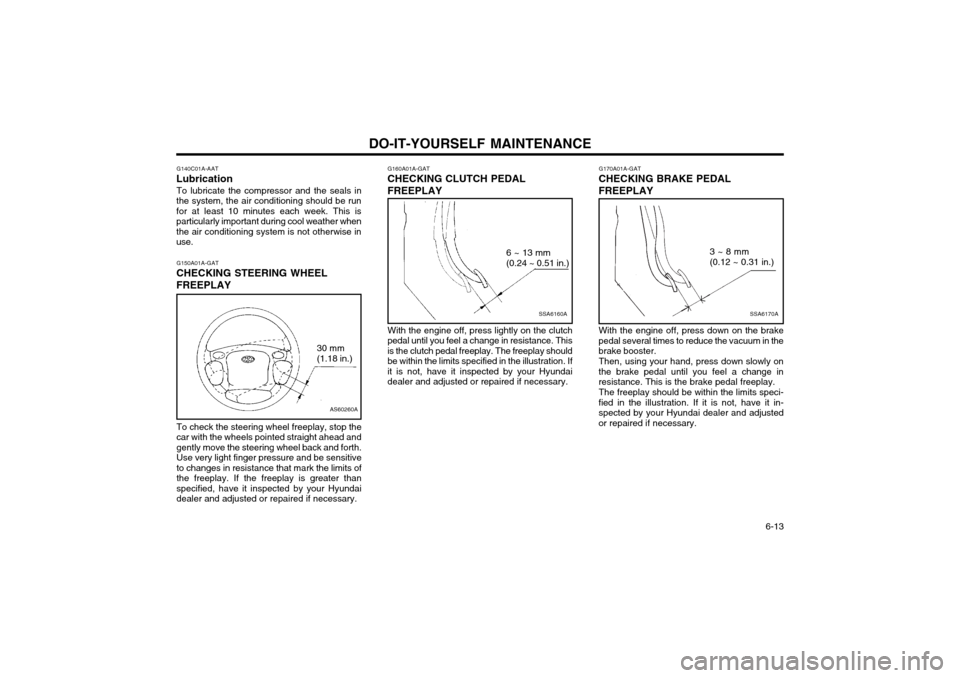
DO-IT-YOURSELF MAINTENANCE 6-13
G170A01A-GAT
CHECKING BRAKE PEDAL FREEPLAY
To check the steering wheel freeplay, stop the car with the wheels pointed straight ahead andgently move the steering wheel back and forth.Use very light finger pressure and be sensitiveto changes in resistance that mark the limits ofthe freeplay. If the freeplay is greater thanspecified, have it inspected by your Hyundaidealer and adjusted or repaired if necessary. G160A01A-GAT
CHECKING CLUTCH PEDAL FREEPLAY
SSA6160A
6 ~ 13 mm (0.24 ~ 0.51 in.)
With the engine off, press lightly on the clutch
pedal until you feel a change in resistance. This is the clutch pedal freeplay. The freeplay shouldbe within the limits specified in the illustration. Ifit is not, have it inspected by your Hyundaidealer and adjusted or repaired if necessary.
SSA6170A
3 ~ 8 mm (0.12 ~ 0.31 in.)
With the engine off, press down on the brake
pedal several times to reduce the vacuum in the brake booster.
Then, using your hand, press down slowly on
the brake pedal until you feel a change inresistance. This is the brake pedal freeplay.
The freeplay should be within the limits speci-
fied in the illustration. If it is not, have it in-spected by your Hyundai dealer and adjustedor repaired if necessary.
G140C01A-AAT
Lubrication
To lubricate the compressor and the seals in
the system, the air conditioning should be run for at least 10 minutes each week. This isparticularly important during cool weather whenthe air conditioning system is not otherwise inuse.
G150A01A-GAT
CHECKING STEERING WHEEL FREEPLAY
AS60260A
30 mm (1.18 in.)
Page 120 of 127

CONSUMER INFORMATION 8-3
tread. Always replace your tires with those of the recommended size. If you change wheels,the new wheel's rim width and offset must meetHyundai specification.
I070A01A-AAT TIRE BALANCING A tire that is out of balance may affect handling and tire wear. The tires on your Hyundai werebalanced before the car was delivered but mayneed balancing again during the years you ownthe car. Whenever a tire is dismounted for repair, it should be rebalanced before being reinstalledon the car. I080A01A-AAT TIRE TRACTION Tire traction can be reduced if you drive on worn tires, tires that are improperly inflated oron slippery road surfaces. Tires should be re-placed when tread wear indicators appear. Toreduce the possibility of losing control, slowdown whenever there is rain, snow or ice on theroad. Wear indicator
I090A01S-GAT WHEN TO REPLACE TIRES
I100A01FC-GAT
SPARE TIRE AND TOOLS
Your Hyundai is delivered with the following: Spare tire and wheel Wheel nut wrench, Wrench bar, Spanner,
Screwdriver
Jack
WARNING:
o Driving on worn-out tires is dangerous!
Worn-out tires can cause loss of braking effectiveness, steering control and trac-tion. When replacing tires, never mix ra-dial and bias-ply tires on the same car. Ifyou replace radial tires with bias-ply tires,they must be installed in sets of four.
o Using tires and wheels of other than the recommended sizes may cause unusualhandling characteristics that may cause
death, serious injury or property dam-age.
The original tires on your car have tread wearindicators. The tread wear indicators appearwhen the tread depth is 1.6 mm (0.06 in.). Thetire should be replaced when these appear as asolid bar across two or more grooves of the
D060J01X
1.6 mm (0.06 in.)
HGK248