ECU Hyundai Azera 2005 User Guide
[x] Cancel search | Manufacturer: HYUNDAI, Model Year: 2005, Model line: Azera, Model: Hyundai Azera 2005Pages: 297, PDF Size: 13.2 MB
Page 59 of 297
1FEATURES OF YOUR HYUNDAI
42
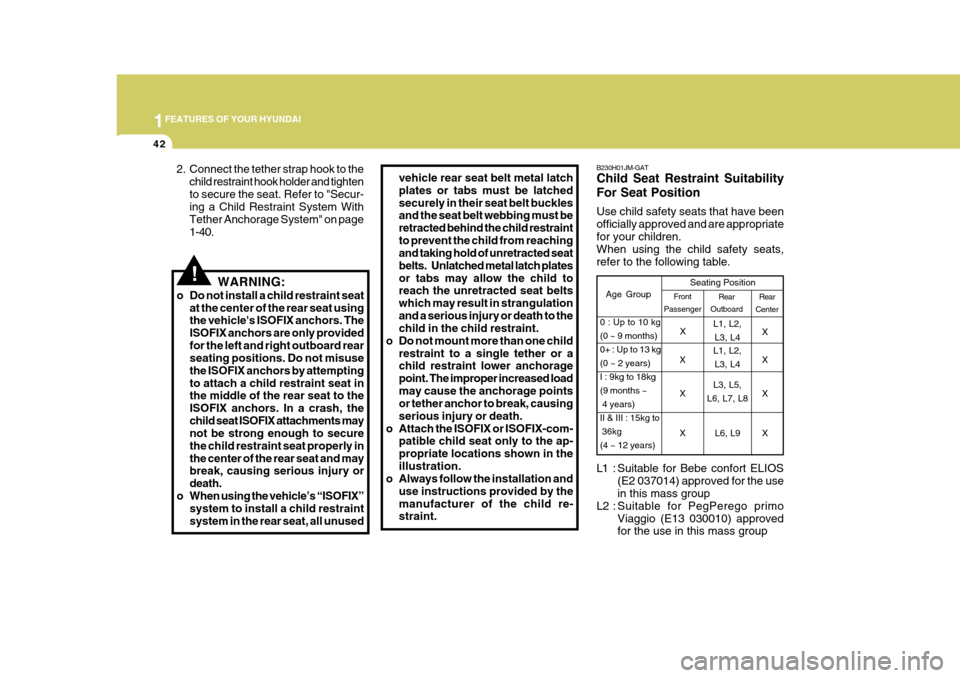
B230H01JM-GAT Child Seat Restraint Suitability For Seat Position Use child safety seats that have been officially approved and are appropriatefor your children. When using the child safety seats, refer to the following table.
Rear
Center
Age Group Seating Position
L1, L2,
L3, L4 X
XX XX XX Rear
Outboard
Front
Passenger
0 : Up to 10 kg (0 ~ 9 months)0+ : Up to 13 kg(0 ~ 2 years)I : 9kg to 18kg(9 months ~ 4 years)II & III : 15kg to 36kg(4 ~ 12 years) X
L1, L2,
L3, L4
L3, L5,
L6, L7, L8
L6, L9
L1 : Suitable for Bebe confort ELIOS (E2 037014) approved for the use in this mass group
L2 : Suitable for PegPerego primo Viaggio (E13 030010) approvedfor the use in this mass group
vehicle rear seat belt metal latch plates or tabs must be latchedsecurely in their seat belt buckles and the seat belt webbing must be retracted behind the child restraintto prevent the child from reaching and taking hold of unretracted seat
belts. Unlatched metal latch platesor tabs may allow the child to reach the unretracted seat belts which may result in strangulationand a serious injury or death to the child in the child restraint.
o Do not mount more than one child
restraint to a single tether or achild restraint lower anchorage point. The improper increased loadmay cause the anchorage points or tether anchor to break, causing serious injury or death.
o Attach the ISOFIX or ISOFIX-com- patible child seat only to the ap-propriate locations shown in theillustration.
o Always follow the installation and
use instructions provided by themanufacturer of the child re- straint.
!WARNING:
o Do not install a child restraint seat at the center of the rear seat using the vehicle's ISOFIX anchors. The ISOFIX anchors are only providedfor the left and right outboard rear seating positions. Do not misuse the ISOFIX anchors by attemptingto attach a child restraint seat in the middle of the rear seat to the ISOFIX anchors. In a crash, thechild seat ISOFIX attachments may not be strong enough to secure the child restraint seat properly inthe center of the rear seat and may break, causing serious injury or death.
o When using the vehicle’s “ISOFIX” system to install a child restraintsystem in the rear seat, all unused
2. Connect the tether strap hook to the
child restraint hook holder and tightento secure the seat. Refer to "Secur- ing a Child Restraint System With Tether Anchorage System" on page1-40.
Page 71 of 297
1FEATURES OF YOUR HYUNDAI
54
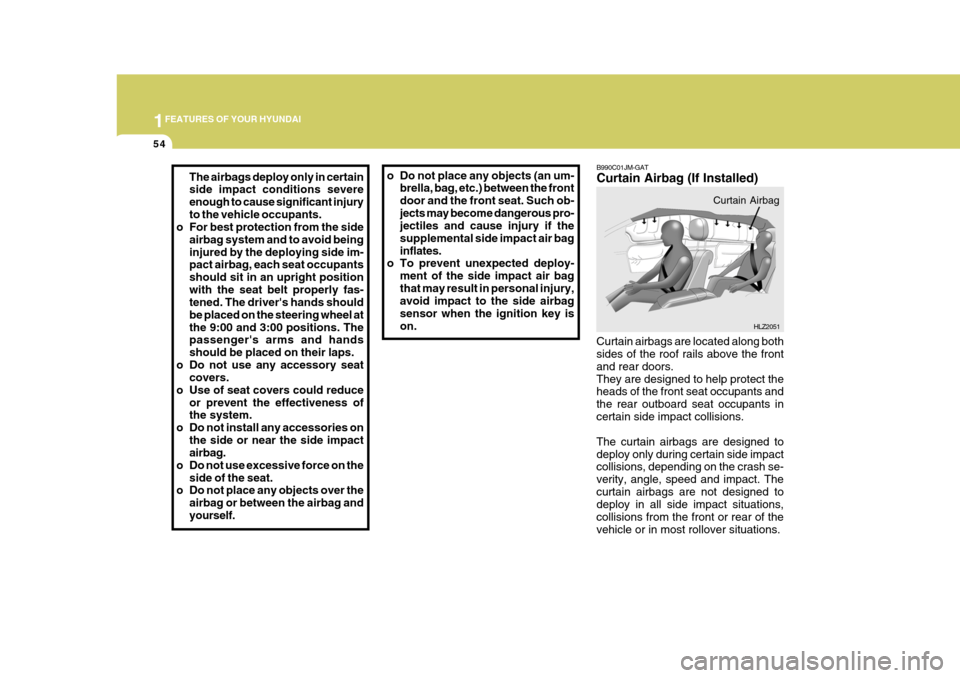
B990C01JM-GAT Curtain Airbag (If Installed)
Curtain airbags are located along both sides of the roof rails above the front and rear doors.They are designed to help protect the heads of the front seat occupants and the rear outboard seat occupants incertain side impact collisions. The curtain airbags are designed to deploy only during certain side impact collisions, depending on the crash se- verity, angle, speed and impact. Thecurtain airbags are not designed to deploy in all side impact situations, collisions from the front or rear of thevehicle or in most rollover situations. HLZ2051
Curtain Airbag
o Do not place any objects (an um-
brella, bag, etc.) between the frontdoor and the front seat. Such ob-jects may become dangerous pro- jectiles and cause injury if the supplemental side impact air baginflates.
o To prevent unexpected deploy-
ment of the side impact air bagthat may result in personal injury, avoid impact to the side airbag sensor when the ignition key ison.The airbags deploy only in certain side impact conditions severe enough to cause significant injuryto the vehicle occupants.
o For best protection from the side
airbag system and to avoid beinginjured by the deploying side im- pact airbag, each seat occupants should sit in an upright positionwith the seat belt properly fas- tened. The driver's hands should be placed on the steering wheel atthe 9:00 and 3:00 positions. The passenger's arms and hands should be placed on their laps.
o Do not use any accessory seat covers.
o Use of seat covers could reduce
or prevent the effectiveness of the system.
o Do not install any accessories on
the side or near the side impactairbag.
o Do not use excessive force on the
side of the seat.
o Do not place any objects over the
airbag or between the airbag and yourself.
Page 72 of 297
1
FEATURES OF YOUR HYUNDAI
55
o The built in coat hooks should
only be used for light weight cloth- ing, ensure that pockets are free of any heavy or sharp objects. When using coat hooks, do not hangclothes on coat hangers.
o The space between the occupant
and the curtain airbag must neverbe occupied by children, passen- gers or pets. Occupants should never lean out or have any parts oftheir body protruding from the window while the engine is run- ning.
o Do not move the sun visor out to cover the side window if there isan item attached to it such asgarage door remote control, pens, air fresheners or the like. These objects may cause injury if theCurtain Airbag is deployed.
o Where sun blinds are fitted to the
rear doors, these must not ob-struct or impair the airbag in any way. o Do not install any accessories or
children’s toys in the Curtain Airbag deployment zones, as thismay impair the operation of the system or throw parts of them into the vehicle cabin causing injury tooccupants if the system is de- ployed.
o To maintain the integrity of the Curtain Airbag system, any work,removal or installation of the airbag and associated compo-nents (such as roof lining and side trims) should always be performed by an authorized Hyundai dealer.
!WARNING:
o Before installing child restraints , always refer to “Child Restraint System” to ensure correct instal- lation and occupant protection is maximized.
o Make sure that the occupant does not have any body parts (head,arms & legs) protruding outsidethe restraining system. If an inflat- ing airbag was to strike an infant child on the head, it may causeserious injury.
o Ensure the opening for the Cur-
tain Airbag System remains unob-structed at all times, so that the airbags can inflate properly if needed.
Important Safety Notes for Cur- tain Airbag Systems Following is a number of safety points concerning this system which shouldalways be observed to ensure risk of injury is reduced in an accident.
Page 118 of 297
1
FEATURES OF YOUR HYUNDAI
101
!
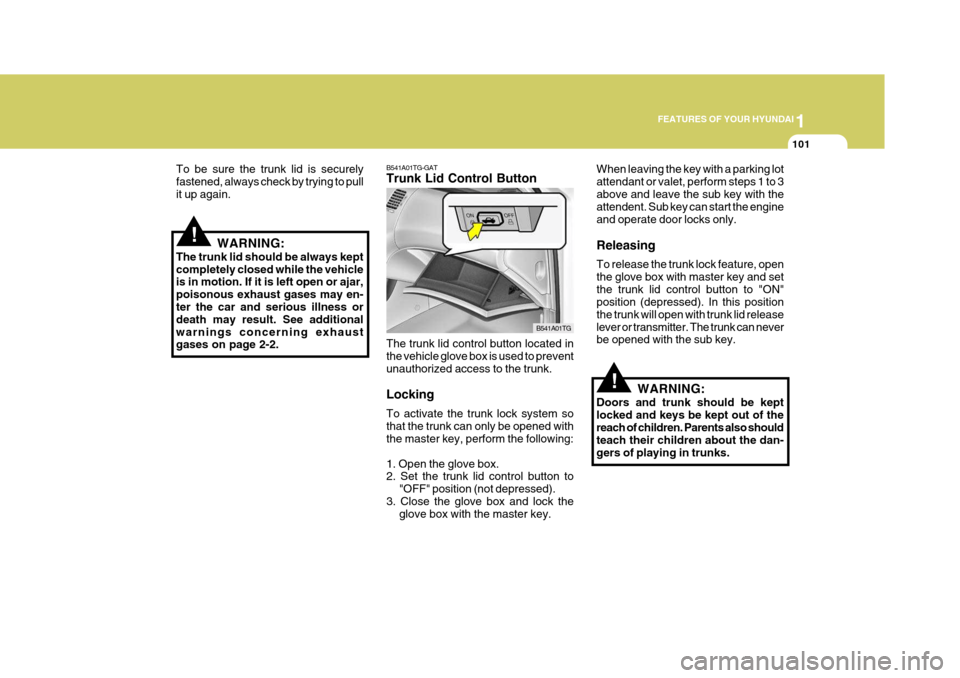
B541A01TG-GAT Trunk Lid Control Button The trunk lid control button located in the vehicle glove box is used to preventunauthorized access to the trunk. Locking To activate the trunk lock system so that the trunk can only be opened with the master key, perform the following: 1. Open the glove box. 2. Set the trunk lid control button to
"OFF" position (not depressed).
3. Close the glove box and lock the glove box with the master key. B541A01TG
When leaving the key with a parking lot attendant or valet, perform steps 1 to 3above and leave the sub key with the attendent. Sub key can start the engine and operate door locks only. Releasing To release the trunk lock feature, open the glove box with master key and setthe trunk lid control button to "ON" position (depressed). In this position the trunk will open with trunk lid releaselever or transmitter. The trunk can never be opened with the sub key.
!WARNING:
The trunk lid should be always kept completely closed while the vehicle is in motion. If it is left open or ajar, poisonous exhaust gases may en-ter the car and serious illness or death may result. See additional warnings concerning exhaust gases on page 2-2. To be sure the trunk lid is securely fastened, always check by trying to pullit up again.
WARNING:
Doors and trunk should be keptlocked and keys be kept out of thereach of children. Parents also should teach their children about the dan- gers of playing in trunks.
Page 121 of 297
1FEATURES OF YOUR HYUNDAI
104
o Automotive fuels are flammable/
explosive materials. When refuel- ing, please note the following guidelines carefully. Failure tofollow these guidelines may re- sult in severe personal injury, se- vere burns or death by fire orexplosion.
- Before refueling always note thelocation of the Emergency Gaso- line Shut-Off, if available, at the gas station facility.
- Before touching the fuel nozzle
or fuel filler cap, you shouldeliminate potentially dangerous static electricity discharge bytouching another metal part of the front of the vehicle, a safe distance away from the fuel fillerneck, nozzle, or other gas source.
- Do not get back into a vehicle
once you have begun refueling.Do not touch, rub or slide against any item or fabric (polyester,satin, nylon, etc.) capable of pro- ducing static electricity. Static electricity discharge can ignitefuel vapors resulting in explo- sion.If you must re-enter the vehicle,
you should once again elimi- nate potentially dangerous static electricity discharge by touch-ing a metal part of the vehicle, away from the fuel filler neck, nozzle or other gasoline source.
- When using a portable fuel con- tainer be sure to place the con-tainer on the ground prior torefueling. Static electricity dis- charge from the container can ignite fuel vapors causing a fire.Once refueling has begun, con- tact with the vehicle should be maintained until the filling iscomplete. Use only portable fuel containers designed to carry and store gasoline.
- Do not use cellular phones around a gas station or whilerefueling any vehicle. Electriccurrent and/or electronic inter- ference from cellular phones can potentially ignite fuel vaporscausing a fire. If you must use your cellular phone use it in a place away from the gas station. - When refueling always shut the
engine off. Sparks produced byelectrical components related tothe engine can ignite fuel va- pors causing a fire. Always in- sure that the engine is OFF be-fore and during refueling. Once refueling is complete, check to make sure the fuel filler cap anddoor are securely closed, before starting the engine.
- Do not light any fire around a gas station. DO NOT use matchesor a lighter and DO NOT SMOKE or leave a lit cigarette in yourvehicle while at a gas station especially during refueling. Automotive fuel is highly flam-mable and can, when ignited, result in explosion by flames.
- If a fire breaks out during refuel- ing, leave the vicinity of the ve-hicle, and immediately contact the manager of the gas stationor contact the police and local fire department. Follow any safety instructions they provide.
Page 125 of 297
1FEATURES OF YOUR HYUNDAI
108
B611A01Y-GAT
B611A01TG
REAR SEAT ARMREST
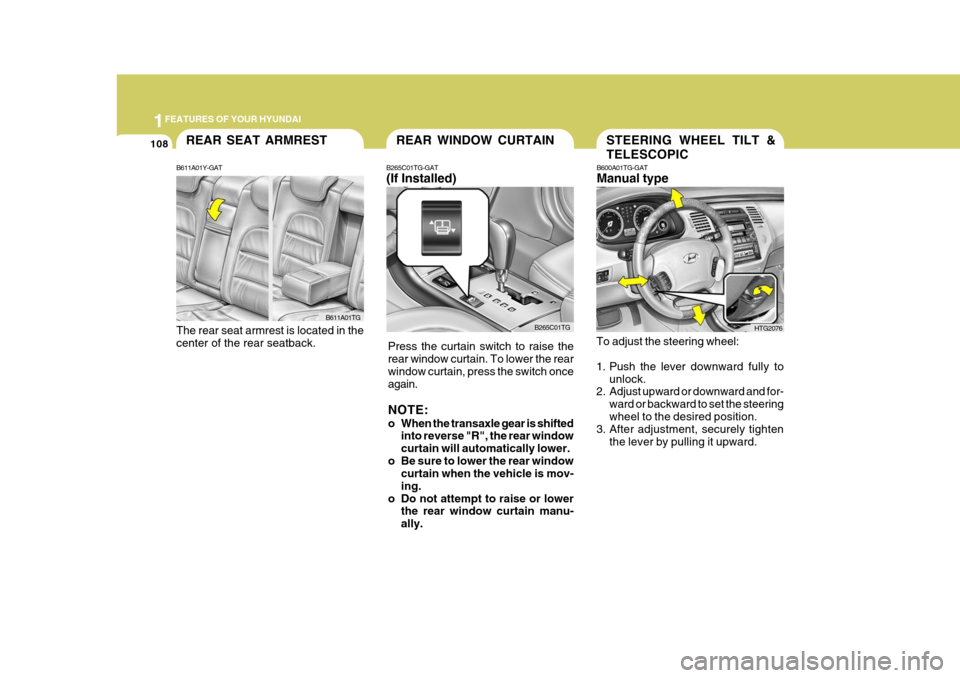
The rear seat armrest is located in the center of the rear seatback.
STEERING WHEEL TILT & TELESCOPIC
B600A01TG-GAT Manual type
To adjust the steering wheel:
1. Push the lever downward fully to
unlock.
2. Adjust upward or downward and for-
ward or backward to set the steering wheel to the desired position.
3. After adjustment, securely tighten
the lever by pulling it upward.
HTG2076
REAR WINDOW CURTAIN
B265C01TG
B265C01TG-GAT (If Installed)
Press the curtain switch to raise the rear window curtain. To lower the rearwindow curtain, press the switch once again. NOTE:
o When the transaxle gear is shifted into reverse "R", the rear window curtain will automatically lower.
o Be sure to lower the rear window curtain when the vehicle is mov-ing.
o Do not attempt to raise or lower the rear window curtain manu-ally.
Page 191 of 297
2
DRIVING YOUR HYUNDAI
7
SKIP
: By rapidly moving the selector
forward or backward twice, it is pos- sible to skip one gear, i.e. 1st to 3rd or 3rd to 1st .
CAUTION:
o In sports mode, the driver must execute upward shifts in accor-dance with prevailing road con- ditions, taking care to keep theengine speed below the red zone.
o For engine protection, upward
shifts are made automatically when the engine rpm reaches the red zone.
o By rapidly moving the selector lever backwards (-) twice it ispossible to skip one gear, i.e.,3rd to 1st, 4th to 2nd or 5th to 3rd. Since sudden engine braking and/or rapid acceleration cancause a loss of traction, how- ever, downshifts must be made carefully in accordance with thevehicle's speed.
!
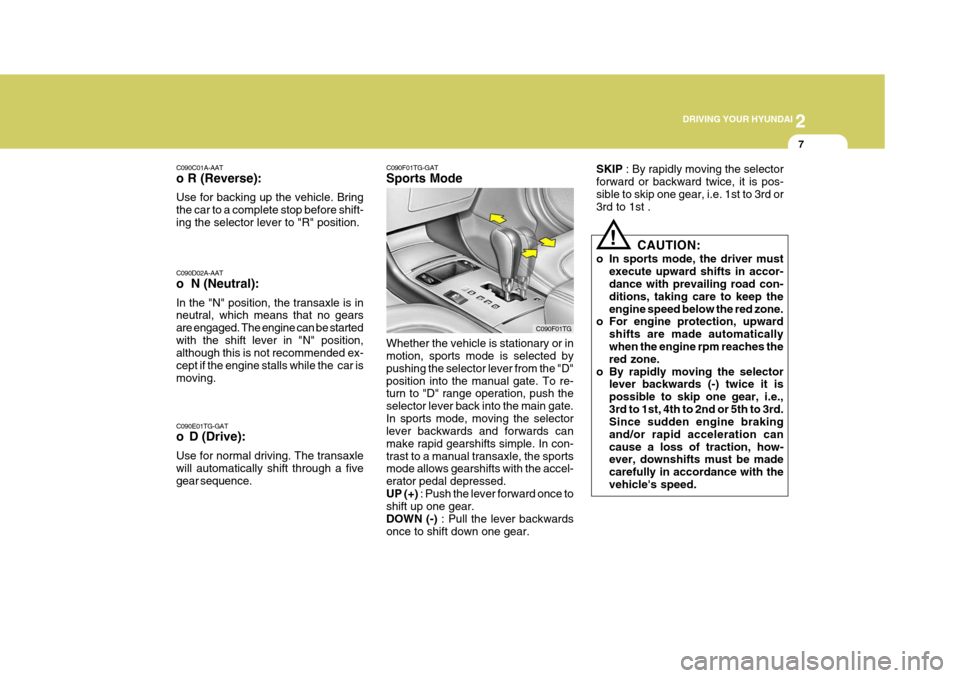
C090F01TG-GAT Sports Mode Whether the vehicle is stationary or in motion, sports mode is selected by pushing the selector lever from the "D"position into the manual gate. To re- turn to "D" range operation, push the selector lever back into the main gate.In sports mode, moving the selector lever backwards and forwards can make rapid gearshifts simple. In con-trast to a manual transaxle, the sports mode allows gearshifts with the accel- erator pedal depressed.UP (+)
: Push the lever forward once to
shift up one gear.DOWN (-) : Pull the lever backwards
once to shift down one gear. C090F01TG
C090D02A-AAT o N (Neutral): In the "N" position, the transaxle is in neutral, which means that no gears are engaged. The engine can be startedwith the shift lever in "N" position, although this is not recommended ex- cept if the engine stalls while the car ismoving. C090E01TG-GAT
o D (Drive): Use for normal driving. The transaxle will automatically shift through a five gear sequence.
C090C01A-AAT o R (Reverse): Use for backing up the vehicle. Bring the car to a complete stop before shift-ing the selector lever to "R" position.
Page 192 of 297

2 DRIVING YOUR HYUNDAI
8
NOTE:
o In sports mode, only the five for-ward gears can be selected. To reverse or park the vehicle, movethe selector lever to the "R" or "P" position as required.
o In sports mode, downward shifts are made automatically when thevehicle slows down. When the vehicle stops, 1st gear is auto-matically selected.
o To maintain the required levels
of vehicle performance andsafety, the system may not ex- ecute certain gearshifts when the selector lever is operated.
o Before driving away from a stop on a slippery road, push the se-lector lever forward into the +(UP)position. This causes the transaxle to shift into 2nd gear which is better for smooth driv-ing away on a slippery road. Push the selector lever to the -(DOWN) side to shift back to 1st gear. C090H01L-GAT NOTE:
o For smooth and safe operation,
depress the brake pedal when shifting from "Neutral" positionor "Park" position to a forward or reverse gear.
o The ignition key must be in the "ON" position and the brake pedalfully depressed in order to move the shift lever from the "P" (Park)position to any of the other posi- tions.
o It is always possible to shift from "R", "N", or "D" position to "P"position. The vehicle must be fully stopped to avoid transaxledamage. C090I03L-GAT
CAUTION:
o Shift into "R" and "P" position only when the vehicle has com-pletely stopped.
o Do not accelerate the engine in reverse or any of the forwardpositions with the brakes applied.
o Always apply the footbrake when shifting from "P" or "N", to "R" or"D"position.
o Do not use the "P" (Park) posi- tion in place of the parking brake.Always set the parking brake,shift the transaxle into "P" (Park) position and turn off the ignition when you leave the vehicle, evenmomentarily. Never leave the ve- hicle unattended while the en- gine is running.
o When accelerating from a stop on a steep hill, the vehicle mayhave a tendency to roll back-wards. Shifting the shift lever into 2nd gear while in Sport mode will help prevent the vehicle fromrolling backwards.
!
Page 203 of 297
2
DRIVING YOUR HYUNDAI
19USE OF LIGHTSTRAILER OR VEHICLE TOWING
C190A01A-GAT If you are considering towing with your car, you should first check with your Province Department of Motor Vehicles to determine their legal requirements.Since laws vary from province to prov- ince the requirements for towing trail- ers, cars, or other types of vehicles orapparatus may differ. Ask your Hyundai dealer for further details before towing.
CAUTION:
Do not do any towing with your carduring its first 2,000 km (1,200 miles) in order to allow the engine to prop-erly break in. Failure to heed this caution may result in serious en- gine or transaxle damage.
!
C180A01A-AAT Check your lights regularly for correct operation and always keep them clean. When driving during the day in condi- tions of poor visibility, it is helpful todrive with headlights on low beam. This enables you to be seen as well as to see.
C190B01S-AAT Trailer Hitches Select the proper hitch and ball combi- nation, making sure that it's location iscompatible with that of the trailer or vehicle being towed. Use a quality non-equalizing hitch whichdistributes the tongue load uniformly throughout the chassis. The hitch should be bolted securely to the car and installed by a qualified technician. DO NOT USE A HITCHDESIGNED FOR TEMPORARY IN- STALLATION AND NEVER USE ONE THAT ATTACHES ONLY TO THEBUMPER. C190C02Y-GAT Trailer Brakes If your trailer is equipped with a braking system, make sure it conforms to fed-eral and/or local regulations and that it is properly installed and operating cor- rectly.
Page 206 of 297

2 DRIVING YOUR HYUNDAI
22
C190F01A-GAT Trailer or Vehicle Towing Tips
1. Before towing, check hitch andsafety chain connections as well as proper operation of the trailer run- ning lights, brake lights, and turn signals.
2. Always drive your vehicle at a mod- erate speed (Less than 100 km/h).
3. Trailer towing requires more fuel than normal conditions.
4. To maintain engine braking effi-
ciency and electrical charging per-formance, do not use fifth gear (manual transaxle) or overdrive (au- tomatic transaxle).
5. Always secure items in the trailer to prevent load shift while driving.
6. Check the condition and air pres- sure of all tires on the trailer and your car. Low tire pressure can se- riously affect the handling. Alsocheck the spare tire.
7. The vehicle/trailer combination is
more affected by crosswind andbuffeting. When being passed by a large vehicle, keep a constant speed and steer straight ahead. If there istoo much wind buffeting, slow down to get out of the other vehicle's air turbulence. 8. When parking your car and trailer,
especially on a hill, be sure to followall the normal precautions. Turn your front wheel into the curb, set the parking brake firmly, and put thetransaxle in 1st or Reverse (manual) or Park (automatic). In addition, place wheel chocks at each of thetrailer's tires.
9. If the trailer has electric brakes,
start your vehicle and trailer mov-ing, and then apply the trailer brake controller by hand to be sure the brakes are working. This lets youcheck your electrical connection at the same time.
10.During your trip, check occasion- ally to be sure that the load issecure, and that the lights and any trailer brakes are still working.
11.Avoid jerky starts, sudden accel- eration or sudden stops.
12.Avoid sharp turns and rapid lane changes.
13.Avoid holding the brake pedal down
too long or too frequently. This couldcause the brakes to overheat, re- sulting in reduced braking efficiency. 14. When going down a hill, shift into a
lower gear and use the engine brak- ing effect. When ascending a long grade, downshift the transaxle to a lower gear and reduce speed toreduce chances of engine over- loading and/or overheating.
15.If you have to stop while going uphill, do not hold the vehicle inplace by pressing on the accelera- tor. This can cause the automatictransaxle to overheat. Use the park- ing brake or foot brake.
NOTE: When towing, check transaxle fluid more frequently.