tow Hyundai Azera 2005 Owner's Manual
[x] Cancel search | Manufacturer: HYUNDAI, Model Year: 2005, Model line: Azera, Model: Hyundai Azera 2005Pages: 297, PDF Size: 13.2 MB
Page 1 of 297

NAME: STREET:TOWN: COUNTRY: P.CODE: NAME: STREET: TOWN:COUNTRY: P.CODE:
A000A01A-GAT This Owner's Manual should be considered a part of the car and remain with it when it is sold for the use of the next owner.OWNER'S I.D.
ORIGINAL: ADDRESS: DATE OF SALE: SUBSEQUENT: ADDRESS: TRANSFER DATE:
Page 20 of 297
1
FEATURES OF YOUR HYUNDAI
3BREAKING IN YOUR NEW HYUNDAI
B010E01A-AAT Gasolines for Cleaner Air To help contribute to cleaner air, Hyundai recommends that you usegasolines treated with detergent addi- tives, which help prevent deposit for- mation in the engine. These gasolineswill help the engine run cleaner and the Emission Control System performance. B010F01A-AAT Operation in Foreign Countries If you are going to drive your Hyundai in another country, be sure to:
o Observe all regulations regarding
registration and insurance.
o Determine that acceptable fuel is
available. B020A01S-GAT During the First 2,000 Km (1,200 Miles) No formal "break-in" procedure is re- quired with your new Hyundai. How-ever, you can contribute to the eco- nomical operation and durability of your Hyundai by observing the followingrecommendations during the first 2,000 km (1,200 miles).
o Don't drive faster than 88 km/h (55
mph).
o While driving, keep your engine speed (rpm, or revolutions per minute) between 2,000 rpm and 4,000 rpm.
o Use moderate acceleration. Don't start quickly or depress the accel-erator pedal fully.
o For the first 300 km (200 miles), try to avoid hard stops.
o Don't lug the engine (in other words, don't drive so slowly in too high a gear that the engine "bucks":shift to a lower gear). o Whether going fast or slow, vary your
speed from time to time.
o Don't let the engine idle longer than 3 minutes for a catalytic converterequipped engine.
o Don't tow a trailer during the first 2,000 km (1,200 miles) of opera-tion.
Page 26 of 297
1
FEATURES OF YOUR HYUNDAI
9
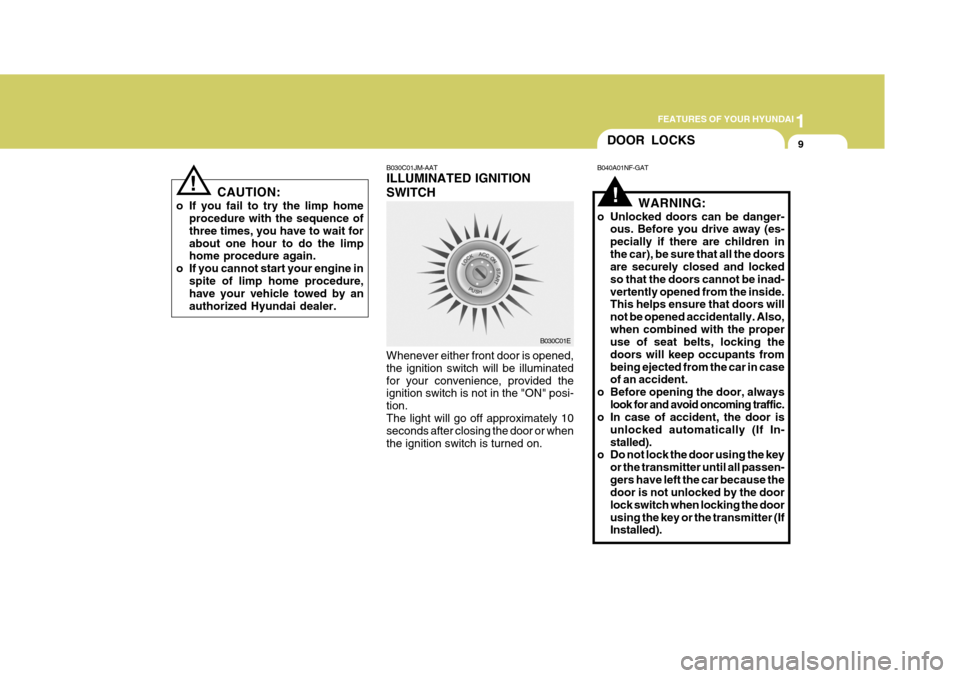
B030C01JM-AAT ILLUMINATED IGNITION SWITCH Whenever either front door is opened, the ignition switch will be illuminatedfor your convenience, provided the ignition switch is not in the "ON" posi- tion.The light will go off approximately 10 seconds after closing the door or when the ignition switch is turned on. B030C01E
CAUTION:
o If you fail to try the limp home procedure with the sequence ofthree times, you have to wait forabout one hour to do the limp home procedure again.
o If you cannot start your engine in
spite of limp home procedure,have your vehicle towed by an authorized Hyundai dealer.
!!
DOOR LOCKS
B040A01NF-GAT
WARNING:
o Unlocked doors can be danger- ous. Before you drive away (es- pecially if there are children inthe car), be sure that all the doors are securely closed and locked so that the doors cannot be inad-vertently opened from the inside. This helps ensure that doors will not be opened accidentally. Also,when combined with the proper use of seat belts, locking the doors will keep occupants frombeing ejected from the car in case of an accident.
o Before opening the door, always
look for and avoid oncoming traffic.
o In case of accident, the door is
unlocked automatically (If In- stalled).
o Do not lock the door using the key
or the transmitter until all passen-gers have left the car because the door is not unlocked by the door lock switch when locking the doorusing the key or the transmitter (If Installed).
Page 27 of 297
1FEATURES OF YOUR HYUNDAI
10
!
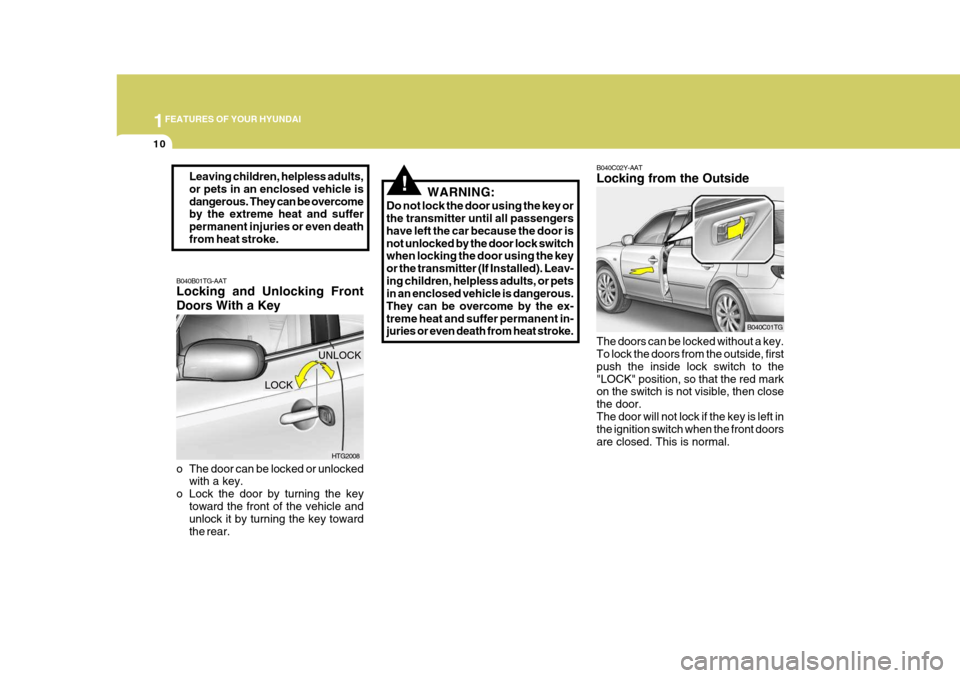
B040B01TG-AAT Locking and Unlocking Front Doors With a Key
o The door can be locked or unlocked
with a key.
o Lock the door by turning the key toward the front of the vehicle and unlock it by turning the key toward the rear. B040C02Y-AAT Locking from the Outside The doors can be locked without a key. To lock the doors from the outside, first push the inside lock switch to the"LOCK" position, so that the red mark on the switch is not visible, then close the door.The door will not lock if the key is left in the ignition switch when the front doors are closed. This is normal.
HTG2008 B040C01TG
LOCK UNLOCK
Leaving children, helpless adults,or pets in an enclosed vehicle isdangerous. They can be overcome by the extreme heat and suffer permanent injuries or even deathfrom heat stroke.
WARNING:
Do not lock the door using the key or the transmitter until all passengers have left the car because the door isnot unlocked by the door lock switch when locking the door using the key or the transmitter (If Installed). Leav-ing children, helpless adults, or pets in an enclosed vehicle is dangerous. They can be overcome by the ex-treme heat and suffer permanent in- juries or even death from heat stroke.
Page 36 of 297
1
FEATURES OF YOUR HYUNDAI
19
!WARNING:
o Be careful that someone's head, hands and body are not trapped by a closing window.
o Never try to operate the main switch on the driver's door andthe individual door windowswitch in opposing directions at the same time. If this is done, the window will stop and cannot beopened or closed.
o Do not leave children alone in the
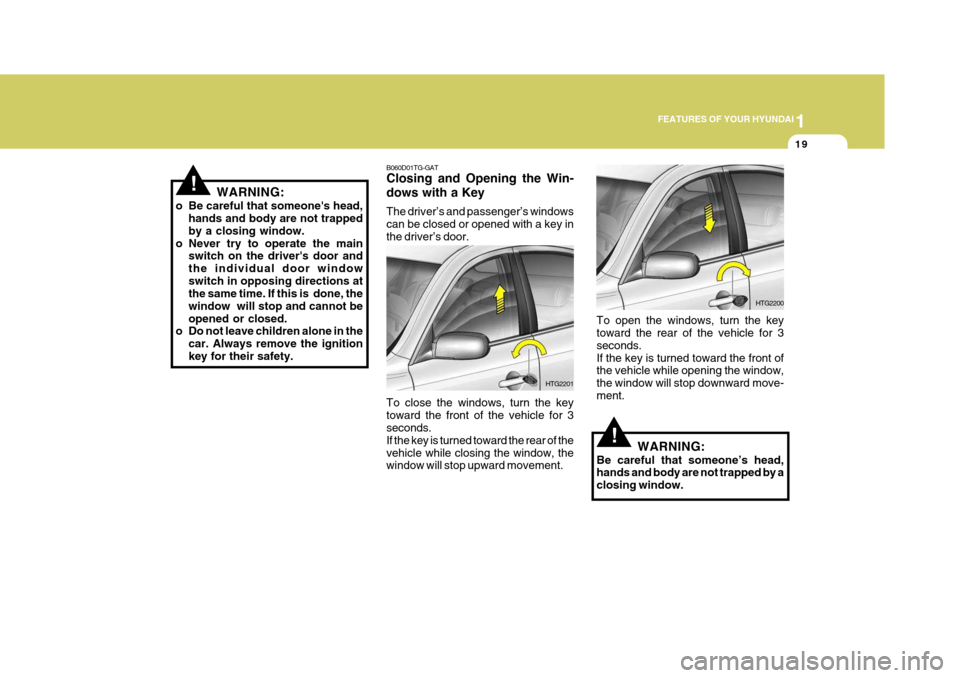
car. Always remove the ignition key for their safety. B060D01TG-GAT Closing and Opening the Win- dows with a Key The driver’s and passenger’s windows can be closed or opened with a key inthe driver’s door.
To close the windows, turn the key toward the front of the vehicle for 3 seconds. If the key is turned toward the rear of thevehicle while closing the window, the window will stop upward movement.
HTG2201
To open the windows, turn the key toward the rear of the vehicle for 3 seconds. If the key is turned toward the front of the vehicle while opening the window, the window will stop downward move-ment.
HTG2200
!WARNING:
Be careful that someone’s head, hands and body are not trapped by a closing window.
Page 38 of 297
1
FEATURES OF YOUR HYUNDAI
21
!
!
SEATS
B080A01A-AAT
ADJUSTABLE FRONT SEATS
WARNING:
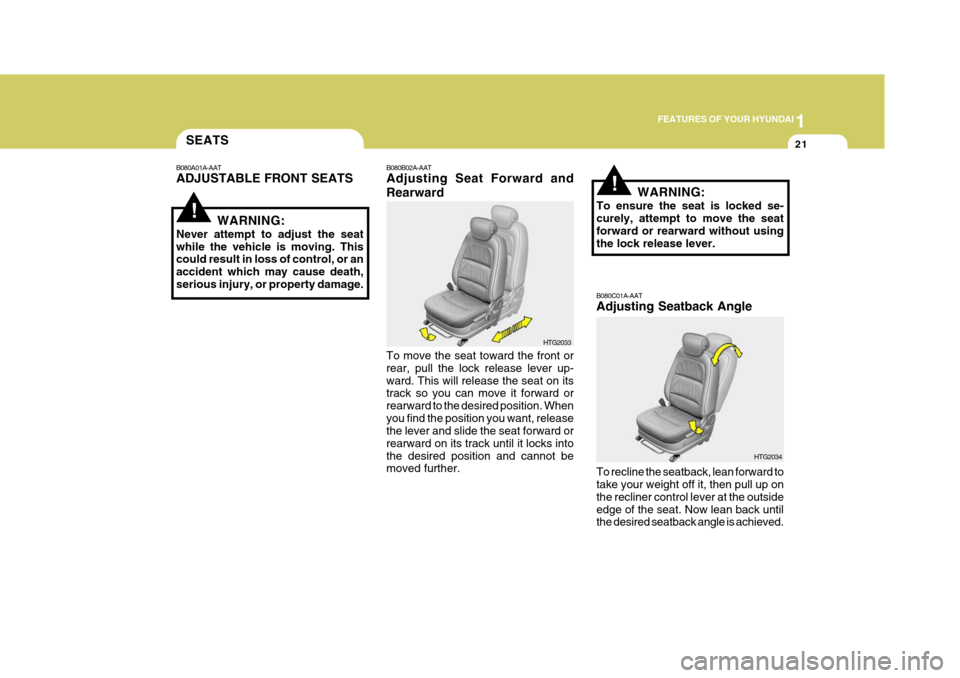
Never attempt to adjust the seat while the vehicle is moving. This could result in loss of control, or an accident which may cause death,serious injury, or property damage. B080B02A-AAT Adjusting Seat Forward and Rearward To move the seat toward the front or rear, pull the lock release lever up-ward. This will release the seat on its track so you can move it forward or rearward to the desired position. Whenyou find the position you want, release the lever and slide the seat forward or rearward on its track until it locks intothe desired position and cannot be moved further.HTG2033
B080C01A-AAT Adjusting Seatback Angle To recline the seatback, lean forward to take your weight off it, then pull up on the recliner control lever at the outsideedge of the seat. Now lean back until the desired seatback angle is achieved.
HTG2034
WARNING:
To ensure the seat is locked se-curely, attempt to move the seat forward or rearward without usingthe lock release lever.
Page 55 of 297
1FEATURES OF YOUR HYUNDAI
38
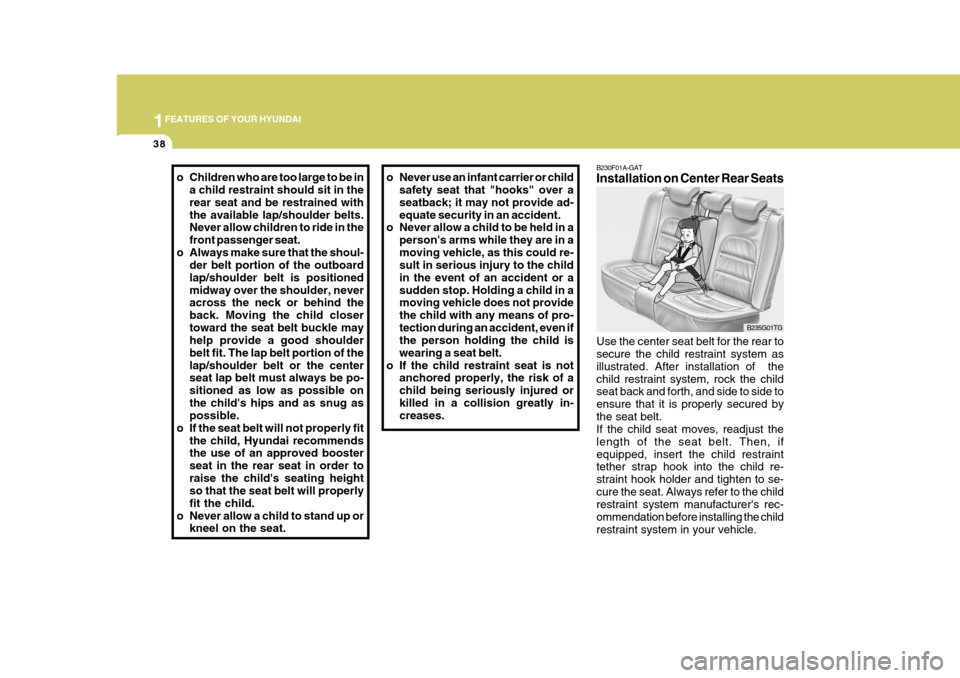
Use the center seat belt for the rear to secure the child restraint system as illustrated. After installation of thechild restraint system, rock the child seat back and forth, and side to side to ensure that it is properly secured bythe seat belt. If the child seat moves, readjust the length of the seat belt. Then, ifequipped, insert the child restraint tether strap hook into the child re- straint hook holder and tighten to se-cure the seat. Always refer to the child restraint system manufacturer's rec- ommendation before installing the childrestraint system in your vehicle.
B235G01TG
B230F01A-GAT Installation on Center Rear Seats
o Never use an infant carrier or child
safety seat that "hooks" over a seatback; it may not provide ad-equate security in an accident.
o Never allow a child to be held in a
person's arms while they are in amoving vehicle, as this could re- sult in serious injury to the child in the event of an accident or asudden stop. Holding a child in a moving vehicle does not provide the child with any means of pro-tection during an accident, even if the person holding the child is wearing a seat belt.
o If the child restraint seat is not anchored properly, the risk of achild being seriously injured orkilled in a collision greatly in- creases.o Children who are too large to be ina child restraint should sit in the rear seat and be restrained withthe available lap/shoulder belts. Never allow children to ride in the front passenger seat.
o Always make sure that the shoul- der belt portion of the outboardlap/shoulder belt is positionedmidway over the shoulder, never across the neck or behind the back. Moving the child closertoward the seat belt buckle may help provide a good shoulder belt fit. The lap belt portion of thelap/shoulder belt or the center seat lap belt must always be po- sitioned as low as possible onthe child's hips and as snug as possible.
o If the seat belt will not properly fit the child, Hyundai recommendsthe use of an approved booster seat in the rear seat in order toraise the child's seating height so that the seat belt will properly fit the child.
o Never allow a child to stand up or kneel on the seat.
Page 56 of 297
1
FEATURES OF YOUR HYUNDAI
39
!
B230G01NF
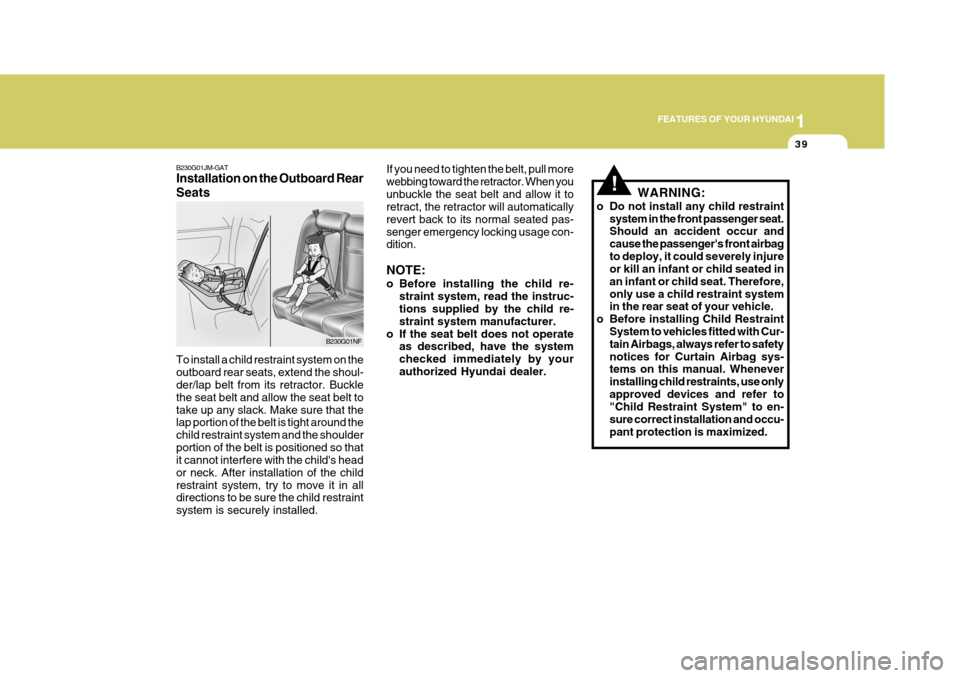
B230G01JM-GAT Installation on the Outboard Rear Seats To install a child restraint system on the outboard rear seats, extend the shoul- der/lap belt from its retractor. Buckle the seat belt and allow the seat belt totake up any slack. Make sure that the lap portion of the belt is tight around the child restraint system and the shoulderportion of the belt is positioned so that it cannot interfere with the child's head or neck. After installation of the childrestraint system, try to move it in all directions to be sure the child restraint system is securely installed.
If you need to tighten the belt, pull more webbing toward the retractor. When youunbuckle the seat belt and allow it to retract, the retractor will automatically revert back to its normal seated pas-senger emergency locking usage con- dition. NOTE:
o Before installing the child re-
straint system, read the instruc- tions supplied by the child re- straint system manufacturer.
o If the seat belt does not operate as described, have the systemchecked immediately by yourauthorized Hyundai dealer. WARNING:
o Do not install any child restraint system in the front passenger seat. Should an accident occur and cause the passenger's front airbagto deploy, it could severely injure or kill an infant or child seated in an infant or child seat. Therefore,only use a child restraint system in the rear seat of your vehicle.
o Before installing Child Restraint
System to vehicles fitted with Cur-tain Airbags, always refer to safety notices for Curtain Airbag sys- tems on this manual. Whenever installing child restraints, use onlyapproved devices and refer to "Child Restraint System" to en- sure correct installation and occu-pant protection is maximized.
Page 74 of 297
1
FEATURES OF YOUR HYUNDAI
57
o Do not tamper with or disconnect
SRS wiring, or other components of the SRS system. Doing so couldresult in injury, due to accidental firing of the airbags or by render- ing the SRS inoperative.
o If components of the airbag sys- tem must be discarded, or if thevehicle must be scrapped, cer-tain safety precautions must be observed. Your Hyundai dealer knows these precautions and cangive you the necessary informa- tion. Failure to follow these pre- cautions and procedures could increase the risk of personal in- jury.
o If you sell your vehicle, make cer- tain that this manual is transferredto the new owner.
o If your car was flooded and has soaked carpeting or water on floor-ing, you shouldn't try to start theengine; have the car towed to an authorized Hyundai dealer.
Page 80 of 297
1
FEATURES OF YOUR HYUNDAI
63
!
Your Hyundai is equipped with dual- diagonal braking systems. This meansyou still have braking on two wheels even if one of the dual systems should fail. With only one of the dual systemsworking, more than normal pedal travel and greater pedal pressure are re- quired to stop the car. Also, the car willnot stop in as short a distance with only half of the brake system working. If the brakes fail while you are driving, shiftto a lower gear for additional engine braking and stop the car as soon as it is safe to do so.
B260H02A-GAT
Parking Brake/Low Brake
Fluid Level Warning Light
WARNING:
If you suspect brake trouble, haveyour brakes checked by a Hyundai dealer as soon as possible. Driving your car with a problem in either thebrake electrical system or brake hydraulic system is dangerous, and could result in a serious injury or death.Warning Light Operation The parking brake/low brake fluid level warning light should come on when theparking brake is applied and the igni- tion switch is turned to "ON" or "START". After the engine is started,the light should go out when the park- ing brake is released. If the parking brake is not applied, thewarning light should come on when the ignition switch is turned to "ON" or "START", then go out when the enginestarts. If the light comes on at any other time, you should slow the vehicle and bring it to a complete stop in a safelocation off the roadway. The brake fluid level warning light indi- cates that the brake fluid level in thebrake master cylinder is low and hy- draulic brake fluid conforming to DOT 3 or DOT 4 specifications should beadded. After adding fluid, if no other trouble is found, the car should be immediately and carefully driven to aHyundai dealer for inspection. If fur- ther trouble is experienced, the vehicle should not be driven at all but taken toa dealer by a professional towing ser- vice or some other safe method.