stop start Hyundai Azera 2005 User Guide
[x] Cancel search | Manufacturer: HYUNDAI, Model Year: 2005, Model line: Azera, Model: Hyundai Azera 2005Pages: 297, PDF Size: 13.2 MB
Page 198 of 297
2 DRIVING YOUR HYUNDAI
14DRIVING FOR ECONOMY
o Don't coast down hills with the car out of gear. This is extremely haz- ardous. Keep the car in gear at all times, use the brakes to slow down, then shift to a lower gear so thatengine braking will help you main- tain a safe speed.
o Don't "ride" the brake pedal. Rest- ing your foot on the brake pedalwhile driving can be dangerous be- cause it can result in the brakesoverheating and losing their effec- tiveness. It also increases the wear of thebrake components.
o If a tire goes flat while you are
driving, apply the brakes gently andkeep the car pointed straight ahead while you slow down. When you are moving slowly enough for it to besafe to do so, pull off the road and stop in a safe place.
o If your car is equipped with an auto- matic transaxle, don't let your carcreep forward. To avoid creeping forward, keep your foot on the brakepedal when the car is stopped.
o Use caution when parking on a hill.
Engage the parking brake and placethe gear selector lever in "P" (auto- matic transaxle) or in first or reversegear (manual transaxle). If your caris facing downhill, turn the front wheels into the curb to help keep the car from rolling. If your car is facinguphill, turn the front wheels away from the curb to help keep the car from rolling. If there is no curb or if itis required by other conditions to keep the car from rolling, block the wheels.
o Under some conditions your park- ing brake can freeze in the engagedposition. This is most likely to hap-pen when there is an accumulation of snow or ice around or near the rear brakes or if the brakes are wet.If there is a risk that the parking brake may freeze, apply it only tem- porarily while you put the gear se-lector lever in "P" (automatic) or in first or reverse gear (manual transaxle) and block the rear wheelsso the car cannot roll. Then release the parking brake.
o Do not hold the vehicle on the up- grade with the accelerator pedal.This can cause the transaxle to overheat. Always use the brakepedal or parking brake. C140A01A-AAT You can save fuel and get more miles from your car if you follow these sug- gestions:
o Drive smoothly. Accelerate at a
moderate rate. Don't make "jack- rabbit" starts or full-throttle shiftsand maintain a steady cruising speed. Don't race between stop- lights. Try to adjust your speed tothat of the other traffic so you don't have to change speeds unneces- sarily. Avoid heavy traffic wheneverpossible. Always maintain a safe distance from other vehicles so you can avoid unnecessary braking. Thisalso reduces brake wear.
o Drive at a moderate speed. The
faster you drive, the more fuel yourcar uses. Driving at a moderate speed, especially on the highway, is one of the most effective ways toreduce fuel consumption.
o Don't "ride" the brake or clutch pedal.
This can increase fuel consumptionand also increase wear on these components. In addition, driving with
Page 206 of 297

2 DRIVING YOUR HYUNDAI
22
C190F01A-GAT Trailer or Vehicle Towing Tips
1. Before towing, check hitch andsafety chain connections as well as proper operation of the trailer run- ning lights, brake lights, and turn signals.
2. Always drive your vehicle at a mod- erate speed (Less than 100 km/h).
3. Trailer towing requires more fuel than normal conditions.
4. To maintain engine braking effi-
ciency and electrical charging per-formance, do not use fifth gear (manual transaxle) or overdrive (au- tomatic transaxle).
5. Always secure items in the trailer to prevent load shift while driving.
6. Check the condition and air pres- sure of all tires on the trailer and your car. Low tire pressure can se- riously affect the handling. Alsocheck the spare tire.
7. The vehicle/trailer combination is
more affected by crosswind andbuffeting. When being passed by a large vehicle, keep a constant speed and steer straight ahead. If there istoo much wind buffeting, slow down to get out of the other vehicle's air turbulence. 8. When parking your car and trailer,
especially on a hill, be sure to followall the normal precautions. Turn your front wheel into the curb, set the parking brake firmly, and put thetransaxle in 1st or Reverse (manual) or Park (automatic). In addition, place wheel chocks at each of thetrailer's tires.
9. If the trailer has electric brakes,
start your vehicle and trailer mov-ing, and then apply the trailer brake controller by hand to be sure the brakes are working. This lets youcheck your electrical connection at the same time.
10.During your trip, check occasion- ally to be sure that the load issecure, and that the lights and any trailer brakes are still working.
11.Avoid jerky starts, sudden accel- eration or sudden stops.
12.Avoid sharp turns and rapid lane changes.
13.Avoid holding the brake pedal down
too long or too frequently. This couldcause the brakes to overheat, re- sulting in reduced braking efficiency. 14. When going down a hill, shift into a
lower gear and use the engine brak- ing effect. When ascending a long grade, downshift the transaxle to a lower gear and reduce speed toreduce chances of engine over- loading and/or overheating.
15.If you have to stop while going uphill, do not hold the vehicle inplace by pressing on the accelera- tor. This can cause the automatictransaxle to overheat. Use the park- ing brake or foot brake.
NOTE: When towing, check transaxle fluid more frequently.
Page 236 of 297

5
VEHICLE MAINTENANCE REQUIREMENTS
9
F070G02A-AAT
o Brake Fluid
Check brake fluid level in the brake fluid reservoir. The level should be between "MIN" and "MAX" marks on the side of the reservoir. Use onlyhydraulic brake fluid conforming to DOT 3 or DOT 4. F070H01TG-AAT
o Rear Disc Brake /
Linings, Parking Brake
Check the rear disc brake and linings for scoring, burning, leaking fluid, bro- ken parts, and excessive wear. In-spect the parking brake system in- cluding the parking brake pedal and cables. For detailed service proce-dures, refer to the Shop Manual. F070J01A-AAT
o Brake Pads, Calipers and
Rotors
Check the pads for excessive wear, discs for run out and wear, and cali-pers for fluid leakage. F070K01A-AAT
o Exhaust Pipe and Muffler
Visually inspect the exhaust pipes,
muffler and hangers for cracks, dete- rioration, or damage. Start the engine and listen carefully for any exhaustgas leakage. Tighten connections or replace parts as necessary.
F070L01A-AAT
o Suspension Mounting Bolts
Check the suspension connections for
looseness or damage. Retighten to thespecified torque.
F070M01Y-AAT
o Steering Gear Box, Linkage &
Boots/Lower Arm Ball Joint, Upper Arm Ball Joint
With the vehicle stopped and engine
off, check for excessive free-play in the steering wheel.
Check the linkage for bends or dam-
age. Check the dust boots and ball joints for deterioration, cracks, or dam-age. Replace any damaged parts. F070N01A-AAT
o Power Steering Pump,
Belt and Hoses
Check the power steering pump and hoses for leakage and damage. Re- place any damaged or leaking parts immediately. Inspect the power steer-ing belt for evidence of cuts, cracks, excessive wear, oiliness and proper tension. Replace or adjust it if neces-sary. F070P01A-AAT o Drive Shafts and Boots Check the drive shafts, boots and clamps for cracks, deterioration, ordamage. Replace any damaged parts and, if necessary, repack the grease. F070Q01A-AAT
o Air Conditioning Refrigerant Check the air conditioning lines and connections for leakage and damage. Check air conditioning performanceaccording to the relevant shop manual if necessary.
Page 262 of 297
6 DO-IT-YOURSELF MAINTENANCE
26HEADLIGHT AIMING ADJUSTMENT
G290A01TG-GAT
G290A01NF
Before performing aiming adjustment, make sure of the following.
1. Keep all tires inflated to the correct pressure.
2. Place the vehicle on level ground and press the front bumper & rear bumper down several times. Place vehicle at a distance of 3m (118 in.) from the test wall.
3. See that the vehicle is unloaded (except for full levels of coolant,engine oil and fuel, and spare tire,jack, and tools). Have the driver or equivalent weight placed in driver's seat.
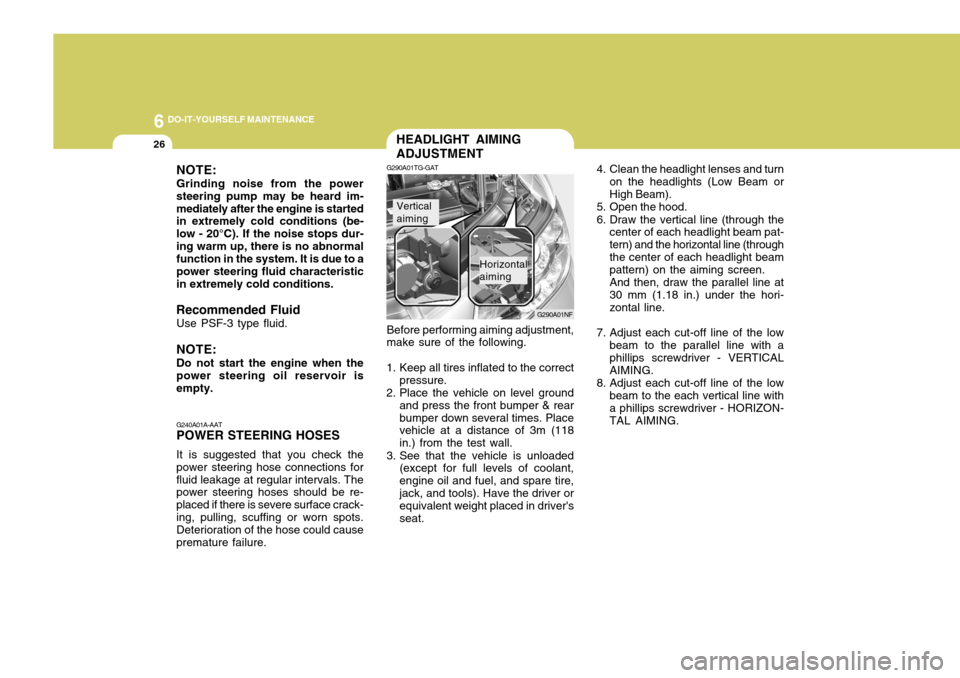
Vertical aiming
Horizontal aiming 4. Clean the headlight lenses and turn
on the headlights (Low Beam or High Beam).
5. Open the hood.
6. Draw the vertical line (through the center of each headlight beam pat- tern) and the horizontal line (throughthe center of each headlight beam pattern) on the aiming screen. And then, draw the parallel line at 30 mm (1.18 in.) under the hori- zontal line.
7. Adjust each cut-off line of the low beam to the parallel line with a phillips screwdriver - VERTICAL AIMING.
8. Adjust each cut-off line of the low beam to the each vertical line with a phillips screwdriver - HORIZON-TAL AIMING.
NOTE: Grinding noise from the power steering pump may be heard im-mediately after the engine is started in extremely cold conditions (be- low - 20°C). If the noise stops dur-ing warm up, there is no abnormal function in the system. It is due to a power steering fluid characteristicin extremely cold conditions.
Recommended Fluid Use PSF-3 type fluid. NOTE: Do not start the engine when the power steering oil reservoir is empty. G240A01A-AAT POWER STEERING HOSES It is suggested that you check the power steering hose connections forfluid leakage at regular intervals. The power steering hoses should be re- placed if there is severe surface crack-ing, pulling, scuffing or worn spots. Deterioration of the hose could cause premature failure.
Page 274 of 297

6 DO-IT-YOURSELF MAINTENANCE
38
1 2 3 4 5 6 7 8 9 10 11 12 13 14 15 16 17 18 19 20 21 22 23 24
HORNTAIL
ECU IG1
DRL
FR FOG
A/CON
F/PUMP
DIODE ATM
STOP
H/LP LO RH
S/ROOF
H/LP WASHER
H/LP HI
ECU (B+)
SNSR3 SNSR1 SNSR2B/UP
IGN COIL
ECU (IG1)
H/LP LO ABS PROTECTED COMPONENTS
ABS/ESP Control module, Multipurpose check connectorABS/ESP Control module, Multipurpose check connector Fuse(FR P/SEAT, T/LID, T/SIG, TILT, PEDAL, RR CURTAIN) Defogger relay Blower relay Fuse(P/WDW LH, P/WDW RH) Start relay, Ignition switch(IG2, START) Engine control unit relay Fuse(KEY SOL, ECS/RR FOG), Power connector Ignition switch(ACC, IG1) Fusible link(ABS1, ABS2, RR HTD, BLOWER) Horn relay Tail light relay PCM (Spare) Burglar alarm horn relay Front fog light relay A/C Relay Fuel pump relay (Spare) ATM Control relay Stop light switch HID Relay Overhead console lamp Headlight washer motor Headlight relay (HIGH) PCM Injector#1~#6, A/C Relay, Cooling fan relay Mass air flow sensor, PCM, Immobilizer control module, Oil control valve#1/#2, Variable intake manifold valve Oxygen Sensor#1~#4 Back-up light switch, Stop light switch, Transaxle range switch, Vehicle speed sensor Ignition coil#1~#6, Condenser PCM Headlight relay(LOW) ABS/ESP Control module, Multipurpose check connector
ABS1 ABS2
I/P (B+)1
RR HTD
BLOWER
P/WDW IGN2
ECU RLY I/P (B+)2
IGN1ALT FUSE RATING
40A20A 40A 40A 40A 40A 40A 30A 30A 30A
150A
15A 20A 10A 10A 15A 15A 10A 20A
-
20A 15A 15A 15A 20A 20A 10A 10A 15A 15A 10A 20A 10A 20A 10ADESCRIPTION
FUSIBLE LINK
FUSE
Page 295 of 297

10INDEX
4
G General Checks ........................................................... 6-3
Glove Box ................................................................. 1-95
HHazard Warning System ............................................ 1-83
Headlight
Aiming adjustment .................................................. 6-26
Leveling device system .......................................... 1-82
Bulb replacement .................................................... 6-28
Switch ..................................................................... 1-77
Washer switch ........................................................ 1-82
Heating and Cooling Control ....................................1-113
Heating and Ventilation ............................................ 1-114
Air flow control ........................................... 1-115, 1-128
Air intake control switch ............................ 1-117, 1-126
Air quality control system ..................................... 1-126
Bi-level heating ..................................................... 1-118
Defrosting/Defogging .................................. 1-119, 1-130
Fan speed control (Blower control) ............ 1-115, 1-125
Temperature control ................................... 1-115, 1-127
High-Mounted Rear Stop Light .................................1-103
Hood Release .......................................................... 1-105
Horn ......................................................................... 1-107
I Ignition Switch ............................................................. 2-3
Immobilizer System ..................................................... 1-5
Limp home procedures ............................................. 1-8
Key ........................................................................... 1-5 Instrument Cluster and
Indicator Lights ..................... 1-58
Instrument Panel Light Control (Rheostat) .................1-85
Intergrated Memory System (I.M.S) ..........................1-26
Interior Light ............................................................... 1-93
Intermittent Wiper ...................................................... 1-82
J Jump Starting .............................................................. 3-3
K
Key .............................................................................. 1-4 If you lose your keys ............................................. 3-13
Positions ................................................................... 2-4
L Light Bulbs Repl acement ........................................... 6-28
Light Bulbs Watages ................................................. 6-36
Lubrication Chart .......................................................... 9-4
M Maintenance Intervals Explanation of scheduled maintenance items ......... 5-7
Maintenance under severe usage conditions .......... 5-6 Scheduled maintenance ........................................... 5-4
Service requirements ................................................ 5-2
Maintenance Precautions ............................................ 6-4
Mirrors
Day/night inside rearview mirror .............................. 1-99
Outside rearview m irror ........................................... 1-96
Outside rearview mirror heater ................................1-98