ESP Hyundai Azera 2005 Owner's Guide
[x] Cancel search | Manufacturer: HYUNDAI, Model Year: 2005, Model line: Azera, Model: Hyundai Azera 2005Pages: 297, PDF Size: 13.2 MB
Page 195 of 297
2
DRIVING YOUR HYUNDAI
11
!
CAUTION:
Driving with varying tire or wheel size may cause the ESP system to malfunction. When replacing tires, make sure they are the same size asyour original tires. WARNING:
Electronic stability program is onlya driving aid; all normal precau- tions for driving in inclement weather and on slippery road sur-faces should be observed.!
ELECTRONIC STABILITY PROGRAM (ESP)
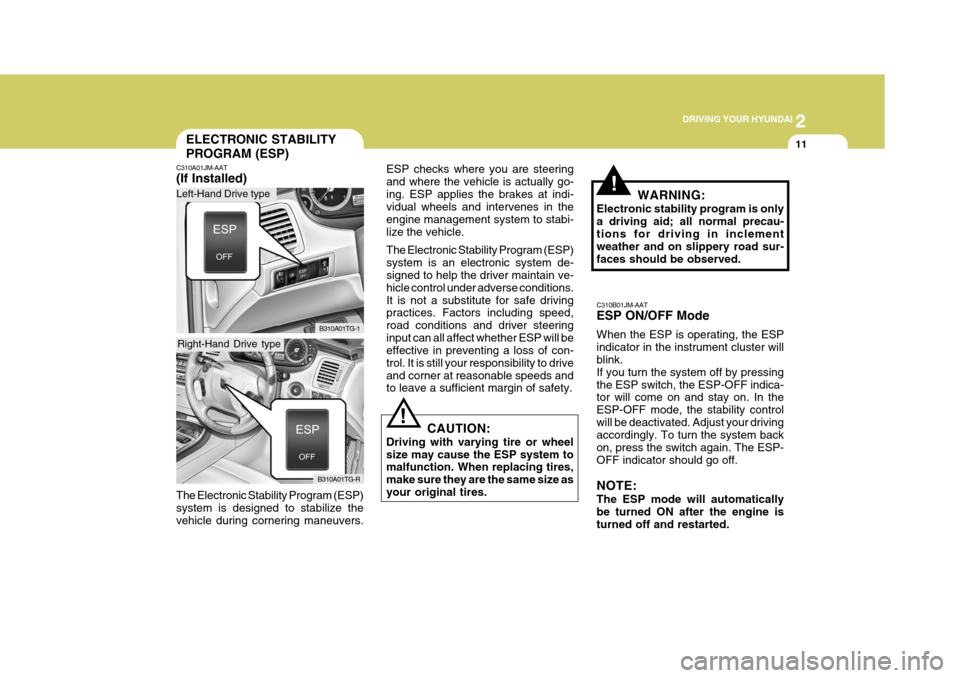
C310A01JM-AAT (If Installed) ESP checks where you are steering and where the vehicle is actually go-ing. ESP applies the brakes at indi- vidual wheels and intervenes in the engine management system to stabi-lize the vehicle. The Electronic Stability Program (ESP) system is an electronic system de- signed to help the driver maintain ve- hicle control under adverse conditions.It is not a substitute for safe driving practices. Factors including speed, road conditions and driver steeringinput can all affect whether ESP will be effective in preventing a loss of con- trol. It is still your responsibility to driveand corner at reasonable speeds and to leave a sufficient margin of safety.
B310A01TG-1
C310B01JM-AAT ESP ON/OFF Mode When the ESP is operating, the ESP indicator in the instrument cluster will blink. If you turn the system off by pressingthe ESP switch, the ESP-OFF indica- tor will come on and stay on. In the ESP-OFF mode, the stability controlwill be deactivated. Adjust your driving accordingly. To turn the system back on, press the switch again. The ESP-OFF indicator should go off. NOTE: The ESP mode will automatically be turned ON after the engine is turned off and restarted.
The Electronic Stability Program (ESP) system is designed to stabilize thevehicle during cornering maneuvers.
B310A01TG-R
Left-Hand Drive type
Right-Hand Drive type
Page 196 of 297
2 DRIVING YOUR HYUNDAI
12
C310D01JM-AAT Indicators and Warning The indicators should illuminate when the ignition key is turned to ON orSTART but should go out after three seconds. If the indicators do not illuminate, orthe ESP or ESP-OFF indicator does not go out after 3 seconds, have the vehicle checked by an authorizeddealer. Should there be any unusual condi- tions in the device while driving, ESP- OFF indicator illuminates as a warn- ing.If ESP-OFF indicator illuminates, pull your car to a safe place and stop the engine.Then, start the engine again to check if the ESP-OFF indicator goes out. If the indicator remains lit even after the engine has been started, have your car checked by an authorizedHyundai dealer.
BACK WARNING SYSTEM
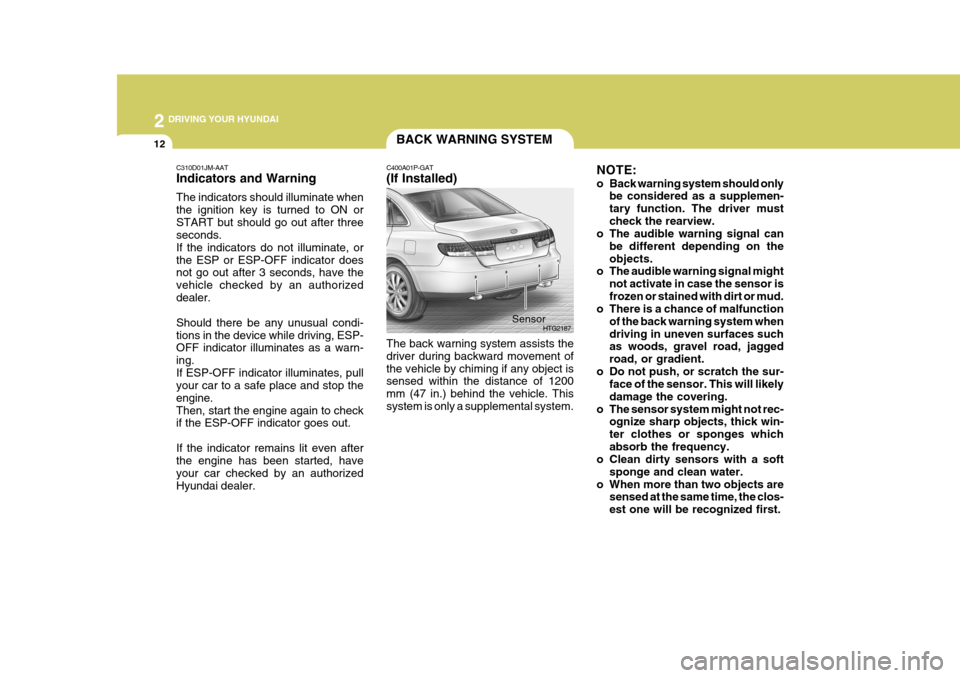
C400A01P-GAT (If Installed) The back warning system assists the driver during backward movement ofthe vehicle by chiming if any object is sensed within the distance of 1200 mm (47 in.) behind the vehicle. Thissystem is only a supplemental system. Sensor
HTG2187 NOTE:
o Back warning system should only
be considered as a supplemen- tary function. The driver mustcheck the rearview.
o The audible warning signal can
be different depending on theobjects.
o The audible warning signal might
not activate in case the sensor isfrozen or stained with dirt or mud.
o There is a chance of malfunction
of the back warning system whendriving in uneven surfaces such as woods, gravel road, jagged road, or gradient.
o Do not push, or scratch the sur- face of the sensor. This will likelydamage the covering.
o The sensor system might not rec- ognize sharp objects, thick win-ter clothes or sponges whichabsorb the frequency.
o Clean dirty sensors with a soft
sponge and clean water.
o When more than two objects are sensed at the same time, the clos-est one will be recognized first.
Page 198 of 297
2 DRIVING YOUR HYUNDAI
14DRIVING FOR ECONOMY
o Don't coast down hills with the car out of gear. This is extremely haz- ardous. Keep the car in gear at all times, use the brakes to slow down, then shift to a lower gear so thatengine braking will help you main- tain a safe speed.
o Don't "ride" the brake pedal. Rest- ing your foot on the brake pedalwhile driving can be dangerous be- cause it can result in the brakesoverheating and losing their effec- tiveness. It also increases the wear of thebrake components.
o If a tire goes flat while you are
driving, apply the brakes gently andkeep the car pointed straight ahead while you slow down. When you are moving slowly enough for it to besafe to do so, pull off the road and stop in a safe place.
o If your car is equipped with an auto- matic transaxle, don't let your carcreep forward. To avoid creeping forward, keep your foot on the brakepedal when the car is stopped.
o Use caution when parking on a hill.
Engage the parking brake and placethe gear selector lever in "P" (auto- matic transaxle) or in first or reversegear (manual transaxle). If your caris facing downhill, turn the front wheels into the curb to help keep the car from rolling. If your car is facinguphill, turn the front wheels away from the curb to help keep the car from rolling. If there is no curb or if itis required by other conditions to keep the car from rolling, block the wheels.
o Under some conditions your park- ing brake can freeze in the engagedposition. This is most likely to hap-pen when there is an accumulation of snow or ice around or near the rear brakes or if the brakes are wet.If there is a risk that the parking brake may freeze, apply it only tem- porarily while you put the gear se-lector lever in "P" (automatic) or in first or reverse gear (manual transaxle) and block the rear wheelsso the car cannot roll. Then release the parking brake.
o Do not hold the vehicle on the up- grade with the accelerator pedal.This can cause the transaxle to overheat. Always use the brakepedal or parking brake. C140A01A-AAT You can save fuel and get more miles from your car if you follow these sug- gestions:
o Drive smoothly. Accelerate at a
moderate rate. Don't make "jack- rabbit" starts or full-throttle shiftsand maintain a steady cruising speed. Don't race between stop- lights. Try to adjust your speed tothat of the other traffic so you don't have to change speeds unneces- sarily. Avoid heavy traffic wheneverpossible. Always maintain a safe distance from other vehicles so you can avoid unnecessary braking. Thisalso reduces brake wear.
o Drive at a moderate speed. The
faster you drive, the more fuel yourcar uses. Driving at a moderate speed, especially on the highway, is one of the most effective ways toreduce fuel consumption.
o Don't "ride" the brake or clutch pedal.
This can increase fuel consumptionand also increase wear on these components. In addition, driving with
Page 199 of 297

2
DRIVING YOUR HYUNDAI
15
o Keep your car clean. For maximum service, your Hyundai should be kept clean and free of corrosive materials. It is especially important that mud, dirt, ice, etc. not be al-lowed to accumulate on the under- side of the car. This extra weight can result in increased fuel con-sumption and also contribute to cor- rosion.
o Travel lightly. Don't carry unneces- sary weight in your car. Weight re-duces fuel economy.
o Don't let the engine idle longer than necessary. If you are waiting (andnot in traffic), turn off your engine and restart only when you're readyto go.
o Remember, your Hyundai does not
require extended warm-up. As soonas the engine is running smoothly, you can drive away. In very cold weather, however, give your enginea slightly longer warm-up period.
your foot resting on the brake pedalmay cause the brakes to overheat,which reduces their effectiveness and may lead to more serious con- sequences.
o Take care of your tires. Keep them inflated to the recommended pres-sure. Incorrect inflation, either toomuch or too little, results in unnec- essary tire wear. Check the tire pres- sures at least once a month.
o Be sure that the wheels are aligned correctly. Improper alignment canresult from hitting curbs or drivingtoo fast over irregular surfaces. Poor alignment causes faster tire wear and may also result in other prob-lems as well as greater fuel con- sumption.
o Keep your car in good condition. For
better fuel economy and reducedmaintenance costs, maintain your car in accordance with the mainte-nance schedule in Section 5. If you drive your car in severe conditions, more frequent maintenance is re-quired (see Section 5 for details). o Don't "lug" or "over-rev" the engine.
Lugging is driving too slowly in too high a gear resulting in the engine bucking. If this happens, shift to alower gear. Over-revving is racing the engine beyond its safe limit. This can be avoided by shifting atthe recommended speeds.
o Use your air conditioning sparingly.
The air conditioning system is oper-ated by engine power so your fuel economy is reduced when you use it.
Page 200 of 297
2 DRIVING YOUR HYUNDAI
16SMOOTH CORNERING
C150A01A-AAT Avoid braking or gear changing in cor- ners, especially when roads are wet. Ideally, corners should always be taken under gentle acceleration. If you followthese suggestions, tire wear will be held to a minimum.WINTER DRIVING
C160A01A-AAT The more severe weather conditions of winter result in greater wear and other problems. To minimize the prob- lems of winter driving, you should fol-low these suggestions: C160B01A-GAT Snowy or Icy Conditions To drive your vehicle in deep snow, it may be necessary to use snow tires orto install tire chains on your tires. If snow tires are needed, it is necessary to select tires equivalent in size and type of the original equipment tires. Failure to do so may adversely affectthe safety and handling of your car. Furthermore, speeding, rapid accel- eration, sudden brake applications, andsharp turns are potentially very haz- ardous practices. During deceleration, use engine brak-ing to the fullest extent. Sudden brake applications on snowy or icy roads may cause skids to occur. You need tokeep sufficient distance between the vehicle in operation in front and your vehicle. Also, apply the brake gently. It should be noted that installing tirechains on the tire will provide a greater driving force, but will not prevent side skids. NOTE: Tire chains are not legal in all prov- inces. Check province laws before fitting tire chains. C160C01A-AAT Use High Quality Ethylene Gly- col Coolant Your Hyundai is delivered with high quality ethylene glycol coolant in the cooling system. It is the only type ofcoolant that should be used because it helps prevent corrosion in the cooling system, lubricates the water pump andprevents freezing. Be sure to replace or replenish your coolant in accor- dance with the maintenance schedulein Section 5. Before winter, have your coolant tested to assure that its freez- ing point is sufficient for the tempera-tures anticipated during the winter.
Page 206 of 297

2 DRIVING YOUR HYUNDAI
22
C190F01A-GAT Trailer or Vehicle Towing Tips
1. Before towing, check hitch andsafety chain connections as well as proper operation of the trailer run- ning lights, brake lights, and turn signals.
2. Always drive your vehicle at a mod- erate speed (Less than 100 km/h).
3. Trailer towing requires more fuel than normal conditions.
4. To maintain engine braking effi-
ciency and electrical charging per-formance, do not use fifth gear (manual transaxle) or overdrive (au- tomatic transaxle).
5. Always secure items in the trailer to prevent load shift while driving.
6. Check the condition and air pres- sure of all tires on the trailer and your car. Low tire pressure can se- riously affect the handling. Alsocheck the spare tire.
7. The vehicle/trailer combination is
more affected by crosswind andbuffeting. When being passed by a large vehicle, keep a constant speed and steer straight ahead. If there istoo much wind buffeting, slow down to get out of the other vehicle's air turbulence. 8. When parking your car and trailer,
especially on a hill, be sure to followall the normal precautions. Turn your front wheel into the curb, set the parking brake firmly, and put thetransaxle in 1st or Reverse (manual) or Park (automatic). In addition, place wheel chocks at each of thetrailer's tires.
9. If the trailer has electric brakes,
start your vehicle and trailer mov-ing, and then apply the trailer brake controller by hand to be sure the brakes are working. This lets youcheck your electrical connection at the same time.
10.During your trip, check occasion- ally to be sure that the load issecure, and that the lights and any trailer brakes are still working.
11.Avoid jerky starts, sudden accel- eration or sudden stops.
12.Avoid sharp turns and rapid lane changes.
13.Avoid holding the brake pedal down
too long or too frequently. This couldcause the brakes to overheat, re- sulting in reduced braking efficiency. 14. When going down a hill, shift into a
lower gear and use the engine brak- ing effect. When ascending a long grade, downshift the transaxle to a lower gear and reduce speed toreduce chances of engine over- loading and/or overheating.
15.If you have to stop while going uphill, do not hold the vehicle inplace by pressing on the accelera- tor. This can cause the automatictransaxle to overheat. Use the park- ing brake or foot brake.
NOTE: When towing, check transaxle fluid more frequently.
Page 229 of 297
5VEHICLE MAINTENANCE REQUIREMENTS
2MAINTENANCE INTERVALS
F010C01A-GAT
Specified Scheduled Procedures
These are the procedures such as
inspections, adjustments and replace- ments that are listed in the mainte-nance charts starting on page 5-4. These procedures must be performed at the intervals shown in the mainte-nance schedule to assure that your warranty remains in effect. Although it is strongly recommended that they beperformed by the factory-trained or distributor-trained technicians at your Hyundai dealer, these procedures maybe performed at any qualified service facility. F010D01A-AAT
General Checks
These are the regular checks youshould perform when you drive your Hyundai or you fill the fuel tank. A listof these items will be found on page 6- 3.
F010A01A-GAT Service Requirements To assure that you receive the great- est number of kilometers of satisfying operation from your Hyundai, certain maintenance procedures must be per-formed. Although careful design and engineering have reduced these to a minimum, those that are required areof the utmost importance.It is your responsibility to have thesemaintenance procedures performed to comply with the terms of the warran- ties covering your new Hyundai. TheService Passport supplied with your new vehicle provides further informa- tion about these warranties.
F010B01A-AAT
Maintenance Requirements
The maintenance required for your
Hyundai can be divided into three main areas: o Specified scheduled procedures o General checks o Do-it-yourself maintenance It is suggested that genuine Hyundai
service parts be used for any requiredrepairs or replacements. Other parts of equivalent quality such as engine oil, engine coolant, manual or autotransaxle oil, brake fluid and so on which are not supplied by Hyundai Motor Company or its distributor maybe used without affecting your war- ranty coverage but you should always be sure these are equivalent to thequality of the original Hyundai parts. Your Service Passport provides fur- ther information about your warrantycoverage.
Page 230 of 297
5
VEHICLE MAINTENANCE REQUIREMENTS
3SCHEDULED MAINTE- NANCE REQUIREMENTS
F010E01A-AAT
Do-It-Yourself Maintenance
If you are mechanically inclined, own a few tools that are required and want to take the time to do so, you can inspect and service a number of items. Formore information about doing it your- self, see Section 6. F010F01A-GAT
A Few Tips
Whenever you have your Hyundai ser- viced, keep copies of the service records in your glove box. This will help ensure that you can documentthat the required procedures have been performed to keep your warranties in effect. This is especially importantwhen service is not performed by an authorized Hyundai dealer. F020A01Y-GAT Inspection should be performed any time a malfunction is experienced or suspected. Receipts for all emissioncontrol system services should be re- tained to demonstrate compliance with conditions of the emissions systemwarranty.For severe usage maintenance require-ments, see page 5-6 of this section.
Page 236 of 297

5
VEHICLE MAINTENANCE REQUIREMENTS
9
F070G02A-AAT
o Brake Fluid
Check brake fluid level in the brake fluid reservoir. The level should be between "MIN" and "MAX" marks on the side of the reservoir. Use onlyhydraulic brake fluid conforming to DOT 3 or DOT 4. F070H01TG-AAT
o Rear Disc Brake /
Linings, Parking Brake
Check the rear disc brake and linings for scoring, burning, leaking fluid, bro- ken parts, and excessive wear. In-spect the parking brake system in- cluding the parking brake pedal and cables. For detailed service proce-dures, refer to the Shop Manual. F070J01A-AAT
o Brake Pads, Calipers and
Rotors
Check the pads for excessive wear, discs for run out and wear, and cali-pers for fluid leakage. F070K01A-AAT
o Exhaust Pipe and Muffler
Visually inspect the exhaust pipes,
muffler and hangers for cracks, dete- rioration, or damage. Start the engine and listen carefully for any exhaustgas leakage. Tighten connections or replace parts as necessary.
F070L01A-AAT
o Suspension Mounting Bolts
Check the suspension connections for
looseness or damage. Retighten to thespecified torque.
F070M01Y-AAT
o Steering Gear Box, Linkage &
Boots/Lower Arm Ball Joint, Upper Arm Ball Joint
With the vehicle stopped and engine
off, check for excessive free-play in the steering wheel.
Check the linkage for bends or dam-
age. Check the dust boots and ball joints for deterioration, cracks, or dam-age. Replace any damaged parts. F070N01A-AAT
o Power Steering Pump,
Belt and Hoses
Check the power steering pump and hoses for leakage and damage. Re- place any damaged or leaking parts immediately. Inspect the power steer-ing belt for evidence of cuts, cracks, excessive wear, oiliness and proper tension. Replace or adjust it if neces-sary. F070P01A-AAT o Drive Shafts and Boots Check the drive shafts, boots and clamps for cracks, deterioration, ordamage. Replace any damaged parts and, if necessary, repack the grease. F070Q01A-AAT
o Air Conditioning Refrigerant Check the air conditioning lines and connections for leakage and damage. Check air conditioning performanceaccording to the relevant shop manual if necessary.
Page 240 of 297
6 DO-IT-YOURSELF MAINTENANCE
4MAINTENANCE PRECAU- TIONS
!
G020D01TG-GAT Improper or incomplete service may result in problems. This section gives instructions only for the maintenanceitems that are easy to perform.Several procedures should be done byan authorized Hyundai dealer. NOTE: Improper owner maintenance dur- ing the warranty period may affectwarranty coverage. WARNING:
o Performing maintenance work on a vehicle can be dangerous. Youcan be seriously injured while performing some maintenance procedures. If you lack sufficientknowledge and experience or the proper tools and equipment to do the work, have it done by anauthorized Hyundai dealer.
o Working under the hood with the engine running is dangerous. It becomes even more dangerous when you wear jewelry or looseclothing. These can become en- tangled in moving parts and re- sult ininjury. Therefore, if youmust run the engine while work- ing under the hood, make certain that you remove all jewelry (espe-cially rings, bracelets, watches, and necklaces) and all neckties, scarves, and similar loose cloth-ing before getting near the en- gine or cooling fans.
CHECKING THE ENGINE OIL
G030A02O-GAT
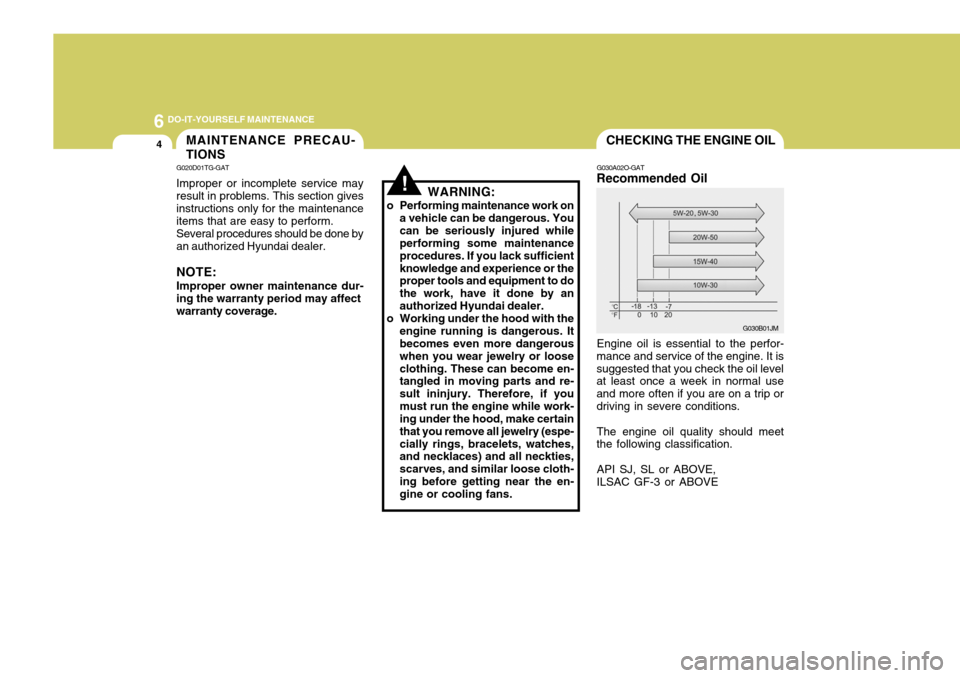
Recommended Oil
Engine oil is essential to the perfor-
mance and service of the engine. It is suggested that you check the oil level at least once a week in normal use and more often if you are on a trip ordriving in severe conditions.
The engine oil quality should meet
the following classification.
API SJ, SL or ABOVE, ILSAC GF-3 or ABOVE G030B01JM