trunk Hyundai Azera 2005 Owner's Guide
[x] Cancel search | Manufacturer: HYUNDAI, Model Year: 2005, Model line: Azera, Model: Hyundai Azera 2005Pages: 297, PDF Size: 13.2 MB
Page 186 of 297
2 DRIVING YOUR HYUNDAI
2
C010A01A-AAT
WARNING: ENGINE EXHAUST CAN BE DANGEROUS!
Engine exhaust fumes can be extremely dangerous. If, at any time, you smell exhaust fumes inside the vehicle, open the windows immediately. o Do not inhale exhaust fumes. Exhaust fumes contain carbon monoxide, a colorless, odorless gas that can cause unconsciousness and death by asphyxiation. o Be sure the exhaust system does not leak. The exhaust system should be checked whenever the vehicle is raised to change the oil or for any other purpose.If you hear a change in the sound of the exhaust or if you drive over something that strikes the underneath side of the car, have the exhaust system checked as soon as possible by your Hyundai dealer. o Do not run the engine in an enclosed area. Letting the engine idle in your garage, even with the garage door open, is a hazardous practice. Never run theengine in your garage any longer than it takes to start the engine and back the car out. o Avoid idling the engine for prolonged periods with people inside the car. If it is necessary to idle the engine for a prolonged period with people inside the car, be sure to do so only in an open area with the air intake set at "Fresh" and fan operating at one of the higher speeds so fresh air is drawn into the interior. If you must drive with the trunk open because you are carrying objects that make this necessary: 1. Close all windows. 2. Open side vents. 3. Set the air intake control at "Fresh", the air flow control at "Floor" or "Face" and the fan at one of the higher speeds.
To assure proper operation of the ventilation system, be sure the ventilation air intakes located just in front ofthe windshield are kept clear of snow, ice, leaves or any other obstructions.
!
Page 205 of 297
2
DRIVING YOUR HYUNDAI
21
!
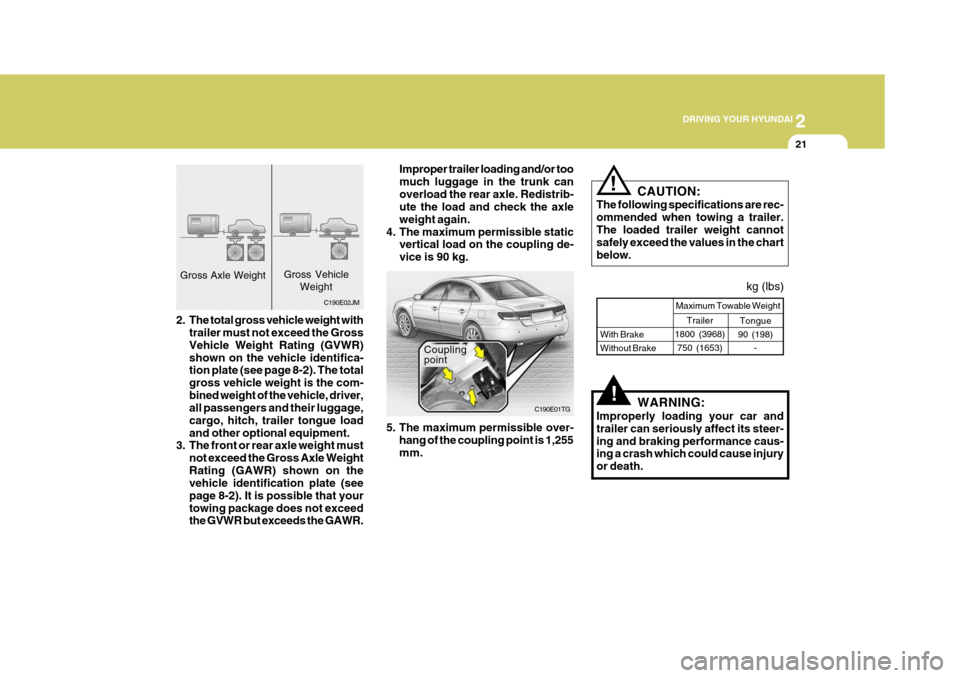
C190E02JM Improper trailer loading and/or too much luggage in the trunk canoverload the rear axle. Redistrib- ute the load and check the axle weight again.
4. The maximum permissible static vertical load on the coupling de-vice is 90 kg.
Gross Axle Weight Gross Vehicle
Weight
2. The total gross vehicle weight with trailer must not exceed the GrossVehicle Weight Rating (GVWR)shown on the vehicle identifica- tion plate (see page 8-2). The total gross vehicle weight is the com-bined weight of the vehicle, driver, all passengers and their luggage, cargo, hitch, trailer tongue loadand other optional equipment.
3. The front or rear axle weight must
not exceed the Gross Axle WeightRating (GAWR) shown on the vehicle identification plate (see page 8-2). It is possible that yourtowing package does not exceed the GVWR but exceeds the GAWR. C190E01TGkg (lbs)
CAUTION:
The following specifications are rec- ommended when towing a trailer.The loaded trailer weight cannot safely exceed the values in the chart below.
!
WARNING:
Improperly loading your car and trailer can seriously affect its steer-ing and braking performance caus- ing a crash which could cause injury or death.
Tongue
90 (198) -
With Brake Without Brake Maximum Towable Weight
Trailer
1800 (3968) 750 (1653)
5. The maximum permissible over- hang of the coupling point is 1,255 mm. Coupling point
Page 212 of 297
3
WHAT TO DO IN AN EMERGENCY
5
6. If you cannot find the cause of the
overheating, wait until the engine temperature has returned to nor- mal. Then, if coolant has been lost, carefully add coolant to the reservoir(Page 6-8) to bring the fluid level in the reservoir up to the halfway mark.
7. Proceed with caution, keeping alert for further signs of overheating. Ifoverheating happens again, call a Hyundai dealer for assistance.
! CAUTION:
Serious loss of coolant indicates there is a leak in the cooling system and this should be checked as soonas possible by a Hyundai dealer.
SPARE TIRE
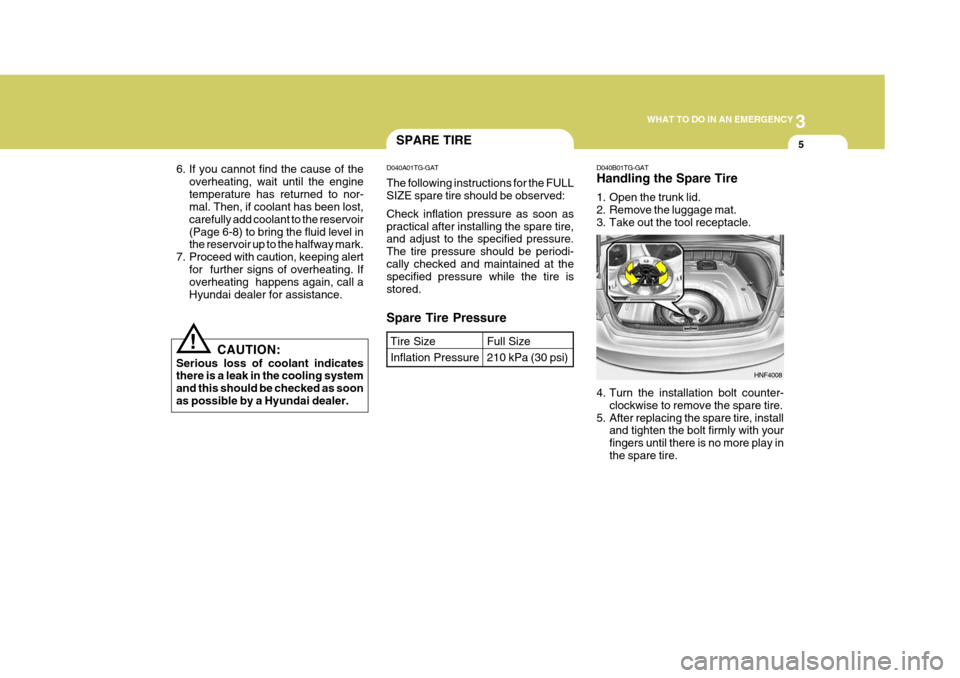
D040B01TG-GAT Handling the Spare Tire
1. Open the trunk lid.
2. Remove the luggage mat.
3. Take out the tool receptacle.
Spare Tire Pressure
D040A01TG-GAT The following instructions for the FULL SIZE spare tire should be observed: Check inflation pressure as soon as practical after installing the spare tire, and adjust to the specified pressure. The tire pressure should be periodi-cally checked and maintained at the specified pressure while the tire is stored.
Tire Size Inflation PressureFull Size 210 kPa (30 psi)
HNF4008
4. Turn the installation bolt counter- clockwise to remove the spare tire.
5. After replacing the spare tire, install and tighten the bolt firmly with your fingers until there is no more play inthe spare tire.
Page 213 of 297
3 WHAT TO DO IN AN EMERGENCY
6CHANGING A FLAT TIREIF YOU HAVE A FLAT TIRE
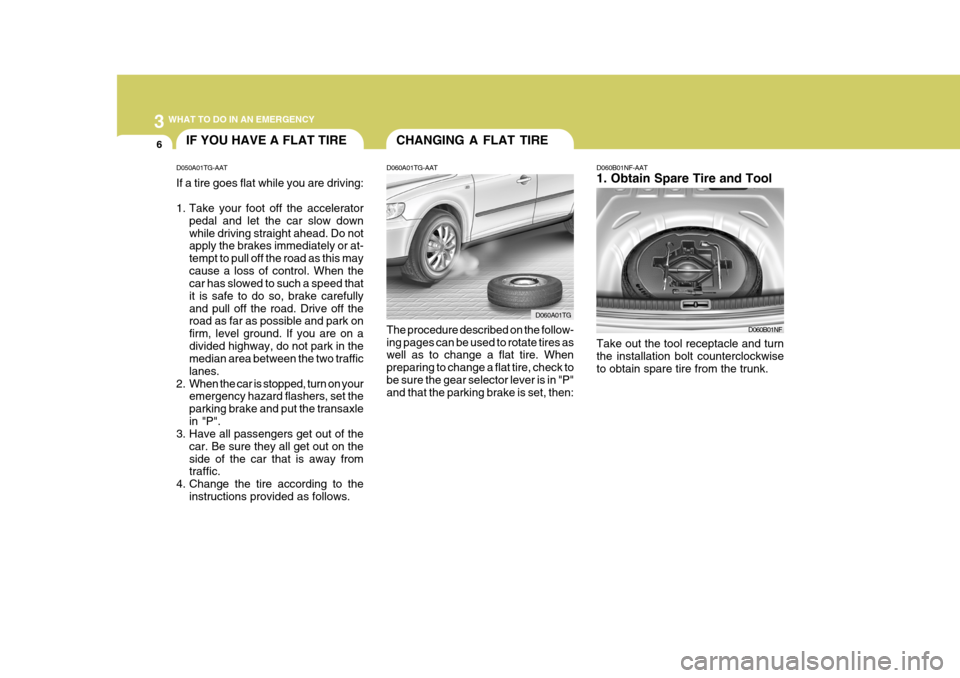
D060A01TG-AAT The procedure described on the follow- ing pages can be used to rotate tires as well as to change a flat tire. When preparing to change a flat tire, check tobe sure the gear selector lever is in "P" and that the parking brake is set, then:
D050A01TG-AAT If a tire goes flat while you are driving:
1. Take your foot off the accelerator
pedal and let the car slow down while driving straight ahead. Do not apply the brakes immediately or at- tempt to pull off the road as this maycause a loss of control. When the car has slowed to such a speed that it is safe to do so, brake carefullyand pull off the road. Drive off the road as far as possible and park on firm, level ground. If you are on adivided highway, do not park in the median area between the two traffic lanes.
2. When the car is stopped, turn on your emergency hazard flashers, set theparking brake and put the transaxlein "P".
3. Have all passengers get out of the
car. Be sure they all get out on theside of the car that is away from traffic.
4. Change the tire according to the instructions provided as follows. D060A01TG
D060B01NF-AAT 1. Obtain Spare Tire and Tool
D060B01NF
Take out the tool receptacle and turn the installation bolt counterclockwiseto obtain spare tire from the trunk.
Page 217 of 297
3 WHAT TO DO IN AN EMERGENCY
10
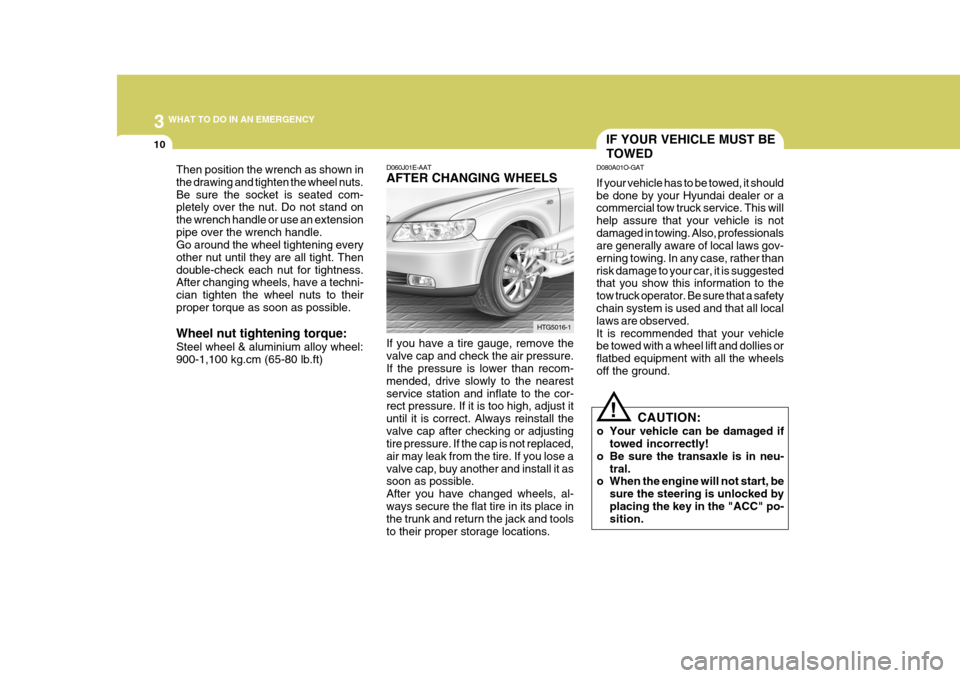
Then position the wrench as shown in the drawing and tighten the wheel nuts.Be sure the socket is seated com- pletely over the nut. Do not stand on the wrench handle or use an extensionpipe over the wrench handle. Go around the wheel tightening every other nut until they are all tight. Thendouble-check each nut for tightness. After changing wheels, have a techni- cian tighten the wheel nuts to theirproper torque as soon as possible. Wheel nut tightening torque: Steel wheel & aluminium alloy wheel: 900-1,100 kg.cm (65-80 lb.ft) D060J01E-AAT AFTER CHANGING WHEELS If you have a tire gauge, remove the valve cap and check the air pressure. If the pressure is lower than recom- mended, drive slowly to the nearestservice station and inflate to the cor- rect pressure. If it is too high, adjust it until it is correct. Always reinstall thevalve cap after checking or adjusting tire pressure. If the cap is not replaced, air may leak from the tire. If you lose avalve cap, buy another and install it as soon as possible. After you have changed wheels, al-ways secure the flat tire in its place in the trunk and return the jack and tools to their proper storage locations.HTG5016-1
IF YOUR VEHICLE MUST BE TOWED
D080A01O-GAT If your vehicle has to be towed, it should be done by your Hyundai dealer or a commercial tow truck service. This will help assure that your vehicle is notdamaged in towing. Also, professionals are generally aware of local laws gov- erning towing. In any case, rather thanrisk damage to your car, it is suggested that you show this information to the tow truck operator. Be sure that a safetychain system is used and that all local laws are observed. It is recommended that your vehicle be towed with a wheel lift and dollies or flatbed equipment with all the wheelsoff the ground.
! CAUTION:
o Your vehicle can be damaged if towed incorrectly!
o Be sure the transaxle is in neu- tral.
o When the engine will not start, be
sure the steering is unlocked by placing the key in the "ACC" po- sition.
Page 267 of 297
6
DO-IT-YOURSELF MAINTENANCE
31
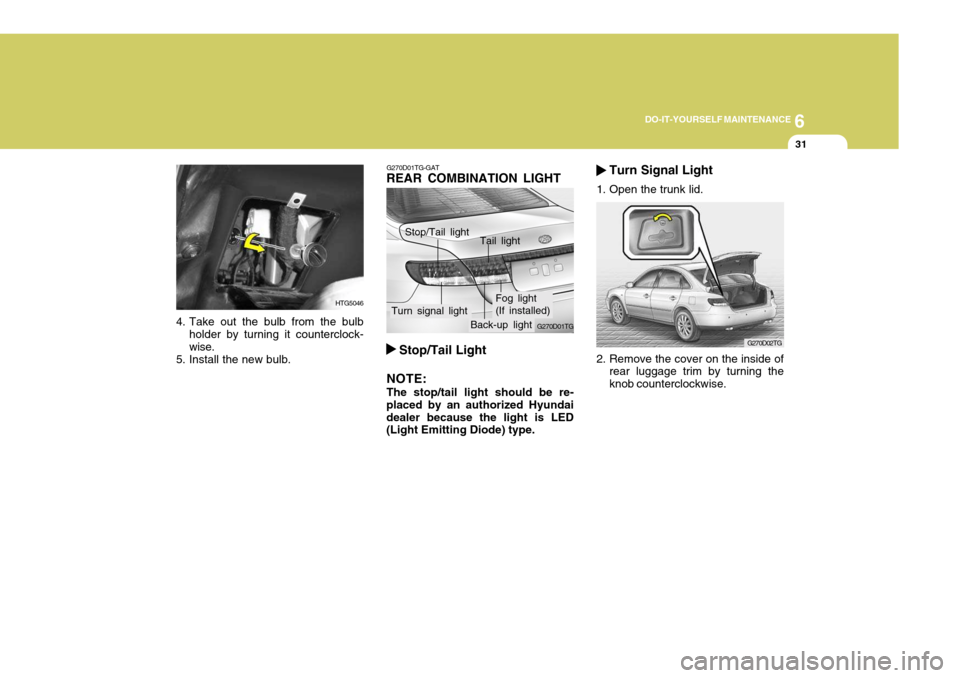
4. Take out the bulb from the bulb
holder by turning it counterclock- wise.
5. Install the new bulb.
HTG5046
G270D01TG-GAT
REAR COMBINATION LIGHT
2. Remove the cover on the inside ofrear luggage trim by turning the knob counterclockwise. G270D02TG
Stop/Tail Light
NOTE: The stop/tail light should be re-
placed by an authorized Hyundai dealer because the light is LED (Light Emitting Diode) type. G270D01TGTurn Signal Light
1. Open the trunk lid.
Stop/Tail light Tail light
Turn signal light Fog light (If installed)
Back-up light
Page 268 of 297
6 DO-IT-YOURSELF MAINTENANCE
32
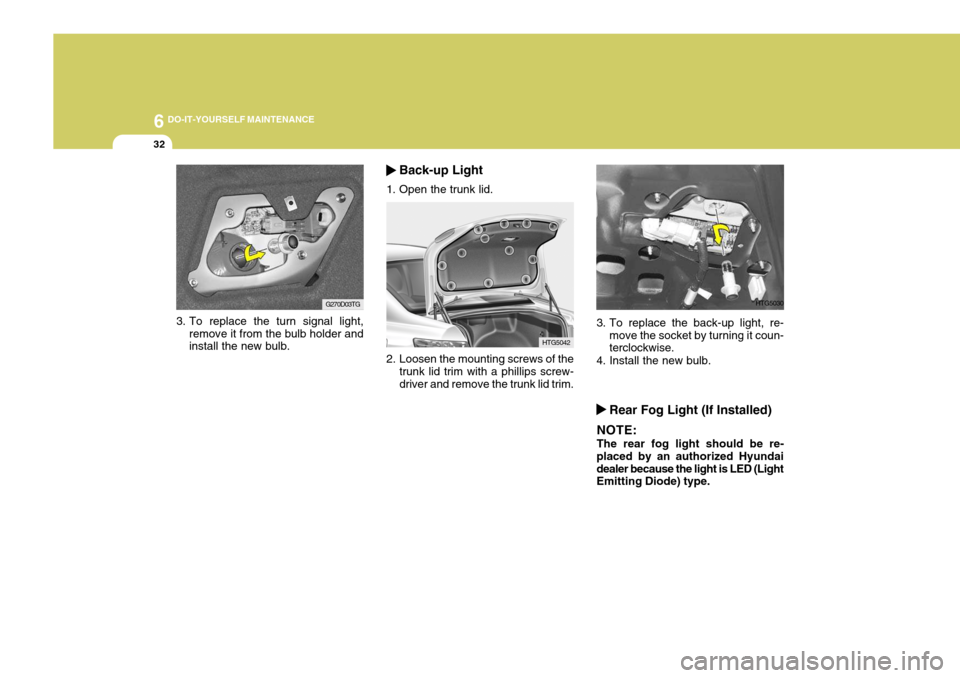
3. To replace the turn signal light,
remove it from the bulb holder and install the new bulb. G270D03TG
HTG5042
2. Loosen the mounting screws of the trunk lid trim with a phillips screw- driver and remove the trunk lid trim.
Back-up Light
1. Open the trunk lid.
3. To replace the back-up light, re- move the socket by turning it coun- terclockwise.
4. Install the new bulb. HTG5030
Rear Fog Light (If Installed)
NOTE: The rear fog light should be re-
placed by an authorized Hyundai dealer because the light is LED (Light Emitting Diode) type.
Page 269 of 297
6
DO-IT-YOURSELF MAINTENANCE
33
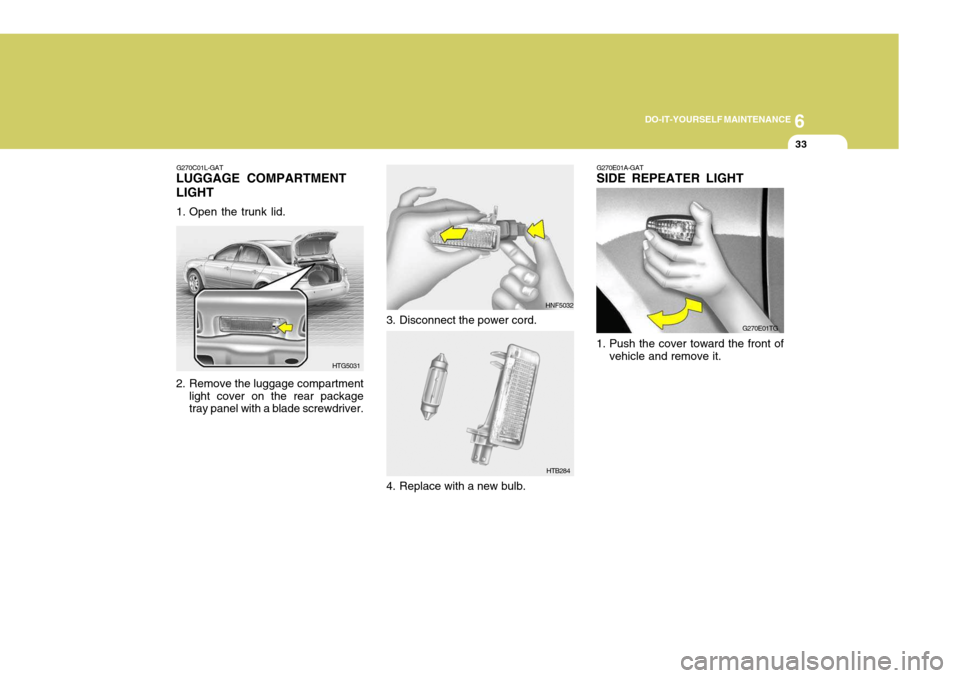
G270E01A-GAT SIDE REPEATER LIGHT
1. Push the cover toward the front of vehicle and remove it. G270E01TGG270C01L-GAT
LUGGAGE COMPARTMENT LIGHT
1. Open the trunk lid.
2. Remove the luggage compartment
light cover on the rear package tray panel with a blade screwdriver. HTG5031 HNF5032
3. Disconnect the power cord.
4. Replace with a new bulb.
HTB284
Page 276 of 297

6 DO-IT-YOURSELF MAINTENANCE
40
PROTECTED COMPONENTS
Fuel lid opener & Trunk lid switch Front lumbar support switch, IMS Control module, Driver/Passenger seat manual switch ATM Key lock control module, Audio, IMS Switch, Accessory relay, Seat/Power outlet relay,
Digital clock & Passenger seat belt IND.
AudioTransaxle range switch, Burglar alarm relay Left front safety window module, Left rear power window switch Right front safety window module, Right rear power window switchRight rear ICM relay boxInstrument cluster, BCM, Rear curtain module, Rain sensor, IMS Control module, Power window main switchBack warning buzzerLeft/Right outside mirror & mirror folding motor, A/C Control module Key solenoid, Power window main switch Rear fog light relayInstrument clusterAir bag cut off switch, SRS Control module(Spare)Tilt & Telescopic module, Sport mode switch Front fog light relay, Left rear combination light, License plate light, Left headlight
FUSE RATING 20A 30A10A 15A 10A 30A30A30A10A15A 10A 20A15A10A15A10A15A 10A 10A
FUSE
T/LID
FR P/SEAT AUDIO-2 AUDIO-1
START
P/WDW LH
P/WDW RH RR P/SEAT MODULE-1
PEDAL ADJ
MIRR HTD KEY SOLRR FOG
A/BAG IND A/BAG
SPARE-2 TILT
TAIL LH
TAIL RHPROTECTED COMPONENTS
Fuel lid opener & Trunk lid switch Front lumbar support switch, IMS Control module, Driver/Passenger seat manual switch ATM Key lock control module, Audio, IMS Switch, Accessory relay, Seat/Power outlet relay,
Digital clock & Passenger seat belt IND.
AudioTransaxle range switch, Burglar alarm relay Left front safety window module, Left rear power window switch Right front safety window module, Right rear power window switchRight rear ICM relay boxInstrument cluster, BCM, Rear curtain module, Rain sensor, IMS Control module, Power window main switchBack warning buzzerLeft/Right outside mirror & mirror folding motor, A/C Control module Key solenoid, Power window main switch Rear fog light relayInstrument clusterAir bag cut off switch, SRS Control module(Spare)Tilt & Telescopic module, Sport mode switch Front fog light relay, Left rear combination light, License plate light, Left headlight Right rear combination light, License plate light, Right headlight
Page 297 of 297

10INDEX
6
TransaxleAutoma tic ................................................................. 2-5
Automatic transaxle fluid checking ......................... 6-14
Trip Computer ............................................................ 1-73
Trunk Lid ................................................................. 1-100
Trunk lid control button ......................................... 1-101
V Vehicle Identification Number (VIN) ............................. 8-2
Vehicle Specifica tions ................................................. 9-1
WWarning and Indicator Lights ..................................... 1-62
Window Defroster Switch .... .......................................1-84
Windows
Power ..................................................................... 1-17
Windshield Wiper and Washer ...................................1-80
Windshield Wiper Blades .... .......................................6-11