radiator Hyundai Azera 2006 Owner's Manual
[x] Cancel search | Manufacturer: HYUNDAI, Model Year: 2006, Model line: Azera, Model: Hyundai Azera 2006Pages: 307, PDF Size: 12.62 MB
Page 88 of 307
1FEATURES OF YOUR HYUNDAI74
B270A01O-AATBRAKE PAD WEAR WARNING
SOUNDThe front and rear disc brake pads have
wear indicators that should make a high-
pitched squealing or scraping noise when
new pads are needed. The sound may
come and go or be heard all the time when
the vehicle is moving. It may also be heard
when the brake pedal is pushed down
firmly. Excessive rotor damage will result
if the worn pads are not replaced. See your
Hyundai dealer immediately.
!
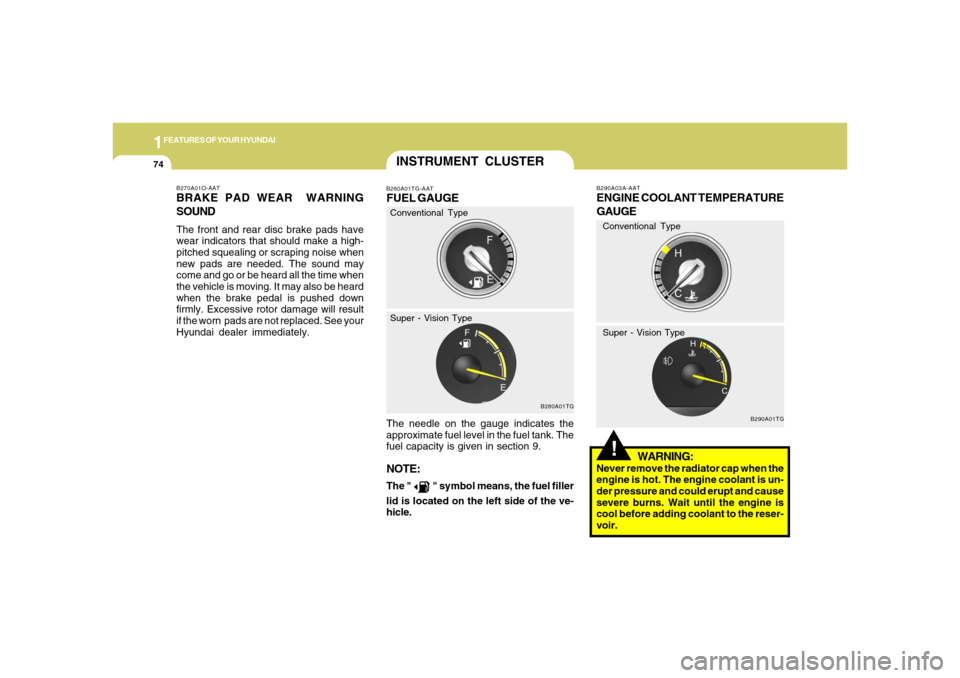
B290A03A-AATENGINE COOLANT TEMPERATURE
GAUGE
WARNING:Never remove the radiator cap when the
engine is hot. The engine coolant is un-
der pressure and could erupt and cause
severe burns. Wait until the engine is
cool before adding coolant to the reser-
voir.
INSTRUMENT CLUSTERB280A01TG-AATFUEL GAUGEThe needle on the gauge indicates the
approximate fuel level in the fuel tank. The
fuel capacity is given in section 9.NOTE:The "
" symbol means, the fuel filler
lid is located on the left side of the ve-
hicle.
B280A01TG
Conventional Type
Super - Vision Type
B290A01TG
Conventional Type
Super - Vision Type
Page 112 of 307
1FEATURES OF YOUR HYUNDAI98
CAUTION:
If the mirror is jammed with ice, do not
adjust the mirror by force. Use an ap-
proved spray de-icer (not radiator anti-
freeze) to release the frozen mecha-
nism or move the vehicle to a warm
place and allow the ice to melt.
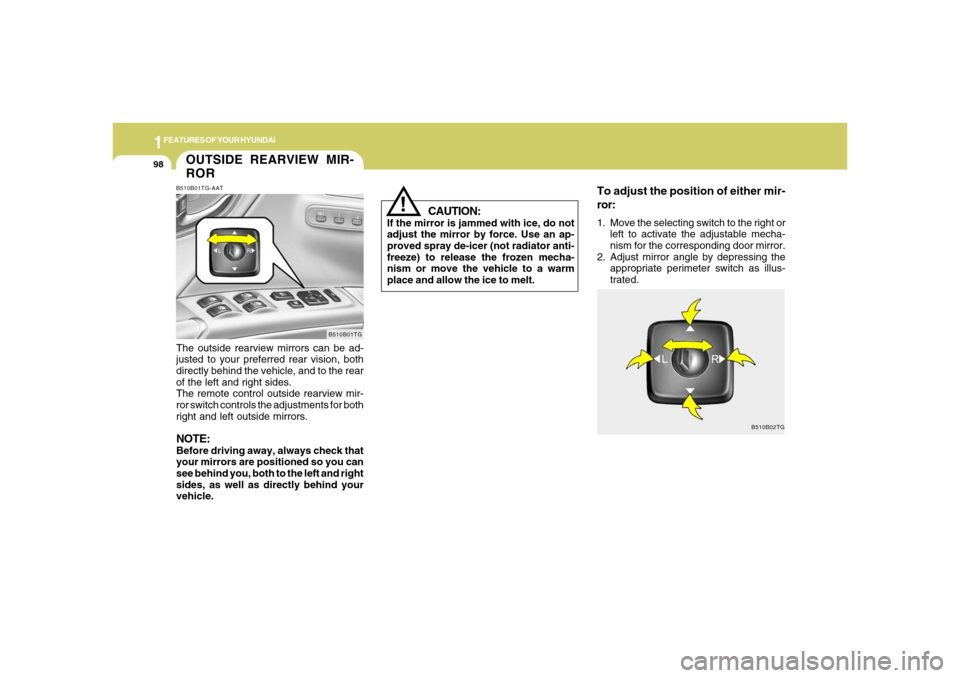
To adjust the position of either mir-
ror:1. Move the selecting switch to the right or
left to activate the adjustable mecha-
nism for the corresponding door mirror.
2. Adjust mirror angle by depressing the
appropriate perimeter switch as illus-
trated.
!
B510B02TG
OUTSIDE REARVIEW MIR-
RORB510B01TG-AATThe outside rearview mirrors can be ad-
justed to your preferred rear vision, both
directly behind the vehicle, and to the rear
of the left and right sides.
The remote control outside rearview mir-
ror switch controls the adjustments for both
right and left outside mirrors.NOTE:Before driving away, always check that
your mirrors are positioned so you can
see behind you, both to the left and right
sides, as well as directly behind your
vehicle.
B510B01TG
Page 114 of 307
1FEATURES OF YOUR HYUNDAI
100
!
WARNING:
Do not adjust or fold the outside rearview
mirrors while the vehicle is moving. This
could result in loss of control, and an
accident causing death, serious injury
or property damage.
CAUTION:
If the mirror is jammed with ice, do not
adjust the mirror by force. Use an ap-
proved spray de-icer (not radiator anti-
freeze) to release the frozen mecha-
nism or move the vehicle to a warm
place and allow the ice to melt.
!
!
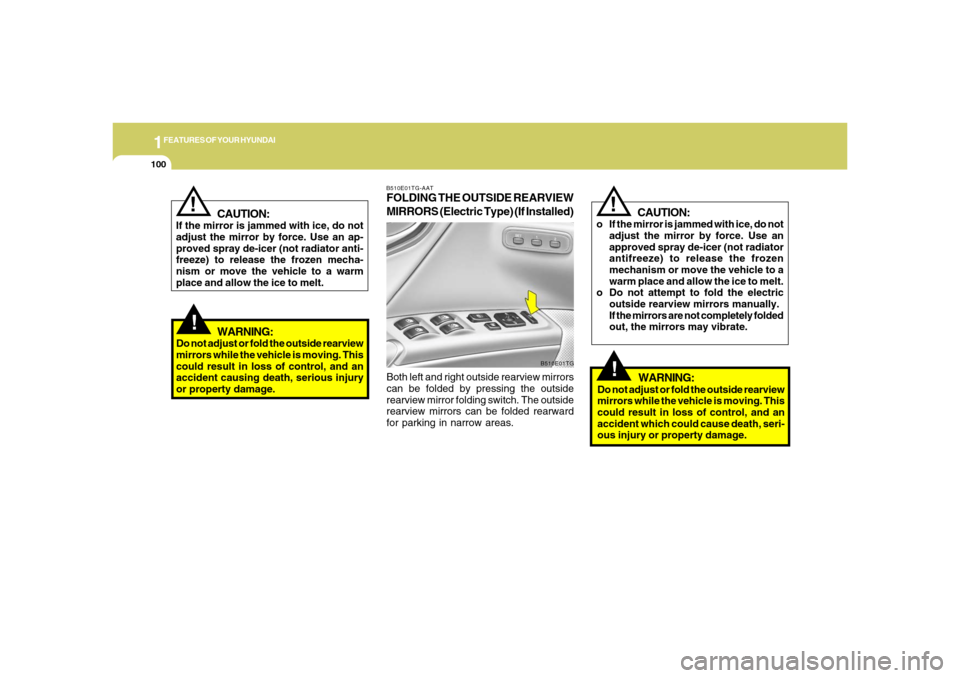
B510E01TG-AATFOLDING THE OUTSIDE REARVIEW
MIRRORS (Electric Type) (If Installed)Both left and right outside rearview mirrors
can be folded by pressing the outside
rearview mirror folding switch. The outside
rearview mirrors can be folded rearward
for parking in narrow areas.
B510E01TG
CAUTION:
o If the mirror is jammed with ice, do not
adjust the mirror by force. Use an
approved spray de-icer (not radiator
antifreeze) to release the frozen
mechanism or move the vehicle to a
warm place and allow the ice to melt.
o Do not attempt to fold the electric
outside rearview mirrors manually.
If the mirrors are not completely folded
out, the mirrors may vibrate.
!
WARNING:
Do not adjust or fold the outside rearview
mirrors while the vehicle is moving. This
could result in loss of control, and an
accident which could cause death, seri-
ous injury or property damage.
Page 211 of 307
34WHAT TO DO IN AN EMERGENCY
IF THE ENGINE OVERHEATS
!!
!
WARNING:
While the engine is running, keep hair,
hands and clothing away from moving
parts such as the fan and drive belts to
prevent injury.
5. If the water pump drive belt is broken or
engine coolant is leaking out, stop the
engine immediately and call the near-
est Hyundai dealer for assistance.
WARNING:
Do not remove the radiator cap when the
engine is hot. This can allow coolant to be
blown out of the opening and cause se-
rious burns.6. If you cannot find the cause of the over-
heating, wait until the engine tempera-
ture has returned to normal. Then, if
coolant has been lost, carefully add
coolant to the reservoir (page 6-7) to
bring the fluid level in the reservoir up to
the halfway mark.
7. Proceed with caution, keeping alert for
further signs of overheating. If over-
heating happens again, call a Hyundai
dealer for assistance.
CAUTION:
Serious loss of coolant indicates there is
a leak in the cooling system and this
should be checked as soon as possible
by a Hyundai dealer.
D030A01TG-AATIf your temperature gauge indicates over-
heating, you experience a loss of power, or
hear loud pinging or knocking, the engine
is probably too hot. If this happens, you
should:
1. Pull off the road and stop as soon as it
is safe to do so.
2. Place the gear selector lever in "P" and
set the parking brake. If the air condi-
tioning is on, turn it off.
3. If engine coolant is running out under
the car or steam is coming out from the
hood, stop the engine. Do not open the
hood until the coolant has stopped
running or the steaming has stopped. If
there is no visible loss of engine coolant
and no steam, leave the engine running
and check to be sure the engine cooling
fan is operating. If the fan is not running,
turn the engine off.
4. Check to see if the water pump drive belt
is missing. If it is not missing, check to
see that it is tight. If the drive belt seems
to be satisfactory, check for coolant
leaking from the radiator, hoses or un-
der the car. (If the air conditioning had
been in use, it is normal for cold water
to be draining from it when you stop).
Page 239 of 307
6
DO-IT-YOURSELF MAINTENANCE
2
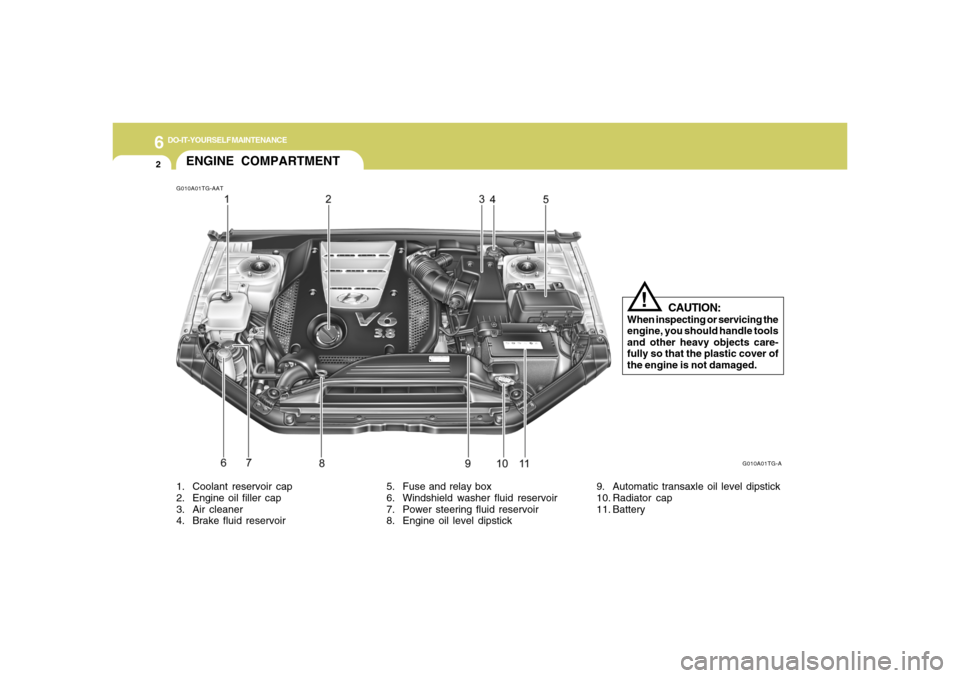
G010A01TG-AATENGINE COMPARTMENT
G010A01TG-A
CAUTION:
When inspecting or servicing the
engine, you should handle tools
and other heavy objects care-
fully so that the plastic cover of
the engine is not damaged.
!
1. Coolant reservoir cap
2. Engine oil filler cap
3. Air cleaner
4. Brake fluid reservoir5. Fuse and relay box
6. Windshield washer fluid reservoir
7. Power steering fluid reservoir
8. Engine oil level dipstick9. Automatic transaxle oil level dipstick
10. Radiator cap
11. Battery
Page 242 of 307
6
DO-IT-YOURSELF MAINTENANCE
5
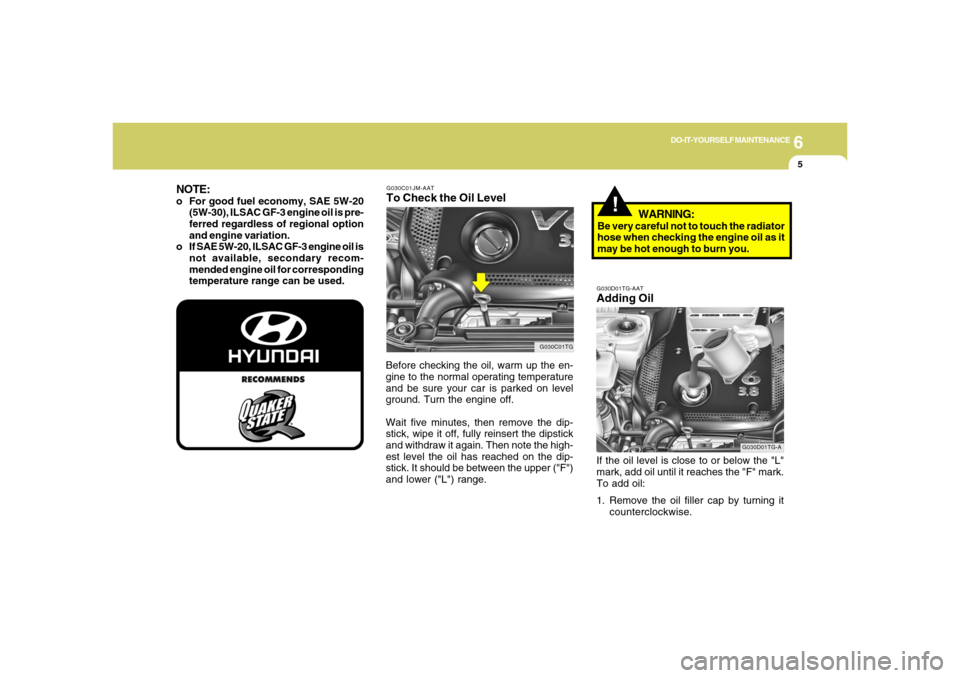
G030C01JM-AATTo Check the Oil LevelBefore checking the oil, warm up the en-
gine to the normal operating temperature
and be sure your car is parked on level
ground. Turn the engine off.
Wait five minutes, then remove the dip-
stick, wipe it off, fully reinsert the dipstick
and withdraw it again. Then note the high-
est level the oil has reached on the dip-
stick. It should be between the upper ("F")
and lower ("L") range.
!
G030C01TG
NOTE:o For good fuel economy, SAE 5W-20
(5W-30), ILSAC GF-3 engine oil is pre-
ferred regardless of regional option
and engine variation.
o If SAE 5W-20, ILSAC GF-3 engine oil is
not available, secondary recom-
mended engine oil for corresponding
temperature range can be used.
G030D01TG-AATAdding OilIf the oil level is close to or below the "L"
mark, add oil until it reaches the "F" mark.
To add oil:
1. Remove the oil filler cap by turning it
counterclockwise.
G030D01TG-A
WARNING:
Be very careful not to touch the radiator
hose when checking the engine oil as it
may be hot enough to burn you.
Page 243 of 307
6
DO-IT-YOURSELF MAINTENANCE
6
CHECKING AND CHANGING
THE ENGINE COOLANT!
G050A01TG-AAT
WARNING:
Do not remove the radiator cap when the
engine is hot. When the engine is hot, the
engine coolant is under pressure and
may erupt through the opening if the cap
is removed. You could be seriously
burned if you do not observe this precau-
tion. Do not remove the radiator cap until
the radiator is cool to the touch.
!
NOTE:Always dispose of used engine oil in an
environmentally acceptable manner. It
is suggested that it be placed in a sealed
container and taken to a service station
for reclamation. Do not pour the oil on the
ground or put it into the household trash.
PROPOSITION 65 WARNING:
Used engine oil may cause irritation or
cancer of the skin if left in contact with
the skin for prolonged periods of time.
Used engine oil contains chemicals that
have caused cancer in laboratory ani-
mals. Always protect your skin by wash-
ing your hands thoroughly with soap and
warm water as soon as possible after
handling used oil.
!!
CAUTION:
Slowly pour the recommended oil into a
funnel. Do not overfill to avoid damage to
the engine.
WARNING:
Be very careful not to touch the radiator
hose when adding the engine oil as it may
be hot enough to burn you.
NOTE:It is recommended that the engine cool-
ant should be changed by an authorized
Hyundai dealer. 2. Add oil, then check the level again. Do
not overfill.
3. Replace the cap by turning it clockwise.
The distance between the "F" and "L" marks
is equal to about 1 quart of oil.
Page 250 of 307
6
DO-IT-YOURSELF MAINTENANCE
13
G110A01E-AATTransaxle fluid in the automatic transaxle
should be checked at those intervals speci-
fied in the vehicle maintenance schedule
in Section 5.NOTE:Automatic transaxle fluid is basically
red in color. As driving distance in-
creases, the fluid color turns darkish red
gradually. It is a normal condition and
you should not judge the need to replace
based upon the changing color.
You must replace the automatic
transaxle fluid in accordance with inter-
vals specified in the vehicle maintenance
schedule in section 5.
!
G110B05A-AATRecommended Fluid
Your Hyundai automatic transaxle is spe-
cially designed to operate with HYUNDAI
GENUINE ATF SP III, DIAMOND ATF SP III,
SK ATF SP III or other brands meeting the
SP III specification approved by Hyundai
Motor Co.. Damage caused by a
nonspecified fluid is not covered by your
new vehicle limited warranty.
CAUTION:
Use of aftermarket ATF additives may
cause damage to the automatic
transaxle.
Only use HYUNDAI GENUINE ATF SP III,
DIAMOND ATF SP III, SK ATF SP III or
other brands meeting the SP III specifi-
cation approved by Hyundai Motor Co..
If you are having your vehicle serviced
at a facility other than a Hyundai dealer,
verify that the correct ATF is used for
your vehicle.
CAUTION:
o Radiator antifreeze (engine coolant)
should not be used in the washer sys-
tem because it will damage the car's
finish.
o The washer lever should not be pulled
and the washer should not be oper-
ated if the washer reservoir is empty.
This can damage the washer fluid
pump.
!!
WARNING:
o Windshield washer fluid agents con-
tain some amounts of alcohol and can
be flammable under certain circum-
stances. Do not allow sparks or flame
to contact the washer fluid or the
washer fluid reservoir. Damage to
the vehicle or its occupants could
occur.
o Windshield washer fluid is poisonous
to humans and animals. Do not drink
windshield washer fluid. Serious in-
jury or death could occur.
CHECKING THE TRANSAXLE
FLUID (AUTOMATIC)
Page 251 of 307
6
DO-IT-YOURSELF MAINTENANCE
14
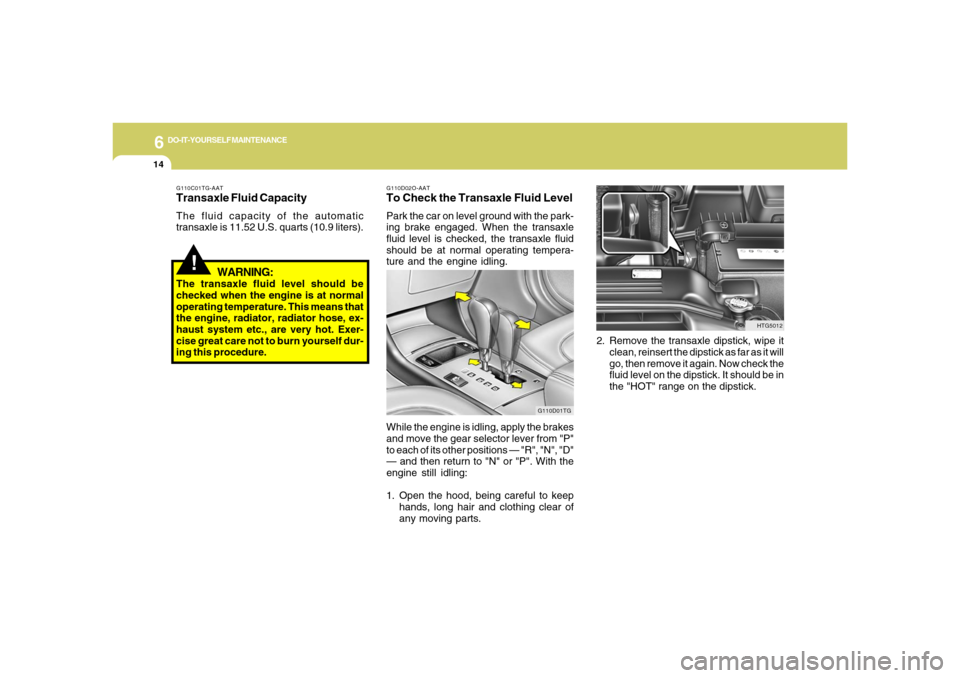
2. Remove the transaxle dipstick, wipe it
clean, reinsert the dipstick as far as it will
go, then remove it again. Now check the
fluid level on the dipstick. It should be in
the "HOT" range on the dipstick.
G110D02O-AATTo Check the Transaxle Fluid LevelPark the car on level ground with the park-
ing brake engaged. When the transaxle
fluid level is checked, the transaxle fluid
should be at normal operating tempera-
ture and the engine idling.
While the engine is idling, apply the brakes
and move the gear selector lever from "P"
to each of its other positions — "R", "N", "D"
— and then return to "N" or "P". With the
engine still idling:
1. Open the hood, being careful to keep
hands, long hair and clothing clear of
any moving parts.
!
G110C01TG-AATTransaxle Fluid CapacityThe fluid capacity of the automatic
transaxle is 11.52 U.S. quarts (10.9 liters).
WARNING:
The transaxle fluid level should be
checked when the engine is at normal
operating temperature. This means that
the engine, radiator, radiator hose, ex-
haust system etc., are very hot. Exer-
cise great care not to burn yourself dur-
ing this procedure.
HTG5012
G110D01TG
Page 253 of 307
6
DO-IT-YOURSELF MAINTENANCE
16
!
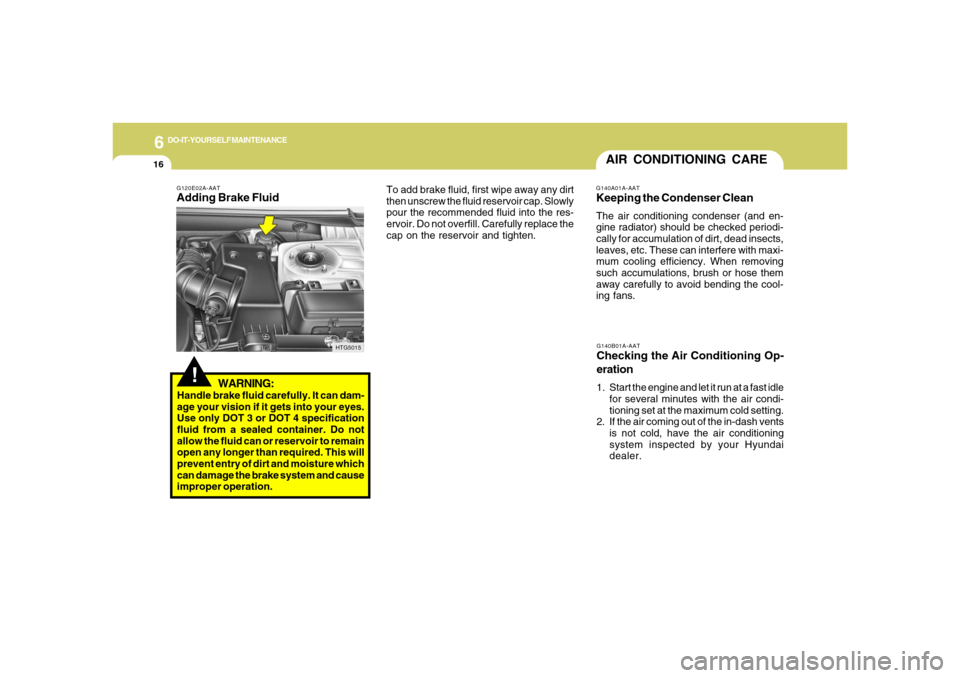
G120E02A-AATAdding Brake Fluid
WARNING:Handle brake fluid carefully. It can dam-
age your vision if it gets into your eyes.
Use only DOT 3 or DOT 4 specification
fluid from a sealed container. Do not
allow the fluid can or reservoir to remain
open any longer than required. This will
prevent entry of dirt and moisture which
can damage the brake system and cause
improper operation.To add brake fluid, first wipe away any dirt
then unscrew the fluid reservoir cap. Slowly
pour the recommended fluid into the res-
ervoir. Do not overfill. Carefully replace the
cap on the reservoir and tighten.
AIR CONDITIONING CAREG140A01A-AATKeeping the Condenser CleanThe air conditioning condenser (and en-
gine radiator) should be checked periodi-
cally for accumulation of dirt, dead insects,
leaves, etc. These can interfere with maxi-
mum cooling efficiency. When removing
such accumulations, brush or hose them
away carefully to avoid bending the cool-
ing fans.G140B01A-AATChecking the Air Conditioning Op-
eration1. Start the engine and let it run at a fast idle
for several minutes with the air condi-
tioning set at the maximum cold setting.
2. If the air coming out of the in-dash vents
is not cold, have the air conditioning
system inspected by your Hyundai
dealer.
HTG5015