ECO mode Hyundai Azera 2007 User Guide
[x] Cancel search | Manufacturer: HYUNDAI, Model Year: 2007, Model line: Azera, Model: Hyundai Azera 2007Pages: 308, PDF Size: 12.63 MB
Page 118 of 308
1FEATURES OF YOUR HYUNDAI
104
!
Integrated HomeLink
® Wireless Con-
trol System
The HomeLink
® Wireless Control System
provides a convenient way to replace up to
three hand-held radio-frequency (RF)
transmitters with a single built-in device.
This innovative feature will learn the radio
frequency codes of most current transmit-
ters to operate devices such as gate op-
erators, garage door openers, entry door
locks, security systems, even home light-
ing. Both standard and rolling code-
equipped transmitters can be programmed
by following the outlined procedures. Ad-
ditional HomeLink
® information can be
found at: www.homelink.com or by calling
1-800-355-3515.
CAUTION:
Before programming HomeLink
® to a
garage door opener or gate operator,
make sure that people and objects are
out of the way of the device to prevent
potential harm or damage. Do not use
HomeLink
® with any garage door opener
that lacks the safety stop and reverse
features as required by U.S. federal
safety standards (this includes any ga-
rage door opener model manufactured
before April 1, 1982). A garage door that
cannot detect an object - signaling the
door to stop and reverse - does not meet
current U.S. federal safety standards.
Using a garage door opener without these
features increases the risk of serious
injury or death.Programming HomeLink
®
NOTE:o When programming a garage door
opener, it is advised to park the ve-
hicle outside of the garage.
o It is recommended that a new battery
be placed in the hand-held transmit-
ter of the device being programmed
to HomeLink
® for quicker training and
accurate transmission of the radio-
frequency signal.
o Some vehicles may require the igni-
tion switch to be turned to the second
(or "accessories") position for pro-
gramming and/or operation of
HomeLink.
o In the event that there are still pro-
gramming difficulties or questions
after following the programming steps
listed below, contact HomeLink
® at:
www.homelink.com or 1-800-355-
3515. Retain the original transmitter of the RF
device you are programming for use in
other vehicles as well as for future
HomeLink
® programming. It is also sug-
gested that upon the sale of the vehicle, the
programmed HomeLink
® buttons be
erased for security purposes.
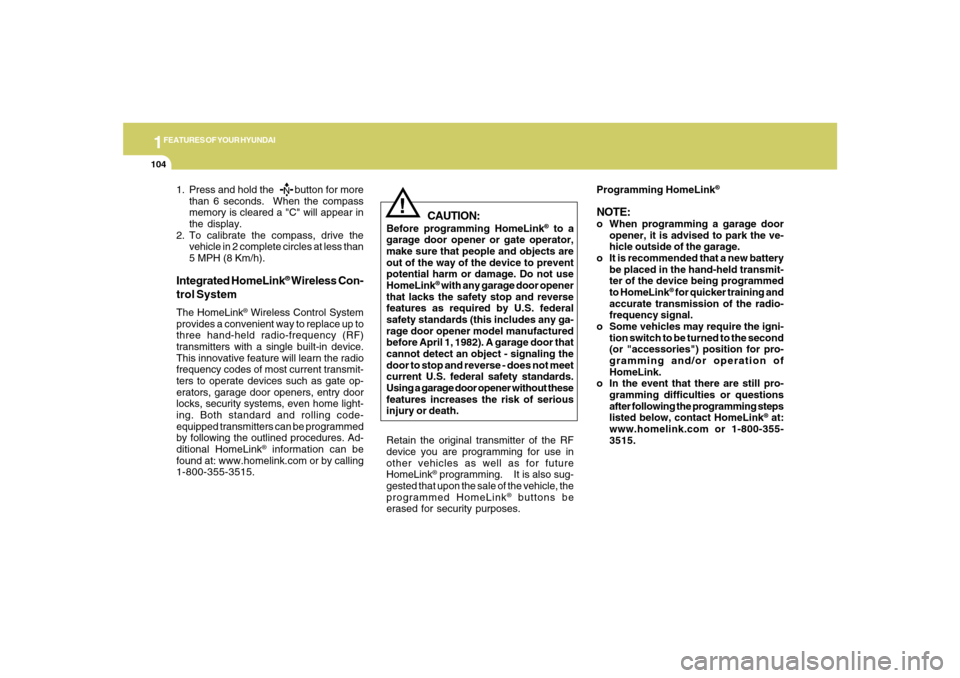
1. Press and hold the button for more
than 6 seconds. When the compass
memory is cleared a "C" will appear in
the display.
2. To calibrate the compass, drive the
vehicle in 2 complete circles at less than
5 MPH (8 Km/h).
Page 120 of 308

1FEATURES OF YOUR HYUNDAI
106
4. Press and hold the just-trained
HomeLink
® button and observe the red
Status Indicator LED. If the indicator
light stays on constantly, programming
is complete and your device should
activate.
5. To program the remaining two
HomeLink® buttons, follow either steps
1 through 4 above for other Rolling
Code devices or steps 2 through 5 in
Standard Programming for standard
devices.
During programming, your handheld trans-
mitter may automatically stop transmitting.
Continue to press the Integrated
HomeLink
® Wireless Control System but-
ton (note steps 2 through 4 in the Standard
Programming portion of this document)
while you press and re-press ("cycle") your
handheld transmitter every two seconds
until the frequency signal has been learned.
The indicator light will flash slowly and
then rapidly after several seconds upon
successful training.Operating HomeLink
®
To operate, simply press and release the
programmed HomeLink
® button. Activa-
tion will now occur for the trained device
(i.e. garage door opener, gate operator,
security system, entry door lock, home/
office lighting, etc.). For convenience, the
hand-held transmitter of the device may
also be used at any time.
Reprogramming a Single HomeLink
®
Button
To program a new device to a previously
trained HomeLink
® button, follow these
steps:
1. Press and hold the desired HomeLink
®
button. Do NOT release until step 4 has
been completed.
2. When the indicator light begins to flash
slowly (after 20 seconds), position the
handheld transmitter 1 to 3 inches away
from the HomeLink
® surface.
3. Press and hold the handheld transmit-
ter button. The HomeLink
® indicator light
will flash, first slowly and then rapidly.
4. When the indicator light begins to flash
rapidly, release both buttons.
5. Press and hold the just-trainedHomeLink
® button and observe the red
Status Indicator LED. If the indicator
light stays on constantly, programming
is complete and your new device should
activate.
Erasing HomeLink
® Buttons
Individual buttons cannot be erased. How-
ever, to erase all three programmed but-
tons:
1. Press and hold the two outer HomeLink
®
buttons until the indicator light begins to
flash-after 20 seconds.
2. Release both buttons. Do not hold for
longer than 30 seconds.
The Integrated HomeLink
® Wireless Con-
trol System is now in the training (learn)
mode and can be programmed at any time
following the appropriate steps in the Pro-
gramming sections above.
FCC ID: NZLZTVHL3
IC: 4112A-ZTVHL3
Page 135 of 308
1
FEATURES OF YOUR HYUNDAI
121
AUDIO REMOTE CONTROL
SWITCHB610A02TG-AAT(If Installed)
NOTE:Do not operate audio remote control
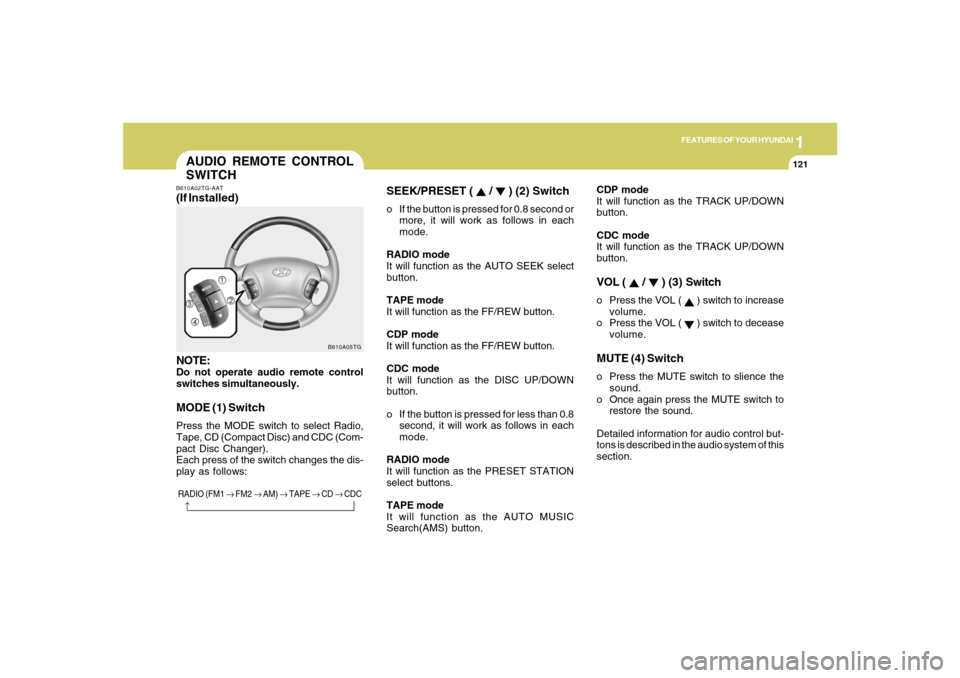
switches simultaneously.MODE (1) SwitchPress the MODE switch to select Radio,
Tape, CD (Compact Disc) and CDC (Com-
pact Disc Changer).
Each press of the switch changes the dis-
play as follows:
B610A05TG
RADIO (FM1 → FM2 → AM) → TAPE → CD → CDC
→
SEEK/PRESET (
/
) (2) Switch
o If the button is pressed for 0.8 second or
more, it will work as follows in each
mode.
RADIO mode
It will function as the AUTO SEEK select
button.
TAPE mode
It will function as the FF/REW button.
CDP mode
It will function as the FF/REW button.
CDC mode
It will function as the DISC UP/DOWN
button.
o If the button is pressed for less than 0.8
second, it will work as follows in each
mode.
RADIO mode
It will function as the PRESET STATION
select buttons.
TAPE mode
It will function as the AUTO MUSIC
Search(AMS) button.CDP mode
It will function as the TRACK UP/DOWN
button.
CDC mode
It will function as the TRACK UP/DOWN
button.
VOL (
/
) (3) Switch
o Press the VOL (
) switch to increase
volume.
o Press the VOL ( ) switch to decease
volume.
MUTE (4) Switcho Press the MUTE switch to slience the
sound.
o Once again press the MUTE switch to
restore the sound.
Detailed information for audio control but-
tons is described in the audio system of this
section.
Page 139 of 308
1
FEATURES OF YOUR HYUNDAI
1251
FEATURES OF YOUR HYUNDAI
125
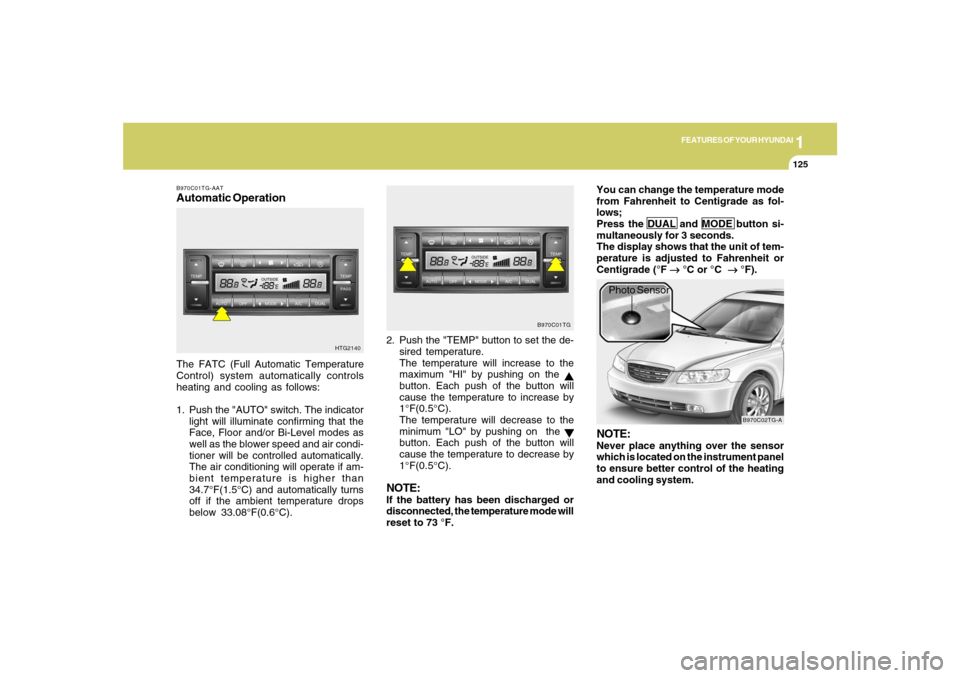
B970C01TG-AATAutomatic OperationThe FATC (Full Automatic Temperature
Control) system automatically controls
heating and cooling as follows:
1. Push the "AUTO" switch. The indicator
light will illuminate confirming that the
Face, Floor and/or Bi-Level modes as
well as the blower speed and air condi-
tioner will be controlled automatically.
The air conditioning will operate if am-
bient temperature is higher than
34.7°F(1.5°C) and automatically turns
off if the ambient temperature drops
below 33.08°F(0.6°C).2. Push the "TEMP" button to set the de-
sired temperature.
The temperature will increase to the
maximum "HI" by pushing on the
button. Each push of the button will
cause the temperature to increase by
1°F(0.5°C).
The temperature will decrease to the
minimum "LO" by pushing on the button. Each push of the button will
cause the temperature to decrease by
1°F(0.5°C).
NOTE:If the battery has been discharged or
disconnected, the temperature mode will
reset to 73 °F.You can change the temperature mode
from Fahrenheit to Centigrade as fol-
lows;
Press the DUAL and MODE button si-
multaneously for 3 seconds.
The display shows that the unit of tem-
perature is adjusted to Fahrenheit or
Centigrade (°F
→ →→ →
→ °C or °C
→ →→ →
→ °F).
HTG2140B970C01TG
B970C02TG-A
Photo Sensor
NOTE:Never place anything over the sensor
which is located on the instrument panel
to ensure better control of the heating
and cooling system.
Page 141 of 308
1
FEATURES OF YOUR HYUNDAI
1271
FEATURES OF YOUR HYUNDAI
127
With the "Fresh" mode selected, air enters
the vehicle from the outside and is heated
or cooled according to the function se-
lected.
With the "Recirculation" mode selected,
air from within the passenger compart-
ment will be drawn through the heating
system and heated or cooled according to
the function selected.NOTE:It should be noted that prolonged opera-
tion of the heating system in "recircula-
tion" mode will give rise to fogging of the
windshield and side windows and the air
within the passenger compartment will
become stale. In addition, prolonged use
of the air conditioning with the "Recircu-
lation" mode selected may result in the
air within the passenger compartment
becoming excessively dry.
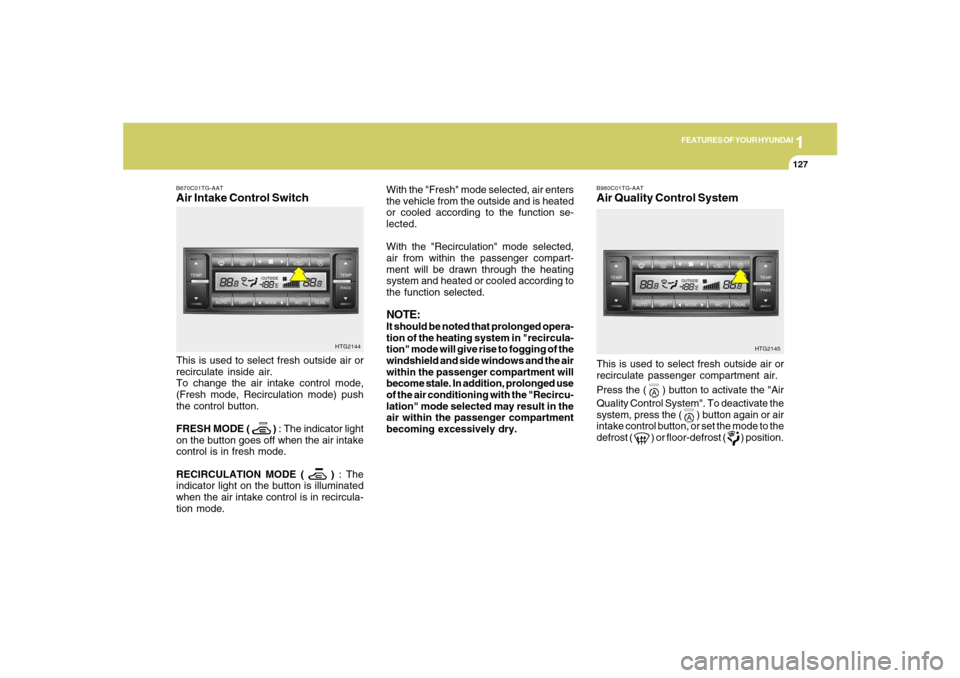
B670C01TG-AATAir Intake Control SwitchThis is used to select fresh outside air or
recirculate inside air.
To change the air intake control mode,
(Fresh mode, Recirculation mode) push
the control button.
FRESH MODE (
) : The indicator light
on the button goes off when the air intake
control is in fresh mode.
RECIRCULATION MODE (
) : The
indicator light on the button is illuminated
when the air intake control is in recircula-
tion mode.HTG2144
HTG2145
This is used to select fresh outside air or
recirculate passenger compartment air.
Press the (
) button to activate the "Air
Quality Control System". To deactivate the
system, press the (
) button again or air
intake control button, or set the mode to the
defrost (
) or floor-defrost (
) position.
B980C01TG-AATAir Quality Control System
Page 145 of 308
1
FEATURES OF YOUR HYUNDAI
1311
FEATURES OF YOUR HYUNDAI
131
B980G01TG-AATAuto De-humidified Control
(If Installed)
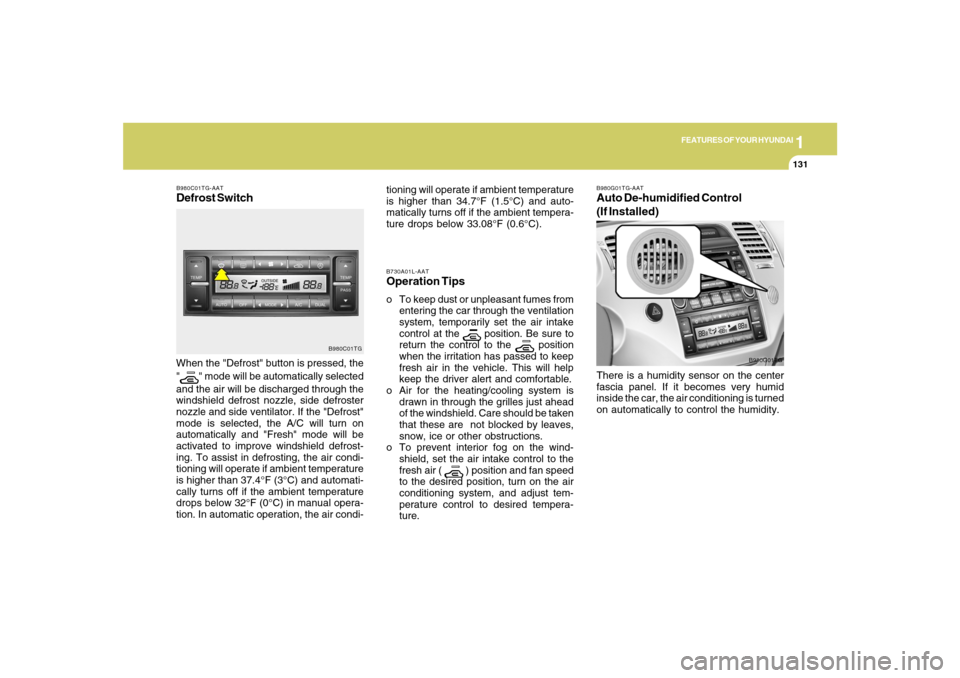
B980C01TG-AATDefrost SwitchWhen the "Defrost" button is pressed, the
"
" mode will be automatically selected
and the air will be discharged through the
windshield defrost nozzle, side defroster
nozzle and side ventilator. If the "Defrost"
mode is selected, the A/C will turn on
automatically and "Fresh" mode will be
activated to improve windshield defrost-
ing. To assist in defrosting, the air condi-
tioning will operate if ambient temperature
is higher than 37.4°F (3°C) and automati-
cally turns off if the ambient temperature
drops below 32°F (0°C) in manual opera-
tion. In automatic operation, the air condi-
B980C01TG
There is a humidity sensor on the center
fascia panel. If it becomes very humid
inside the car, the air conditioning is turned
on automatically to control the humidity.
B980G01TG B730A01L-AAT
Operation Tipso To keep dust or unpleasant fumes from
entering the car through the ventilation
system, temporarily set the air intake
control at the
position. Be sure to
return the control to the
position
when the irritation has passed to keep
fresh air in the vehicle. This will help
keep the driver alert and comfortable.
o Air for the heating/cooling system is
drawn in through the grilles just ahead
of the windshield. Care should be taken
that these are not blocked by leaves,
snow, ice or other obstructions.
o To prevent interior fog on the wind-
shield, set the air intake control to the
fresh air (
) position and fan speed
to the desired position, turn on the air
conditioning system, and adjust tem-
perature control to desired tempera-
ture. tioning will operate if ambient temperature
is higher than 34.7°F (1.5°C) and auto-
matically turns off if the ambient tempera-
ture drops below 33.08°F (0.6°C).
Page 155 of 308
1
FEATURES OF YOUR HYUNDAI
1411
FEATURES OF YOUR HYUNDAI
141
o Press the MARK button to bookmark the
desired track for more than one second.
This will display the "
" symbol on the
LCD for five seconds with sequential
number. To play the bookmarked tracks,
press the MARK button within a second.
o Press the MARK button to erase the
bookmarked tracks for more than one
second. This will erase the bookmark
with beep sound.
7. PAGE UP/DOWN ButtonPress the button and you can check the file
title more than 16 characters on MP3 CD.
The button doesn't work on file title less
than 16 characters.8. EQUALIZER (EQ) ButtonPress the EQ button to select the CLAS-
SIC, POPS, ROCK, JAZZ and DEFEAT
MODE for the desired tone quality. Each
press of the button changes the display as
follows;
9. CD EJECT ButtonWhen the (
)button is pressed with a CD
loaded, the CD will eject. Forcing to eject
: To force to eject a CD, press this button for
more than 3 seconds. (Do this only when
a CD is jammed and you can not eject it in
the normal way - e.g.) in case that you have
inserted 2 CDs by mistake)
10. SCAN Buttono To playback the first 10 seconds of each
track, press the button with the beep
sound for more than one second. Press
the button again when reached the
desired track.
o To playback the first 10 seconds of each
track in the selected folder, press the
button within one second. If it pressed
for more than one second, it will play-
back the first seconds of each track in
the all folder with beep sound. Press the
button again within one second when
reached the desired track, the search-
ing function is released and the track
you desired will be played in the se-
lected folder. (MP3 CD only)
11. FILE SEARCH Knob (TUNE Se-
lect Knob)o You can skip the track by turning the
FILE SEARCH knob to counterclock-
wise or clockwise.
After selecting the desired track, press the
FILE SEARCH knob to playback the track.
If you do not press the FILE SEARCH knob
within 5 seconds, the file searching func-
tion will be released.12. CHANGE DIRECTORY(DIR) But-
tono You can move through the folder by
pushing the DIR button to up (
) and
down (
).
After moving the desired folder, press the
FILE SEARCH knob to playback the first
file in the selected folder.
If you do not press the FILE SEARCH knob
within 5 seconds, the folder searching
function will be released.
It is not operated in single folder.
CLASSIC → POPS → ROCK → JAZZ →DEFEAT
Page 161 of 308
1
FEATURES OF YOUR HYUNDAI
1471
FEATURES OF YOUR HYUNDAI
147
M455D01TG-GAT1. TAPE PROGRAM Buttono This allows you to play the reverse side
of the tape by merely depressing the
program button. An arrow will appear in
the display to show tape direction.
o Push the TAPE button to turn on that
function without pushing power ON-
OFF control knob.2. TAPE EJECT Buttono When the button is pressed with a cas-
sette loaded, the cassette will eject.
o When the button is pressed during FF/
REW mode, the cassette will eject.3. AUTO MUSIC Search ButtonPress the button to find the starting point of
each song in a prerecorded music tape.
The quiet space between songs (must
have at least 4 sec. gap) can be accepted
by the AUTO MUSIC search button.
o Pressing the button (
) will play the
beginning of the next music segment.
o Pressing the button (
) will start
replay at the beginning of the music just
listened to.
4. FF/REW Buttono Fast forward tape winding starts when
the FF button is pressed during PLAY or
REW mode.
o Tape PLAY starts when the FF button is
pressed again during FF mode.
o Tape rewinding starts when the REW
button is pressed during PLAY or FF
mode.
o Tape PLAY starts when the REW button
pressed again during REW mode.5. REPEAT Buttono To repeat the track you are currently
listening to, press the RPT button. To
cancel, press again.
o If you do not release RPT operation
when the track ends, it will automati-
cally be replayed.
This process will be continued until you
push the button again.6. DOLBY ButtonIf you get background noise during tape
PLAY, you can reduce this considerably
by merely pressing the DOLBY button. If
you want to cancel the DOLBY feature,
press the button again.
7. EQUALIZER (EQ) ButtonPress the EQ button to select the CLAS-
SIC, POPS, ROCK, JAZZ and DEFEAT
MODE for the desired tone quality. Each
press of the button changes the display as
follows;NOTE:o To assure proper operation of the
unit, keep the vehicle interior tem-
perature within a normal range by
using the vehicle’s air conditioning or
heating system.
o When replacing the fuse, replace it
with a fuse having the correct capac-
ity.
o The preset station frequencies are all
erased when the car battery is dis-
connected. Therefore, all data will have
to be set again if this should occur.
o Do not add any oil to the rotating parts.
Keep magnets, screwdrivers and
other metallic objects away from the
tape mechanism and head. CLASSIC → POPS → ROCK → JAZZ →DEFEAT
Page 165 of 308
1
FEATURES OF YOUR HYUNDAI
1511
FEATURES OF YOUR HYUNDAI
151
6. BOOKMARK (MARK) ButtonWhen the CD player unit is operating, the
desired track on the disc can be
bookmarked by using the MARK button.
o Press the MARK button to bookmark the
desired track for more than one second.
This will display the "
" symbol on the
LCD for five seconds with sequential
number. To play the bookmarked tracks,
press the MARK button within a second.
o Press the MARK button to erase the
bookmarked tracks for more than one
second. This will erase the bookmark
with beep sound.
7. PAGE UP/DOWN ButtonPress the button and you can check the file
title more than 16 characters on MP3 CD.
The button doesn't work on file title less
than 16 characters.
8. EQUALIZER (EQ) ButtonPress the EQ button to select the CLAS-
SIC, POPS, ROCK, JAZZ and DEFEAT
MODE for the desired tone quality. Each
press of the button changes the display as
follows;9. CD EJECT ButtonWhen the (
)button is pressed with a CD
loaded, the CD will eject. Forcing to eject
: To force to eject a CD, press this button for
more than 3 seconds. (Do this only when
a CD is jammed and you can not eject it in
the normal way - e.g.) in case that you have
inserted 2 CDs by mistake)
10. SCAN Buttono To playback the first 10 seconds of each
track, press the button with the beep
sound for more than one second. Press
the button again when reached the
desired track.
o To playback the first 10 seconds of each
track in the selected folder, press the
button within one second. If it pressed
for more than one second, it will play-
back the first seconds of each track in
the all folder with beep sound.
Press the button again within one sec-
ond when reached the desired track,
the searching function is released and
the track you desired will be played in
the selected folder. (MP3 CD only)11. FILE SEARCH Knob (TUNE Se-
lect Knob)o You can skip the track by turning the
FILE SEARCH knob to counterclock-
wise or clockwise.
After selecting the desired track, press the
FILE SEARCH knob to playback the track.
If you do not press the FILE SEARCH knob
within 5 seconds, the file searching func-
tion will be released. CLASSIC → POPS → ROCK → JAZZ →DEFEAT
Page 169 of 308
1
FEATURES OF YOUR HYUNDAI
1551
FEATURES OF YOUR HYUNDAI
155
6. SCAN ButtonWhen you press the button, frequency is
changed and the next channel is received
automatically. To stay on a station, press
the SCAN button again.7. EQUALIZER (EQ) ButtonPress the EQ button to select the CLAS-
SIC, POPS, ROCK, JAZZ and DEFEAT
MODE for the desired tone quality. Each
press of the button changes the display as
follows;
HOW TO PRESET STATIONSSix AM and twelve FM stations may be
programmed into the memory of the radio.
Then, by simply pressing the AM / FM
select button and/or one of the six station
select buttons, you may recall any of these
stations instantly. To program the stations,
follow these steps:
o Press AM/FM selector to set the band for
AM, FM1 and FM2.
o Select the desired station to be stored
by seek or manual tuning.
o Determine the preset station select
button you wish to use to access that
station.
o Press the station select button for more
than two seconds. A select button indi-
cator will show in the display indicating
which select button you have de-
pressed. The frequency display will flash
after it has been stored into the memory.
You should then release the button,
and proceed to program the next de-
sired station. A total of 18 stations can
be programmed by selecting one AM
and two FM station per button.
8. PRESET STATION Select ButtonsSix (6) stations for AM, FM1 and FM2
respectively can be preset in the electronic
memory circuit.o When completed, any preset station
may be recalled by selecting AM, FM1
or FM2 band and the appropriate sta-
tion button.
!
CLASSIC → POPS → ROCK → JAZZ →DEFEAT
CAUTION
o Do not place beverages close to the
audio system. The audio system
mechanism may be damaged if you
spill them.
o Do not strike or allow anything to im-
pact the audio system, damage to the
system mechanisms could occur.