change time Hyundai Azera 2007 User Guide
[x] Cancel search | Manufacturer: HYUNDAI, Model Year: 2007, Model line: Azera, Model: Hyundai Azera 2007Pages: 308, PDF Size: 12.63 MB
Page 203 of 308
2
DRIVING YOUR HYUNDAI
23
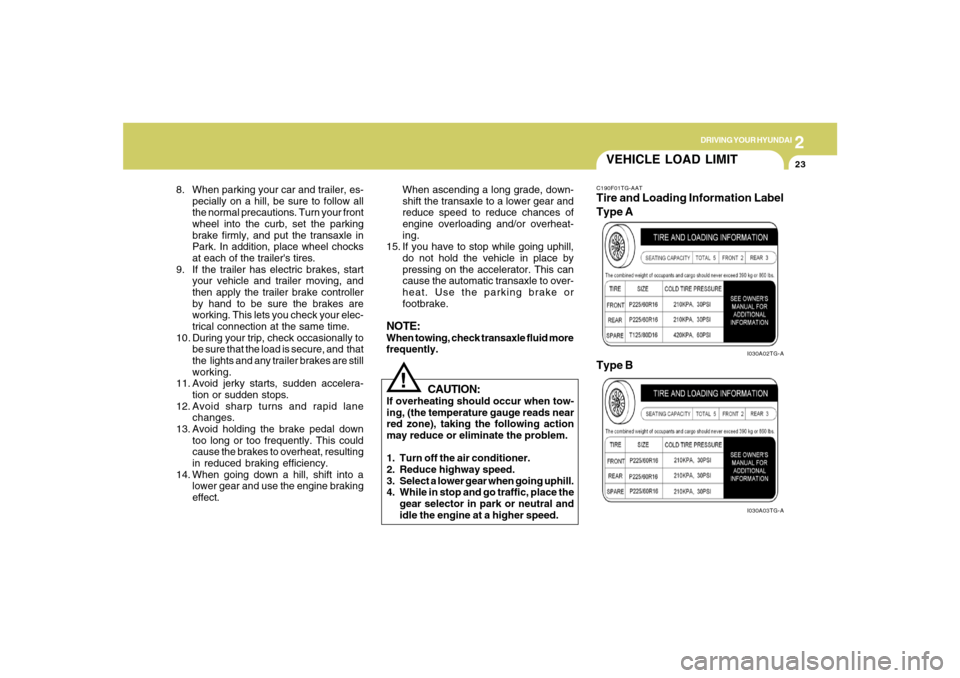
VEHICLE LOAD LIMITC190F01TG-AATTire and Loading Information Label
I030A02TG-AI030A03TG-A
Type A
Type B
8. When parking your car and trailer, es-
pecially on a hill, be sure to follow all
the normal precautions. Turn your front
wheel into the curb, set the parking
brake firmly, and put the transaxle in
Park. In addition, place wheel chocks
at each of the trailer's tires.
9. If the trailer has electric brakes, start
your vehicle and trailer moving, and
then apply the trailer brake controller
by hand to be sure the brakes are
working. This lets you check your elec-
trical connection at the same time.
10. During your trip, check occasionally to
be sure that the load is secure, and that
the lights and any trailer brakes are still
working.
11. Avoid jerky starts, sudden accelera-
tion or sudden stops.
12. Avoid sharp turns and rapid lane
changes.
13. Avoid holding the brake pedal down
too long or too frequently. This could
cause the brakes to overheat, resulting
in reduced braking efficiency.
14. When going down a hill, shift into a
lower gear and use the engine braking
effect.
CAUTION:
If overheating should occur when tow-
ing, (the temperature gauge reads near
red zone), taking the following action
may reduce or eliminate the problem.
1. Turn off the air conditioner.
2. Reduce highway speed.
3. Select a lower gear when going uphill.
4. While in stop and go traffic, place the
gear selector in park or neutral and
idle the engine at a higher speed.
!When ascending a long grade, down-
shift the transaxle to a lower gear and
reduce speed to reduce chances of
engine overloading and/or overheat-
ing.
15. If you have to stop while going uphill,
do not hold the vehicle in place by
pressing on the accelerator. This can
cause the automatic transaxle to over-
heat. Use the parking brake or
footbrake.
NOTE:When towing, check transaxle fluid more
frequently.
Page 244 of 308
6
DO-IT-YOURSELF MAINTENANCE
6
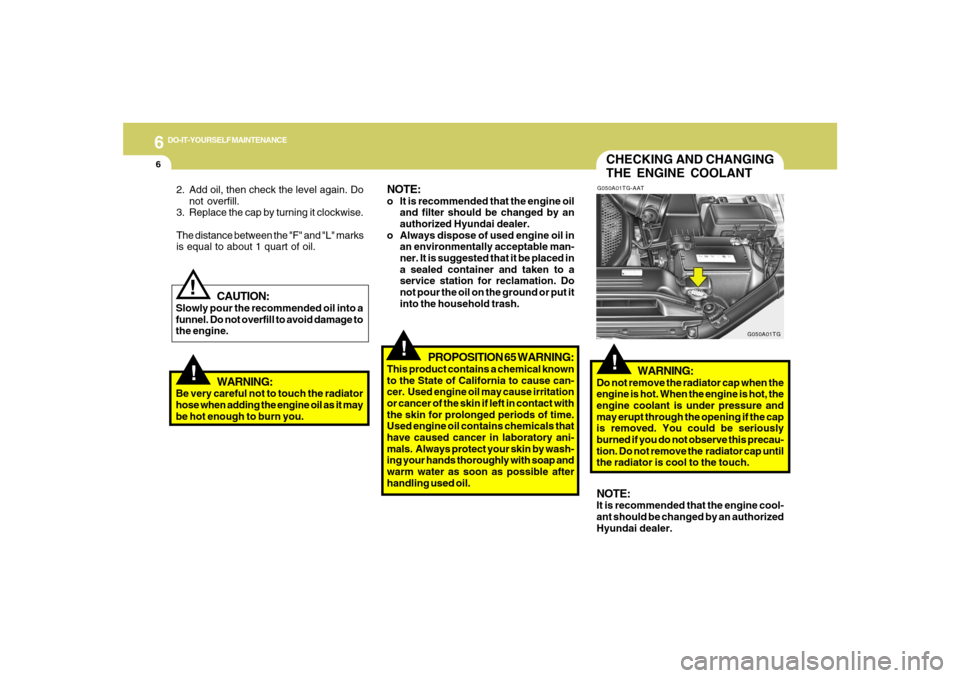
CHECKING AND CHANGING
THE ENGINE COOLANT!
G050A01TG-AAT
WARNING:
Do not remove the radiator cap when the
engine is hot. When the engine is hot, the
engine coolant is under pressure and
may erupt through the opening if the cap
is removed. You could be seriously
burned if you do not observe this precau-
tion. Do not remove the radiator cap until
the radiator is cool to the touch.
!
NOTE:o It is recommended that the engine oil
and filter should be changed by an
authorized Hyundai dealer.
o Always dispose of used engine oil in
an environmentally acceptable man-
ner. It is suggested that it be placed in
a sealed container and taken to a
service station for reclamation. Do
not pour the oil on the ground or put it
into the household trash.
PROPOSITION 65 WARNING:
This product contains a chemical known
to the State of California to cause can-
cer. Used engine oil may cause irritation
or cancer of the skin if left in contact with
the skin for prolonged periods of time.
Used engine oil contains chemicals that
have caused cancer in laboratory ani-
mals. Always protect your skin by wash-
ing your hands thoroughly with soap and
warm water as soon as possible after
handling used oil.
!!
CAUTION:
Slowly pour the recommended oil into a
funnel. Do not overfill to avoid damage to
the engine.
WARNING:
Be very careful not to touch the radiator
hose when adding the engine oil as it may
be hot enough to burn you.
NOTE:It is recommended that the engine cool-
ant should be changed by an authorized
Hyundai dealer. 2. Add oil, then check the level again. Do
not overfill.
3. Replace the cap by turning it clockwise.
The distance between the "F" and "L" marks
is equal to about 1 quart of oil.
G050A01TG