glove Hyundai Azera 2007 Owner's Manual
[x] Cancel search | Manufacturer: HYUNDAI, Model Year: 2007, Model line: Azera, Model: Hyundai Azera 2007Pages: 308, PDF Size: 12.63 MB
Page 13 of 308

1. Fuse Box .........................................................................6-19
2. Instrument Cluster ...........................................................1-62
3. Parking Brake Pedal .....................................................1-107
4. Brake Pedal ....................................................................2-10
5. Accelerator Pedal ...........................................................2-10
6. Multi-Function Light/Front Fog Light Switch ......... 1-80, 1-83
7. Audio Remote Control Switch (If Installed) ...................1-121
8. Horn and Driver's Front Airbag ........................... 1-116, 1-45
9. Cruise Control Switch ...................................................1-118
CAUTION:
When installing a container of liquid air freshener inside the vehicle, do not place it near the instrument cluster
nor on the instrument panel surface. If there is any leakage from the air freshener onto these areas
(Instrument cluster, instrument panel or air ventilator), it may damage these parts. If the liquid from the air
freshener does leak onto these areas, wash them with water immediately.
!
10. Windshield Wiper/Washer Switch ..................................1-84
11. Audio System (If Installed) ............................................1-136
12. Passenger's Front Airbag ...............................................1-45
13. Heating/Air Conditioning Control Panel .......................1-124
14. Glove Box ........................................................................1-96
15. Accessory Box ................................................................1-97
16. Shift Lever ......................................................................... 2-6
17. Drink Holder ....................................................................1-89
18. Center Console ...............................................................1-97
Page 18 of 308
1FEATURES OF YOUR HYUNDAI4
!
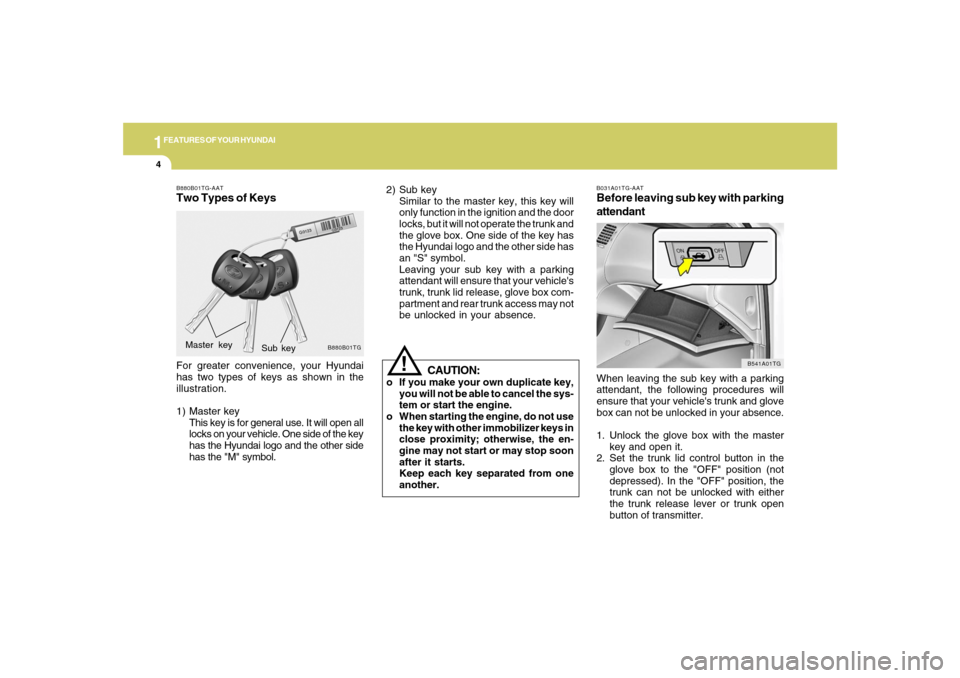
2) Sub key
Similar to the master key, this key will
only function in the ignition and the door
locks, but it will not operate the trunk and
the glove box. One side of the key has
the Hyundai logo and the other side has
an "S" symbol.
Leaving your sub key with a parking
attendant will ensure that your vehicle's
trunk, trunk lid release, glove box com-
partment and rear trunk access may not
be unlocked in your absence.
CAUTION:
o If you make your own duplicate key,
you will not be able to cancel the sys-
tem or start the engine.
o When starting the engine, do not use
the key with other immobilizer keys in
close proximity; otherwise, the en-
gine may not start or may stop soon
after it starts.
Keep each key separated from one
another.
B031A01TG-AATBefore leaving sub key with parking
attendantWhen leaving the sub key with a parking
attendant, the following procedures will
ensure that your vehicle's trunk and glove
box can not be unlocked in your absence.
1. Unlock the glove box with the master
key and open it.
2. Set the trunk lid control button in the
glove box to the "OFF" position (not
depressed). In the "OFF" position, the
trunk can not be unlocked with either
the trunk release lever or trunk open
button of transmitter.
B541A01TG
B880B01TG-AATTwo Types of KeysFor greater convenience, your Hyundai
has two types of keys as shown in the
illustration.
1) Master key
This key is for general use. It will open all
locks on your vehicle. One side of the key
has the Hyundai logo and the other side
has the "M" symbol.
B880B01TG
Sub key Master key
Page 19 of 308
1
FEATURES OF YOUR HYUNDAI
5
3. Close the glove box, and lock the glove
box using the master key.
4. Switch the rear seatback knobs to the
"LOCK" position (refer to page 1-26).
5. Leave the sub key with the attendant.
Trunk and glove box are secured be-
cause the sub key only allows ignition
and door lock operation.
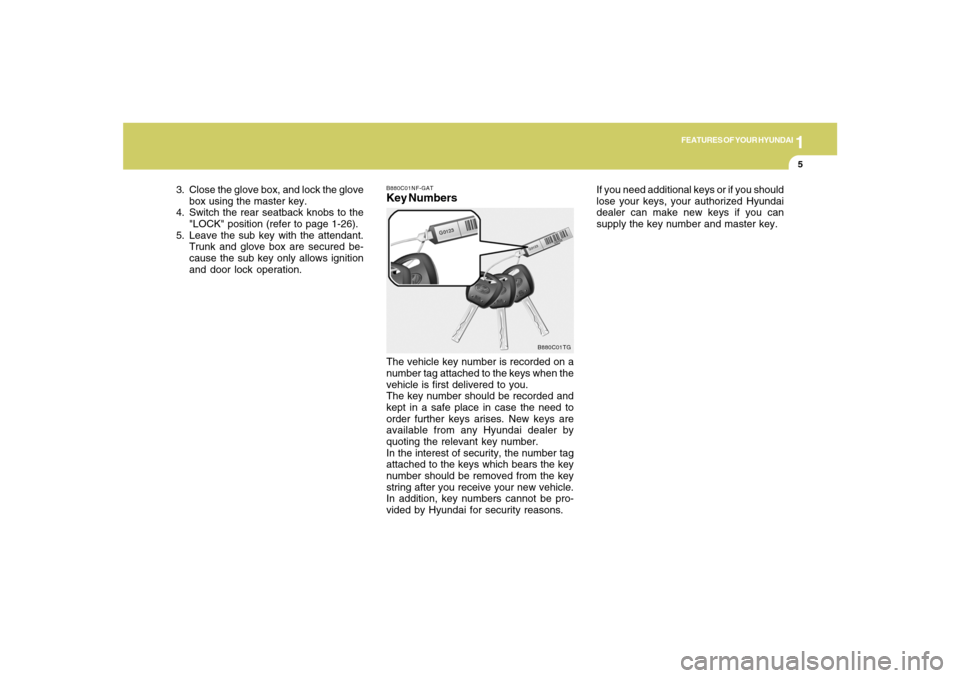
B880C01NF-GATKey NumbersThe vehicle key number is recorded on a
number tag attached to the keys when the
vehicle is first delivered to you.
The key number should be recorded and
kept in a safe place in case the need to
order further keys arises. New keys are
available from any Hyundai dealer by
quoting the relevant key number.
In the interest of security, the number tag
attached to the keys which bears the key
number should be removed from the key
string after you receive your new vehicle.
In addition, key numbers cannot be pro-
vided by Hyundai for security reasons.
B880C01TG
If you need additional keys or if you should
lose your keys, your authorized Hyundai
dealer can make new keys if you can
supply the key number and master key.
Page 59 of 308
1
FEATURES OF YOUR HYUNDAI
45
B240A01TG
The purpose of the SRS is to provide the
vehicle's driver and/or the front passenger
with additional protection than that offered
by the seat belt system alone in case of a
frontal impact of sufficient severity.
The SRS uses sensors to gather informa-
tion about the driver's seat position, the
driver's and front passenger's seat belt
usage and impact severity.
The driver's seat track position sensor,
which is installed on the seat track, deter-
mines if the seat is fore or aft of a reference
position. The seat belt buckle sensors de-
termine if the driver and front passenger's
seat belts are fastened. These sensors
provide the ability to control the SRS de-
ployment based on how close the driver's
seat is to the steering wheel, whether or not
the seat belts are fastened, and how se-
vere the impact is.
The advanced SRS offers the ability to
control the airbag inflation with two levels.
A first stage level is provided for moderate-
severity impacts. A second stage level is
provided for more severe impacts.According to the impact severity, seating
position and seat belt usage, the
SRSCM(SRS Control Module) controls the
airbag inflation. Failure to properly wear
seat belts can increase the risk or severity
of injury in an accident.
Additionally, your Hyundai is equipped
with an occupant classification system in
the front passenger's seat. The occupant
classification system detects the presence
of a passenger in the front passenger's
seat and will turn off the front passenger's
airbag under certain conditions. For more
detail, see "Occupant Classification Sys-
tem" later in this section.
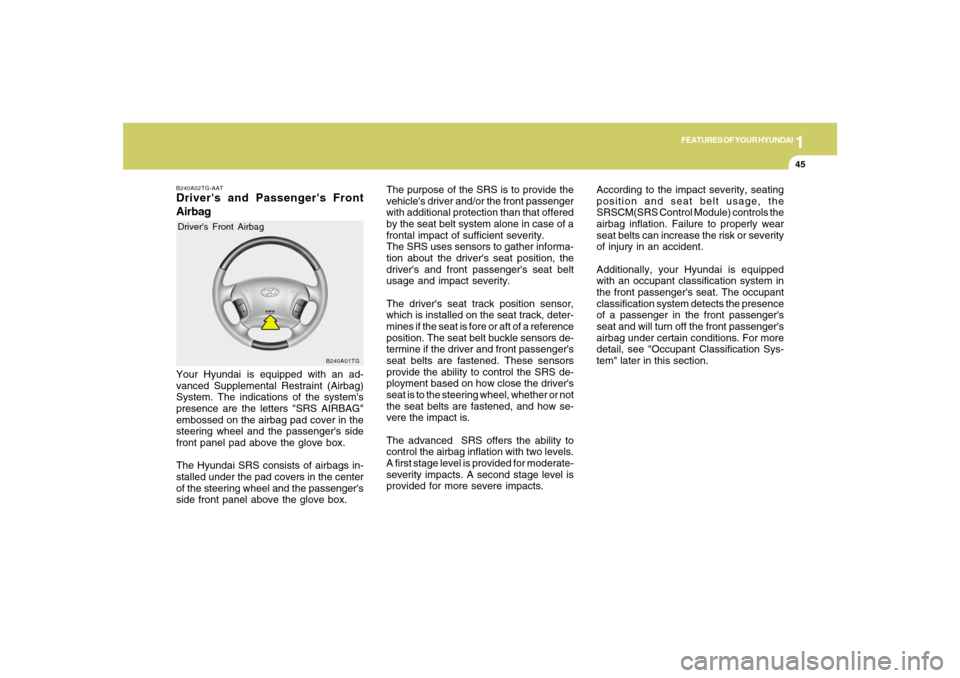
B240A02TG-AATDriver's and Passenger's Front
AirbagYour Hyundai is equipped with an ad-
vanced Supplemental Restraint (Airbag)
System. The indications of the system's
presence are the letters "SRS AIRBAG"
embossed on the airbag pad cover in the
steering wheel and the passenger's side
front panel pad above the glove box.
The Hyundai SRS consists of airbags in-
stalled under the pad covers in the center
of the steering wheel and the passenger's
side front panel above the glove box.Driver's Front Airbag
Page 60 of 308
1FEATURES OF YOUR HYUNDAI46
CAUTION:
If a seat track position sensor or an
occupant classification system is not
working properly, the SRS airbag warn-
ing light on the instrument panel
will illuminate because the SRS airbag
warning light is connected with the seat
track position sensor and the occupant
classification system. If the SRS airbag
warning light does not illuminate when
the ignition key is turned to the "ON"
position, remains illuminated after ap-
proximately 6 seconds when the ignition
key is turned to the "ON" position, or if it
illuminates while the vehicle is being
driven, have an authorized Hyundai
dealer inspect the advanced SRS airbag
system as soon as possible.
!
AIR
BAG
!
WARNING:
o Modification to the seat structure can
adversely affect the seat track posi-
tion sensor and cause the airbag to
deploy at a different level than should
be provided.
o Do not place any objects underneath
the front seats as they could damage
the seat track position sensor or in-
terfere with the occupant classifica-
tion system.
o Do not place any objects that may
cause magnetic fields near the front
seat. These may cause a malfunction
of the seat track position sensor.
NOTE:o Be sure to read information about the
SRS on the labels provided on the
reverse of the sun visor and in the
glove box.
o Advanced airbags are combined with
pre-tensioner seat belts to help pro-
vide enhanced occupant protection
in frontal crashes. Front airbags are
not intended to deploy in collisions in
which sufficient protection can be pro-
vided by the pre-tensioner seat belt.
o If you are considering modification of
your vehicle due to a disability, please
contact the Hyundai Customer As-
sistance Center at 1-800-633-5151.
Page 62 of 308
1FEATURES OF YOUR HYUNDAI48
!
WARNING:
o Move your seat as far back as prac-
tical from the front airbags, while still
maintaining control of the vehicle. You
and your passengers should never
sit or lean unnecessarily close to the
airbags. Improperly positioned driv-
ers and passengers can be severely
injured by inflating airbags.
o No objects should be placed over or
near the airbag modules on the steer-
ing wheel, instrument panel, and the
front passenger's panel above the
glove box, because any such object
could cause harm if the vehicle is in a
crash severe enough to cause the
airbags to deploy.
o If the airbags deploy, they must be
replaced by an authorized Hyundai
dealer. Deployed airbags WILL NOT
inflate again and will provide no pro-
tection in subsequent collisions.
o Do not tamper with or disconnect SRS
wiring or other components of the
SRS system. Doing so could result in
injury, due to accidental deployment
of the airbags or by rendering the SRS
inoperative.
o Even though your vehicle is equipped
with the occupant classification sys-
tem, do not install a child restraint
system in the front passenger seat
position. A child restraint system
must never be placed in the front seat.
The infant or child could be severely
injured or killed by an airbag deploy-
ment in case of an accident.
o Children younger than 13 years must
always be properly restrained in the
rear seat. Never allow children to ride
in the front passenger seat. If a child
over 13 must be seated in the front
seat, he or she must be properly belted
and the seat should be moved as far
back as possible.
o For maximum safety protection in all
types of crashes, all occupants in-
cluding the driver should always wear
their seat belts whether or not an
airbag is also provided at their seat-
ing position to minimize the risk of
severe injury or death in the event of
a crash. Do not sit or lean unneces-
sarily close to the airbag while the
vehicle is in motion.
!
WARNING:
!
WARNING:
B240A02TG
Rear impact
Side Impact
Rollover
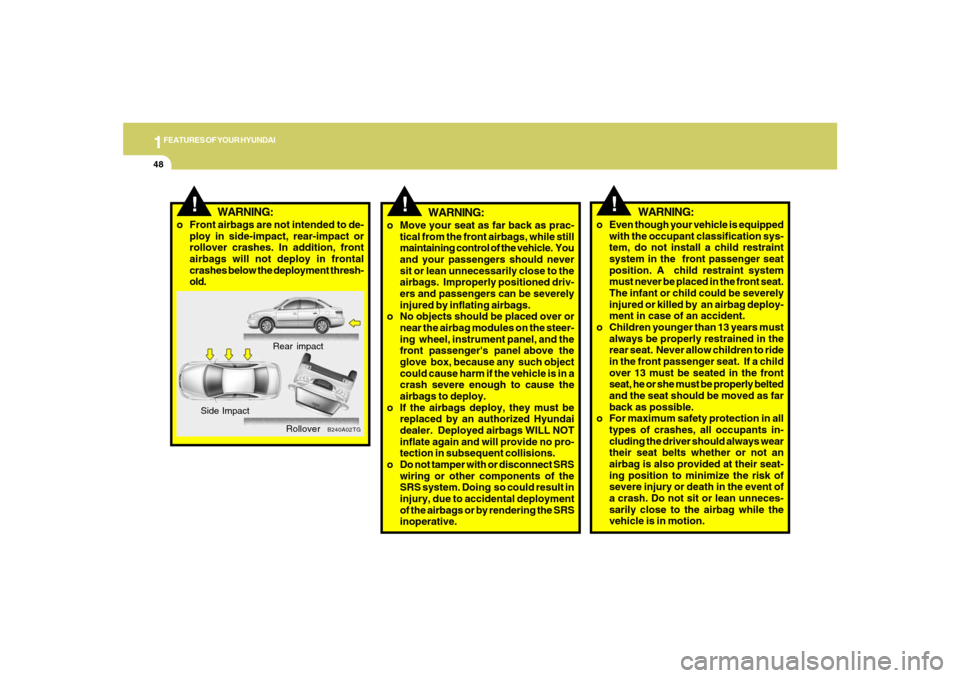
o Front airbags are not intended to de-
ploy in side-impact, rear-impact or
rollover crashes. In addition, front
airbags will not deploy in frontal
crashes below the deployment thresh-
old.
Page 64 of 308
1FEATURES OF YOUR HYUNDAI50
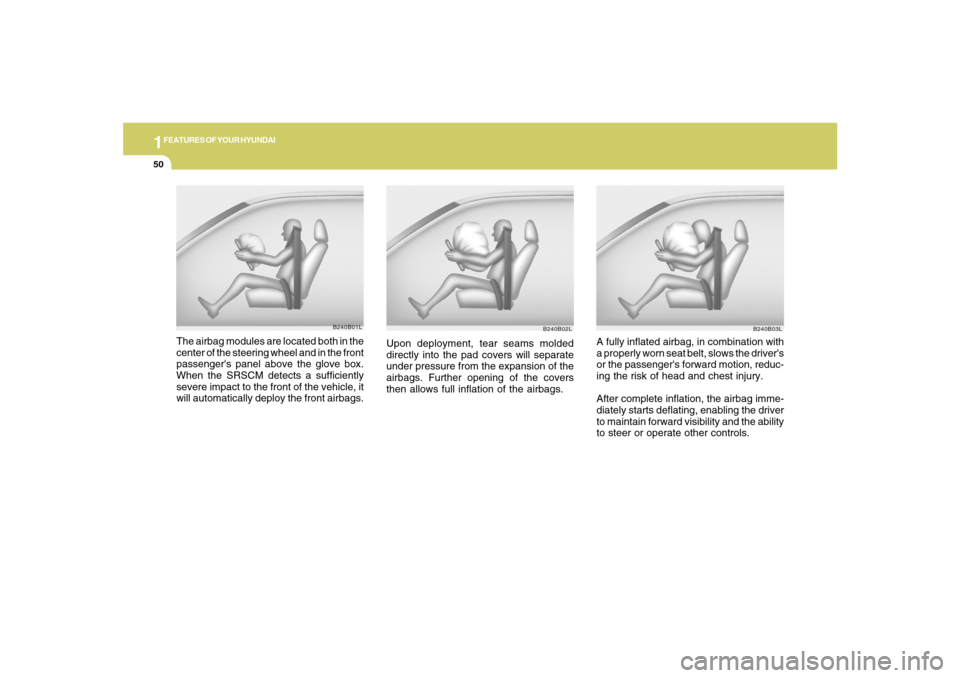
B240B02L
Upon deployment, tear seams molded
directly into the pad covers will separate
under pressure from the expansion of the
airbags. Further opening of the covers
then allows full inflation of the airbags.A fully inflated airbag, in combination with
a properly worn seat belt, slows the driver's
or the passenger's forward motion, reduc-
ing the risk of head and chest injury.
After complete inflation, the airbag imme-
diately starts deflating, enabling the driver
to maintain forward visibility and the ability
to steer or operate other controls.
B240B03L
The airbag modules are located both in the
center of the steering wheel and in the front
passenger's panel above the glove box.
When the SRSCM detects a sufficiently
severe impact to the front of the vehicle, it
will automatically deploy the front airbags.
B240B01L
Page 65 of 308
1
FEATURES OF YOUR HYUNDAI
51
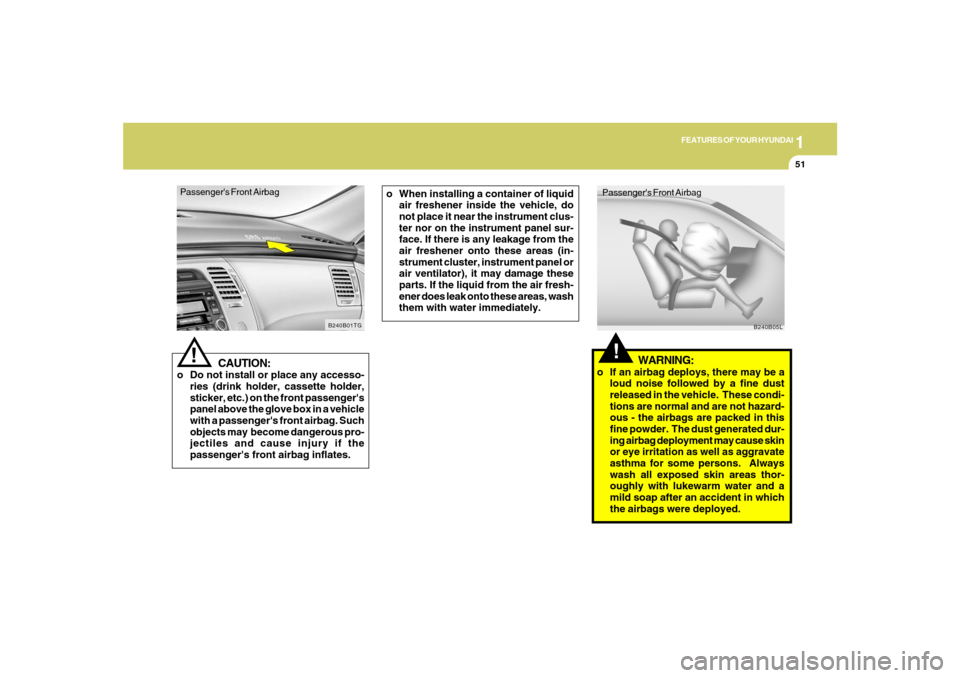
Passenger's Front Airbag
CAUTION:
o Do not install or place any accesso-
ries (drink holder, cassette holder,
sticker, etc.) on the front passenger's
panel above the glove box in a vehicle
with a passenger's front airbag. Such
objects may become dangerous pro-
jectiles and cause injury if the
passenger's front airbag inflates.
!
B240B01TG
!Passenger's Front Airbag
B240B05L
o When installing a container of liquid
air freshener inside the vehicle, do
not place it near the instrument clus-
ter nor on the instrument panel sur-
face. If there is any leakage from the
air freshener onto these areas (in-
strument cluster, instrument panel or
air ventilator), it may damage these
parts. If the liquid from the air fresh-
ener does leak onto these areas, wash
them with water immediately.
WARNING:
o If an airbag deploys, there may be a
loud noise followed by a fine dust
released in the vehicle. These condi-
tions are normal and are not hazard-
ous - the airbags are packed in this
fine powder. The dust generated dur-
ing airbag deployment may cause skin
or eye irritation as well as aggravate
asthma for some persons. Always
wash all exposed skin areas thor-
oughly with lukewarm water and a
mild soap after an accident in which
the airbags were deployed.
Page 74 of 308
1FEATURES OF YOUR HYUNDAI60
B240D02NF-AATAdditional Safety PrecautionsoNever let passengers ride in the cargo
area (trunk) or on top of a folded-down
back seat. All occupants should sit
upright, fully back in their seats with
their seat belts on and their feet on the
floor.
oPassengers should not move out of or
change seats while the vehicle is mov-
ing. A passenger who is not wearing a
seat belt during a crash or emergency
stop can be thrown against the inside of
the vehicle, against other occupants, or
out of the vehicle.
oEach seat belt is designed to restrain
one occupant. If more than one person
uses the same seat belt, they could be
seriously injured or killed in a collision.
oDo not use any accessories on seat
belts. Devices claiming to improve oc-
cupant comfort or reposition the seat
belt can reduce the protection provided
by the seat belt and increase the chance
of serious injury in a crash.
oPassengers should not place hard or
sharp objects between themselves
and the airbags. Carrying hard or sharp
objects on your lap or in your mouth can
result in injuries if an airbag inflates.
WARNING:
o Do not install a child restraint system
in the front passenger seat position.
A child restraint system must never
be placed in the front seat. The infant
or child could be severely injured by
an airbag deployment in case of an
accident.
o Modification to SRS components or
wiring, including the addition of any
kind of badges to the pad covers or
modifications to the body structure,
can adversely affect SRS perfor-
mance and lead to possible injury.
o For cleaning the airbag pad covers,
use only a soft, dry cloth or one which
has been moistened with plain water.
Solvents or cleaners could adversely
affect the airbag covers and proper
deployment of the system.
o No objects should be placed over or
near the airbag modules on the steer-
ing wheel, instrument panel, and the
front passenger's panel above the
glove box, because any such object
could cause harm if the vehicle is in a
crash severe enough to cause the
airbags to inflate.
!
o If the airbags inflate, they must be
replaced by an authorized Hyundai
dealer.
o Do not tamper with or disconnect SRS
wiring, or other components of the
SRS system. Doing so could result in
injury, due to accidental inflation of
the airbags or by rendering the SRS
inoperative.
o If components of the airbag system
must be discarded, or if the vehicle
must be scrapped, certain safety pre-
cautions must be observed. Your
Hyundai dealer knows these precau-
tions and can give you the necessary
information. Failure to follow these
precautions and procedures could in-
crease the risk of personal injury.
o If your car was flooded and has soaked
carpeting or water on flooring, you
shouldn't try to start the engine; have
the car towed to an authorized Hyundai
dealer.
!
WARNING:
Page 107 of 308
1
FEATURES OF YOUR HYUNDAI
93
!
CAUTION:
o Do not open the sunroof in severely
cold temperatures or when it is cov-
ered with ice or snow.
o Periodically remove any dirt that may
have accumulated on the guide rails.
o Do not press any sunroof control but-
ton longer than necessary. Damage
to the motor or system components
could occur.
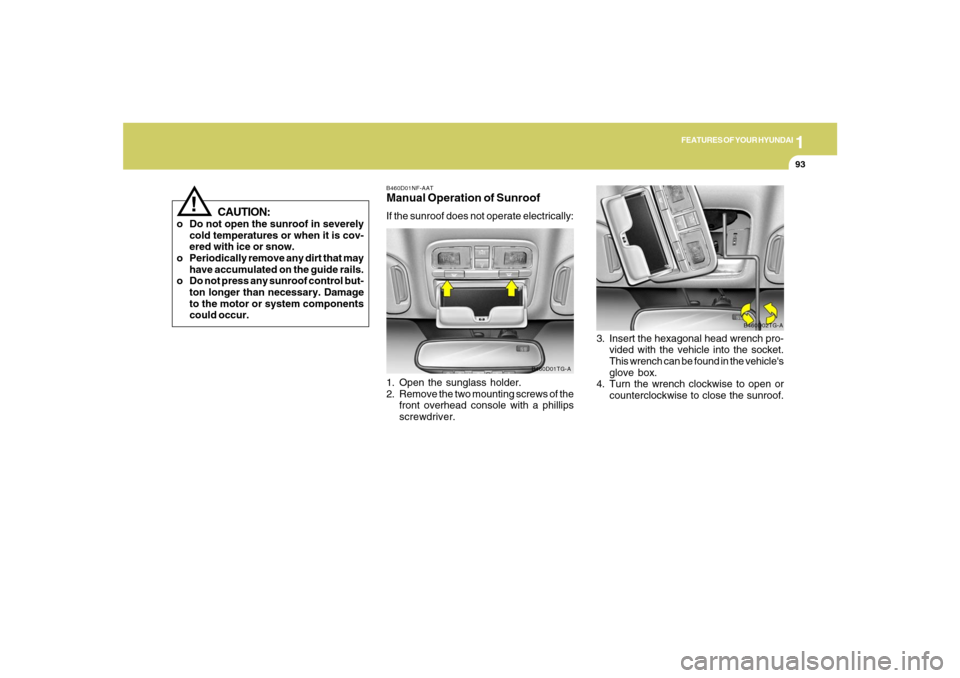
B460D01NF-AATManual Operation of SunroofIf the sunroof does not operate electrically:
1. Open the sunglass holder.
2. Remove the two mounting screws of the
front overhead console with a phillips
screwdriver.
B460D01TG-A
3. Insert the hexagonal head wrench pro-
vided with the vehicle into the socket.
This wrench can be found in the vehicle's
glove box.
4. Turn the wrench clockwise to open or
counterclockwise to close the sunroof.
B460D02TG-A