power steering Hyundai Azera 2015 User Guide
[x] Cancel search | Manufacturer: HYUNDAI, Model Year: 2015, Model line: Azera, Model: Hyundai Azera 2015Pages: 473, PDF Size: 11.92 MB
Page 347 of 473
Driving your vehicle
64 5
• Remember, your vehicle does not
require extended warm-up. After the
engine has started, allow the engine to
run for 10 to 20 seconds prior to plac-
ing the vehicle in gear. In very cold
weather, however, give your engine a
slightly longer warm-up period.
• Do not "lug" or "over-rev" the engine.
Lugging is driving very slowly in too
high a gear resulting in engine bucking.
If this happens, shift to a lower gear.
Over-revving is racing the engine
beyond its safe limit. This can be avoid-
ed by shifting at the recommended
speeds.• Use your air conditioning sparingly.
The air conditioning system is operat-
ed by engine power so your fuel econ-
omy is reduced when you use it.
• Open windows at high speeds can
reduce fuel economy.
• Fuel economy is less in crosswinds
and headwinds. To help offset some of
this loss, slow down when driving in
these conditions.
Keeping a vehicle in good operating con-
dition is important both for economy and
safety. Therefore, we recommend that the
system be serviced by an authorized
HYUNDAI dealer.
WARNING - Engine off dur-
ing motion
Never turn the engine off to coast
down hills or anytime the vehicle is
in motion. The power steering and
power brakes will not function
properly without the engine run-
ning. Instead, keep the engine on
and downshift to an appropriate
gear for engine braking effect. In
addition, turning off the ignition
while driving could engage the
steering wheel lock resulting in
loss of vehicle steering which
could cause serious injury or
death.
Page 380 of 473
623
What to do in an emergency
If towing service is not available in an
emergency, your vehicle may be temporar-
ily towed using a cable or chain secured to
the emergency towing hook under the
front/rear of the vehicle. Use extreme cau-
tion when towing the vehicle. A driver must
be in the vehicle to steer it and operate the
brakes.
Towing in this manner may be done only
on hard-surfaced roads for a short dis-
tance and at low speeds. Also, the wheels,
axles, power train, steering and brakes
must all be in good condition.
• Do not use the tow hooks to pull a vehi-
cle out of mud, sand or other conditions
from which the vehicle cannot be driven
out under its own power.
• Avoid towing a vehicle heavier than the
vehicle doing the towing.
• The drivers of both vehicles should com-
municate with each other frequently.• Before emergency towing, check that
the hook is not broken or damaged.
• Fasten the towing cable or chain
securely to the hook.
• Do not jerk the hook. Apply steady and
even force.
• To avoid damaging the hook, do not
pull from the side or at a vertical angle.
Always pull straight ahead.CAUTION
• Attach a towing strap to the tow
hook.
• Using a portion of the vehicle
other than the tow hooks for tow-
ing may damage the body of your
vehicle.
• Use only a cable or chain specifi-
cally intended for use in towing
vehicles. Securely fasten the
cable or chain to the towing hook
provided.WARNING
Use extreme caution when towing
the vehicle.
• Avoid sudden starts or erratic
driving maneuvers which would
place excessive stress on the
emergency towing hook and tow-
ing cable or chain. The hook and
towing cable or chain may break
and cause serious injury or dam-
age.
• If the disabled vehicle is unable
to be moved, do not forcibly con-
tinue the towing. We recommend
that you contact an authorized
HYUNDAI dealer or a commercial
tow truck service for assistance.
• Tow the vehicle as straight ahead
as possible.
• Keep away from the vehicle dur-
ing towing.
Page 381 of 473
What to do in an emergency
24 6
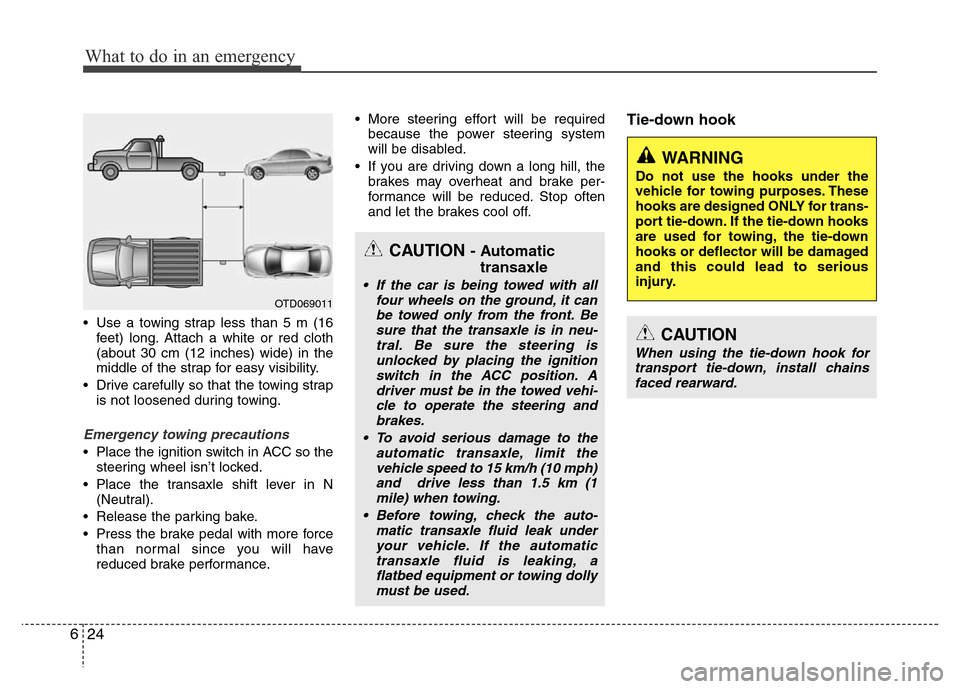
• Use a towing strap less than 5 m (16
feet) long. Attach a white or red cloth
(about 30 cm (12 inches) wide) in the
middle of the strap for easy visibility.
• Drive carefully so that the towing strap
is not loosened during towing.
Emergency towing precautions
• Place the ignition switch in ACC so the
steering wheel isn’t locked.
• Place the transaxle shift lever in N
(Neutral).
• Release the parking bake.
• Press the brake pedal with more force
than normal since you will have
reduced brake performance.• More steering effort will be required
because the power steering system
will be disabled.
• If you are driving down a long hill, the
brakes may overheat and brake per-
formance will be reduced. Stop often
and let the brakes cool off.
Tie-down hook
CAUTION - Automatic
transaxle
• If the car is being towed with all
four wheels on the ground, it can
be towed only from the front. Be
sure that the transaxle is in neu-
tral. Be sure the steering is
unlocked by placing the ignition
switch in the ACC position. A
driver must be in the towed vehi-
cle to operate the steering and
brakes.
• To avoid serious damage to the
automatic transaxle, limit the
vehicle speed to 15 km/h (10 mph)
and drive less than 1.5 km (1
mile) when towing.
• Before towing, check the auto-
matic transaxle fluid leak under
your vehicle. If the automatic
transaxle fluid is leaking, a
flatbed equipment or towing dolly
must be used.
OTD069011
WARNING
Do not use the hooks under the
vehicle for towing purposes. These
hooks are designed ONLY for trans-
port tie-down. If the tie-down hooks
are used for towing, the tie-down
hooks or deflector will be damaged
and this could lead to serious
injury.
CAUTION
When using the tie-down hook for
transport tie-down, install chains
faced rearward.
Page 383 of 473
7
Engine compartment / 7-2
Maintenance services / 7-3
Owner maintenance / 7-4
Scheduled maintenance service / 7-6
Explanation of scheduled maintenance items / 7-24
Engine oil / 7-27
Engine coolant / 7-28
Brake fluid / 7-31
Power steering fluid / 7-32
Washer fluid / 7-33
Parking brake / 7-33
Air cleaner / 7-34
Climate control air filter / 7-36
Wiper blades / 7-38
Battery / 7-40
Tires and wheels / 7-43
Fuses / 7-53
Light bulbs / 7-65
Appearance care / 7-74
Emission control system / 7-80
Maintenance
Page 384 of 473
Maintenance
2 7
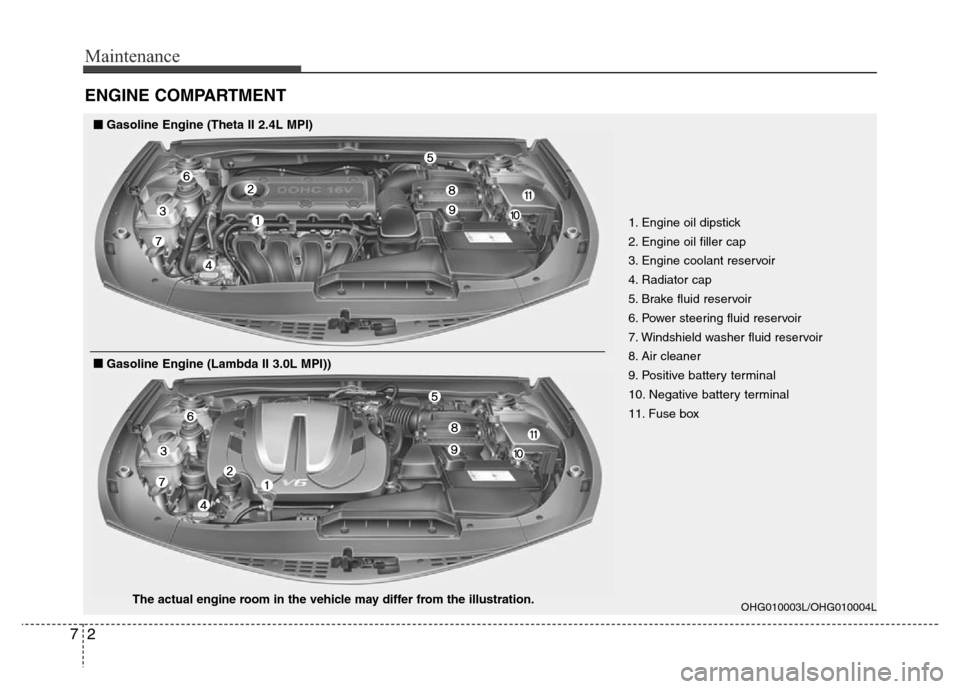
ENGINE COMPARTMENT
1. Engine oil dipstick
2. Engine oil filler cap
3. Engine coolant reservoir
4. Radiator cap
5. Brake fluid reservoir
6. Power steering fluid reservoir
7. Windshield washer fluid reservoir
8. Air cleaner
9.
Positive battery terminal
10. Negative battery terminal
11. Fuse box
OHG010003L/OHG010004L
■Gasoline Engine (Theta II 2.4L MPI)
■Gasoline Engine (Lambda II 3.0L MPI))
The actual engine room in the vehicle may differ from the illustration.
Page 388 of 473
Maintenance
6 7
SCHEDULED MAINTENANCE SERVICE
At least once a year:
• Clean body and door drain holes.
• Lubricate door hinges and checks, and
hood hinges.
• Lubricate door and hood locks and
latches.
• Lubricate door rubber weatherstrips.
• Check the air conditioning system.
• Check the power steering fluid level.
• Inspect and lubricate automatic
transaxle linkage and controls.
• Clean battery and terminals.
• Check the brake fluid level.Follow Normal Maintenance Schedule if
the vehicle is usually operated where
none of the following conditions apply. If
any of the following conditions apply, fol-
low Maintenance Under Severe Usage
Conditions.
• Repeated short distance driving.
• Driving in dusty conditions or sandy
areas.
• Extensive use of brakes.
• Driving in areas where salt or other
corrosive materials are being used.
• Driving on rough or muddy roads.
• Driving in mountainous areas.
• Extended periods of idling or low
speed operation.
• Driving for a prolonged period in cold
temperatures and/or extremely humid
climates.
• More than 50% driving in heavy city
traffic during hot weather above 32°C
(90°F).
If your vehicle is operated under the
above conditions, you should inspect,
replace or refill more frequently than the
following Normal Maintenance Schedule.
After the periods or distance shown in
the chart, continue to follow the pre-
scribed maintenance intervals.
Page 389 of 473
77
Maintenance
NORMAL MAINTENANCE SCHEDULE - EXCEPT EUROPE
The following maintenance services must be performed to ensure good emission control and performance. Keep receipts for all
vehicle emission services to protect your warranty. Where both mileage and time are shown, the frequency of service is deter-
mined by whichever occurs first.
❈Inspect : Inspect and if necessary, adjust, correct, clean or replace
*
1: Check the engine oil level and leak every 500 km (350
miles) or before starting a long trip.
*
2: Driving in summer season temperature over 40 °C (104 °F
- SAUDI, UAE, OMAN, KUWAIT, BAHRAIN, QATAR, IRAN,
YEMEN ETC) or driving over 170 km/h (106 mile/h) must
conform the severe driving condition.
*
3: Adjust alternator and power steering (and water pump drive
belt) and air conditioner drive belt (if equipped).
Inspect and if necessary repair or replace.
*
4: The fuel filter is considered to be maintenance free but peri-
odic inspection is recommended for this maintenance
schedule depends on fuel quality. If there are some impor-
tant matters like fuel flow restriction, surging, loss of power,
hard starting problem etc, replace the fuel filter immediate-
ly regardless of maintenance schedule and we recommend
that you consult an authorized HYUNDAI dealer.*
5: For your convenience, it can be replaced prior to it's interval
when you do maintenance of other items.
*
6: Inspect for excessive valve noise and/or engine vibration
and adjust if necessary. We recommend that the system be
checked by an authorized HYUNDAI dealer.
*
7: When adding coolant, use only deionized water or soft
water for your vehicle and never mix hard water in the
coolant filled at the factory. An improper coolant mixture can
result in serious malfunction or engine damage.
*
8: If good quality gasolines meet Europe Fuel standards
(EN228) or equivalents including fuel additives is not avail-
able, one bottle of additive is recommended. Additives are
available from your authorized HYUNDAI dealer along with
information on how to use them. Do not mix other additives.
Page 390 of 473
Maintenance
8 7
NORMAL MAINTENANCE SCHEDULE - EXCEPT EUROPE (CONT.)
15,000 km (10,000 miles) or 12months
❑ Inspect air cleaner filter - Except Middle East
❑ Inspect air conditioner refrigerant/compressor (if equipped)
❑ Inspect battery condition
❑ Inspect brake lines, hoses and connections
❑ Inspect brake fluid
❑ Inspect disc brakes and pads
❑ Inspect exhaust system
❑ Inspect front suspension ball joints
❑ Inspect parking brake
❑ Inspect power steering fluid and hoses
❑ Inspect steering gear rack, linkage and boots
❑ Inspect tire (pressure & tread wear)
❑ Replace air cleaner filter - For Middle East
❑ Replace climate control air filter (if equipped)
❑ Replace engine oil and filter
- Except Middle East *
1
❑ Replace engine oil and filter - For Middle East *1 *2
(Every 10,000 km (6,500 miles) or 12months)
❑ Add fuel additives *8
(Every 5,000 km or 6months)
30,000 km (20,000 miles) or 24months
❑ Inspect air cleaner filter - Except Middle East
❑ Inspect air conditioner refrigerant/compressor (if equipped)
❑ Inspect battery condition
❑ Inspect brake lines, hoses and connections
❑ Inspect brake fluid
❑ Inspect disc brakes and pads
❑ Inspect drive belt *
3
❑ Inspect drive shafts and boots
❑ Inspect exhaust system
❑ Inspect front suspension ball joints
❑ Inspect fuel filter *
4
❑ Inspect fuel tank air filter
❑ Inspect parking brake
❑ Inspect power steering fluid and hoses
❑ Inspect steering gear rack, linkage and boots
❑ Inspect tire (pressure & tread wear)
❑ Replace air cleaner filter - For Middle East
❑ Replace climate control air filter (if equipped)
❑ Replace engine oil and filter
- Except Middle East *
1
(Continued)
Page 391 of 473
79
Maintenance
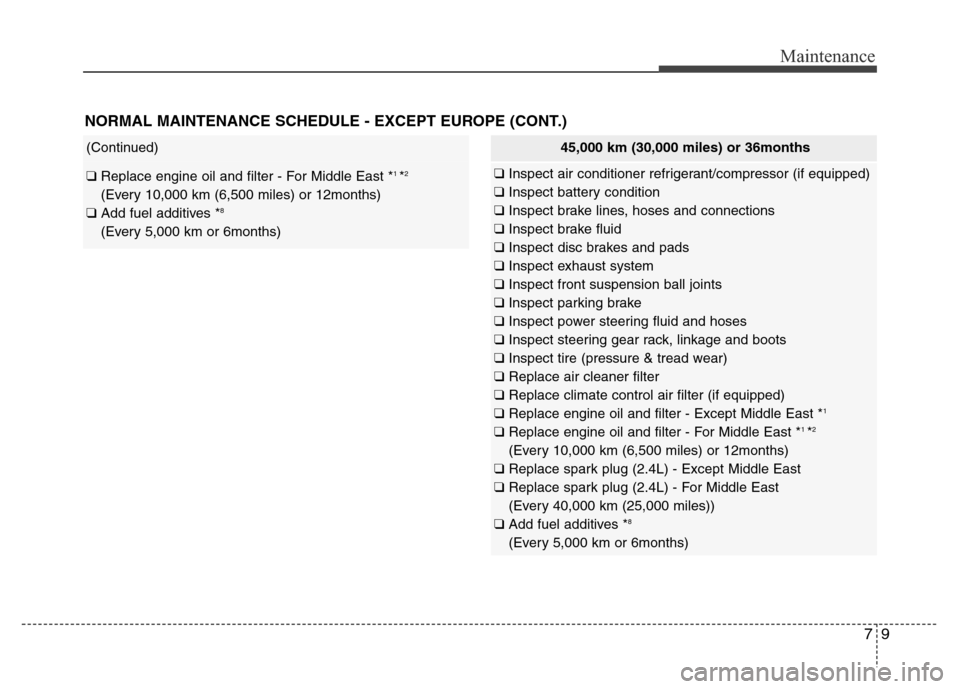
NORMAL MAINTENANCE SCHEDULE - EXCEPT EUROPE (CONT.)
(Continued)
❑ Replace engine oil and filter - For Middle East *1 *2
(Every 10,000 km (6,500 miles) or 12months)
❑ Add fuel additives *8
(Every 5,000 km or 6months)
45,000 km (30,000 miles) or 36months
❑ Inspect air conditioner refrigerant/compressor (if equipped)
❑ Inspect battery condition
❑ Inspect brake lines, hoses and connections
❑ Inspect brake fluid
❑ Inspect disc brakes and pads
❑ Inspect exhaust system
❑ Inspect front suspension ball joints
❑ Inspect parking brake
❑ Inspect power steering fluid and hoses
❑ Inspect steering gear rack, linkage and boots
❑ Inspect tire (pressure & tread wear)
❑ Replace air cleaner filter
❑ Replace climate control air filter (if equipped)
❑ Replace engine oil and filter - Except Middle East *
1
❑ Replace engine oil and filter - For Middle East *1 *2
(Every 10,000 km (6,500 miles) or 12months)
❑ Replace spark plug (2.4L) - Except Middle East
❑ Replace spark plug (2.4L) - For Middle East
(Every 40,000 km (25,000 miles))
❑ Add fuel additives *
8
(Every 5,000 km or 6months)
Page 392 of 473
Maintenance
10 7
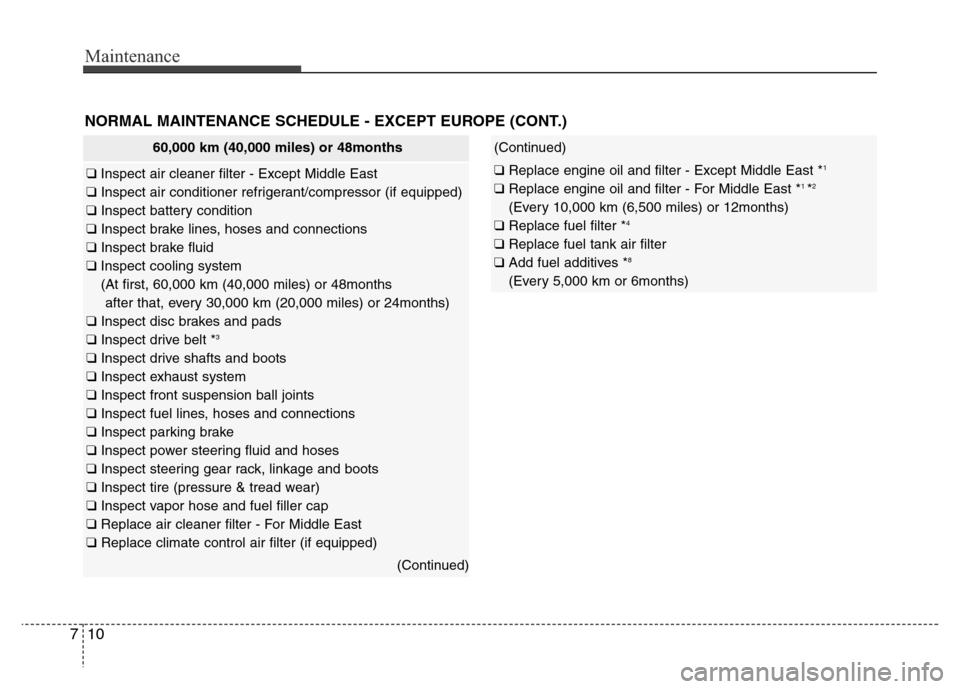
NORMAL MAINTENANCE SCHEDULE - EXCEPT EUROPE (CONT.)
60,000 km (40,000 miles) or 48months
❑ Inspect air cleaner filter - Except Middle East
❑ Inspect air conditioner refrigerant/compressor (if equipped)
❑ Inspect battery condition
❑ Inspect brake lines, hoses and connections
❑ Inspect brake fluid
❑ Inspect cooling system
(At first, 60,000 km (40,000 miles) or 48months
after that, every 30,000 km (20,000 miles) or 24months)
❑ Inspect disc brakes and pads
❑ Inspect drive belt *
3
❑ Inspect drive shafts and boots
❑ Inspect exhaust system
❑ Inspect front suspension ball joints
❑ Inspect fuel lines, hoses and connections
❑ Inspect parking brake
❑ Inspect power steering fluid and hoses
❑ Inspect steering gear rack, linkage and boots
❑ Inspect tire (pressure & tread wear)
❑ Inspect vapor hose and fuel filler cap
❑ Replace air cleaner filter - For Middle East
❑ Replace climate control air filter (if equipped)
(Continued)
(Continued)
❑ Replace engine oil and filter - Except Middle East *1
❑ Replace engine oil and filter - For Middle East *1 *2
(Every 10,000 km (6,500 miles) or 12months)
❑ Replace fuel filter *4
❑ Replace fuel tank air filter
❑ Add fuel additives *8
(Every 5,000 km or 6months)