instrument panel Hyundai Azera 2017 Owner's Guide
[x] Cancel search | Manufacturer: HYUNDAI, Model Year: 2017, Model line: Azera, Model: Hyundai Azera 2017Pages: 520, PDF Size: 16.33 MB
Page 184 of 520
4105
Features of your vehicle
The high beam switches to low beam
in the below conditions.
- When the Smart High Beam is off.
- When the light switch is not in theAUTO position.
- When the headlamp is detected from the on-coming vehicle.
- When the tail lamp is detected from the front vehicle.
- When the surrounding is bright enough high beams are not need-
ed.
- When streetlights or other lights are detected.
- When vehicle speed is below 22 mph (35 km/h).
Turn signals and lane change
signals
The ignition switch must be on for the
turn signals to function. To turn on
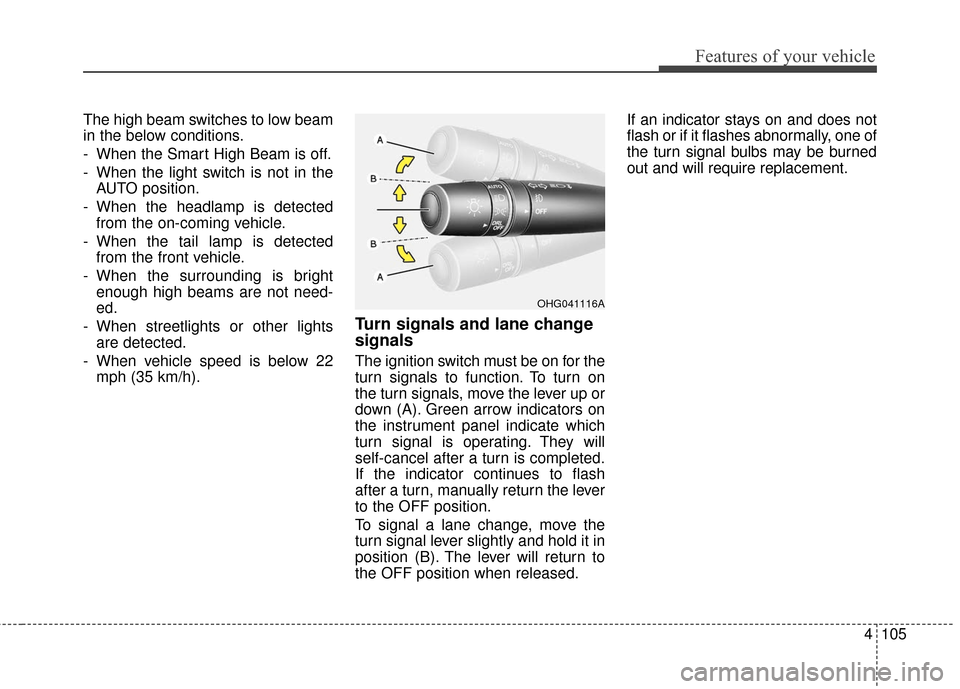
the turn signals, move the lever up or
down (A). Green arrow indicators on
the instrument panel indicate which
turn signal is operating. They will
self-cancel after a turn is completed.
If the indicator continues to flash
after a turn, manually return the lever
to the OFF position.
To signal a lane change, move the
turn signal lever slightly and hold it in
position (B). The lever will return to
the OFF position when released. If an indicator stays on and does not
flash or if it flashes abnormally, one of
the turn signal bulbs may be burned
out and will require replacement.
OHG041116A
Page 191 of 520
Features of your vehicle
112
4
DEFROSTER
✽
✽ NOTICE
If you want to defrost and defog
the front windshield, refer to
“Windshield defrosting and defog-
ging” in this section.
Rear window defroster
The defroster heats the window to
remove frost, fog and thin ice from
the rear window, while the engine is
running.
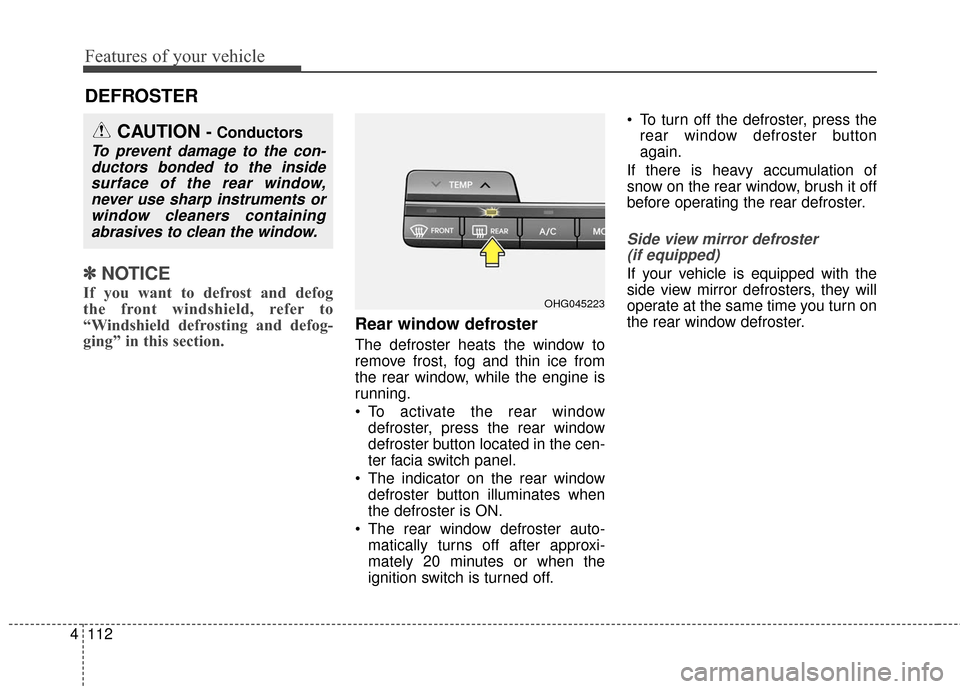
To activate the rear window
defroster, press the rear window
defroster button located in the cen-
ter facia switch panel.
The indicator on the rear window defroster button illuminates when
the defroster is ON.
The rear window defroster auto- matically turns off after approxi-
mately 20 minutes or when the
ignition switch is turned off. To turn off the defroster, press the
rear window defroster button
again.
If there is heavy accumulation of
snow on the rear window, brush it off
before operating the rear defroster.
Side view mirror defroster (if equipped)
If your vehicle is equipped with the
side view mirror defrosters, they will
operate at the same time you turn on
the rear window defroster.
CAUTION - Conductors
To prevent damage to the con-ductors bonded to the insidesurface of the rear window,never use sharp instruments orwindow cleaners containingabrasives to clean the window.
OHG045223
Page 194 of 520
4115
Features of your vehicle
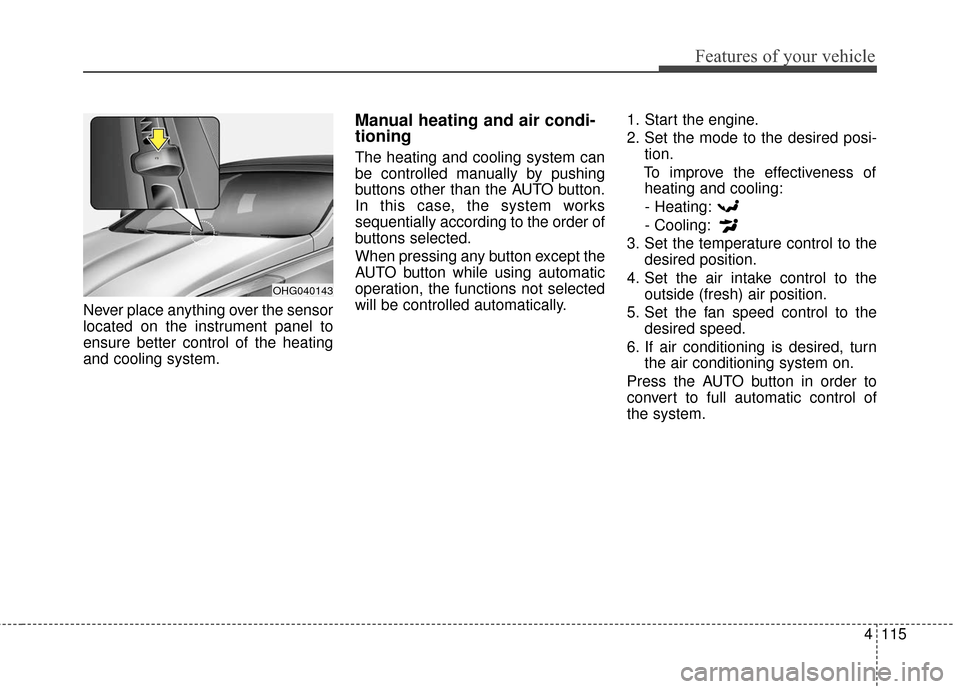
Never place anything over the sensor
located on the instrument panel to
ensure better control of the heating
and cooling system.
Manual heating and air condi-
tioning
The heating and cooling system can
be controlled manually by pushing
buttons other than the AUTO button.
In this case, the system works
sequentially according to the order of
buttons selected.
When pressing any button except the
AUTO button while using automatic
operation, the functions not selected
will be controlled automatically.1. Start the engine.
2. Set the mode to the desired posi-
tion.
To improve the effectiveness of heating and cooling:
- Heating:
- Cooling:
3. Set the temperature control to the desired position.
4. Set the air intake control to the outside (fresh) air position.
5. Set the fan speed control to the desired speed.
6. If air conditioning is desired, turn the air conditioning system on.
Press the AUTO button in order to
convert to full automatic control of
the system.
OHG040143
Page 196 of 520

4117
Features of your vehicle
Floor-Level (A, C, D, E)
Most of the air flow is directed to the
floor, with a small amount of air
directed to the windshield and side
window defrosters.
Bi-Level (B, C, D, E, F)
Air flow is directed towards the face
and the floor.
Face-Level (B, C, D, E, F)
Air flow is directed toward the upper
body and face. Additionally, each
outlet can be controlled to direct the
air discharged from the outlet.
Floor & Defrost (A, C, D, E)
Most of the air flow is directed to the
floor and the windshield with a small
amount directed to the side window
defrosters. Defrost-Level
Most of the air flow is directed to the
windshield with a small amount of air
directed to the side window defrosters.
✽ ✽
NOTICE
The defrost mode is more effective
when a warmer air temperature set-
ting is selected.
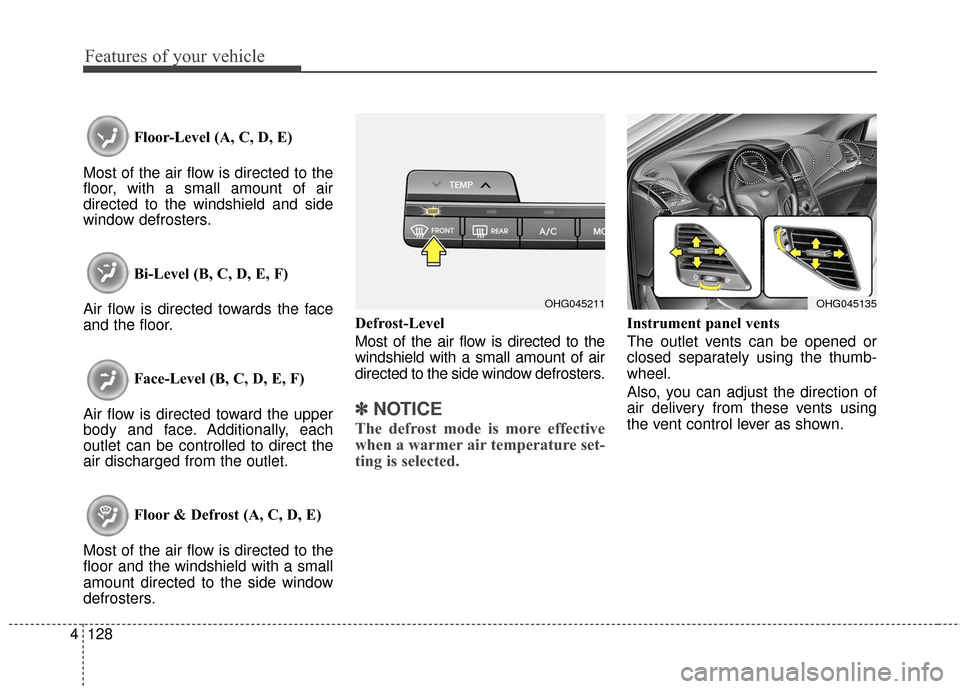
Instrument panel vents
The outlet vents can be opened or
closed separately using the thumb-
wheel.
Also, you can adjust the direction of
air delivery from these vents using
the vent control lever as shown.
OHG045135OHG045211
Page 205 of 520
Features of your vehicle
126
4
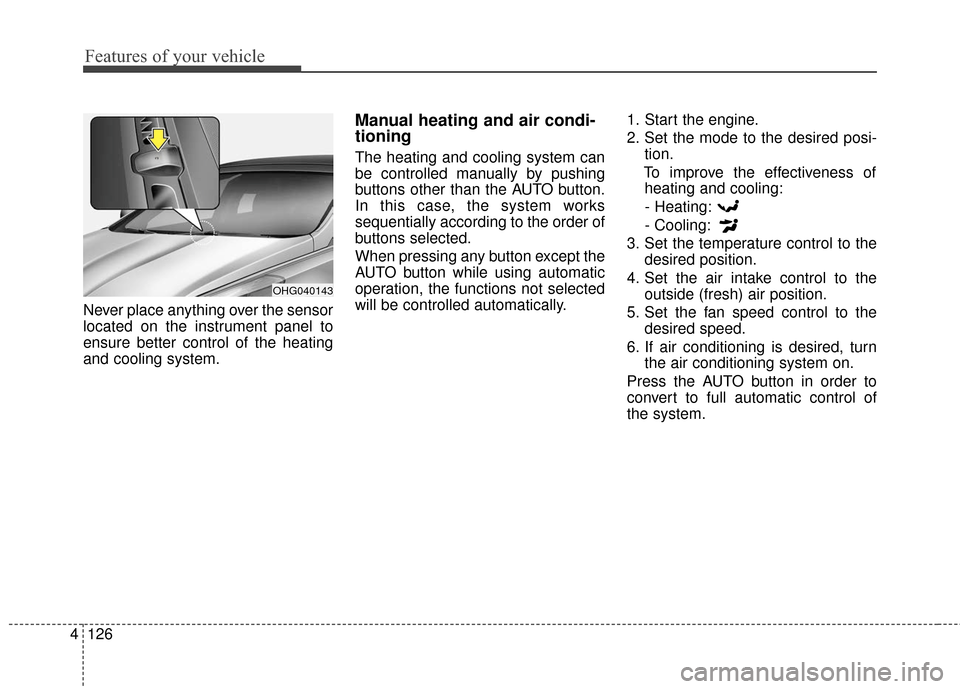
Never place anything over the sensor
located on the instrument panel to
ensure better control of the heating
and cooling system.
Manual heating and air condi-
tioning
The heating and cooling system can
be controlled manually by pushing
buttons other than the AUTO button.
In this case, the system works
sequentially according to the order of
buttons selected.
When pressing any button except the
AUTO button while using automatic
operation, the functions not selected
will be controlled automatically. 1. Start the engine.
2. Set the mode to the desired posi-
tion.
To improve the effectiveness of heating and cooling:
- Heating:
- Cooling:
3. Set the temperature control to the desired position.
4. Set the air intake control to the outside (fresh) air position.
5. Set the fan speed control to the desired speed.
6. If air conditioning is desired, turn the air conditioning system on.
Press the AUTO button in order to
convert to full automatic control of
the system.
OHG040143
Page 207 of 520
Features of your vehicle
128
4
Floor-Level (A, C, D, E)
Most of the air flow is directed to the
floor, with a small amount of air
directed to the windshield and side
window defrosters.
Bi-Level (B, C, D, E, F)
Air flow is directed towards the face
and the floor.
Face-Level (B, C, D, E, F)
Air flow is directed toward the upper
body and face. Additionally, each
outlet can be controlled to direct the
air discharged from the outlet.
Floor & Defrost (A, C, D, E)
Most of the air flow is directed to the
floor and the windshield with a small
amount directed to the side window
defrosters. Defrost-Level
Most of the air flow is directed to the
windshield with a small amount of air
directed to the side window defrosters.
✽ ✽
NOTICE
The defrost mode is more effective
when a warmer air temperature set-
ting is selected.
Instrument panel vents
The outlet vents can be opened or
closed separately using the thumb-
wheel.
Also, you can adjust the direction of
air delivery from these vents using
the vent control lever as shown.
OHG045135OHG045211
Page 468 of 520
Maintenance
52
7
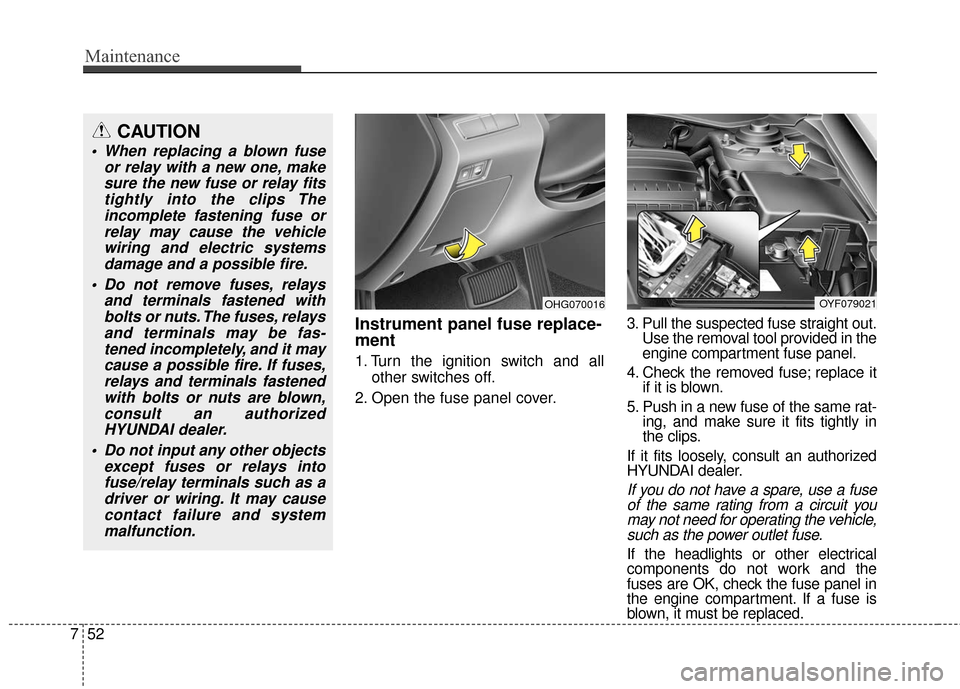
Instrument panel fuse replace-
ment
1. Turn the ignition switch and all
other switches off.
2. Open the fuse panel cover. 3. Pull the suspected fuse straight out.
Use the removal tool provided in the
engine compartment fuse panel.
4. Check the removed fuse; replace it if it is blown.
5. Push in a new fuse of the same rat- ing, and make sure it fits tightly in
the clips.
If it fits loosely, consult an authorized
HYUNDAI dealer.
If you do not have a spare, use a fuse of the same rating from a circuit youmay not need for operating the vehicle,such as the power outlet fuse.
If the headlights or other electrical
components do not work and the
fuses are OK, check the fuse panel in
the engine compartment. If a fuse is
blown, it must be replaced.
OHG070016OYF079021
CAUTION
When replacing a blown fuse
or relay with a new one, makesure the new fuse or relay fitstightly into the clips Theincomplete fastening fuse orrelay may cause the vehiclewiring and electric systemsdamage and a possible fire.
Do not remove fuses, relays and terminals fastened withbolts or nuts. The fuses, relaysand terminals may be fas-tened incompletely, and it maycause a possible fire. If fuses,relays and terminals fastenedwith bolts or nuts are blown,consult an authorizedHYUNDAI dealer.
Do not input any other objects except fuses or relays intofuse/relay terminals such as adriver or wiring. It may causecontact failure and systemmalfunction.
Page 471 of 520
755
Maintenance
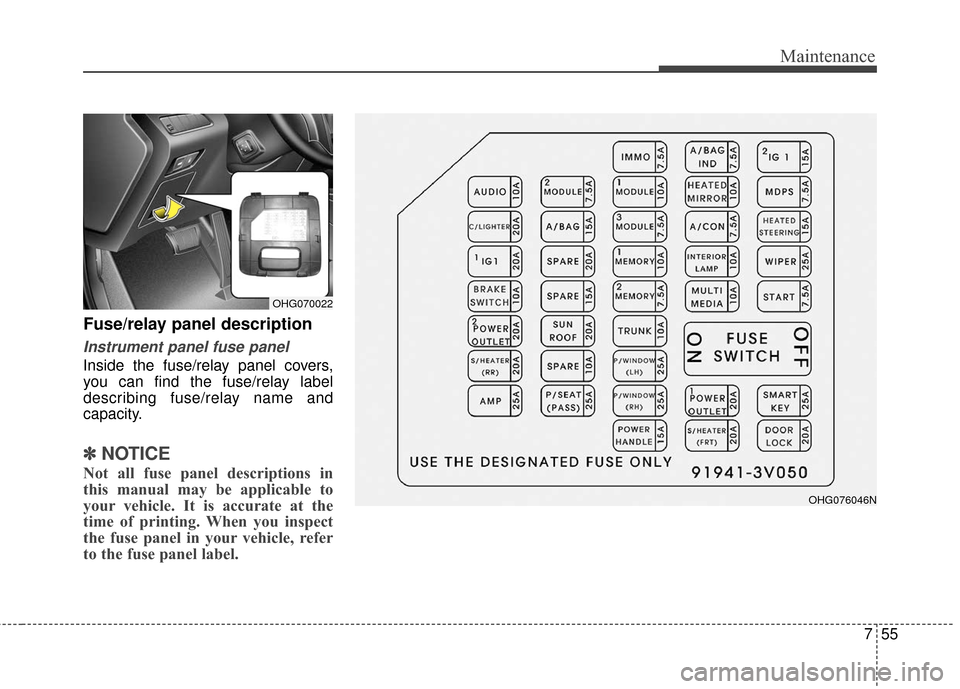
Fuse/relay panel description
Instrument panel fuse panel
Inside the fuse/relay panel covers,
you can find the fuse/relay label
describing fuse/relay name and
capacity.
✽ ✽NOTICE
Not all fuse panel descriptions in
this manual may be applicable to
your vehicle. It is accurate at the
time of printing. When you inspect
the fuse panel in your vehicle, refer
to the fuse panel label.
OHG076046N
OHG070022
Page 472 of 520
Maintenance
56
7
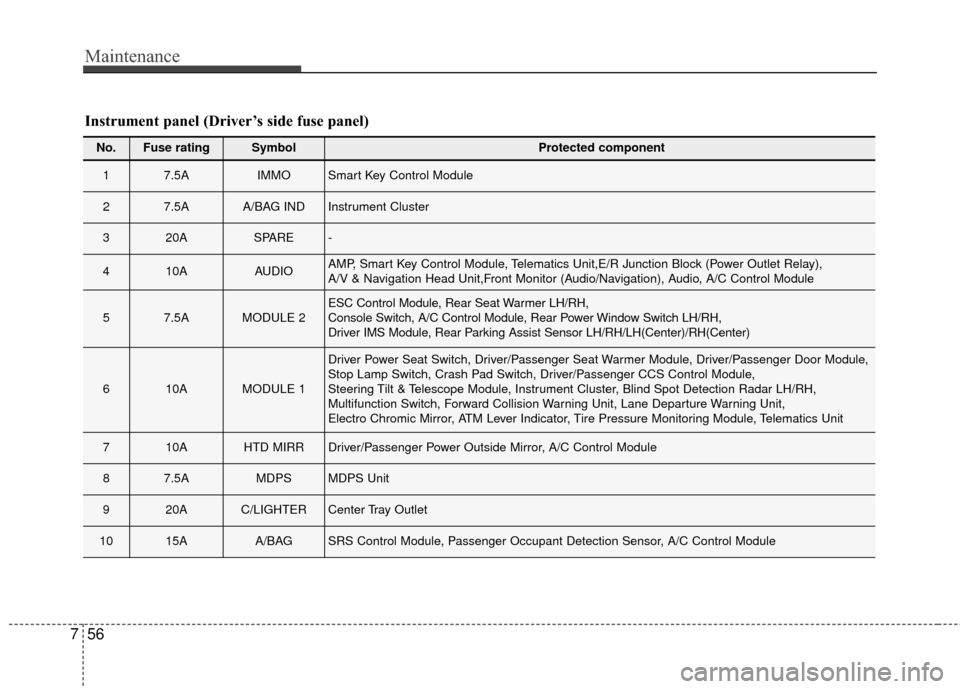
Instrument panel (Driver’s side fuse panel)
No.Fuse ratingSymbol Protected component
17.5AIMMOSmart Key Control Module
27.5A A/BAG INDInstrument Cluster
320ASPARE-
410AAUDIOAMP, Smart Key Control Module, Telematics Unit,E/R Junction Block (Power Outlet Relay),
A/V & Navigation Head Unit,Front Monitor (Audio/Navigation), Audio, A/C Control Module
57.5AMODULE 2ESC Control Module, Rear Seat Warmer LH/RH,
Console Switch, A/C Control Module, Rear Power Window Switch LH/RH,
Driver IMS Module, Rear Parking Assist Sensor LH/RH/LH(Center)/RH(Center)
610AMODULE 1
Driver Power Seat Switch, Driver/Passenger Seat Warmer Module, Driver/Passenger Door Module,
Stop Lamp Switch, Crash Pad Switch, Driver/Passenger CCS Control Module,
Steering Tilt & Telescope Module, Instrument Cluster, Blind Spot Detection Radar LH/RH,
Multifunction Switch, Forward Collision Warning Unit, Lane Departure Warning Unit,
Electro Chromic Mirror, ATM Lever Indicator, Tire Pressure Monitoring Module, Telematics Unit
710AHTD MIRRDriver/Passenger Power Outside Mirror, A/C Control Module
87.5AMDPSMDPS Unit
920AC/LIGHTERCenter Tray Outlet
1015AA/BAGSRS Control Module, Passenger Occupant Detection Sensor, A/C Control Module
Page 511 of 520
I3
Index
Bulb replacement, see light bulbs..................................7-63
Bulb wattage ....................................................................8-2
Button start/stop, see engine start/stop button ................5-5
California perchlorate notice ........................................7-82
Capacities (Lubricants) ....................................................8-5
CareExterior care ..............................................................7-72
Interior care ..............................................................7-78
Tire care ....................................................................7-37\
Cargo capacity ..............................................................5-84
Cargo weight ..................................................................5-87
Center console storage ................................................4-137
Central door lock switch................................................4-17
Certification label ..................................................5-85, 8-7
Chains Tire chains ................................................................5-79
Changing tires ................................................................6-14
Checking tire inflation pressure ....................................7-38
Child restraint system ....................................................3-28 Lower anchor ............................................................3-34
Seat belt ....................................................................3-30\
Tether anchor system ................................................3-33
Child-protector rear door lock ......................................4-18
Climate control air filter ..................................4-123, 4-133
Climate control air filter replacement............................7-30
Clock (Digital) ............................................................4-142 Clothes hanger ............................................................4-143
Combined instrument, see instrument cluster ..............4-58
Compact spare tire ........................................................6-18
Compact spare tire replacement ....................................7-41
Coolant ........................................................................\
..7-24
Cooling fluid, see engine coolant ..................................7-24
Crankcase emission control system ..............................7-79
Cruise control system ....................................................5-38
Cup holder ..................................................................4-139
Cup holder (rear) ..........................................................3-15
Curtain air bag ..............................................................3-51
Dashboard illumination, see instrument panel
illumination ................................................................4-59
Dashboard, see instrument cluster ................................4-58
Daytime running light (DRL) ......................................4-101
Defogging (Windshield) ..............................................4-135
Defogging logic (Windshield) ....................................4-137
Defroster (Rear window) ............................................4-112
Defrosting (Windshield) ..............................................4-136
Digital clock ................................................................4-142
Dimensions ......................................................................8-\
2
Display illumination, see instrument panel illumination ................................................................4-59
Displays, see instrument cluster ....................................4-58
Door courtesy lamp ....................................................4-111
C
D