parking brake Hyundai Azera 2017 Owner's Guide
[x] Cancel search | Manufacturer: HYUNDAI, Model Year: 2017, Model line: Azera, Model: Hyundai Azera 2017Pages: 520, PDF Size: 16.33 MB
Page 327 of 520
523
Driving your vehicle
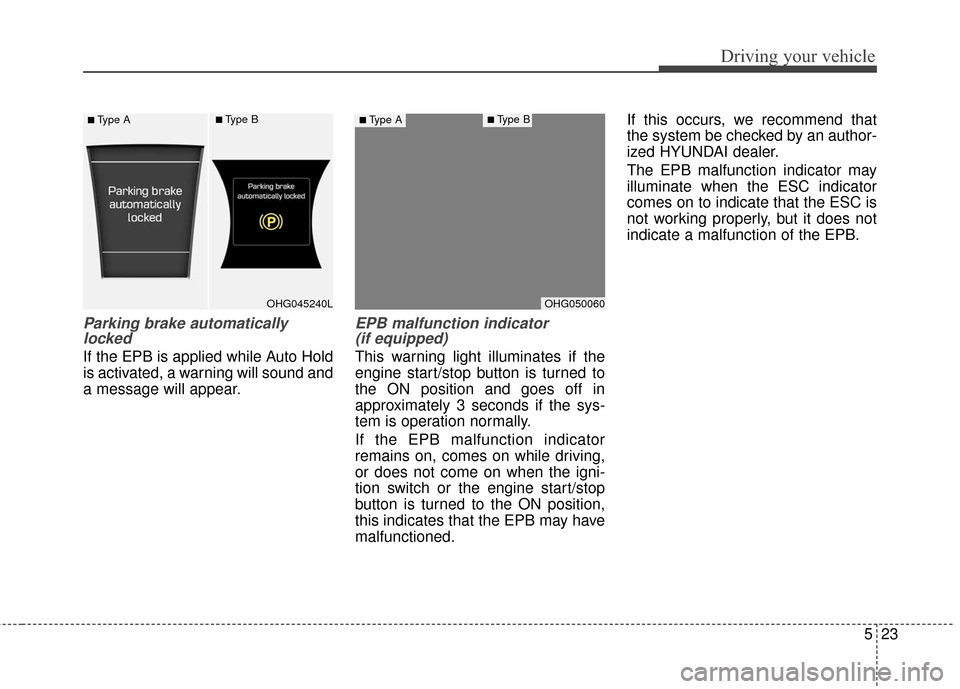
Parking brake automaticallylocked
If the EPB is applied while Auto Hold
is activated, a warning will sound and
a message will appear.
EPB malfunction indicator (if equipped)
This warning light illuminates if the
engine start/stop button is turned to
the ON position and goes off in
approximately 3 seconds if the sys-
tem is operation normally.
If the EPB malfunction indicator
remains on, comes on while driving,
or does not come on when the igni-
tion switch or the engine start/stop
button is turned to the ON position,
this indicates that the EPB may have
malfunctioned. If this occurs, we recommend that
the system be checked by an author-
ized HYUNDAI dealer.
The EPB malfunction indicator may
illuminate when the ESC indicator
comes on to indicate that the ESC is
not working properly, but it does not
indicate a malfunction of the EPB.
OHG045240L
■Type A■Type B
OHG050060
■Type A■Type B
Page 328 of 520
Driving your vehicle
24
5
Emergency braking
If there is a problem with the brake
pedal while driving, emergency brak-
ing is possible by pulling up and
holding the EPB switch. Braking is
possible only while you are holding
the EPB switch.
✽ ✽
NOTICE
During emergency braking by the
EPB, the parking brake warning
light will illuminate to indicate that
the system is operating.
WARNING
Do not operate the parking
brake while the vehicle is mov-
ing except in an emergency sit-
uation.
CAUTION
The EPB warning light may
illuminate if the EPB switch isoperated abnormally or EPB isoperated while the battery isweak due to personallyinstalled equipment and soon. Shut the engine off andturn it on again after a fewseconds. Then wait for a while,pull the EPB switch and pushthe EPB switch with brakepedal depressed. The warninglight will go off and the EPBwill operate normally. If AutoHold lamp is yellow, then shutthe engine off and turn it ononce more. However, if theEPB warning light is still on,we recommend that the sys-tem be checked by an author-ized HYUNDAI dealer.
If the parking brake warning light does not illuminate orblinks even though the EPBswitch was pulled, the EPB isnot applied.
(Continued)
(Continued) If the parking brake warning light blinks when the EPBwarning light is on, press theswitch firmly then let it goback to its original positionand pull it up. If the EPB warn-ing does not go off, we recom-mend that the system bechecked by an authorizedHYUNDAI dealer.
CAUTION
If you continuously notice anoise or burning smell when theEPB is used for emergencybraking, we recommend that thesystem be checked by anauthorized HYUNDAI dealer.
Page 331 of 520
527
Driving your vehicle
(Continued)In these cases, the brake warning
light comes on, the AUTO HOLD
indicator changes from green to
white, and a warning sounds and a
message will appear to inform you
that EPB has been automatically
engaged. Before driving off again,
press foot brake pedal, check the
surrounding area near your vehi-
cle and release parking brake
manually with the EPB switch.
• If the AUTO HOLD indicator changes to yellow, the Auto Hold
is not working properly. We rec-
ommend that you contact an
authorized HYUNDAI dealer.
• While operating Auto Hold, you may hear mechanical noise.
However, it is normal operating
noise.
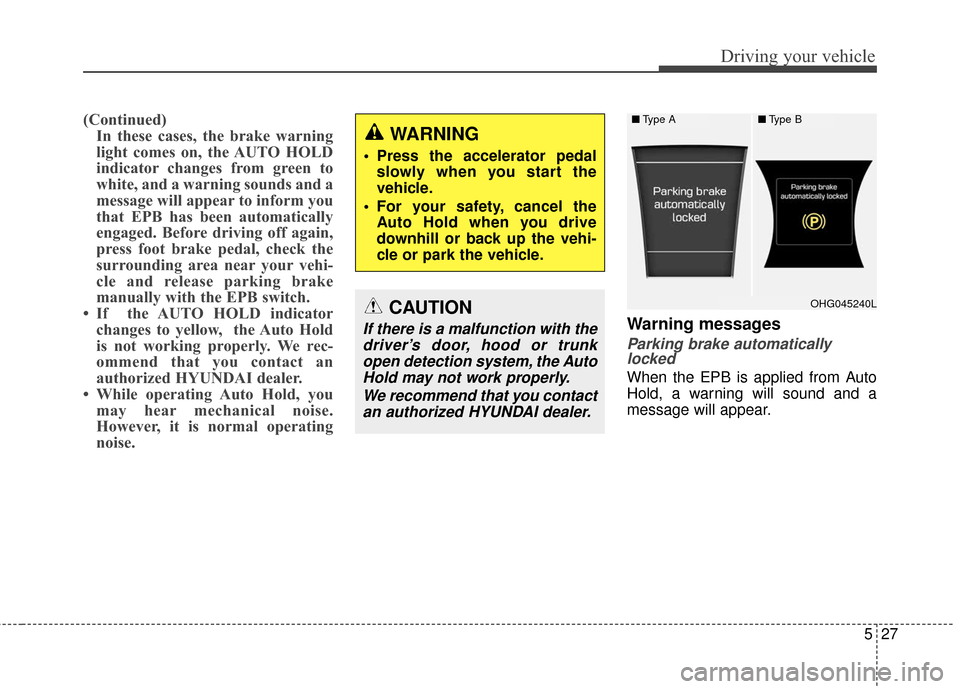
Warning messages
Parking brake automaticallylocked
When the EPB is applied from Auto
Hold, a warning will sound and a
message will appear.
■ Type A■Type B
OHG045240L
WARNING
Press the accelerator pedal
slowly when you start the
vehicle.
For your safety, cancel the Auto Hold when you drive
downhill or back up the vehi-
cle or park the vehicle.
CAUTION
If there is a malfunction with thedriver’s door, hood or trunkopen detection system, the AutoHold may not work properly.
We recommend that you contactan authorized HYUNDAI dealer.
Page 340 of 520
Driving your vehicle
36
5
Good braking practices Check to be sure the parking brake
is not engaged and that the park-
ing brake indicator light is out
before driving away.
Driving through water may get the brakes wet. They can also get wet
when the car is washed. Wet brakes
can be dangerous! Your vehicle will
not stop as quickly if the brakes are
wet. Wet brakes may cause the
vehicle to pull to one side.
To dry the brakes, apply the brakes
lightly until the braking action
returns to normal, taking care to
keep the vehicle under control at
all times. If the braking action does
not return to normal, stop as soon
as it is safe to do so and call an
authorized HYUNDAI dealer for
assistance.
Do not coast down hills with the vehicle out of gear. This is extreme-
ly hazardous. Keep the vehicle in
gear at all times, use the brakes to
slow down, then shift to a lower
gear so that engine braking will
help you maintain a safe speed. Do not "ride" the brake pedal.
Resting your foot on the brake
pedal while driving can be danger-
ous because the brakes might
overheat and lose their effective-
ness. It also increases the wear of
the brake components.
If a tire goes flat while you are driv- ing, apply the brakes gently and
keep the vehicle pointed straight
ahead while you slow down. When
you are moving slowly enough for it
to be safe to do so, pull off the road
and stop in a safe place.
If your vehicle is equipped with an automatic transaxle, do not let your
vehicle creep forward. To avoid
creeping forward, keep your foot
firmly on the brake pedal when the
vehicle is stopped.
WARNING
Whenever leaving the vehicleor parking, always set the
parking brake as far as possi-
ble and fully engage the vehi-
cle's transaxle into the P
(Park) position. Vehicles not
fully engaged in P (Park) with
the parking brake set are at
risk for moving inadvertently
and injuring yourself or oth-
ers.
All vehicles should always have the parking brake fully
engaged when parking to
avoid inadvertent movement
of the vehicle which can injure
occupants or pedestrians.
Page 341 of 520
537
Driving your vehicle
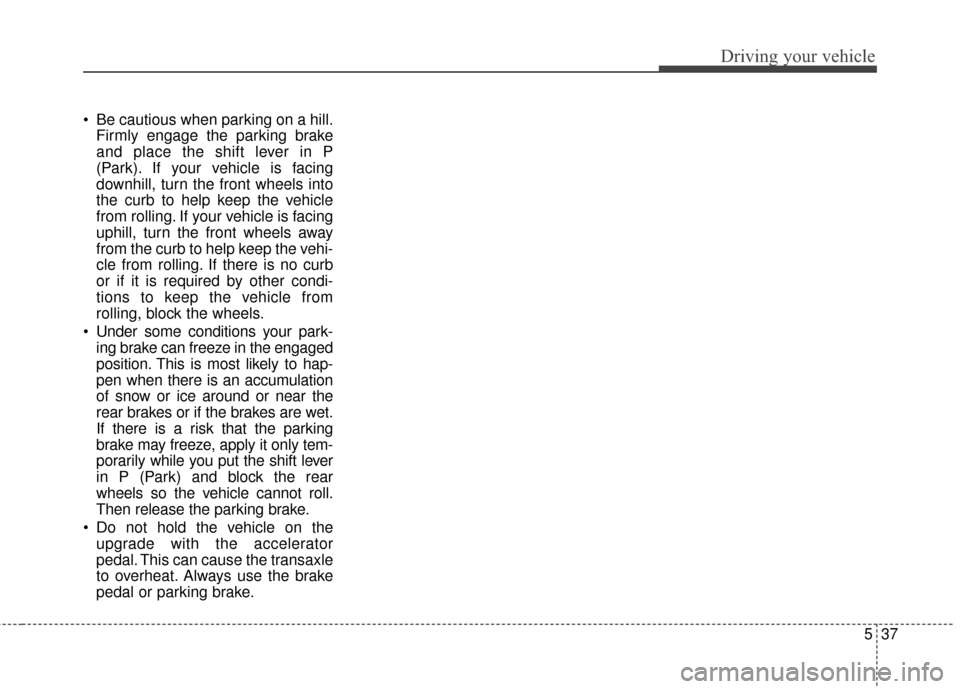
Be cautious when parking on a hill.Firmly engage the parking brake
and place the shift lever in P
(Park). If your vehicle is facing
downhill, turn the front wheels into
the curb to help keep the vehicle
from rolling. If your vehicle is facing
uphill, turn the front wheels away
from the curb to help keep the vehi-
cle from rolling. If there is no curb
or if it is required by other condi-
tions to keep the vehicle from
rolling, block the wheels.
Under some conditions your park- ing brake can freeze in the engaged
position. This is most likely to hap-
pen when there is an accumulation
of snow or ice around or near the
rear brakes or if the brakes are wet.
If there is a risk that the parking
brake may freeze, apply it only tem-
porarily while you put the shift lever
in P (Park) and block the rear
wheels so the vehicle cannot roll.
Then release the parking brake.
Do not hold the vehicle on the upgrade with the accelerator
pedal. This can cause the transaxle
to overheat. Always use the brake
pedal or parking brake.
Page 349 of 520
545
Driving your vehicle
Cancelled automatically
The driver's door is opened.
The EPB (electronic parking brake)is applied.
The vehicle speed is over 110 mph (180 km/h)
The vehicle stops on a steep incline.
The ESC or ABS is operating.
The ESC is turned off.
The sensor or the cover is dirty or blocked with foreign matter.
The vehicle stops and go repeat- edly for a long period of time.
The driver starts driving by depressing the accelerator pedal
or pushing the RES+ switch if a
vehicle stops far away ahead of the
your vehicle.
The shift lever is shifted to N (Neutral), R (Reverse), D (Drive).
The vehicle stops on a steep incline.
The vehicle stops and go repeat- edly for a long period of time.
The Smart Cruise Control has mal- functioned. The accelerator pedal is continu-
ously depressed for more than 1
minute.
Each of these actions will cancel
the smart cruise control operation.
(The SET indicator, set speed and
vehicle to vehicle distance on the
LCD display will go off.)
In a condition the smart cruise con-
trol is cancelled automatically, the
smart cruise control will not
resume even though the RES+ or
SET- switch is pushed. Also, the
EPB (electronic parking brake) will
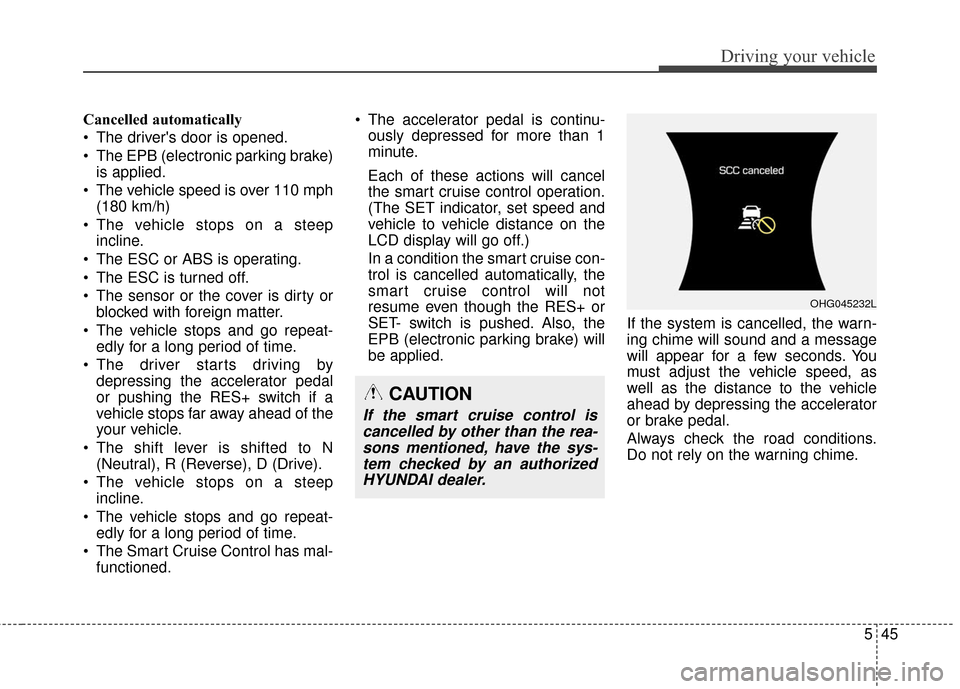
be applied. If the system is cancelled, the warn-
ing chime will sound and a message
will appear for a few seconds. You
must adjust the vehicle speed, as
well as the distance to the vehicle
ahead by depressing the accelerator
or brake pedal.
Always check the road conditions.
Do not rely on the warning chime.
OHG045232L
CAUTION
If the smart cruise control is
cancelled by other than the rea-sons mentioned, have the sys-tem checked by an authorizedHYUNDAI dealer.
Page 384 of 520
Driving your vehicle
80
5
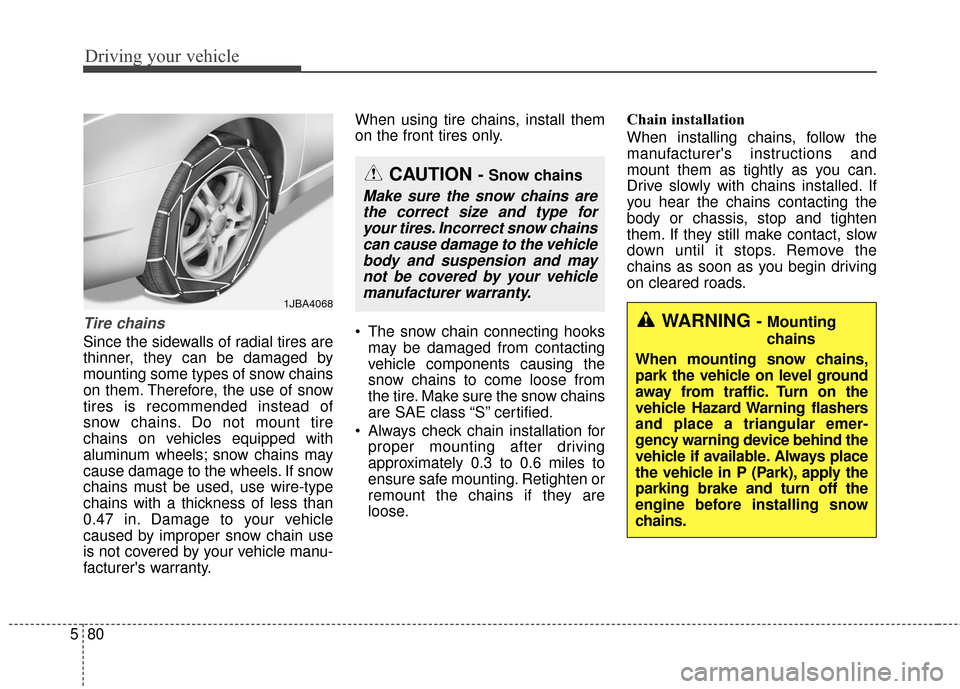
Tire chains
Since the sidewalls of radial tires are
thinner, they can be damaged by
mounting some types of snow chains
on them. Therefore, the use of snow
tires is recommended instead of
snow chains. Do not mount tire
chains on vehicles equipped with
aluminum wheels; snow chains may
cause damage to the wheels. If snow
chains must be used, use wire-type
chains with a thickness of less than
0.47 in. Damage to your vehicle
caused by improper snow chain use
is not covered by your vehicle manu-
facturer's warranty. When using tire chains, install them
on the front tires only.
The snow chain connecting hooks
may be damaged from contacting
vehicle components causing the
snow chains to come loose from
the tire. Make sure the snow chains
are SAE class “S” certified.
Always check chain installation for proper mounting after driving
approximately 0.3 to 0.6 miles to
ensure safe mounting. Retighten or
remount the chains if they are
loose. Chain installation
When installing chains, follow the
manufacturer's instructions and
mount them as tightly as you can.
Drive slowly with chains installed. If
you hear the chains contacting the
body or chassis, stop and tighten
them. If they still make contact, slow
down until it stops. Remove the
chains as soon as you begin driving
on cleared roads.
1JBA4068
CAUTION - Snow chains
Make sure the snow chains are
the correct size and type foryour tires. Incorrect snow chainscan cause damage to the vehiclebody and suspension and maynot be covered by your vehiclemanufacturer warranty.
WARNING - Mounting
chains
When mounting snow chains,
park the vehicle on level ground
away from traffic. Turn on the
vehicle Hazard Warning flashers
and place a triangular emer-
gency warning device behind the
vehicle if available. Always place
the vehicle in P (Park), apply the
parking brake and turn off the
engine before installing snow
chains.
Page 386 of 520
Driving your vehicle
82
5
To keep locks from freezing
To keep the locks from freezing,
squirt an approved de-icer fluid or
glycerine into the key opening. If a
lock is covered with ice, squirt it with
an approved de-icing fluid to remove
the ice. If the lock is frozen internally,
you may be able to thaw it out by
using a heated key. Handle the heat-
ed key with care to avoid injury.
Use approved window washer
anti-freeze in system
To keep the water in the window
washer system from freezing, add an
approved window washer anti-freeze
solution in accordance with instruc-
tions on the container. Window wash-
er anti-freeze is available from an
authorized HYUNDAI dealer and
most auto parts outlets. Do not use
engine coolant or other types of anti-
freeze as these may damage the
paint finish.
Don't let your parking brake
freeze
Under some conditions your parking
brake can freeze in the engaged posi-
tion. This is most likely to happen
when there is an accumulation of
snow or ice around or near the rear
brakes or if the brakes are wet. If there
is a risk the parking brake may freeze,
apply it only temporarily while you put
the shift lever in P (Park) and block
the rear wheels so the vehicle cannot
roll. Then release the parking brake.
Don't let ice and snow accu-
mulate underneath
Under some conditions, snow and
ice can build up under the fenders
and interfere with the steering. When
driving in severe winter conditions
where this may happen, you should
periodically check underneath the
vehicle to be sure the movement of
the front wheels and the steering
components is not obstructed.
Carry emergency equipment
Depending on the severity of the
weather where you drive your vehicle,
you should carry appropriate emer-
gency equipment. Some of the items
you may want to carry include tire
chains, tow straps or chains, flash-
light, emergency flares, sand, shovel,
jumper cables, window scraper,
gloves, ground cloth, coveralls, blan-
ket, etc.
Don't place foreign objects or
materials in the engine com-
partment
Placement of foreign objects or
materials which prevent cooling of
the engine, in the engine compart-
ment, may cause a failure or com-
bustion. The manufacturer is not
responsible for the damage caused
by such placement.
Page 395 of 520
63
What to do in an emergency
IN CASE OF AN EMERGENCY WHILE DRIVING
If the engine stalls at a cross-
road or crossing
If the engine stalls at a crossroad or
crossing, set the shift lever in the N
(Neutral) position and then push the
vehicle to a safe place.
If you have a flat tire while
driving
If a tire goes flat while you are driving:
1. Take your foot off the acceleratorpedal and let the vehicle slow
down while driving straight ahead.
Do not apply the brakes immedi-
ately or attempt to pull off the road
as this may cause a loss of con-
trol. When the vehicle has slowed
to such a speed that it is safe to do
so, brake carefully and pull off the
road. Drive off the road as far as
possible and park on a firm level
ground. If you are on a divided
highway, do not park in the median
area between the two traffic lanes.
2. When the vehicle is stopped, turn on your emergency hazard flash-
ers, set the parking brake and put
the transaxle in P (Park).
3. Have all passengers get out of the vehicle. Be sure they all get out on
the side of the vehicle that is away
from traffic.
4. When changing a flat tire, follow the instruction provided later in
this section.
If engine stalls while driving
1. Reduce your speed gradually,keeping a straight line. Move cau-
tiously off the road to a safe place.
2. Turn on your emergency flashers.
3. Try to start the engine again. If your vehicle will not start, contact
an authorized HYUNDAI dealer or
seek other qualified assistance.
Page 399 of 520
67
What to do in an emergency
IF THE ENGINE OVERHEATS
If your temperature gauge indicates
overheating, you experience a loss
of power, or hear loud pinging or
knocking, the engine is probably too
hot. If this happens, you should:
1. Pull off the road and stop as soonas it is safe to do so.
2. Place the shift lever in P (Park) and set the parking brake. If the air
conditioning is on, turn it off.
3. If engine coolant is running out under the vehicle or steam is com-
ing out from the hood, stop the
engine. Do not open the hood until
the coolant has stopped running
or the steaming has stopped. If
there is no visible loss of engine
coolant and no steam, leave the
engine running and check to be
sure the engine cooling fan is
operating. If the fan is not running,
turn the engine off. 4. Check to see if the water pump
drive belt is missing. If it is not
missing, check to see that it is
tight. If the drive belt seems to be
satisfactory, check for coolant
leaking from the radiator, hoses or
under the vehicle. (If the air condi-
tioning had been in use, it is nor-
mal for clear water to be draining
from it when you stop).
5. If the water pump drive belt is bro- ken or engine coolant is leaking
out, stop the engine immediately
and call the nearest authorized
HYUNDAI dealer for assistance. 6. If you cannot find the cause of the
overheating, wait until the engine
temperature has returned to nor-
mal. Then, if coolant has been lost,
carefully add coolant to the reser-
voir to bring the fluid level in the
reservoir up to the halfway mark.
7. Proceed with caution, keeping alert for further signs of overheat-
ing. If overheating happens again,
call an authorized HYUNDAI deal-
er for assistance.
Serious loss of coolant indicates
there is a leak in the cooling system
and this should be checked as soon
as possible by an authorized
HYUNDAI dealer.
WARNING - Under the
hood
While the engine is running,
keep hair, hands and clothing
away from moving parts such
as the fan and drive belts to pre-
vent injury.
WARNING - Radiator cap
Do not remove the radiator cap
when the engine is hot. This may
result in coolant being blown out
of the opening and cause serious
burns.