change time Hyundai Azera 2017 Owner's Guide
[x] Cancel search | Manufacturer: HYUNDAI, Model Year: 2017, Model line: Azera, Model: Hyundai Azera 2017Pages: 520, PDF Size: 16.33 MB
Page 348 of 520
Driving your vehicle
44
5
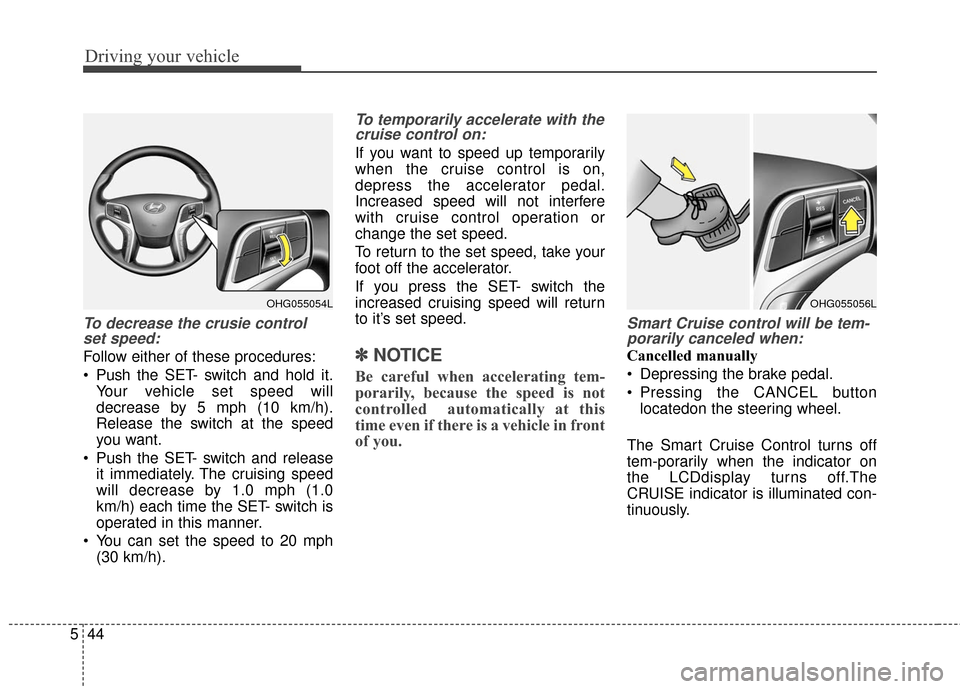
To decrease the crusie control
set speed:
Follow either of these procedures:
Push the SET- switch and hold it.
Your vehicle set speed will
decrease by 5 mph (10 km/h).
Release the switch at the speed
you want.
Push the SET- switch and release it immediately. The cruising speed
will decrease by 1.0 mph (1.0
km/h) each time the SET- switch is
operated in this manner.
You can set the speed to 20 mph (30 km/h).
To temporarily accelerate with thecruise control on:
If you want to speed up temporarily
when the cruise control is on,
depress the accelerator pedal.
Increased speed will not interfere
with cruise control operation or
change the set speed.
To return to the set speed, take your
foot off the accelerator.
If you press the SET- switch the
increased cruising speed will return
to it’s set speed.
✽ ✽ NOTICE
Be careful when accelerating tem-
porarily, because the speed is not
controlled automatically at this
time even if there is a vehicle in front
of you.
Smart Cruise control will be tem-
porarily canceled when:
Cancelled manually
Depressing the brake pedal.
Pressing the CANCEL button
locatedon the steering wheel.
The Smart Cruise Control turns off
tem-porarily when the indicator on
the LCDdisplay turns off.The
CRUISE indicator is illuminated con-
tinuously.
OHG055054LOHG055056L
Page 351 of 520
547
Driving your vehicle
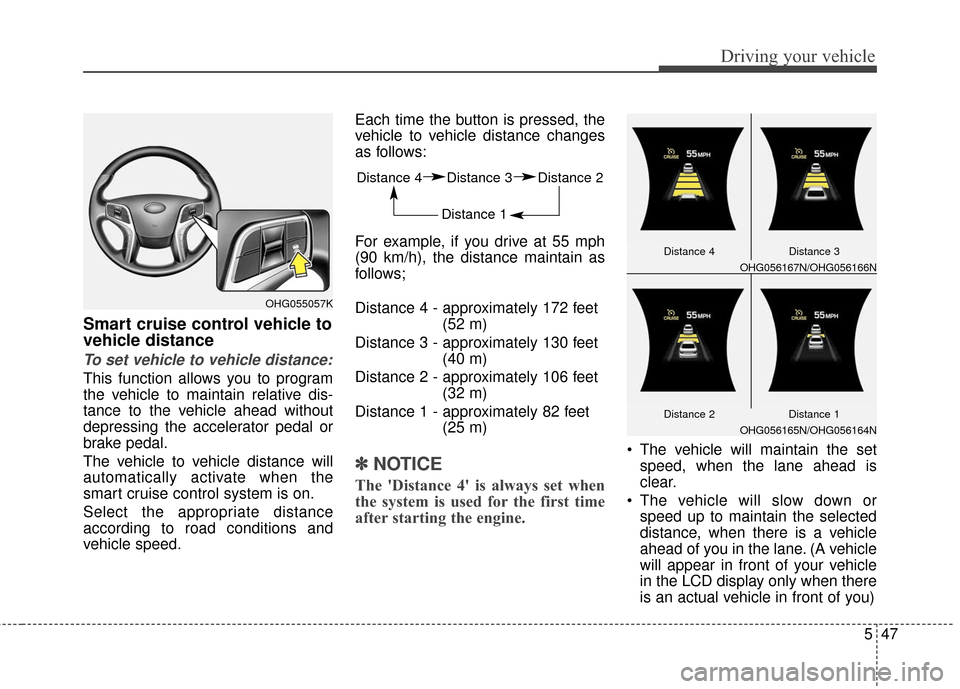
Smart cruise control vehicle to
vehicle distance
To set vehicle to vehicle distance:
This function allows you to program
the vehicle to maintain relative dis-
tance to the vehicle ahead without
depressing the accelerator pedal or
brake pedal.
The vehicle to vehicle distance will
automatically activate when the
smart cruise control system is on.
Select the appropriate distance
according to road conditions and
vehicle speed.Each time the button is pressed, the
vehicle to vehicle distance changes
as follows:
For example, if you drive at 55 mph
(90 km/h), the distance maintain as
follows;
Distance 4 - approximately 172 feet
(52 m)
Distance 3 - approximately 130 feet (40 m)
Distance 2 - approximately 106 feet (32 m)
Distance 1 - approximately 82 feet (25 m)
✽ ✽NOTICE
The 'Distance 4' is always set when
the system is used for the first time
after starting the engine.
The vehicle will maintain the set
speed, when the lane ahead is
clear.
The vehicle will slow down or speed up to maintain the selected
distance, when there is a vehicle
ahead of you in the lane. (A vehicle
will appear in front of your vehicle
in the LCD display only when there
is an actual vehicle in front of you)
OHG055057K
Distance 4 Distance 3 Distance 2
Distance 1
OHG056167N/OHG056166N
Distance 4 Distance 3
Distance 1
OHG056165N/OHG056164N
Distance 2
Page 369 of 520
565
Driving your vehicle
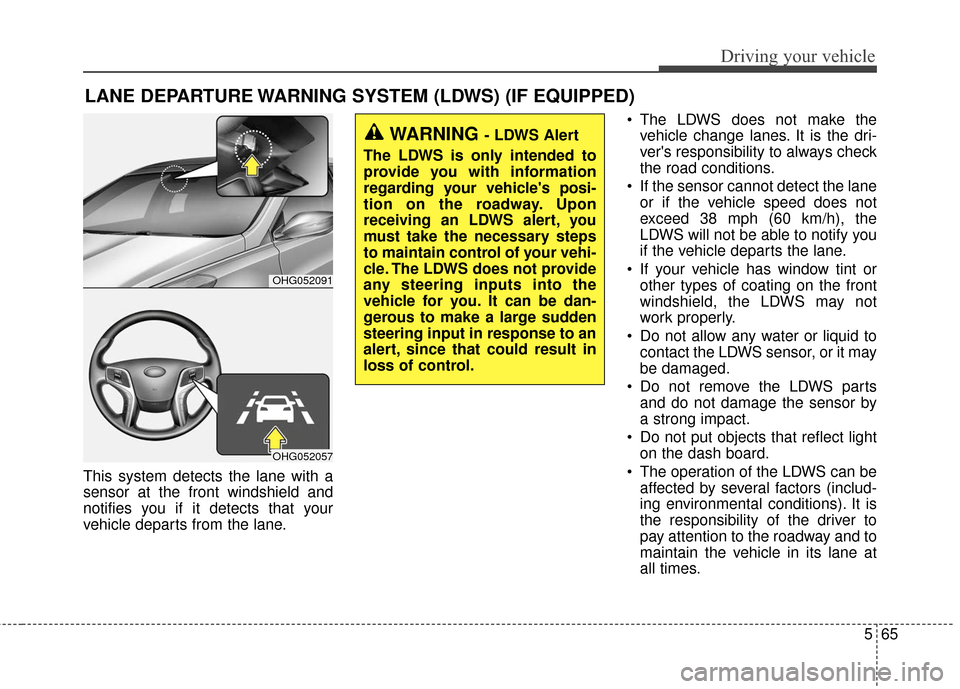
This system detects the lane with a
sensor at the front windshield and
notifies you if it detects that your
vehicle departs from the lane. The LDWS does not make the
vehicle change lanes. It is the dri-
ver's responsibility to always check
the road conditions.
If the sensor cannot detect the lane or if the vehicle speed does not
exceed 38 mph (60 km/h), the
LDWS will not be able to notify you
if the vehicle departs the lane.
If your vehicle has window tint or other types of coating on the front
windshield, the LDWS may not
work properly.
Do not allow any water or liquid to contact the LDWS sensor, or it may
be damaged.
Do not remove the LDWS parts and do not damage the sensor by
a strong impact.
Do not put objects that reflect light on the dash board.
The operation of the LDWS can be affected by several factors (includ-
ing environmental conditions). It is
the responsibility of the driver to
pay attention to the roadway and to
maintain the vehicle in its lane at
all times.
LANE DEPARTURE WARNING SYSTEM (LDWS) (IF EQUIPPED)
OHG052091
OHG052057
WARNING - LDWS Alert
The LDWS is only intended to
provide you with information
regarding your vehicle's posi-
tion on the roadway. Upon
receiving an LDWS alert, you
must take the necessary steps
to maintain control of your vehi-
cle. The LDWS does not provide
any steering inputs into the
vehicle for you. It can be dan-
gerous to make a large sudden
steering input in response to an
alert, since that could result in
loss of control.
Page 385 of 520
581
Driving your vehicle
The use of chains may adverselyaffect vehicle handling.
Do not exceed 20 mph or the chain manufacturer’s recommend-
ed speed limit, whichever is lower.
Drive carefully and avoid bumps, holes, sharp turns, and other road
hazards, which may cause the
vehicle to bounce.
Avoid sharp turns or locked-wheel braking.Use high quality ethylene gly-
col coolant
Your vehicle is delivered with high
quality ethylene glycol coolant in the
cooling system. It is the only type of
coolant that should be used because
it helps prevent corrosion in the cool-
ing system, lubricates the water
pump and prevents freezing. Be sure
to replace or replenish your coolant
in accordance with the maintenance
schedule in section 7. Before winter,
have your coolant tested to assure
that its freezing point is sufficient for
the temperatures anticipated during
the winter.
Check battery and cables
Winter puts additional burdens on
the battery system. Visually inspect
the battery and cables as described
in section 7. The level of charge in
your battery can be checked by an
authorized HYUNDAI dealer or a
service station.
Change to "winter weight" oil
if necessary
In some climates it is recommended
that a lower viscosity "winter weight"
oil be used during cold weather. See
section 8 for recommendations. If
you aren't sure what weight oil you
should use, consult an authorized
HYUNDAI dealer.
Check spark plugs and igni-
tion system
Inspect your spark plugs as described
in section 7 and replace them if nec-
essary. Also check all ignition wiring
and components to be sure they are
not cracked, worn or damaged in any
way.CAUTION - Snow chains
Chains that are the wrong size or improperly installed candamage your vehicle's brakelines, suspension, body andwheels.
Stop driving and retighten the chains any time you hear themhitting the vehicle.
Page 440 of 520
Maintenance
24
7
Changing the engine oil and
filter
Have engine oil and filter changed by
an authorized HYUNDAI dealer
according to the Maintenance
Schedule at the beginning of this
section. The high-pressure cooling system
has a reservoir filled with year-round
antifreeze coolant. The reservoir is
filled at the factory.
Check the antifreeze protection and
coolant level at least once a year, at the
beginning of the winter season, and
before traveling to a colder climate.
WARNING
-
California proposition 65
Engine oil contains chemicals
known to the State of California
to cause cancer, birth defects
and reproductive harm. Used
engine oil may cause irritation or
cancer of the skin if left in con-
tact with the skin for prolonged
periods of time. Always protect
your skin by washing your
hands thoroughly with soap and
warm water as soon as possible
after handling used oil.
ENGINE COOLANT
WARNING - Cooling fan
Use caution when
working near the
blade of the cooling
fan. The electric
motor (cooling fan) is
controlled by engine coolant
temperature, refrigerant pres-
sure and vehicle speed. It may
sometimes operate even when
the engine is not running.
Your vehicle equipped with GDI,
the electric motor (cooling fan)
may operate until you discon-
nect the negative battery cable.
Not heeding these warnings
could result in serious injuries.
Page 479 of 520
763
Maintenance
LIGHT BULBS
Use only the bulbs of the specifiedwattage.
If you do not have necessary tools,
the correct bulbs and the expertise,
consult an authorized HYUNDAI
dealer. In many cases, it is difficult to
replace vehicle light bulbs because
other parts of the vehicle must be
removed before you can get to the
bulb. This is especially true if you
have to remove the headlight assem-
bly to get to the bulb(s).
Removing/installing the headlight
assembly can result in damage to
the vehicle.
✽ ✽ NOTICE
After driving in rain or washing the
vehicle, the headlight and taillight
lenses could appear frosty. This con-
dition is caused by the temperature
difference between the lamp inside
and outside. This is similar to the
condensation on your windows
inside your vehicle during the rain
and doesn’t indicate a problem with
your vehicle. If the water leaks into
the lamp bulb circuitry, have the
vehicle checked by an authorized
HYUNDAI dealer.
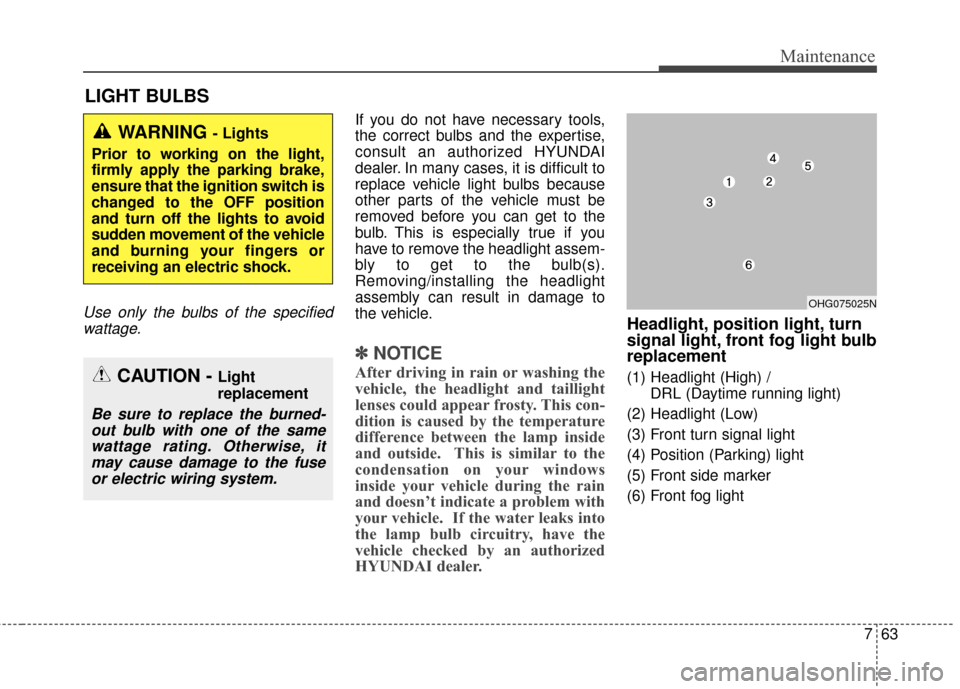
Headlight, position light, turn
signal light, front fog light bulb
replacement
(1) Headlight (High) /
DRL (Daytime running light)
(2) Headlight (Low)
(3) Front turn signal light
(4) Position (Parking) light
(5) Front side marker
(6) Front fog light
WARNING - Lights
Prior to working on the light,
firmly apply the parking brake,
ensure that the ignition switch is
changed to the OFF position
and turn off the lights to avoid
sudden movement of the vehicle
and burning your fingers or
receiving an electric shock.
CAUTION - Light
replacement
Be sure to replace the burned- out bulb with one of the samewattage rating. Otherwise, itmay cause damage to the fuseor electric wiring system.
OHG075025N
Page 515 of 520
I7
Index
LabelAir bag warning label................................................3-60
Refrigerant label ..........................................................8-8
Tire sidewall labeling ................................................7-43
Tire specification and pressure label ..........................8-8
Vehicle certification label............................................8-7
Jack label ..................................................................6-20
Lane departure warning system (LDWS) ......................5-65
LCD display ..................................................................4-63 LCD modes ..............................................................4-63
Trip computer mode ..................................................4-64
Turn By Turn (TBT) mode........................................4-65
LDWS Mode ............................................................4-65
A/V mode ..................................................................4-65
Information mode ......................................................4-66
LCD display warnings and indicators ..........................4-77
Light bulbs ....................................................................7-63\
Headlight, position light, turn signal light,front fog light bulb replacement ............................7-63
High mounted stop light replacement ......................7-69
Interior light bulb replacement..................................7-70
License plate light bulb replacement ........................7-69
Rear combination light bulb replacement ................7-67
Side repeater light bulb replacement ........................7-67 Lighting........................................................................\
4-100
Battery saver function ............................................4-100
Auto light position ..................................................4-103
Daytime running light (DRL) ................................4-101
Front fog light ........................................................4-106
Lighting control Headlight (Headlamp) escort function ....................4-101
Headlight (Headlamp) welcome function ..............4-101
Headlight position ..................................................4-102
High beam operation ..............................................4-103
Parking light position ..............................................4-102
Smart High Beam ....................................................4-104
Turn signals and lane change signals ......................4-105
Lower anchor ................................................................3-34
Lubricants and capacities ................................................8-5
Maintenance Explanation of scheduled maintenance items ..........7-20
Maintenance services ..................................................7-4
Maintenance under severe usage conditions ............7-19
Normal maintenance schedule ....................................7-9
Owner maintenance ....................................................7-6
Scheduled maintenance service ..................................7-8
Tire maintenance ......................................................7-42
L
M