battery Hyundai Azera 2017 Workshop Manual
[x] Cancel search | Manufacturer: HYUNDAI, Model Year: 2017, Model line: Azera, Model: Hyundai Azera 2017Pages: 520, PDF Size: 16.33 MB
Page 451 of 520

735
Maintenance
When you don’t use the vehicle for a
long time in a low temperature area,
separate the battery and keep it
indoors.
WARNING - Recharging
battery
Never attempt to recharge the
battery when the battery cables
are connected. Some charging
equipment can release a volt-
age spike that will damage vehi-
cle electronics, resulting in
thousands of dollars in required
repair parts which are not cov-
ered by warranty if damaged by
not following this warning.WARNING
-
California proposition 65
Battery posts, terminals, and
related accessories contain
lead and lead compounds,
chemicals known to the State of
California to cause cancer, birth
defects and reproductive harm.
Batteries also contain other
chemicals known to the State of
California to cause cancer.
Wash hands after handling.
WARNING - Risk of
electrocution
Never touch the electrical igni-
tion system while the vehicle is
running. This system works
with high voltage which can
"zap" you.
(Continued) The battery containslead. Do not dispose of it
after use. Please return
the battery to an author-
ized HYUNDAI dealer to
be recycled.
When lifting a plastic-cased battery, excessive pressure
on the case may cause battery
acid to leak, resulting in per-
sonal injury. Lift with a battery
carrier or with your hands on
opposite corners.
Never attempt to recharge the battery when the battery
cables are connected.
The electrical ignition system works with high voltage.
Never touch these compo-
nents with the engine running
or the ignition switched on.
Failure to follow the above
warnings can result in serious
bodily injury or death.
Page 452 of 520
Maintenance
36
7
Battery recharging
Your vehicle has a maintenance-free,
calcium-based battery.
If the battery becomes discharged
in a short time (because, for exam-
ple, the headlights or interior lights
were left on while the vehicle was
not in use), recharge it by slow
charging (trickle) for 10 hours.
If the battery gradually discharges because of high electric load while
the vehicle is being used, recharge
it at 20-30A for two hours. When recharging the battery, observe
the following precautions:
The battery must be removed from
the vehicle and placed in an area
with good ventilation.
Watch the battery during charging, and stop or reduce the charging
rate if the battery cells begin
gassing (boiling) violently or if the
temperature of the electrolyte of
any cell exceeds 120°F (49°C).
Wear eye protection when check- ing the battery during charging.
Disconnect the battery charger in the following order.
1. Turn off the battery charger main switch.
2. Unhook the negative clamp from the negative battery terminal.
3. Unhook the positive clamp from the positive battery terminal.
Before performing maintenance or recharging the battery, turn off all
accessories and stop the engine.
The negative battery cable must be removed first and installed last
when the battery is disconnected.
Reset items
Items should be reset after the bat-
tery has been discharged or the bat-
tery has been disconnected.
Auto up/down window (See section 4)
Sunroof (See section 4)
Driver position memory system (See section 4)
Trip computer (See section 4)
Climate control system (See section 4)
Clock (See section 4)
Audio (See section 4)
Page 464 of 520
Maintenance
48
7
Intended Outboard Sidewall : The
side of an asymmetrical tire, that
must always face outward when
mounted on a vehicle.
Kilopascal (kPa): The metric unit for
air pressure.
Light truck (LT) tire: A tire designat-
ed by its manufacturer as primarily
intended for use on lightweight trucks
or multipurpose passenger vehicles.
Load ratings : The maximum load
that a tire is rated to carry for a given
inflation pressure.
Load Index: An assigned number
ranging from 1 to 279 that corre-
sponds to the load carrying capacity
of a tire.
Maximum Inflation Pressure : The
maximum air pressure to which a
cold tire may be inflated. The maxi-
mum air pressure is molded onto the
sidewall.
Maximum Load Rating : The load
rating for a tire at the maximum per-
missible inflation pressure for that
tire. Maximum Loaded Vehicle Weight:
The sum of curb weight; accessory
weight; vehicle capacity weight; and
production options weight.
Normal Occupant Weight:The
number of occupants a vehicle is
designed to seat multiplied by 150
pounds (68 kg).
Occupant Distribution
: Designated
seating positions.
Outward Facing Sidewall : The side
of a asymmetrical tire that has a par-
ticular side that faces outward when
mounted on a vehicle. The outward
facing sidewall bears white lettering
or bears manufacturer, brand, and/or
model name molding that is higher or
deeper than the same moldings on
the inner facing sidewall.
Passenger (P-Metric) Tire : A tire
used on passenger cars and some
light duty trucks and multipurpose
vehicles.
Ply: A layer of rubber-coated parallel
cords Pneumatic tire: A mechanical
device made of rubber, chemicals,
fabric and steel or other materials,
that, when mounted on an automo-
tive wheel, provides the traction and
contains the gas or fluid that sustains
the load.
Production options weight
:The
combined weight of installed regular
production options weighing over 2.3
kg (5 lbs.) in excess of the standard
items which they replace, not previ-
ously considered in curb weight or
accessory weight, including heavy
duty brakes, ride levelers, roof rack,
heavy duty battery, and special trim.
Recommended Inflation Pressure :
Vehicle manufacturer's recommend-
ed tire inflation pressure and shown
on the tire placard.
Radial Ply Tire : A pneumatic tire in
which the ply cords that extend to the
beads are laid at 90 degrees to the
centerline of the tread.
Rim: A metal support for a tire and
upon which the tire beads are seat-
ed.
Sidewall: The portion of a tire
between the tread and the bead.
Page 467 of 520
751
Maintenance
FUSES
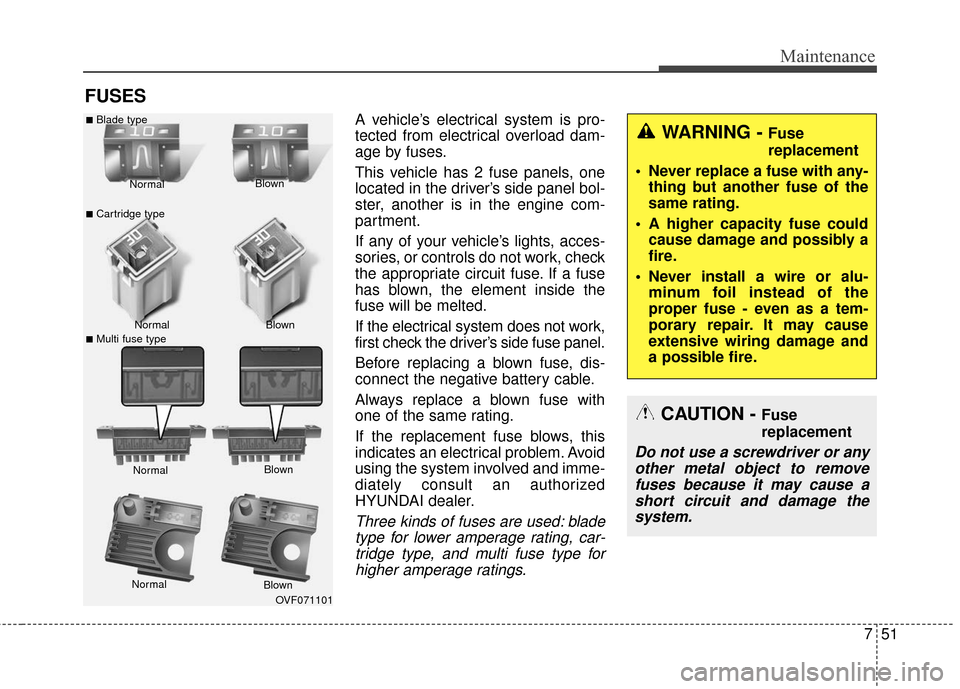
A vehicle’s electrical system is pro-
tected from electrical overload dam-
age by fuses.
This vehicle has 2 fuse panels, one
located in the driver’s side panel bol-
ster, another is in the engine com-
partment.
If any of your vehicle’s lights, acces-
sories, or controls do not work, check
the appropriate circuit fuse. If a fuse
has blown, the element inside the
fuse will be melted.
If the electrical system does not work,
first check the driver’s side fuse panel.
Before replacing a blown fuse, dis-
connect the negative battery cable.
Always replace a blown fuse with
one of the same rating.
If the replacement fuse blows, this
indicates an electrical problem. Avoid
using the system involved and imme-
diately consult an authorized
HYUNDAI dealer.
Three kinds of fuses are used: bladetype for lower amperage rating, car-tridge type, and multi fuse type forhigher amperage ratings.
OVF071101
Normal
Normal
■Blade type
■Cartridge type
■Multi fuse type Blown
Blown
Normal Blown
Normal Blown
WARNING - Fuse
replacement
Never replace a fuse with any- thing but another fuse of the
same rating.
A higher capacity fuse could cause damage and possibly a
fire.
Never install a wire or alu- minum foil instead of the
proper fuse - even as a tem-
porary repair. It may cause
extensive wiring damage and
a possible fire.
CAUTION - Fuse
replacement
Do not use a screwdriver or anyother metal object to removefuses because it may cause ashort circuit and damage thesystem.
Page 470 of 520
Maintenance
54
7
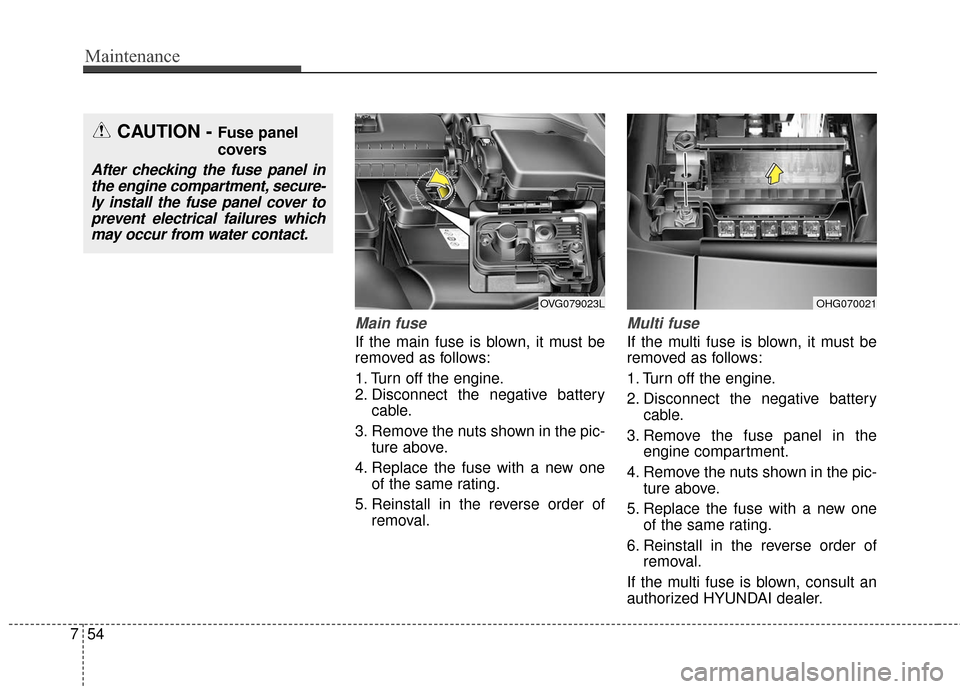
Main fuse
If the main fuse is blown, it must be
removed as follows:
1. Turn off the engine.
2. Disconnect the negative battery
cable.
3. Remove the nuts shown in the pic- ture above.
4. Replace the fuse with a new one of the same rating.
5. Reinstall in the reverse order of removal.
Multi fuse
If the multi fuse is blown, it must be
removed as follows:
1. Turn off the engine.
2. Disconnect the negative batterycable.
3. Remove the fuse panel in the engine compartment.
4. Remove the nuts shown in the pic- ture above.
5. Replace the fuse with a new one of the same rating.
6. Reinstall in the reverse order of removal.
If the multi fuse is blown, consult an
authorized HYUNDAI dealer.
OHG070021OVG079023L
CAUTION - Fuse panel
covers
After checking the fuse panel in the engine compartment, secure-ly install the fuse panel cover toprevent electrical failures whichmay occur from water contact.
Page 477 of 520
761
Maintenance
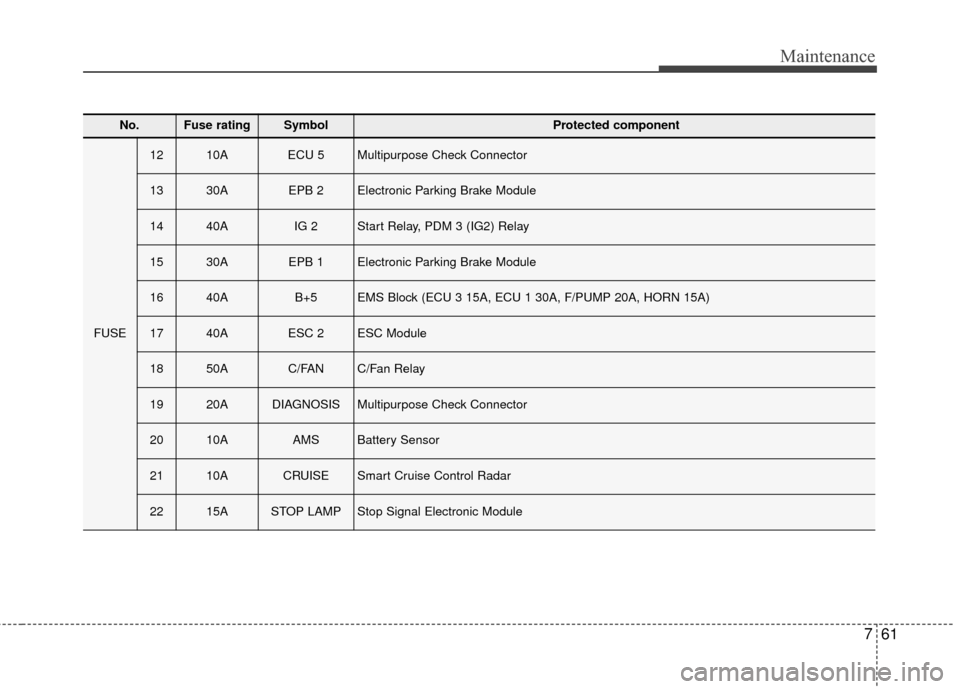
No.Fuse ratingSymbol Protected component
FUSE
1210AECU 5Multipurpose Check Connector
1330AEPB 2Electronic Parking Brake Module
1440AIG 2Start Relay, PDM 3 (IG2) Relay
1530AEPB 1Electronic Parking Brake Module
1640AB+5EMS Block (ECU 3 15A, ECU 1 30A, F/PUMP 20A, HORN 15A)
1740AESC 2ESC Module
1850AC/FANC/Fan Relay
1920ADIAGNOSISMultipurpose Check Connector
2010AAMSBattery Sensor
2110ACRUISESmart Cruise Control Radar
2215ASTOP LAMPStop Signal Electronic Module
Page 496 of 520
Maintenance
80
7
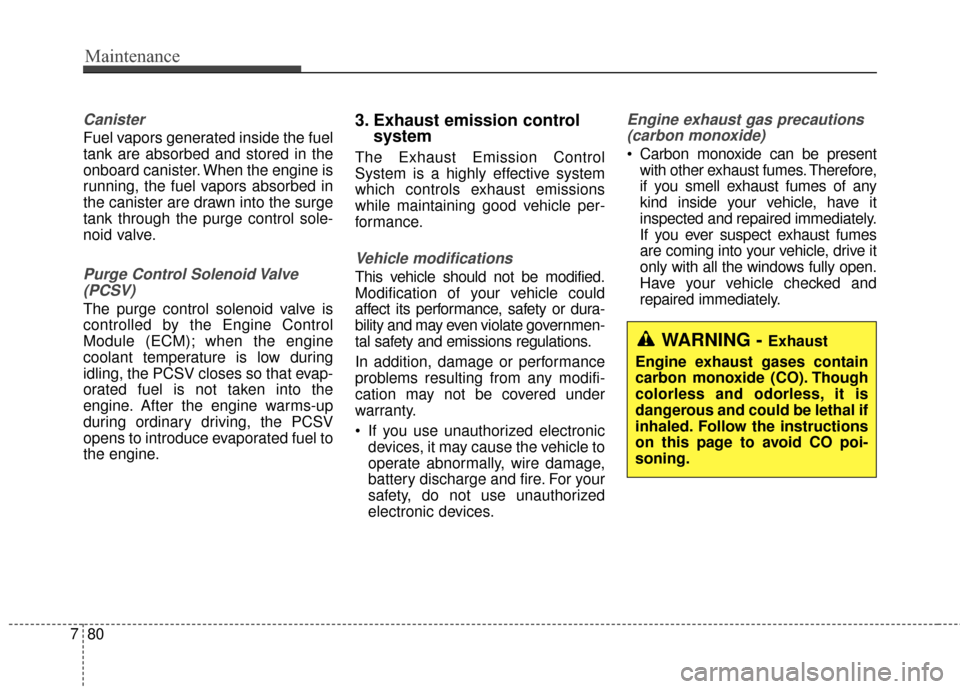
Canister
Fuel vapors generated inside the fuel
tank are absorbed and stored in the
onboard canister. When the engine is
running, the fuel vapors absorbed in
the canister are drawn into the surge
tank through the purge control sole-
noid valve.
Purge Control Solenoid Valve
(PCSV)
The purge control solenoid valve is
controlled by the Engine Control
Module (ECM); when the engine
coolant temperature is low during
idling, the PCSV closes so that evap-
orated fuel is not taken into the
engine. After the engine warms-up
during ordinary driving, the PCSV
opens to introduce evaporated fuel to
the engine.
3. Exhaust emission control system
The Exhaust Emission Control
System is a highly effective system
which controls exhaust emissions
while maintaining good vehicle per-
formance.
Vehicle modifications
This vehicle should not be modified.
Modification of your vehicle could
affect its performance, safety or dura-
bility and may even violate governmen-
tal safety and emissions regulations.
In addition, damage or performance
problems resulting from any modifi-
cation may not be covered under
warranty.
If you use unauthorized electronic
devices, it may cause the vehicle to
operate abnormally, wire damage,
battery discharge and fire. For your
safety, do not use unauthorized
electronic devices.
Engine exhaust gas precautions (carbon monoxide)
Carbon monoxide can be present with other exhaust fumes. Therefore,
if you smell exhaust fumes of any
kind inside your vehicle, have it
inspected and repaired immediately.
If you ever suspect exhaust fumes
are coming into your vehicle, drive it
only with all the windows fully open.
Have your vehicle checked and
repaired immediately.
WARNING - Exhaust
Engine exhaust gases contain
carbon monoxide (CO). Though
colorless and odorless, it is
dangerous and could be lethal if
inhaled. Follow the instructions
on this page to avoid CO poi-
soning.
Page 510 of 520
Index
2I
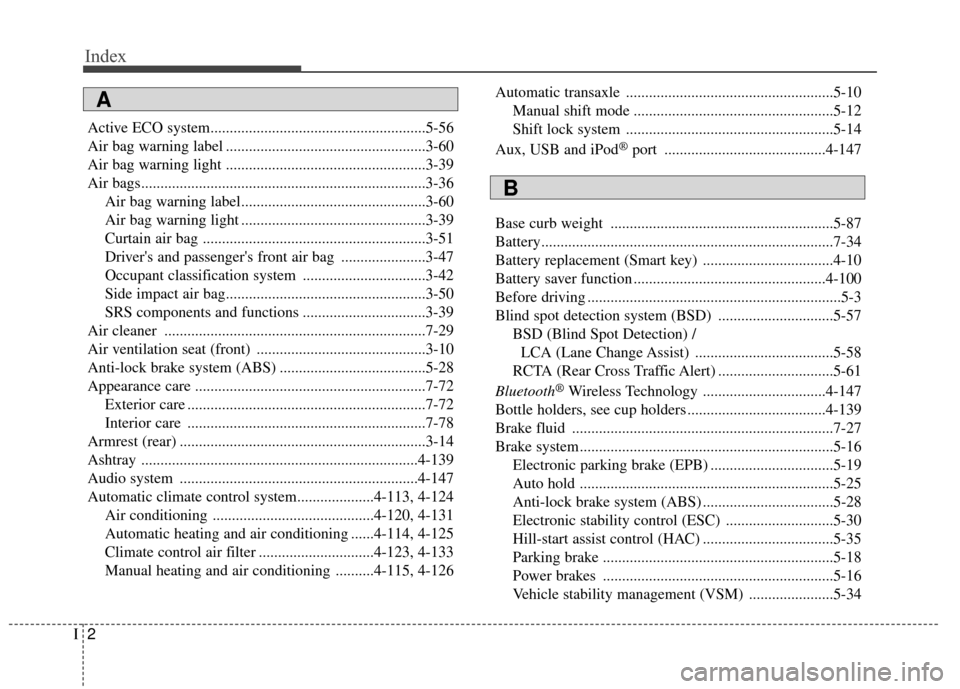
Active ECO system........................................................5-56
Air bag warning label ....................................................3-60
Air bag warning light ....................................................3-39
Air bags........................................................................\
..3-36Air bag warning label................................................3-60
Air bag warning light ................................................3-39
Curtain air bag ..........................................................3-51
Driver's and passenger's front air bag ......................3-47
Occupant classification system ................................3-42
Side impact air bag....................................................3-50
SRS components and functions ................................3-39
Air cleaner ....................................................................7-29\
Air ventilation seat (front) ............................................3-10
Anti-lock brake system (ABS) ......................................5-28
Appearance care ............................................................7-72 Exterior care ..............................................................7-72
Interior care ..............................................................7-78
Armrest (rear) ................................................................3-14
Ashtray ........................................................................\
4-139
Audio system ..............................................................4-147
Automatic climate control system....................4-113, 4-124 Air conditioning ..........................................4-120, 4-131
Automatic heating and air conditioning ......4-114, 4-125
Climate control air filter ..............................4-123, 4-133
Manual heating and air conditioning ..........4-115, 4-126 Automatic transaxle ......................................................5-10
Manual shift mode ....................................................5-12
Shift lock system ......................................................5-14
Aux, USB and iPod
®port ..........................................4-147
Base curb weight ..........................................................5-87
Battery........................................................................\
....7-34
Battery replacement (Smart key) ..................................4-10
Battery saver function ..................................................4-100
Before driving ..................................................................5-3
Blind spot detection system (BSD) ..............................5-57 BSD (Blind Spot Detection) / LCA (Lane Change Assist) ....................................5-58
RCTA (Rear Cross Traffic Alert) ..............................5-61
Bluetooth
®Wireless Technology ................................4-147
Bottle holders, see cup holders ....................................4-139
Brake fluid ....................................................................7-27\
Brake system..................................................................5-16 Electronic parking brake (EPB) ................................5-19
Auto hold ..................................................................5-25
Anti-lock brake system (ABS) ..................................5-28
Electronic stability control (ESC) ............................5-30
Hill-start assist control (HAC) ..................................5-35
Parking brake ............................................................5-18
Power brakes ............................................................5-16
Vehicle stability management (VSM) ......................5-34
A
B
Page 515 of 520
I7
Index
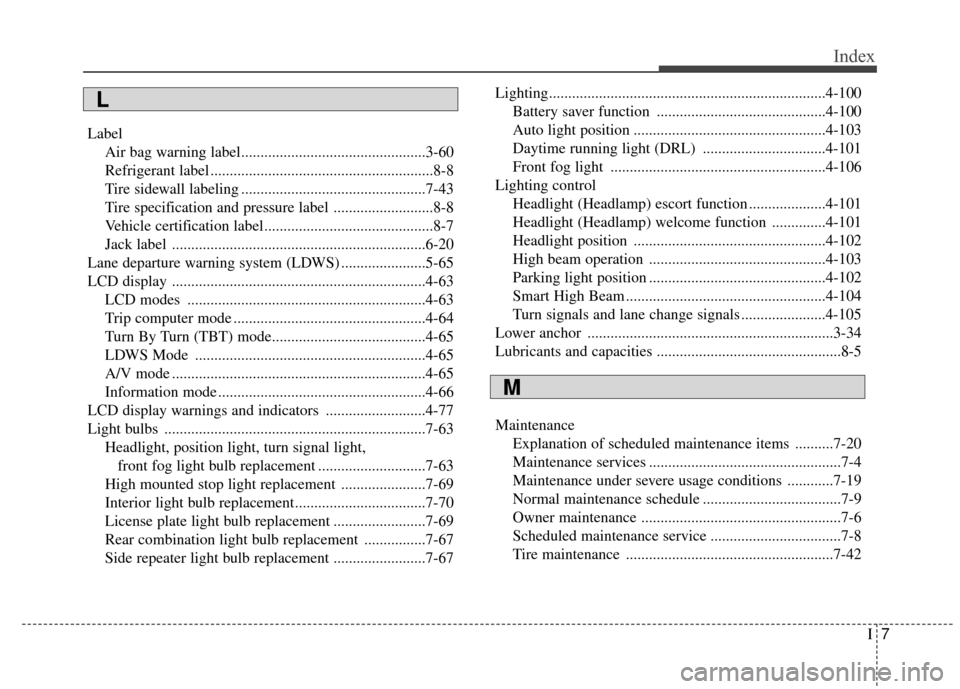
LabelAir bag warning label................................................3-60
Refrigerant label ..........................................................8-8
Tire sidewall labeling ................................................7-43
Tire specification and pressure label ..........................8-8
Vehicle certification label............................................8-7
Jack label ..................................................................6-20
Lane departure warning system (LDWS) ......................5-65
LCD display ..................................................................4-63 LCD modes ..............................................................4-63
Trip computer mode ..................................................4-64
Turn By Turn (TBT) mode........................................4-65
LDWS Mode ............................................................4-65
A/V mode ..................................................................4-65
Information mode ......................................................4-66
LCD display warnings and indicators ..........................4-77
Light bulbs ....................................................................7-63\
Headlight, position light, turn signal light,front fog light bulb replacement ............................7-63
High mounted stop light replacement ......................7-69
Interior light bulb replacement..................................7-70
License plate light bulb replacement ........................7-69
Rear combination light bulb replacement ................7-67
Side repeater light bulb replacement ........................7-67 Lighting........................................................................\
4-100
Battery saver function ............................................4-100
Auto light position ..................................................4-103
Daytime running light (DRL) ................................4-101
Front fog light ........................................................4-106
Lighting control Headlight (Headlamp) escort function ....................4-101
Headlight (Headlamp) welcome function ..............4-101
Headlight position ..................................................4-102
High beam operation ..............................................4-103
Parking light position ..............................................4-102
Smart High Beam ....................................................4-104
Turn signals and lane change signals ......................4-105
Lower anchor ................................................................3-34
Lubricants and capacities ................................................8-5
Maintenance Explanation of scheduled maintenance items ..........7-20
Maintenance services ..................................................7-4
Maintenance under severe usage conditions ............7-19
Normal maintenance schedule ....................................7-9
Owner maintenance ....................................................7-6
Scheduled maintenance service ..................................7-8
Tire maintenance ......................................................7-42
L
M
Page 517 of 520
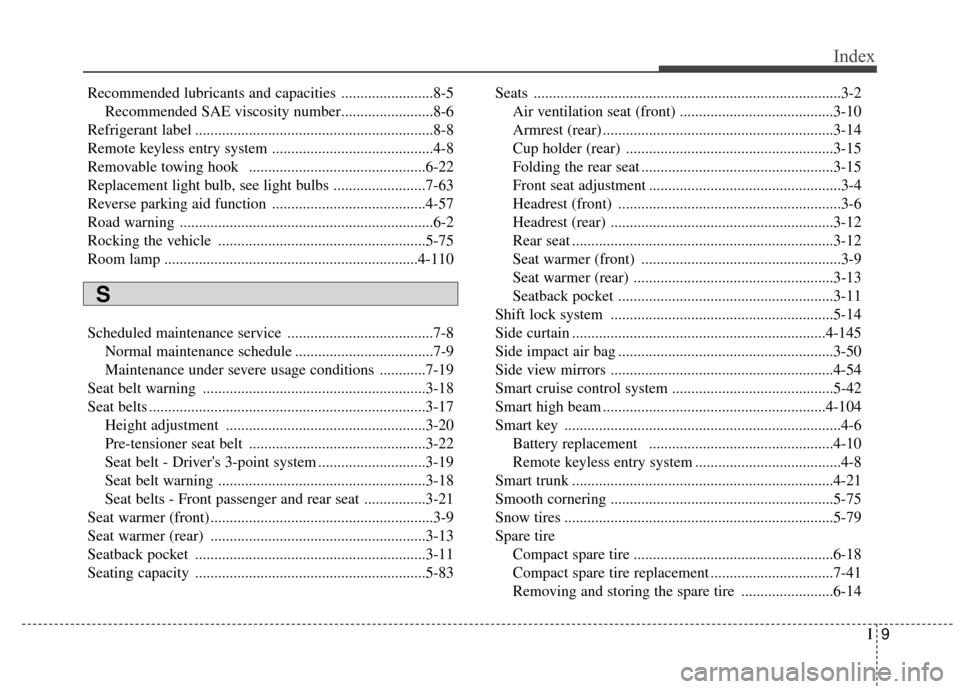
I9
Index
Recommended lubricants and capacities ........................8-5Recommended SAE viscosity number........................8-6
Refrigerant label ..............................................................8-8
Remote keyless entry system ..........................................4-8
Removable towing hook ..............................................6-22
Replacement light bulb, see light bulbs ........................7-63
Reverse parking aid function ........................................4-57
Road warning ..................................................................6-2
Rocking the vehicle ......................................................5-75
Room lamp ..................................................................4-110
Scheduled maintenance service ......................................7-8 Normal maintenance schedule ....................................7-9
Maintenance under severe usage conditions ............7-19
Seat belt warning ..........................................................3-18
Seat belts ........................................................................\
3-17 Height adjustment ....................................................3-20
Pre-tensioner seat belt ..............................................3-22
Seat belt - Driver's 3-point system ............................3-19
Seat belt warning ......................................................3-18
Seat belts - Front passenger and rear seat ................3-21
Seat warmer (front) ..........................................................3-9
Seat warmer (rear) ........................................................3-13
Seatback pocket ............................................................3-11
Seating capacity ............................................................5-83 Seats ........................................................................\
........3-2
Air ventilation seat (front) ........................................3-10
Armrest (rear) ............................................................3-14
Cup holder (rear) ......................................................3-15
Folding the rear seat ..................................................3-15
Front seat adjustment ..................................................3-4
Headrest (front) ..........................................................3-6
Headrest (rear) ..........................................................3-12
Rear seat ....................................................................3-12\
Seat warmer (front) ....................................................3-9
Seat warmer (rear) ....................................................3-13
Seatback pocket ........................................................3-11
Shift lock system ..........................................................5-14
Side curtain ..................................................................4-145
Side impact air bag ........................................................3-50
Side view mirrors ..........................................................4-54
Smart cruise control system ..........................................5-42
Smart high beam ..........................................................4-104
Smart key ........................................................................\
4-6 Battery replacement ................................................4-10
Remote keyless entry system ......................................4-8
Smart trunk ....................................................................4-21\
Smooth cornering ..........................................................5-75
Snow tires ......................................................................5-\
79
Spare tire Compact spare tire ....................................................6-18
Compact spare tire replacement ................................7-41
Removing and storing the spare tire ........................6-14
S