transmission Hyundai Coupe 2002 User Guide
[x] Cancel search | Manufacturer: HYUNDAI, Model Year: 2002, Model line: Coupe, Model: Hyundai Coupe 2002Pages: 140, PDF Size: 1.45 MB
Page 95 of 140
3-7
IN CASE OF EMERGENCY
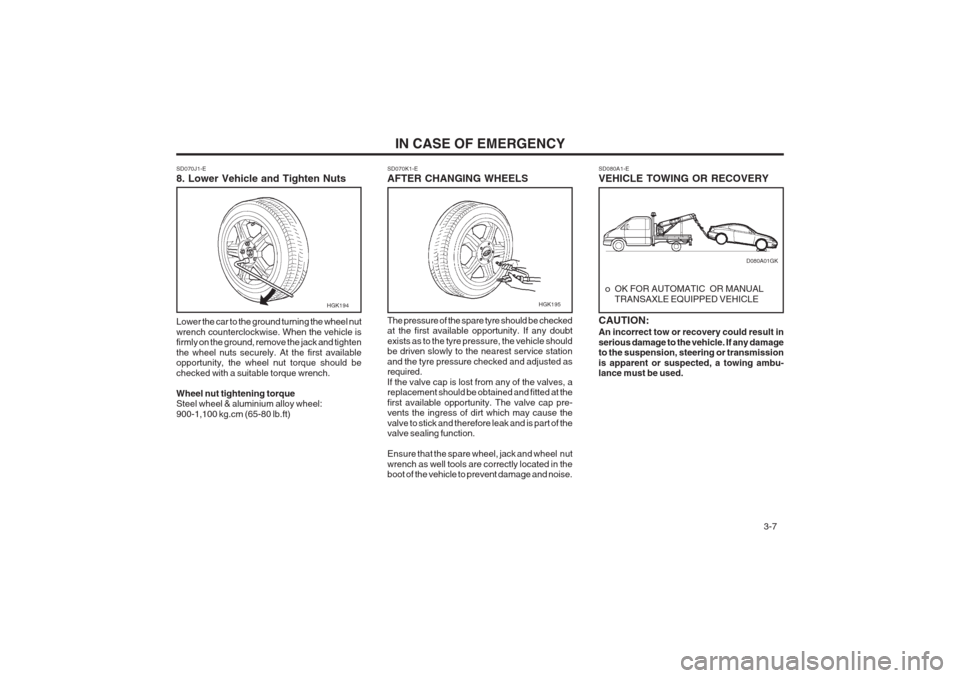
SD080A1-E VEHICLE TOWING OR RECOVERY
o OK FOR AUTOMATIC OR MANUALTRANSAXLE EQUIPPED VEHICLE
CAUTION: An incorrect tow or recovery could result in serious damage to the vehicle. If any damage to the suspension, steering or transmission is apparent or suspected, a towing ambu- lance must be used.
HGK194
SD070J1-E 8. Lower Vehicle and Tighten Nuts Lower the car to the ground turning the wheel nut wrench counterclockwise. When the vehicle is firmly on the ground, remove the jack and tighten the wheel nuts securely. At the first available opportunity, the wheel nut torque should be checked with a suitable torque wrench. Wheel nut tightening torque Steel wheel & aluminium alloy wheel: 900-1,100 kg.cm (65-80 lb.ft) SD070K1-E AFTER CHANGING WHEELS The pressure of the spare tyre should be checked at the first available opportunity. If any doubt exists as to the tyre pressure, the vehicle should be driven slowly to the nearest service station and the tyre pressure checked and adjusted as required. If the valve cap is lost from any of the valves, a replacement should be obtained and fitted at the first available opportunity. The valve cap pre- vents the ingress of dirt which may cause the valve to stick and therefore leak and is part of the valve sealing function. Ensure that the spare wheel, jack and wheel nut wrench as well tools are correctly located in the boot of the vehicle to prevent damage and noise.
D080A01GK
HGK195
Page 96 of 140
IN CASE OF EMERGENCY
3-8 since the steering lock is not designed to withstand the force required to hold the front wheels straight during the tow.
o The vehicle must not be towed with the front wheels on the ground for more than thirty miles.
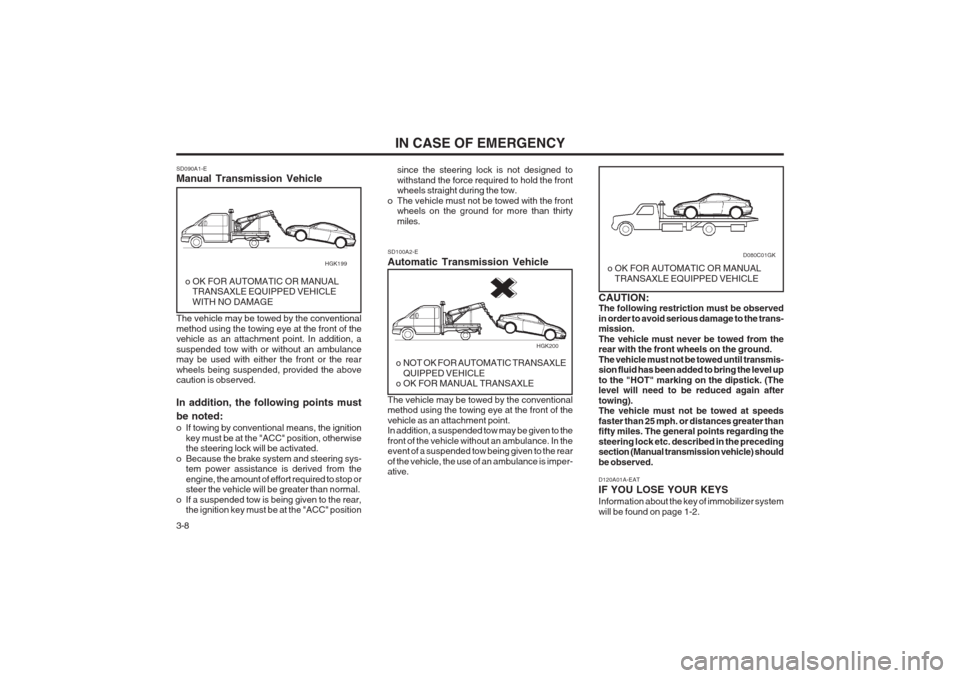
SD100A2-E Automatic Transmission Vehicle
o NOT OK FOR AUTOMATIC TRANSAXLE QUIPPED VEHICLE
o OK FOR MANUAL TRANSAXLE
The vehicle may be towed by the conventional method using the towing eye at the front of the vehicle as an attachment point. In addition, a suspended tow may be given to the front of the vehicle without an ambulance. In the event of a suspended tow being given to the rear of the vehicle, the use of an ambulance is imper- ative.
o OK FOR AUTOMATIC OR MANUAL
TRANSAXLE EQUIPPED VEHICLE
CAUTION: The following restriction must be observed in order to avoid serious damage to the trans- mission. The vehicle must never be towed from the rear with the front wheels on the ground. The vehicle must not be towed until transmis- sion fluid has been added to bring the level up to the "HOT" marking on the dipstick. (The level will need to be reduced again after towing). The vehicle must not be towed at speeds faster than 25 mph. or distances greater than fifty miles. The general points regarding the steering lock etc. described in the preceding section (Manual transmission vehicle) should be observed. D120A01A-EAT IF YOU LOSE YOUR KEYS Information about the key of immobilizer system will be found on page 1-2.
SD090A1-E Manual Transmission Vehicle
o OK FOR AUTOMATIC OR MANUAL
TRANSAXLE EQUIPPED VEHICLE WITH NO DAMAGE
The vehicle may be towed by the conventionalmethod using the towing eye at the front of the vehicle as an attachment point. In addition, a suspended tow with or without an ambulance may be used with either the front or the rear wheels being suspended, provided the above caution is observed. In addition, the following points must be noted:
o If towing by conventional means, the ignition key must be at the "ACC" position, otherwise the steering lock will be activated.
o Because the brake system and steering sys- tem power assistance is derived from the engine, the amount of effort required to stop or steer the vehicle will be greater than normal.
o If a suspended tow is being given to the rear, the ignition key must be at the "ACC" position HGK200
D080C01GK
HGK199
Page 99 of 140
VEHICLE MAINTENANCE REQUIREMENTS 5-1
SF020A1-E MAINTENANCE AND SERVICINGREQUIREMENTS To ensure the continued reliability and safety of the vehicle, certain routine maintenance opera- tions are required at specific mileage or time intervals. It is the responsibility of the vehicle owner to ensure that the maintenance schedules shown in both this Owners Manual and the Warranty and Service Passport are adhered to. The new vehicle warranty may be invalidated if the routine maintenance operations are not per- formed in line with the recommendations outlined and the safety and durability of the vehicle ad- versely affected. It is recommended that all maintenance opera- tions with the exception of the daily operating checks are entrusted to a Hyundai dealer to ensure that the latest repair and maintenance procedures and specialized servicing tools are employed. In addition, the use of genuine Hyundai replacement parts will ensure that the vehicle safety and performance will not be compro- mised.
SF000A1-E
5. VEHICLE MAINTE-
NANCE REQUIRE- MENTS NOTE: The inspection and testing of certain elec- tronic fuel injection/engine management and automatic transmission control systems re- quire specialised electronic equipment spe- cifically designed for Hyundai vehicles. The use of general purpose electrical test equip- ment may result in damage to the control unit microprocessors. SF020C1-E Specified Scheduled ProceduresThe Specified scheduled procedures are listed in the maintenance charts beginning at page 5- 2. The operations specified must be performed at the time or mileage intervals shown irrespec- tive of whether the mileage interval has been reached before the specified time interval. Certain lubricants and components degradewith both time and mileage (e.g. engine oil and brake fluid) and therefore it is not permissable to base the maintenance schedule upon mile- age alone. It is strongly recommended that the maintenance operations are performed by the factory-trained or distributor-trained technicians at your Hyundai dealer because of the need for specialized knowledge and tooling and to en- sure that no possibility of invalidating the man- ufacturers warranty exists. The maintenance schedules relate to vehiclesoperated under normal conditions, vehicles which are operated under adverse conditionswill require more frequent maintenance which is described at page 5-4. SF030B1-E SERVICE HISTORY It is important that all scheduled maintenance services are recorded in the warranty and ser- vice passport to ensure that proof of mainte- nance is available when warranty service is required.
5
Page 115 of 140
OWNER MAINTENANCE
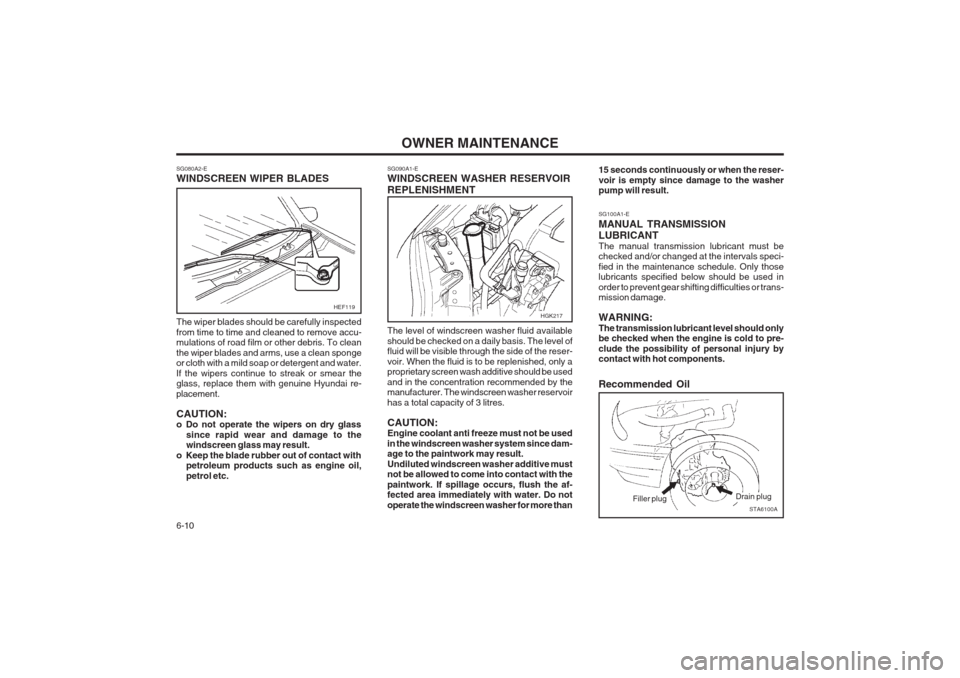
6-10 15 seconds continuously or when the reser- voir is empty since damage to the washer pump will result. SG100A1-E MANUAL TRANSMISSION LUBRICANT The manual transmission lubricant must be checked and/or changed at the intervals speci- fied in the maintenance schedule. Only those lubricants specified below should be used in order to prevent gear shifting difficulties or trans- mission damage. WARNING: The transmission lubricant level should only be checked when the engine is cold to pre- clude the possibility of personal injury by contact with hot components.
Filler plugDrain plug
STA6100A
Recommended Oil
SG080A2-E WINDSCREEN WIPER BLADES
SG090A1-EWINDSCREEN WASHER RESERVOIR REPLENISHMENT
The wiper blades should be carefully inspected from time to time and cleaned to remove accu- mulations of road film or other debris. To clean the wiper blades and arms, use a clean sponge or cloth with a mild soap or detergent and water. If the wipers continue to streak or smear the glass, replace them with genuine Hyundai re- placement. CAUTION:
o Do not operate the wipers on dry glass since rapid wear and damage to thewindscreen glass may result.
o Keep the blade rubber out of contact with petroleum products such as engine oil, petrol etc. The level of windscreen washer fluid availableshould be checked on a daily basis. The level of fluid will be visible through the side of the reser- voir. When the fluid is to be replenished, only a proprietary screen wash additive should be used and in the concentration recommended by the manufacturer. The windscreen washer reservoir has a total capacity of 3 litres. CAUTION: Engine coolant anti freeze must not be used in the windscreen washer system since dam- age to the paintwork may result. Undiluted windscreen washer additive must not be allowed to come into contact with the paintwork. If spillage occurs, flush the af- fected area immediately with water. Do not operate the windscreen washer for more than
HGK217HEF119
Page 116 of 140
OWNER MAINTENANCE 6-11
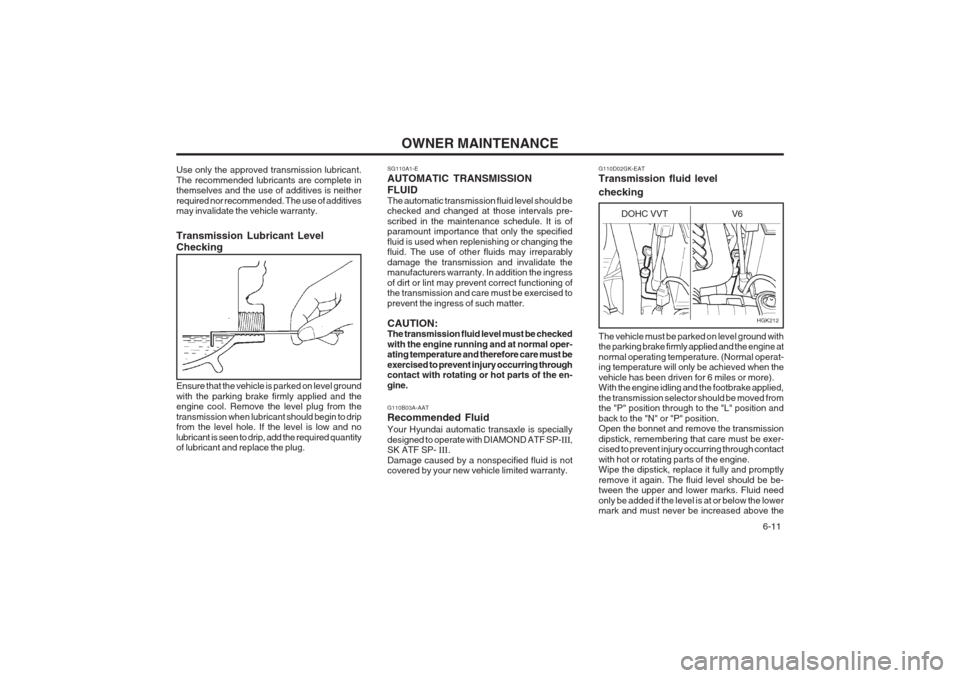
Use only the approved transmission lubricant. The recommended lubricants are complete in themselves and the use of additives is neither required nor recommended. The use of additives may invalidate the vehicle warranty. Transmission Lubricant Level Checking
Ensure that the vehicle is parked on level ground with the parking brake firmly applied and the engine cool. Remove the level plug from the transmission when lubricant should begin to drip from the level hole. If the level is low and no lubricant is seen to drip, add the required quantity of lubricant and replace the plug.
SG110A1-E AUTOMATIC TRANSMISSION FLUID The automatic transmission fluid level should be checked and changed at those intervals pre- scribed in the maintenance schedule. It is of paramount importance that only the specified fluid is used when replenishing or changing the fluid. The use of other fluids may irreparably damage the transmission and invalidate the manufacturers warranty. In addition the ingress of dirt or lint may prevent correct functioning of the transmission and care must be exercised to prevent the ingress of such matter. CAUTION: The transmission fluid level must be checked with the engine running and at normal oper- ating temperature and therefore care must be exercised to prevent injury occurring through contact with rotating or hot parts of the en- gine. G110B03A-AAT Recommended Fluid Your Hyundai automatic transaxle is specially designed to operate with DIAMOND ATF SP-
III,
SK ATF SP- III.
Damage caused by a nonspecified fluid is not covered by your new vehicle limited warranty. G110D02GK-EAT Transmission fluid level checking The vehicle must be parked on level ground with the parking brake firmly applied and the engine at normal operating temperature. (Normal operat- ing temperature will only be achieved when the vehicle has been driven for 6 miles or more). With the engine idling and the footbrake applied, the transmission selector should be moved from the "P" position through to the "L" position and back to the "N" or "P" position. Open the bonnet and remove the transmission dipstick, remembering that care must be exer- cised to prevent injury occurring through contact with hot or rotating parts of the engine. Wipe the dipstick, replace it fully and promptly remove it again. The fluid level should be be- tween the upper and lower marks. Fluid need only be added if the level is at or below the lower mark and must never be increased above the
DOHC VVT V6
HGK212
Page 117 of 140
OWNER MAINTENANCE
6-12 SG120A1-E BRAKE SYSTEM CHECKING CAUTION: Correct operation of the braking system is essential to the safe operation of the vehicle and therefore, any maintenance operations other than those listed below should be en- trusted to a Hyundai dealer. SG120C2-E Brake Fluid Recommendations Only brake fluid conforming to DOT 3 or DOT 4 specifications or higher may be used in the braking system. Care should be taken to ob- serve the instructions and precautions printed upon the container. SG120D1-E Brake Fluid LevelThe fluid level in the brake fluid reservoir should be checked periodically. The level should be between the "MIN" and "MAX" marks on the side of the reservoir. If the level is at or below the "MIN" mark, fluid should be added having care- fully cleaned the area surrounding the reservoir cap to ensure that dirt is not allowed to enter the system. It should be borne in mind that the brake fluid level will decrease slightly as the friction linings of the pads and shoes become worn and that this is a normal condition.
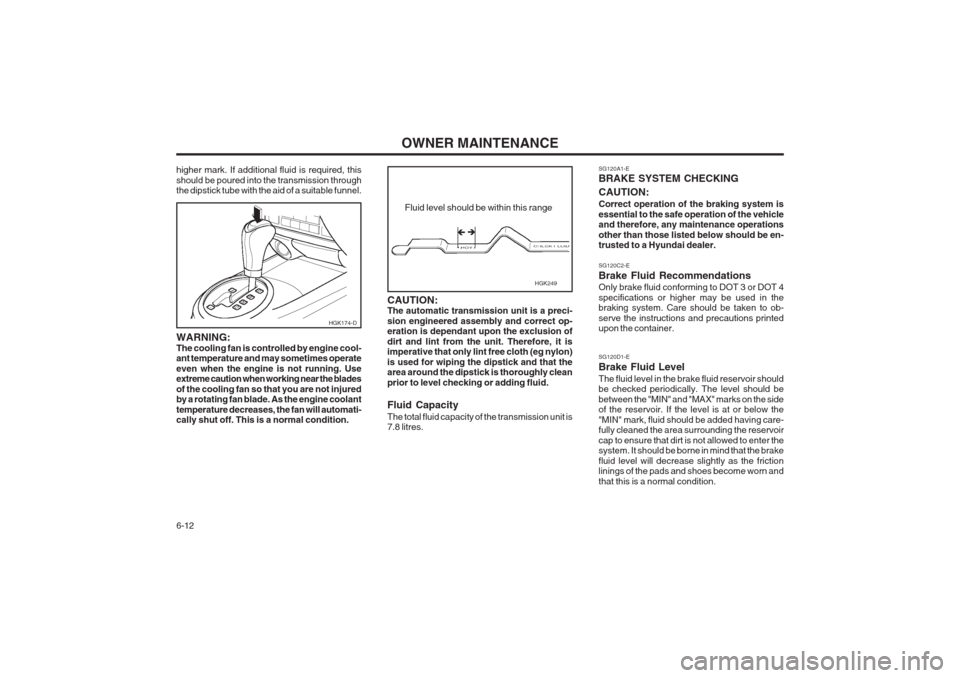
higher mark. If additional fluid is required, thisshould be poured into the transmission through the dipstick tube with the aid of a suitable funnel. WARNING: The cooling fan is controlled by engine cool- ant temperature and may sometimes operate even when the engine is not running. Use extreme caution when working near the blades of the cooling fan so that you are not injured by a rotating fan blade. As the engine coolant temperature decreases, the fan will automati- cally shut off. This is a normal condition.
CAUTION:The automatic transmission unit is a preci- sion engineered assembly and correct op- eration is dependant upon the exclusion of dirt and lint from the unit. Therefore, it is imperative that only lint free cloth (eg nylon) is used for wiping the dipstick and that the area around the dipstick is thoroughly clean prior to level checking or adding fluid. Fluid Capacity The total fluid capacity of the transmission unit is 7.8 litres.
HGK174-D
Fluid level should be within this range
HGK249
ÎÎ
Page 123 of 140
OWNER MAINTENANCE
6-18 NOTE: Grinding noise from power steering pump may be heard immediately after the engine is started in extremely cold condition (below -20°C). In this case, if the noise stops during warm up, there is no abnormal function in the system. This is due to a power steering fluid characteristic in extremely cold conditions. FLUID RECOMMENDATION
Only automatic transmission fluid meeting the specification of PSF-3 should be used in the power steering system.
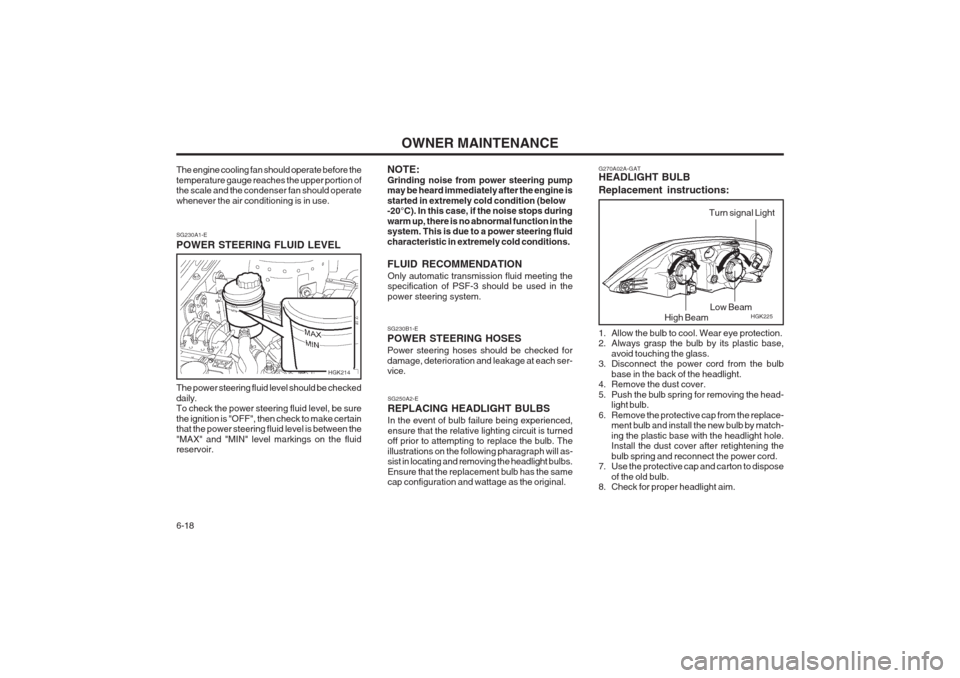
SG230A1-E POWER STEERING FLUID LEVEL The power steering fluid level should be checked daily. To check the power steering fluid level, be sure the ignition is "OFF", then check to make certain that the power steering fluid level is between the "MAX" and "MIN" level markings on the fluid reservoir.
SG250A2-E REPLACING HEADLIGHT BULBS In the event of bulb failure being experienced, ensure that the relative lighting circuit is turned off prior to attempting to replace the bulb. The illustrations on the following pharagraph will as- sist in locating and removing the headlight bulbs. Ensure that the replacement bulb has the same cap configuration and wattage as the original.
SG230B1-E POWER STEERING HOSES Power steering hoses should be checked for damage, deterioration and leakage at each ser- vice.
The engine cooling fan should operate before the temperature gauge reaches the upper portion of the scale and the condenser fan should operate whenever the air conditioning is in use.
HGK214 G270A02A-GAT HEADLIGHT BULB Replacement instructions:
HGK225
1. Allow the bulb to cool. Wear eye protection.
2. Always grasp the bulb by its plastic base, avoid touching the glass.
3. Disconnect the power cord from the bulb
base in the back of the headlight.
4. Remove the dust cover.
5. Push the bulb spring for removing the head- light bulb.
6. Remove the protective cap from the replace- ment bulb and install the new bulb by match-ing the plastic base with the headlight hole. Install the dust cover after retightening the bulb spring and reconnect the power cord.
7. Use the protective cap and carton to dispose
of the old bulb.
8. Check for proper headlight aim.High Beam Low Beam
Turn signal Light
Page 137 of 140
INDEX10-1
C CARE OF CASSETTE
TAPE ........................................................... 1-64
CARE OF DISC ................................................................................ 1-64
CARE OF SEAT BELTS .................................................................. 1-11
CATALYTIC CONVERTOR OPERATING PRECAUTIONS .......7-1~7-2
CENTRAL DOOR LOCK .................................................................... 1-4
CHANGING A FLAT TYPE ................................................................ 3-3
CHECKING THE CLUTCH FLUID ...................................................6-13
CHILD RESTRAINT SYSTEM ......................................................... 1-13
CIGAR LIGHTER .............................................................................. 1-36
CLUTCH PEDAL FREEPLAY .......................................................... 6-15
COMBINATION IGNITION SWITCH AND STEERING LOCK .......... 2-2 CRUISE CONTROL ......................................................................... 1-48
D DAILY OPERATING CHECKS ........................................................... 6-4
DEFROSTING/DEMISTING ............................................................. 1-55
DIGITAL CLOCK .............................................................................. 1-36
DOOR LOCKS .................................................................................... 1-2
DOOR WINDOWS .............................................................................. 1-6
DRINK HOLDER .............................................................................. 1-37
DRIVE BELTS .................................................................................. 6-16
DRIVING FOR ECONOMY .............................................................. 2-10
JK000A2-EAT 10. INDEX A AIR BAG
........................................................................................... 1-18
AIR CONDITIONING SWITCH ......................................................... 1-54
AIR CONDITIONING SYSTEM MAINTENANCE ............................6-13
AIR CLEANER ELEMENT REPLACEMENT ..................................... 6-9
AIR FILTER ...................................................................................... 1-61
ANTENNA ......................................................................................... 1-66
ANTI-LOCK BRAKE SYSTEM ........................................................... 2-8
AUTOMATIC TRANSMISSION FLUID ............................................. 6-11
AUTOMATIC TRANSMISSION .......................................................... 2-5
B BATTERY MAINTENANCE .............................................................. 6-17
BEFORE FOLDING THE REAR SEATS ........................................... 1-9
BEFORE STARTING THE ENGINE .................................................. 2-2
BONNET RELEASE ......................................................................... 1-44
BRAKE PEDAL FREEPLAY ............................................................. 6-16
BRAKE SYSTEM CHECKING ......................................................... 6-12
10
Page 139 of 140
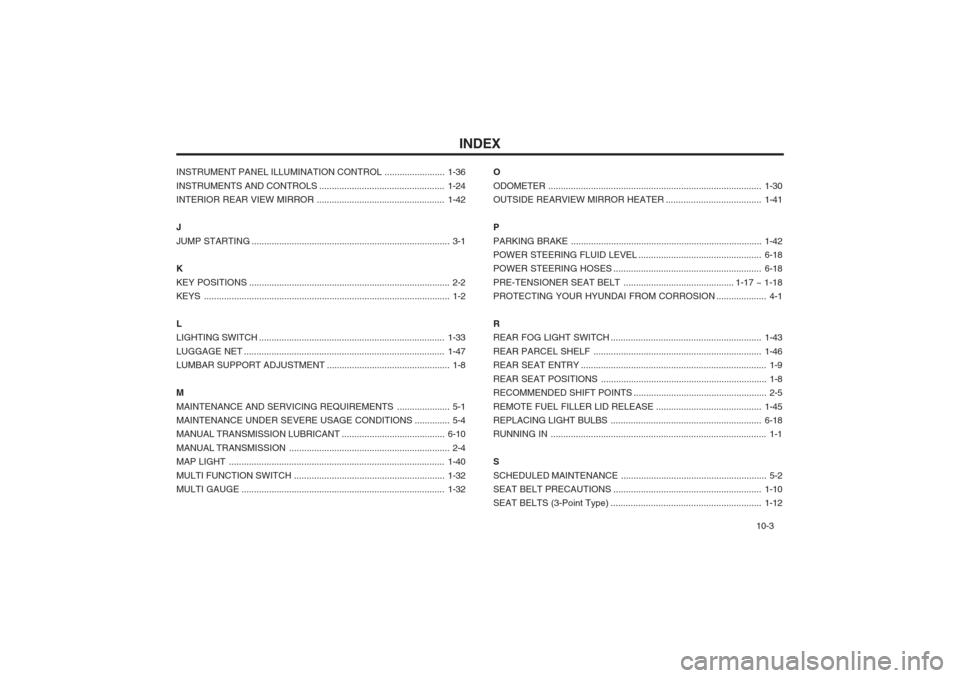
INDEX10-3
INSTRUMENT PANEL ILLUMINATION CONTROL
........................1-36
INSTRUMENTS AND CONTROLS ..................................................1-24
INTERIOR REAR VIEW MIRROR ...................................................1-42
J JUMP STARTING ............................................................................... 3-1
KKEY POSITIONS ................................................................................ 2-2
KEYS .................................................................................................. 1-2
L LIGHTING SWITCH .......................................................................... 1-33
LUGGAGE NET ................................................................................ 1-47
LUMBAR SUPPORT ADJUSTMENT ................................................. 1-8
M
MAINTENANCE AND SERVICING REQUIREM ENTS ..................... 5-1
MAINTENANCE UNDER SEVERE USAGE CONDITIONS .............. 5-4
MANUAL TRANSMISSION LUBRICANT .............. ...........................6-10
MANUAL TRANSMISSION ................................................................ 2-4
MAP LIGHT ...................................................................................... 1-40
MULTI FUNCTION SWITCH ................................ ............................1-32
MULTI GAUGE ................................................................................. 1-32OODOMETER
..................................................................................... 1-30
OUTSIDE REARVIEW MIRROR HEATER ...................................... 1-41
PPARKING BRAKE ............................................................................ 1-42
POWER STEERING FLUID LEVEL ................................................. 6-18
POWER STEERIN G HOSES ........................................................... 6-18
PRE-TENSIONER SEAT BELT ............................................ 1-17 ~ 1-18
PROTECTING YOUR HYUNDAI FROM CORROSION .................... 4-1
R
REAR FOG LIGHT SWITCH ............................................................ 1-43
REAR PARCEL SHELF ................................................................... 1-46
REAR SEAT ENTRY .......................................................................... 1-9
REAR SEAT POSITIONS .................................................................. 1-8
RECOMMENDED SHIFT POINTS ..................................................... 2-5
REMOTE FUEL FILLER LID RELEASE.......................................... 1-45
REPLACING LIGHT BULBS ................................. ...........................6-18
RUNNING IN ...................................................................................... 1-1
S SCHEDULED MAINTENANCE .......................................................... 5-2
SEAT BELT PRECAUTIONS ........................................................... 1-10
SEAT BELTS (3-Point Type) ............................................................ 1-12