fuel Hyundai Coupe 2002 Owner's Guide
[x] Cancel search | Manufacturer: HYUNDAI, Model Year: 2002, Model line: Coupe, Model: Hyundai Coupe 2002Pages: 140, PDF Size: 1.45 MB
Page 100 of 140
VEHICLE MAINTENANCE REQUIREMENTS
5- 2
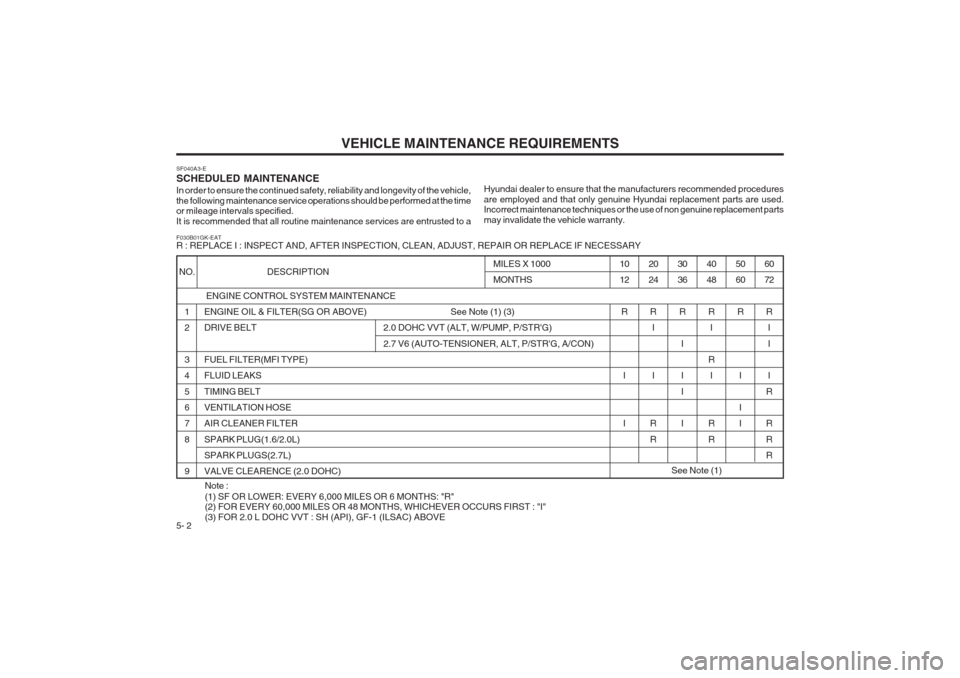
SF040A3-E SCHEDULED MAINTENANCE In order to ensure the continued safety, reliability and longevity of the vehicle, the following maintenance service operations should be performed at the time or mileage intervals specified. It is recommended that all routine maintenance services are entrusted to a
Hyundai dealer to ensure that the manufacturers recommended proceduresare employed and that only genuine Hyundai replacement parts are used. Incorrect maintenance techniques or the use of non genuine replacement parts may invalidate the vehicle warranty.
F030B01GK-EAT R : REPLACE I : INSPECT AND, AFTER INSPECTION, CLEAN, ADJUST, REPAIR OR REPLACE IF NECESSARY
ENGINE CONTROL SYSTEM MAINTENANCE
ENGINE OIL & FILTER(SG OR ABOVE) See Note (1) (3)
DRIVE BELT 2.0 DOHC VVT (ALT, W/PUMP, P/STR'G) 2.7 V6 (AUTO-TENSIONER, ALT, P/STR'G, A/CON)
FUEL FILTER(MFI TYPE)FLUID LEAKS TIMING BELT VENTILATION HOSEAIR CLEANER FILTER SPARK PLUG(1.6/2.0L) SPARK PLUGS(2.7L)VALVE CLEARENCE (2.0 DOHC)
NO. DESCRIPTION60 72
R I I I
RR R R
5060
R
I I I
4048
R I
R I
R R
30 36
R I I I I
20 24
R I I
R R
10 12
R
I I
MILES X 1000 MONTHS
Note : (1) SF OR LOWER: EVERY 6,000 MILES OR 6 MONTHS: "R" (2) FOR EVERY 60,000 MILES OR 48 MONTHS, WHICHEVER OCCURS FIRST : "I" (3) FOR 2.0 L DOHC VVT : SH (API), GF-1 (ILSAC) ABOVE
1 2 3 4 5 67 8 9
See Note (1)
Page 103 of 140
VEHICLE MAINTENANCE REQUIREMENTS 5-5
6ZF060D1-A
o Fuel lines, fuel hoses and connec-
tions
Check the fuel lines, fuel hoses and connections for leakage and damage. Replace any damaged or leaking parts immediately. 6ZF060E1-A o Timing beltInspect all parts related to the timing belt for damage and deformation. Replace any dam- aged parts immediately. 6ZF060G1-A
o Vapour hose and fuel filler cap The vapor hose and fuel filler cap should be inspected at those intervals specified in the main- tenance schedule. Make sure that a new vapour hose or fuel filler cap is correctly replaced. 6ZF060F1-A
o Vacuum, crankcase
ventilation hoses
Inspect the surface of hoses for evidence of heat and/or mechanical damage. Hard and brittle rub- ber, cracking, tears, cuts, abrasions, and exces- sive swelling indicate deterioration. Particular attention should be paid to examining those hose surfaces nearest to high heat sources, such as the exhaust manifold. Inspect the hose routing to assure that the hoses do not come in contact with any heat source,sharp edges or moving component which might cause heat damage or mechanical wear. Inspect all hose connections, such as clamps and cou- plings, to make sure they are secure, and that no leaks are present. Hoses should be replaced immediately if there is any evidence of deteriora- tion or damage. 6ZF060H1-A
o Air cleaner filter A Genuine Hyundai air cleaner filter is recom- mended when filter is replaced. 6ZF060J1-A
o Spark plugs Make sure to install new spark plugs of the correct heat range.
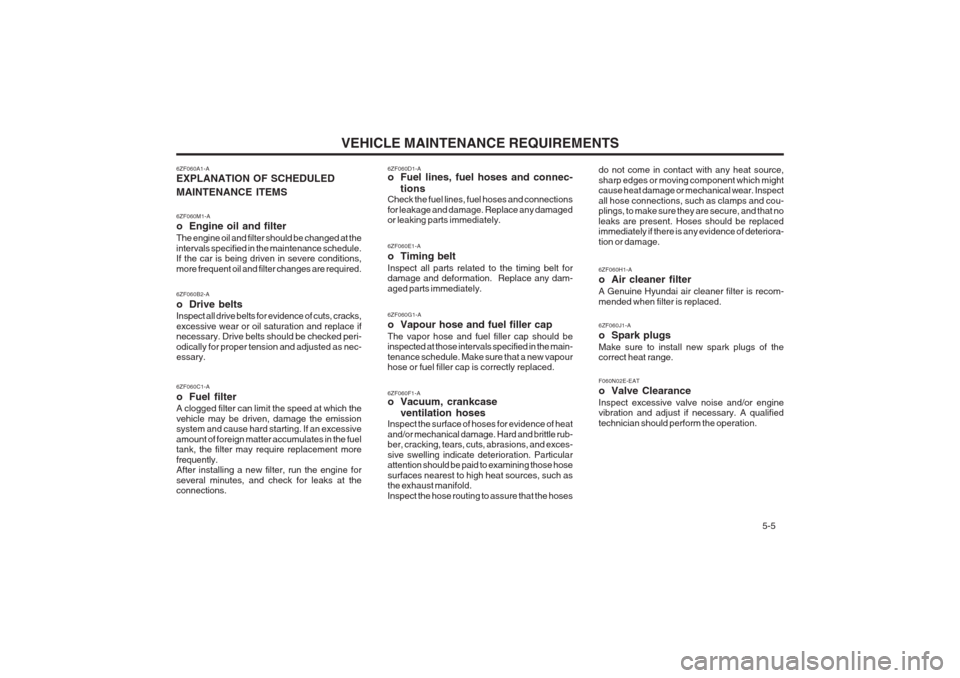
6ZF060A1-A EXPLANATION OF SCHEDULED MAINTENANCE ITEMS 6ZF060M1-A
o Engine oil and filter The engine oil and filter should be changed at the intervals specified in the maintenance schedule. If the car is being driven in severe conditions, more frequent oil and filter changes are required. 6ZF060B2-A
o Drive belts Inspect all drive belts for evidence of cuts, cracks, excessive wear or oil saturation and replace if necessary. Drive belts should be checked peri- odically for proper tension and adjusted as nec- essary. 6ZF060C1-A
o Fuel filter A clogged filter can limit the speed at which the vehicle may be driven, damage the emission system and cause hard starting. If an excessive amount of foreign matter accumulates in the fuel tank, the filter may require replacement more frequently. After installing a new filter, run the engine for several minutes, and check for leaks at the connections.
F060N02E-EAT
o Valve Clearance Inspect excessive valve noise and/or engine vibration and adjust if necessary. A qualified technician should perform the operation.
Page 109 of 140
OWNER MAINTENANCE
6-4
SG020B1-E DAILY OPERATING CHECKS The following items should be checked on a daily basis or whenever the vehicle is refuelled, which- ever occurs sooner.
o Engine oil level.
o Engine coolant level.
o Power steering fluid level.
o Brake fluid level.
o Windscreen washer fluid level.
o Battery condition.
o Tyre condition and pressures.
o Operation and cleanliness of all lighting equip-
ment.
o Windscreen wiper and washer operation.
o Horn operation.
o Warning lamp operation.
o Adjustment and cleanliness of mirrors.
o Seat and seat belt adjustment and operation.
o Fluid leakage. The vehicle must not be driven if the daily oper- ating checks indicate that any item of equipment related to the safety or roadworthiness of the vehicle is not functioning correctly. SG030A1-E ENGINE OIL The correct engine oil level is of paramount importance. An excessively high or low oil level may result in irreparable damage being sus- tained by the engine. The engine oil level must be checked on a daily basis or whenever the vehicle is refuelled, whichever occurs sooner. In addition, it is imperative that only an approved grade and specification of oil is used to avoid the possibility of serious engine damage and prema- ture wear. The use of "budget price" oil is a false economy that must be avoided if the maximum reliability and useful life is to be obtained from the vehicle.
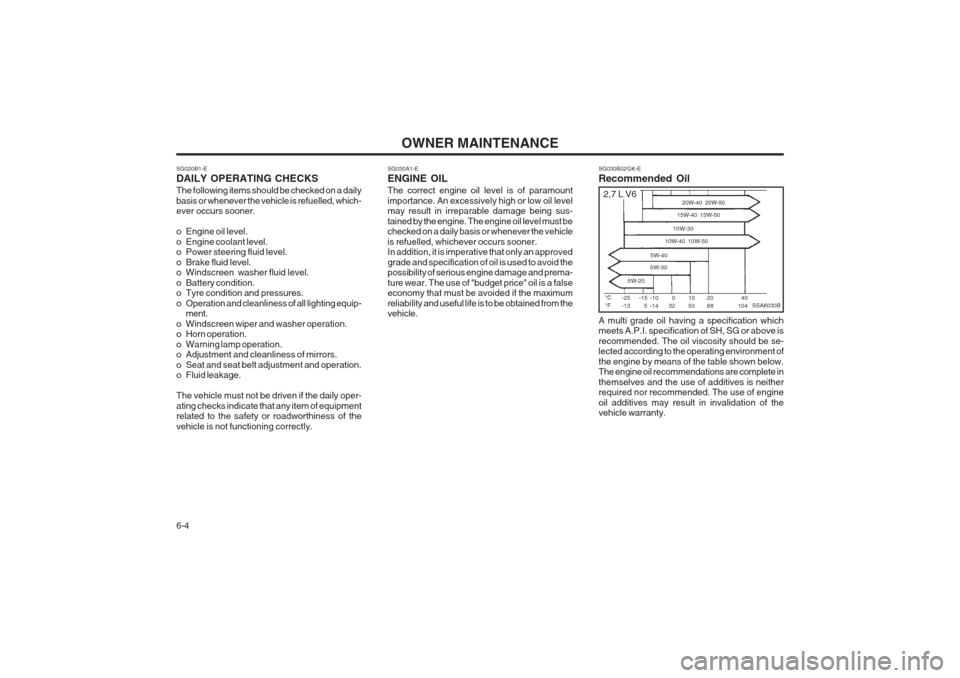
SG030B02GK-E Recommended Oil A multi grade oil having a specification which meets A.P.I. specification of SH, SG or above is recommended. The oil viscosity should be se- lected according to the operating environment of the engine by means of the table shown below. The engine oil recommendations are complete in themselves and the use of additives is neither required nor recommended. The use of engine oil additives may result in invalidation of the vehicle warranty.
SSA6030B°C °F
-25-13 20W-40 20W-50
15W-40 15W-50
10W-30
10W-40 10W-50
5W-40
5W-30
5W-2040
104
20 68
1050
032
-15 5 -10-14
2,7 L V6
Page 124 of 140
OWNER MAINTENANCE 6-19
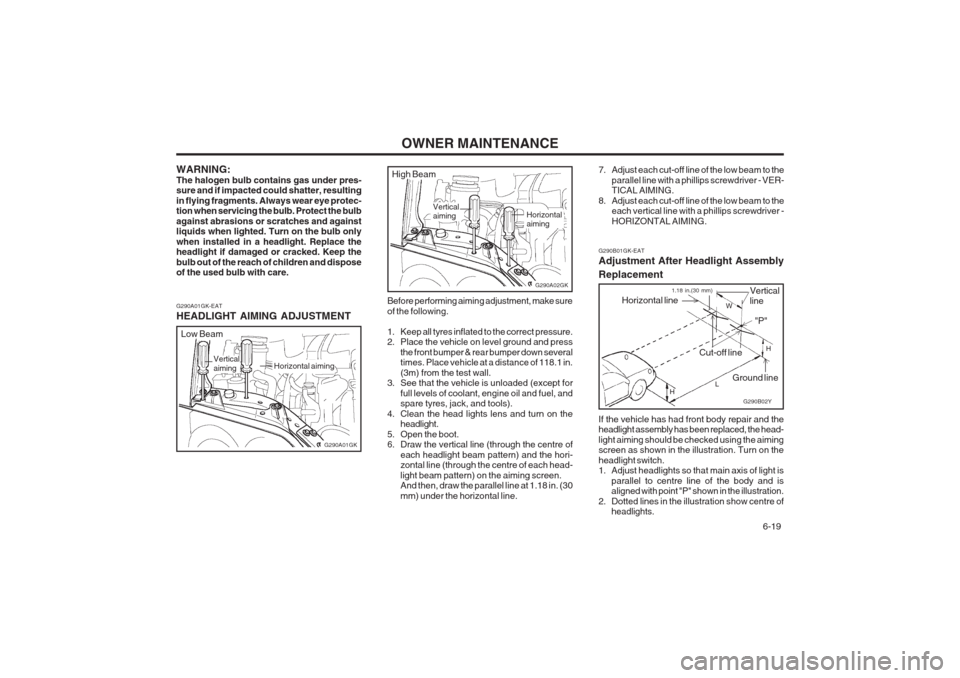
G290A01GK-EAT HEADLIGHT AIMING ADJUSTMENT
Before performing aiming adjustment, make sure of the following.
1. Keep all tyres inflated to the correct pressure.
2. Place the vehicle on level ground and press
the front bumper & rear bumper down severaltimes. Place vehicle at a distance of 118.1 in. (3m) from the test wall.
3. See that the vehicle is unloaded (except for
full levels of coolant, engine oil and fuel, and spare tyres, jack, and tools).
4. Clean the head lights lens and turn on the headlight.
5. Open the boot.
6. Draw the vertical line (through the centre of each headlight beam pattern) and the hori-zontal line (through the centre of each head- light beam pattern) on the aiming screen. And then, draw the parallel line at 1.18 in. (30 mm) under the horizontal line.
WARNING:The halogen bulb contains gas under pres- sure and if impacted could shatter, resulting in flying fragments. Always wear eye protec- tion when servicing the bulb. Protect the bulb against abrasions or scratches and against liquids when lighted. Turn on the bulb only when installed in a headlight. Replace the headlight if damaged or cracked. Keep the bulb out of the reach of children and dispose of the used bulb with care.
Vertical aiming
G290A01GK
Horizontal aiming
Low Beam
Vertical aiming
G290A02GK
Horizontal aiming
High Beam
7. Adjust each cut-off line of the low beam to the
parallel line with a phillips screwdriver - VER- TICAL AIMING.
8. Adjust each cut-off line of the low beam to the each vertical line with a phillips screwdriver - HORIZONTAL AIMING.
G290B01GK-EAT Adjustment After Headlight Assembly Replacement
G290B02Y
Vertical line
Cut-off line Ground line
Horizontal line
LW
H
H "P"1.18 in.(30 mm)
If the vehicle has had front body repair and the headlight assembly has been replaced, the head- light aiming should be checked using the aiming screen as shown in the illustration. Turn on the headlight switch.
1. Adjust headlights so that main axis of light is parallel to centre line of the body and isaligned with point "P" shown in the illustration.
2. Dotted lines in the illustration show centre of headlights.
Page 129 of 140
EMISSION CONTROL SYSTEM 7-1
SH010A1-E EMISSION CONTROL SYSTEMS (Not all models) Depending upon the market for which the vehicle is destined, the emission control system will comprise one or more of the following emission control devices. (1) Crankcase emission control system (2) Evaporative emission control system (3) Exhaust emission control system In order that the proper functioning of the emis- sion control systems may be ensured, it is recommended that the vehicle is inspected and maintained by an authorized Hyundai dealer in accordance with the maintenance schedule in this manual.
SH000A1-E
7. EMISSION
CONTROL SYSTEM
SH010B1-E
1. CRANKCASE EMISSION CONTROL SYSTEM
The positive crankcase ventilation system is employed to prevent air pollution caused by blow-by gases being emitted from the crankcase by introducing fresh air to the crankcase through the air cleaner where this mixes with blow-by gases and then passes through the PCV valve into the intake manifold from where it subse- quently enters the combustion chamber and is burned.
SH010D1-E
3. EXHAUST EMISSION CONTROL SYSTEM The exhaust emission control system is a highly effective system which controls exhaust emis- sion while maintaining good vehicle performance.
SH010C1-E
2. EVAPORATIVE EMISSION CONTROL SYSTEM
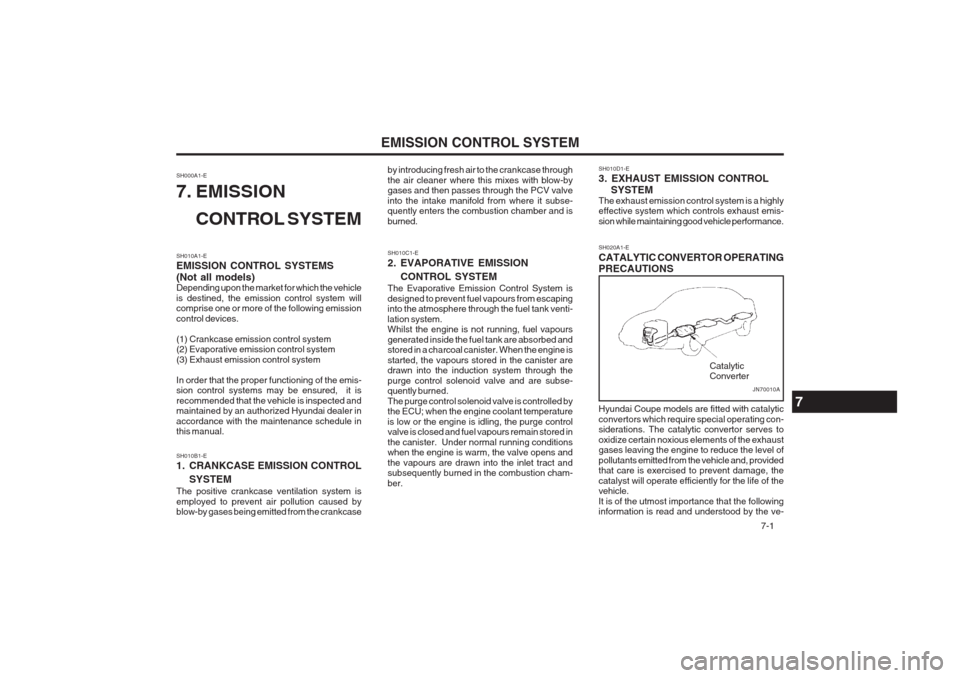
The Evaporative Emission Control System is designed to prevent fuel vapours from escaping into the atmosphere through the fuel tank venti- lation system. Whilst the engine is not running, fuel vapours generated inside the fuel tank are absorbed and stored in a charcoal canister. When the engine is started, the vapours stored in the canister are drawn into the induction system through the purge control solenoid valve and are subse- quently burned. The purge control solenoid valve is controlled by the ECU; when the engine coolant temperature is low or the engine is idling, the purge control valve is closed and fuel vapours remain stored in the canister. Under normal running conditions when the engine is warm, the valve opens and the vapours are drawn into the inlet tract and subsequently burned in the combustion cham- ber. SH020A1-E CATALYTIC CONVERTOR OPERATING PRECAUTIONS
JN70010A
Catalytic Converter
Hyundai Coupe models are fitted with catalytic convertors which require special operating con- siderations. The catalytic convertor serves to oxidize certain noxious elements of the exhaust gases leaving the engine to reduce the level of pollutants emitted from the vehicle and, provided that care is exercised to prevent damage, the catalyst will operate efficiently for the life of the vehicle. It is of the utmost importance that the following information is read and understood by the ve-7
Page 130 of 140
EMISSION CONTROL SYSTEM
7-2
hicle operator in order to prevent operational problems arising from damage to the catalyst. Damage to the catalyst will result if contamina- tion occurs through the use of leaded fuel. Whilst the vehicle is fitted with a reduced diameter filler neck to prevent charging of the fuel tank with a leaded fuel pump nozzle, it is possible that the use of funnels or jerry cans will permit leaded fuel to be introduced into the fuel tank. The catalyst is intolerant of unburnt fuel and therefore if an engine misfire condition exists, damage to the catalyst will occur. It is imperative that if a misfire condition develops, the vehicle is immediately presented to a Hyundai dealer for rectification. Similarly, the practice of certain ignition system diagnosis procedures which in- volve inducing a misfire (cylinder power balance tests for example) may result in catalyst dam- age. For these reasons, it is advisable that the ex- haust gas emission be tested at each routine service with a gas analyzer having a Hydrocar- bon measuring facility to ensure continued reli- ability of the catalyst. Push or tow starting of the vehicle is to be avoided since unburnt fuel may be enter the catalyst and result in damage. (Note, it is impos- sible to push or tow start a Hyundai model equipped with fuel injection since the fuel pump safety interlock will prevent the pump from oper- ating under these conditions). Operation of the catalyst involves extremely high temperatures being attained within the catalytic convertor, and although the convertor is fitted
with heat shields, it is important that the vehicleis not parked over combustible or volatile mate- rial which may result in fire. If the above precautions are not adhered to and the catalyst becomes inoperative, the resultant increase in core temperature will result in a "melt down" where the catalyst core will melt and subsequently may block the exhaust system. Due to the fragile nature of the catalyst element, it is important that damage does not occur when the vehicle is raised by means of a garage jack. Care must also be exercised to avoid driving over road hazards or debris which may cause damage to the catalyst element.
Page 134 of 140
VEHICLE SPECIFICATIONS 9-1
Standard Option
SJ000A1-F
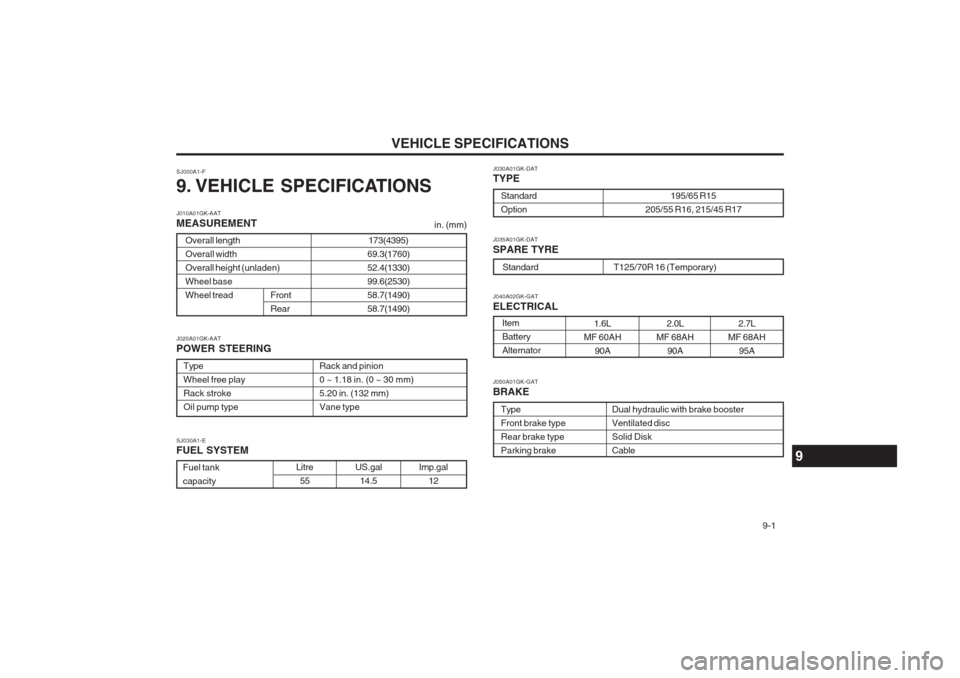
9. VEHICLE SPECIFICATIONS
Litre55
in. (mm)
173(4395)
69.3(1760) 52.4(1330)99.6(2530)58.7(1490)58.7(1490)
Rack and pinion 0 ~ 1.18 in. (0 ~ 30 mm)5.20 in. (132 mm)Vane type
9
J010A01GK-AAT MEASUREMENT J020A01GK-AAT POWER STEERING SJ030A1-E FUEL SYSTEM J030A01GK-DATTYPE J040A02GK-GAT ELECTRICAL
Item BatteryAlternator
Overall lengthOverall widthOverall height (unladen)Wheel baseWheel tread
FrontRear
TypeWheel free playRack strokeOil pump type
Fuel tankcapacity US.gal
14.5 Imp.gal
12 195/65 R15
205/55 R16, 215/45 R17
1.6L
MF 60AH 90A2.0L
MF 68AH 90A2.7L
MF 68AH 95A
J035A01GK-DAT SPARE TYRE
T125/70R 16 (Temporary)
Standard
Dual hydraulic with brake booster Ventilated discSolid DiskCable
J050A01GK-GAT BRAKE
Type Front brake typeRear brake typeParking brake
Page 138 of 140
INDEX
10-2
E EFFECTIVE BRAKING
....................................................................... 2-8
ELECTRIC COOLING FANS ........................................................... 6-17
EMISSION CONTROL SYSTEMS ..................................................... 7-1
ENGINE COMPARTMENT ................................................................. 6-1
ENGINE COOLANT CHECKING AND REPLACI NG ........................ 6-7
ENGINE COOLANT TEMPERATURE GUAGE ...............................1-29
ENGINE OIL AND FILTER REPLACEMENT .................................... 6-6
ENGINE OIL CO NSUMPTION ........................................................... 6-6
ENGINE OIL REPLENISHMENT ............ ........................................... 6-5
ENGINE OIL ....................................................................................... 6-4
EXTERIOR REAR VIEW MIRROR .................................................. 1-41
F
FOLDING REAR SEAT .................................................................... 1-10
FRONT ASHTRAY ........ ................................................................... 1-37
FRONT DOOR EDGE WARNING LAMP ........................................1-44
FRONT FOG LIGHT SWITCH ......................................................... 1-43
FRONT SEAT ADJUSTMENT ........................................................... 1-7
FRONT SEAT BELT PIVOT HEIGHT ADJUSTMENT ....................1-11
FUEL ECONOMY ............................................................................... 2-3
FUEL GAUGE .................................................................................. 1-28
FUEL RECOMMENDATIONS ........... ................................................. 1-1
FUSE PANEL DESCRIPTION ......................................................... 6-22
FUSIBLE LINKS ............................................................................... 6-16G
GLOVE BOX .....................................................................................
1-39
H HATCHBACK DOOR ........................................................................ 1-45
HATCHBACK DOOR WIPER AND WA SHER ................................1-35
HAZARD WARNING SYSTEM ........................................................ 1-35
HEADLIGHT BULB ........................................................................... 6-18
HEADLIGHT AIMING ADJUSTMENT ..............................................6-18
HEADLIGHT LEVELING DEVICE SYSTEM ....................................1-37
HEAD RESTRAINT ADJUSTMENT ................................................... 1-7
HEATED REAR WINDOW ............................................................... 1-35
HEATING AND COO LING CONTROL ............................................ 1-50
ROTARY TYPE ................................................................. 1-51 ~ 1-54
AUTOMATIC TYPE ........................................................... 1-56 ~ 1-61
HORN ............................................................................................... 1-47
IIF THE ENGINE CANNOT BE CRANKED ........................................ 3-1
IF THE ENGINE OVERHEATS .......................................................... 3-2
IF THE ENGINE WILL NOT START .................................................. 3-1
IF THE EVENT OF A PUNCTURE .................................................... 3-3
IMMOBILIZER SYSTEM ..................................................................... 1-2
INDIVIDUAL CIRCUIT FUSES ......................................................... 6-17
INSTRUMENT CLUSTER AND INDICATORS ................................1-25
Page 139 of 140
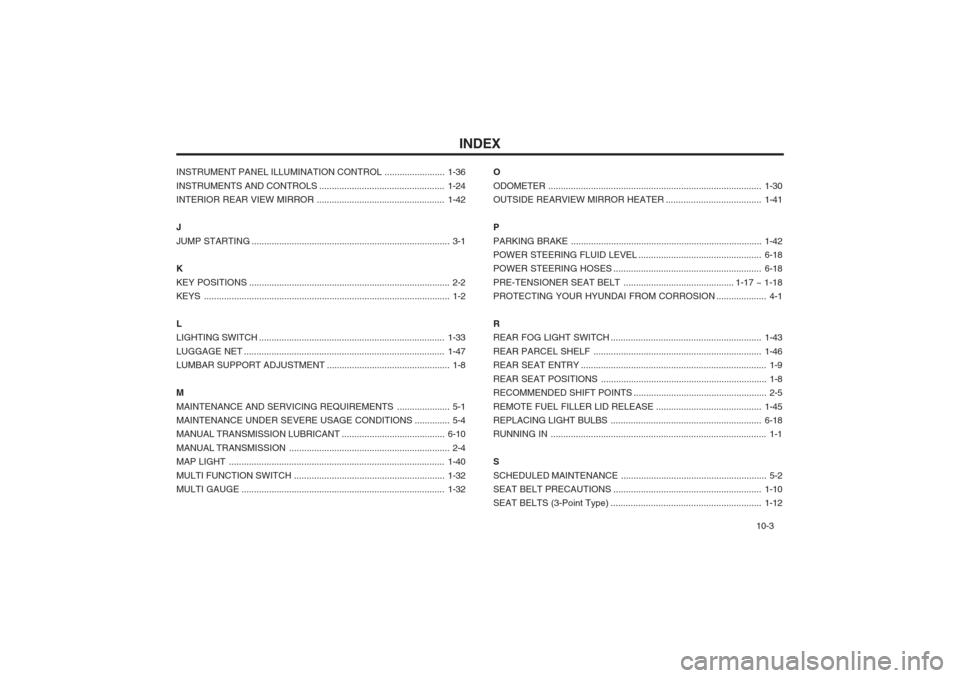
INDEX10-3
INSTRUMENT PANEL ILLUMINATION CONTROL
........................1-36
INSTRUMENTS AND CONTROLS ..................................................1-24
INTERIOR REAR VIEW MIRROR ...................................................1-42
J JUMP STARTING ............................................................................... 3-1
KKEY POSITIONS ................................................................................ 2-2
KEYS .................................................................................................. 1-2
L LIGHTING SWITCH .......................................................................... 1-33
LUGGAGE NET ................................................................................ 1-47
LUMBAR SUPPORT ADJUSTMENT ................................................. 1-8
M
MAINTENANCE AND SERVICING REQUIREM ENTS ..................... 5-1
MAINTENANCE UNDER SEVERE USAGE CONDITIONS .............. 5-4
MANUAL TRANSMISSION LUBRICANT .............. ...........................6-10
MANUAL TRANSMISSION ................................................................ 2-4
MAP LIGHT ...................................................................................... 1-40
MULTI FUNCTION SWITCH ................................ ............................1-32
MULTI GAUGE ................................................................................. 1-32OODOMETER
..................................................................................... 1-30
OUTSIDE REARVIEW MIRROR HEATER ...................................... 1-41
PPARKING BRAKE ............................................................................ 1-42
POWER STEERING FLUID LEVEL ................................................. 6-18
POWER STEERIN G HOSES ........................................................... 6-18
PRE-TENSIONER SEAT BELT ............................................ 1-17 ~ 1-18
PROTECTING YOUR HYUNDAI FROM CORROSION .................... 4-1
R
REAR FOG LIGHT SWITCH ............................................................ 1-43
REAR PARCEL SHELF ................................................................... 1-46
REAR SEAT ENTRY .......................................................................... 1-9
REAR SEAT POSITIONS .................................................................. 1-8
RECOMMENDED SHIFT POINTS ..................................................... 2-5
REMOTE FUEL FILLER LID RELEASE.......................................... 1-45
REPLACING LIGHT BULBS ................................. ...........................6-18
RUNNING IN ...................................................................................... 1-1
S SCHEDULED MAINTENANCE .......................................................... 5-2
SEAT BELT PRECAUTIONS ........................................................... 1-10
SEAT BELTS (3-Point Type) ............................................................ 1-12