fuel Hyundai Coupe 2002 User Guide
[x] Cancel search | Manufacturer: HYUNDAI, Model Year: 2002, Model line: Coupe, Model: Hyundai Coupe 2002Pages: 140, PDF Size: 1.45 MB
Page 77 of 140
DRIVING YOUR HYUNDAI 2- 3
SB050B1-E STEERING WHEEL LOCKWhen the key is removed, the steering column lock will be activated and will engage when the steering wheel is turned to the appropriate po- sition. It is not necessary to turn the wheel until locked each time the key is removed since in the event of any unauthorized attempt at re- moval, the lock will become effective as soon as the steering wheel is turned. To unlock the steering, insert the key and turn to the "ACC" position. If the steering is locked, it may be necessary to rock the steering wheel slightly to facilitate turning the key. Under no circum- stances should the key be forced since break- age of the key will occur.
SC060B1-E FUEL ECONOMY The following suggestions are made to assist in achieving the greatest degree of fuel economy.
o Maintaining a constant check on fuel con-
sumption will enable the most economical use pattern and driving style to be adopted.
o Avoid using the vehicle for very short jour- neys if possible, particularly when a coldstart is involved.
o Ensure that tyre pressures are maintained at the correct level.
o Use only the recommended grade of fuel.
o Avoid carrying unnecessary weight, and if a roof rack is in use, remove it as soon aspossible after use.
o Anticipate the road and conditions ahead to enable adjustments in speed to be madesmoothly. Avoid heavy acceleration and sharp braking.
o Avoid cruising at unnecessary high speeds.
o Always ensure that the periodic maintenance services are performed by a Hyundai dealer
at the time and/or mileage intervals speci- fied.
o Use the air conditioning only when neces-
sary.
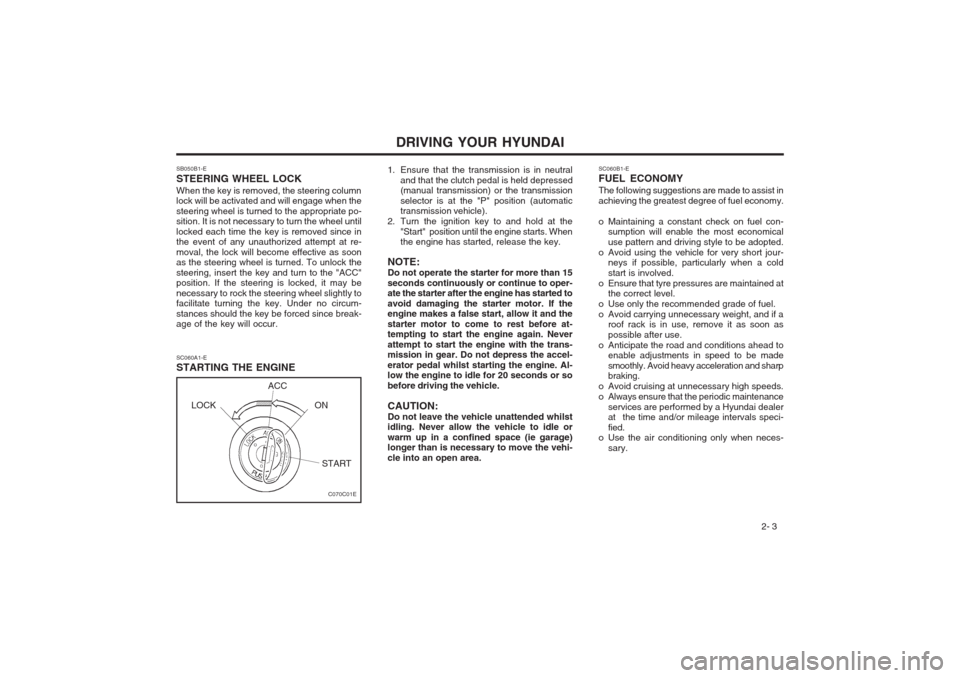
SC060A1-E STARTING THE ENGINE 1. Ensure that the transmission is in neutral
and that the clutch pedal is held depressed (manual transmission) or the transmission selector is at the "P" position (automatic transmission vehicle).
2. Turn the ignition key to and hold at the
"Start" position until the engine starts. Whenthe engine has started, release the key.
NOTE: Do not operate the starter for more than 15seconds continuously or continue to oper- ate the starter after the engine has started to avoid damaging the starter motor. If the engine makes a false start, allow it and the starter motor to come to rest before at- tempting to start the engine again. Never attempt to start the engine with the trans- mission in gear. Do not depress the accel- erator pedal whilst starting the engine. Al- low the engine to idle for 20 seconds or so before driving the vehicle. CAUTION: Do not leave the vehicle unattended whilst idling. Never allow the vehicle to idle or warm up in a confined space (ie garage) longer than is necessary to move the vehi- cle into an open area.
C070C01E
LOCK ACC
ON
START
Page 79 of 140
DRIVING YOUR HYUNDAI 2- 5
SC090B1-F Using the Clutch The clutch should be pressed all the way to the floor before shifting, then released slowly. Do not rest your foot on the clutch pedal while driving.This can cause unnecessary wear.Do not partially engage the clutch to hold the car on an incline. This causes unnecessary wear.Use the parking brake to hold the car on an incline. Do not operate the clutch pedal rapidly and repeatedly.
NOTE:
o During cold weather, shifting may be dif-
ficult until the transaxle lubricant has warmed up. This is normal and not harm- ful to the transaxle.
o If you 've come to a complete stop and
it's hard to shift into 1 st
or R(Reverse),
put the shift lever in N(Neutral) positionand let up on the clutch. Press the clutch pedal back down, and then shift into 1 st
or R(Reverse) gear position.
o Do not use the shift lever as a handrest during driving, as this can result in pre- mature wear of the transaxle shift forks. C070E02GK-AAT RECOMMENDED SHIFT POINTSThe shift points as shown below are recom- mended for optimum fuel economy and perfor- mance.
1-2 2-3 3-44-5
Shift
from-to Recommended
15 mph (20 km/h)25 mph (40 km/h)35 mph (55 km/h) 45 mph (75 km/h) HGK174-D
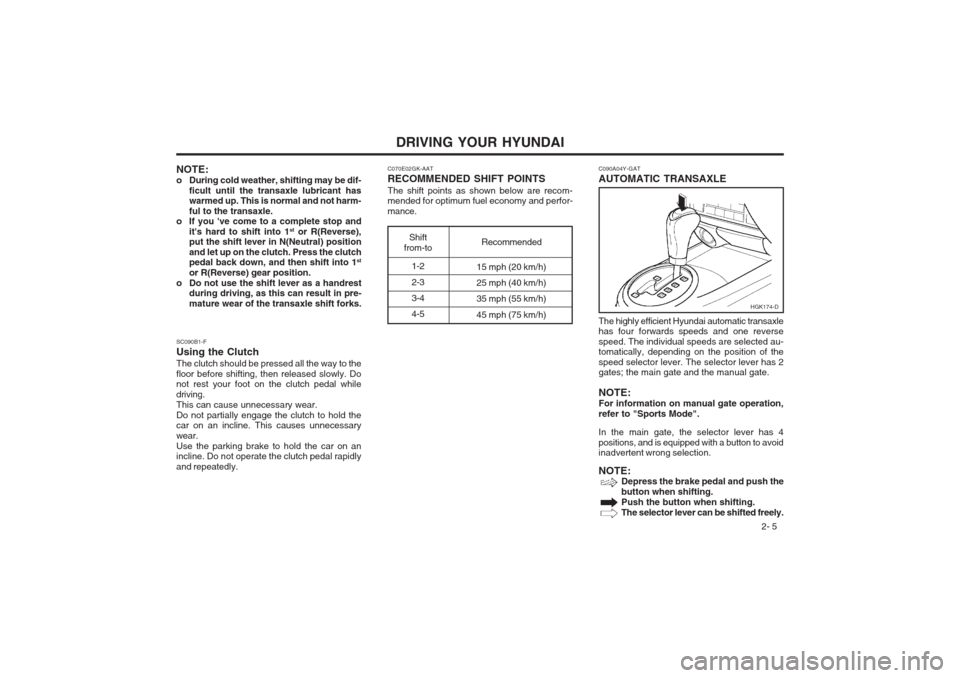
C090A04Y-GAT AUTOMATIC TRANSAXLE The highly efficient Hyundai automatic transaxle has four forwards speeds and one reverse speed. The individual speeds are selected au- tomatically, depending on the position of the speed selector lever. The selector lever has 2 gates; the main gate and the manual gate. NOTE: For information on manual gate operation,refer to "Sports Mode". In the main gate, the selector lever has 4 positions, and is equipped with a button to avoid inadvertent wrong selection. NOTE:
Depress the brake pedal and push the button when shifting.Push the button when shifting.The selector lever can be shifted freely.
Page 84 of 140
DRIVING YOUR HYUNDAI
2- 10
C300D01GK-GAT Indicator and WarningThe indicator should illuminate when the igni- tion key is turned to ON
or START but should
go out after three seconds. If the indicator does not illuminate, or the TCS indicator does not go out after 3 seconds, have it checked by an authorized dealer. Should there be any unusual conditions in the device, TCS-OFF either illuminates or blinks as a warning. If TCS-OFF illuminates or blinks, pull your carto a safe place and stop the engine. Then, start the engine again to check if the TCS-OFF indicator goes out. If the indicator remains lit even after the engine has been started, have your car checked by an authorized Hyundai dealer. NOTE:
1) When TCS-OFF illuminates or blinks, trac- tion control is automatically deactivatedfor safety.
3) When the engine starts, a click is heard
from the engine compartment; however, this is only the sound of traction control being checked.
4) When moving out of the mud or fresh snow, pressing the accelerator pedal maynot cause the engine speed to increase. 2) This warning function is not provided
when the driver choose the TCS-OFF mode. o Take care of your tires. Keep them inflated
to the recommended pressure. Incorrect infla-tion, either too much or too little, results in unnecessary tire wear. Check the tire pres- sures at least once a month.
o Be sure that the wheels are aligned cor-
rectly. Improper alignment can result fromhitting curbs or driving too fast over irregular surfaces. Poor alignment causes faster tire wear and may also result in other problems as well as greater fuel consumption.
o Keep your car in good condition. For better
fuel economy and reduced maintenance costs, maintain your car in accordance with the maintenance schedule in Section 5. If you drive your car in severe conditions, more frequent maintenance is required (see Section 5 for details).
o Keep your car clean. For maximum service, your car should be kept clean and free ofcorrosive materials. It is especially impor- tant that mud, dirt, ice, etc. not be allowed to accumulate on the underside of the car. This extra weight can result in increased fuel consumption and also contribute to corro- sion.
o Travel lightly. Don't carry unnecessary weight in your car. Weight is an enemy of good fueleconomy.
o Don't let the engine idle longer than neces- sary. If you are waiting (and not in traffic),turn off your engine and restart only when you're ready to go.
SC150A1-F DRIVING FOR ECONOMYYou can save fuel and get more miles from your car if you follow these suggestions:
o Drive smoothly. Accelerate at a moderate
rate. Don't make "jack-rabbit" starts or full- throttle shifts and maintain a steady cruising speed. Don't race between stoplights. Try to adjust your speed to that of the other traffic so you don't have to change speeds unnec- essarily. Avoid heavy traffic whenever possible. Al-ways maintain a safe distance from other vehicles so you can avoid unnecessary brak- ing. This also reduces brake wear.
o Drive at a moderate speed. The faster you drive, the more fuel your car uses. Driving ata moderate speed, especially on the high- way, is one of the most effective ways to reduce fuel consumption.
o Don't "ride" the brake or clutch pedal. This
can increase fuel consumption and also increase wear on these components. In ad- dition, driving with your foot resting on the brake pedal may cause the brakes to over- heat, which reduces their effectiveness and may lead to more serious consequences.
Page 85 of 140
DRIVING YOUR HYUNDAI 2- 11
o Remember, your car does not require ex-
tended warm-up. As soon as the engine is running smoothly, you can drive away. In very cold weather, however, give your en- gine a slightly longer warm-up period.
o Don't "lug" or "over-rev" the engine. Lugging
is driving too slowly in too high a gearresulting in the engine bucking. If this hap- pens to you, shift to a lower gear. Over-revving is racing the engine beyond its safe limit. This can be avoided by shifting at the recommended speeds.
o Use your air conditioning sparingly. The air conditioning system is operated by the en-gine power so your fuel economy is reduced when you use it.
SC160A1-F SMOOTH CORNERINGAvoid braking or gear changing in corners, especially when roads are wet. Ideally, corners should always be taken under gentle accelera- tion. If you follow these suggestions, tire wear will be held to a minimum. SC170A1-E WINTER MOTORINGThe onset of winter conditions subject motor vehicles to greater operating demands. There- fore, the following suggestions will assist in maintaining peak performance and reliability during these periods: ZC170B1-E Electrical SystemWinter conditions impose severe demands upon vehicle electrical systems, particularly the charg- ing circuit. The battery condition and perfor- mance along with the alternator performance and drive belt condition should be checked prior to the onset of winter. ZC170C1-E Anti-freeze/Corrosion inhibitorThe cooling system must always contain an Ethylene-Glycol based anti-freeze solution. The system is filled during manufacture with solu- tion of the correct strength which should be checked before the onset of winter and adjust- ed or changed as required. NOTE: The anti-freeze solution contains a corro- sion inhibitor to prevent degradation of the aluminum castings contained within the engine. Therefore, never, drain the system and refill with water only. In addition, anti-freeze solution must ALWAYS be used in vehicles fitted with air conditioning, to prevent the heater matrix from freezing and subsequently bursting with the refrigeration sys- tem in use.
ZC170D1-E Door LocksShould the door lock mechanism become fro- zen, a proprietary lock de-icer should be used. Alternatively, warming the door key may thaw the door lock. However, the key should be handled carefully to avoid burning the fingers. Never attempt to thaw a frozen door lock using hot water, since the water will eventually freeze and compound the problem. NOTE: The proper temperature for using the immo-bilizer key is from -40°F (-40°C) to 176°F (80°C). If you heat the immobilizer key over 176°F (80°C) to open the frozen lock, it may cause damage to the transponder in its head. SC170E1-E Windscreen Washers and WipersThe windscreen washer bottle should be filled with a solution of water and a proprietary winter screen wash additive. The windscreen wipers should not be used if the blades are frozen to the windscreen or if they are covered with snow, before this is removed. NOTE: Never allow undiluted screen washer fluid additive to spill upon the paintwork or use engine coolant anti-freeze since damage to the paintwork may result.
Page 86 of 140
DRIVING YOUR HYUNDAI
2- 12 WARNING: It is not recommended that the vehicle be used for towing until the first 1000 miles of Running In has been completed. All Hyundai coupe models are suited to towing trailers and caravans up to the limits indicated be- low. Coupe models fitted with automatic transmission have a transmission oil cooler and further transmission cooling should not be required.
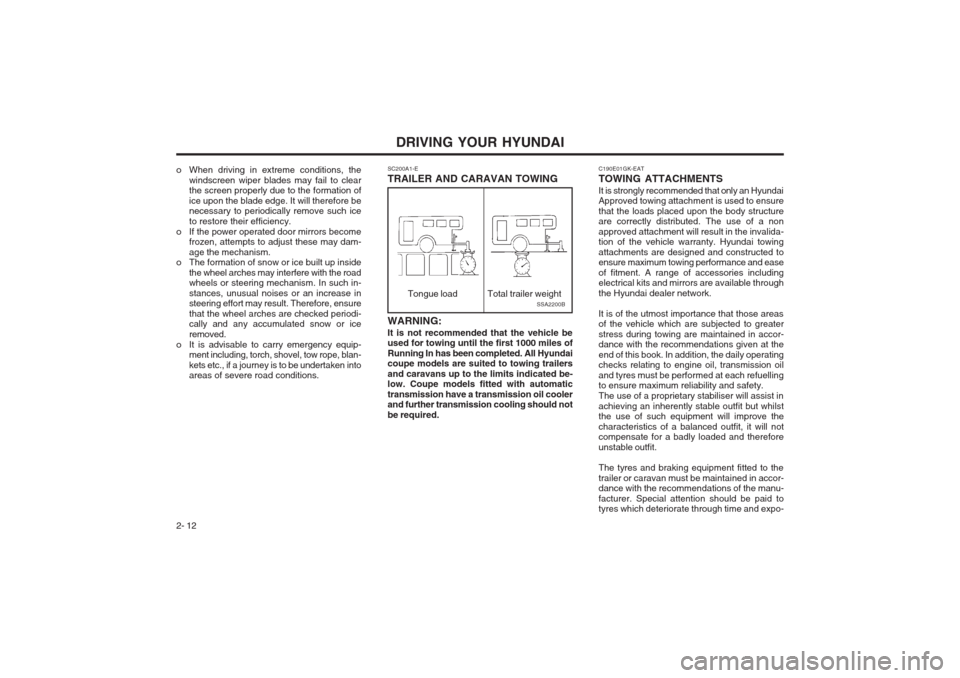
SC200A1-E TRAILER AND CARAVAN TOWING
Tongue loadSSA2200B
Total trailer weight
C190E01GK-EAT TOWING ATTACHMENTSIt is strongly recommended that only an Hyundai Approved towing attachment is used to ensure that the loads placed upon the body structure are correctly distributed. The use of a non approved attachment will result in the invalida- tion of the vehicle warranty. Hyundai towing attachments are designed and constructed to ensure maximum towing performance and ease of fitment. A range of accessories including electrical kits and mirrors are available through the Hyundai dealer network. It is of the utmost importance that those areas of the vehicle which are subjected to greater stress during towing are maintained in accor- dance with the recommendations given at the end of this book. In addition, the daily operating checks relating to engine oil, transmission oil and tyres must be performed at each refuelling to ensure maximum reliability and safety. The use of a proprietary stabiliser will assist inachieving an inherently stable outfit but whilst the use of such equipment will improve the characteristics of a balanced outfit, it will not compensate for a badly loaded and therefore unstable outfit. The tyres and braking equipment fitted to the trailer or caravan must be maintained in accor- dance with the recommendations of the manu- facturer. Special attention should be paid to tyres which deteriorate through time and expo-
o When driving in extreme conditions, the
windscreen wiper blades may fail to clearthe screen properly due to the formation of ice upon the blade edge. It will therefore be necessary to periodically remove such ice to restore their efficiency.
o If the power operated door mirrors become frozen, attempts to adjust these may dam-age the mechanism.
o The formation of snow or ice built up inside
the wheel arches may interfere with the road wheels or steering mechanism. In such in- stances, unusual noises or an increase in steering effort may result. Therefore, ensure that the wheel arches are checked periodi- cally and any accumulated snow or ice removed.
o It is advisable to carry emergency equip- ment including, torch, shovel, tow rope, blan-kets etc., if a journey is to be undertaken into areas of severe road conditions.
Page 87 of 140
DRIVING YOUR HYUNDAI 2- 13
NOTE:
o The total gross vehicle weight with trailer
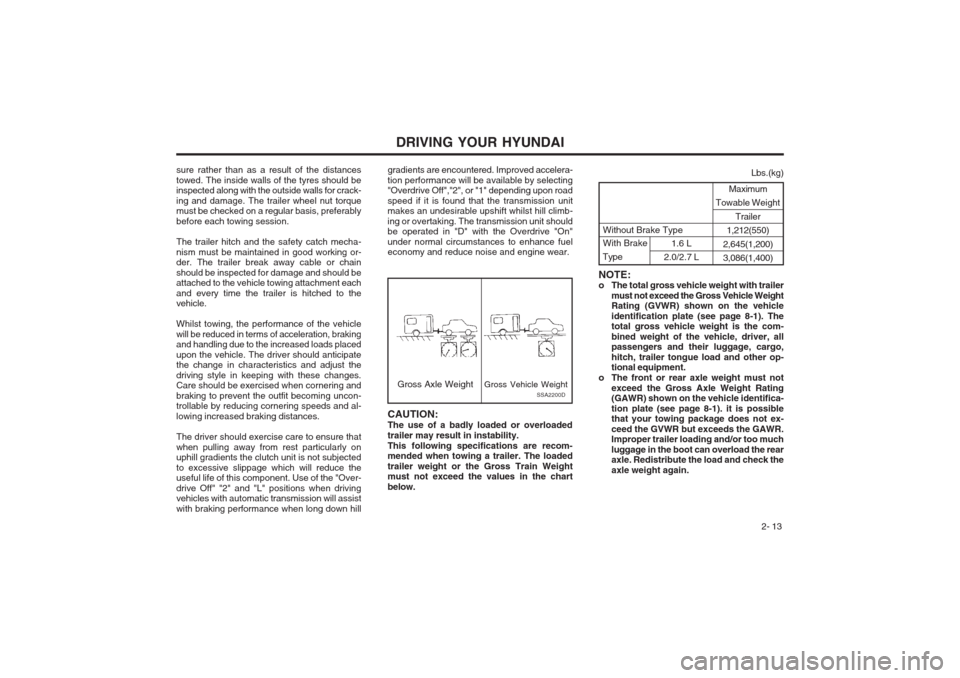
must not exceed the Gross Vehicle WeightRating (GVWR) shown on the vehicle identification plate (see page 8-1). The total gross vehicle weight is the com- bined weight of the vehicle, driver, all passengers and their luggage, cargo, hitch, trailer tongue load and other op- tional equipment.
o The front or rear axle weight must not exceed the Gross Axle Weight Rating(GAWR) shown on the vehicle identifica- tion plate (see page 8-1). it is possible that your towing package does not ex- ceed the GVWR but exceeds the GAWR. Improper trailer loading and/or too much luggage in the boot can overload the rear axle. Redistribute the load and check the axle weight again.
sure rather than as a result of the distancestowed. The inside walls of the tyres should be inspected along with the outside walls for crack- ing and damage. The trailer wheel nut torque must be checked on a regular basis, preferably before each towing session. The trailer hitch and the safety catch mecha- nism must be maintained in good working or- der. The trailer break away cable or chain should be inspected for damage and should be attached to the vehicle towing attachment each and every time the trailer is hitched to the vehicle. Whilst towing, the performance of the vehicle will be reduced in terms of acceleration, braking and handling due to the increased loads placed upon the vehicle. The driver should anticipate the change in characteristics and adjust the driving style in keeping with these changes. Care should be exercised when cornering and braking to prevent the outfit becoming uncon- trollable by reducing cornering speeds and al- lowing increased braking distances. The driver should exercise care to ensure that when pulling away from rest particularly on uphill gradients the clutch unit is not subjected to excessive slippage which will reduce the useful life of this component. Use of the "Over- drive Off" "2" and "L" positions when driving vehicles with automatic transmission will assist with braking performance when long down hill gradients are encountered. Improved accelera-tion performance will be available by selecting "Overdrive Off","2", or "1" depending upon road speed if it is found that the transmission unit makes an undesirable upshift whilst hill climb- ing or overtaking. The transmission unit should be operated in "D" with the Overdrive "On" under normal circumstances to enhance fuel economy and reduce noise and engine wear.
SSA2200DGross Axle Weight
Gross Vehicle Weight
CAUTION: The use of a badly loaded or overloadedtrailer may result in instability.This following specifications are recom- mended when towing a trailer. The loaded trailer weight or the Gross Train Weight must not exceed the values in the chart below. Maximum
Towable Weight
Trailer
1,212(550)
2,645(1,200) 3,086(1,400)
Lbs.(kg)
With Brake
Type1.6 L
2.0/2.7 L
Without Brake Type
Page 88 of 140
DRIVING YOUR HYUNDAI
2- 14
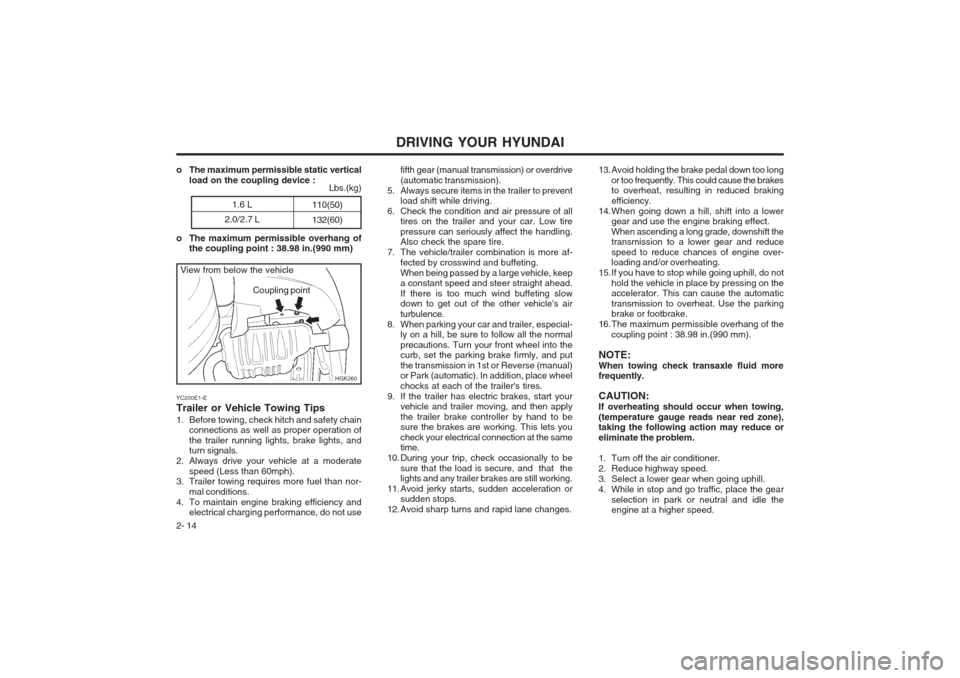
Coupling point
HGK260
View from below the vehicle 13. Avoid holding the brake pedal down too long
or too frequently. This could cause the brakes to overheat, resulting in reduced braking efficiency.
14. When going down a hill, shift into a lower gear and use the engine braking effect.When ascending a long grade, downshift the transmission to a lower gear and reduce speed to reduce chances of engine over- loading and/or overheating.
15. If you have to stop while going uphill, do not hold the vehicle in place by pressing on theaccelerator. This can cause the automatic transmission to overheat. Use the parking brake or footbrake.
16. The maximum permissible overhang of the coupling point : 38.98 in.(990 mm).
NOTE: When towing check transaxle fluid more frequently. CAUTION: If overheating should occur when towing,(temperature gauge reads near red zone), taking the following action may reduce or eliminate the problem.
1. Turn off the air conditioner.
2. Reduce highway speed.
3. Select a lower gear when going uphill.
4. While in stop and go traffic, place the gear selection in park or neutral and idle the engine at a higher speed.
fifth gear (manual transmission) or overdrive (automatic transmission).
5. Always secure items in the trailer to prevent load shift while driving.
6. Check the condition and air pressure of all tires on the trailer and your car. Low tirepressure can seriously affect the handling. Also check the spare tire.
7. The vehicle/trailer combination is more af-
fected by crosswind and buffeting. When being passed by a large vehicle, keep a constant speed and steer straight ahead. If there is too much wind buffeting slow down to get out of the other vehicle's air turbulence.
8. When parking your car and trailer, especial- ly on a hill, be sure to follow all the normalprecautions. Turn your front wheel into the curb, set the parking brake firmly, and put the transmission in 1st or Reverse (manual) or Park (automatic). In addition, place wheel chocks at each of the trailer's tires.
9. If the trailer has electric brakes, start your vehicle and trailer moving, and then applythe trailer brake controller by hand to be sure the brakes are working. This lets you check your electrical connection at the same time.
10. During your trip, check occasionally to be sure that the load is secure, and that thelights and any trailer brakes are still working.
11. Avoid jerky starts, sudden acceleration or sudden stops.
12. Avoid sharp turns and rapid lane changes.
o The maximum permissible static vertical
load on the coupling device :
o The maximum permissible overhang of the coupling point : 38.98 in.(990 mm)
YC200E1-E Trailer or Vehicle Towing Tips
1. Before towing, check hitch and safety chain connections as well as proper operation of the trailer running lights, brake lights, and turn signals.
2. Always drive your vehicle at a moderate speed (Less than 60mph).
3. Trailer towing requires more fuel than nor-
mal conditions.
4. To maintain engine braking efficiency and electrical charging performance, do not use
1.6 L
2.0/2.7 L 110(50) 132(60)
Lbs.(kg)
Page 89 of 140
3-1
IN CASE OF EMERGENCY
that the transmission selector is at the "P" or"N" position.
2. Check the battery terminals and connections
to ensure that these are clean and also tight.
3. If the ignition warning lamps dim when the
engine is cranked and the battery terminals have been checked, a discharged battery is indicated.
4. Do not attempt to push or tow start the ve-
hicle, refer to "Jump Starting" for information regarding engine starting when the battery is discharged.
SD000A1-E
3. IN CASE OF EMER-
GENCY
SD020A1-E IF THE ENGINE WILL NOT START Seek assistance from the nearest Hyundai dealer with regard to the method of ignition and fuel system diagnosis. CAUTION: If the engine refuses to start, no attempt should be made to push or tow start the vehicle. Vehicles with automatic transmis- sion or fuel injection will not be able to be started in this manner since no drive is trans- mitted through the automatic transmission whilst the engine is not running, and in the case of fuel injected derivatives, the fuel pump will not operate under tow start conditions. In addition, if the vehicle is equipped with an exhaust catalyst, damage to the catalyst may result if the vehicle is tow started. SD020B1-E IF THE ENGINE CANNOT BECRANKED
1. If the vehicle is fitted with manual transmis- sion, ensure that the clutch pedal is depressedwhilst cranking the engine. If the vehicle is fitted with automatic transmission, ensure SD020C1-F If Engine Turns Over Normally but Does Not Start
1. Check fuel Level
2. Check all connectors at ignition coil and spark
plugs.Replace any that may be disconnected or loose.
3. Check fuel line in the engine room.
4. If engine still refuses to start, call a Hyundai dealer or seek other qualified assistance.
AD020D1-A If Engine Stalls While Driving
1. Reduce your speed gradually, keeping a straight line. Move cautionsly off the road to a safe place.
2. Turn on your emergency flashers.
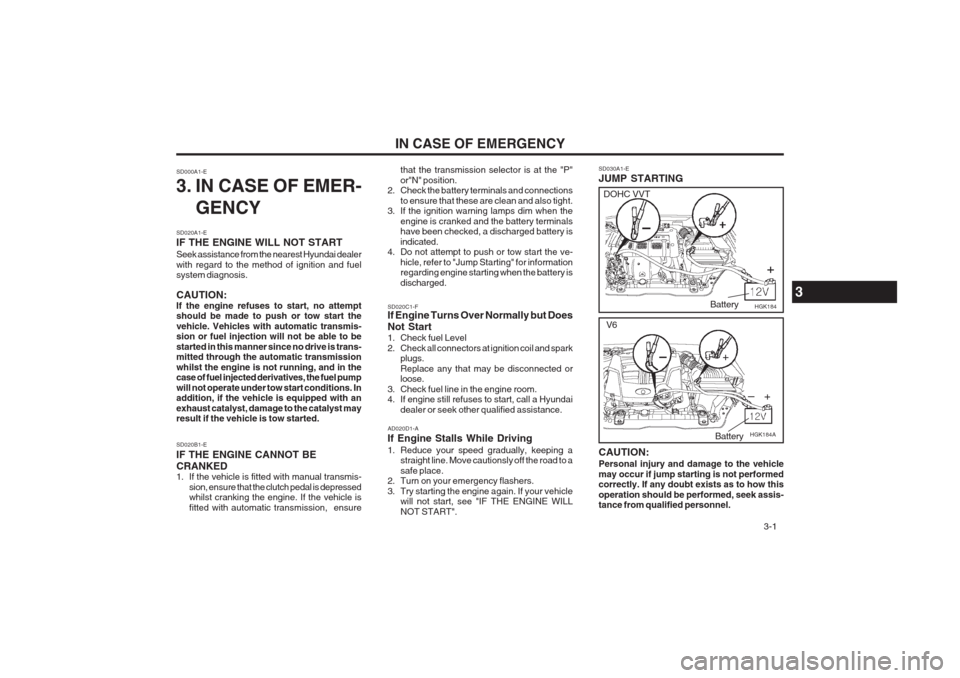
3. Try starting the engine again. If your vehicle will not start, see "IF THE ENGINE WILLNOT START". SD030A1-E JUMP STARTING
3
HGK184
Battery
DOHC VVT
HGK184A
V6
Battery
CAUTION: Personal injury and damage to the vehicle may occur if jump starting is not performed correctly. If any doubt exists as to how this operation should be performed, seek assis- tance from qualified personnel.
Page 90 of 140
IN CASE OF EMERGENCY
3-2 4. Check to see if the water pump drive belt is
missing. If it is not missing, check to see that it is tight. If the drive belt seems to be satisfac- tory, check for coolant leaking from the radia- tor, hoses or under the car. (If the air condi- tioning had been in use, it is normal for cold water to be draining from it).
WARNING: Whilst the engine is running, keep hands and clothing away from moving parts such as the fan and drive belts to prevent injury.
5. If the water pump drive belt is broken or coolant is leaking out, stop the engine imme- diately and call the nearest Hyundai dealer for assistance.
WARNING:Do not remove the radiator cap when the engine is hot since steam and boiling water may be ejected from the radiator resulting in burns or scalding.
6. If the cause of the overheating cannot be found, wait until the engine temperature has returned to normal. Then, if coolant has been lost, carefully remove the radiator cap and add water to bring the fluid level in the reser- voir up to the base of the radiator fill opening. Fill the coolant expansion tank to the halfway mark.
WARNING: Motor vehicle batteries contain sulphuric acid and emit hydrogen gas. Protective clothing should be worn and care exercised to prevent the acid from coming into contact with skin or clothing and the vehicle. Naked lights should not be permitted in the vicinity of the battery. Care should be exercised to prevent sparks occurring during connection. If acid acciden- tally comes into contact with skin or eyes, the affected area should immediately be flushed with copious amounts of water and medical assistance sought.
1. Ensure that the booster battery is 12 volt type.
If the booster battery is installed in another vehicle, ensure that the two vehicles are not touching.
2. Turn off all unnecessary electrical equipment in both vehicles.
3. Ensure that the engine of the vehicle provid- ing the jump start is running prior to connec- tion of the jump cables.
4. Connect the red jump cable to the positive (+)
terminal of the booster battery and the other end to the positive (+) terminal of the dis- charged battery.
5. Attach the black jump cable to the negative
(-) terminal of the booster battery, and the other end to a ground point within the engine compartment of the vehicle with the flat bat- tery. Do not connect to the negative battery terminal of the flat battery since sparks may be generated with the subsequent risk of explosion. 6. Raise the booster vehicle engine speed to
2,000 r.p.m. and start the engine of the vehi- cle with the flat battery.
7. Remove jump cables in the reverse order of installation (black cable first).
CAUTION: If the jump cable is incorrectly installed, dam- age to the vehicle electrical system may oc- cur, in particular the electronic components such as the Fuel Injection system computer and the Automatic Transmission computer. The battery must never be disconnected whilst the engine is running. SD040A1-E IF THE ENGINE OVERHEATSIf the temperature gauge indicates overheating:
1. Pull off the road and stop as soon as it is safe to do so.
2. Place the gear selector lever in "P" (auto- matic), or neutral (manual transaxle) and set the parking brake. If the air conditioning is on, turn it off.
3. If coolant is running out under the car or steam is coming out from under the bonnet stop the engine. Do not open the bonnet until the cool-ant has stopped running or the steam- ing has stopped. If there is no visible loss of coolant and no steam, leave the engine run- ning and check to be sure the engine cooling fan is operating. If the fan is not running, turn the engine off.
Page 99 of 140
VEHICLE MAINTENANCE REQUIREMENTS 5-1
SF020A1-E MAINTENANCE AND SERVICINGREQUIREMENTS To ensure the continued reliability and safety of the vehicle, certain routine maintenance opera- tions are required at specific mileage or time intervals. It is the responsibility of the vehicle owner to ensure that the maintenance schedules shown in both this Owners Manual and the Warranty and Service Passport are adhered to. The new vehicle warranty may be invalidated if the routine maintenance operations are not per- formed in line with the recommendations outlined and the safety and durability of the vehicle ad- versely affected. It is recommended that all maintenance opera- tions with the exception of the daily operating checks are entrusted to a Hyundai dealer to ensure that the latest repair and maintenance procedures and specialized servicing tools are employed. In addition, the use of genuine Hyundai replacement parts will ensure that the vehicle safety and performance will not be compro- mised.
SF000A1-E
5. VEHICLE MAINTE-
NANCE REQUIRE- MENTS NOTE: The inspection and testing of certain elec- tronic fuel injection/engine management and automatic transmission control systems re- quire specialised electronic equipment spe- cifically designed for Hyundai vehicles. The use of general purpose electrical test equip- ment may result in damage to the control unit microprocessors. SF020C1-E Specified Scheduled ProceduresThe Specified scheduled procedures are listed in the maintenance charts beginning at page 5- 2. The operations specified must be performed at the time or mileage intervals shown irrespec- tive of whether the mileage interval has been reached before the specified time interval. Certain lubricants and components degradewith both time and mileage (e.g. engine oil and brake fluid) and therefore it is not permissable to base the maintenance schedule upon mile- age alone. It is strongly recommended that the maintenance operations are performed by the factory-trained or distributor-trained technicians at your Hyundai dealer because of the need for specialized knowledge and tooling and to en- sure that no possibility of invalidating the man- ufacturers warranty exists. The maintenance schedules relate to vehiclesoperated under normal conditions, vehicles which are operated under adverse conditionswill require more frequent maintenance which is described at page 5-4. SF030B1-E SERVICE HISTORY It is important that all scheduled maintenance services are recorded in the warranty and ser- vice passport to ensure that proof of mainte- nance is available when warranty service is required.
5