tow Hyundai Coupe 2002 Owner's Guide
[x] Cancel search | Manufacturer: HYUNDAI, Model Year: 2002, Model line: Coupe, Model: Hyundai Coupe 2002Pages: 140, PDF Size: 1.45 MB
Page 89 of 140
3-1
IN CASE OF EMERGENCY
that the transmission selector is at the "P" or"N" position.
2. Check the battery terminals and connections
to ensure that these are clean and also tight.
3. If the ignition warning lamps dim when the
engine is cranked and the battery terminals have been checked, a discharged battery is indicated.
4. Do not attempt to push or tow start the ve-
hicle, refer to "Jump Starting" for information regarding engine starting when the battery is discharged.
SD000A1-E
3. IN CASE OF EMER-
GENCY
SD020A1-E IF THE ENGINE WILL NOT START Seek assistance from the nearest Hyundai dealer with regard to the method of ignition and fuel system diagnosis. CAUTION: If the engine refuses to start, no attempt should be made to push or tow start the vehicle. Vehicles with automatic transmis- sion or fuel injection will not be able to be started in this manner since no drive is trans- mitted through the automatic transmission whilst the engine is not running, and in the case of fuel injected derivatives, the fuel pump will not operate under tow start conditions. In addition, if the vehicle is equipped with an exhaust catalyst, damage to the catalyst may result if the vehicle is tow started. SD020B1-E IF THE ENGINE CANNOT BECRANKED
1. If the vehicle is fitted with manual transmis- sion, ensure that the clutch pedal is depressedwhilst cranking the engine. If the vehicle is fitted with automatic transmission, ensure SD020C1-F If Engine Turns Over Normally but Does Not Start
1. Check fuel Level
2. Check all connectors at ignition coil and spark
plugs.Replace any that may be disconnected or loose.
3. Check fuel line in the engine room.
4. If engine still refuses to start, call a Hyundai dealer or seek other qualified assistance.
AD020D1-A If Engine Stalls While Driving
1. Reduce your speed gradually, keeping a straight line. Move cautionsly off the road to a safe place.
2. Turn on your emergency flashers.
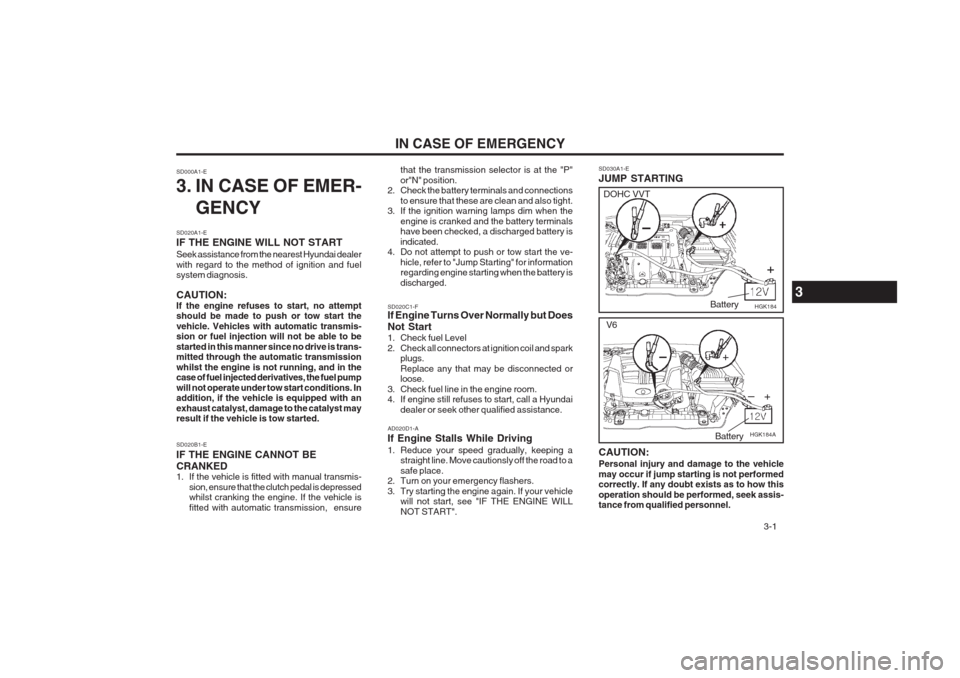
3. Try starting the engine again. If your vehicle will not start, see "IF THE ENGINE WILLNOT START". SD030A1-E JUMP STARTING
3
HGK184
Battery
DOHC VVT
HGK184A
V6
Battery
CAUTION: Personal injury and damage to the vehicle may occur if jump starting is not performed correctly. If any doubt exists as to how this operation should be performed, seek assis- tance from qualified personnel.
Page 95 of 140
3-7
IN CASE OF EMERGENCY
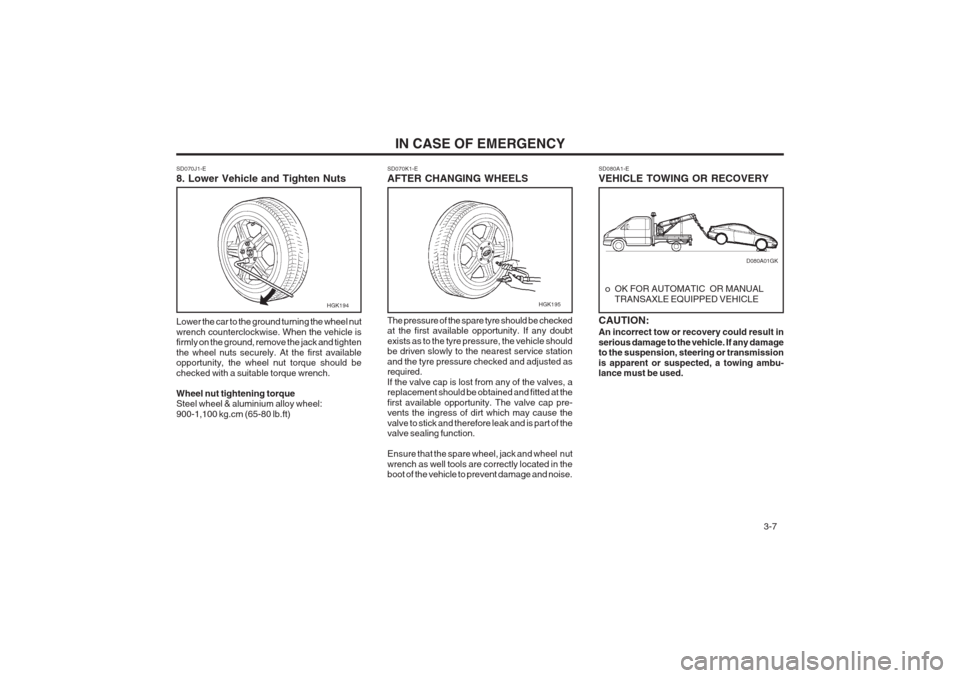
SD080A1-E VEHICLE TOWING OR RECOVERY
o OK FOR AUTOMATIC OR MANUALTRANSAXLE EQUIPPED VEHICLE
CAUTION: An incorrect tow or recovery could result in serious damage to the vehicle. If any damage to the suspension, steering or transmission is apparent or suspected, a towing ambu- lance must be used.
HGK194
SD070J1-E 8. Lower Vehicle and Tighten Nuts Lower the car to the ground turning the wheel nut wrench counterclockwise. When the vehicle is firmly on the ground, remove the jack and tighten the wheel nuts securely. At the first available opportunity, the wheel nut torque should be checked with a suitable torque wrench. Wheel nut tightening torque Steel wheel & aluminium alloy wheel: 900-1,100 kg.cm (65-80 lb.ft) SD070K1-E AFTER CHANGING WHEELS The pressure of the spare tyre should be checked at the first available opportunity. If any doubt exists as to the tyre pressure, the vehicle should be driven slowly to the nearest service station and the tyre pressure checked and adjusted as required. If the valve cap is lost from any of the valves, a replacement should be obtained and fitted at the first available opportunity. The valve cap pre- vents the ingress of dirt which may cause the valve to stick and therefore leak and is part of the valve sealing function. Ensure that the spare wheel, jack and wheel nut wrench as well tools are correctly located in the boot of the vehicle to prevent damage and noise.
D080A01GK
HGK195
Page 96 of 140
IN CASE OF EMERGENCY
3-8 since the steering lock is not designed to withstand the force required to hold the front wheels straight during the tow.
o The vehicle must not be towed with the front wheels on the ground for more than thirty miles.
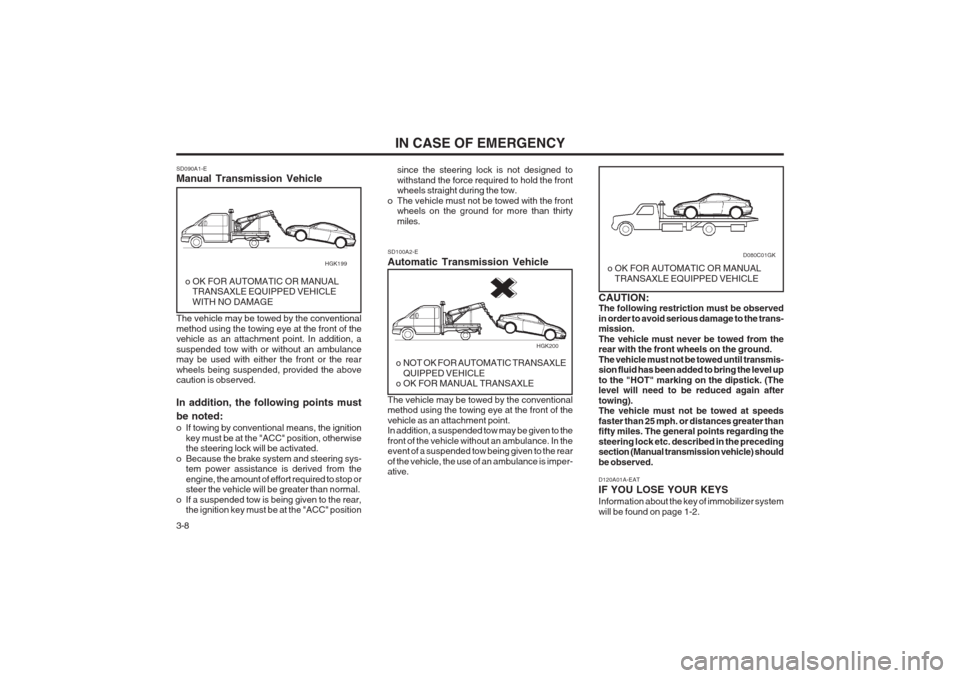
SD100A2-E Automatic Transmission Vehicle
o NOT OK FOR AUTOMATIC TRANSAXLE QUIPPED VEHICLE
o OK FOR MANUAL TRANSAXLE
The vehicle may be towed by the conventional method using the towing eye at the front of the vehicle as an attachment point. In addition, a suspended tow may be given to the front of the vehicle without an ambulance. In the event of a suspended tow being given to the rear of the vehicle, the use of an ambulance is imper- ative.
o OK FOR AUTOMATIC OR MANUAL
TRANSAXLE EQUIPPED VEHICLE
CAUTION: The following restriction must be observed in order to avoid serious damage to the trans- mission. The vehicle must never be towed from the rear with the front wheels on the ground. The vehicle must not be towed until transmis- sion fluid has been added to bring the level up to the "HOT" marking on the dipstick. (The level will need to be reduced again after towing). The vehicle must not be towed at speeds faster than 25 mph. or distances greater than fifty miles. The general points regarding the steering lock etc. described in the preceding section (Manual transmission vehicle) should be observed. D120A01A-EAT IF YOU LOSE YOUR KEYS Information about the key of immobilizer system will be found on page 1-2.
SD090A1-E Manual Transmission Vehicle
o OK FOR AUTOMATIC OR MANUAL
TRANSAXLE EQUIPPED VEHICLE WITH NO DAMAGE
The vehicle may be towed by the conventionalmethod using the towing eye at the front of the vehicle as an attachment point. In addition, a suspended tow with or without an ambulance may be used with either the front or the rear wheels being suspended, provided the above caution is observed. In addition, the following points must be noted:
o If towing by conventional means, the ignition key must be at the "ACC" position, otherwise the steering lock will be activated.
o Because the brake system and steering sys- tem power assistance is derived from the engine, the amount of effort required to stop or steer the vehicle will be greater than normal.
o If a suspended tow is being given to the rear, the ignition key must be at the "ACC" position HGK200
D080C01GK
HGK199
Page 102 of 140
VEHICLE MAINTENANCE REQUIREMENTS
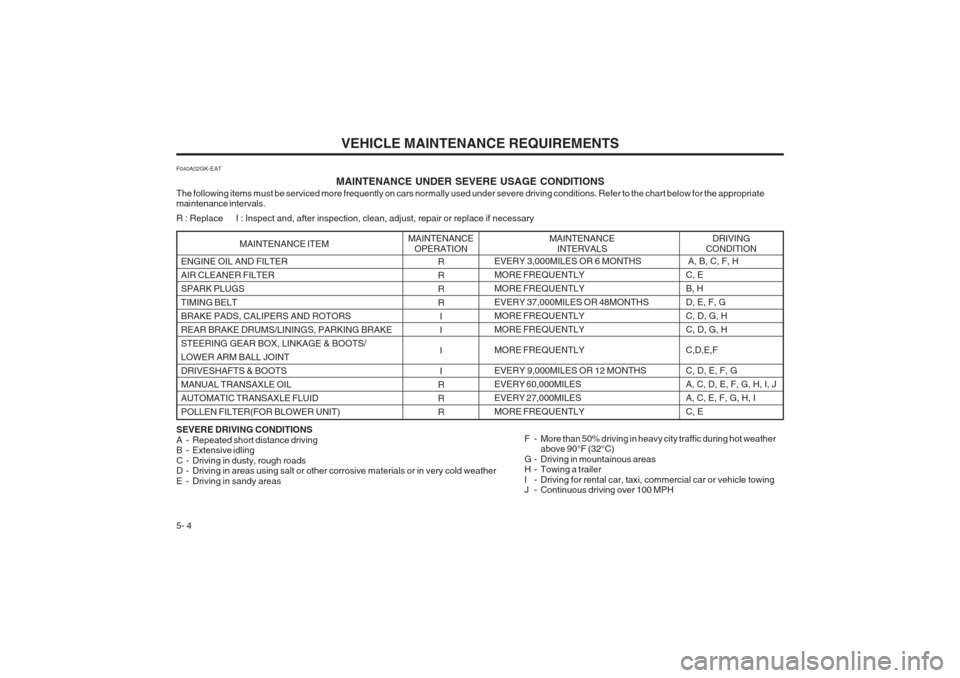
5- 4 MAINTENANCE UNDER SEVERE USAGE CONDITIONS
The following items must be serviced more frequently on cars normally used under severe driving conditions. Refer to the chart below for the appropriate maintenance intervals. R : Replace I : Inspect and, after inspection, clean, adjust, repair or replace if necessary
F040A02GK-EAT
DRIVING
CONDITION
R RRR
II II
R RR
MAINTENANCE ITEM MAINTENANCE
OPERATION MAINTENANCE
INTERVALS
ENGINE OIL AND FILTER AIR CLEANER FILTERSPARK PLUGSTIMING BELTBRAKE PADS, CALIPERS AND ROTORSREAR BRAKE DRUMS/LININGS, PARKING BRAKESTEERING GEAR BOX, LINKAGE & BOOTS/LOWER ARM BALL JOINTDRIVESHAFTS & BOOTSMANUAL TRANSAXLE OILAUTOMATIC TRANSAXLE FLUIDPOLLEN FILTER(FOR BLOWER UNIT) EVERY 3,000MILES OR 6 MONTHSMORE FREQUENTLYMORE FREQUENTLYEVERY 37,000MILES OR 48MONTHSMORE FREQUENTLYMORE FREQUENTLY MORE FREQUENTLYEVERY 9,000MILES OR 12 MONTHS EVERY 60,000MILESEVERY 27,000MILESMORE FREQUENTLY
A, B, C, F, HC, EB, HD, E, F, GC, D, G, HC, D, G, H C,D,E,FC, D, E, F, G A, C, D, E, F, G, H, I, JA, C, E, F, G, H, IC, E
SEVERE DRIVING CONDITIONS
A - Repeated short distance driving
B - Extensive idling
C - Driving in dusty, rough roads
D - Driving in areas using salt or other corrosive materials or in very cold weather
E - Driving in sandy areas F - More than 50% driving in heavy city traffic during hot weather
above 90°F (32°C)
G - Driving in mountainous areas
H - Towing a trailer
I - Driving for rental car, taxi, commercial car or vehicle towing
J - Continuous driving over 100 MPH
Page 114 of 140
OWNER MAINTENANCE 6-9
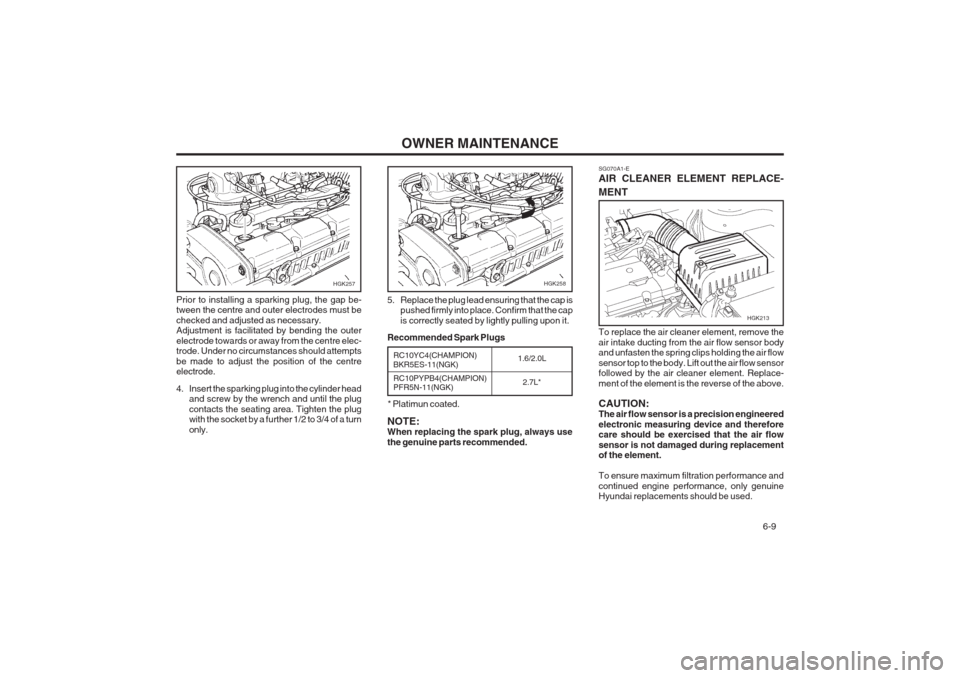
SG070A1-E AIR CLEANER ELEMENT REPLACE- MENT
Prior to installing a sparking plug, the gap be- tween the centre and outer electrodes must be checked and adjusted as necessary. Adjustment is facilitated by bending the outer electrode towards or away from the centre elec- trode. Under no circumstances should attempts be made to adjust the position of the centre electrode.
4. Insert the sparking plug into the cylinder head and screw by the wrench and until the plug contacts the seating area. Tighten the plug with the socket by a further 1/2 to 3/4 of a turn only. 5. Replace the plug lead ensuring that the cap is
pushed firmly into place. Confirm that the capis correctly seated by lightly pulling upon it.
Recommended Spark Plugs To replace the air cleaner element, remove theair intake ducting from the air flow sensor body and unfasten the spring clips holding the air flow sensor top to the body. Lift out the air flow sensor followed by the air cleaner element. Replace- ment of the element is the reverse of the above. CAUTION: The air flow sensor is a precision engineered electronic measuring device and therefore care should be exercised that the air flow sensor is not damaged during replacement of the element. To ensure maximum filtration performance and continued engine performance, only genuine Hyundai replacements should be used.
NOTE:When replacing the spark plug, always use the genuine parts recommended.
RC10YC4(CHAMPION) BKR5ES-11(NGK) RC10PYPB4(CHAMPION) PFR5N-11(NGK)1.6/2.0L
2.7L*
* Platimun coated.
HGK213
HGK258HGK257
Page 130 of 140
EMISSION CONTROL SYSTEM
7-2
hicle operator in order to prevent operational problems arising from damage to the catalyst. Damage to the catalyst will result if contamina- tion occurs through the use of leaded fuel. Whilst the vehicle is fitted with a reduced diameter filler neck to prevent charging of the fuel tank with a leaded fuel pump nozzle, it is possible that the use of funnels or jerry cans will permit leaded fuel to be introduced into the fuel tank. The catalyst is intolerant of unburnt fuel and therefore if an engine misfire condition exists, damage to the catalyst will occur. It is imperative that if a misfire condition develops, the vehicle is immediately presented to a Hyundai dealer for rectification. Similarly, the practice of certain ignition system diagnosis procedures which in- volve inducing a misfire (cylinder power balance tests for example) may result in catalyst dam- age. For these reasons, it is advisable that the ex- haust gas emission be tested at each routine service with a gas analyzer having a Hydrocar- bon measuring facility to ensure continued reli- ability of the catalyst. Push or tow starting of the vehicle is to be avoided since unburnt fuel may be enter the catalyst and result in damage. (Note, it is impos- sible to push or tow start a Hyundai model equipped with fuel injection since the fuel pump safety interlock will prevent the pump from oper- ating under these conditions). Operation of the catalyst involves extremely high temperatures being attained within the catalytic convertor, and although the convertor is fitted
with heat shields, it is important that the vehicleis not parked over combustible or volatile mate- rial which may result in fire. If the above precautions are not adhered to and the catalyst becomes inoperative, the resultant increase in core temperature will result in a "melt down" where the catalyst core will melt and subsequently may block the exhaust system. Due to the fragile nature of the catalyst element, it is important that damage does not occur when the vehicle is raised by means of a garage jack. Care must also be exercised to avoid driving over road hazards or debris which may cause damage to the catalyst element.
Page 140 of 140

INDEX
10-4
SEAT CUSHION HEIGHT ADJUSTMENT
........................................ 1-8
SEAT WARM ER ................................................................................. 1-8
SERVICE HISTORY ....... .................................................................... 5-1
SMOOTH CORNERING ................................................................... 2-11
SNOW TYRES ................................................................................... 8-1
SPARE TYRE ..................................................................................... 3-3
SPARKING PLUG REPLACEMENT .................................................. 6-8
SPECTACLE CASE ......................................................................... 1-40
SPEEDOMETER .............................................................................. 1-29
STARTING THE ENGINE ............... ................................................... 2-3
STEERING WHEEL FREEPLAY ..................................................... 6-15
STEERING WHEEL TILT LEVER .................................................... 1-47
STEREO SOUND SYSTEM ............................................................. 1-62
SUN VISOR ...................................................................................... 1-47
SUNROOF ........................................................................................ 1-38
SUPPLEMENTAL RESTRAINT (AIRBAG) SYSTEM ......................1-18
T TACHOMETER ................................................................................. 1-29
THEFT-ALARM SYSTEM ................................................................... 1-4
TOWING ATTACHMENT S ............................................................... 2-12
TRACTION CONTROL SYSTEM ................... .................................... 2-9
TRAILER AND CARAVAN TOWING ............................................... 2-12
TRIP COMPUTER ............................................................................ 1-30
TRIP ODOMETER ............................................................................ 1-30TYRE PRESSURES
........................................................................... 8-1
TYRE BALANCING ............................................................................ 8-3
TYRE CHAINS ................................................................................... 8-2
TYRE REPLACEMEN T ...................................................................... 8-3
TYRE ROTATION .............................................................................. 8-2
V
VARIABLE INTERMITTENT WIPE FACILITY .................................1-34
VEHICLE IDENTIFI CATION NUMBER .............................................. 8-1
VEHICLE TOWING OR RECOVERY ................................................ 3-7
WWHEEL REPLACEMENT ................................................................... 8-3
WINDSCREEN WASHER RESERVOIR REPLENISHMENT ..........6-10
WINDSCREEN WIPER BLADES ..................................................... 6-10
WINDSCREEN WASHER OPERATION ..........................................1-34
WINDSCREEN WIPER/WASHER SWITCH ....................................1-34
WINTER MOTORING ....................................................................... 2-11