light Hyundai Coupe 2002 Owner's Guide
[x] Cancel search | Manufacturer: HYUNDAI, Model Year: 2002, Model line: Coupe, Model: Hyundai Coupe 2002Pages: 140, PDF Size: 1.45 MB
Page 82 of 140
DRIVING YOUR HYUNDAI
2- 8 o Since the power assistance provided by the
brake servo is derived from the engine, coasting with the engine turned off or towing of the vehicle with the engine turned off will result in greatly increased pedal pressures being required to stop the vehicle.
o Do not hold the vehicle on the upgrade with the accelerator pedal. This can cause thetransmission to overheat. Always use the brake pedal or parking brake.
SC140B1-E ANTI-LOCK BRAKE SYSTEM (Not all models) The Anti-Lock Brake System (ABS) is designed to prevent wheel lock-up during sudden braking or on hazardous road surfaces. The ABS con- trol module monitors the wheel speed and con- trols the pressure applied to each brake. Thus, in emergency situations or on slick roads, ABS will increase vehicle control during braking. NOTE: During ABS operation, a slight pulsation may be felt in the brake pedal when the brakes are applied. Also, a noise may be heard in the engine compartment while brak- ing. These conditions are normal and indi- cate that the anti-lock brake system is func- tioning properly.
when you are driving down a long hill, slowdown and shift to a lower gear. When you do this, engine braking will help slow the car.
o Slow down before shifting to a lower gear.
Otherwise, the lower gear may not be en-gaged.
o Always use the parking brake. Do not de- pend on placing the transaxle in "P" to keep the car from moving.
o Exercise extreme caution when driving on a slippery surface. Be especially careful whenbraking, accelerating or shifting gears. On a slippery surface, an abrupt change in vehi- cle speed can cause the drive wheels to lose traction and the vehicle to go out of control.
WARNING:
o Avoid high cornering speeds.
o Do not make quick steering wheel move- ments, such as sharp lane changes orfast, sharp turns.
o Always wear your seat belts.
o The risk of rollover is greatly increased if
you lose control of your vehicle at high- way speeds.
o Loss of control often occurs if two or more wheels drop off the roadway andthe driver oversteers to reenter the road- way.
o In the event your vehicle leaves the road- way, do not steer sharply. Instead, slowdown before pulling back into the travel lanes. o In a collision crash, un unbelted person
is significantly more likely to die than aperson wearing a seatbelt.
SC140A1-E EFFECTIVE BRAKINGBraking system performance and friction mate- rial life are greatly affected by the driving style adopted. The following suggestions are made to assist in achieving the best results from the braking system.
o Anticipate the road and conditions ahead in order that heavy braking may be avoided.
o When descending long gradients, use the engine to assist in retarding the vehicle to minimize the possibility of brake fade occur- ring.
o When trailer towing, ensure that the trailer brakes function correctly and use enginebraking to assist the vehicle braking system.
o Use only genuine Hyundai replacement brake pads and shoes to ensure consistentfriction characteristics and wear rates.
o After driving through deep water (e.g.
fording), the brakes may become wet and performance reduced. Always check brake efficiency after emerging from the water and dry the brakes by lightly depressing the brake pedal several times whilst driving slow- ly.
o Apply the parking brake only when the vehi- cle is at rest.
Page 83 of 140
DRIVING YOUR HYUNDAI 2- 9
WARNING: ABS will not prevent accidents due to im-proper or dangerous driving manoeuvres. Even though vehicle control is improved during emergency braking, always maintain a safe distance between you and objects ahead. Vehicle speeds should always be reduced during extreme road conditions. The braking distance for cars equipped with an anti-lock braking system may be longer than for those without it in the following road conditions.
o Driving on rough, gravel or snow-cov-
ered roads.
o Driving with tire chains installed.
o Driving on roads where the road surface is pitted or has different surface height.
These roads should be driven at reduced speeds. The safety features of an ABS equipped vehicle should not be tested by high speed driving or cornering. This could endanger the safety of yourself or others. C300B01GK-GAT TCS ON/OFF ModeIn the TCS ON mode, the indicator in the instrument cluster will not be illuminated. To switch the TCS OFF mode, press the TCSswitch . To switch the TCS mode, press the TCS switch again. In the TCS OFF mode, the SLIP control will be deactivated and the TCS- OFF indicator in the instrument cluster will be illuminated. NOTE:
1) Turn off the engine. Then restart the
engine, and the TCS mode will automati-cally turn ON.
2) When the traction control is operating properly, you can feel a slight pulsationin the vehicle. This is only the effect of brake control and indicates nothing un- usual.
CAUTION:When the TCS indicator blinks, SLIP controlhas been activated. It also means that the road is slippery or your car is accelerating excessively. In this situation, release foot pressure from the accelerator pedal and maintain moderate speed. WARNING: Traction control is only a driving aid; allnormal precautions for driving in inclement weather and on slippery road surfaces should be observed.
C300A03Y-EAT TRACTION CONTROL SYSTEM (TCS) (Not all models)
HGK156A-D
On slippery road surfaces, the traction control system (TCS) limits the drive wheels from spin- ning excessively, thus helping the car to accel- erate. It also provides sufficient driving force and steering performance as the car turns at accelerated speeds. SLIP Control Limits the drive wheels from spinning exces- sively during starting or while making accelerat- ed turns on slippery roads to avoid losing the driving force of the front wheels. Driving hints TCS does not actively apply brakes. Be sure to decelerate the car sufficiently before entering curves.
Page 84 of 140
DRIVING YOUR HYUNDAI
2- 10
C300D01GK-GAT Indicator and WarningThe indicator should illuminate when the igni- tion key is turned to ON
or START but should
go out after three seconds. If the indicator does not illuminate, or the TCS indicator does not go out after 3 seconds, have it checked by an authorized dealer. Should there be any unusual conditions in the device, TCS-OFF either illuminates or blinks as a warning. If TCS-OFF illuminates or blinks, pull your carto a safe place and stop the engine. Then, start the engine again to check if the TCS-OFF indicator goes out. If the indicator remains lit even after the engine has been started, have your car checked by an authorized Hyundai dealer. NOTE:
1) When TCS-OFF illuminates or blinks, trac- tion control is automatically deactivatedfor safety.
3) When the engine starts, a click is heard
from the engine compartment; however, this is only the sound of traction control being checked.
4) When moving out of the mud or fresh snow, pressing the accelerator pedal maynot cause the engine speed to increase. 2) This warning function is not provided
when the driver choose the TCS-OFF mode. o Take care of your tires. Keep them inflated
to the recommended pressure. Incorrect infla-tion, either too much or too little, results in unnecessary tire wear. Check the tire pres- sures at least once a month.
o Be sure that the wheels are aligned cor-
rectly. Improper alignment can result fromhitting curbs or driving too fast over irregular surfaces. Poor alignment causes faster tire wear and may also result in other problems as well as greater fuel consumption.
o Keep your car in good condition. For better
fuel economy and reduced maintenance costs, maintain your car in accordance with the maintenance schedule in Section 5. If you drive your car in severe conditions, more frequent maintenance is required (see Section 5 for details).
o Keep your car clean. For maximum service, your car should be kept clean and free ofcorrosive materials. It is especially impor- tant that mud, dirt, ice, etc. not be allowed to accumulate on the underside of the car. This extra weight can result in increased fuel consumption and also contribute to corro- sion.
o Travel lightly. Don't carry unnecessary weight in your car. Weight is an enemy of good fueleconomy.
o Don't let the engine idle longer than neces- sary. If you are waiting (and not in traffic),turn off your engine and restart only when you're ready to go.
SC150A1-F DRIVING FOR ECONOMYYou can save fuel and get more miles from your car if you follow these suggestions:
o Drive smoothly. Accelerate at a moderate
rate. Don't make "jack-rabbit" starts or full- throttle shifts and maintain a steady cruising speed. Don't race between stoplights. Try to adjust your speed to that of the other traffic so you don't have to change speeds unnec- essarily. Avoid heavy traffic whenever possible. Al-ways maintain a safe distance from other vehicles so you can avoid unnecessary brak- ing. This also reduces brake wear.
o Drive at a moderate speed. The faster you drive, the more fuel your car uses. Driving ata moderate speed, especially on the high- way, is one of the most effective ways to reduce fuel consumption.
o Don't "ride" the brake or clutch pedal. This
can increase fuel consumption and also increase wear on these components. In ad- dition, driving with your foot resting on the brake pedal may cause the brakes to over- heat, which reduces their effectiveness and may lead to more serious consequences.
Page 85 of 140
DRIVING YOUR HYUNDAI 2- 11
o Remember, your car does not require ex-
tended warm-up. As soon as the engine is running smoothly, you can drive away. In very cold weather, however, give your en- gine a slightly longer warm-up period.
o Don't "lug" or "over-rev" the engine. Lugging
is driving too slowly in too high a gearresulting in the engine bucking. If this hap- pens to you, shift to a lower gear. Over-revving is racing the engine beyond its safe limit. This can be avoided by shifting at the recommended speeds.
o Use your air conditioning sparingly. The air conditioning system is operated by the en-gine power so your fuel economy is reduced when you use it.
SC160A1-F SMOOTH CORNERINGAvoid braking or gear changing in corners, especially when roads are wet. Ideally, corners should always be taken under gentle accelera- tion. If you follow these suggestions, tire wear will be held to a minimum. SC170A1-E WINTER MOTORINGThe onset of winter conditions subject motor vehicles to greater operating demands. There- fore, the following suggestions will assist in maintaining peak performance and reliability during these periods: ZC170B1-E Electrical SystemWinter conditions impose severe demands upon vehicle electrical systems, particularly the charg- ing circuit. The battery condition and perfor- mance along with the alternator performance and drive belt condition should be checked prior to the onset of winter. ZC170C1-E Anti-freeze/Corrosion inhibitorThe cooling system must always contain an Ethylene-Glycol based anti-freeze solution. The system is filled during manufacture with solu- tion of the correct strength which should be checked before the onset of winter and adjust- ed or changed as required. NOTE: The anti-freeze solution contains a corro- sion inhibitor to prevent degradation of the aluminum castings contained within the engine. Therefore, never, drain the system and refill with water only. In addition, anti-freeze solution must ALWAYS be used in vehicles fitted with air conditioning, to prevent the heater matrix from freezing and subsequently bursting with the refrigeration sys- tem in use.
ZC170D1-E Door LocksShould the door lock mechanism become fro- zen, a proprietary lock de-icer should be used. Alternatively, warming the door key may thaw the door lock. However, the key should be handled carefully to avoid burning the fingers. Never attempt to thaw a frozen door lock using hot water, since the water will eventually freeze and compound the problem. NOTE: The proper temperature for using the immo-bilizer key is from -40°F (-40°C) to 176°F (80°C). If you heat the immobilizer key over 176°F (80°C) to open the frozen lock, it may cause damage to the transponder in its head. SC170E1-E Windscreen Washers and WipersThe windscreen washer bottle should be filled with a solution of water and a proprietary winter screen wash additive. The windscreen wipers should not be used if the blades are frozen to the windscreen or if they are covered with snow, before this is removed. NOTE: Never allow undiluted screen washer fluid additive to spill upon the paintwork or use engine coolant anti-freeze since damage to the paintwork may result.
Page 88 of 140
DRIVING YOUR HYUNDAI
2- 14
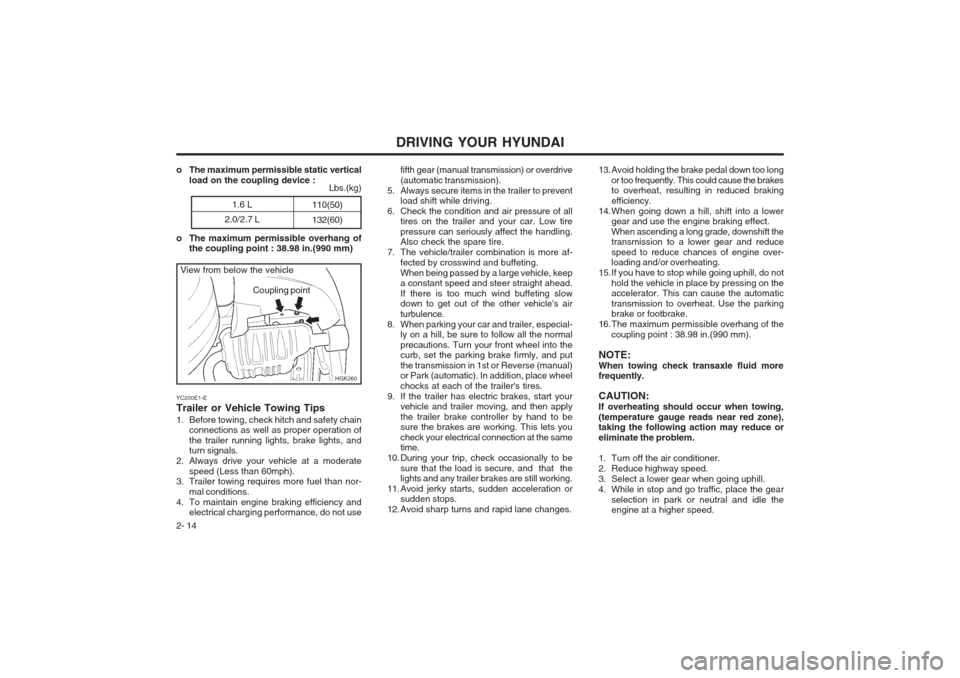
Coupling point
HGK260
View from below the vehicle 13. Avoid holding the brake pedal down too long
or too frequently. This could cause the brakes to overheat, resulting in reduced braking efficiency.
14. When going down a hill, shift into a lower gear and use the engine braking effect.When ascending a long grade, downshift the transmission to a lower gear and reduce speed to reduce chances of engine over- loading and/or overheating.
15. If you have to stop while going uphill, do not hold the vehicle in place by pressing on theaccelerator. This can cause the automatic transmission to overheat. Use the parking brake or footbrake.
16. The maximum permissible overhang of the coupling point : 38.98 in.(990 mm).
NOTE: When towing check transaxle fluid more frequently. CAUTION: If overheating should occur when towing,(temperature gauge reads near red zone), taking the following action may reduce or eliminate the problem.
1. Turn off the air conditioner.
2. Reduce highway speed.
3. Select a lower gear when going uphill.
4. While in stop and go traffic, place the gear selection in park or neutral and idle the engine at a higher speed.
fifth gear (manual transmission) or overdrive (automatic transmission).
5. Always secure items in the trailer to prevent load shift while driving.
6. Check the condition and air pressure of all tires on the trailer and your car. Low tirepressure can seriously affect the handling. Also check the spare tire.
7. The vehicle/trailer combination is more af-
fected by crosswind and buffeting. When being passed by a large vehicle, keep a constant speed and steer straight ahead. If there is too much wind buffeting slow down to get out of the other vehicle's air turbulence.
8. When parking your car and trailer, especial- ly on a hill, be sure to follow all the normalprecautions. Turn your front wheel into the curb, set the parking brake firmly, and put the transmission in 1st or Reverse (manual) or Park (automatic). In addition, place wheel chocks at each of the trailer's tires.
9. If the trailer has electric brakes, start your vehicle and trailer moving, and then applythe trailer brake controller by hand to be sure the brakes are working. This lets you check your electrical connection at the same time.
10. During your trip, check occasionally to be sure that the load is secure, and that thelights and any trailer brakes are still working.
11. Avoid jerky starts, sudden acceleration or sudden stops.
12. Avoid sharp turns and rapid lane changes.
o The maximum permissible static vertical
load on the coupling device :
o The maximum permissible overhang of the coupling point : 38.98 in.(990 mm)
YC200E1-E Trailer or Vehicle Towing Tips
1. Before towing, check hitch and safety chain connections as well as proper operation of the trailer running lights, brake lights, and turn signals.
2. Always drive your vehicle at a moderate speed (Less than 60mph).
3. Trailer towing requires more fuel than nor-
mal conditions.
4. To maintain engine braking efficiency and electrical charging performance, do not use
1.6 L
2.0/2.7 L 110(50) 132(60)
Lbs.(kg)
Page 90 of 140
IN CASE OF EMERGENCY
3-2 4. Check to see if the water pump drive belt is
missing. If it is not missing, check to see that it is tight. If the drive belt seems to be satisfac- tory, check for coolant leaking from the radia- tor, hoses or under the car. (If the air condi- tioning had been in use, it is normal for cold water to be draining from it).
WARNING: Whilst the engine is running, keep hands and clothing away from moving parts such as the fan and drive belts to prevent injury.
5. If the water pump drive belt is broken or coolant is leaking out, stop the engine imme- diately and call the nearest Hyundai dealer for assistance.
WARNING:Do not remove the radiator cap when the engine is hot since steam and boiling water may be ejected from the radiator resulting in burns or scalding.
6. If the cause of the overheating cannot be found, wait until the engine temperature has returned to normal. Then, if coolant has been lost, carefully remove the radiator cap and add water to bring the fluid level in the reser- voir up to the base of the radiator fill opening. Fill the coolant expansion tank to the halfway mark.
WARNING: Motor vehicle batteries contain sulphuric acid and emit hydrogen gas. Protective clothing should be worn and care exercised to prevent the acid from coming into contact with skin or clothing and the vehicle. Naked lights should not be permitted in the vicinity of the battery. Care should be exercised to prevent sparks occurring during connection. If acid acciden- tally comes into contact with skin or eyes, the affected area should immediately be flushed with copious amounts of water and medical assistance sought.
1. Ensure that the booster battery is 12 volt type.
If the booster battery is installed in another vehicle, ensure that the two vehicles are not touching.
2. Turn off all unnecessary electrical equipment in both vehicles.
3. Ensure that the engine of the vehicle provid- ing the jump start is running prior to connec- tion of the jump cables.
4. Connect the red jump cable to the positive (+)
terminal of the booster battery and the other end to the positive (+) terminal of the dis- charged battery.
5. Attach the black jump cable to the negative
(-) terminal of the booster battery, and the other end to a ground point within the engine compartment of the vehicle with the flat bat- tery. Do not connect to the negative battery terminal of the flat battery since sparks may be generated with the subsequent risk of explosion. 6. Raise the booster vehicle engine speed to
2,000 r.p.m. and start the engine of the vehi- cle with the flat battery.
7. Remove jump cables in the reverse order of installation (black cable first).
CAUTION: If the jump cable is incorrectly installed, dam- age to the vehicle electrical system may oc- cur, in particular the electronic components such as the Fuel Injection system computer and the Automatic Transmission computer. The battery must never be disconnected whilst the engine is running. SD040A1-E IF THE ENGINE OVERHEATSIf the temperature gauge indicates overheating:
1. Pull off the road and stop as soon as it is safe to do so.
2. Place the gear selector lever in "P" (auto- matic), or neutral (manual transaxle) and set the parking brake. If the air conditioning is on, turn it off.
3. If coolant is running out under the car or steam is coming out from under the bonnet stop the engine. Do not open the bonnet until the cool-ant has stopped running or the steam- ing has stopped. If there is no visible loss of coolant and no steam, leave the engine run- ning and check to be sure the engine cooling fan is operating. If the fan is not running, turn the engine off.
Page 93 of 140
3-5
IN CASE OF EMERGENCY
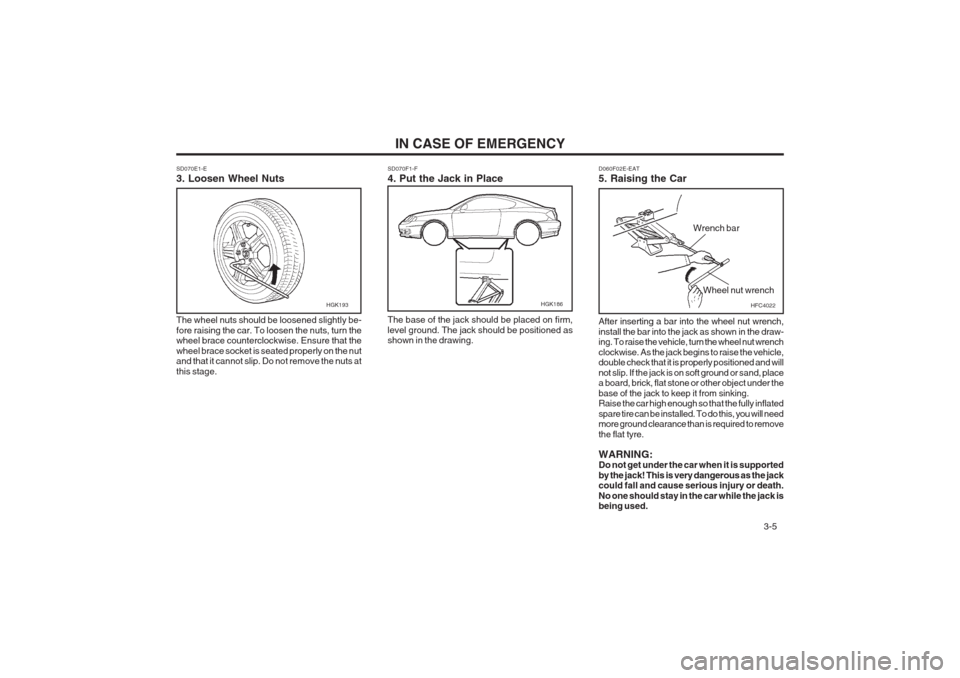
SD070E1-E 3. Loosen Wheel Nuts The wheel nuts should be loosened slightly be- fore raising the car. To loosen the nuts, turn the wheel brace counterclockwise. Ensure that the wheel brace socket is seated properly on the nut and that it cannot slip. Do not remove the nuts at this stage. SD070F1-F 4. Put the Jack in Place The base of the jack should be placed on firm, level ground. The jack should be positioned as shown in the drawing.
HGK193HGK186
D060F02E-EAT 5. Raising the Car After inserting a bar into the wheel nut wrench, install the bar into the jack as shown in the draw- ing. To raise the vehicle, turn the wheel nut wrench clockwise. As the jack begins to raise the vehicle, double check that it is properly positioned and will
not slip. If the jack is on soft ground or
sand, place
a board, brick, flat stone or other object under thebase of the jack to keep it from sinking. Raise the car high enough so that the fully inflated spare tire can be installed. To do this, you will need more ground clearance than is required to remove
the flat tyre. WARNING: Do not get under the car when it is supported by the jack! This is very dangerous as the jack could fall and cause serious injury or death. No one should stay in the car while the jack is being used.
HFC4022
Wrench bar
Wheel nut wrench
Page 94 of 140
IN CASE OF EMERGENCY
3-6
HGK232
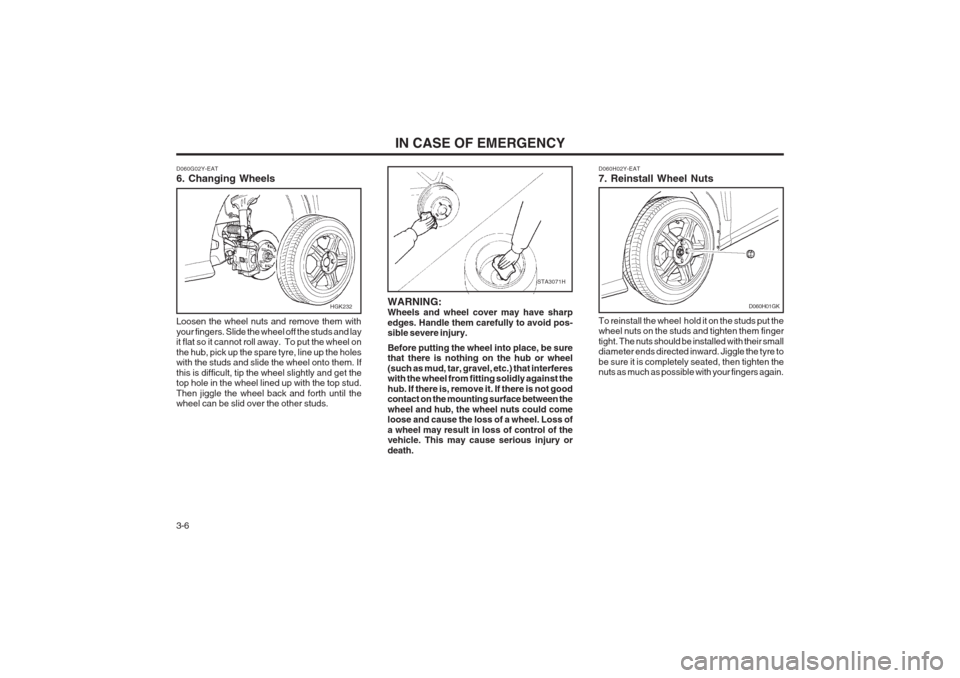
D060H02Y-EAT 7. Reinstall Wheel Nuts To reinstall the wheel hold it on the studs put the wheel nuts on the studs and tighten them finger tight. The nuts should be installed with their small diameter ends directed inward. Jiggle the tyre to be sure it is completely seated, then tighten the nuts as much as possible with your fingers again.
WARNING:Wheels and wheel cover may have sharp edges. Handle them carefully to avoid pos- sible severe injury. Before putting the wheel into place, be sure that there is nothing on the hub or wheel (such as mud, tar, gravel, etc.) that interferes with the wheel from fitting solidly against the hub. If there is, remove it. If there is not good contact on the mounting surface between the wheel and hub, the wheel nuts could come loose and cause the loss of a wheel. Loss of a wheel may result in loss of control of the vehicle. This may cause serious injury or death.
STA3071H
D060G02Y-EAT 6. Changing Wheels
Loosen the wheel nuts and remove them with your fingers. Slide the wheel off the studs and lay it flat so it cannot roll away. To put the wheel on the hub, pick up the spare tyre, line up the holes with the studs and slide the wheel onto them. If this is difficult, tip the wheel slightly and get the top hole in the wheel lined up with the top stud. Then jiggle the wheel back and forth until the wheel can be slid over the other studs.
D060H01GK
Page 97 of 140
APPEARANCE CARE 4-1
retreatment programme must be observed in accordance with the Terms and Conditions outlined in the separate Anti Perforation War- ranty Booklet. NOTE: The underbody should never be steamcleaned since the underbody coating may be removed by this process. During the interim period between powerwashing the underbody, the more vulnera- ble areas such as wheel arches should be hosed off particularly during the winter sea- son to prevent prolonged contact with road salts.Ensure that the various drain points located at the bottom of the door panels and sills are kept clear to prevent water from becom- ing trapped within the cavities. Wherever possible, the parking of the vehicle in a confined, poorly ventilated location (a ga- rage for example) should be avoided when the vehicle is wet or is covered with snow or ice. Under these conditions, the internal cavities of the vehicle will remain damp for prolonged periods of time which will en- courage corrosion. Parking the vehicle where good ventilation exists (outside for example) is preferable.
SE020A1-E PROTECTING YOUR HYUNDAI FROM CORROSION By using the most advanced design and con- struction practices, every Hyundai is built to retain the original factory finish for many years. However, long term durability is also greatly dependant upon maintaining the various protec- tion systems and coatings used in manufacture since constant, exposure to the elements will result in a breakdown and loss of effectiveness. The following suggestions are made to assist in the maintenance of the vehicle bodywork. SE030A1-E UNDERBODY COATINGSEvery Hyundai passenger car receives a full underbody and cavity injection treatment during production. In order that this treatment may retain maximum effectiveness it is recommend- ed that the underbody receives a power wash and a thorough inspection after each winter season. In so doing any accumulations of mud, which act as moisture traps and combine with road salts to accelerate corrosion will be re- moved. In order to maintain the Anti Perforation Warranty, the requirements regarding the
SE000A1-E
4. APPEARANCE
CARE
E030A01GK-AAT VALETINGRegular cleaning of the exterior paintwork serves two important functions. Firstly, the removal of abrasive dirt and contaminants will maintain the lustre of the paintwork and will prevent discolouration and dulling due to prolonged con- tact. Secondly, the presence of damage through im- pact or abrasion will be apparent allowing early rectification to be made thus preventing corro- sion from becoming established and spreading beneath the paint film. To avoid "water spotting" the vehicle should not be washed in direct sun- light particularly in the case of vehicles having dark body colours. The heat from the sun rays is absorbed by the paint film increasing the surface temperature. This action causes water used for washing to evaporate quickly leaving behind the deposits from the water and the shampoo used. Use only a shampoo intended for the purpose and ensure that the body work is thoroughly wetted to soften the dirt film prior to attempting to remove this. After removing the dirt film with a soft sponge, the body work should be thoroughly rinsed and then dried with a good quality chamois leather to prevent streaking or spotting of the paint work. Household detergents, solvents and abrasive cleaning materials should not be used in order to avoid damaging the paint film. High pressure car washes may cause water to enter your vehicle. Plastic wheel covers should be cleaned using a sponge and water. Cast alloy wheels should be cleaned using a mild soap or neutral detergent. Abrasive compounds must not be used since in the event of these damaging the lacquer coating,
4
Page 98 of 140
APPEARANCE CARE
4-2
oxidization of the aluminium wheel will occur, spoiling the appearance. The use of an a toothbrush will facilitate cleaning between the wheel "spokes". SE040B1-E STAIN/SPOT REMOVALShould tree sap, dead insects or tar prove to be difficult to remove from the paint film, turpentine or a proprietary paint cutting compound may be used. Ensure that the area to be cleaned is not rubbed intensively to prevent breaking through the colour coat and exposing the under coat. SE040C1-E POLISHING The exterior paint work should be polished with a proprietary wax polish when water no longer collects in bead form on the paint work. The instructions of the product manufacturer should be adhered to. SE040E1-E BUMPER MAINTENANCEThe special material from which the bumpers are manufactured warrants special attention to pre- serve the appearance of the bumpers. Avoid contact with battery electrolyte or brake fluid and ensure that accidental spillages are immediately flushed with water. Do not use abrasive cleaning materials which may damage the bumpers.
SE040F1-E ACCIDENT REPAIRS In the event of the body work sustaining damage, the following points should be noted prior to repairs being undertaken. If body panels are replaced or repaired, anti corrosion treatment must be applied to the repair area. The product used must be compatible with those used in manufacture. It is recommended that repairs are entrusted to a Hyundai dealer to ensure that replacement parts used are of the same high quality as those used in manufacture of the vehicle and that the correct repair methods and materials will ensure adequate levels of corrosion protection and the continued validity of the Anti Perforation Warranty. SE050A1-E INTERIOR During the winter period, it is possible that the passenger compartment flooring may become wet from damp footwear or quantities of snow adhering to footwear. The carpet should not be allowed to remain in this condition since the carpet may begin to create musty smells and will promote corrosion of the floor pan in addition to the carpet and under felt beginning to rot.SE050C1-E INTERIOR VALETING The soft trim and carpets should be maintained with the regular use of a vacuum cleaner. Heavy soiling should be removed with a dry cleaning agent recommended for this purpose following the instructions of the product manufacturer. Paint thinner, solvents or other such cleaning materials should not be used since damage to the upholstery may result. SE050D1-E SEAT BELTSSeat belts should be cleaned only with a mild soap solution. Strong detergents, solvens or bleaches may damage the belt webbing and therefore reduce the effectiveness of the belt. Belts which display signs of fraying, wear of cut should be replaced. SE050E1-E WINDOWS A proprietary glass cleaner should be used to clean the inside of the windows. However, the rear heated windscreen must only be cleaned using a light horizontal cleaning action. Care should be exercised to avoid the use of abrasive cleaners or contact with items of jewellery which may damage the heating elements.
Avoid subjecting the bumpers to high tempera- tures such as may be encountered in high bake paint ovens.