ECU Hyundai Coupe 2002 Owner's Manual
[x] Cancel search | Manufacturer: HYUNDAI, Model Year: 2002, Model line: Coupe, Model: Hyundai Coupe 2002Pages: 140, PDF Size: 1.45 MB
Page 10 of 140
CONTROLS AND EQUIPMENT
1- 2 SB040A1-F DOOR LOCKS WARNING:
o Unlocked doors can be dangerous.
Before you drive away-especially if thereare children in the car-be sure that all the doors are securely closed and locked, the doors cannot be opened from inside. This helps assure that doors will not be opened accidentally. Also, when combined with the proper use of seat belts, locking the doors helps keep occupants from being ejected from the car in case of an accident.
o Before opening the door, always look for and avoid oncoming traffic.
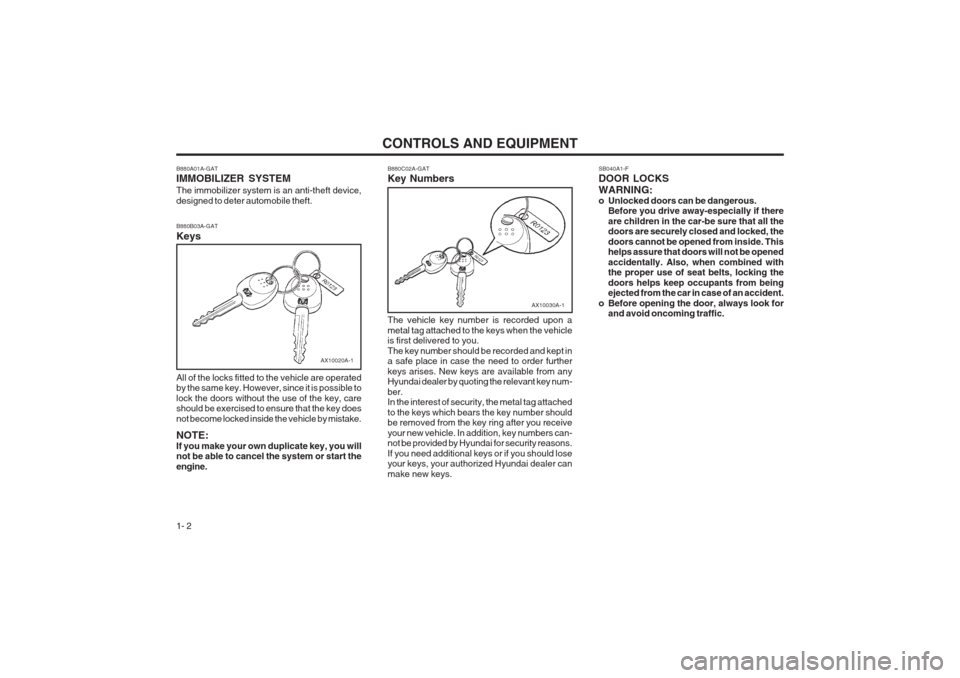
B880B03A-GAT Keys
All of the locks fitted to the vehicle are operated by the same key. However, since it is possible to lock the doors without the use of the key, care should be exercised to ensure that the key does not become locked inside the vehicle by mistake. NOTE: If you make your own duplicate key, you will not be able to cancel the system or start the engine. AX10020A-1B880C02A-GAT Key Numbers
AX10030A-1
The vehicle key number is recorded upon a metal tag attached to the keys when the vehicle is first delivered to you. The key number should be recorded and kept in a safe place in case the need to order further keys arises. New keys are available from any Hyundai dealer by quoting the relevant key num- ber. In the interest of security, the metal tag attached to the keys which bears the key number should be removed from the key ring after you receive your new vehicle. In addition, key numbers can- not be provided by Hyundai for security reasons. If you need additional keys or if you should lose your keys, your authorized Hyundai dealer can make new keys.
B880A01A-GAT IMMOBILIZER SYSTEM The immobilizer system is an anti-theft device, designed to deter automobile theft.
Page 18 of 140
CONTROLS AND EQUIPMENT
1- 10 SB090E1-E Injured Persons A seat belt should be used when an injured person is being transported. For specific recom- mendations, the advice of a qualified Medical Practioner should be sought.
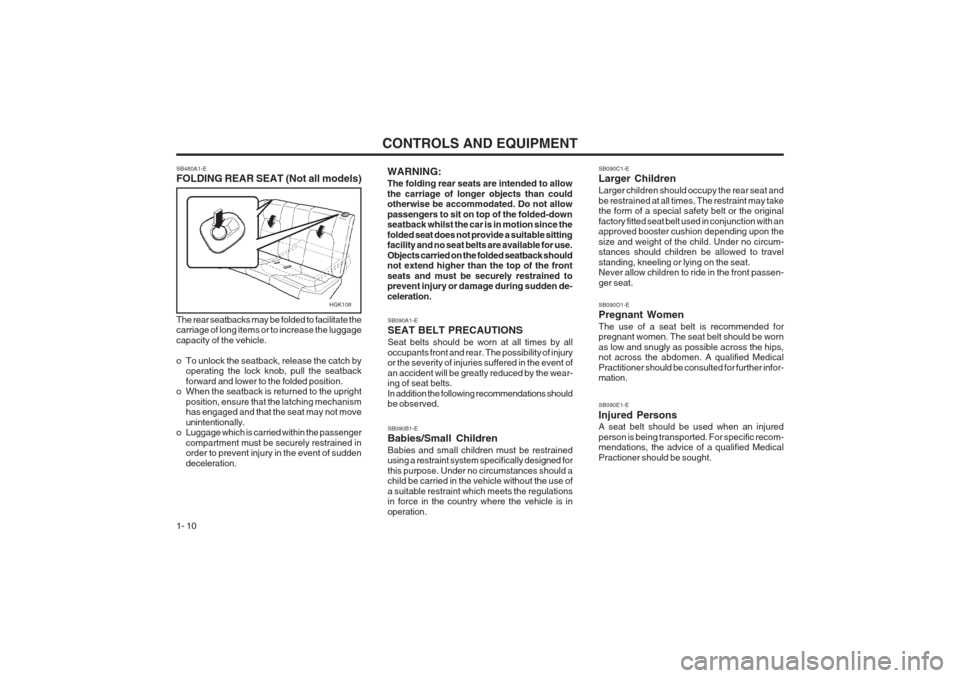
SB480A1-E FOLDING REAR SEAT (Not all models) The rear seatbacks may be folded to facilitate the carriage of long items or to increase the luggage capacity of the vehicle.
o To unlock the seatback, release the catch by
operating the lock knob, pull the seatback forward and lower to the folded position.
o When the seatback is returned to the upright
position, ensure that the latching mechanism has engaged and that the seat may not move unintentionally.
o Luggage which is carried within the passenger
compartment must be securely restrained in order to prevent injury in the event of sudden deceleration. WARNING: The folding rear seats are intended to allow the carriage of longer objects than could otherwise be accommodated. Do not allow passengers to sit on top of the folded-down seatback whilst the car is in motion since the folded seat does not provide a suitable sitting facility and no seat belts are available for use. Objects carried on the folded seatback should not extend higher than the top of the front seats and must be securely restrained to prevent injury or damage during sudden de- celeration.
SB090A1-E SEAT BELT PRECAUTIONS Seat belts should be worn at all times by all occupants front and rear. The possibility of injury or the severity of injuries suffered in the event of an accident will be greatly reduced by the wear- ing of seat belts. In addition the following recommendations should be observed. SB090B1-E Babies/Small Children Babies and small children must be restrained using a restraint system specifically designed for this purpose. Under no circumstances should a child be carried in the vehicle without the use of a suitable restraint which meets the regulations in force in the country where the vehicle is in operation. SB090C1-E Larger Children Larger children should occupy the rear seat and be restrained at all times. The restraint may take the form of a special safety belt or the original factory fitted seat belt used in conjunction with an approved booster cushion depending upon the size and weight of the child. Under no circum- stances should children be allowed to travel standing, kneeling or lying on the seat. Never allow children to ride in the front passen- ger seat. SB090O1-E Pregnant Women The use of a seat belt is recommended for pregnant women. The seat belt should be worn as low and snugly as possible across the hips, not across the abdomen. A qualified Medical Practitioner should be consulted for further infor- mation.
HGK108
Page 19 of 140
CONTROLS AND EQUIPMENT1- 11
SB090F1-E Seat Belt Occupancy The seat belts are designed to be used by one seat occupant only. The use of a seat belt by more than one person increases the levels of injury which may be sustained in the event of an accident. SE090G1-E Do Not Lie Down To ensure that the maximum level of protection may be afforded by the seat belt system, all passengers should be sitting in an upright posi- tion throughout the journey. The seat belt will be unable to afford maximum protection if the front seats are at or near the fully reclined position. SB090H1-E CARE OF SEAT BELTS Seat belt assemblies must never be disassembled or modified in any way. In addition, care should be exercised to ensure that the belt assemblies do not become damaged by being trapped in seat mechanisms, door shuts etc. SB090I-E Periodic Inspection It is recommended that all seat belts be inspected periodically for wear or damage of any kind. Parts of the system that are damaged should be replaced as soon as possible. Under no circum- stances must any part of the seat belt assem- blies be dismantled or repaired.
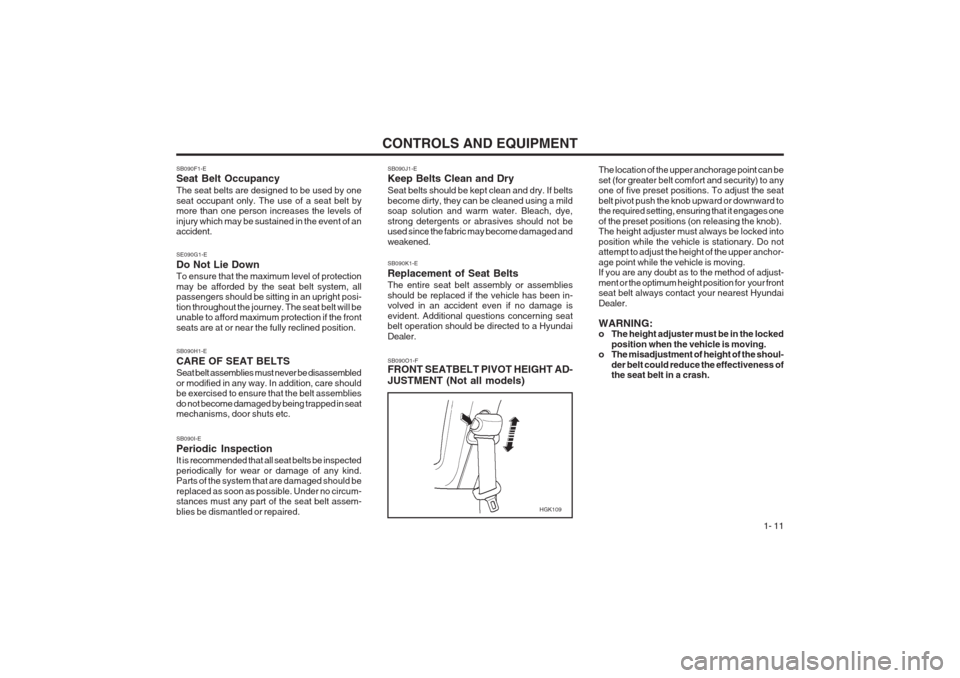
SB090J1-E Keep Belts Clean and Dry Seat belts should be kept clean and dry. If belts become dirty, they can be cleaned using a mild soap solution and warm water. Bleach, dye, strong detergents or abrasives should not be used since the fabric may become damaged and weakened. SB090K1-E Replacement of Seat Belts The entire seat belt assembly or assemblies should be replaced if the vehicle has been in- volved in an accident even if no damage is evident. Additional questions concerning seat belt operation should be directed to a Hyundai Dealer. SB090O1-F FRONT SEATBELT PIVOT HEIGHT AD- JUSTMENT (Not all models)
The location of the upper anchorage point can be set (for greater belt comfort and security) to any one of five preset positions. To adjust the seat belt pivot push the knob upward or downward to the required setting, ensuring that it engages one of the preset positions (on releasing the knob). The height adjuster must always be locked into position while the vehicle is stationary. Do not attempt to adjust the height of the upper anchor- age point while the vehicle is moving. If you are any doubt as to the method of adjust- ment or the optimum height position for your front seat belt always contact your nearest Hyundai Dealer. WARNING:
o The height adjuster must be in the locked
position when the vehicle is moving.
o The misadjustment of height of the shoul-
der belt could reduce the effectiveness ofthe seat belt in a crash.
HGK109
Page 21 of 140
CONTROLS AND EQUIPMENT1- 13
shoulder belt must always be positioned as low as possible on the child's hips and as snug as possible.
o If the seat belt will not properly fit the child, we recommend the use of an ap- proved booster seat in the rear seat in order to raise the child's seating height so that the seat belt will properly fit the child.
o Never allow a child to stand up or kneel on
the seat.
o Never use an infant carrier or child safety
seat that "hooks" over a seatback; it may not provide adequate security in an acci- dent.
o Never allow a child to be held in a person's
arms while they are in a moving vehicle, as this could result in serious injury to the child in the event of an accident or a sudden stop. Holding a child in a moving vehicle does not provide the child with any means of protection during an acci- dent, even if the person holding the child is wearing a seat belt.
o If the safety seat is not anchored properly, the risk of a child being seriously injured or killed in a collision greatly increases.
WARNING:
o A child restraint system must be placed in
the rear seat. Never install a child or infantseat on the front passenger's seat. Should an accident occur and cause the passenger side airbag to deploy, it could severely injure or kill an infant or child seated in an infant or child seat. Thus, only use a child restraint in the rear seat of your vehicle.
o Since a safety belt or child restraint sys-
tem can become very hot if it is left in a closed vehicle, be sure to check the seat cover and buckles before placing a child there.
o When the child restraint system is not in use, store it in the boot or fasten it with a safety belt so that it will not be thrown forward in the case of a sudden stop or an accident.
o Children who are too large to be in a child
restraint should sit in the rear seat and be restrained with the available lap/shoulder belts. Never allow children to ride in the front passenger seat.
o Always make sure that the shoulder belt portion of the outboard lap/shoulder belt is positioned midway over the shoulder, never across the neck or behind the back. Moving the child closer to the center of the vehicle may help provide a good shoulder belt fit. The lap belt portion of the lap/
B230A02GK-EAT CHILD RESTRAINT SYSTEM Children riding in the car should sit in the rear seat and must always be properly restrained to minimize the risk of injury in an accident, sudden stop or sudden maneuver. According to accident statistics, children are safer when properly re- strained in the rear seats than in the front seat. Larger children should use one of the seat belts provided. You are required by law to use safety restraints for children. If small children ride in your vehicle you must put them in a child restraint system (safety seat). Children could be injured or killed in a crash if their restraints are not properly secured. For small children and babies, a child seat or infant seat must be used. Before buying a particular child restraint system, make sure it fits your car seat and seat belts, and fits your child. Follow all the instructions provided by the manufacturer when installing the child restraint system.
Page 22 of 140
CONTROLS AND EQUIPMENT
1- 14
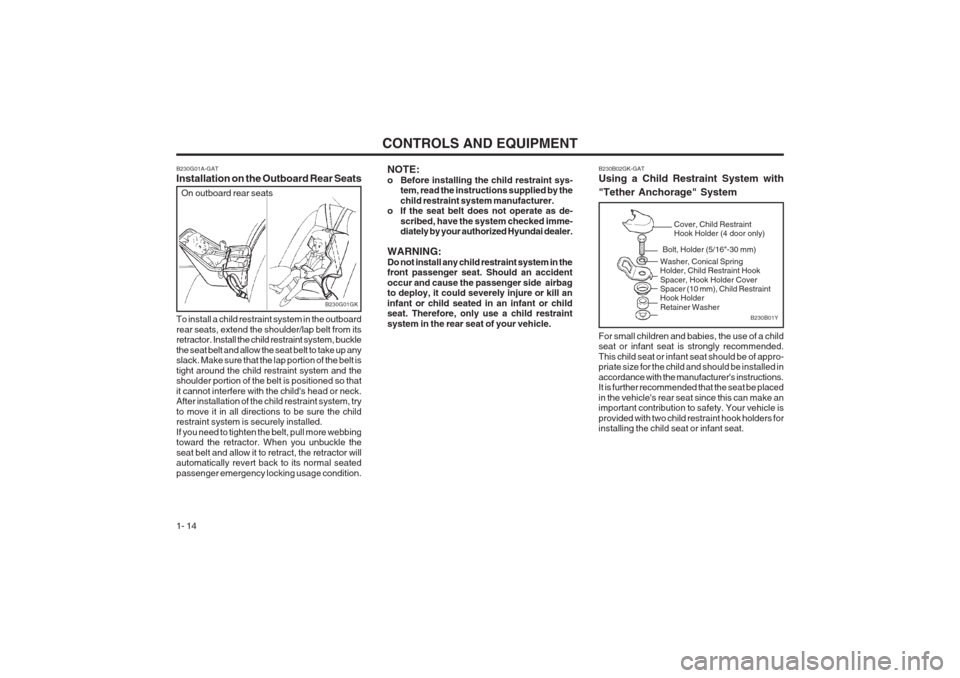
B230G01A-GAT Installation on the Outboard Rear Seats
B230G01GK
On outboard rear seats
To install a child restraint system in the outboard rear seats, extend the shoulder/lap belt from its retractor. Install the child restraint system, buckle the seat belt and allow the seat belt to take up any slack. Make sure that the lap portion of the belt is tight around the child restraint system and the shoulder portion of the belt is positioned so that it cannot interfere with the child's head or neck. After installation of the child restraint system, try to move it in all directions to be sure the child restraint system is securely installed. If you need to tighten the belt, pull more webbing toward the retractor. When you unbuckle the seat belt and allow it to retract, the retractor will automatically revert back to its normal seated passenger emergency locking usage condition. NOTE:
o Before installing the child restraint sys-
tem, read the instructions supplied by thechild restraint system manufacturer.
o If the seat belt does not operate as de-
scribed, have the system checked imme- diately by your authorized Hyundai dealer.
WARNING: Do not install any child restraint system in the front passenger seat. Should an accident occur and cause the passenger side airbag to deploy, it could severely injure or kill an infant or child seated in an infant or child seat. Therefore, only use a child restraint system in the rear seat of your vehicle. B230B02GK-GAT Using a Child Restraint System with "Tether Anchorage" System For small children and babies, the use of a child seat or infant seat is strongly recommended. This child seat or infant seat should be of appro- priate size for the child and should be installed in accordance with the manufacturer's instructions. It is further recommended that the seat be placed in the vehicle's rear seat since this can make an important contribution to safety. Your vehicle is provided with two child restraint hook holders for installing the child seat or infant seat.
B230B01Y
Cover, Child Restraint Hook Holder (4 door only)
Bolt, Holder (5/16"-30 mm)
Washer, Conical SpringHolder, Child Restraint Hook Spacer, Hook Holder Cover Spacer (10 mm), Child RestraintHook Holder Retainer Washer
Page 23 of 140
CONTROLS AND EQUIPMENT1- 15
B230E01GK
Covering shelf
Back panel
Front of Vehicle
Tether strap hook
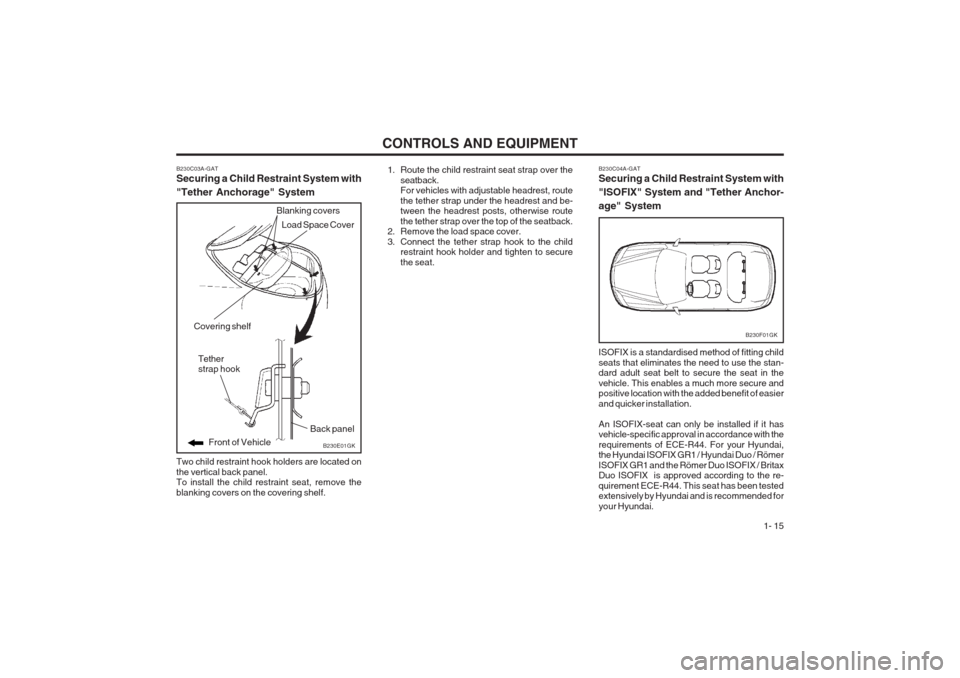
B230C03A-GAT Securing a Child Restraint System with "Tether Anchorage" System Two child restraint hook holders are located on the vertical back panel. To install the child restraint seat, remove the blanking covers on the covering shelf.
Blanking covers
Load Space Cover
1. Route the child restraint seat strap over the
seatback. For vehicles with adjustable headrest, route the tether strap under the headrest and be- tween the headrest posts, otherwise route the tether strap over the top of the seatback.
2. Remove the load space cover.
3. Connect the tether strap hook to the child restraint hook holder and tighten to securethe seat. B230C04A-GAT Securing a Child Restraint System with "ISOFIX" System and "Tether Anchor-age" System
B230F01GK
ISOFIX is a standardised method of fitting child seats that eliminates the need to use the stan- dard adult seat belt to secure the seat in the vehicle. This enables a much more secure and positive location with the added benefit of easier and quicker installation. An ISOFIX-seat can only be installed if it has vehicle-specific approval in accordance with the requirements of ECE-R44. For your Hyundai, the Hyundai ISOFIX GR1 / Hyundai Duo / Römer ISOFIX GR1 and the Römer Duo ISOFIX / Britax Duo ISOFIX is approved according to the re- quirement ECE-R44. This seat has been tested extensively by Hyundai and is recommended for your Hyundai.
Page 24 of 140
CONTROLS AND EQUIPMENT
1- 16
NOTE: At present, this seat is the only one comply- ing with that provision. In case that other manufacturers will furnish proof of a respec- tive certification, Hyundai is going to evalu- ate this seat carefully and will give a recom- mendation provided that seat complies to the law. Please ask your Hyundai dealer in this respect.
B230D02GK
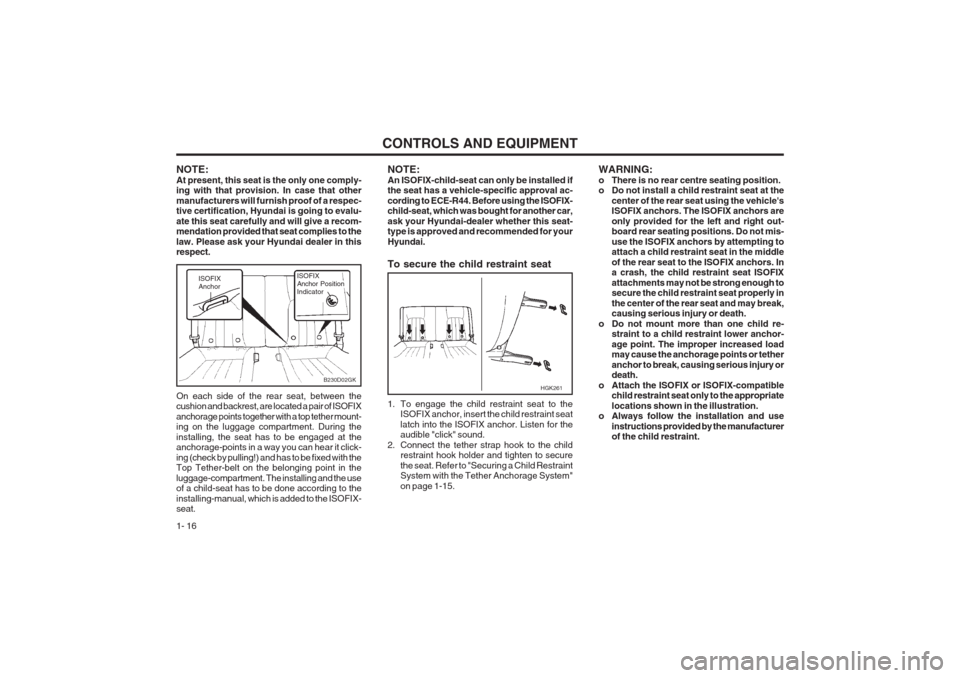
ISOFIX AnchorISOFIX Anchor
Position
Indicator
On each side of the rear seat, between the cushion and backrest, are located a pair of ISOFIX anchorage points together with a top tether mount- ing on the luggage compartment. During the installing, the seat has to be engaged at the anchorage-points in a way you can hear it click- ing (check by pulling!) and has to be fixed with the Top Tether-belt on the belonging point in the luggage-compartment. The installing and the use of a child-seat has to be done according to the installing-manual, which is added to the ISOFIX- seat. NOTE: An ISOFIX-child-seat can only be installed if the seat has a vehicle-specific approval ac- cording to ECE-R44. Before using the ISOFIX- child-seat, which was bought for another car, ask your Hyundai-dealer whether this seat- type is approved and recommended for your Hyundai. To secure the child restraint seat
1. To engage the child restraint seat to the
ISOFIX anchor, insert the child restraint seat latch into the ISOFIX anchor. Listen for the audible "click" sound.
2. Connect the tether strap hook to the child restraint hook holder and tighten to secure the seat. Refer to "Securing a Child Restraint System with the Tether Anchorage System" on page 1-15.
HGK261 WARNING:
o There is no rear centre seating position.
o Do not install a child restraint seat at the
center of the rear seat using the vehicle'sISOFIX anchors. The ISOFIX anchors are only provided for the left and right out- board rear seating positions. Do not mis- use the ISOFIX anchors by attempting to attach a child restraint seat in the middle of the rear seat to the ISOFIX anchors. In a crash, the child restraint seat ISOFIX attachments may not be strong enough to secure the child restraint seat properly in the center of the rear seat and may break, causing serious injury or death.
o Do not mount more than one child re- straint to a child restraint lower anchor- age point. The improper increased load may cause the anchorage points or tether anchor to break, causing serious injury or death.
o Attach the ISOFIX or ISOFIX-compatible child restraint seat only to the appropriate locations shown in the illustration.
o Always follow the installation and use
instructions provided by the manufacturer of the child restraint.
Page 53 of 140
CONTROLS AND EQUIPMENT1- 45
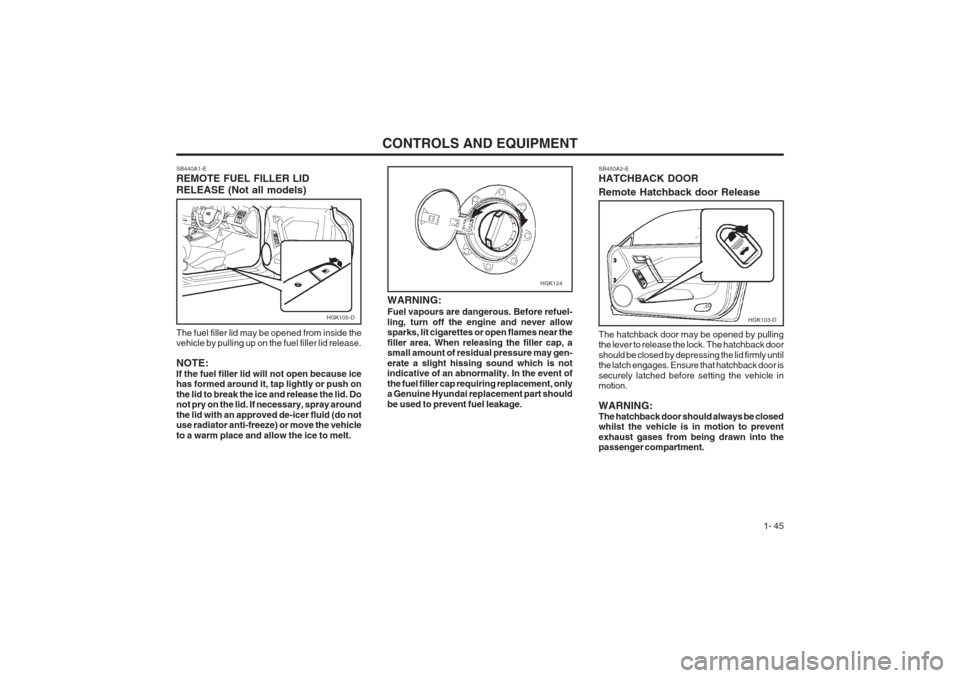
SB450A2-E HATCHBACK DOOR Remote Hatchback door Release The hatchback door may be opened by pulling the lever to release the lock. The hatchback door should be closed by depressing the lid firmly until the latch engages. Ensure that hatchback door is securely latched before setting the vehicle in motion. WARNING: The hatchback door should always be closed whilst the vehicle is in motion to prevent exhaust gases from being drawn into the passenger compartment.
HGK103-D
SB440A1-E REMOTE FUEL FILLER LID RELEASE (Not all models) The fuel filler lid may be opened from inside the vehicle by pulling up on the fuel filler lid release. NOTE: If the fuel filler lid will not open because ice has formed around it, tap lightly or push on the lid to break the ice and release the lid. Do not pry on the lid. If necessary, spray around the lid with an approved de-icer fluid (do not use radiator anti-freeze) or move the vehicle to a warm place and allow the ice to melt.
HGK105-D
HGK124
WARNING: Fuel vapours are dangerous. Before refuel- ling, turn off the engine and never allow sparks, lit cigarettes or open flames near the filler area. When releasing the filler cap, a small amount of residual pressure may gen- erate a slight hissing sound which is not indicative of an abnormality. In the event of the fuel filler cap requiring replacement, only a Genuine Hyundai replacement part should be used to prevent fuel leakage.
Page 81 of 140
DRIVING YOUR HYUNDAI 2- 7
C090H01L-GAT NOTE:
o For smooth and safe operation, depress
the brake pedal when shifting from "Neu- tral" position or "Park" position to a for- ward or reverse gear.
o The ignition key must be in the "ON" position and the brake pedal fully de-pressed in order to move the shift lever from the "P" (Park) position to any of the other positions.
o It is always possible to shift from "R", "N", "D" position to "P" position. Thevehicle must be fully stopped to avoid transaxle damage.
SKIP
: By rapidly moving the selector forwards
or backwards twice, it is possible to skip onegear, i.e. 1st to 3rd or 3rd to 1st . CAUTION:
o In sports mode, the driver must execute upward shifts in accordance with pre-vailing road conditions, taking care to keep the engine speed below the red zone.
o For engine protection, upward shifts are made automatically when the engine rpmreaches the red zone.
o By rapidly moving the selector lever back- wards (-) twice it is possible to skip onegear by using the sports mode. Since sudden engine braking and/or rapid ac- celeration can cause a loss of traction, however, downshifts must be made care- fully in accordance with the vehicle's speed.
NOTE:
o In sports mode, only the four forward gears can be selected. To reverse or parkthe vehicle, move the selector lever to the "R" or "P" position as required.
o In sports mode, downward shifts are made automatically when the vehicleslows down. When the vehicle stops, 1st gear is automatically selected.
o To maintain the required levels of vehicle performance and safety, the system maynot execute certain gearshifts when the selector lever is operated. o Before driving away from a stop on a
slippery road, push the selector leverforward into the +(UP) position. This causes the transaxle to shift into 2nd gear which is better for smooth driving away on a slippery road. Push the selec- tor lever to the -(DOWN) side to shift back to 1st gear. C090I01L-GAT CAUTION:
o Shift into "R" and "P" position only when
the vehicle has completely stopped.
o Do not accelerate the engine in reverse or any of the forward positions with the brakes applied.
o Always apply the footbrake when shift- ing from "P" or "N", to "R", "D"position.
o Do not use the "P" (Park) position in place of the parking brake. Always set the parking brake, shift the transaxle into "P" (Park) position and turn off the igni- tion when you leave the vehicle, even momentarily. Never leave the vehicle unattended while the engine is running.
o Check the automatic transaxle fluid level regularly, and add fluid as necessary.
C090N01O-AAT Good Driving Practices
o Never move the gear selector lever from "P" or "N" to any other position with the acceler- ator pedal depressed.
o Never move the gear selector lever into "P" when the vehicle is in motion.
o Be sure the car is completely stopped be- fore you attempt to shift into "R".
o Never take the car out of gear and coast down a hill. This may be extremely hazard-ous. Always leave the car in gear when moving.
o Do not "ride" the brakes. This can cause them to overheat and malfunction. Instead,
Page 88 of 140
DRIVING YOUR HYUNDAI
2- 14
Coupling point
HGK260
View from below the vehicle 13. Avoid holding the brake pedal down too long
or too frequently. This could cause the brakes to overheat, resulting in reduced braking efficiency.
14. When going down a hill, shift into a lower gear and use the engine braking effect.When ascending a long grade, downshift the transmission to a lower gear and reduce speed to reduce chances of engine over- loading and/or overheating.
15. If you have to stop while going uphill, do not hold the vehicle in place by pressing on theaccelerator. This can cause the automatic transmission to overheat. Use the parking brake or footbrake.
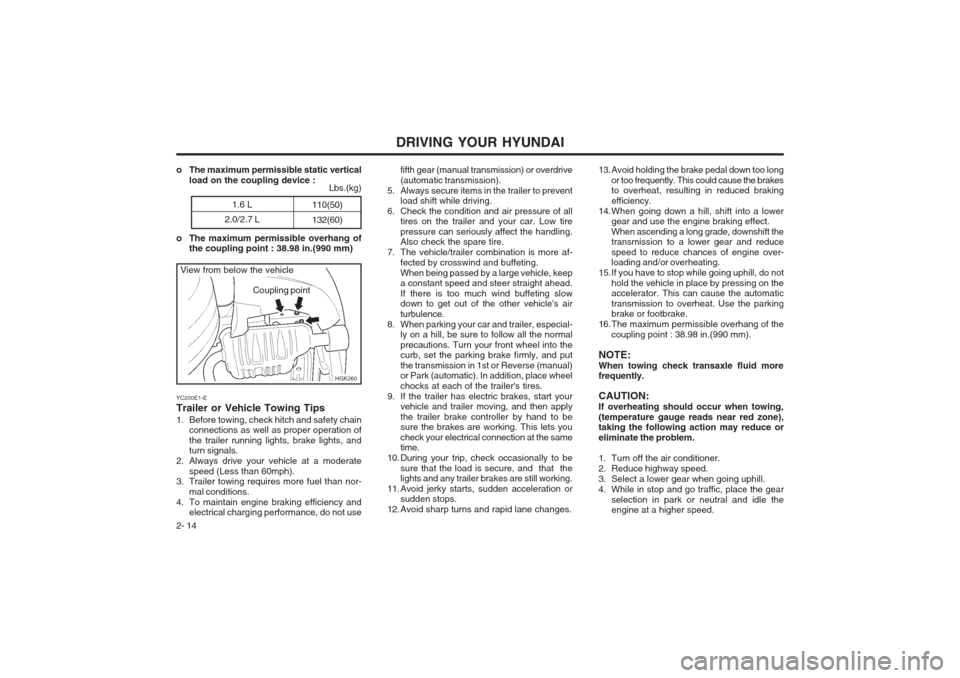
16. The maximum permissible overhang of the coupling point : 38.98 in.(990 mm).
NOTE: When towing check transaxle fluid more frequently. CAUTION: If overheating should occur when towing,(temperature gauge reads near red zone), taking the following action may reduce or eliminate the problem.
1. Turn off the air conditioner.
2. Reduce highway speed.
3. Select a lower gear when going uphill.
4. While in stop and go traffic, place the gear selection in park or neutral and idle the engine at a higher speed.
fifth gear (manual transmission) or overdrive (automatic transmission).
5. Always secure items in the trailer to prevent load shift while driving.
6. Check the condition and air pressure of all tires on the trailer and your car. Low tirepressure can seriously affect the handling. Also check the spare tire.
7. The vehicle/trailer combination is more af-
fected by crosswind and buffeting. When being passed by a large vehicle, keep a constant speed and steer straight ahead. If there is too much wind buffeting slow down to get out of the other vehicle's air turbulence.
8. When parking your car and trailer, especial- ly on a hill, be sure to follow all the normalprecautions. Turn your front wheel into the curb, set the parking brake firmly, and put the transmission in 1st or Reverse (manual) or Park (automatic). In addition, place wheel chocks at each of the trailer's tires.
9. If the trailer has electric brakes, start your vehicle and trailer moving, and then applythe trailer brake controller by hand to be sure the brakes are working. This lets you check your electrical connection at the same time.
10. During your trip, check occasionally to be sure that the load is secure, and that thelights and any trailer brakes are still working.
11. Avoid jerky starts, sudden acceleration or sudden stops.
12. Avoid sharp turns and rapid lane changes.
o The maximum permissible static vertical
load on the coupling device :
o The maximum permissible overhang of the coupling point : 38.98 in.(990 mm)
YC200E1-E Trailer or Vehicle Towing Tips
1. Before towing, check hitch and safety chain connections as well as proper operation of the trailer running lights, brake lights, and turn signals.
2. Always drive your vehicle at a moderate speed (Less than 60mph).
3. Trailer towing requires more fuel than nor-
mal conditions.
4. To maintain engine braking efficiency and electrical charging performance, do not use
1.6 L
2.0/2.7 L 110(50) 132(60)
Lbs.(kg)