fuel pump Hyundai Coupe 2002 Owner's Manual
[x] Cancel search | Manufacturer: HYUNDAI, Model Year: 2002, Model line: Coupe, Model: Hyundai Coupe 2002Pages: 140, PDF Size: 1.45 MB
Page 9 of 140
CONTROLS AND EQUIPMENT1- 1
The use of leaded fuel in this vehicle will result in irreversible pollution of the catalyst element. Such pollution will prevent correct operation of the catalyst and give rise to increased operating temperatures leading to the catalyst element melting and restricting the exhaust flow along with an increase in exhaust emission levels. CAUTION: The vehicle warranty will not extend to dam- age arising from the use of incorrect fuels. Overseas Operation: When the vehicle is to be operated overseas, the vehicle operator should establish that a suitable fuel for satisfactory operation of the vehicle is available.
SB020A1-E RUNNING IN The longevity and performance of the vehicle are greatly affected by the care exercised during the first 1000 miles of motoring. Because of modern manufacturing techniques, rigid guidelines re- garding maximum road speeds have become unnecessary. However, certain precautions should be observed in order to obtain the best possible performance and useful life from the vehicle.
1) Do not race the engine without a load (i.e
revving the engine in neutral).
2) During the first 500 miles the maximum en- gine speed should be restricted to 3000 rpmand gradually increased thereafter.
3) Avoid prolonged constant speed operation.
The internal components of the engine will become more quickly run in if the operation speed is varied during the running in period.
4) Never allow the engine to labour. Use the
gearbox freely and avoid large throttle open- ings when the engine speed is below 1500 rpm.
5) Avoid rapid acceleration and maximum
throttle openings.
6) Avoid harsh braking during the first 100
miles of urban motoring or 1000 miles of motorway driving to allow the friction facings of the brake pads and shoes to bed against the discs and drums properly.
7) Avoid trailer towing during the running in period.
1. CONTROLS AND
EQUIPMENT
SB010E1-E PETROLS FOR CLEANER AIR To help contribute to cleaner air, Hyundai recom- mends that you use petrols treated with deter- gent additives, which help to prevent deposit formation in the engine. These petrols will help the engines run cleaner and the Emission Con- trol System performance.
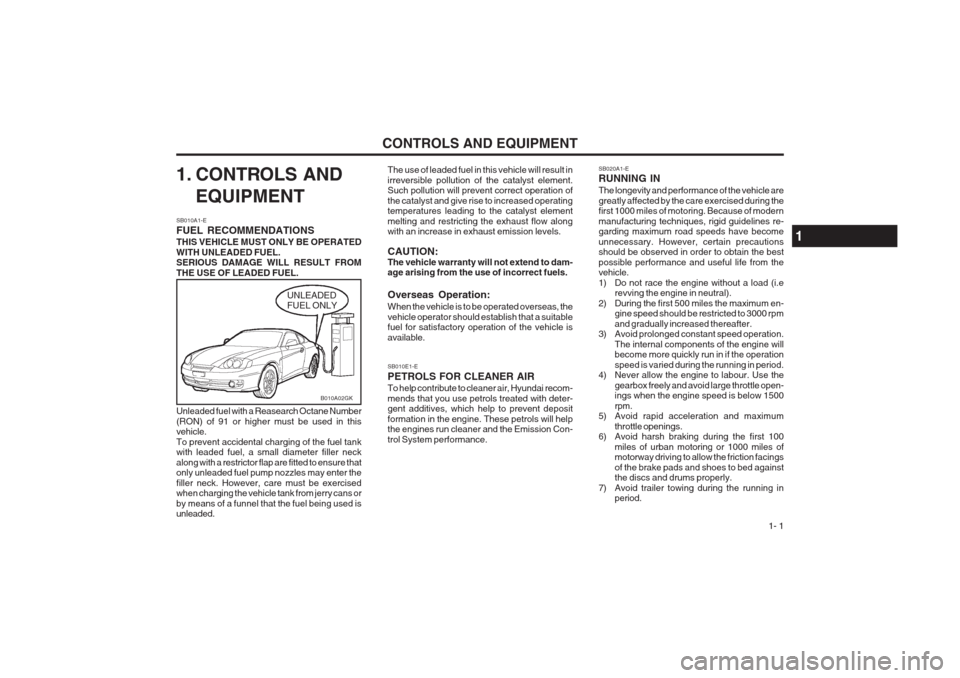
Unleaded fuel with a Reasearch Octane Number(RON) of 91 or higher must be used in this vehicle. To prevent accidental charging of the fuel tank with leaded fuel, a small diameter filler neck along with a restrictor flap are fitted to ensure that only unleaded fuel pump nozzles may enter the filler neck. However, care must be exercised when charging the vehicle tank from jerry cans or by means of a funnel that the fuel being used is unleaded.
SB010A1-E FUEL RECOMMENDATIONS THIS VEHICLE MUST ONLY BE OPERATED WITH UNLEADED FUEL. SERIOUS DAMAGE WILL RESULT FROM THE USE OF LEADED FUEL.
1
B010A02GK
UNLEADED FUEL ONLY
Page 35 of 140
CONTROLS AND EQUIPMENT1- 27
SB2100I-E
DOOR AJAR WARNING LAMP
The door ajar warning lamp indicates that a door is not correctly closed. Ensure that the lamp is extinguished prior to driving the vehicle.
SB210P1-E
LOW FUEL LEVEL WARNING LAMP
The low fuel warning lamp serves to warn the driver that the remaining fuel quantity is approxi- mately 9 litres and that the vehicle should be refuelled. If the vehicle is driven for an extended period with the low fuel warning lamp illuminated there exists a possibility that misfiring due to fuel
defective, approximately fifty per cent of thenormal braking performance will be available. If failure of one of the circuits occurs, the required amount of pedal effort, pedal travel and stopping distance will be increased. Use of the gearbox is recommended to assist in bringing the vehicle to rest. The vehicle must not be driven once brake failure has occurred until the system has been repaired and is functioning normally. The braking system employs a vacuum servo in order that the pedal efforts are reduced. Power for the servo is derived from the engine and therefore, in the event of the engine stopping or the vehicle being towed, pedal efforts will be substantially increased.
SB210M1-E CHARGING SYSTEM WARNING LAMP
The charging system warning lamp should illumi- nate when the ignition switch is turned to the "ON" position and should be extinguished when the engine is started. If the lamp fails to illuminate when the ignition is turned "ON" or fails to extin- guish after starting the engine, the nearest Hyundai dealer should be contacted. If the lamp illuminates whilst the vehicle is being driven, stop the vehicle as soon as it is safe to do so and check the condition of the generator drive belt. If the belt is in place and the tension is satisfactory, the advice of a Hyundai dealer should be sought.
B260H01GK-EAT PARKING BRAKE/BRAKE FLUID LEVEL WARNING LAMP
WARNING: In the event of problems being suspected with the braking system, the advice of the nearest Hyundai dealer must be sought be- fore the vehicle is driven. Driving the vehicle with either an electrical or hydraulic braking system defect may be dangerous, resulting in accident or personal injury. Warning lamp operation The parking brake/brake fluid level warning lamp will be illuminated whenever the ignition switch is turned to the "ON" or "START" position when the parking brake is applied and must be extin- guished in a three seconds after the engine starts. If the warning lamp fails to extinguish or illumi- nates at any other time, the vehicle must be brought to rest in a safe location and the level of brake fluid in the reservoir checked. If the fluid level is incorrect, fluid conforming to DOT 3 or DOT 4 specifications should be added. If, after correcting the brake fluid level, the warning lamp continues to be illuminated, the advice of the nearest Hyundai dealer must be sought before the vehicle is driven again. The Hyundai Lantra is equipped with a diagonally split dual braking system which will ensure that in the event of one of the brake circuits becoming SB210N2-E
HATCHBACK DOOR OPEN WARNING LAMP
The hatchback door warning lamp indicates when the hatchback door is open or is not fully closed. Ensure that the lamp has extinguished prior to driving the vehicle.CAUTION: If the drive belt (generator belt) is loosen, broken, or missing while the vehicle is driv- ing, there may be a serious malfunction, en- gine could overheat because this belt also drives the water pump.
Page 89 of 140
3-1
IN CASE OF EMERGENCY
that the transmission selector is at the "P" or"N" position.
2. Check the battery terminals and connections
to ensure that these are clean and also tight.
3. If the ignition warning lamps dim when the
engine is cranked and the battery terminals have been checked, a discharged battery is indicated.
4. Do not attempt to push or tow start the ve-
hicle, refer to "Jump Starting" for information regarding engine starting when the battery is discharged.
SD000A1-E
3. IN CASE OF EMER-
GENCY
SD020A1-E IF THE ENGINE WILL NOT START Seek assistance from the nearest Hyundai dealer with regard to the method of ignition and fuel system diagnosis. CAUTION: If the engine refuses to start, no attempt should be made to push or tow start the vehicle. Vehicles with automatic transmis- sion or fuel injection will not be able to be started in this manner since no drive is trans- mitted through the automatic transmission whilst the engine is not running, and in the case of fuel injected derivatives, the fuel pump will not operate under tow start conditions. In addition, if the vehicle is equipped with an exhaust catalyst, damage to the catalyst may result if the vehicle is tow started. SD020B1-E IF THE ENGINE CANNOT BECRANKED
1. If the vehicle is fitted with manual transmis- sion, ensure that the clutch pedal is depressedwhilst cranking the engine. If the vehicle is fitted with automatic transmission, ensure SD020C1-F If Engine Turns Over Normally but Does Not Start
1. Check fuel Level
2. Check all connectors at ignition coil and spark
plugs.Replace any that may be disconnected or loose.
3. Check fuel line in the engine room.
4. If engine still refuses to start, call a Hyundai dealer or seek other qualified assistance.
AD020D1-A If Engine Stalls While Driving
1. Reduce your speed gradually, keeping a straight line. Move cautionsly off the road to a safe place.
2. Turn on your emergency flashers.
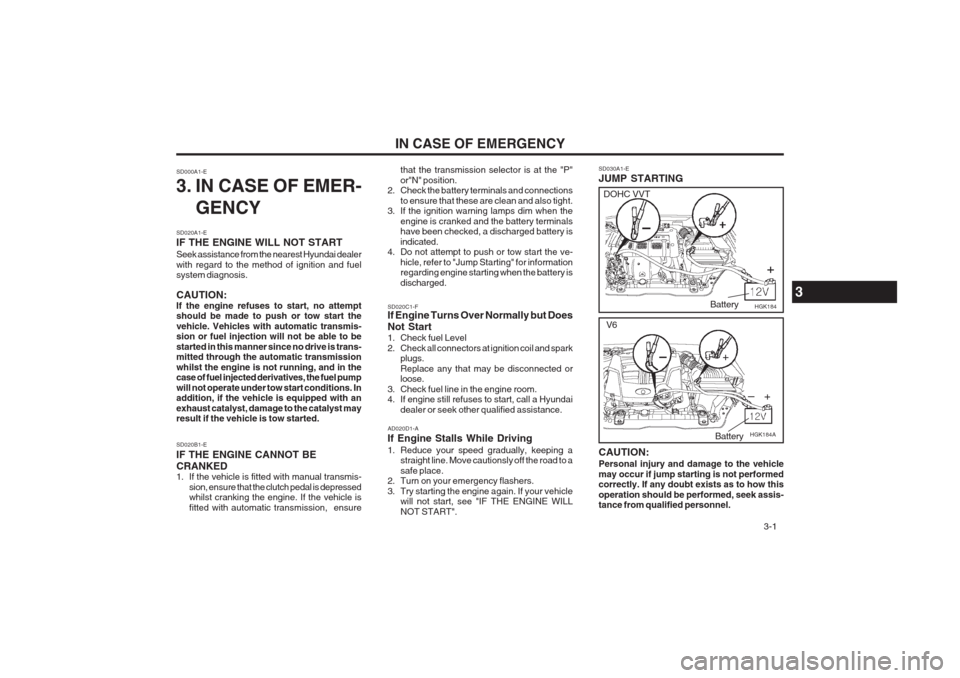
3. Try starting the engine again. If your vehicle will not start, see "IF THE ENGINE WILLNOT START". SD030A1-E JUMP STARTING
3
HGK184
Battery
DOHC VVT
HGK184A
V6
Battery
CAUTION: Personal injury and damage to the vehicle may occur if jump starting is not performed correctly. If any doubt exists as to how this operation should be performed, seek assis- tance from qualified personnel.
Page 90 of 140
IN CASE OF EMERGENCY
3-2 4. Check to see if the water pump drive belt is
missing. If it is not missing, check to see that it is tight. If the drive belt seems to be satisfac- tory, check for coolant leaking from the radia- tor, hoses or under the car. (If the air condi- tioning had been in use, it is normal for cold water to be draining from it).
WARNING: Whilst the engine is running, keep hands and clothing away from moving parts such as the fan and drive belts to prevent injury.
5. If the water pump drive belt is broken or coolant is leaking out, stop the engine imme- diately and call the nearest Hyundai dealer for assistance.
WARNING:Do not remove the radiator cap when the engine is hot since steam and boiling water may be ejected from the radiator resulting in burns or scalding.
6. If the cause of the overheating cannot be found, wait until the engine temperature has returned to normal. Then, if coolant has been lost, carefully remove the radiator cap and add water to bring the fluid level in the reser- voir up to the base of the radiator fill opening. Fill the coolant expansion tank to the halfway mark.
WARNING: Motor vehicle batteries contain sulphuric acid and emit hydrogen gas. Protective clothing should be worn and care exercised to prevent the acid from coming into contact with skin or clothing and the vehicle. Naked lights should not be permitted in the vicinity of the battery. Care should be exercised to prevent sparks occurring during connection. If acid acciden- tally comes into contact with skin or eyes, the affected area should immediately be flushed with copious amounts of water and medical assistance sought.
1. Ensure that the booster battery is 12 volt type.
If the booster battery is installed in another vehicle, ensure that the two vehicles are not touching.
2. Turn off all unnecessary electrical equipment in both vehicles.
3. Ensure that the engine of the vehicle provid- ing the jump start is running prior to connec- tion of the jump cables.
4. Connect the red jump cable to the positive (+)
terminal of the booster battery and the other end to the positive (+) terminal of the dis- charged battery.
5. Attach the black jump cable to the negative
(-) terminal of the booster battery, and the other end to a ground point within the engine compartment of the vehicle with the flat bat- tery. Do not connect to the negative battery terminal of the flat battery since sparks may be generated with the subsequent risk of explosion. 6. Raise the booster vehicle engine speed to
2,000 r.p.m. and start the engine of the vehi- cle with the flat battery.
7. Remove jump cables in the reverse order of installation (black cable first).
CAUTION: If the jump cable is incorrectly installed, dam- age to the vehicle electrical system may oc- cur, in particular the electronic components such as the Fuel Injection system computer and the Automatic Transmission computer. The battery must never be disconnected whilst the engine is running. SD040A1-E IF THE ENGINE OVERHEATSIf the temperature gauge indicates overheating:
1. Pull off the road and stop as soon as it is safe to do so.
2. Place the gear selector lever in "P" (auto- matic), or neutral (manual transaxle) and set the parking brake. If the air conditioning is on, turn it off.
3. If coolant is running out under the car or steam is coming out from under the bonnet stop the engine. Do not open the bonnet until the cool-ant has stopped running or the steam- ing has stopped. If there is no visible loss of coolant and no steam, leave the engine run- ning and check to be sure the engine cooling fan is operating. If the fan is not running, turn the engine off.
Page 100 of 140
VEHICLE MAINTENANCE REQUIREMENTS
5- 2
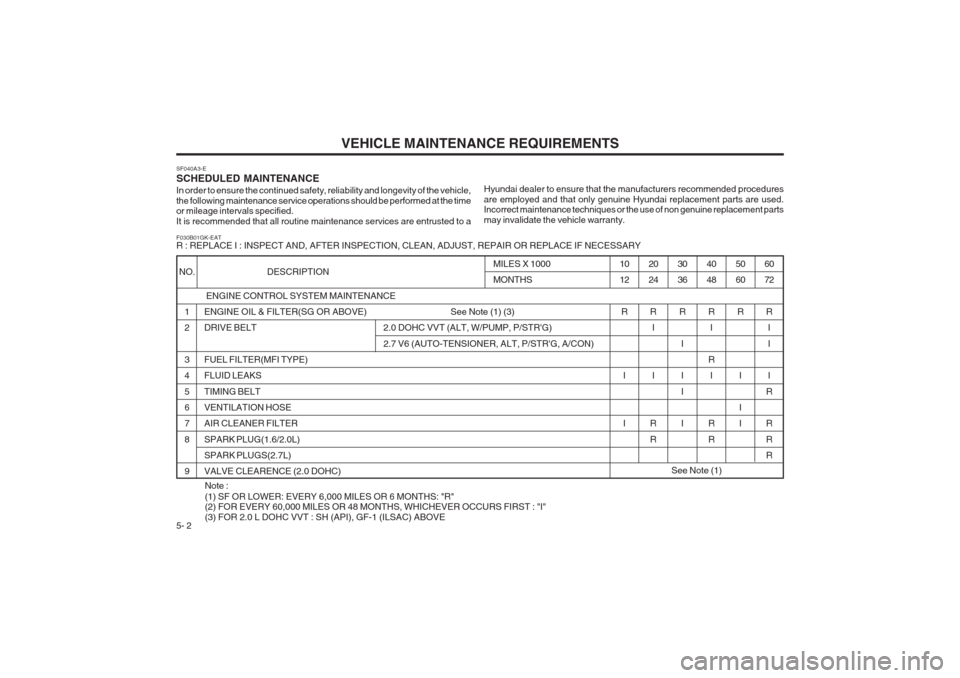
SF040A3-E SCHEDULED MAINTENANCE In order to ensure the continued safety, reliability and longevity of the vehicle, the following maintenance service operations should be performed at the time or mileage intervals specified. It is recommended that all routine maintenance services are entrusted to a
Hyundai dealer to ensure that the manufacturers recommended proceduresare employed and that only genuine Hyundai replacement parts are used. Incorrect maintenance techniques or the use of non genuine replacement parts may invalidate the vehicle warranty.
F030B01GK-EAT R : REPLACE I : INSPECT AND, AFTER INSPECTION, CLEAN, ADJUST, REPAIR OR REPLACE IF NECESSARY
ENGINE CONTROL SYSTEM MAINTENANCE
ENGINE OIL & FILTER(SG OR ABOVE) See Note (1) (3)
DRIVE BELT 2.0 DOHC VVT (ALT, W/PUMP, P/STR'G) 2.7 V6 (AUTO-TENSIONER, ALT, P/STR'G, A/CON)
FUEL FILTER(MFI TYPE)FLUID LEAKS TIMING BELT VENTILATION HOSEAIR CLEANER FILTER SPARK PLUG(1.6/2.0L) SPARK PLUGS(2.7L)VALVE CLEARENCE (2.0 DOHC)
NO. DESCRIPTION60 72
R I I I
RR R R
5060
R
I I I
4048
R I
R I
R R
30 36
R I I I I
20 24
R I I
R R
10 12
R
I I
MILES X 1000 MONTHS
Note : (1) SF OR LOWER: EVERY 6,000 MILES OR 6 MONTHS: "R" (2) FOR EVERY 60,000 MILES OR 48 MONTHS, WHICHEVER OCCURS FIRST : "I" (3) FOR 2.0 L DOHC VVT : SH (API), GF-1 (ILSAC) ABOVE
1 2 3 4 5 67 8 9
See Note (1)
Page 130 of 140
EMISSION CONTROL SYSTEM
7-2
hicle operator in order to prevent operational problems arising from damage to the catalyst. Damage to the catalyst will result if contamina- tion occurs through the use of leaded fuel. Whilst the vehicle is fitted with a reduced diameter filler neck to prevent charging of the fuel tank with a leaded fuel pump nozzle, it is possible that the use of funnels or jerry cans will permit leaded fuel to be introduced into the fuel tank. The catalyst is intolerant of unburnt fuel and therefore if an engine misfire condition exists, damage to the catalyst will occur. It is imperative that if a misfire condition develops, the vehicle is immediately presented to a Hyundai dealer for rectification. Similarly, the practice of certain ignition system diagnosis procedures which in- volve inducing a misfire (cylinder power balance tests for example) may result in catalyst dam- age. For these reasons, it is advisable that the ex- haust gas emission be tested at each routine service with a gas analyzer having a Hydrocar- bon measuring facility to ensure continued reli- ability of the catalyst. Push or tow starting of the vehicle is to be avoided since unburnt fuel may be enter the catalyst and result in damage. (Note, it is impos- sible to push or tow start a Hyundai model equipped with fuel injection since the fuel pump safety interlock will prevent the pump from oper- ating under these conditions). Operation of the catalyst involves extremely high temperatures being attained within the catalytic convertor, and although the convertor is fitted
with heat shields, it is important that the vehicleis not parked over combustible or volatile mate- rial which may result in fire. If the above precautions are not adhered to and the catalyst becomes inoperative, the resultant increase in core temperature will result in a "melt down" where the catalyst core will melt and subsequently may block the exhaust system. Due to the fragile nature of the catalyst element, it is important that damage does not occur when the vehicle is raised by means of a garage jack. Care must also be exercised to avoid driving over road hazards or debris which may cause damage to the catalyst element.
Page 134 of 140
VEHICLE SPECIFICATIONS 9-1
Standard Option
SJ000A1-F
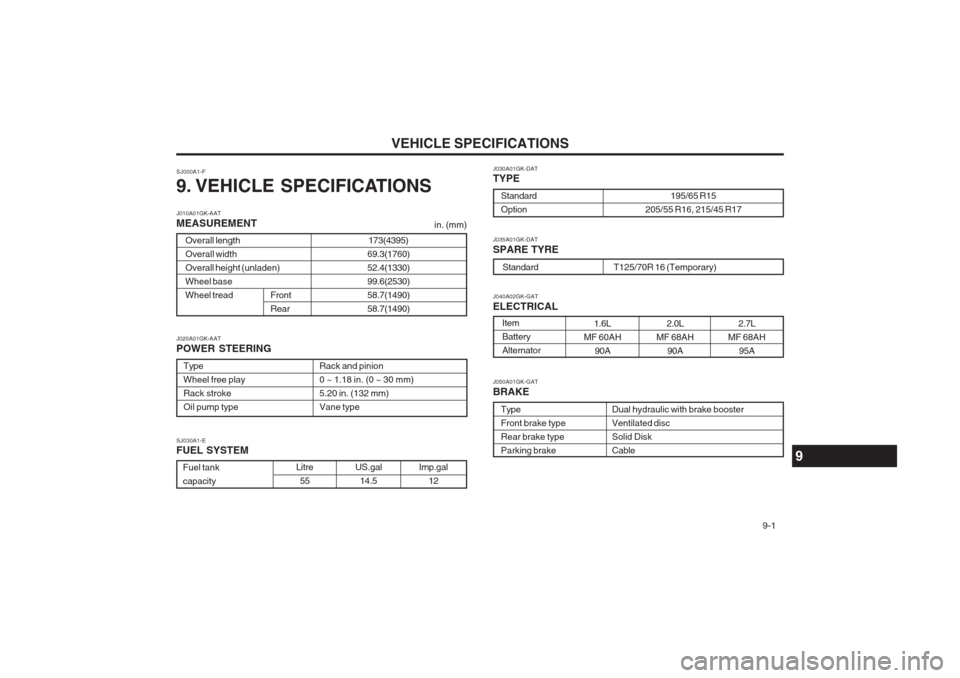
9. VEHICLE SPECIFICATIONS
Litre55
in. (mm)
173(4395)
69.3(1760) 52.4(1330)99.6(2530)58.7(1490)58.7(1490)
Rack and pinion 0 ~ 1.18 in. (0 ~ 30 mm)5.20 in. (132 mm)Vane type
9
J010A01GK-AAT MEASUREMENT J020A01GK-AAT POWER STEERING SJ030A1-E FUEL SYSTEM J030A01GK-DATTYPE J040A02GK-GAT ELECTRICAL
Item BatteryAlternator
Overall lengthOverall widthOverall height (unladen)Wheel baseWheel tread
FrontRear
TypeWheel free playRack strokeOil pump type
Fuel tankcapacity US.gal
14.5 Imp.gal
12 195/65 R15
205/55 R16, 215/45 R17
1.6L
MF 60AH 90A2.0L
MF 68AH 90A2.7L
MF 68AH 95A
J035A01GK-DAT SPARE TYRE
T125/70R 16 (Temporary)
Standard
Dual hydraulic with brake booster Ventilated discSolid DiskCable
J050A01GK-GAT BRAKE
Type Front brake typeRear brake typeParking brake