maintenance Hyundai Coupe 2002 Owner's Manual
[x] Cancel search | Manufacturer: HYUNDAI, Model Year: 2002, Model line: Coupe, Model: Hyundai Coupe 2002Pages: 140, PDF Size: 1.45 MB
Page 2 of 140
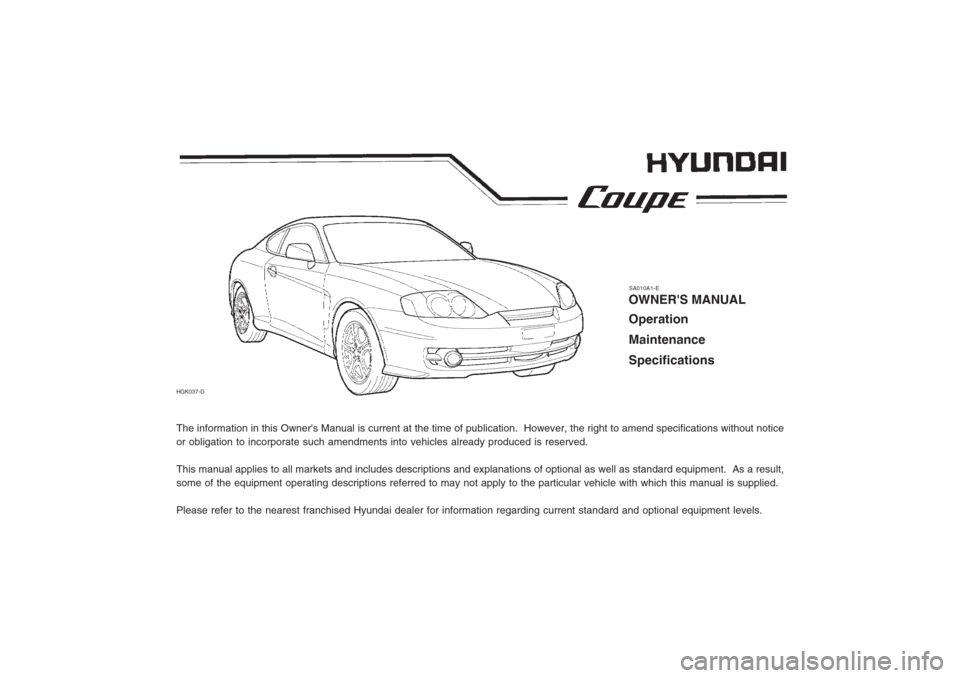
The information in this Owner's Manual is current at the time of publication. However, the right to amend specifications without notice or obligation to incorporate such amendments into vehicles already produced is reserved. This manual applies to all markets and includes descriptions and explanations of optional as well as standard equipment. As a result,
some of the equipment operating descriptions referred to may not apply to the particular vehicle with which this manual is supp lied.
Please refer to the nearest franchised Hyundai dealer for information regarding current standard and optional equipment levels. SA010A1-E
OWNER'S MANUAL Operation MaintenanceSpecifications
HGK037-D
Page 3 of 140
SA020A1-EResponsibilty For Maintenance
It is the responsibility of the vehicle owner/driver to ensure that all routine maintenance services are undertaken in line with the recommendations specified in Section 5 of this manual. In addition, in order to ensure continued validity of thenew vehicle warranty and safe operation of the vehicle, non scheduled mainte-nance/running repairs should be undertaken at the earliest available opportunity.Under severe operating conditions, more frequent maintenance is required.Details of the maintenance schedule for such conditions are also given in section 5. It is recommended that all maintenance operations and repairs are entrusted to afranchised Hyundai dealer to ensure that the latest repair methods, specializedtooling and genuine Hyundai parts are used to ensure the continued reliability andsafety of the vehicle.
Page 4 of 140

SA030A1-EFOREWORD
Hyundai Motor Company wish to take this opportunity to thank you for purchasing a Hyundai product and to welcome you to the ever increasing number of discriminating motorists who drive Hyundai vehicles. The advanced engineeringand construction methods employed during both design and production of the Hyundai marque are something ofwhich we are proud, and this commitment to providing a high quality product is supported by a comprehensive aftersales and warranty service of which we are equally proud. This owners manual will introduce the operating and maintenance requirements for the vehicle and it is recommended that it is carefully read to ensure that the maximum performance and durability along with safe and satisfactory operationare obtained. The recommended routine maintenance servicing along with any running repairs that may be requiredshould be entrusted to a franchised Hyundai dealer to ensure that only the latest methods and genuine Hyundaireplacement parts are used for the continued reliability, safety and performance of the vehicle. Should any question or query exist regarding any aspect of your Hyundai please contact the nearest Hyundai dealer who will be only too pleased to assist wherever possible. Note: This owners manual should be considered as part of the vehicle and should be kept in the vehicle at all times for
ease of reference.In the event of the vehicle being sold please ensure that this manual is left in the vehicle for the reference of the new owner. CAUTION: Severe engine and transaxle damage may result from the use of poor quality fuels and lubricants that do not meet Hyundai specifications. You must always use high quality fuels and lubricants that meetthe specifications listed on Page 9-3 in the Vehicle Specifications section of the Owner's Manual. Copyright 2002 Hyundai Motor Company. All rights reserved. No part of this publication may be reproduced, stored in any retrieval system or transmitted in any form or by any means without the prior written permission of Hyundai MotorCompany.
Page 7 of 140
SA060A1-ETABLE OF CONTENTS
SECTION PAGE
1. CONTROLS AND EQUIPMENT .......................................................................... 1-1
2. DRIVING YOUR HYUNDAI ................................................................................. 2-1
3. IN CASE OF EMERGENCY ................................................................................ 3-1
4. APPEARANCE CARE ......................................................................................... 4-1
5. VEHICLE MAINTENANCE REQUIREMENTS .................................................... 5-1
6. OWNER MAINTENANCE .................................................................................... 6-1
7. EMISSION CONTROL SYSTEM ......................................................................... 7-1
8. CONSUMER INFORMATION .............................................................................. 8-1
9. VEHICLE S PECIFICATIONS .............................................................................. 9-1
10. INDEX ......... ..................................................................................................... 10-1
1
2
3
4
5
6
7
8
9
10
Page 30 of 140
CONTROLS AND EQUIPMENT
1- 22 WARNING:
o Extreme Hazard! Do not use a rearward
facing child restraint on a seat protectedby an airbag in front of it!
o Modification to SRS components or wir-ing,
including the addition of any kind of badges to the pad cover or modifications to the body structure, can adversely affect SRS performance and lead to possible injury.
o For cleaning the horn pad, use only a soft, dry cloth or one which has been moist- ened with plain water. Solvents or clean- ers could adversely affect the airbag cover and proper deployment of the system.
o No objects should be placed over or near
the airbag module on the steering wheel, because any such object could cause harm if the vehicle is in a crash severe enough to cause the airbag to inflate.
o If the airbag inflates, it must be replaced by an authorized Hyundai dealer.
o Do not tamper with or disconnect SRS wiring, or other components of the SRS system. Doing so could result in injury, due to accidental firing of the airbag or by rendering the SRS inoperative.
o If components of the airbag system must
be discarded, or if the vehicle must be scrapped, certain safety precautions must be observed. Your Hyundai dealer knows these precautions and can give you the necessary information. Failure to follow these precautions and procedures could increase the risk of personal injury.
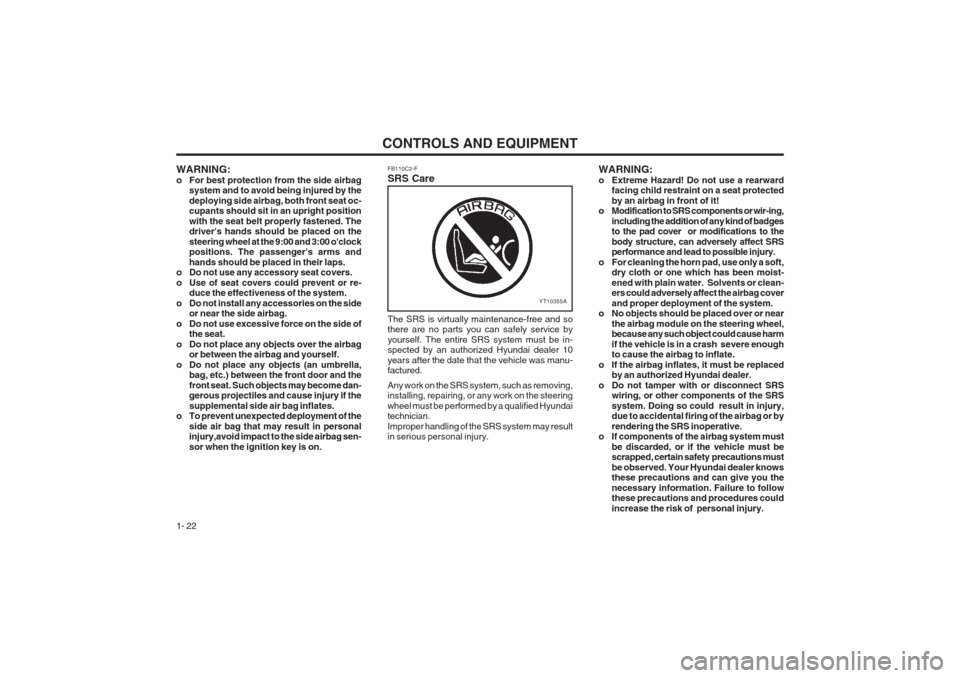
WARNING:
o For best protection from the side airbag
system and to avoid being injured by thedeploying side airbag, both front seat oc- cupants should sit in an upright position with the seat belt properly fastened. The driver's hands should be placed on the steering wheel at the 9:00 and 3:00 o'clock positions. The passenger's arms and hands should be placed in their laps.
o Do not use any accessory seat covers.
o Use of seat covers could prevent or re- duce the effectiveness of the system.
o Do not install any accessories on the side or near the side airbag.
o Do not use excessive force on the side of the seat.
o Do not place any objects over the airbag or between the airbag and yourself.
o Do not place any objects (an umbrella, bag, etc.) between the front door and thefront seat. Such objects may become dan- gerous projectiles and cause injury if the supplemental side air bag inflates.
o To prevent unexpected deployment of the
side air bag that may result in personal injury,avoid impact to the side airbag sen- sor when the ignition key is on. FB110C2-F SRS Care
YT10355A
The SRS is virtually maintenance-free and so there are no parts you can safely service by yourself. The entire SRS system must be in- spected by an authorized Hyundai dealer 10 years after the date that the vehicle was manu- factured. Any work on the SRS system, such as removing, installing, repairing, or any work on the steering wheel must be performed by a qualified Hyundai technician. Improper handling of the SRS system may result in serious personal injury.
Page 38 of 140
CONTROLS AND EQUIPMENT
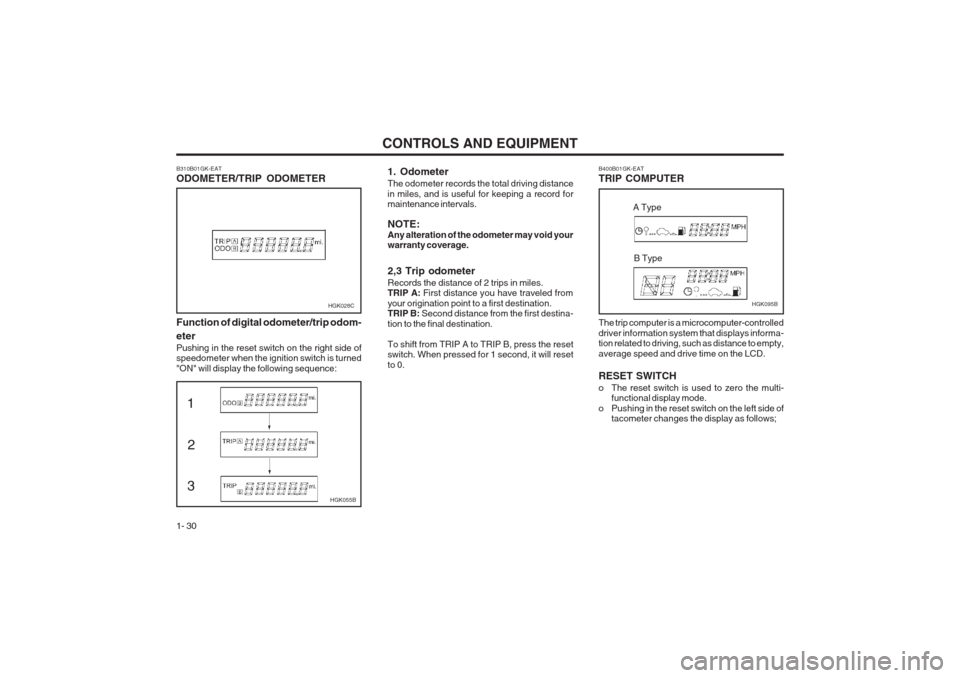
1- 30 The trip computer is a microcomputer-controlled driver information system that displays informa- tion related to driving, such as distance to empty, average speed and drive time on the LCD. RESET SWITCH
o The reset switch is used to zero the multi-
functional display mode.
o Pushing in the reset switch on the left side of tacometer changes the display as follows;
HGK095B
B400B01GK-EAT TRIP COMPUTER
A Type
B Type
1. Odometer The odometer records the total driving distance in miles, and is useful for keeping a record for maintenance intervals. NOTE: Any alteration of the odometer may void your warranty coverage. 2,3 Trip odometer Records the distance of 2 trips in miles. TRIP A:
First distance you have traveled from
your origination point to a first destination.TRIP B: Second distance from the first destina-
tion to the final destination. To shift from TRIP A to TRIP B, press the reset switch. When pressed for 1 second, it will reset to 0.
B310B01GK-EAT ODOMETER/TRIP ODOMETERHGK028C
Function of digital odometer/trip odom- eter
Pushing in the reset switch on the right side of speedometer when the ignition switch is turned "ON" will display the following sequence:
HGK055B
13 2
Page 75 of 140
DRIVING YOUR HYUNDAI 2- 1
SC000A1-E
2. DRIVING YOUR HYUNDAI
2
C010A01O-EAT
WARNING: ENGINE EXHAUST CAN BE DANGEROUS!
Engine exhaust gases are potentially lethal. If at any time engine exhaust gas is detected within the passenger compartment, move the vehicle to an open area and open all windows. o Never inhale exhaust gas. Exhaust gases contain Carbon Monoxide which is colourless and odourless. Carbon Monoxide is poisonous and can cause unconsciousness and death by asphyxiation. o Exhaust System Maintenance. Ensure that the exhaust system is maintained in good condition and is free from excessive corrosion and damage which may result in leakage. If the vehicle is driven over an object which strikes the exhaust system, ensure that the exhaust system is inspected at the first available opportunity to ensure that no leakage exists. o Confined Areas. Do not run the engine in confined spaces, allowing the engine to idle in a garage, even when the doors are open is dangerous practice. Only start the engine immediately prior to moving the vehicle out of the garage. o Prolonged Idling. If it is necessary to allow the vehicle to idle for prolonged periods, ensure that the heating system air intake control is set to the "Fresh" position, the blower is set to high speed operation and that the vehicle is standing in an open area. o Load Carrying. If it is necessary to carry long objects which do not permit the hatchback door to be fully closed, the side windows must remain closed and the heating air intake control set to the "Fresh" position with the blower running at the highest speed setting. To ensure correct operation of the heater system, the air intake grilles at the base of the windscreen must not be obstructed by snow leaves etc..
Page 77 of 140
DRIVING YOUR HYUNDAI 2- 3
SB050B1-E STEERING WHEEL LOCKWhen the key is removed, the steering column lock will be activated and will engage when the steering wheel is turned to the appropriate po- sition. It is not necessary to turn the wheel until locked each time the key is removed since in the event of any unauthorized attempt at re- moval, the lock will become effective as soon as the steering wheel is turned. To unlock the steering, insert the key and turn to the "ACC" position. If the steering is locked, it may be necessary to rock the steering wheel slightly to facilitate turning the key. Under no circum- stances should the key be forced since break- age of the key will occur.
SC060B1-E FUEL ECONOMY The following suggestions are made to assist in achieving the greatest degree of fuel economy.
o Maintaining a constant check on fuel con-
sumption will enable the most economical use pattern and driving style to be adopted.
o Avoid using the vehicle for very short jour- neys if possible, particularly when a coldstart is involved.
o Ensure that tyre pressures are maintained at the correct level.
o Use only the recommended grade of fuel.
o Avoid carrying unnecessary weight, and if a roof rack is in use, remove it as soon aspossible after use.
o Anticipate the road and conditions ahead to enable adjustments in speed to be madesmoothly. Avoid heavy acceleration and sharp braking.
o Avoid cruising at unnecessary high speeds.
o Always ensure that the periodic maintenance services are performed by a Hyundai dealer
at the time and/or mileage intervals speci- fied.
o Use the air conditioning only when neces-
sary.
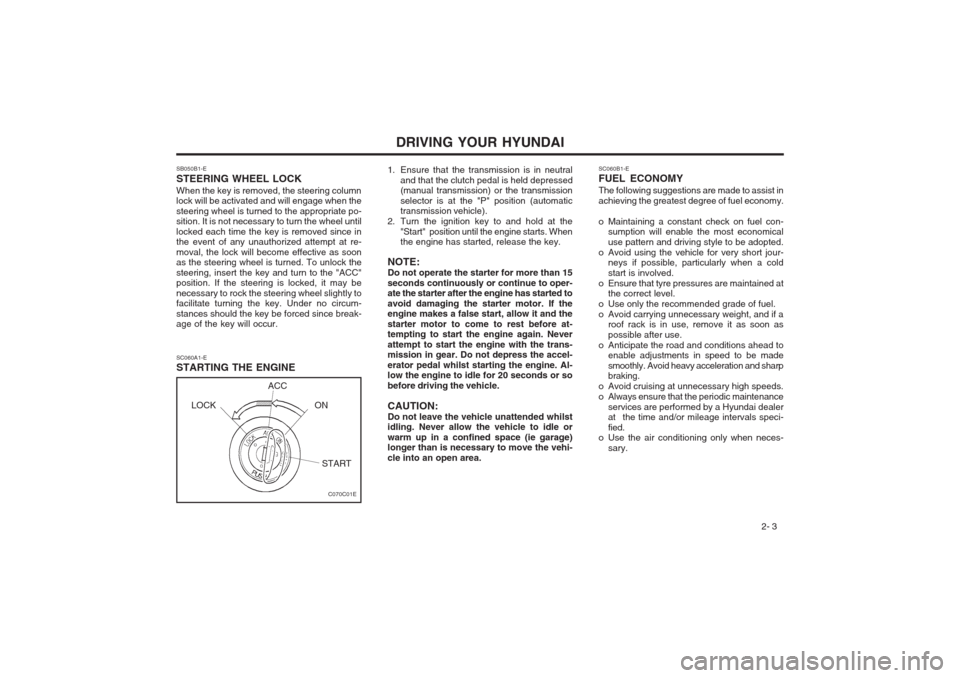
SC060A1-E STARTING THE ENGINE 1. Ensure that the transmission is in neutral
and that the clutch pedal is held depressed (manual transmission) or the transmission selector is at the "P" position (automatic transmission vehicle).
2. Turn the ignition key to and hold at the
"Start" position until the engine starts. Whenthe engine has started, release the key.
NOTE: Do not operate the starter for more than 15seconds continuously or continue to oper- ate the starter after the engine has started to avoid damaging the starter motor. If the engine makes a false start, allow it and the starter motor to come to rest before at- tempting to start the engine again. Never attempt to start the engine with the trans- mission in gear. Do not depress the accel- erator pedal whilst starting the engine. Al- low the engine to idle for 20 seconds or so before driving the vehicle. CAUTION: Do not leave the vehicle unattended whilst idling. Never allow the vehicle to idle or warm up in a confined space (ie garage) longer than is necessary to move the vehi- cle into an open area.
C070C01E
LOCK ACC
ON
START
Page 84 of 140
DRIVING YOUR HYUNDAI
2- 10
C300D01GK-GAT Indicator and WarningThe indicator should illuminate when the igni- tion key is turned to ON
or START but should
go out after three seconds. If the indicator does not illuminate, or the TCS indicator does not go out after 3 seconds, have it checked by an authorized dealer. Should there be any unusual conditions in the device, TCS-OFF either illuminates or blinks as a warning. If TCS-OFF illuminates or blinks, pull your carto a safe place and stop the engine. Then, start the engine again to check if the TCS-OFF indicator goes out. If the indicator remains lit even after the engine has been started, have your car checked by an authorized Hyundai dealer. NOTE:
1) When TCS-OFF illuminates or blinks, trac- tion control is automatically deactivatedfor safety.
3) When the engine starts, a click is heard
from the engine compartment; however, this is only the sound of traction control being checked.
4) When moving out of the mud or fresh snow, pressing the accelerator pedal maynot cause the engine speed to increase. 2) This warning function is not provided
when the driver choose the TCS-OFF mode. o Take care of your tires. Keep them inflated
to the recommended pressure. Incorrect infla-tion, either too much or too little, results in unnecessary tire wear. Check the tire pres- sures at least once a month.
o Be sure that the wheels are aligned cor-
rectly. Improper alignment can result fromhitting curbs or driving too fast over irregular surfaces. Poor alignment causes faster tire wear and may also result in other problems as well as greater fuel consumption.
o Keep your car in good condition. For better
fuel economy and reduced maintenance costs, maintain your car in accordance with the maintenance schedule in Section 5. If you drive your car in severe conditions, more frequent maintenance is required (see Section 5 for details).
o Keep your car clean. For maximum service, your car should be kept clean and free ofcorrosive materials. It is especially impor- tant that mud, dirt, ice, etc. not be allowed to accumulate on the underside of the car. This extra weight can result in increased fuel consumption and also contribute to corro- sion.
o Travel lightly. Don't carry unnecessary weight in your car. Weight is an enemy of good fueleconomy.
o Don't let the engine idle longer than neces- sary. If you are waiting (and not in traffic),turn off your engine and restart only when you're ready to go.
SC150A1-F DRIVING FOR ECONOMYYou can save fuel and get more miles from your car if you follow these suggestions:
o Drive smoothly. Accelerate at a moderate
rate. Don't make "jack-rabbit" starts or full- throttle shifts and maintain a steady cruising speed. Don't race between stoplights. Try to adjust your speed to that of the other traffic so you don't have to change speeds unnec- essarily. Avoid heavy traffic whenever possible. Al-ways maintain a safe distance from other vehicles so you can avoid unnecessary brak- ing. This also reduces brake wear.
o Drive at a moderate speed. The faster you drive, the more fuel your car uses. Driving ata moderate speed, especially on the high- way, is one of the most effective ways to reduce fuel consumption.
o Don't "ride" the brake or clutch pedal. This
can increase fuel consumption and also increase wear on these components. In ad- dition, driving with your foot resting on the brake pedal may cause the brakes to over- heat, which reduces their effectiveness and may lead to more serious consequences.
Page 97 of 140
APPEARANCE CARE 4-1
retreatment programme must be observed in accordance with the Terms and Conditions outlined in the separate Anti Perforation War- ranty Booklet. NOTE: The underbody should never be steamcleaned since the underbody coating may be removed by this process. During the interim period between powerwashing the underbody, the more vulnera- ble areas such as wheel arches should be hosed off particularly during the winter sea- son to prevent prolonged contact with road salts.Ensure that the various drain points located at the bottom of the door panels and sills are kept clear to prevent water from becom- ing trapped within the cavities. Wherever possible, the parking of the vehicle in a confined, poorly ventilated location (a ga- rage for example) should be avoided when the vehicle is wet or is covered with snow or ice. Under these conditions, the internal cavities of the vehicle will remain damp for prolonged periods of time which will en- courage corrosion. Parking the vehicle where good ventilation exists (outside for example) is preferable.
SE020A1-E PROTECTING YOUR HYUNDAI FROM CORROSION By using the most advanced design and con- struction practices, every Hyundai is built to retain the original factory finish for many years. However, long term durability is also greatly dependant upon maintaining the various protec- tion systems and coatings used in manufacture since constant, exposure to the elements will result in a breakdown and loss of effectiveness. The following suggestions are made to assist in the maintenance of the vehicle bodywork. SE030A1-E UNDERBODY COATINGSEvery Hyundai passenger car receives a full underbody and cavity injection treatment during production. In order that this treatment may retain maximum effectiveness it is recommend- ed that the underbody receives a power wash and a thorough inspection after each winter season. In so doing any accumulations of mud, which act as moisture traps and combine with road salts to accelerate corrosion will be re- moved. In order to maintain the Anti Perforation Warranty, the requirements regarding the
SE000A1-E
4. APPEARANCE
CARE
E030A01GK-AAT VALETINGRegular cleaning of the exterior paintwork serves two important functions. Firstly, the removal of abrasive dirt and contaminants will maintain the lustre of the paintwork and will prevent discolouration and dulling due to prolonged con- tact. Secondly, the presence of damage through im- pact or abrasion will be apparent allowing early rectification to be made thus preventing corro- sion from becoming established and spreading beneath the paint film. To avoid "water spotting" the vehicle should not be washed in direct sun- light particularly in the case of vehicles having dark body colours. The heat from the sun rays is absorbed by the paint film increasing the surface temperature. This action causes water used for washing to evaporate quickly leaving behind the deposits from the water and the shampoo used. Use only a shampoo intended for the purpose and ensure that the body work is thoroughly wetted to soften the dirt film prior to attempting to remove this. After removing the dirt film with a soft sponge, the body work should be thoroughly rinsed and then dried with a good quality chamois leather to prevent streaking or spotting of the paint work. Household detergents, solvents and abrasive cleaning materials should not be used in order to avoid damaging the paint film. High pressure car washes may cause water to enter your vehicle. Plastic wheel covers should be cleaned using a sponge and water. Cast alloy wheels should be cleaned using a mild soap or neutral detergent. Abrasive compounds must not be used since in the event of these damaging the lacquer coating,
4