child seat Hyundai Coupe 2003 User Guide
[x] Cancel search | Manufacturer: HYUNDAI, Model Year: 2003, Model line: Coupe, Model: Hyundai Coupe 2003Pages: 310, PDF Size: 2.87 MB
Page 165 of 310

INDEX10-1
Catalytic Converter
.................................................................... 7-1 ~ 7-2
CD Auto changer (H250, H260) .............................................. 1-70, 1-77
Child Restraint system ........................................................... 1-14 ~ 1-19
Child Seat Restraint Suitability For Seat Position ............................1-18
Cigarette Lighter ................................................................................ 1-37
Clock ................................................................................................ 1-36
Clutch Checking fluid ............................................................................... 6-13
Pedal free play ............................................................................. 6-16
Combination Light Daytime running lights .................................................................. 1-34
Headlight flasher ........................................................................... 1-34
Headlight switch ........................................................................... 1-33
High-beam switch ......................................................................... 1-34
Lane change signal ...................................................................... 1-33
Turn signal operation .................................................................... 1-33
Compact Disk Player Operation (H260) ........................................... 1-75
Cooling Fans ..................................................................................... 6-19
Corrosion Protection Cleaning the interior ....................................................................... 4-3
Protecting your Hyundai from corrosion ................ ......................... 4-1
Washing and waxing ...................................................................... 4-2
Cruise Control ................................................................................... 1-47
D Defrosting/Defogging ......................................................................... 1-54
Door
Central door lock ............................................................................ 1-5
Door locks ...................................................................................... 1-3 Locking and unlocking front door with a key ................................. 1-4
Drink Holder ...................................................................................... 1-38
Drive Belts ........................................................................................ 6-17
ZK000A1-G 10. INDEX A
Air bag ....................................................................................
1-20 ~ 1-24
Air cleaner filter ................................................................................. 6-10
Air Conditioning Care .............................................................................................. 6-14
Operation ...................................................................................... 6-14
Switch ........................................................................................... 1-55
Air filter .............................................................................................. 1-62
Antenna ............................................................................................. 1-87
Ashtray .............................................................................................. 1-37
Audio Fault Code .............................................................................. 1-79
Automatic Transaxle ........................................................................... 2-6 B Battery ...................................................................................... 2-11, 6-18
Brake Anti-lock system ............................................................................. 2-9
Checking the brakes .................................................................... 6-13
Fluid .............................................................................................. 6-13
Pedal clearance ............................................................................ 6-16
Pedal free play ............................................................................. 6-16
Practices ......................................................................................... 2-8
Breaking-In your new Hyundai ........................................................... 1-1
C Care of Cassette tapes .......................................................... 1-85 ~ 1-86
Care of Disk ...................................................................................... 1-85
Cassette Tape Player Operation (H250) ..........................................1-68
10
Page 183 of 310
CONTROLS AND EQUIPMENT1- 7
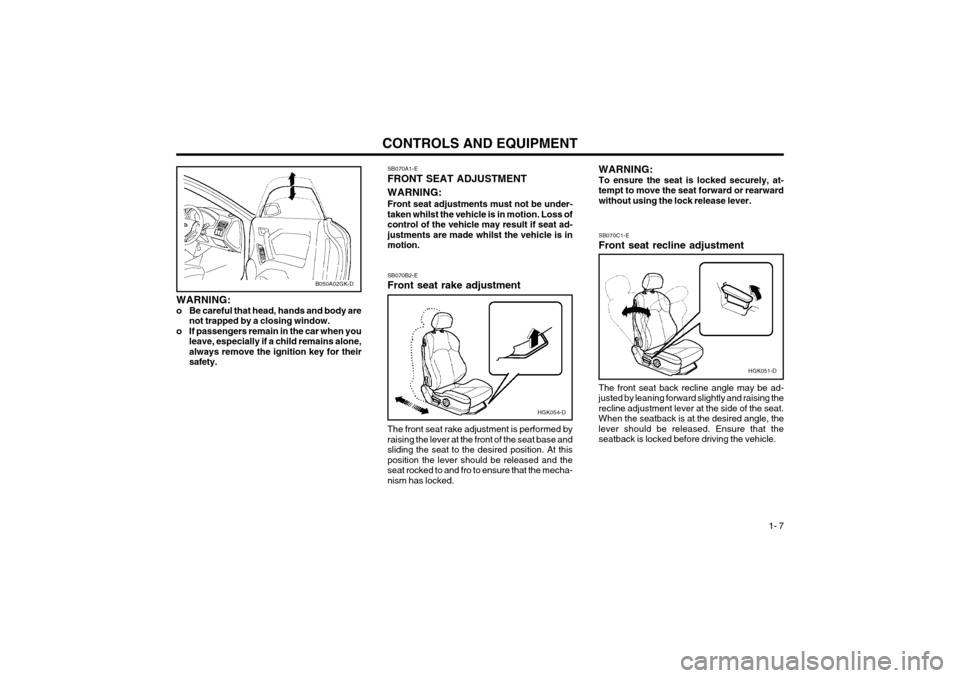
SB070A1-E FRONT SEAT ADJUSTMENT WARNING: Front seat adjustments must not be under- taken whilst the vehicle is in motion. Loss ofcontrol of the vehicle may result if seat ad-justments are made whilst the vehicle is inmotion. SB070B2-E Front seat rake adjustment The front seat rake adjustment is performed by raising the lever at the front of the seat base andsliding the seat to the desired position. At thisposition the lever should be released and theseat rocked to and fro to ensure that the mecha-nism has locked.
B050A02GK-D
WARNING:
o Be careful that head, hands and body are
not trapped by a closing window.
o If passengers remain in the car when you leave, especially if a child remains alone,always remove the ignition key for theirsafety.
HGK054-D
SB070C1-E Front seat recline adjustment The front seat back recline angle may be ad- justed by leaning forward slightly and raising therecline adjustment lever at the side of the seat.When the seatback is at the desired angle, thelever should be released. Ensure that theseatback is locked before driving the vehicle.
HGK051-D
WARNING: To ensure the seat is locked securely, at-tempt to move the seat forward or rearwardwithout using the lock release lever.
Page 187 of 310

CONTROLS AND EQUIPMENT1- 11
SB090E1-E Injured Persons A seat belt should be used when an injured person is being transported. For specific recom-mendations, the advice of a qualified MedicalPractioner should be sought.
WARNING: The folding rear seats are intended to allow the carriage of longer objects than couldotherwise be accommodated. Do not allowpassengers to sit on top of the folded-downseatback whilst the car is in motion since thefolded seat does not provide a suitable sittingfacility and no seat belts are available for use.Objects carried on the folded seatback shouldnot extend higher than the top of the frontseats and must be securely restrained toprevent injury or damage during sudden de-celeration.
SB090A1-E SEAT BELT PRECAUTIONSSeat belts should be worn at all times by all occupants front and rear. The possibility of injuryor the severity of injuries suffered in the event ofan accident will be greatly reduced by the wear-ing of seat belts.In addition the following recommendations shouldbe observed. SB090B1-E Babies/Small Children Babies and small children must be restrained using a restraint system specifically designed forthis purpose. Under no circumstances should achild be carried in the vehicle without the use ofa suitable restraint which meets the regulationsin force in the country where the vehicle is inoperation. SB090C1-E Larger Children Larger children should occupy the rear seat and be restrained at all times. The restraint may takethe form of a special safety belt or the originalfactory fitted seat belt used in conjunction with anapproved booster cushion depending upon thesize and weight of the child. Under no circum-stances should children be allowed to travelstanding, kneeling or lying on the seat.Never allow children to ride in the front passen-ger seat.SB090O1-E Pregnant WomenThe use of a seat belt is recommended for pregnant women. The seat belt should be wornas low and snugly as possible across the hips,not across the abdomen. A qualified MedicalPractitioner should be consulted for further infor-mation.
SB500A1-E REAR PARCEL SHELF Large or heavy items must not be placed upon the rear parcel shelf to prevent the possibility ofinjury arising from such items in the event ofimpact.
B140A01GK
SB090F1-E Seat Belt OccupancyThe seat belts are designed to be used by one seat occupant only. The use of a seat belt bymore than one person increases the levels ofinjury which may be sustained in the event of anaccident. SE090G1-E Do Not Lie Down To ensure that the maximum level of protection may be afforded by the seat belt system, allpassengers should be sitting in an upright posi-tion throughout the journey. The seat belt will beunable to afford maximum protection if the frontseats are at or near the fully reclined position.
Page 190 of 310

CONTROLS AND EQUIPMENT
1- 14 shoulder belt must always be positioned as low as possible on the child's hips andas snug as possible.
o If the seat belt will not properly fit the child, Hyundai recommends the use of anapproved booster seat in the rear seat inorder to raise the child's seating height sothat the seat belt will properly fit the child.
o Never allow a child to stand up or kneel on the seat.
o Never use an infant carrier or child safety seat that "hooks" over a seatback; it maynot provide adequate security in an acci-dent.
o Never allow a child to be held in a person's arms while they are in a moving vehicle, asthis could result in serious injury to thechild in the event of an accident or asudden stop. Holding a child in a movingvehicle does not provide the child withany means of protection during an acci-dent, even if the person holding the childis wearing a seat belt.
o If the child restraint seat is not anchored properly, the risk of a child being seri-ously injured or killed in a collision greatlyincreases.
WARNING:
o A child restraint system must be placed in
the rear seat. Never install a child or infantseat on the front passenger's seat.Should an accident occur and cause thepassenger side airbag to deploy, it couldseverely injure or kill an infant or childseated in an infant or child seat. Thus, onlyuse a child restraint in the rear seat of yourvehicle.
o Since a safety belt or child restraint sys- tem can become very hot if it is left in aclosed vehicle, be sure to check the seatcover and buckles before placing a childthere.
o When the child restraint system is not in use, store it in the boot or fasten it with asafety belt so that it will not be thrownforward in the case of a sudden stop or anaccident.
o Children who are too large to be in a child restraint should sit in the rear seat and berestrained with the available lap/shoulderbelts. Never allow children to ride in thefront passenger seat.
o Always make sure that the shoulder belt portion of the outboard lap/shoulder beltis positioned midway over the shoulder,never across the neck or behind the back.Moving the child closer to the center of thevehicle may help provide a good shoulderbelt fit. The lap belt portion of the lap/
B230A02GK-EAT CHILD RESTRAINT SYSTEMChildren riding in the car should sit in the rear seat and must always be properly restrained tominimize the risk of injury in an accident, suddenstop or sudden maneuver. According to accidentstatistics, children are safer when properly re-strained in the rear seats than in the front seat.Larger children not in a child restraint should useone of the seat belts provided.You are required by law to use safety restraintsfor children. If small children ride in your vehicleyou must put them in a child restraint system(safety seat).Children could be injured or killed in a crash iftheir restraints are not properly secured. Forsmall children and babies, a child seat or infantseat must be used. Before buying a particularchild restraint system, make sure it fits your carseat and seat belts, and fits your child. Follow allthe instructions provided by the manufacturerwhen installing the child restraint system.
Page 191 of 310
CONTROLS AND EQUIPMENT1- 15
B230G01A-GAT Installation on the Outboard Rear Seats
B230G01GK
On outboard rear seats
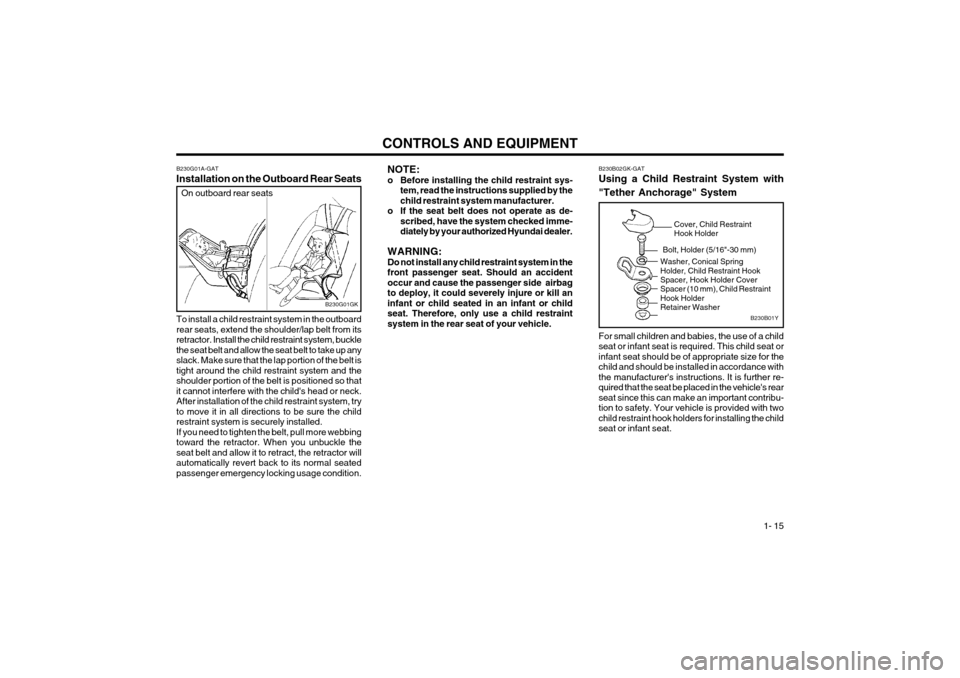
To install a child restraint system in the outboard rear seats, extend the shoulder/lap belt from itsretractor. Install the child restraint system, bucklethe seat belt and allow the seat belt to take up anyslack. Make sure that the lap portion of the belt istight around the child restraint system and theshoulder portion of the belt is positioned so thatit cannot interfere with the child's head or neck.After installation of the child restraint system, tryto move it in all directions to be sure the childrestraint system is securely installed.If you need to tighten the belt, pull more webbingtoward the retractor. When you unbuckle theseat belt and allow it to retract, the retractor willautomatically revert back to its normal seatedpassenger emergency locking usage condition. NOTE:
o Before installing the child restraint sys-
tem, read the instructions supplied by thechild restraint system manufacturer.
o If the seat belt does not operate as de- scribed, have the system checked imme-diately by your authorized Hyundai dealer.
WARNING:Do not install any child restraint system in thefront passenger seat. Should an accidentoccur and cause the passenger side airbagto deploy, it could severely injure or kill aninfant or child seated in an infant or childseat. Therefore, only use a child restraintsystem in the rear seat of your vehicle. B230B02GK-GAT Using a Child Restraint System with "Tether Anchorage" System For small children and babies, the use of a child seat or infant seat is required. This child seat orinfant seat should be of appropriate size for thechild and should be installed in accordance withthe manufacturer's instructions. It is further re-quired that the seat be placed in the vehicle's rearseat since this can make an important contribu-tion to safety. Your vehicle is provided with twochild restraint hook holders for installing the childseat or infant seat.
B230B01Y
Cover, Child Restraint Hook Holder
Bolt, Holder (5/16"-30 mm)
Washer, Conical Spring Holder, Child Restraint HookSpacer, Hook Holder Cover Spacer (10 mm), Child Restraint Hook HolderRetainer Washer
Page 192 of 310

CONTROLS AND EQUIPMENT
1- 16
B230E01GK
Back panel
Front of Vehicle
Tether strap hook
B230C02GK-GAT Securing a Child Restraint System with "Tether Anchorage" System Two child restraint hook holders are located on the vertical back panel.
Load Space Cover
1. Route the child restraint seat strap over the
seatback. For vehicles with adjustable headrests, routethe tether strap under the headrest and be-tween the headrest posts, otherwise routethe tether strap over the top of the seatback.
2. Remove the load space cover.
3. Connect the tether strap hook to the child restraint hook holder and tighten to securethe seat. B230C04A-EAT Securing a Child Restraint System with "ISOFIX" System and "Tether Anchor-age" System
B230F01GK
ISOFIX is a standardised method of fitting child seats that eliminates the need to use the stan-dard adult seat belt to secure the seat in thevehicle. This enables a much more secure andpositive location with the added benefit of easierand quicker installation. An ISOFIX-seat can only be installed if it has vehicle-specific approval in accordance with therequirements of ECE-R44. For your Hyundai,the Hyundai ISOFIX GR1 / Hyundai Duo / RömerISOFIX GR1 and the Römer Duo ISOFIX / BritaxDuo ISOFIX is approved according to the re-quirement ECE-R44. This seat has been testedextensively by Hyundai and is recommended foryour Hyundai.
Page 193 of 310
CONTROLS AND EQUIPMENT1- 17
NOTE: At present, this seat is the only one comply-ing with that provision. In case that othermanufacturers will furnish proof of a respec-tive certification, Hyundai is going to evalu-ate this seat carefully and will give a recom-mendation provided that seat complies to thelaw. Please ask your Hyundai dealer in thisrespect.
B230D02GK
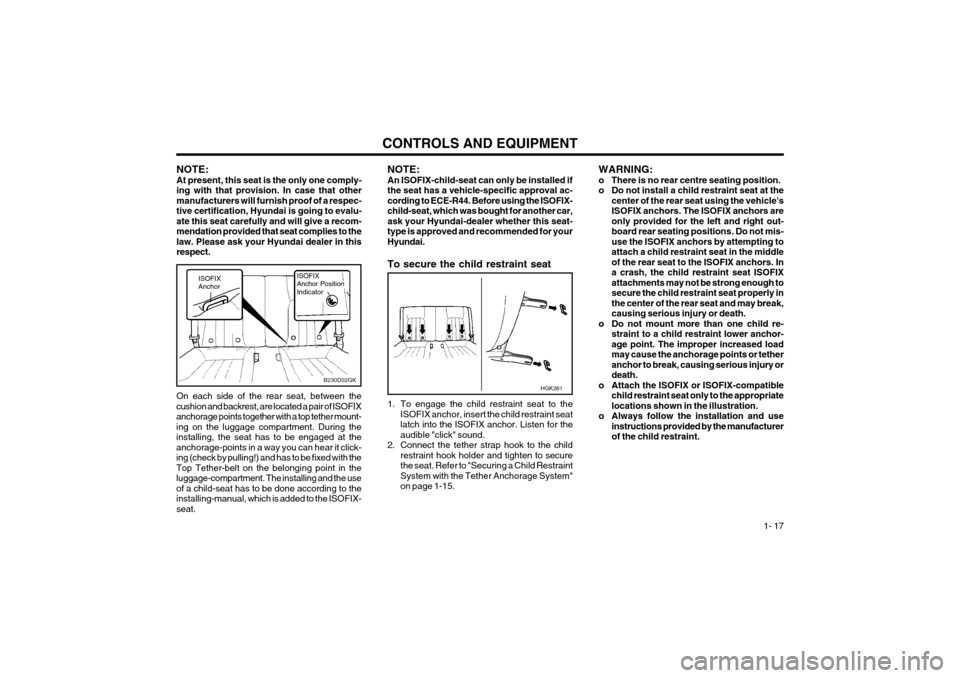
ISOFIX AnchorISOFIX Anchor
Position
Indicator
On each side of the rear seat, between the cushion and backrest, are located a pair of ISOFIXanchorage points together with a top tether mount-ing on the luggage compartment. During theinstalling, the seat has to be engaged at theanchorage-points in a way you can hear it click-ing (check by pulling!) and has to be fixed with theTop Tether-belt on the belonging point in theluggage-compartment. The installing and the useof a child-seat has to be done according to theinstalling-manual, which is added to the ISOFIX-seat. NOTE:An ISOFIX-child-seat can only be installed ifthe seat has a vehicle-specific approval ac-cording to ECE-R44. Before using the ISOFIX-child-seat, which was bought for another car,ask your Hyundai-dealer whether this seat-type is approved and recommended for yourHyundai. To secure the child restraint seat
1. To engage the child restraint seat to the
ISOFIX anchor, insert the child restraint seat latch into the ISOFIX anchor. Listen for theaudible "click" sound.
2. Connect the tether strap hook to the child restraint hook holder and tighten to securethe seat. Refer to "Securing a Child RestraintSystem with the Tether Anchorage System"on page 1-15.
HGK261 WARNING:
o There is no rear centre seating position.
o Do not install a child restraint seat at the
center of the rear seat using the vehicle'sISOFIX anchors. The ISOFIX anchors areonly provided for the left and right out-board rear seating positions. Do not mis-use the ISOFIX anchors by attempting toattach a child restraint seat in the middleof the rear seat to the ISOFIX anchors. Ina crash, the child restraint seat ISOFIXattachments may not be strong enough tosecure the child restraint seat properly inthe center of the rear seat and may break,causing serious injury or death.
o Do not mount more than one child re- straint to a child restraint lower anchor-age point. The improper increased loadmay cause the anchorage points or tetheranchor to break, causing serious injury ordeath.
o Attach the ISOFIX or ISOFIX-compatible child restraint seat only to the appropriatelocations shown in the illustration.
o Always follow the installation and use instructions provided by the manufacturerof the child restraint.
Page 194 of 310

CONTROLS AND EQUIPMENT
1- 18 B180B01GK-GAT Pre-tensioner Seat Belt (Not all models)Your Hyundai vehicle is equipped with driver's and front passenger's pre-tensioner seat belts.The purpose of the pre-tensioner is to make surethat the seat belts fit tightly against the occu-pant's body in certain frontal collisions.The pre-tensioner seat belts can be activatedalone or, where the frontal collision is severeenough, together with the airbags. When the vehicle stops suddenly, or if the occu- pant tries to lean forward too quickly, the seat beltretractor will lock into position. In certain frontal
B180B01S-D
B230H03GK-EAT Child Seat Restraint Suitability For Seat Position Use child safety seats that have been officially approved and are appropriate for your children.
Age Group
Seating Position
0 : Up to 10 kg (0 ~ 9 months)0+ : Up to 13 kg(0 ~ 2 years)I : 9kg to 18kg(9 months ~4 years)II & III : 15kg to 36kg(4 ~ 12 years)
U : Suitable for "universal" category restraints
approved for use in this mass group
UF : Suitable for forward-facing "universal" cat- egory restraints approved for use in this mass group
L1 : Suitable for "Römer ISOFIX GR1" approved for use in this mass group(Approval No: E1 R44-03301133)
X : Seat position not suitable for children in this mass group
N/A : No seating position is provided The seat belt pre-tensioner system consistsmainly of the following components. Their locations are shown in the illustration.
1. SRS airbag warning light
2. Seat belt pre-tensioner assembly
3. SRS control module WARNING: To obtain maximum benefit from a pre-tensioner seat belt:
1. The seat belt must be worn correctly.
2. The seat belt must be adjusted to the
correct position.
B180B01GK-D
Driver's side airbag
1
2
3Passenger's side airbag
N/A N/A N/A N/A
Rear
Center
Rear
Outboard
X X
L1 X
1st
Passenger
XX X X NOTE: This vehicle is equipped with thether anchor-age and ISOFIX system to supply most suit-able safety. we recommend to buy a childrestraint system to use thether anchorageand ISOFIX system.
collisions, the pre-tensioner will activate and pullthe seat belt into tighter contact against theoccupant's body.
Page 196 of 310

CONTROLS AND EQUIPMENT
1- 20
o The driver should sit back as far as pos- sible while still maintaining control of the vehicle. If you are sitting too close to theairbag, it can cause death or serious injurywhen it inflates.
o No objects should be placed over or near the airbag modules on the steering wheel,instrument panel, and the frontpassenger's panel above the glove box,because any such object could causeharm if the vehicle is in a crash severeenough to cause the airbags to inflate.
o If the airbags inflate, they must be re- placed by an authorized Hyundai dealer.
o Do not tamper with or disconnect SRS wiring, or other components of the SRSsystem. Doing so could result in injury,due to accidental firing of the airbags orby rendering the SRS inoperative.
B240A02GK
Rear impact
Side Impact Rollover
NOTE: Be sure to read information about the SRS onthe labels provided on the backside of thesun visor and in the glove box. WARNING:
o As its name implies, the SRS is designed
to work with, and be supplemental to, thedriver's and the passenger's three pointseat belt systems and is not a substitutefor them. Therefore your seat belts mustbe worn at all times while the vehicle is inmotion. In addition, the airbags deployonly in certain frontal impact conditionssevere enough to cause significant injuryto the vehicle occupants.
o The SRS is designed to deploy the airbags only when an impact is sufficiently severeand when the impact angle is less than 30°from the forward longitudinal axis of thevehicle and will not deploy in side, rear orrollover impacts. Additionally, the airbagswill only deploy once. Thus, seat beltsmust be worn at all times.
o Front airbags are not intended to deploy in light collisions in which protection canbe provided by the seat belt alone.
o Front airbags are not intended to deploy in side-impact, rear-impact or rollovercrashes. In addition, airbags will not de-ploy in frontal crashes below the deploy-ment threshold speed. o Do not install a child restraint system in the
front passenger seat position. A childrestraint system must never be placed inthe front seat. The infant or child could beseverely injured or killed by an airbagdeployment in case of an accident.
o Do not allow children to ride in the front passenger seat. If older children (teenagesand older) must ride in the front seat,make sure they are always properly beltedand that the seat is moved back as far aspossible.
o For maximum safety protection in all types of crashes, all occupants including thedriver should always wear their seat beltswhether or not an airbag is also providedat their seating position to minimize therisk of severe injury or death in the eventof a crash. Do not sit or lean unnecessarilyclose to the airbag while the vehicle is inmotion.
o The SRS airbag system must deploy very rapidly to provide protection in a crash. Ifan occupant is out of position because ofnot wearing a seat belt, the airbag mayforcefully contact the occupant causingserious or fatal injuries.
Page 199 of 310
CONTROLS AND EQUIPMENT1- 23
WARNING:
o Do not install a child restraint system in
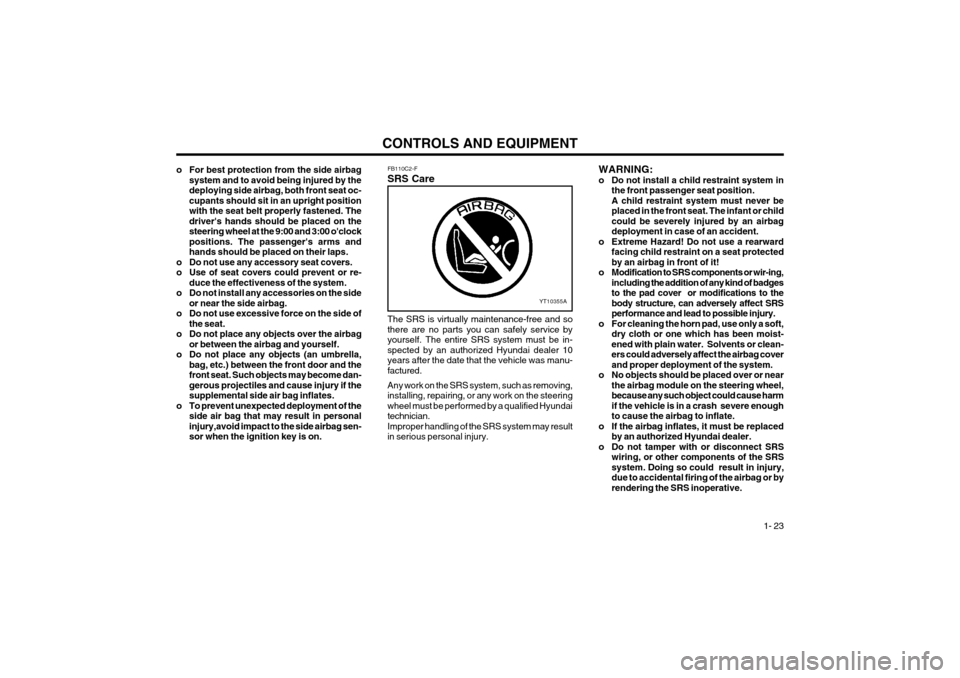
the front passenger seat position.A child restraint system must never beplaced in the front seat. The infant or childcould be severely injured by an airbagdeployment in case of an accident.
o Extreme Hazard! Do not use a rearward facing child restraint on a seat protectedby an airbag in front of it!
o Modification to SRS components or wir-ing, including the addition of any kind of badgesto the pad cover or modifications to thebody structure, can adversely affect SRSperformance and lead to possible injury.
o For cleaning the horn pad, use only a soft, dry cloth or one which has been moist-ened with plain water. Solvents or clean-ers could adversely affect the airbag coverand proper deployment of the system.
o No objects should be placed over or near the airbag module on the steering wheel,because any such object could cause harmif the vehicle is in a crash severe enoughto cause the airbag to inflate.
o If the airbag inflates, it must be replaced by an authorized Hyundai dealer.
o Do not tamper with or disconnect SRS wiring, or other components of the SRSsystem. Doing so could result in injury,due to accidental firing of the airbag or byrendering the SRS inoperative.
o For best protection from the side airbag
system and to avoid being injured by thedeploying side airbag, both front seat oc-cupants should sit in an upright positionwith the seat belt properly fastened. Thedriver's hands should be placed on thesteering wheel at the 9:00 and 3:00 o'clockpositions. The passenger's arms andhands should be placed on their laps.
o Do not use any accessory seat covers.
o Use of seat covers could prevent or re- duce the effectiveness of the system.
o Do not install any accessories on the side or near the side airbag.
o Do not use excessive force on the side of the seat.
o Do not place any objects over the airbag or between the airbag and yourself.
o Do not place any objects (an umbrella, bag, etc.) between the front door and thefront seat. Such objects may become dan-gerous projectiles and cause injury if thesupplemental side air bag inflates.
o To prevent unexpected deployment of the side air bag that may result in personalinjury,avoid impact to the side airbag sen-sor when the ignition key is on. FB110C2-F SRS Care
YT10355A
The SRS is virtually maintenance-free and so there are no parts you can safely service byyourself. The entire SRS system must be in-spected by an authorized Hyundai dealer 10years after the date that the vehicle was manu-factured. Any work on the SRS system, such as removing, installing, repairing, or any work on the steeringwheel must be performed by a qualified Hyundaitechnician.Improper handling of the SRS system may resultin serious personal injury.