seats Hyundai Coupe 2003 User Guide
[x] Cancel search | Manufacturer: HYUNDAI, Model Year: 2003, Model line: Coupe, Model: Hyundai Coupe 2003Pages: 310, PDF Size: 2.87 MB
Page 167 of 310

INDEX10-3
R Rear Seats
Before Folding the Rear Seats ..................................................... 1-10
Fold down ..................................................................................... 1-10
Rear seat entry ............................................................................. 1-10
Rear Seat Pos itions ....................................................................... 1-9
Rear Window Defroster Switch ......................................................... 1-36
Rear Window Wiper and Switch .. ..................................................... 1-35
SSeat Belts 3-Point type .................................................................................. 1-13
Adjustable height .......................................................................... 1-13
Adjusting your seat belt ................................................................ 1-13
Care of seat belts ......................................................................... 1-12
Precautions ................................................................................... 1-11
Pre-tentioner Seat Belt ................................................................. 1-18
Spark Plugs ........................................................................................ 6-8
Spectacle Case ................................................................................. 1-40
Speedometer ..................................................................................... 1-30
Starting Procedures ............................................................................ 2-3Steering Wheel Free play ...................................................................................... 6-15
Tilt lever ........................................................................................ 1-47
Stereo Radio Operation (H250, H260) ....................................1-65, 1-72
Stereo Sound System ............................................................ 1-63 ~ 1-64Sun Visor .......................................................................................... 1-46
Sunroof .............................................................................................. 1-38
TTachometer ....................................................................................... 1-30
Tail Gate ........................................................................................... 1-45
TCS (Traction control system) .......................................................... 2-10
Theft Alarm System ............................................................................ 1-5
JJump Starting
...................................................................................... 3-1
K
Keys .................................................................................................. 1-2 If you lose your keys .................................................................... 3-10
Positions ......................................................................................... 2-2
L
Light Bulb Replacement .................................................................... 6-20
Lubrication Chart ................................................................................. 9-3
Luggage Net ...................................................................................... 1-47
M Maintenance Intervals Explanation of scheduled maintenance items ....................... 5-5 ~ 5-7
Maintenance under severe usage conditions ................................. 5-4
Scheduled maintenance ................................................................. 5-2
Service requirements ...................................................................... 5-1
Map Light .......................................................................................... 1-40
Mirros Day-night inside rearview ............................................................. 1-42
Outside rearview folding ............................................................... 1-42
Outsde rearview heating .............................................................. 1-41
Multi gauge ........................................................................................ 1-32
OOdometer .......................................................................................... 1-30
PParking Brake ................................................................................... 1-43
Power Steering Fluid Level ............................................................... 6-19
Page 185 of 310
CONTROLS AND EQUIPMENT1- 9
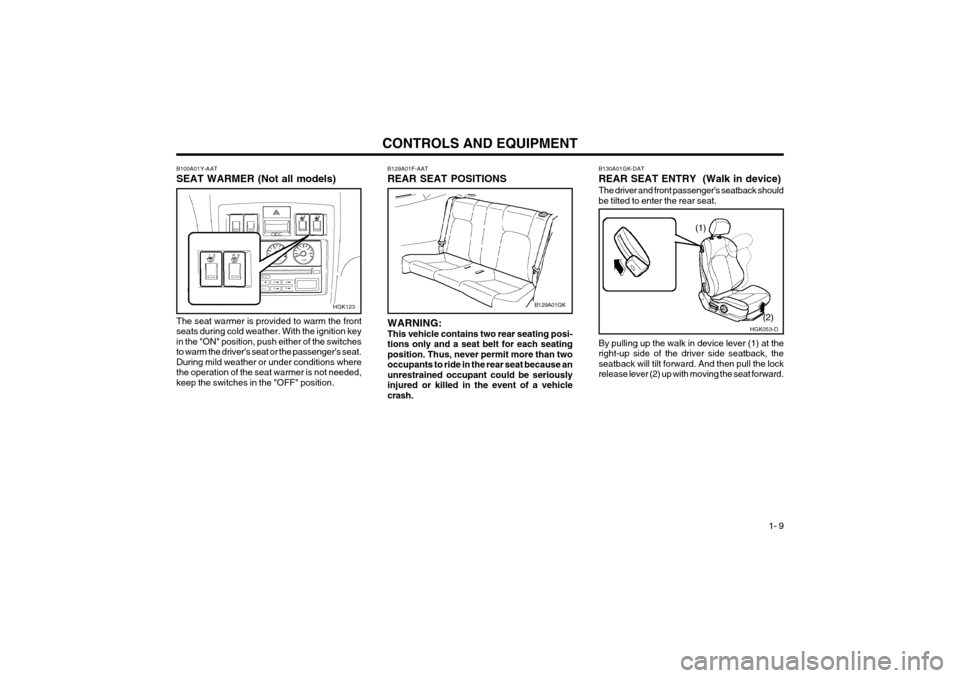
B129A01F-AAT REAR SEAT POSITIONS WARNING: This vehicle contains two rear seating posi-tions only and a seat belt for each seatingposition. Thus, never permit more than twooccupants to ride in the rear seat because anunrestrained occupant could be seriouslyinjured or killed in the event of a vehiclecrash.
B129A01GK
B100A01Y-AAT SEAT WARMER (Not all models) The seat warmer is provided to warm the front seats during cold weather. With the ignition keyin the "ON" position, push either of the switchesto warm the driver's seat or the passenger's seat.During mild weather or under conditions wherethe operation of the seat warmer is not needed,keep the switches in the "OFF" position.
HGK123
B130A01GK-DAT REAR SEAT ENTRY (Walk in device)The driver and front passenger's seatback should be tilted to enter the rear seat.
HGK053-D
(2)
(1)
By pulling up the walk in device lever (1) at the right-up side of the driver side seatback, theseatback will tilt forward. And then pull the lockrelease lever (2) up with moving the seat forward.
Page 186 of 310
CONTROLS AND EQUIPMENT
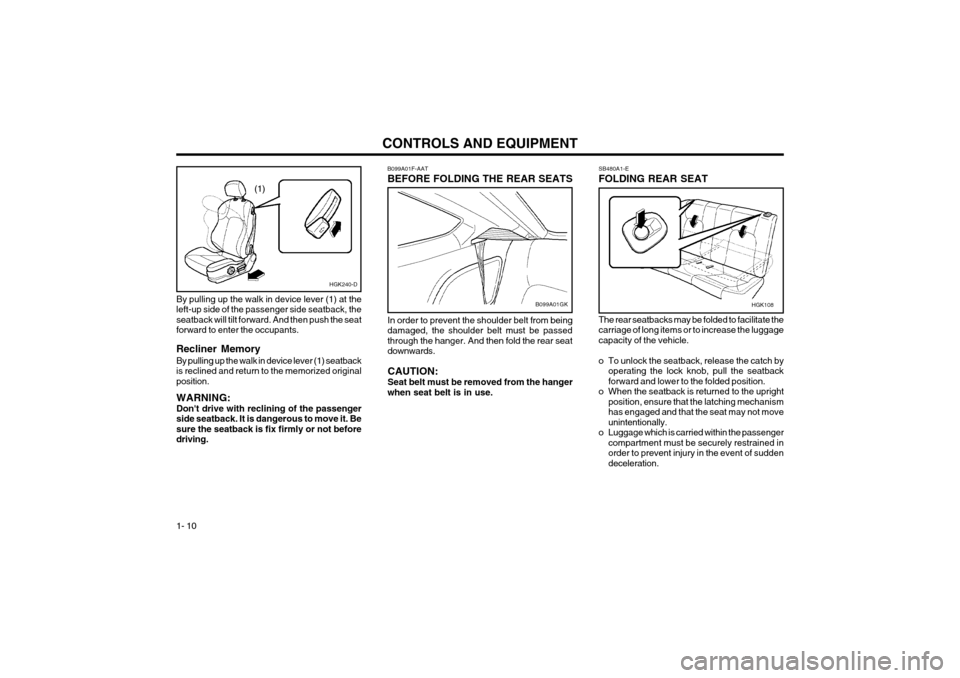
1- 10 SB480A1-E FOLDING REAR SEAT The rear seatbacks may be folded to facilitate the carriage of long items or to increase the luggagecapacity of the vehicle.
o To unlock the seatback, release the catch by
operating the lock knob, pull the seatback forward and lower to the folded position.
o When the seatback is returned to the upright position, ensure that the latching mechanismhas engaged and that the seat may not moveunintentionally.
o Luggage which is carried within the passenger compartment must be securely restrained inorder to prevent injury in the event of suddendeceleration.
HGK108
B099A01F-AAT BEFORE FOLDING THE REAR SEATS
In order to prevent the shoulder belt from being
damaged, the shoulder belt must be passed through the hanger. And then fold the rear seat downwards. CAUTION: Seat belt must be removed from the hanger
when seat belt is in use.
HGK240-D
(1)
By pulling up the walk in device lever (1) at the left-up side of the passenger side seatback, theseatback will tilt forward. And then push the seatforward to enter the occupants. Recliner Memory By pulling up the walk in device lever (1) seatback is reclined and return to the memorized originalposition. WARNING: Don't drive with reclining of the passengerside seatback. It is dangerous to move it. Besure the seatback is fix firmly or not beforedriving.
B099A01GK
Page 187 of 310

CONTROLS AND EQUIPMENT1- 11
SB090E1-E Injured Persons A seat belt should be used when an injured person is being transported. For specific recom-mendations, the advice of a qualified MedicalPractioner should be sought.
WARNING: The folding rear seats are intended to allow the carriage of longer objects than couldotherwise be accommodated. Do not allowpassengers to sit on top of the folded-downseatback whilst the car is in motion since thefolded seat does not provide a suitable sittingfacility and no seat belts are available for use.Objects carried on the folded seatback shouldnot extend higher than the top of the frontseats and must be securely restrained toprevent injury or damage during sudden de-celeration.
SB090A1-E SEAT BELT PRECAUTIONSSeat belts should be worn at all times by all occupants front and rear. The possibility of injuryor the severity of injuries suffered in the event ofan accident will be greatly reduced by the wear-ing of seat belts.In addition the following recommendations shouldbe observed. SB090B1-E Babies/Small Children Babies and small children must be restrained using a restraint system specifically designed forthis purpose. Under no circumstances should achild be carried in the vehicle without the use ofa suitable restraint which meets the regulationsin force in the country where the vehicle is inoperation. SB090C1-E Larger Children Larger children should occupy the rear seat and be restrained at all times. The restraint may takethe form of a special safety belt or the originalfactory fitted seat belt used in conjunction with anapproved booster cushion depending upon thesize and weight of the child. Under no circum-stances should children be allowed to travelstanding, kneeling or lying on the seat.Never allow children to ride in the front passen-ger seat.SB090O1-E Pregnant WomenThe use of a seat belt is recommended for pregnant women. The seat belt should be wornas low and snugly as possible across the hips,not across the abdomen. A qualified MedicalPractitioner should be consulted for further infor-mation.
SB500A1-E REAR PARCEL SHELF Large or heavy items must not be placed upon the rear parcel shelf to prevent the possibility ofinjury arising from such items in the event ofimpact.
B140A01GK
SB090F1-E Seat Belt OccupancyThe seat belts are designed to be used by one seat occupant only. The use of a seat belt bymore than one person increases the levels ofinjury which may be sustained in the event of anaccident. SE090G1-E Do Not Lie Down To ensure that the maximum level of protection may be afforded by the seat belt system, allpassengers should be sitting in an upright posi-tion throughout the journey. The seat belt will beunable to afford maximum protection if the frontseats are at or near the fully reclined position.
Page 190 of 310

CONTROLS AND EQUIPMENT
1- 14 shoulder belt must always be positioned as low as possible on the child's hips andas snug as possible.
o If the seat belt will not properly fit the child, Hyundai recommends the use of anapproved booster seat in the rear seat inorder to raise the child's seating height sothat the seat belt will properly fit the child.
o Never allow a child to stand up or kneel on the seat.
o Never use an infant carrier or child safety seat that "hooks" over a seatback; it maynot provide adequate security in an acci-dent.
o Never allow a child to be held in a person's arms while they are in a moving vehicle, asthis could result in serious injury to thechild in the event of an accident or asudden stop. Holding a child in a movingvehicle does not provide the child withany means of protection during an acci-dent, even if the person holding the childis wearing a seat belt.
o If the child restraint seat is not anchored properly, the risk of a child being seri-ously injured or killed in a collision greatlyincreases.
WARNING:
o A child restraint system must be placed in
the rear seat. Never install a child or infantseat on the front passenger's seat.Should an accident occur and cause thepassenger side airbag to deploy, it couldseverely injure or kill an infant or childseated in an infant or child seat. Thus, onlyuse a child restraint in the rear seat of yourvehicle.
o Since a safety belt or child restraint sys- tem can become very hot if it is left in aclosed vehicle, be sure to check the seatcover and buckles before placing a childthere.
o When the child restraint system is not in use, store it in the boot or fasten it with asafety belt so that it will not be thrownforward in the case of a sudden stop or anaccident.
o Children who are too large to be in a child restraint should sit in the rear seat and berestrained with the available lap/shoulderbelts. Never allow children to ride in thefront passenger seat.
o Always make sure that the shoulder belt portion of the outboard lap/shoulder beltis positioned midway over the shoulder,never across the neck or behind the back.Moving the child closer to the center of thevehicle may help provide a good shoulderbelt fit. The lap belt portion of the lap/
B230A02GK-EAT CHILD RESTRAINT SYSTEMChildren riding in the car should sit in the rear seat and must always be properly restrained tominimize the risk of injury in an accident, suddenstop or sudden maneuver. According to accidentstatistics, children are safer when properly re-strained in the rear seats than in the front seat.Larger children not in a child restraint should useone of the seat belts provided.You are required by law to use safety restraintsfor children. If small children ride in your vehicleyou must put them in a child restraint system(safety seat).Children could be injured or killed in a crash iftheir restraints are not properly secured. Forsmall children and babies, a child seat or infantseat must be used. Before buying a particularchild restraint system, make sure it fits your carseat and seat belts, and fits your child. Follow allthe instructions provided by the manufacturerwhen installing the child restraint system.
Page 191 of 310
CONTROLS AND EQUIPMENT1- 15
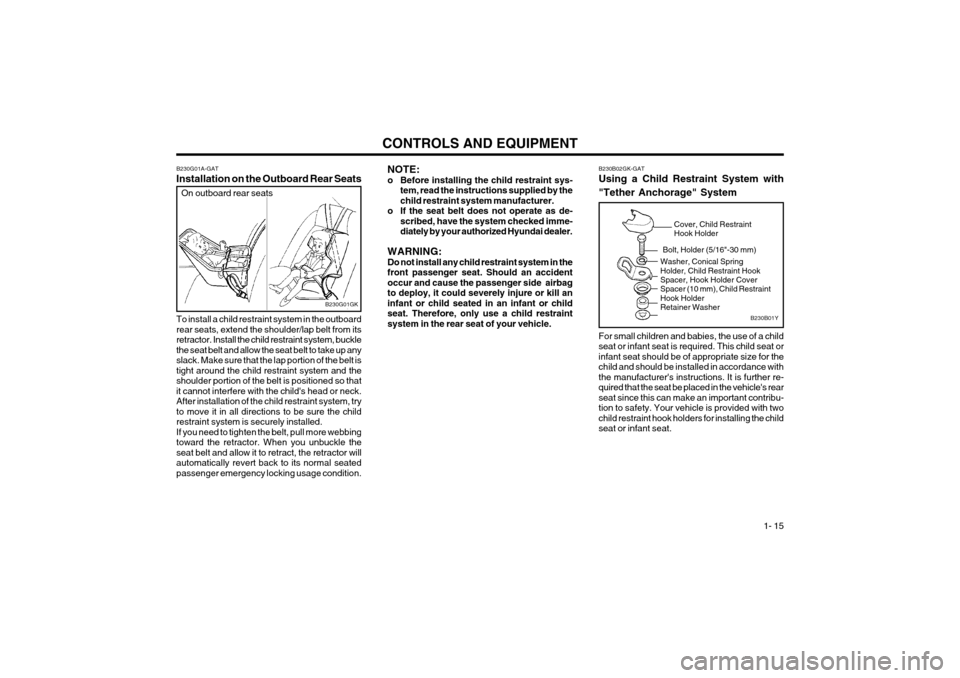
B230G01A-GAT Installation on the Outboard Rear Seats
B230G01GK
On outboard rear seats
To install a child restraint system in the outboard rear seats, extend the shoulder/lap belt from itsretractor. Install the child restraint system, bucklethe seat belt and allow the seat belt to take up anyslack. Make sure that the lap portion of the belt istight around the child restraint system and theshoulder portion of the belt is positioned so thatit cannot interfere with the child's head or neck.After installation of the child restraint system, tryto move it in all directions to be sure the childrestraint system is securely installed.If you need to tighten the belt, pull more webbingtoward the retractor. When you unbuckle theseat belt and allow it to retract, the retractor willautomatically revert back to its normal seatedpassenger emergency locking usage condition. NOTE:
o Before installing the child restraint sys-
tem, read the instructions supplied by thechild restraint system manufacturer.
o If the seat belt does not operate as de- scribed, have the system checked imme-diately by your authorized Hyundai dealer.
WARNING:Do not install any child restraint system in thefront passenger seat. Should an accidentoccur and cause the passenger side airbagto deploy, it could severely injure or kill aninfant or child seated in an infant or childseat. Therefore, only use a child restraintsystem in the rear seat of your vehicle. B230B02GK-GAT Using a Child Restraint System with "Tether Anchorage" System For small children and babies, the use of a child seat or infant seat is required. This child seat orinfant seat should be of appropriate size for thechild and should be installed in accordance withthe manufacturer's instructions. It is further re-quired that the seat be placed in the vehicle's rearseat since this can make an important contribu-tion to safety. Your vehicle is provided with twochild restraint hook holders for installing the childseat or infant seat.
B230B01Y
Cover, Child Restraint Hook Holder
Bolt, Holder (5/16"-30 mm)
Washer, Conical Spring Holder, Child Restraint HookSpacer, Hook Holder Cover Spacer (10 mm), Child Restraint Hook HolderRetainer Washer
Page 192 of 310

CONTROLS AND EQUIPMENT
1- 16
B230E01GK
Back panel
Front of Vehicle
Tether strap hook
B230C02GK-GAT Securing a Child Restraint System with "Tether Anchorage" System Two child restraint hook holders are located on the vertical back panel.
Load Space Cover
1. Route the child restraint seat strap over the
seatback. For vehicles with adjustable headrests, routethe tether strap under the headrest and be-tween the headrest posts, otherwise routethe tether strap over the top of the seatback.
2. Remove the load space cover.
3. Connect the tether strap hook to the child restraint hook holder and tighten to securethe seat. B230C04A-EAT Securing a Child Restraint System with "ISOFIX" System and "Tether Anchor-age" System
B230F01GK
ISOFIX is a standardised method of fitting child seats that eliminates the need to use the stan-dard adult seat belt to secure the seat in thevehicle. This enables a much more secure andpositive location with the added benefit of easierand quicker installation. An ISOFIX-seat can only be installed if it has vehicle-specific approval in accordance with therequirements of ECE-R44. For your Hyundai,the Hyundai ISOFIX GR1 / Hyundai Duo / RömerISOFIX GR1 and the Römer Duo ISOFIX / BritaxDuo ISOFIX is approved according to the re-quirement ECE-R44. This seat has been testedextensively by Hyundai and is recommended foryour Hyundai.
Page 194 of 310

CONTROLS AND EQUIPMENT
1- 18 B180B01GK-GAT Pre-tensioner Seat Belt (Not all models)Your Hyundai vehicle is equipped with driver's and front passenger's pre-tensioner seat belts.The purpose of the pre-tensioner is to make surethat the seat belts fit tightly against the occu-pant's body in certain frontal collisions.The pre-tensioner seat belts can be activatedalone or, where the frontal collision is severeenough, together with the airbags. When the vehicle stops suddenly, or if the occu- pant tries to lean forward too quickly, the seat beltretractor will lock into position. In certain frontal
B180B01S-D
B230H03GK-EAT Child Seat Restraint Suitability For Seat Position Use child safety seats that have been officially approved and are appropriate for your children.
Age Group
Seating Position
0 : Up to 10 kg (0 ~ 9 months)0+ : Up to 13 kg(0 ~ 2 years)I : 9kg to 18kg(9 months ~4 years)II & III : 15kg to 36kg(4 ~ 12 years)
U : Suitable for "universal" category restraints
approved for use in this mass group
UF : Suitable for forward-facing "universal" cat- egory restraints approved for use in this mass group
L1 : Suitable for "Römer ISOFIX GR1" approved for use in this mass group(Approval No: E1 R44-03301133)
X : Seat position not suitable for children in this mass group
N/A : No seating position is provided The seat belt pre-tensioner system consistsmainly of the following components. Their locations are shown in the illustration.
1. SRS airbag warning light
2. Seat belt pre-tensioner assembly
3. SRS control module WARNING: To obtain maximum benefit from a pre-tensioner seat belt:
1. The seat belt must be worn correctly.
2. The seat belt must be adjusted to the
correct position.
B180B01GK-D
Driver's side airbag
1
2
3Passenger's side airbag
N/A N/A N/A N/A
Rear
Center
Rear
Outboard
X X
L1 X
1st
Passenger
XX X X NOTE: This vehicle is equipped with thether anchor-age and ISOFIX system to supply most suit-able safety. we recommend to buy a childrestraint system to use thether anchorageand ISOFIX system.
collisions, the pre-tensioner will activate and pullthe seat belt into tighter contact against theoccupant's body.
Page 307 of 310

INDEX10-1
C CARE OF CAS
SETTE TAPE ........................................................... 1-65
CARE OF DISC ................................................................................ 1-65
CARE OF SEAT BELTS .................................................................. 1-12
CATALYTIC CONVERTOR OPERATING PRECAUTIONS .......7-1~7-2
CENTRAL DOOR LOCK .................................................................... 1-4
CHANGING A FLAT TYPE ................................................................ 3-3
CHECKING THE CLUTCH FLUID ................................................... 6-13
CHILD RESTRAINT SYSTEM ......................................................... 1-14
CIGAR LIGHTER .............................................................................. 1-37
CLUTCH PEDAL FREEPLAY .......................................................... 6-15
COMBINATION IGNITION SWITCH AND STEERING LOCK .......... 2-2
CRUISE CONTROL ......................................................................... 1-49
D DAILY OPERATING CHECKS ........................................................... 6-4
DEFROSTING/DEFOGGING ........................................................... 1-55
DIGITAL CLOCK .............................................................................. 1-37
DOOR LOCKS .................................................................................... 1-2 DOOR WINDOWS .............................................................................. 1-6
DRINK HOLDER .............................................................................. 1-38
DRIVE BELTS .................................................................................. 6-16
DRIVING FOR ECONOMY .............................................................. 2-10
JK000A2-EAT 10. INDEX
A AIR BAG ........................................................................................... 1-19
AIR CONDITIONING SWITCH ......................................................... 1-56
AIR CONDITIONING SYSTEM MAINTENANCE ............................6-13
AIR CLEANER ELEMENT REPLACEMENT ..................................... 6-9
AIR CONDITIONER FILTER ............................................................ 1-62
ANTENNA ......................................................................................... 1-67
ANTI-LOCK BRAKE SYSTEM ........................................................... 2-8
AUTOMATIC TRANSMISSION FLUID ............................................. 6-11
AUTOMATIC TRANSMISSION .......................................................... 2-5
BBATTERY MAINTENANCE .............................................................. 6-17
BEFORE FOLDING THE REAR SEATS ......................................... 1-10
BEFORE STARTING THE ENGINE .................................................. 2-2
BONNET RELEASE ......................................................................... 1-45
BRAKE PEDAL FREEPLAY ............................................................. 6-16
BRAKE SYSTEM CHECKING ......................................................... 6-12
10