warning lights Hyundai Coupe 2003 Owner's Guide
[x] Cancel search | Manufacturer: HYUNDAI, Model Year: 2003, Model line: Coupe, Model: Hyundai Coupe 2003Pages: 310, PDF Size: 2.87 MB
Page 253 of 310

DRIVING YOUR HYUNDAI
2- 10 C310D01O-AAT
Indicators and Warning The indicators should illuminate when the igni-
tion key is turned to ON or START but should go out after three seconds.
If the indicators do not illuminate, or the TCS or
TCS-OFF indicator does not go out after 3seconds, have it checked by an authorizeddealer.
Should there be any unusual conditions in the
device while driving, TCS-OFF indicator illumi-nates as a warning.
If TCS-OFF indicator illuminates, pull your car
to a safe place and stop the engine. Then, start the engine again to check if the
TCS-OFF indicator goes out.
If the indicator remains lit even after the engine
has been started, have your car checked by anauthorized Hyundai dealer. effect of brake control and indicates noth-ing unusual.
3) When the engine starts, a click is heard from the engine compartment; however,this is only the sound of traction controlbeing checked.
4) When moving out of the mud or fresh snow, pressing the accelerator pedal maynot cause the engine speed to increasedue to TCS operation. NOTE:
1) When the TCS-OFF indicator illuminates,
traction control is automatically deacti- vated for safety.
2) This warning function is not provided when the driver selects the TCS-OFFmode.
SC150A1-F DRIVING FOR ECONOMY You can save fuel and get more miles from your car if you follow these suggestions:
o Drive smoothly. Accelerate at a moderate rate. Don't make "jack-rabbit" starts or full- throttle shifts and maintain a steady cruisingspeed. Don't race between stoplights. Try toadjust your speed to that of the other trafficso you don't have to change speeds unnec-essarily. Avoid heavy traffic whenever possible. Al- ways maintain a safe distance from othervehicles so you can avoid unnecessary brak-ing. This also reduces brake wear.
o Drive at a moderate speed. The faster you drive, the more fuel your car uses. Driving ata moderate speed, especially on the high-way, is one of the most effective ways toreduce fuel consumption.
o Don't "ride" the brake or clutch pedal. This can increase fuel consumption and alsoincrease wear on these components. In ad-dition, driving with your foot resting on thebrake pedal may cause the brakes to over-
C310B01O-AAT
TCS ON/OFF Mode When the TCS is running, the TCS indicator
light in the instrument cluster will blink. If you turn the system off by pressing the TCS
switch, the TCS-OFF indicator light will comeon and stay on. In the TCS-OFF mode, theSLIP control will be deactivated. Adjust youdriving accordingly. To turn the system backon, press the switch again. The TCS-OFF indi-cator light should go off.
NOTE:
1) The TCS mode will automatically be turned ON after the engine is turned offand restarted.
2) When the traction control system is op- erating properly, you can feel a slightpulsation in the vehicle. This is only the
CAUTION: When the TCS indicator blinks, SLIP control
has been activated. It also means that the road is slippery or your car is acceleratingexcessively. In this situation, gently releasefoot pressure from the accelerator pedaland maintain moderate speed.
WARNING: Traction control is only a driving aid; all
normal precautions for driving in inclement weather and on slippery road surfacesshould be observed.
Page 260 of 310

IN CASE OF EMERGENCY
3-2 4. Check to see if the water pump drive belt is
missing. If it is not missing, check to see that it is tight. If the drive belt seems to be satisfac-tory, check for coolant leaking from the radia-tor, hoses or under the car. (If the air condi-tioning had been in use, it is normal for coldwater to be draining from it).
WARNING:Whilst the engine is running, keep hands andclothing away from moving parts such as thefan and drive belts to prevent injury.
5. If the water pump drive belt is broken or coolant is leaking out, stop the engine imme- diately and call the nearest Hyundai dealerfor assistance.
WARNING:Do not remove the radiator cap when theengine is hot since steam and boiling watermay be ejected from the radiator resulting inburns or scalding.
6. If the cause of the overheating cannot be found, wait until the engine temperature has returned to normal. Then, if coolant has beenlost, carefully remove the radiator cap andadd water to bring the fluid level in the reser-voir up to the base of the radiator fill opening.Fill the coolant expansion tank to the halfwaymark.
WARNING:Motor vehicle batteries contain sulphuric acidand emit hydrogen gas. Protective clothingshould be worn and care exercised to preventthe acid from coming into contact with skin orclothing and the vehicle. Naked lights shouldnot be permitted in the vicinity of the battery.Care should be exercised to prevent sparksoccurring during connection. If acid acciden-tally comes into contact with skin or eyes, theaffected area should immediately be flushedwith copious amounts of water and medicalassistance sought.
1. Ensure that the booster battery is 12 volt type.
If the booster battery is installed in another vehicle, ensure that the two vehicles are nottouching.
2. Turn off all unnecessary electrical equipment in both vehicles.
3. Ensure that the engine of the vehicle provid- ing the jump start is running prior to connec-tion of the jump cables.
4. Connect the red jump cable to the positive (+) terminal of the booster battery and the otherend to the positive (+) terminal of the dis-charged battery.
5. Attach the black jump cable to the negative (-) terminal of the booster battery, and theother end to a ground point within the enginecompartment of the vehicle with the flat bat-tery. Do not connect to the negative batteryterminal of the flat battery since sparks maybe generated with the subsequent risk ofexplosion. 6. Raise the booster vehicle engine speed to
2,000 r.p.m. and start the engine of the vehi-cle with the flat battery.
7. Remove jump cables in the reverse order of installation (black cable first).
CAUTION:If the jump cable is incorrectly installed, dam-age to the vehicle electrical system may oc-cur, in particular the electronic componentssuch as the Fuel Injection system computerand the Automatic Transaxle computer. Thebattery must never be disconnected whilstthe engine is running. SD040A1-E IF THE ENGINE OVERHEATSIf the temperature gauge indicates overheating:
1. Pull off the road and stop as soon as it is safe to do so.
2. Place the gear selector lever in "P" (auto- matic), or neutral (manual transaxle) and set the parking brake. If the air conditioning is on,turn it off.
3. If coolant is running out under the car or steam is coming out from under the bonnetstop the engine. Do not open the bonnet untilthe coolant has stopped running or the steam-ing has stopped. If there is no visible loss ofcoolant and no steam, leave the engine run-ning and check to be sure the engine coolingfan is operating.If the fan is not running, turn the engine off.
Page 292 of 310

OWNER MAINTENANCE 6-17
SG200B2-E INDIVIDUAL CIRCUIT FUSES The fuse box containing the individual circuit fuses is located on the lower portion of thedashboard adjacent to the bonnet release. Thefuse box cover is removed by pushing lightly andthen releasing the lid. A fuse rating grid will befound on the reverse side of the cover. In theevent of fuse failure, the fuse should be replacedwith one of equivalent rating. A fuse removal toolis provided within the fuse box to facilitate re-placement.In the event of a replacement fuse failing shortlyafter installation a malfunction within the circuitprotected by that fuse is indicated. The circuitshould be checked by a Hyundai dealer at thefirst available opportunity.
AXA6201B
WARNING: The use of replacement fuses having a higherrating than specified or other means of con-necting the circuit will create a potential firehazard. NOTE: See page 6-22 for the fuse panel descriptions. SG210A1-E BATTERY MAINTENANCE WARNING: Motor vehicle batteries contain sulphuric acid which is corrosive and poisonous. Hydrogengas is emitted from the battery which is ex-plosive when combined with oxygen. Thefollowing precautions must be strictly ob-served to avoid personal injury or damage tothe vehicle.
HGK185-D
SG220A1-E ELECTRIC COOLING FANS WARNING: The cooling fan is controlled by engine cool-ant temperature and may sometimes operateeven when the engine is not running. Useextreme caution when working near the bladesof the cooling fan so that you are not injuredby a rotating fan blade. As the engine coolanttemperature decreases, the fan will automati-cally shut off. This is a normal condition.
o If battery electrolyte is spilled onto skin or into
eyes, the effected area must be flushed withcopious amounts of water and medical assis-tance sought.
o If battery electrolyte is ingested, copious amounts of water or milk followed by an ant-acid (raw egg or milk of magnesia) must bedrunk. Vomiting should not be induced andmedical assistance must be sought.
o Batteries must only be charged in well venti- lated areas from which naked lights or sourcesof sparks are excluded.
o Ensure that children, pets or other unautho- rized persons are kept away from batteries.
o Do not allow anything to bridge the positive (+) and negative (-) terminals of the battery.
o Never invert the battery. The battery fitted during production is of the "Maintenance Free" type.
Page 294 of 310
OWNER MAINTENANCE 6-19
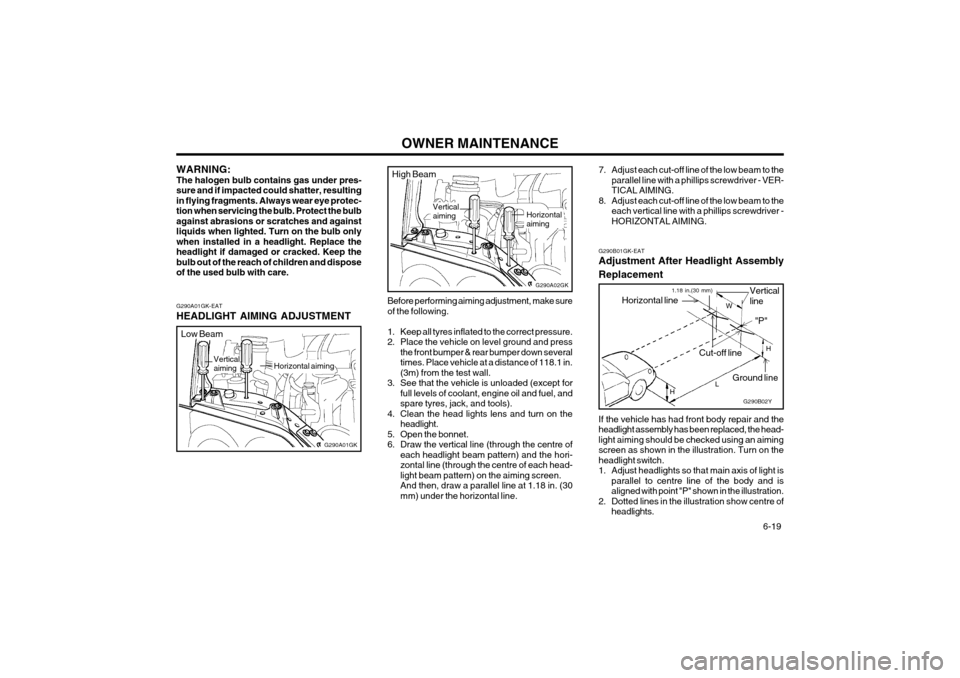
G290A01GK-EAT HEADLIGHT AIMING ADJUSTMENT
Before performing aiming adjustment, make sure of the following.
1. Keep all tyres inflated to the correct pressure.
2. Place the vehicle on level ground and press
the front bumper & rear bumper down severaltimes. Place vehicle at a distance of 118.1 in.(3m) from the test wall.
3. See that the vehicle is unloaded (except for full levels of coolant, engine oil and fuel, andspare tyres, jack, and tools).
4. Clean the head lights lens and turn on the headlight.
5. Open the bonnet.
6. Draw the vertical line (through the centre of each headlight beam pattern) and the hori-zontal line (through the centre of each head-light beam pattern) on the aiming screen.And then, draw a parallel line at 1.18 in. (30mm) under the horizontal line.
WARNING:The halogen bulb contains gas under pres-sure and if impacted could shatter, resultingin flying fragments. Always wear eye protec-tion when servicing the bulb. Protect the bulbagainst abrasions or scratches and againstliquids when lighted. Turn on the bulb onlywhen installed in a headlight. Replace theheadlight if damaged or cracked. Keep thebulb out of the reach of children and disposeof the used bulb with care.
Vertical aiming
G290A01GK
Horizontal aiming
Low Beam
Vertical aiming
G290A02GK
Horizontal aiming
High Beam
7. Adjust each cut-off line of the low beam to the
parallel line with a phillips screwdriver - VER- TICAL AIMING.
8. Adjust each cut-off line of the low beam to the each vertical line with a phillips screwdriver -HORIZONTAL AIMING.
G290B01GK-EAT Adjustment After Headlight Assembly Replacement
G290B02Y
Vertical line
Cut-off line Ground line
Horizontal line
LW
H
H "P"1.18 in.(30 mm)
If the vehicle has had front body repair and the headlight assembly has been replaced, the head-light aiming should be checked using an aimingscreen as shown in the illustration. Turn on theheadlight switch.
1. Adjust headlights so that main axis of light is parallel to centre line of the body and isaligned with point "P" shown in the illustration.
2. Dotted lines in the illustration show centre of headlights.