engine cover Hyundai Coupe 2004 User Guide
[x] Cancel search | Manufacturer: HYUNDAI, Model Year: 2004, Model line: Coupe, Model: Hyundai Coupe 2004Pages: 389, PDF Size: 10.22 MB
Page 126 of 389

VEHICLE MAINTENANCE REQUIREMENTS 5-1
F010C01A-GAT
Specified Scheduled Procedures
These are the procedures such as inspections,
adjustments and replacements that are listed in the maintenance charts starting on page 5-2.These procedures must be performed at theintervals shown in the maintenance schedule toassure that your warranty remains in effect.Although it is strongly recommended that theybe performed by the factory-trained or distribu-tor-trained technicians at your Hyundai dealer,these procedures may be performed at anyqualified service facility.
It is suggested that genuine Hyundai service
parts be used for any required repairs or re-placements. Other parts of equivalent qualitysuch as engine oil, engine coolant, manual orauto transaxle oil, brake fluid and so on which
are not supplied by Hyundai Motor Company or
its distributor may be used without affectingyour warranty coverage but you should alwaysbe sure these are equivalent to the quality of theoriginal Hyundai parts. Your Service Passportprovides further information about your warran-ty coverage.
5. VEHICLE
MAINTENANCE REQUIREMENTS F010E01A-AAT
Do-It-Yourself Maintenance If you are mechanically inclined, own a few tools that are required and want to take the time to do so, you can inspect and service a number of items. For more information about doing it your-self, see Section 6.
F010D01A-AAT
General Checks These are the regular checks you should per-
form when you drive your Hyundai or you fill the fuel tank. A list of these items will be found onpage 6-4.
F010A01A-GAT
MAINTENANCE INTERVALS Service Requirements To assure that you receive the greatest number
of kilometers of satisfying operation from your Hyundai, certain maintenance procedures mustbe performed. Although careful design and en-gineering have reduced these to a minimum,those that are required are of the utmost impor-tance.
It is your responsibility to have these mainte-
nance procedures performed to comply with theterms of the warranties covering your newHyundai. The Service Passport supplied withyour new vehicle provides further informationabout these warranties.
F010B01A-AAT
Maintenance Requirements The maintenance required for your Hyundai can be divided into three main areas: o Specified scheduled procedures o General checkso Do-it-yourself maintenance F010F01A-AAT
A Few Tips
o Whenever you have your Hyundai serviced, keep copies of the service records in your glovebox. This will help ensure that you candocument that the required procedures havebeen performed to keep your warranties ineffect. This is especially important when service is not performed by an authorized Hyundai dealer.
o If you choose to do your own maintenance and repairs, you may find it helpful to havean official Hyundai Shop Manual. A copy of this publication may be purchased at your Hyundai dealer's parts department.
F020A02A-GAT
SCHEDULED MAINTENANCE RE- QUIREMENTS Inspection should be performed any time a
malfunction is experienced or suspected. Re- ceipts for all emission control system servicesshould be retained to demonstrate compliance with conditions of the emissions system war- ranty.
For severe usage maintenance requirements,
see page 5-4 of this section.
5
Page 133 of 389

DO-IT-YOURSELF MAINTENANCE 6-1
6. DO-IT-YOURSELF MAINTENANCE G010A01GK-GAT ENGINE COMPARTMENT (1.6 DOHC)
CAUTION: When inspecting or servicing the engine,
you should handle tools and other heavy objects carefully so that the plastic rockercover of the engine is not damaged.
6
1. Engine oil filler cap
2. Brake Booster
3. Brake fluid reservoir
4. Clutch fluid reservoir (If installed)
5. Relay box 6. Windshield washer fluid reservoir cap
7. Power steering fluid reservoir
8. Engine coolant reservoir
9. Engine oil level dipstick
10. Radiator cap
11. Automatic transaxle fluid level dipstick
(If installed)
12. Air cleaner
13. Battery HGK238
1
23 4 5
6 7 8 9 10 11 12 13
Page 134 of 389

DO-IT-YOURSELF MAINTENANCE
6-2 G010A01GK-AAT ENGINE COMPARTMENT (2.0 DOHC CVVT)
1. Engine oil filler cap
2. Brake Booster
3. Brake fluid reservoir
4. Clutch fluid reservoir (If installed)
5. Relay box 6. Windshield washer fluid reservoir cap
7. Power steering fluid reservoir
8. Engine coolant reservoir
9. Engine oil level dipstick
10. Radiator cap
11. Automatic transaxle fluid level dipstick
(If installed)
12. Air cleaner
13. Battery
1
HGK059
2
6 34
5
78 9 1 0 11 1213 CAUTION: When inspecting or servicing the engine, you should handle tools and other heavyobjects carefully so that the plastic rockercover of the engine is not damaged.
Page 135 of 389

DO-IT-YOURSELF MAINTENANCE 6-3
G010B01GK-GAT ENGINE COMPARTMENT (2.7 V6)1
HGK209
2
6 3
4
5
78 9 10 11 12
1. Power steering fluid reservoir
2. Brake Booster
3. Brake fluid reservoir
4. Air filter element 5. Relay box
6. Windshield washer fluid reservoir cap
7. Engine coolant reservoir
8. Engine oil level dipstick 9. Radiator cap
10. Engine oil filler cap
11. Automatic transaxle fluid level dipstick
(If installed)
12. Battery CAUTION:When inspecting or servicing the engine,
you should handle tools and other heavy objects carefully so that the plastic rockercover of the engine is not damaged.
Page 141 of 389

DO-IT-YOURSELF MAINTENANCE 6-9
G060A02Y-GAT
SPARK PLUGS
YN60100A
V6
Your engine was originally equipped with plati- num-tipped spark plugs. (For 2.7L only). Platinum-tipped spark plugs will last longer than conventional type spark plugs and can be iden-tified by blue lines on the ceramic shell. NOTE: Do not clean or regap platinum-tipped spark plugs. G060B01GK-GAT
Replacing the Spark Plugs
The spark plugs should be changed at the
intervals specified in the vehicle maintenanceschedule in Section 5 or whenever engine per-formance indicates they should be changed.Symptoms that suggest poor spark plug perfor-mance include engine misfiring under load, lossof fuel economy, poor acceleration, etc. Whenspark plugs are replaced, always use sparkplugs recommended by Hyundai. The use ofother spark plugs can result in loss of perfor-mance, radio interference or engine damage.
NOTE: When replacing the spark plugs, genuine
Hyundai replacement parts are recom- mended. Recommended Spark Plugs:
Type
RC10YC4(CHAMPION) BKR5ES-11(NGK) RC10PYPB4(CHAMPION) PFR5N-11(NGK) RC10YC(CHAMPION) BKR5ES(NGK) RC10YC(CHAMPION) BKR5ES(NGK) Remark
Unleaded
Leaded
1.6/2.0L 2.7L*
2.7L
1.6/2.0L
1.0~1.1 mm (0.039 ~ 0.043 in.)*0.7~0.8 mm (0.028 ~ 0.032 in.)*: leaded one DOHC1.0~1.1 mm (0.039 ~ 0.043 in.)
*0.7~0.8 mm (0.028 ~ 0.032 in.)
* Platinum coated. G060C02GK-GAT
Changing the Spark Plugs
You will find it easier to change spark plugs if
the engine is cold. Always change one spark plug at a time. This helps avoid getting the wiresmixed up.
1. Remove the engine rocker cover.
NOTE: It is recommended that the spark plugs for
2.7L Engines should be changed by an au- thorized Hyundai dealer.
2. Using a clean cloth, remove any dirt that has accumulated around the base of the spark plug so it cannot fall into the cylinder whenthe spark plug is removed.
3. To remove the spark plug cable, pull straight up on the insulated connector, not the cable.Pulling on the cable may damage the carboncore conductor.
HGK256
Page 142 of 389

DO-IT-YOURSELF MAINTENANCE
6-10 G070A02GK-AAT
CHANGING THE AIR CLEANER FIL- TER
To change the filter, unsnap the clips around the cover. When this is done, the cover can belifted off, the old filter removed and the new filterput in its place. Genuine Hyundai ReplacementParts are recommended. CAUTION:
o Operating your vehicle without a proper air cleaner filter in place can result in excessive engine wear.
o Be careful that dust or dirt does not enter the air intake, or damage may result.
o When removing the air cleaner filter, be careful that dust or dirt does not enterthe air intake. These may result in dam-age to the air cleaner filter.
HGK213
WARNING: It is recommended that the engine be cool
or cold when changing the spark plugs. If the engine is hot, you could burn yourselfon the insulated connector, the spark plugor the engine itself.
4. When preparing to remove the old spark plug, guide the socket down over the spark plug, being careful not to damage the ce-ramic insulator.
5. To remove the old spark plug, turn the wrench handle in a counterclockwise direc-tion.
6. To install the new spark plug, guide the socket down over the spark plug, beingcareful not to damage the ceramic insulator. NOTE: Spark plugs should be tightened firmly. Over-
tightening can damage the threads in the aluminum cylinder head. Also, leaving them too loose can cause the spark plug to get very hot and possibly result in damage tothe engine.
7. Replace the cable by pushing the insulated connector directly down onto the electrode. Check to be sure it has snapped into placeand can't fall off.
HGK258HGK257
Page 144 of 389

DO-IT-YOURSELF MAINTENANCE
6-12 G110D02Y-AAT
To Check the Transaxle Fluid Level
HGK174
Park the car on level ground with the parking brake engaged. When the transaxle fluid levelis checked, the transaxle fluid should be atnormal operating temperature and the engineidling.
G110C02Y-GAT
Transaxle Fluid Capacity
The fluid capacity of the automatic transaxle is 7.8 liters (8.2 U.S. quarts). WARNING: The transaxle fluid level should be checked when the engine is at normal operating tem-perature. This means that the engine, radia-tor, exhaust system etc., are very hot. Exer-cise great care not to burn yourself duringthis procedure.
G100B02A-AAT
To Check the Manual Transaxle Fluid Level
SSA6100B
Park the car on level ground with the engine off.
1. Using a wrench of the correct size, loosen the oil filler plug by turning it counterclock- wise and remove it with your fingers.
2. Use your finger or suitable tool to feel inside the hole. The oil level should be at its bottomedge. If it is not, check for leaks beforeadding oil. To refill the transaxle or bring theoil level up,add oil slowly until it reaches theproper level. Do not overfill.
3. Replace the plug and washer, screw it in with your fingers and then tighten securelywith the wrench. G110A02A-AAT CHECKING THE TRANSAXLE FLUID (AUTOMATIC) Transaxle fluid in the automatic transaxle should be checked at those intervals specified in thevehicle maintenance schedule in Section 5. NOTE: Basically automatic transaxle fluid is red color. As driving distance increases, thefluid color turns darkish red gradually. It isnormal condition and you should not usefluid color as a criterion for replacing thetransaxle fluid. You must replace the automatic transaxle fluid in accordance with intervals specifiedin the vehicle maintenances schedule insection 5. G110B03A-AAT
Recommended Fluid
Your Hyundai automatic transaxle is specially
designed to operate with DIAMOND ATF SP-III or SK ATF SP-III. Damage caused by anonspecified fluid is not covered by your newvehicle limited warranty.
Page 148 of 389

DO-IT-YOURSELF MAINTENANCE
6-16 G160A01A-GAT CHECKING CLUTCH PEDAL FREE-PLAY With the engine off, press lightly on the clutch pedal until you feel a change in resistance. Thisis the clutch pedal freeplay. The freeplay shouldbe within the limits specified in the illustration. Ifit is not, have it inspected by your Hyundaidealer and adjusted or repaired if necessary.
SSA6160A
6 ~ 13 mm (0.24 ~ 0.51 in.)
G150A01A-GAT
CHECKING STEERING WHEEL FREEPLAY
To check the steering wheel freeplay, stop the car with the wheels pointed straight ahead andgently move the steering wheel back and forth.Use very light finger pressure and be sensitiveto changes in resistance that mark the limits ofthe freeplay. If the freeplay is greater thanspecified, have it inspected by your Hyundaidealer and adjusted or repaired if necessary.
HGK218
30 mm (1.18in.)
HGK253
HGK254
3. Remove the filter cover.
4. Replace the air filter with a new one.
5. Installation is the reverse order of disassem-
bly.
CAUTION: Be sure to install the air filter in the direction
of the arrow sign. Otherwise, it may causenoise or deterioration.
Page 151 of 389

DO-IT-YOURSELF MAINTENANCE 6-19
CAUTION: A burned-out fuse indicates that there is a
problem in the electrical circuit. If you re- place a fuse and it blows as soon as theaccessory is turned on, the problem is seri-ous and should be referred to a Hyundaidealer for diagnosis and repair. Never re-place a fuse with anything except a fusewith the same or a lower amperage rating. Ahigher capacity fuse could cause damageand create a fire hazard.
NOTE: See page 6-23 for the fuse panel descrip-
tions.
Burned out
G200B03YGood G210A01A-AAT
CHECKING THE BATTERY
WARNING: Batteries can be dangerous! When working
with batteries, carefully observe the follow- ing precautions to avoid serious injuries.
The fluid in the battery contains a strong solu-
tion of sulfuric acid, which is poisonous andhighly corrosive. Be careful not to spill it onyourself or the car. If you do spill battery fluid onyourself, immediately do the following:
o If battery fluid is on your skin, flush the affected areas with water for at least 15 minutes and then seek medical assistance.
o If battery fluid is in your eyes, rinse out your eyes with water and get medical assistanceas soon as possible. While you are beingdriven to get medical assistance, continueto rinse your eyes by using a sponge or softcloth saturated with water.
o If you swallow battery fluid, drink a large quantity of water or milk followed by milk ofmagnesia, eat a raw egg or drink vegetableoil. Get medical assistance as soon aspossible.
While batteries are being charged (either by a
battery charger or by the vehicle's alternator),they produce explosive gases. Always observethese warnings to prevent injuries from occur-ring: G210B01A-AAT
Checking the Battery Keep the battery clean. Any evidence of corro-
sion around the battery posts or terminals shouldbe removed using a solution of household bak-ing soda and warm water. After the batteryterminals are dry, cover them with a light coat-ing of grease.
G220A01A-AAT
CHECKING ELECTRIC COOLING FANS WARNING: The cooling fan is controlled by engine cool-
ant temperature and may sometimes oper- ate even when the engine is not running.Use extreme caution when working near theblades of the coolant fan, so that you are notinjured by a rotating fan blade. As the cool-ant temperature decreases the fan will auto-matically shut off. This is a normal condi-tion.
G220B01A-AAT
Checking Engine Cooling Fan The engine coolant fan should come on auto-
matically if the engine coolant temperature ishigh.
o Charge batteries only in a well ventilated
area.
o Do not permit flames, sparks or smoking in the area.
o Keep children away from the area.
Page 153 of 389
DO-IT-YOURSELF MAINTENANCE 6-21
G290A02GK-GAT
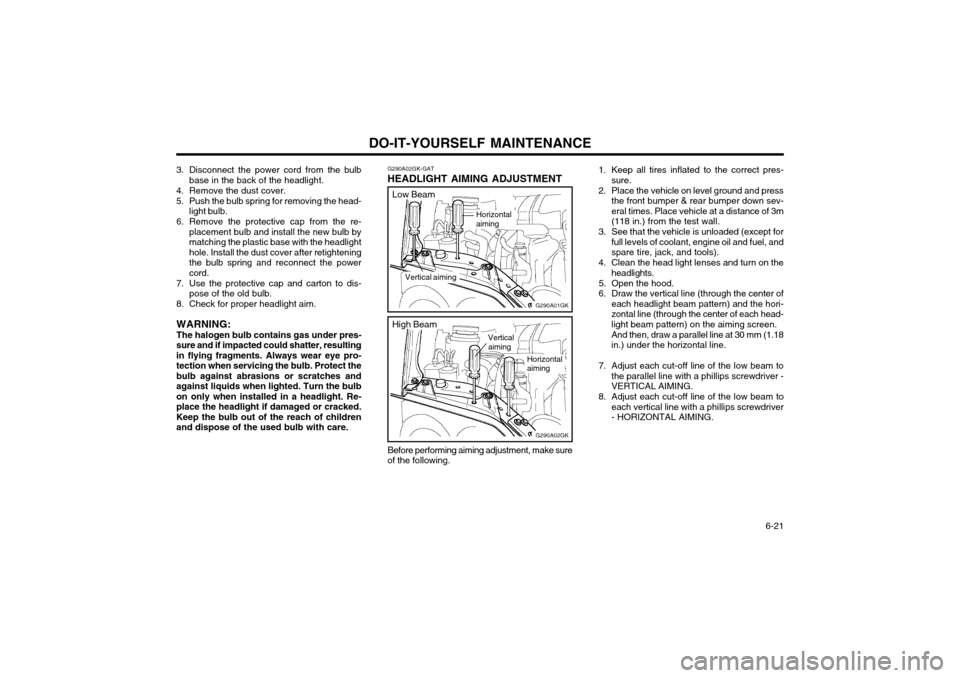
HEADLIGHT AIMING ADJUSTMENT
Horizontal aiming
G290A01GK
Vertical aiming
3. Disconnect the power cord from the bulb
base in the back of the headlight.
4. Remove the dust cover.
5. Push the bulb spring for removing the head- light bulb.
6. Remove the protective cap from the re- placement bulb and install the new bulb by matching the plastic base with the headlighthole. Install the dust cover after retighteningthe bulb spring and reconnect the powercord.
7. Use the protective cap and carton to dis- pose of the old bulb.
8. Check for proper headlight aim.
WARNING: The halogen bulb contains gas under pres-
sure and if impacted could shatter, resulting in flying fragments. Always wear eye pro-tection when servicing the bulb. Protect thebulb against abrasions or scratches andagainst liquids when lighted. Turn the bulbon only when installed in a headlight. Re-place the headlight if damaged or cracked.Keep the bulb out of the reach of childrenand dispose of the used bulb with care.
Before performing aiming adjustment, make sure
of the following.
Low Beam
G290A02GK
Vertical aiming
High Beam
Horizontal aiming1. Keep all tires inflated to the correct pres-
sure.
2. Place the vehicle on level ground and press the front bumper & rear bumper down sev- eral times. Place vehicle at a distance of 3m(118 in.) from the test wall.
3. See that the vehicle is unloaded (except for full levels of coolant, engine oil and fuel, andspare tire, jack, and tools).
4. Clean the head light lenses and turn on the headlights.
5. Open the hood.
6. Draw the vertical line (through the center of each headlight beam pattern) and the hori-zontal line (through the center of each head-light beam pattern) on the aiming screen. And then, draw a parallel line at 30 mm (1.18 in.) under the horizontal line.
7. Adjust each cut-off line of the low beam to the parallel line with a phillips screwdriver -VERTICAL AIMING.
8. Adjust each cut-off line of the low beam to each vertical line with a phillips screwdriver- HORIZONTAL AIMING.