engine cover Hyundai Coupe 2004 Owner's Guide
[x] Cancel search | Manufacturer: HYUNDAI, Model Year: 2004, Model line: Coupe, Model: Hyundai Coupe 2004Pages: 389, PDF Size: 10.22 MB
Page 176 of 389
A100A01L-EAT GUIDE TO HYUNDAI GENUINE PARTS
1. What are Hyundai GenuineParts?
Hyundai Genuine Parts are the same parts used by Hyundai Motor Com- pany to manufacture vehicles. Theyare designed and tested for the opti- mum safety, performance, and reli- ability to our customers.
2. Why should you use genuine parts?
Hyundai Genuine Parts are engineered and built to meet rigid manufacturing requirements. Using imitation, coun- terfeit or used salvage parts is not covered under the Hyundai New Ve-hicle Limited Warranty or any other Hyundai warranty. In addition, any damage to or failure of GenuineHyundai Parts caused by the installa- tion or failure of an imitation, counter- feit or used salvage part is not coveredby Hyundai Motor Company.
3. How can you tell if you are
purchasing Hyundai Genuine Parts?
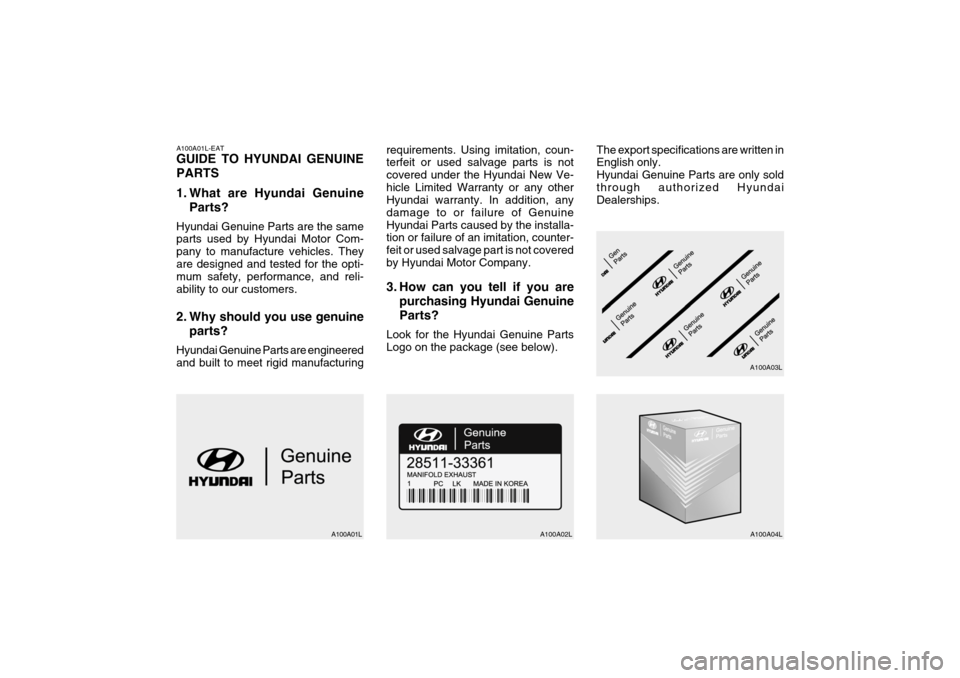
Look for the Hyundai Genuine Parts Logo on the package (see below). The export specifications are written inEnglish only. Hyundai Genuine Parts are only soldthrough authorized Hyundai Dealerships.
A100A01L
A100A02L A100A04L
A100A03L
Page 213 of 389
1
CONTROLS AND EQUIPMENT
33
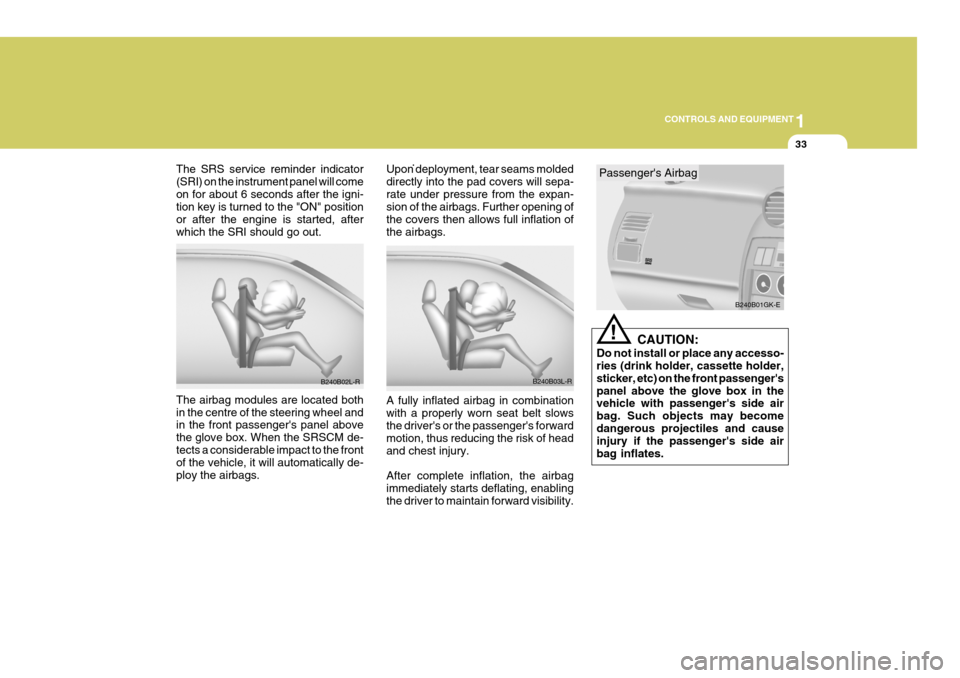
The SRS service reminder indicator (SRI) on the instrument panel will comeon for about 6 seconds after the igni- tion key is turned to the "ON" position or after the engine is started, afterwhich the SRI should go out. The airbag modules are located both in the centre of the steering wheel and in the front passenger's panel above the glove box. When the SRSCM de-tects a considerable impact to the front of the vehicle, it will automatically de- ploy the airbags. B240B02L-R Passenger's Airbag
Upon deployment, tear seams moldeddirectly into the pad covers will sepa-rate under pressure from the expan- sion of the airbags. Further opening of the covers then allows full inflation ofthe airbags. A fully inflated airbag in combination with a properly worn seat belt slows the driver's or the passenger's forward motion, thus reducing the risk of headand chest injury. After complete inflation, the airbag immediately starts deflating, enabling the driver to maintain forward visibility. B240B03L-R
B240B01GK-E
!
CAUTION:
Do not install or place any accesso- ries (drink holder, cassette holder, sticker, etc) on the front passenger'spanel above the glove box in the vehicle with passenger's side air bag. Such objects may becomedangerous projectiles and cause injury if the passenger's side air bag inflates.
Page 253 of 389
1
CONTROLS AND EQUIPMENT
73AUDIO REMOTE CONTROL SWITCH
!WARNING:
o Keep the main switch off when not using the cruise control.
o Use the cruise control system only when traveling on open high- ways in good weather.
o Do not use the cruise control when it may not be safe to keepthe car at a constant speed, for instance, driving in heavy or vary-ing traffic, or on slippery (rainy, icy or snow-covered) or winding roads or over 6% up-hill or down-hill roads.
o Pay particular attention to the
driving conditions whenever us-ing the cruise control system.
o During cruise-control driving
with a manual transaxle vehicle,do not shift into neutral without depressing the clutch pedal, or the engine will be overrevved. Ifthis happens, depress the clutch pedal or release the main switch. o With the cruise control engaged,
when the brake pedal is applied, it is normal to hear the cruise control system deactivate. This is an indication of normal systemoperation.
o During normal cruise control
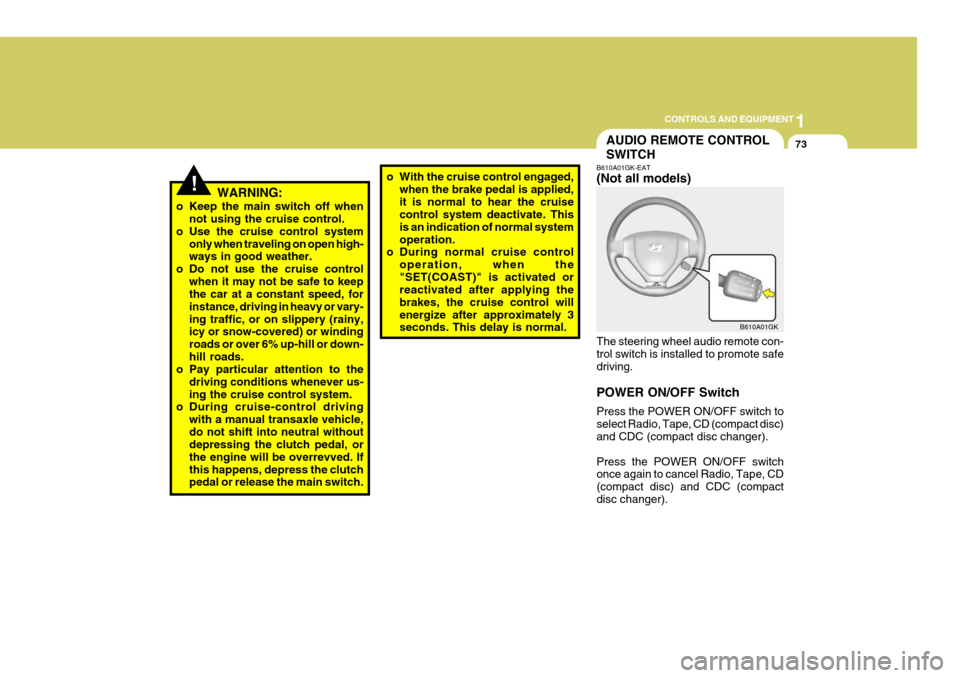
operation, when the"SET(COAST)" is activated or reactivated after applying the brakes, the cruise control willenergize after approximately 3 seconds. This delay is normal. B610A01GK-EAT (Not all models) The steering wheel audio remote con- trol switch is installed to promote safe driving. POWER ON/OFF Switch Press the POWER ON/OFF switch to select Radio, Tape, CD (compact disc) and CDC (compact disc changer). Press the POWER ON/OFF switch once again to cancel Radio, Tape, CD (compact disc) and CDC (compactdisc changer).B610A01GK
Page 272 of 389
1FEATURES OF YOUR HYUNDAI
92STEREO SOUND SYSTEM
AM reception
Ionosphere
FM reception
B750A01L
B750A02A-AAT How Car Audio Works
Ionosphere
B750A02L Mountains
Buildings Unobstructed
area
FM radio station
B750A03L
Obstructed area Iron bridges
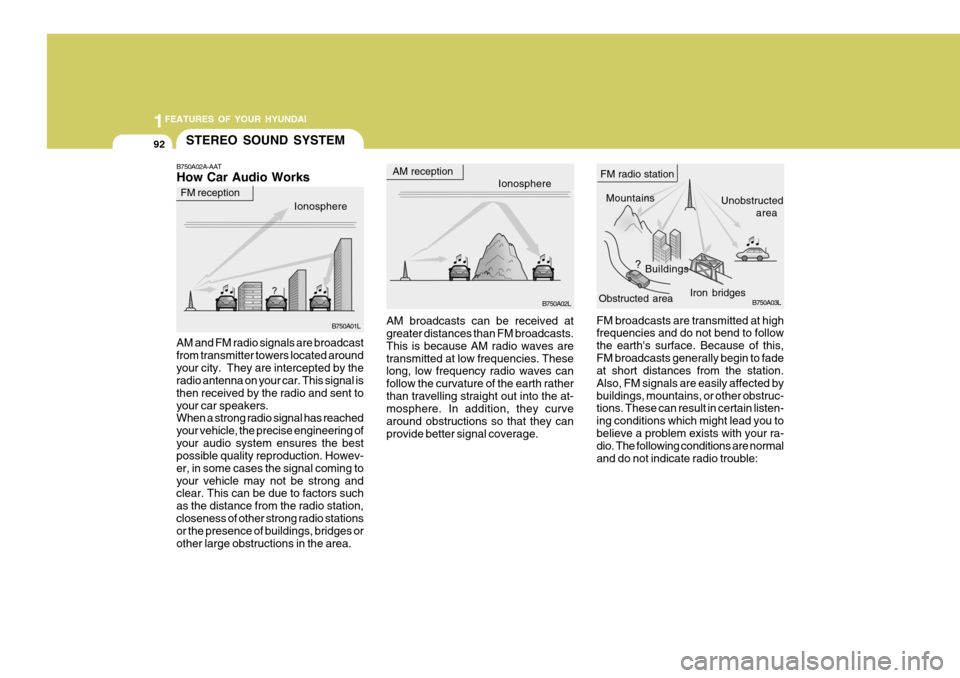
FM broadcasts are transmitted at high frequencies and do not bend to follow the earth's surface. Because of this,FM broadcasts generally begin to fade at short distances from the station. Also, FM signals are easily affected bybuildings, mountains, or other obstruc- tions. These can result in certain listen- ing conditions which might lead you tobelieve a problem exists with your ra- dio. The following conditions are normal and do not indicate radio trouble:
AM broadcasts can be received at greater distances than FM broadcasts. This is because AM radio waves aretransmitted at low frequencies. These long, low frequency radio waves can follow the curvature of the earth ratherthan travelling straight out into the at- mosphere. In addition, they curve around obstructions so that they canprovide better signal coverage.
AM and FM radio signals are broadcastfrom transmitter towers located aroundyour city. They are intercepted by the radio antenna on your car. This signal is then received by the radio and sent toyour car speakers. When a strong radio signal has reached your vehicle, the precise engineering ofyour audio system ensures the best possible quality reproduction. Howev- er, in some cases the signal coming toyour vehicle may not be strong and clear. This can be due to factors such as the distance from the radio station,closeness of other strong radio stations or the presence of buildings, bridges or other large obstructions in the area.
Page 288 of 389
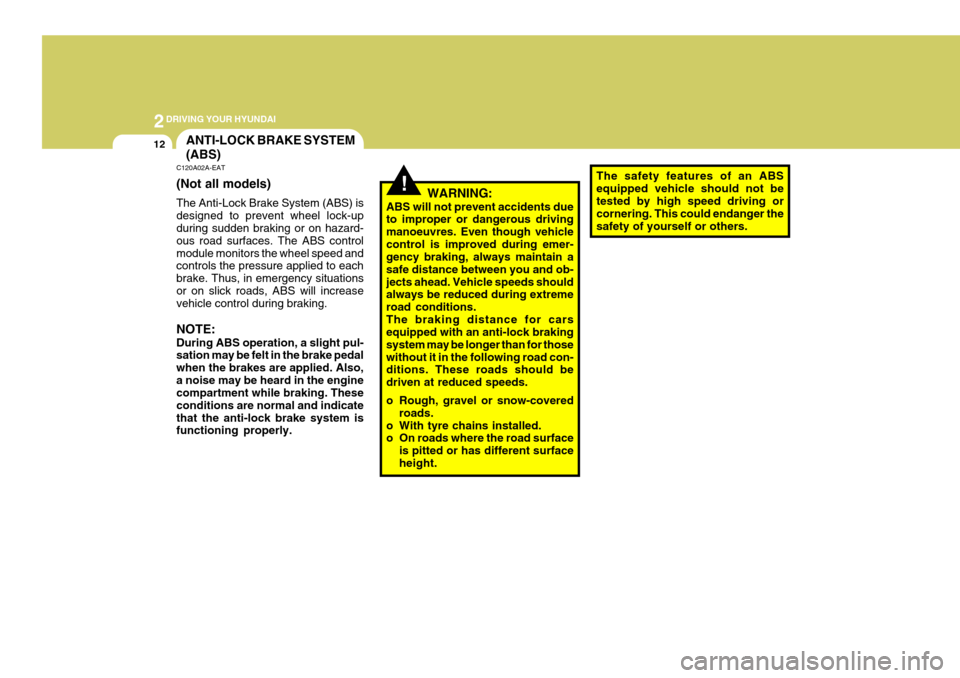
2DRIVING YOUR HYUNDAI
12
WARNING:
ABS will not prevent accidents due to improper or dangerous driving manoeuvres. Even though vehiclecontrol is improved during emer- gency braking, always maintain a safe distance between you and ob-jects ahead. Vehicle speeds should always be reduced during extreme road conditions.The braking distance for cars equipped with an anti-lock braking system may be longer than for thosewithout it in the following road con- ditions. These roads should be driven at reduced speeds.
o Rough, gravel or snow-covered roads.
o With tyre chains installed.
o On roads where the road surface
is pitted or has different surface height.!The safety features of an ABS equipped vehicle should not be tested by high speed driving or cornering. This could endanger thesafety of yourself or others.
ANTI-LOCK BRAKE SYSTEM (ABS)
C120A02A-EAT (Not all models) The Anti-Lock Brake System (ABS) is designed to prevent wheel lock-up during sudden braking or on hazard- ous road surfaces. The ABS controlmodule monitors the wheel speed and controls the pressure applied to each brake. Thus, in emergency situationsor on slick roads, ABS will increase vehicle control during braking. NOTE: During ABS operation, a slight pul- sation may be felt in the brake pedal when the brakes are applied. Also,a noise may be heard in the engine compartment while braking. These conditions are normal and indicatethat the anti-lock brake system is functioning properly.
Page 293 of 389

2
DRIVING YOUR HYUNDAI
17
In addition, anti-freeze solution must ALWAYS be used in vehicles fittedwith air conditioning, to prevent the heater matrix from freezing and sub- sequently bursting with the refrigera-tion system in use. ZC170D1-E Door Locks Should the door lock mechanism be- come frozen, a proprietary lock de-icer should be used. Alternatively, warm- ing the door key may thaw the doorlock. However, the key should be handled carefully to avoid burning the fingers.Never attempt to thaw a frozen door lock using hot water, since the water will eventually freeze and compoundthe problem. NOTE: The proper temperature for using the immobilizer key is from -40°F (- 40°C) to 176°F (80°C). If you heat the immobilizer key over 176°F (80°C)to open the frozen lock, it may cause damage to the transponder in its head. SC170E1-E Windscreen Washers and Wip- ers The windscreen washer bottle should be filled with a solution of water and a proprietary winter screen wash addi-tive. The windscreen wipers should not be used if the blades are frozen to the windscreen or if they are coveredwith snow, before this is removed. NOTE: Never allow undiluted screen washer fluid additive to spill upon the paintwork or use engine cool- ant anti-freeze since damage to thepaintwork may result.
o When driving in extreme conditions,
the windscreen wiper blades may fail to clear the screen properly due to the formation of ice upon theblade edge. It will therefore be nec- essary to periodically remove such ice to restore their efficiency.
o If the power operated door mirrors become frozen, attempts to adjustthese may damage the mechanism. o The formation of snow or ice built up
inside the wheel arches may inter-fere with the road wheels or steering mechanism. In such instances, un- usual noises or an increase in steer-ing effort may result. Therefore, ensure that the wheel arches are checked periodically and any accu-mulated snow or ice removed.
o It is advisable to carry emergency
equipment including, torch, shovel,tow rope, blankets etc., if a journey is to be undertaken into areas of severe road conditions.
Page 328 of 389
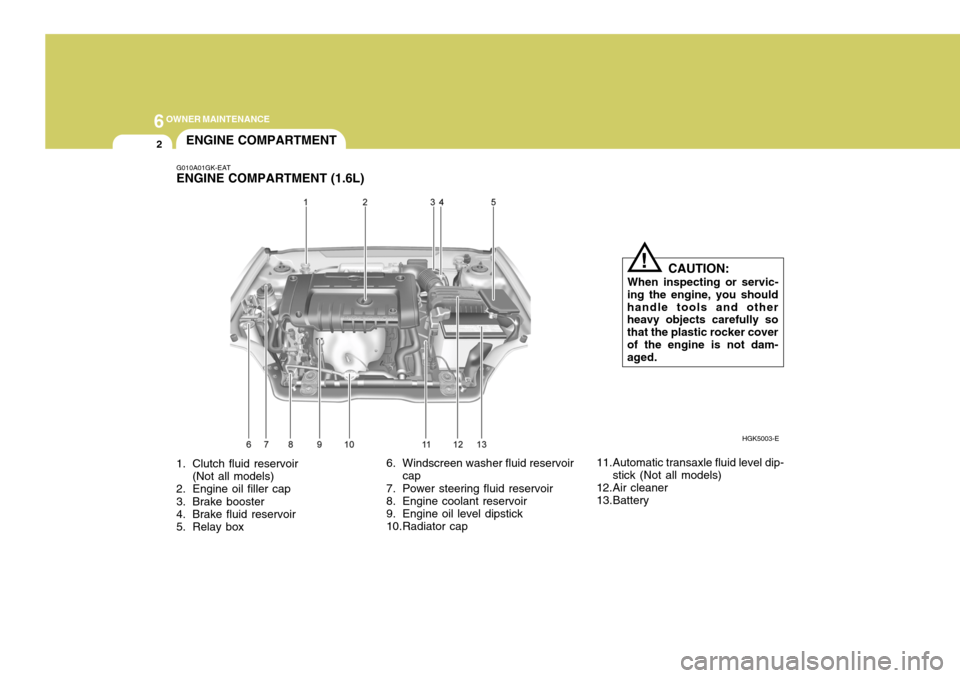
6OWNER MAINTENANCE
2
1. Clutch fluid reservoir
(Not all models)
2. Engine oil filler cap
3. Brake booster
4. Brake fluid reservoir
5. Relay box
G010A01GK-EAT ENGINE COMPARTMENT (1.6L)
ENGINE COMPARTMENT
HGK5003-E
CAUTION:
When inspecting or servic-
ing the engine, you should handle tools and other heavy objects carefully so that the plastic rocker coverof the engine is not dam- aged.
!
6. Windscreen washer fluid reservoir cap
7. Power steering fluid reservoir
8. Engine coolant reservoir
9. Engine oil level dipstick
10.Radiator cap 11.Automatic transaxle fluid level dip-
stick (Not all models)
12.Air cleaner
13.Battery
Page 329 of 389
6
OWNER MAINTENANCE
3
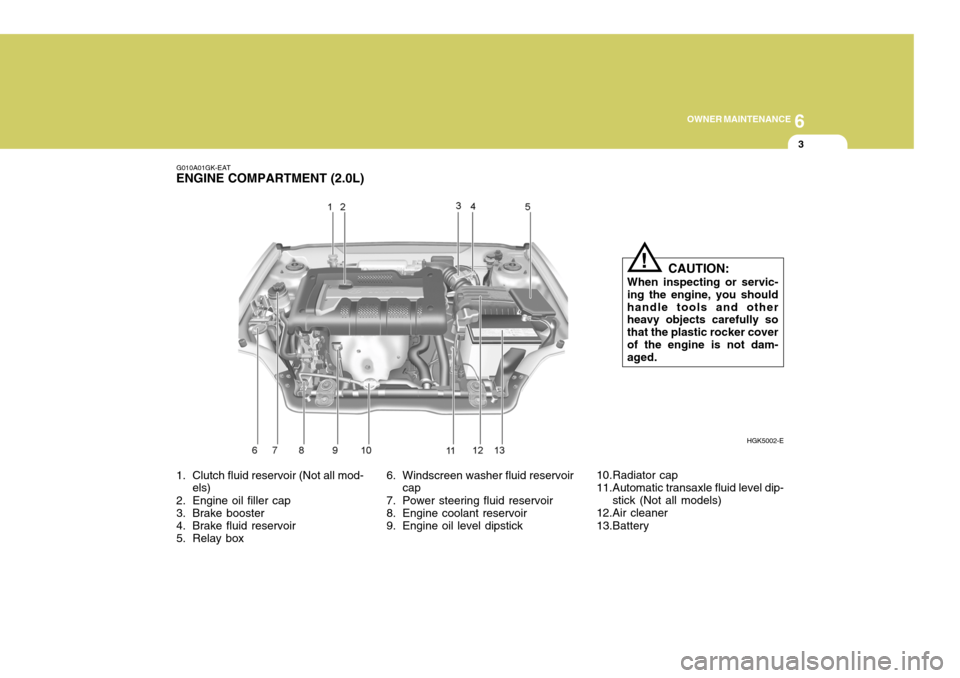
G010A01GK-EAT
ENGINE COMPARTMENT (2.0L)
1. Clutch fluid reservoir (Not all mod- els)
2. Engine oil filler cap
3. Brake booster
4. Brake fluid reservoir
5. Relay box 6. Windscreen washer fluid reservoir
cap
7. Power steering fluid reservoir
8. Engine coolant reservoir
9. Engine oil level dipstick 10.Radiator cap
11.Automatic transaxle fluid level dip-
stick (Not all models)
12.Air cleaner
13.Battery CAUTION:
When inspecting or servic- ing the engine, you shouldhandle tools and other heavy objects carefully so that the plastic rocker coverof the engine is not dam- aged.
!
HGK5002-E
Page 330 of 389
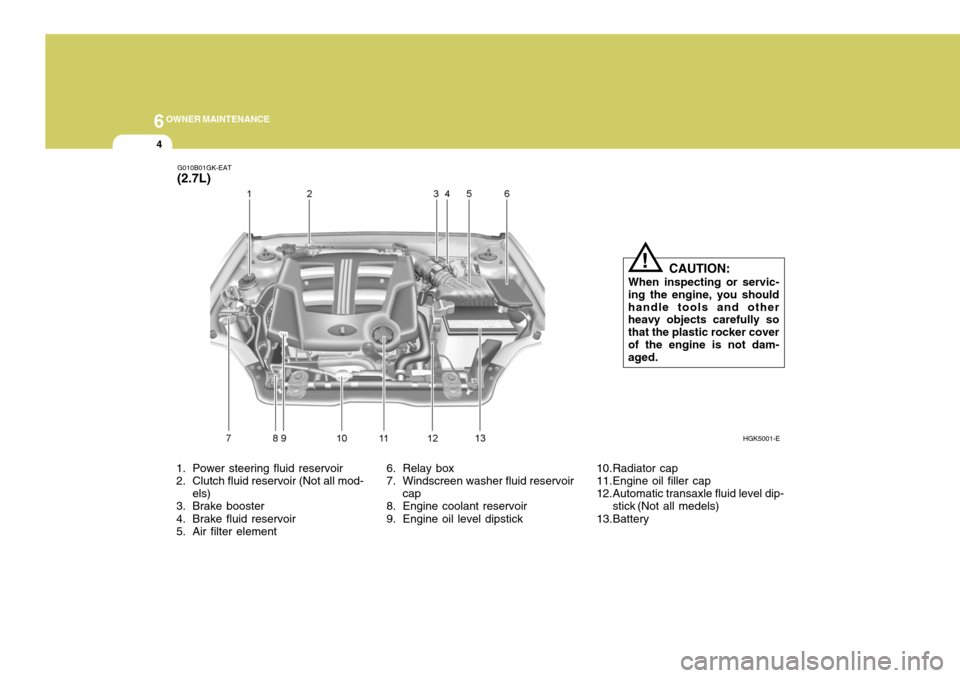
6OWNER MAINTENANCE
4
1. Power steering fluid reservoir
2. Clutch fluid reservoir (Not all mod-els)
3. Brake booster
4. Brake fluid reservoir
5. Air filter element 6. Relay box
7. Windscreen washer fluid reservoir
cap
8. Engine coolant reservoir
9. Engine oil level dipstick 10.Radiator cap
11.Engine oil filler cap
12.Automatic transaxle fluid level dip-
stick (Not all medels)
13.Battery
G010B01GK-EAT
(2.7L)
HGK5001-E
CAUTION:
When inspecting or servic-ing the engine, you shouldhandle tools and other heavy objects carefully so that the plastic rocker coverof the engine is not dam- aged.
!
Page 340 of 389
6OWNER MAINTENANCE
14
!
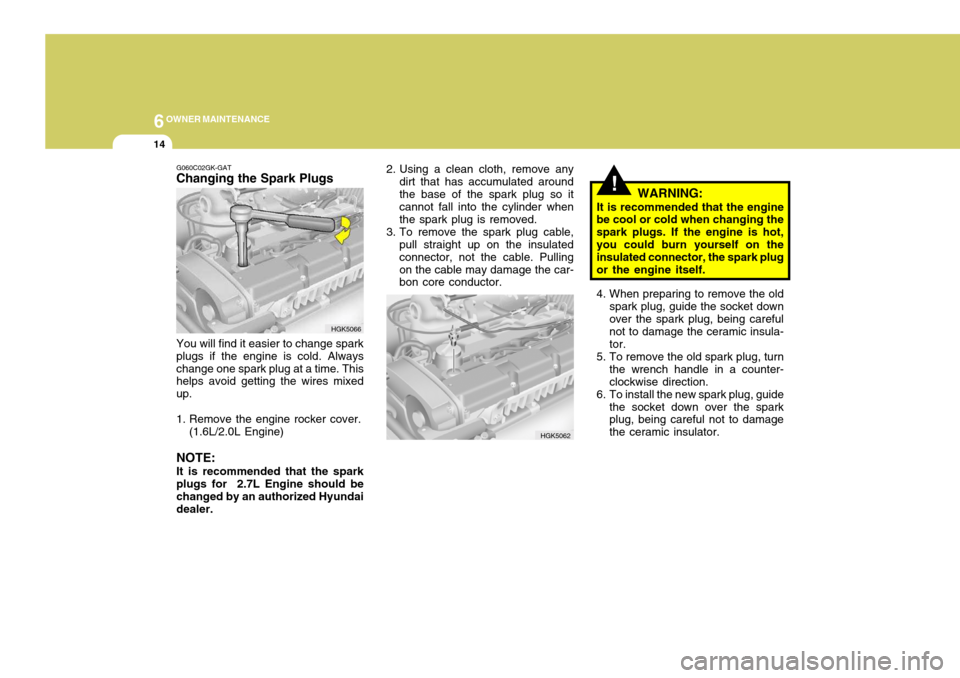
HGK5066 4. When preparing to remove the old
spark plug, guide the socket down over the spark plug, being careful not to damage the ceramic insula-tor.
5. To remove the old spark plug, turn
the wrench handle in a counter-clockwise direction.
6. To install the new spark plug, guide the socket down over the spark plug, being careful not to damage the ceramic insulator.
G060C02GK-GAT Changing the Spark Plugs You will find it easier to change spark plugs if the engine is cold. Alwayschange one spark plug at a time. This helps avoid getting the wires mixed up.
1. Remove the engine rocker cover.
(1.6L/2.0L Engine)
NOTE: It is recommended that the spark plugs for 2.7L Engine should be changed by an authorized Hyundaidealer. 2. Using a clean cloth, remove any
dirt that has accumulated aroundthe base of the spark plug so it cannot fall into the cylinder when the spark plug is removed.
3. To remove the spark plug cable, pull straight up on the insulatedconnector, not the cable. Pullingon the cable may damage the car- bon core conductor.
HGK5062 WARNING:
It is recommended that the engine
be cool or cold when changing the spark plugs. If the engine is hot,you could burn yourself on the insulated connector, the spark plug or the engine itself.