radiator cap Hyundai Coupe 2004 User Guide
[x] Cancel search | Manufacturer: HYUNDAI, Model Year: 2004, Model line: Coupe, Model: Hyundai Coupe 2004Pages: 389, PDF Size: 10.22 MB
Page 224 of 389
1CONTROLS AND EQUIPMENT
44
!
INSTRUMENT CLUSTER
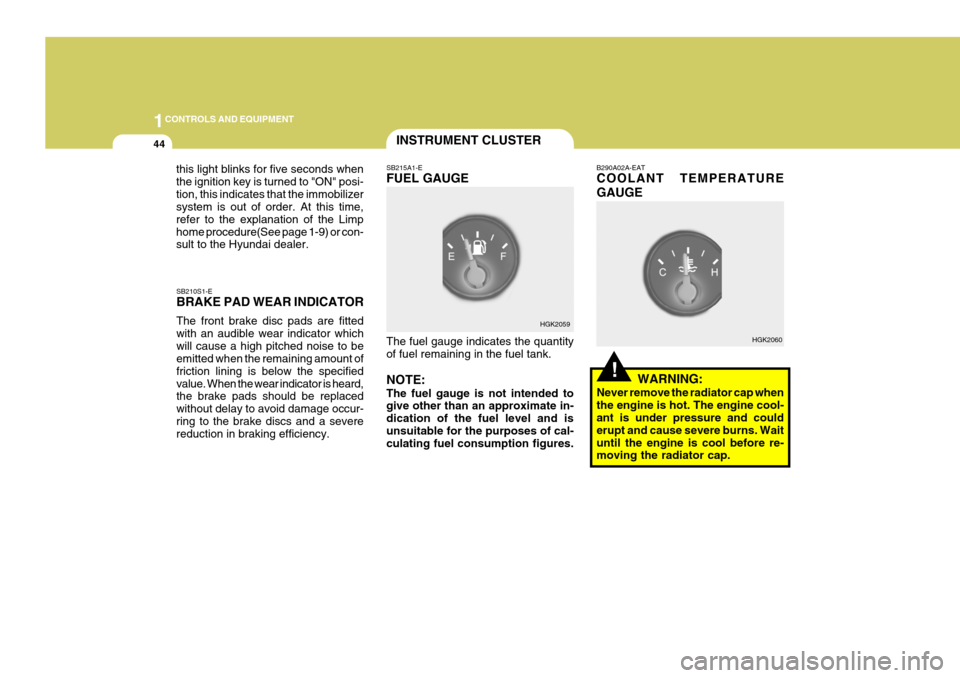
SB210S1-E BRAKE PAD WEAR INDICATOR The front brake disc pads are fitted with an audible wear indicator whichwill cause a high pitched noise to be emitted when the remaining amount of friction lining is below the specifiedvalue. When the wear indicator is heard, the brake pads should be replaced without delay to avoid damage occur-ring to the brake discs and a severe reduction in braking efficiency. SB215A1-E FUEL GAUGE The fuel gauge indicates the quantity of fuel remaining in the fuel tank. NOTE: The fuel gauge is not intended to give other than an approximate in- dication of the fuel level and isunsuitable for the purposes of cal- culating fuel consumption figures. B290A02A-EAT COOLANT TEMPERATURE GAUGE
WARNING:
Never remove the radiator cap when the engine is hot. The engine cool- ant is under pressure and could erupt and cause severe burns. Waituntil the engine is cool before re- moving the radiator cap.
HGK2059
HGK2060
this light blinks for five seconds when the ignition key is turned to "ON" posi-tion, this indicates that the immobilizer system is out of order. At this time, refer to the explanation of the Limphome procedure(See page 1-9) or con- sult to the Hyundai dealer.
Page 246 of 389

1CONTROLS AND EQUIPMENT
66
!WARNING:
Fuel vapours are dangerous. Be- fore refuelling, turn off the engine and never allow sparks, lit ciga-rettes or open flames near the filler area. When releasing the filler cap, a small amount of residual pres-sure may generate a slight hissing sound which is not indicative of an abnormality. In the event of the fuelfiller cap requiring replacement, only a Genuine Hyundai replace- ment part should be used to pre-vent fuel leakage. HGK2018Q
SB440A1-E (Not all models) The fuel filler lid may be opened from inside the vehicle by pulling up on thefuel filler lid release. NOTE: If the fuel filler lid will not open because ice has formed around it, tap lightly or push on the lid to break the ice and release the lid. Donot lever the lid. If necessary, spray around the lid with an approved de- icer fluid (do not use radiator anti-freeze) or move the vehicle to a warm place and allow the ice to melt.REMOTE FUEL FILLER LID RELEASE
HGK2017-E
!WARNING:
o Always double check to be sure that the bonnet is firmly latched before driving away. If it is notlatched, the bonnet could fly open while the vehicle is being driven, causing a total loss of visibility,which might result in an acci- dent.
o Do not move the vehicle with the bonnet in the raised position, asvision is obstructed and the bon- net could fall or be damaged.
Page 303 of 389
3
IN CASE OF EMERGENCY
5
!
!WARNING:
Whilst the engine is running, keep hands and clothing away from mov- ing parts such as the fan and drive belts to prevent injury.
5. If the water pump drive belt is bro- ken or coolant is leaking out, stop the engine immediately and call the nearest Hyundai dealer for assis-tance.
WARNING:
Do not remove the radiator cap when the engine is hot since steam and boiling water may be ejected fromthe radiator resulting in burns or scalding.
!
6. If the cause of the overheating can- not be found, wait until the engine temperature has returned to nor- mal. Then, if coolant has been lost, carefully add coolant to the reser-voir (page 6-11) to bring the fluid level in the reservoir up to the base of the radiator fill opening. Fill thecoolant expansion tank to the half- way mark.
7. Proceed with caution until it is es- tablished that the engine is operat-ing normally. If the engine over- heats repeatedly, the advice of aHyundai dealer should be sought.
CAUTION:
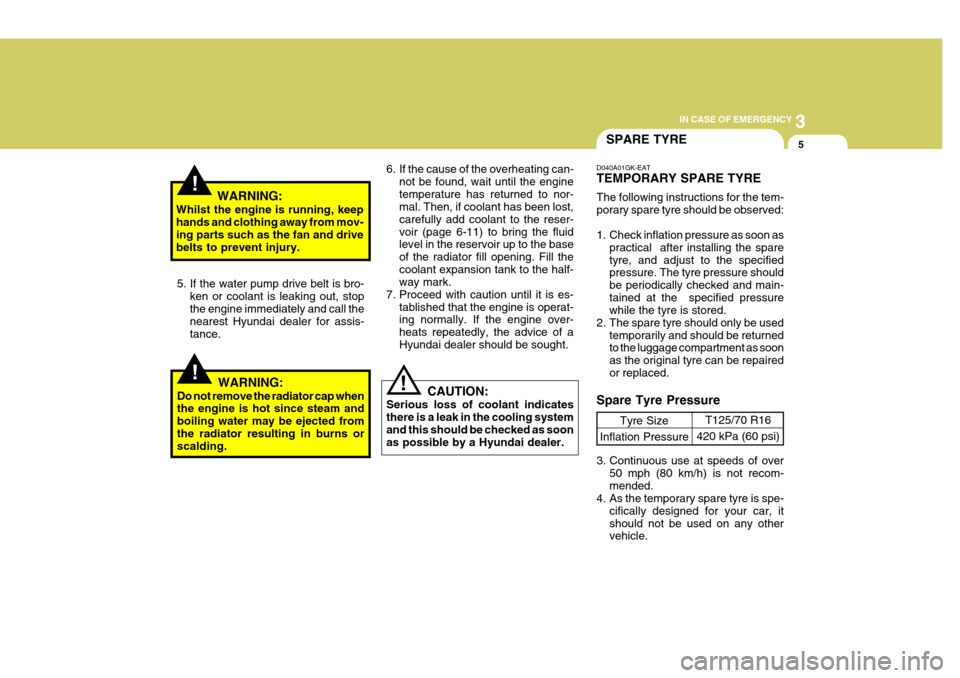
Serious loss of coolant indicatesthere is a leak in the cooling systemand this should be checked as soon as possible by a Hyundai dealer.D040A01GK-EAT TEMPORARY SPARE TYRE The following instructions for the tem- porary spare tyre should be observed:
1. Check inflation pressure as soon as practical after installing the spare tyre, and adjust to the specified pressure. The tyre pressure should be periodically checked and main-tained at the specified pressure while the tyre is stored.
2. The spare tyre should only be used temporarily and should be returnedto the luggage compartment as soon as the original tyre can be repairedor replaced.
SPARE TYRE
Tyre Size
Inflation Pressure T125/70 R16
420 kPa (60 psi)
Spare Tyre Pressure
3. Continuous use at speeds of over 50 mph (80 km/h) is not recom- mended.
4. As the temporary spare tyre is spe-
cifically designed for your car, itshould not be used on any other vehicle.
Page 328 of 389
6OWNER MAINTENANCE
2
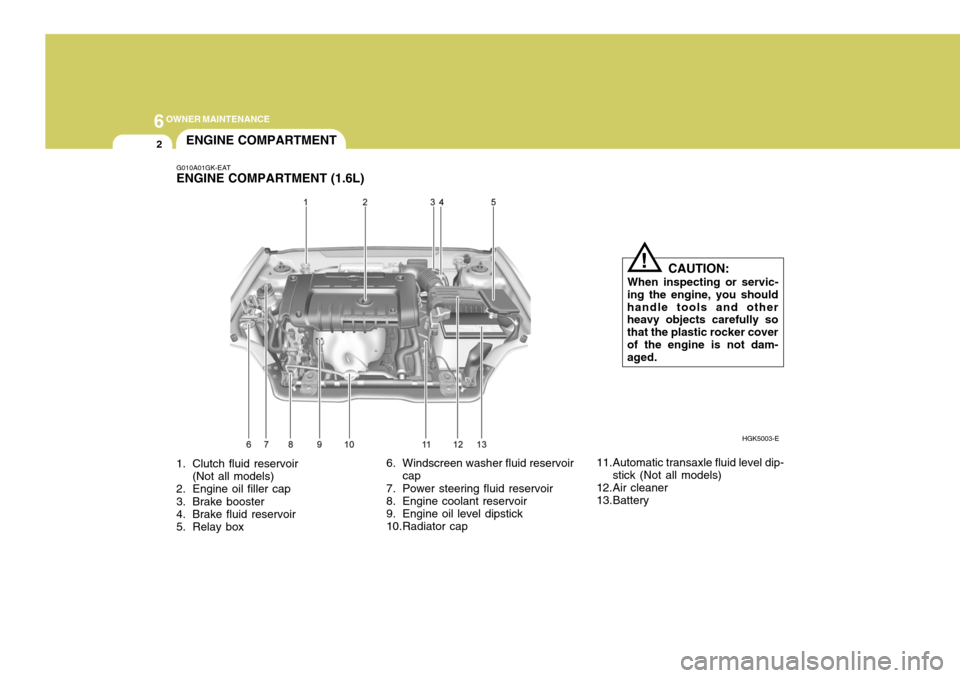
1. Clutch fluid reservoir
(Not all models)
2. Engine oil filler cap
3. Brake booster
4. Brake fluid reservoir
5. Relay box
G010A01GK-EAT ENGINE COMPARTMENT (1.6L)
ENGINE COMPARTMENT
HGK5003-E
CAUTION:
When inspecting or servic-
ing the engine, you should handle tools and other heavy objects carefully so that the plastic rocker coverof the engine is not dam- aged.
!
6. Windscreen washer fluid reservoir cap
7. Power steering fluid reservoir
8. Engine coolant reservoir
9. Engine oil level dipstick
10.Radiator cap 11.Automatic transaxle fluid level dip-
stick (Not all models)
12.Air cleaner
13.Battery
Page 329 of 389
6
OWNER MAINTENANCE
3
G010A01GK-EAT
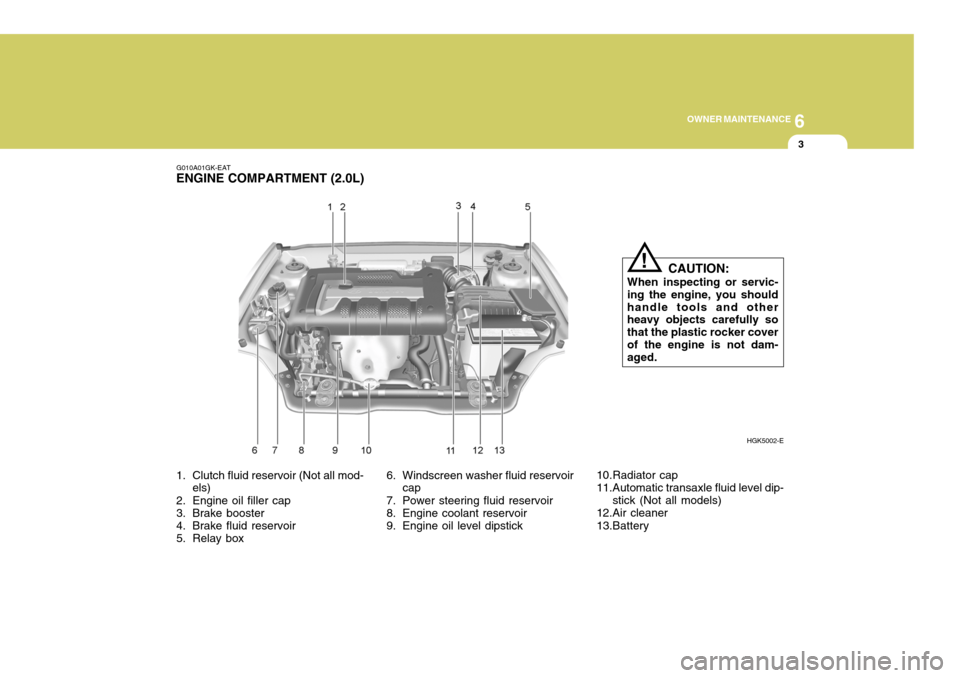
ENGINE COMPARTMENT (2.0L)
1. Clutch fluid reservoir (Not all mod- els)
2. Engine oil filler cap
3. Brake booster
4. Brake fluid reservoir
5. Relay box 6. Windscreen washer fluid reservoir
cap
7. Power steering fluid reservoir
8. Engine coolant reservoir
9. Engine oil level dipstick 10.Radiator cap
11.Automatic transaxle fluid level dip-
stick (Not all models)
12.Air cleaner
13.Battery CAUTION:
When inspecting or servic- ing the engine, you shouldhandle tools and other heavy objects carefully so that the plastic rocker coverof the engine is not dam- aged.
!
HGK5002-E
Page 330 of 389
6OWNER MAINTENANCE
4
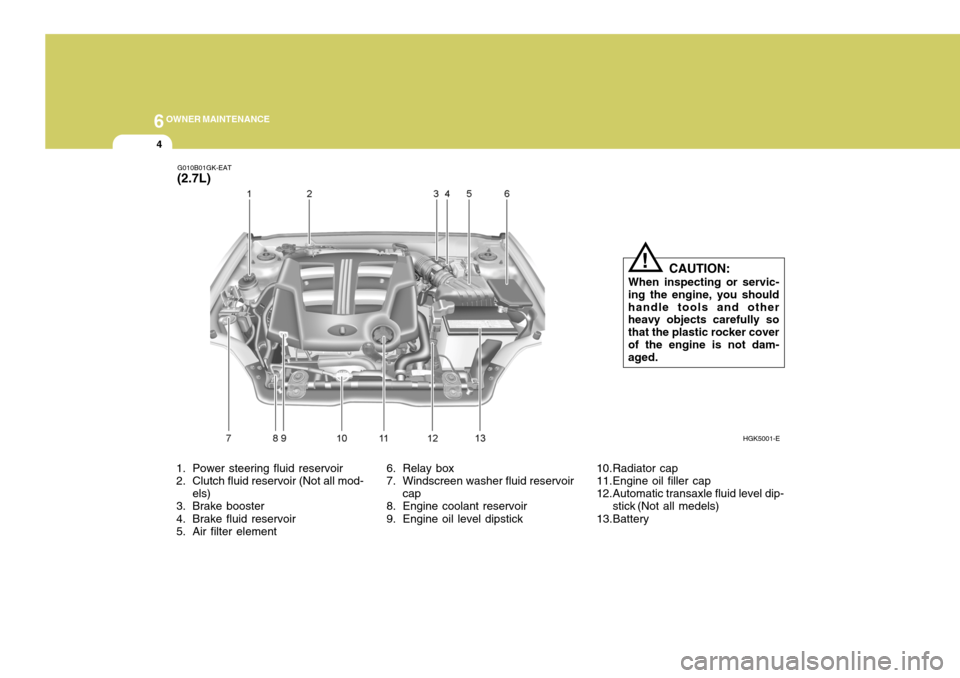
1. Power steering fluid reservoir
2. Clutch fluid reservoir (Not all mod-els)
3. Brake booster
4. Brake fluid reservoir
5. Air filter element 6. Relay box
7. Windscreen washer fluid reservoir
cap
8. Engine coolant reservoir
9. Engine oil level dipstick 10.Radiator cap
11.Engine oil filler cap
12.Automatic transaxle fluid level dip-
stick (Not all medels)
13.Battery
G010B01GK-EAT
(2.7L)
HGK5001-E
CAUTION:
When inspecting or servic-ing the engine, you shouldhandle tools and other heavy objects carefully so that the plastic rocker coverof the engine is not dam- aged.
!
Page 333 of 389

6
OWNER MAINTENANCE
7
HGK5005
SG030D2-E
ENGINE OIL REPLENISHMENT
If the indicated oil level is at or below the lower mark of the dipstick, oilshould be added until the level is at or below the upper mark. To add oil to the engine, remove the filler cap by rotating in an counter- clockwise direction and pour engine oil into the engine. Before checkingthe level again, allow several minutes for the oil to drain into the sump. Replace the oil filler cap rotating it ina clockwise direction until tight.The quantity of oil required to raisethe level from the minimum to maxi- mum level is approximately 1 litre. 1.6L/2.0L
G350A01A-GAT ENGINE OIL CONSUMPTION Function of engine oil Engine oil has the primary function of lubricating and cooling the inside of the engine. Engine oil consumption It is normal that an engine should consume some engine oil while nor- mal driving. The cause of oil con- sumption in a normal engine are asfollows;
o Engine oil is used to lubricate pis-
tons, piston rings and cylinders. A thin film of oil is left on the cylinder wall when a piston moves downwards in the cylinder. High negative pressure generated dur-ing engine operation sucks some of the oil into the combustion cham- ber.This oil with some oil of the cylin-der wall is burned by the high tem-perature combustion gases during the combustion process.
2.7L
!WARNING:
Be very careful not to touch the
radiator hose when checking the engine oil as it may be hot enough to burn you.
Page 336 of 389
6OWNER MAINTENANCE
10
SG050B1-E
Coolant recommendations
Only ethylene glycol based coolant with a corrosion inhibitor suited to aluminium alloy engine components should be used in the cooling system.No further additives or inhibitors should be used. The coolant specific gravity should be checked as pre-scribed in the maintenance schedule to ensure adequate frost and corro- sion protection. In addition, the en-gine coolant must be replaced at the specified interval since the corrosion inhibitor properties deteriorate withtime.It is important to note that whilst anincrease in the concentration of anti freeze gives an increase in the level of frost protection, a solution which isin excess of 65% anti freeze will result in reduced frost protection and engine overheating. Therefore therecommended concentration of 50% should not be exceeded for general use. The use of methanol based anti freeze compounds may result in engine over- heating and will invalidate the vehiclewarranty.
!
ENGINE COOLANT CHECK- ING AND REPLACING
SG050A1-E
WARNING:
Do not remove the radiator cap
when the engine is hot, since the system is pressurized and coolant may be ejected from the radiator resulting in scalding. NOTE: It is imperative that vehicles fitted
with an air conditioning system have a coolant concentration of the recommended strength at all times. The use of the air condition-ing system when the cooling sys- tem is filled with water only will result in the heater matrix freezingand subsequently bursting.
Page 337 of 389
6
OWNER MAINTENANCE
11
HGK4006
SG050C1-E
Engine Coolant Level
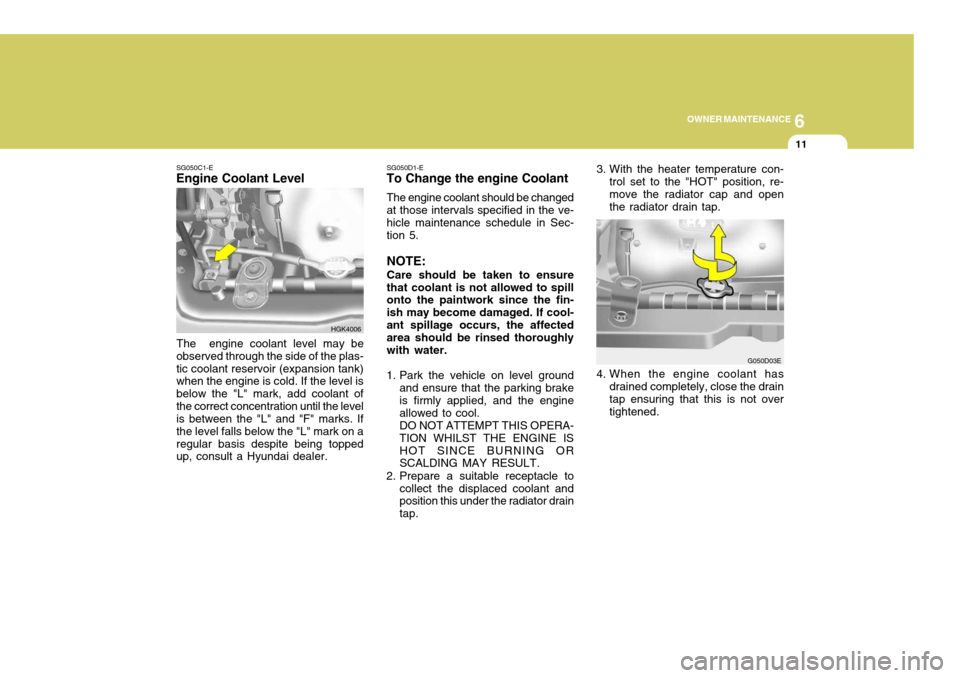
The engine coolant level may be
observed through the side of the plas- tic coolant reservoir (expansion tank) when the engine is cold. If the level is below the "L" mark, add coolant ofthe correct concentration until the level is between the "L" and "F" marks. If the level falls below the "L" mark on aregular basis despite being topped up, consult a Hyundai dealer. SG050D1-E
To Change the engine Coolant
The engine coolant should be changed at those intervals specified in the ve- hicle maintenance schedule in Sec- tion 5. NOTE: Care should be taken to ensure that coolant is not allowed to spill onto the paintwork since the fin- ish may become damaged. If cool-ant spillage occurs, the affected area should be rinsed thoroughly with water.
1. Park the vehicle on level ground and ensure that the parking brake is firmly applied, and the engine allowed to cool.DO NOT ATTEMPT THIS OPERA-TION WHILST THE ENGINE ISHOT SINCE BURNING OR SCALDING MAY RESULT.
2. Prepare a suitable receptacle to collect the displaced coolant andposition this under the radiator drain tap. 4. When the engine coolant has
drained completely, close the drain tap ensuring that this is not over tightened. G050D03E
3. With the heater temperature con-
trol set to the "HOT" position, re-move the radiator cap and open the radiator drain tap.
Page 338 of 389

6OWNER MAINTENANCE
12
G050D04E
SPARK PLUGS
G060A01GK-EAT Your engine was originally equipped with platinum-tipped or iridium-tipped spark plugs (2.7L only).Platinum-tipped or iridium-tipped sparkplugs will last longer than conven-tional type spark plugs. Platinum- tipped spark plug can be identified by blue lines on the ceramic shell. NOTE: Do not clean or regap platinum- tipped/iridium-tipped spark plugs.
0.039 ~ 0.043 in. (1.0~1.1 mm)
!WARNING:
The cooling fan is controlled by engine coolant temperature and may sometimes operate even whenthe engine is not running. Use extreme caution when working near the blades of the cooling fan sothat you are not injured by a rotat- ing fan blade. As the engine cool- ant temperature decreases, the fanwill automatically shut off. This is a normal condition.
5. Prepare a suitable quantity of new
engine coolant (refer to section 9) and pour this into the radiator.
HSM392
1.6L/2.0L 2.7L
0.039 ~ 0.043 in. (1.0~1.1 mm)
6. Start the engine with the radiator
cap still removed and continue to add coolant as the level decreases as air is expelled from the system.When the level remains constant, replace the radiator cap and re- plenish the coolant reservoir.
7. When the engine is hot, check to ensure that no coolant leaks arepresent.