radiator cap Hyundai Coupe 2004 Owner's Manual
[x] Cancel search | Manufacturer: HYUNDAI, Model Year: 2004, Model line: Coupe, Model: Hyundai Coupe 2004Pages: 389, PDF Size: 10.22 MB
Page 38 of 389

FEATURES OF YOUR HYUNDAI
1- 30 B330A02A-AAT TACHOMETER
HGK131A
The tachometer registers the speed of your en- gine in revolutions per minute (rpm). CAUTION: The engine should not be raced to such aspeed that the needle enters the red zone onthe tachometer face. This can cause severeengine damage and may void your warranty.
WARNING:Never remove the radiator cap when the en-gine is hot. The engine coolant is under pres-sure and could erupt and cause severe burns.Wait until the engine is cool before removingthe radiator cap. The needle on the engine coolant temperature gauge should stay in the normal range. If itmoves across the dial to "H" (Hot), pull over andstop as soon as possible and turn off the engine.Then open the hood and, after the engine hascooled, check the coolant level and the waterpump drive belt. If you suspect cooling systemtrouble, have your cooling system checked by aHyundai dealer as soon as possible. B300A01A-GAT SPEEDOMETER Your Hyundai's speedometer is calibrated in kilometers per hour or miles per hour.
HGK130A
B310B01GK-GAT ODOMETER/TRIP ODOMETER
HGK028A
Function of digital odometer/trip odom- eter
Pushing in the reset switch on the right side of speedometer when the ignition switch is turned"ON" will display the following sequence:
HGK055A
132
Page 53 of 389

FEATURES OF YOUR HYUNDAI 1- 45
B540A01F-AAT TAIL GATE Remote Tail Gate Release To open the tail gate without using the key, pull up
the lid release lever located on the driver's doorpanel.To close, lower the tail gate, then press down on
it until it locks. To be sure the tail gate is securelyfastened, always try to pull it up again. WARNING: The tail gate should always be kept complete-ly closed while the vehicle is in motion. If it isleft open or ajar, poisonous exhaust gasesmay enter the car resulting in serious illnessor death to the occupants. See additionalwarnings concerning exhaust gases on page2-1.
HGK124
WARNING: Gasoline vapors are dangerous. Before refu-
eling, always stop the engine and never allowsparks or open flames near the filler area. Ifyou need to replace the filler cap, use agenuine Hyundai replacement part.If you open the fuel filler cap during highambient temperatures, a slight "pressuresound" may be heard. This is normal and nota cause for concern.Whenever you open the fuel filler cap, turn itslowly.
HGK103
B560A01A-AAT REMOTE FUEL-FILLER LID RELEASE The fuel-filler lid may be opened from inside the vehicle by pulling up on the fuel-filler lid opener
located on the front floor area on the left side ofthe car. NOTE: If the fuel-filler lid will not open because ice
has formed around it, tap lightly or push onthe lid to break the ice and release the lid. Donot pry on the lid. If necessary, spray aroundthe lid with an approved de-icer fluid (do notuse radiator anti-freeze) or move the vehicleto a warm place and allow the ice to melt.
HGK105
Page 114 of 389

WHAT TO DO IN AN EMERGENCY 3-3
5. If the water pump drive belt is broken or
engine coolant is leaking out, stop the engine immediately and call the nearest Hyundaidealer for assistance.
WARNING:Do not remove the radiator cap when theengine is hot. This can allow coolant to beblown out of the opening and cause seriousburns.
6. If you cannot find the cause of the overheat- ing, wait until the engine temperature has returned to normal. Then, if the engine cool-ant has been lost, carefully add coolant to thereservoir (page 6-8) to bring the fluid level inthe reservoir up to the halfway mark.
7. Proceed with caution, keeping alert for fur- ther signs of overheating. If overheating hap-pens again, call a Hyundai dealer for assis-tance.
CAUTION:Serious loss of engine coolant indicates thereis a leak in the cooling system and this shouldbe checked as soon as possible by a Hyundaidealer. 2. The spare tire should only be used temporari-
ly and should be returned to the luggagecompartment as soon as the original tire canbe repaired or replaced.
3. Continuous use at speeds of over 80 km/h (50 mph) is not recommended.
4. As the temporary spare tire is specifically designed for your car, it should not be used onany other vehicle.
5. The temporary spare tire should not be used on any other wheels, nor should standardtires, snow tires, wheel covers or trim ringsbe used with the temporary spare wheel. Ifsuch use is attempted, damage to theseitems or other car components may occur.
6. The temporary spare tire pressure should be checked once a month while the tire is stored.
D040A01GK-GAT TEMPORARY SPARE TIREThe following instructions for the temporary spare tire should be observed:
1. Check inflation pressure as soon as practical
after installing the spare tire, and adjust to the specified pressure. The tire pressure shouldbe periodically checked and maintained atthe specified pressure while the tire is stored.
Spare Tire Pressure CAUTION:
o Do not use snow chains with your tempo-
rary spare tire.
o Do not use more than one temporary spare tire at a time.
D040B01A-AAT Handling the Spare Tire
HGK190
Remove the installation bolt to remove the spare tire. To replace the spare tire in its storagecompartment, tighten the bolt firmly with yourfingers until there is no more play in the spare tire.
Tire Size Inflation Pressure T125/70R 16420 kPa (60 psi)
Page 133 of 389

DO-IT-YOURSELF MAINTENANCE 6-1
6. DO-IT-YOURSELF MAINTENANCE G010A01GK-GAT ENGINE COMPARTMENT (1.6 DOHC)
CAUTION: When inspecting or servicing the engine,
you should handle tools and other heavy objects carefully so that the plastic rockercover of the engine is not damaged.
6
1. Engine oil filler cap
2. Brake Booster
3. Brake fluid reservoir
4. Clutch fluid reservoir (If installed)
5. Relay box 6. Windshield washer fluid reservoir cap
7. Power steering fluid reservoir
8. Engine coolant reservoir
9. Engine oil level dipstick
10. Radiator cap
11. Automatic transaxle fluid level dipstick
(If installed)
12. Air cleaner
13. Battery HGK238
1
23 4 5
6 7 8 9 10 11 12 13
Page 134 of 389

DO-IT-YOURSELF MAINTENANCE
6-2 G010A01GK-AAT ENGINE COMPARTMENT (2.0 DOHC CVVT)
1. Engine oil filler cap
2. Brake Booster
3. Brake fluid reservoir
4. Clutch fluid reservoir (If installed)
5. Relay box 6. Windshield washer fluid reservoir cap
7. Power steering fluid reservoir
8. Engine coolant reservoir
9. Engine oil level dipstick
10. Radiator cap
11. Automatic transaxle fluid level dipstick
(If installed)
12. Air cleaner
13. Battery
1
HGK059
2
6 34
5
78 9 1 0 11 1213 CAUTION: When inspecting or servicing the engine, you should handle tools and other heavyobjects carefully so that the plastic rockercover of the engine is not damaged.
Page 135 of 389

DO-IT-YOURSELF MAINTENANCE 6-3
G010B01GK-GAT ENGINE COMPARTMENT (2.7 V6)1
HGK209
2
6 3
4
5
78 9 10 11 12
1. Power steering fluid reservoir
2. Brake Booster
3. Brake fluid reservoir
4. Air filter element 5. Relay box
6. Windshield washer fluid reservoir cap
7. Engine coolant reservoir
8. Engine oil level dipstick 9. Radiator cap
10. Engine oil filler cap
11. Automatic transaxle fluid level dipstick
(If installed)
12. Battery CAUTION:When inspecting or servicing the engine,
you should handle tools and other heavy objects carefully so that the plastic rockercover of the engine is not damaged.
Page 139 of 389

DO-IT-YOURSELF MAINTENANCE 6-7
-15 (5)
-25 (-13) -35 (-31)-45 (-49)
G050A01A-AAT
CHECKING AND CHANGING THE EN- GINE COOLANT
WARNING: Do not remove the radiator cap when the
engine is hot. When the engine is hot, the engine coolant is under pressure and mayerupt through the opening if the cap isremoved. You could be seriously burned ifyou do not observe this precaution. Do notremove the radiator cap until the radiator iscool to the touch. G050B01A-AAT
Recommended Engine Coolant
Use a high quality ethylene-glycol coolant in a
50/50 mix with water. The engine coolant shouldbe compatible with aluminum engine parts.Additional corrosion inhibitors or additives shouldnot be used. The cooling system must be main-tained with the correct concentration and typeof engine coolant to prevent freezing and corro-sion. Never allow the concentration of anti-freeze to exceed the 60% level or go below the35% level, or damage to the cooling systemmay result. For proper concentration when add-ing or replacing the engine coolant, refer to thefollowing table.
HGK187
35% 40%50%60%
G050C01A-AAT
To Check the Coolant Level The coolant level can be seen on the side of the plastic coolant reservoir. The level of the cool-ant should be between the "LOW" and "FULL"lines on the reservoir when the engine is cool.If the level is below the "LOW" mark, addengine coolant to bring it up between "LOW"and "FULL". If the level is low, inspect forcoolant leaks and recheck the fluid level fre-quently. If the level drops again, visit yourHyundai dealer for an inspection and diagnosisof the reason.
7. Refill the crankcase with the recommended
engine oil. Refer to the specification in chap-ter 9 for engine oil capacity.
8. Start the engine and check to be sure no oil is leaking from the drain plug or oil filter.
9. Shut off the engine and recheck the oil level.
NOTE:Always dispose of used engine oil in an
environmentally acceptable manner. It is sug-gested that it be placed in a sealed containerand taken to a service station for maybereclaimation. Do not pour the oil on theground or put it in with the household trash.
WARNING: Used motor oil may cause irritation or can-
cer of the skin if left in contact with the skin for prolonged periods of time. Wash yourhands thoroughly with soap and warm wa-ter as soon as possible after handling usedoil.
Ambient
temperature °C ( °F) Engine Coolant concentration
Antifreezesolution Water
65% 60%50%40%
Page 140 of 389

DO-IT-YOURSELF MAINTENANCE
6-8 4. Turn the radiator cap counterclockwise with-
out pressing down on it, until it stops. This relieves any pressure remaining in the cool-ing system. And remove the radiator cap bypushing down and turning counterclockwise. Now fill the radiator with clean demineral- ized or distilled water. Continue to add cleandemineralized or distilled water in small quan-tities until the fluid level stays up in theradiator neck.
G050D02A-AAT
To Change the Engine Coolant
The engine coolant should be changed at those
intervals specified in the vehicle maintenanceschedule in Section 5.
NOTE: Engine coolant can damage the finish of
your car. If you spill engine coolant on the car, wash it off thoroughly with clean water.
1. Park the car on level ground, set the park- ing brake and remove the radiator cap when cool.
2. Be sure your drain receptacle is in place. Open the drain cock on the radiator. Allowall the engine coolant to drain from thecooling system, then securely close the draincock.
3. Check Section 9 for the capacity of the cooling system in your car. Then, followingthe manufacturer's directions on the enginecoolant container, add the appropriate quan-tity of engine coolant to the radiator.
G050D01A
5. Start the engine, top off the radiator withwater and then add engine coolant to the reservoir until the level is between "L" and"F".
6. Replace the radiator and reservoir caps and check to be sure the drain cocks are fullyclosed and not leaking.
WARNING: The cooling fan is controlled by engine cool- ant temperature and may sometimes oper-ate even when the engine is not running.Use extreme caution when working near theblades of the coolant fan so that you are notinjured by a rotating fan blade. As the en-gine coolant temperature decreases, the fanwill automatically shut off. This is a normalcondition.
G050D02A
Page 143 of 389
DO-IT-YOURSELF MAINTENANCE 6-11
G090A01A-GAT
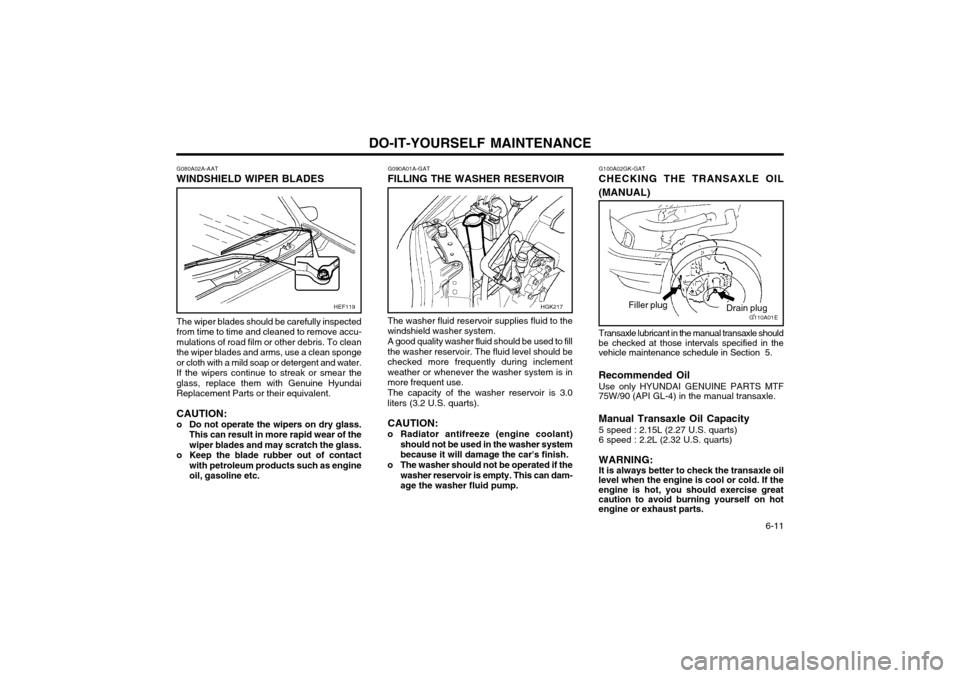
FILLING THE WASHER RESERVOIR The washer fluid reservoir supplies fluid to the windshield washer system. A good quality washer fluid should be used to fill the washer reservoir. The fluid level should bechecked more frequently during inclementweather or whenever the washer system is inmore frequent use. The capacity of the washer reservoir is 3.0 liters (3.2 U.S. quarts). CAUTION:
o Radiator antifreeze (engine coolant) should not be used in the washer system because it will damage the car's finish.
o The washer should not be operated if the washer reservoir is empty. This can dam-age the washer fluid pump.
HGK217
G080A02A-AAT WINDSHIELD WIPER BLADES The wiper blades should be carefully inspected from time to time and cleaned to remove accu-mulations of road film or other debris. To cleanthe wiper blades and arms, use a clean spongeor cloth with a mild soap or detergent and water.If the wipers continue to streak or smear theglass, replace them with Genuine HyundaiReplacement Parts or their equivalent. CAUTION:
o Do not operate the wipers on dry glass.
This can result in more rapid wear of the wiper blades and may scratch the glass.
o Keep the blade rubber out of contact with petroleum products such as engineoil, gasoline etc.HEF119
Transaxle lubricant in the manual transaxle should
be checked at those intervals specified in the vehicle maintenance schedule in Section 5. Recommended Oil
Use only HYUNDAI GENUINE PARTS MTF
75W/90 (API GL-4) in the manual transaxle.Manual Transaxle Oil Capacity
5 speed : 2.15L (2.27 U.S. quarts) 6 speed : 2.2L (2.32 U.S. quarts) WARNING: It is always better to check the transaxle oil
level when the engine is cool or cold. If the engine is hot, you should exercise great caution to avoid burning yourself on hot engine or exhaust parts. G100A02GK-GAT
CHECKING THE TRANSAXLE OIL (MANUAL)
G110A01E
Filler plug
Drain plug
Page 146 of 389

DO-IT-YOURSELF MAINTENANCE
6-14 G130B02A-AAT
To Replace the Fluid
Recommended brake fluid conforming to DOT 3 or DOT 4 specification should be used. Thereservoir cap must be fully tightened to avoidcontamination from foreign matter or moisture. NOTE: Do not allow any other liquids to contami- nate the brake fluid. Seal damage will result. WARNING: Use caution when handling brake fluid. It can damage your vision if you get it in youreyes. It will also damage your vehicle's paintif spilled on it and not removed immediately. G140A01A-AAT
AIR CONDITIONING CARE Keeping the Condenser Clean
The air conditioning condenser (and engine radiator) should be checked periodically foraccumulation of dirt, dead insects, leaves, etc.These can interfere with maximum cooling effi-ciency. When removing such accumulations,brush or hose them away carefully to avoidbending the cooling fans.
G120D01A-AAT
To Check the Fluid Level
The fluid level in the brake fluid reservoir should
be checked periodically. The level should be between the "MIN" and "MAX" marks on theside of the reservoir. If the level is at or belowthe "MIN" mark, carefully add fluid to bring it upto "MAX". Do not overfill.
G120E02A-AAT
Adding Brake Fluid WARNING: Handle brake fluid carefully. It can damage your vision if it gets into your eyes. Use onlyDOT 3 or DOT 4 specification fluid from asealed container. Do not allow the fluid canor reservoir to remain open any longer thanrequired. This will avoid entry of dirt andmoisture which can damage the brake sys-tem and cause improper operation. To add brake fluid, first wipe away any dirt thenunscrew the fluid reservoir cap. Slowly pour therecommended fluid into the reservoir. Do notoverfill. Carefully replace the cap on the reser-voir and tighten. G130A01S-AAT
CHECKING THE CLUTCH FLUID (Manual Transaxle)To Check the Clutch Fluid
The clutch fluid level in the master cylinder should be checked when performing other un-der hood services. The system should bechecked for leakage at the same time. Check tomake certain that the clutch fluid level is alwaysbetween the "MAX" and "MIN" level markingson the fluid reservoir. Fill as required. Fluid lossindicates a leak in the clutch system whichshould be inspected and repaired immediately.Consult your Hyundai dealer.
HGK215HGK216