maintenance schedule Hyundai Coupe 2004 Owner's Guide
[x] Cancel search | Manufacturer: HYUNDAI, Model Year: 2004, Model line: Coupe, Model: Hyundai Coupe 2004Pages: 389, PDF Size: 10.22 MB
Page 323 of 389
5
VEHICLE MAINTENANCE REQUIREMENTS
7EXPLANATION OF SCHEDULED MAINTENANCE ITEMS
6ZF060M1-A
o Engine oil and filter
The engine oil and filter should be changed at the intervals specified in the maintenance schedule. If the car is being driven in severe conditions,more frequent oil and filter changes are required. 6ZF060B2-A
o Drive belts
Inspect all drive belts for evidence of cuts, cracks, excessive wear or oilsaturation and replace if necessary. Drive belts should be checked periodi- cally for proper tension and adjustedas necessary. 6ZF060C1-A
o Fuel filter
A clogged filter can limit the speed at
which the vehicle may be driven, dam- age the emission system and cause hard starting. If an excessive amountof foreign matter accumulates in the fuel tank, the filter may require re- placement more frequently. After installing a new filter, run the
engine for several minutes, and checkfor leaks at the connections.
6ZF060D1-A
o Fuel lines, fuel hoses and
connections
Check the fuel lines, fuel hoses and
connections for leakage and damage. Replace any damaged or leaking parts immediately. 6ZF060E1-A o Timing belt Inspect all parts related to the timing belt for damage and deformation. Replace any damaged parts immedi- ately. 6ZF060G1-A
o Vapour hose and fuel filler cap The vapor hose and fuel filler cap should be inspected at those intervals specified in the maintenance sched- ule. Make sure that a new vapour hoseor fuel filler cap is correctly replaced.
Page 324 of 389

5VEHICLE MAINTENANCE REQUIREMENTS
8
6ZF060F1-A
o Vacuum, crankcaseventilation hoses
Inspect the surface of hoses for evi- dence of heat and/or mechanical dam- age. Hard and brittle rubber, cracking, tears, cuts, abrasions, and excessiveswelling indicate deterioration. Particu- lar attention should be paid to examin- ing those hose surfaces nearest tohigh heat sources, such as the ex- haust manifold. Inspect the hose routing to assure that the hoses do not come in contact with any heat source, sharp edges or mov- ing component which might cause heatdamage or mechanical wear. Inspect all hose connections, such as clamps and couplings, to make sure they aresecure, and that no leaks are present. Hoses should be replaced immedi- ately if there is any evidence of dete-rioration or damage. 6ZF060H1-A
o Air cleaner filter
A Genuine Hyundai air cleaner filter is
recommended when the filter is re- placed.
6ZF060J1-A
o Spark plugs
Make sure to install new spark plugs
of the correct heat range.
F060N02E-EAT
o Valve Clearance
Inspect excessive valve noise and/or
engine vibration and adjust if neces- sary. A qualified technician should perform the operation. 6ZF070B1-A
o Cooling system
Check the cooling system part, such
as radiator, coolant reservoir, hosesand connections for leakage and dam- age. Replace any damaged parts.
6ZF070C1-A
o Coolant
The coolant should be changed at
the intervals specified in the mainte-nance schedule.
6ZF070D1-A
o Manual transaxle oil
Inspect the manual transaxle oil ac-
cording to the maintenance schedule. NOTE:
If the oil level is low, check for
possible leaks before adding oil. Do not overfill.
Page 334 of 389
6OWNER MAINTENANCE
8ENGINE OIL AND FILTER REPLACEMENT
G040A04GK-EAT
o The engine oil consumption is
strongly effected by the viscosity and quality of oil, engine rpm and driving condition etc. More engine oil may be consumed under severe driving conditions such as high speeds, frequent acceleration and deceleration,compared to normal driving.
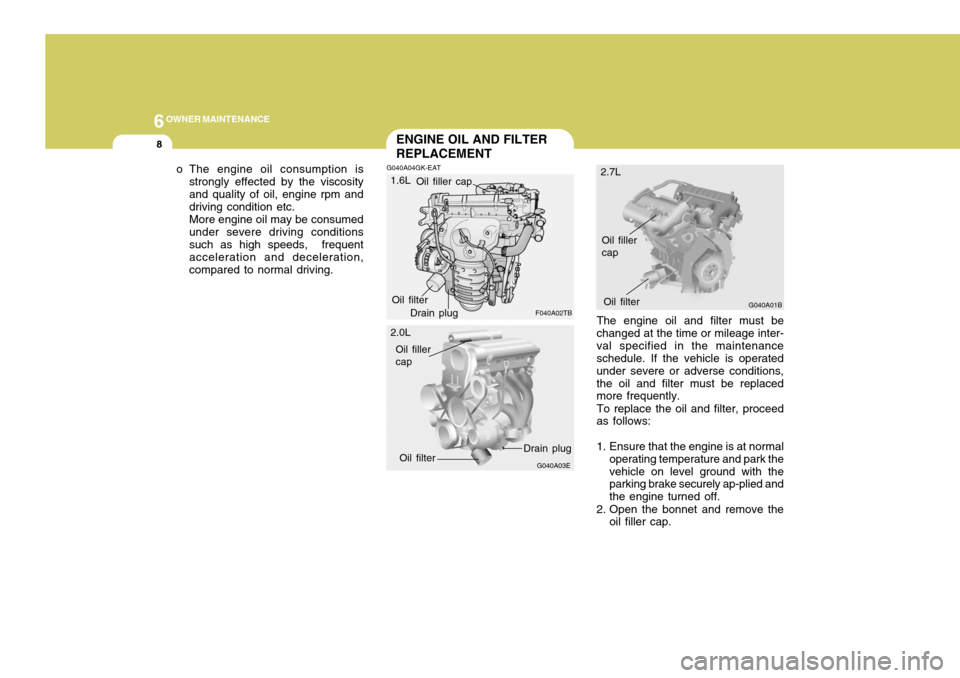
F040A02TB
G040A03E G040A01B
The engine oil and filter must be
changed at the time or mileage inter-val specified in the maintenance schedule. If the vehicle is operated under severe or adverse conditions,the oil and filter must be replaced more frequently.
To replace the oil and filter, proceed
as follows:
1. Ensure that the engine is at normal
operating temperature and park the vehicle on level ground with the parking brake securely ap-plied and the engine turned off.
2. Open the bonnet and remove the oil filler cap.
Oil filler cap
1.6L 2.0L 2.7L
Oil filter Drain plug
Oil filler cap
Oil filter Drain plug
Oil filler cap
Oil filter
Page 336 of 389
6OWNER MAINTENANCE
10
SG050B1-E
Coolant recommendations
Only ethylene glycol based coolant with a corrosion inhibitor suited to aluminium alloy engine components should be used in the cooling system.No further additives or inhibitors should be used. The coolant specific gravity should be checked as pre-scribed in the maintenance schedule to ensure adequate frost and corro- sion protection. In addition, the en-gine coolant must be replaced at the specified interval since the corrosion inhibitor properties deteriorate withtime.It is important to note that whilst anincrease in the concentration of anti freeze gives an increase in the level of frost protection, a solution which isin excess of 65% anti freeze will result in reduced frost protection and engine overheating. Therefore therecommended concentration of 50% should not be exceeded for general use. The use of methanol based anti freeze compounds may result in engine over- heating and will invalidate the vehiclewarranty.
!
ENGINE COOLANT CHECK- ING AND REPLACING
SG050A1-E
WARNING:
Do not remove the radiator cap
when the engine is hot, since the system is pressurized and coolant may be ejected from the radiator resulting in scalding. NOTE: It is imperative that vehicles fitted
with an air conditioning system have a coolant concentration of the recommended strength at all times. The use of the air condition-ing system when the cooling sys- tem is filled with water only will result in the heater matrix freezingand subsequently bursting.
Page 337 of 389
6
OWNER MAINTENANCE
11
HGK4006
SG050C1-E
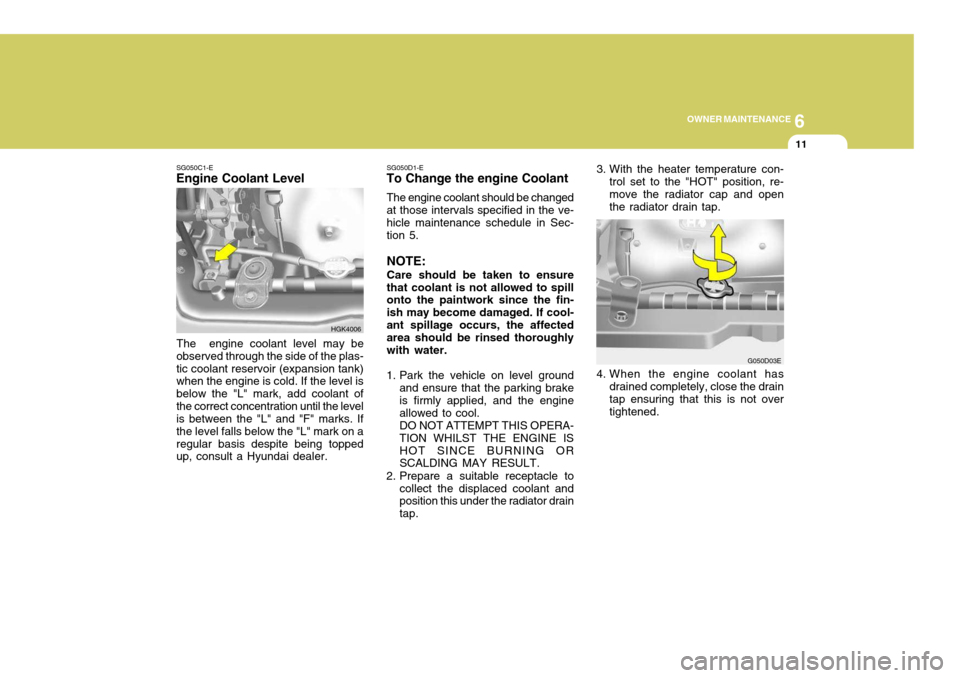
Engine Coolant Level
The engine coolant level may be
observed through the side of the plas- tic coolant reservoir (expansion tank) when the engine is cold. If the level is below the "L" mark, add coolant ofthe correct concentration until the level is between the "L" and "F" marks. If the level falls below the "L" mark on aregular basis despite being topped up, consult a Hyundai dealer. SG050D1-E
To Change the engine Coolant
The engine coolant should be changed at those intervals specified in the ve- hicle maintenance schedule in Sec- tion 5. NOTE: Care should be taken to ensure that coolant is not allowed to spill onto the paintwork since the fin- ish may become damaged. If cool-ant spillage occurs, the affected area should be rinsed thoroughly with water.
1. Park the vehicle on level ground and ensure that the parking brake is firmly applied, and the engine allowed to cool.DO NOT ATTEMPT THIS OPERA-TION WHILST THE ENGINE ISHOT SINCE BURNING OR SCALDING MAY RESULT.
2. Prepare a suitable receptacle to collect the displaced coolant andposition this under the radiator drain tap. 4. When the engine coolant has
drained completely, close the drain tap ensuring that this is not over tightened. G050D03E
3. With the heater temperature con-
trol set to the "HOT" position, re-move the radiator cap and open the radiator drain tap.
Page 339 of 389
6
OWNER MAINTENANCE
13
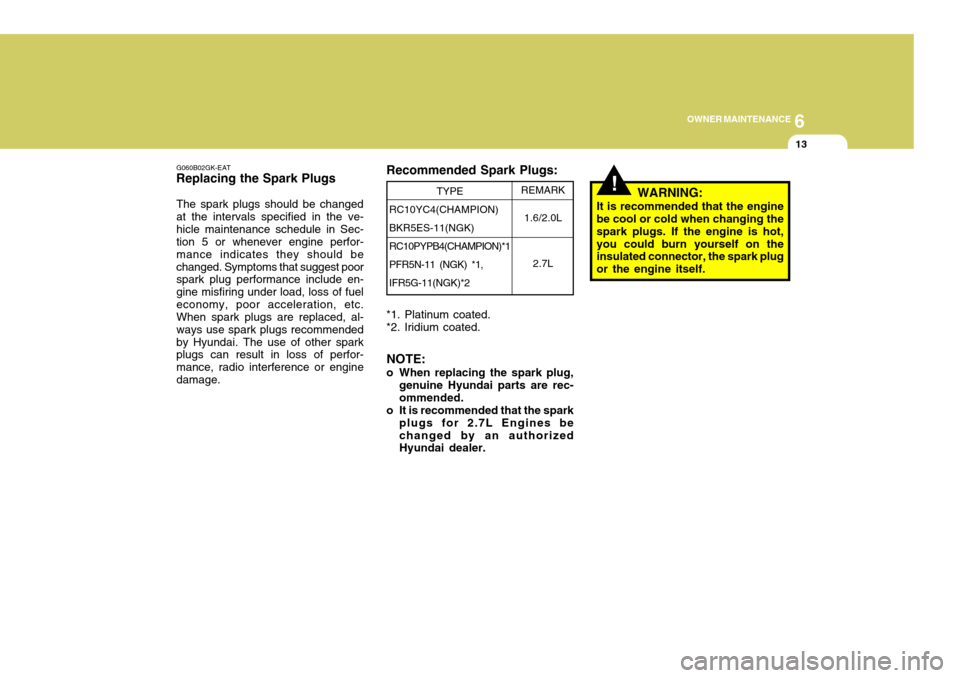
Recommended Spark Plugs:
G060B02GK-EAT
Replacing the Spark Plugs
The spark plugs should be changed at the intervals specified in the ve-hicle maintenance schedule in Sec- tion 5 or whenever engine perfor- mance indicates they should bechanged. Symptoms that suggest poor spark plug performance include en- gine misfiring under load, loss of fueleconomy, poor acceleration, etc. When spark plugs are replaced, al- ways use spark plugs recommendedby Hyundai. The use of other spark plugs can result in loss of perfor- mance, radio interference or enginedamage. TYPE
RC10YC4(CHAMPION) BKR5ES-11(NGK)RC10PYPB4(CHAMPION)*1
PFR5N-11 (NGK) *1,IFR5G-11(NGK)*2
REMARK
1.6/2.0L
2.7L
NOTE:
o When replacing the spark plug, genuine Hyundai parts are rec- ommended.
o It is recommended that the spark plugs for 2.7L Engines bechanged by an authorized Hyundai dealer.
*1. Platinum coated. *2. Iridium coated.
!WARNING:
It is recommended that the engine be cool or cold when changing the spark plugs. If the engine is hot,you could burn yourself on the insulated connector, the spark plug or the engine itself.
Page 345 of 389
6
OWNER MAINTENANCE
19
G100B01L
CAUTION:
The transaxle lubricant level should only be checked when the engine is cold to prelude the possibility ofpersonal injury by contact with hot components.
!
1. To check the transaxle lubricant level, the vehicle should be placed on level ground and the level plug removed with a suitable spanner.
2. If the level is correct, lubricant should begin to drip from the plugorifice. In this case the plug shouldbe replaced.If the level is incorrect, lubricantshould be added until it begins to drip from the plug orifice at which time the plug should be replaced. To Check the Transaxle Oil Level
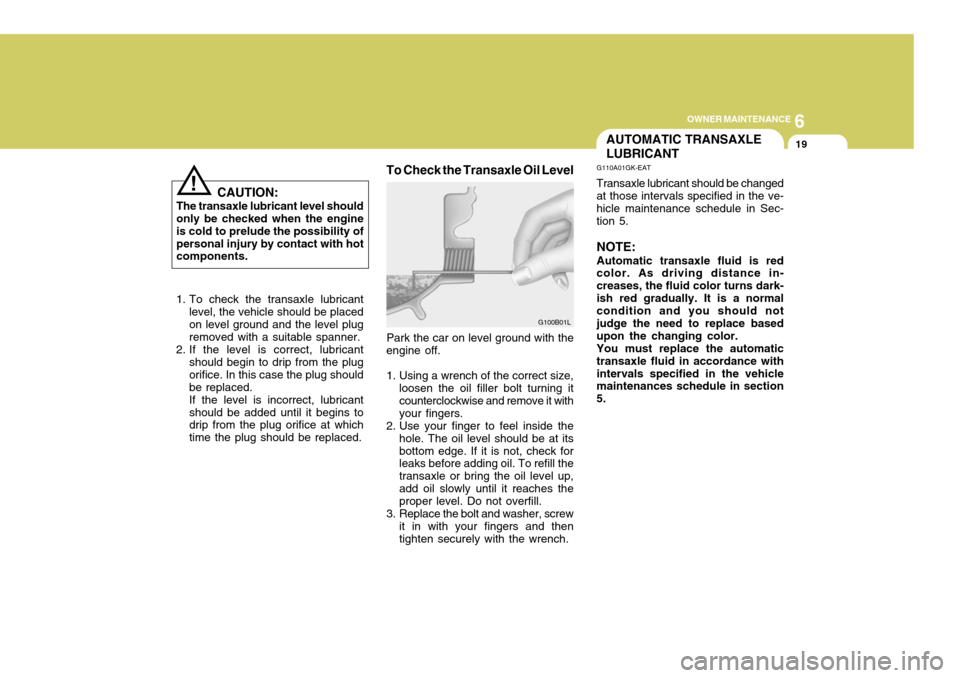
Park the car on level ground with the
engine off.
1. Using a wrench of the correct size, loosen the oil filler bolt turning it counterclockwise and remove it with your fingers.
2. Use your finger to feel inside the
hole. The oil level should be at itsbottom edge. If it is not, check for leaks before adding oil. To refill the transaxle or bring the oil level up,add oil slowly until it reaches the proper level. Do not overfill.
3. Replace the bolt and washer, screw it in with your fingers and thentighten securely with the wrench.
AUTOMATIC TRANSAXLE LUBRICANT
G110A01GK-EAT Transaxle lubricant should be changed at those intervals specified in the ve- hicle maintenance schedule in Sec-tion 5. NOTE: Automatic transaxle fluid is red color. As driving distance in- creases, the fluid color turns dark-ish red gradually. It is a normal condition and you should not judge the need to replace basedupon the changing color.You must replace the automatictransaxle fluid in accordance withintervals specified in the vehicle maintenances schedule in section 5.
Page 372 of 389
7EMISSION CONTROL SYSTEMS
2
SH010A1-E (Not all models) Depending upon the market for which the vehicle is destined, the emission control system will comprise one or more of the following emission controldevices.
(1) Crankcase emission control sys-
tem
(2) Evaporative emission control sys- tem
(3) Exhaust emission control systemIn order that the proper functioning of the emission control systems may be ensured, it is recommended that the vehicle is inspected and maintainedby an authorized Hyundai dealer in accordance with the maintenance schedule in this manual. EMISSION CONTROL SYS- TEMS
SH010B1-E
1. CRANKCASE EMISSION CON- TROL SYSTEM The positive crankcase ventilation system is employed to prevent air pollution caused by blow-by gases being emitted from the crankcase byintroducing fresh air to the crankcase through the air cleaner where this mixes with blow-by gases and thenpasses through the PCV valve into the intake manifold from where it sub- sequently enters the combustionchamber and is burned.
SH010C1-E
2. EVAPORATIVE EMISSION
CONTROL SYSTEM
The Evaporative Emission Control
System is designed to prevent fuelvapours from escaping into the atmo-sphere through the fuel tank ventila- tion system. SH010D1-E
3. EXHAUST EMISSION
CONTROL SYSTEM
The exhaust emission control system
is a highly effective system which controls exhaust emission while main- taining good vehicle performance. Whilst the engine is not running, fuel vapours generated inside the fuel tankare absorbed and stored in a char- coal canister. When the engine is started, the vapours stored in thecanister are drawn into the induction system through the purge control so- lenoid valve and are subsequentlyburned.The purge control solenoid valve iscontrolled by the ECU; when the en-gine coolant temperature is low or the engine is idling, the purge control valve is closed and fuel vapours re-main stored in the canister. Under normal running conditions when the engine is warm, the valve opens andthe vapours are drawn into the inlet tract and subsequently burned in the combustion chamber.
Page 388 of 389

10INDEX
4
Map light ................................................................... 1-61
Multi functi on switch................................................. 1-50
Multi gauge ............................................................... 1-49
O Odometer .................................................................. 1-46
Outside rearview mirror heater ................................. 1-63
PParking brake ............................................................ 1-64
Pollen filter ................................................................ 1-91
Power steering fluid level ................... ....................... 6-31
Power steering hoses ............................................... 6-30
Power window ........................................................... 1-11
Pre-tensioner seat belt .............................................. 1-28
Protecting your hyundai from corrosion ...................... 4-2
R Rear fog light switch ................................................. 1-54
Rear parcel shelf ....................................................... 1-18
Rear seat entry ......................................................... 1-16
Rear seat pos itions................................................... 1-16
Recommended shift points ......................................... 2-7
Remote fuel filler lid releas e .....................................1-66
Replacing light bulbs ................................................. 6-33
Running in your nero Hyundai .................................... 1-3SScheduled maintenance
.............................................. 5-4
Seat belt pr ecautions................................................ 1-18
Seat belts (3-point type) .... .......................................1-21
Seat cushion height adjustm ent ...............................1-15
Seat warmer .............................................................. 1-15
Service history ............................................................ 5-1
Smooth cornering ...................................................... 2-16
Snow tyres .................................................................. 8-4
Spare tyre ................................................................... 3-5
Sparking plug replacement .......................................6-13
Spectacle case .......................................................... 1-61
Speedometer ............................................................. 1-45
Starting the engine ...................................................... 2-3
Steering wheel freeplay ............................................ 6-26
Steering wheel tilt lever ............................................ 1-69
Stereo sound system ................................................ 1-92
Sun viso r ................................................................... 1-68
Sunroof ...................................................................... 1-59
Supplemental restraint (airbag) system ....................1-30
T Tachometer ............................................................... 1-45
Theft-alarm system ..................................................... 1-8
Trailer or vehicle towing ............................................ 2-18
Electronic stability program (ESP)............................ 2-13
Trailer or vehicle towing tips..................................... 2-21