auto ac Hyundai Coupe 2004 Workshop Manual
[x] Cancel search | Manufacturer: HYUNDAI, Model Year: 2004, Model line: Coupe, Model: Hyundai Coupe 2004Pages: 389, PDF Size: 10.22 MB
Page 112 of 389

WHAT TO DO IN AN EMERGENCY 3-1
3. WHAT TO DO IN AN
EMERGENCY
D010A01A-AAT IF THE ENGINE WILL NOT START WARNING: If the engine will not start, do not push or pullthe car to start it. This could result in acollision or cause other damage. In addition,push or pull starting may cause the catalyticconverter to be overloaded and create a firehazard. D010B02A-AAT If Engine Doesn't Turn Over or Turns Over Slowly
D010B01GK
1. If your car has an automatic transaxle, be sure the gear selector lever is in "N" or "P" and the emergency brake is set. 2. Check the battery connections to be sure
they are clean and tight.
3. Turn on the interior light. If the light dims or goes out when you operate the starter, thebattery is discharged.
4. Check the starter connections to be sure they are securely tightened.
5. Do not push or pull the vehicle to start it. See instructions for "Jump Starting" on the follow-ing pages.
D010C01A-AAT If Engine Turns Over Normally but Does Not Start
1 Check fuel level.
2 With the key in the off position, Check all connectors at ignition coils and spark plugs.Reconnect any that may be disconnected orloose.
3 Check the fuel line in the engine room.
4 If engine still refuses to start, call a Hyundai dealer or seek other qualified assistance.
D010D01A-AAT If Engine Stalls While Driving
1. Reduce your speed gradually, keeping a straight line. Move cautiously off the road to a safe place.
2. Turn on your emergency flashers.
3. Try to start the engine again. If your vehicle will not start, contact a Hyundai dealer or seekother qualified assistance. D020A02A-AAT JUMP STARTING
HGK184
Battery
WARNING: The gas produced by the battery during thejump-start operation is highly explosive. Ifthese instructions are not followed exactly,serious personal injury and damage to thevehicle may occur! If you are not sure how tofollow this procedure, seek qualified assis-
3
HGK184A
DOHC
V6Battery
Page 113 of 389

WHAT TO DO IN AN EMERGENCY
3-2
tance. Automobile batteries contain sulfuric acid. This is poisonous and highly corrosive.When jump starting, wear protective glassesand be careful not to get acid on yourself,your clothing or on the car.
o If you should accidentally get acid on your
skin or in your eyes, immediately remove any contaminated clothing and flush the area withclear water for at least 15 minutes. Thenpromptly obtain medical attention. If you mustbe transported to an emergency facility, con-tinue to apply water to the affected area witha sponge or cloth.
o The gas produced by the battery during the jump-start operation is highly explosive. Donot smoke or allow a spark or open flame inthe vicinity.
o The battery being used to provide the jump start must be 12-volt. If you cannot determinethat it is a 12-volt battery, do not attempt touse it for the jump start.
o To jump start a car with a discharged battery, follow this procedure exactly:
1. If the booster battery is installed in another vehicle, be sure the two vehicles are nottouching.
2. Turn off all unnecessary lights and acces- sories in both vehicles. 3. Attach the clamps of the jumper cable in the
exact location shown on the previous page.First, attach one clamp of the jumper cable tothe positive (+) post or cable of the dis-charged battery. Then attach the other end ofthe same cable to the positive (+) post orcable of the booster battery. Next, using theother cable, attach one clamp to the negative(-) post or cable of the booster battery. Thenattach the other end of that cable to a solidmetal part of the engine away from thebattery. Do not connect the cable to anymoving part.
4. Start the engine in the car with the booster battery and let it run for a few minutes. Thiswill help to assure that the booster battery isfully charged. During the jumping operation,run the engine in this vehicle at about 2000rpm.
5. Start the engine in the car with the discharged battery using the normal starting procedure.After the engine starts, leave the jumpercables connected and let the engine run atfast idle or about 2000 rpm for several min-utes.
6. Carefully remove the jumper cables in the reverse order of attachment.
If you do not know why your battery becamedischarged (because the lights were left on,etc.), have the charging system checked by yourHyundai dealer. D030A02A-AAT IF THE ENGINE OVERHEATSIf your temperature gauge indicates overheating, you experience a loss of power, or hear loudpinging or knocking, the engine is probably toohot. If this happens to you, you should:
1. Pull off the road and stop as soon as it is safe
to do so.
2. Place the gear selector lever in "P" (auto- matic), or neutral (manual transaxle) and set the parking brake. If the air conditioning is on,turn it off.
3. If engine coolant is running out under the car or steam is coming out from the hood, stopthe engine. Do not open the hood until theengine coolant has stopped running or thesteaming has stopped. If there is no visibleloss of engine coolant and no steam, leavethe engine running and check to be sure theengine cooling fan is operating. If the fan isnot running, turn the engine off.
4. Check to see if the water pump drive belt is missing. If it is not missing, check to see thatit is tight. If the drive belt seems to be satis-factory, check for engine coolant leaking fromthe radiator, hoses or under the car. (If the airconditioning had been in use, it is normal forcold water to be draining from it when youstop).
WARNING:While the engine is running, keep hair, hands,and clothing away from moving parts such asthe fan and drive belts to prevent injury.
Page 115 of 389
WHAT TO DO IN AN EMERGENCY
3-4
Boss
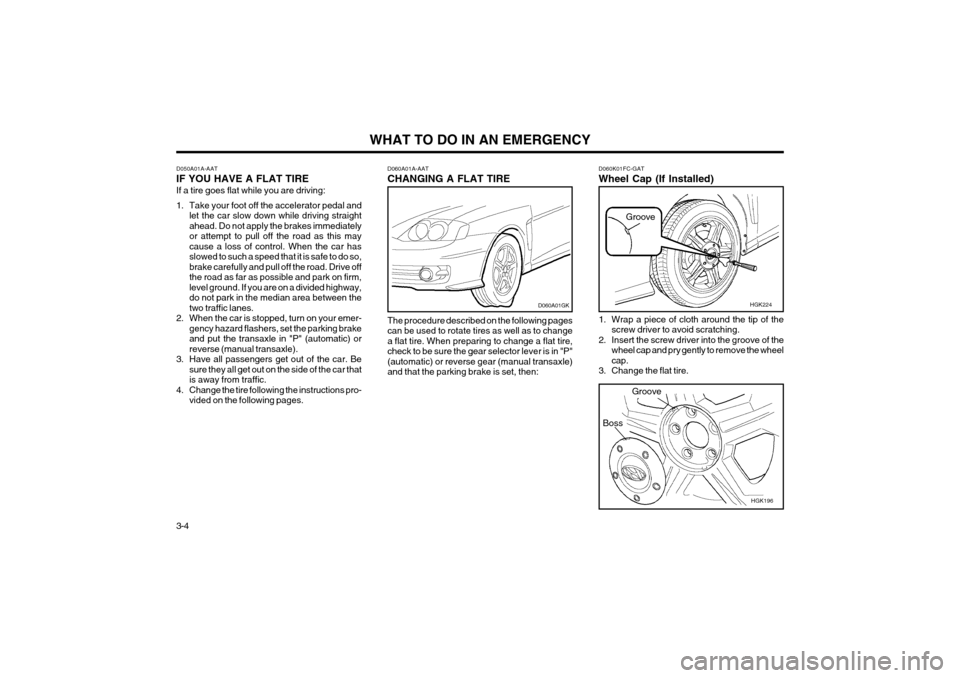
D060A01A-AAT CHANGING A FLAT TIRE The procedure described on the following pages can be used to rotate tires as well as to changea flat tire. When preparing to change a flat tire,check to be sure the gear selector lever is in "P"(automatic) or reverse gear (manual transaxle)and that the parking brake is set, then:
D060A01GK
D050A01A-AAT IF YOU HAVE A FLAT TIREIf a tire goes flat while you are driving:
1. Take your foot off the accelerator pedal and
let the car slow down while driving straight ahead. Do not apply the brakes immediatelyor attempt to pull off the road as this maycause a loss of control. When the car hasslowed to such a speed that it is safe to do so,brake carefully and pull off the road. Drive offthe road as far as possible and park on firm,level ground. If you are on a divided highway,do not park in the median area between thetwo traffic lanes.
2. When the car is stopped, turn on your emer- gency hazard flashers, set the parking brakeand put the transaxle in "P" (automatic) orreverse (manual transaxle).
3. Have all passengers get out of the car. Be sure they all get out on the side of the car thatis away from traffic.
4. Change the tire following the instructions pro- vided on the following pages.
D060K01FC-GAT Wheel Cap (If Installed)
HGK196
1. Wrap a piece of cloth around the tip of the
screw driver to avoid scratching.
2. Insert the screw driver into the groove of the wheel cap and pry gently to remove the wheel cap.
3. Change the flat tire. HGK224
Groove
Groove
Page 119 of 389

WHAT TO DO IN AN EMERGENCY
3-8 D080A02A-GAT IF YOUR CAR MUST BE TOWED CAUTION: Your car can be damaged if towed incorrect-ly! If your car has to be towed, it should be done by your Hyundai dealer or a commercial tow truckservice. This will help assure that your car is notdamaged in towing. Also, professionals are gen-erally aware of local laws governing towing. Inany case, rather than risk damage to your car, itis suggested that you show this information to thetow truck operator. Be sure that a safety chainsystem is used and that all local laws are ob-served.
D080B01A-AAT Towing a Car with a Manual Transaxle
o If the car is being towed with the rear wheels
on the ground, be sure the parking brake is released.
o If the car is being towed with the front wheels on the ground, be sure that the transaxle is inneutral. Also, be sure that the ignition key is inthe "ACC" position. This is necessary toprevent damage to the steering lock mecha-nism, which is not designed to hold the frontwheels straight while the car is being towed.
o If any of the loaded wheels or suspension components are damaged, a towing dollymust be used.
o OK FOR AUTOMATIC OR MANUAL
TRANSAXLE EQUIPPED VEHICLE o OK FOR AUTOMATIC OR MANUAL
TRANSAXLE EQUIPPED VEHICLEWITH NO DAMAGE
D080A01GKHGK199
D060J01FC-GAT After Changing Wheels If you have a tire gauge, remove the valve cap and check the air pressure. If the pressure islower than recommended, drive slowly to thenearest service station and inflate to the correctpressure. If it is too high, adjust it until it is correct.Always reinstall the valve cap after checking oradjusting tire pressure. If the cap is not replaced,air may leak from the tire. If you lose a valve cap,buy another and install it as soon as possible.After you have changed wheels, always securethe flat tire in its place in the luggage compart-ment and return the jack and tools to their properstorage locations.
HGK195
Page 120 of 389

WHAT TO DO IN AN EMERGENCY 3-9
D080C02A-GAT Towing a Car With an Automatic Transaxle CAUTION: A car with an automatic transaxle should never be towed from the rear with the frontwheels on the ground. This can cause seri-ous damage to the transaxle. If the car mustbe towed from the rear, a towing dolly mustbe used under the front wheels. If the car is being towed with the rear wheels on the ground, be sure the parking brake is re-leased.
o NOT OK FOR AUTOMATIC TRANSAXLE
EQUIPPED VEHICLE
o OK FOR MANUAL TRANSAXLE
D080D02A-AAT Emergency Towing For emergency towing when no commercial tow vehicle is available, attach a tow cable, chain orstrap to one of the towing hooks under the front/rear of your car. Do not attempt to tow yourvehicle in this manner on any unpaved surface.This could result in serious damage to your car.Nor should towing be attempted if the wheels,drive train, axles, steering or brakes are dam-aged. Before towing, be sure the transaxle is inneutral and the key is in "ACC" (with the engineoff) or in the "ON" position (with the enginerunning). A driver must be in the towed car tosteer it and operate the brakes. CAUTION:
o If the car is being towed with all four
wheels on the ground, it can be towedonly from the front. Be sure that thetransaxle is in neutral. Do not tow at speedsgreater than 50 km/h (30 mph) and formore than 25 km (15 miles).
o Be sure the steering is unlocked by plac- ing the key in the "ACC" position. A drivermust be in the towed vehicle to operatethe steering and brakes
o OK FOR AUTOMATIC OR MANUAL
TRANSAXLE EQUIPPED VEHICLE
HGK200
D080C01GK
HGK188
NOTE: Before towing, check the level of the transaxlefluid. If it is below the "HOT" range on thedipstick, add fluid. If you cannot add fluid, atowing dolly must be used.
Front
Rear
Page 123 of 389

CORROSION PREVENTION AND APPEARANCE CARE
4-2
E020C01A-AAT Keep Your Garage DryDon't park your car in a damp, poorly ventilated garage. This creates a favorable environment forcorrosion. This is particularly true if you washyour car in the garage or drive it into the garagewhen it is still wet or covered with snow, ice ormud. Even a heated garage can contribute tocorrosion unless it is well ventilated so moistureis dispersed. E020D01A-AAT Keep Paint and Trim in Good Condition Scratches or chips in the finish should be cov- ered with "touch-up" paint as soon as possible toreduce the possibility of corrosion. If bare metal is showing through, the attention of a qualified body and paint shop is recommended. E020E01A-AAT Don't Neglect the Interior Moisture can collect under the floor mats and carpeting to cause corrosion. Check under themats periodically to be sure the carpeting is dry.Use particular care if you carry fertilizers, clean-ing materials or chemicals in the car.These should be carried only in proper contain-ers and any spills or leaks should be cleaned up,flushed with clear water and thoroughly dried.
E030A01GK-AAT WASHING AND WAXING Washing Your Hyundai Never wash your car when the surface is hot from being in the sun. Always wash your car inthe shade. Wash your car frequently. Dirt is abrasive and can scratch the paint if it is not removed. Airpollution or acid rain may damage the paint andtrim through chemical action if pollutants areallowed to remain in contact with the surface. Ifyou live near the ocean or in an area where roadsalts or dust control chemicals are used, youshould pay particular attention to the undersideof the car. Start by rinsing the car to remove dustand loose dirt. In winter, or if you have driventhrough mud or muddy water, be sure to thor-oughly clean the underside as well. Use a harddirect stream of water to remove accumulationsof mud or corrosive materials. High pressure carwashes may cause water to enter your vehicle.Use a good quality car-washing solution andfollow the manufacturer's directions on the pack-age. These are available at your Hyundai dealeror auto parts outlet. Don't use strong householddetergents, gasoline, strong solvents or abra-sive cleaning powders as these may damage thefinish.Use a clean sponge or cloth, rinse it frequentlyand don't damage the finish by rubbing too hard.For stubborn spots, dampen them frequently andremove them a little at a time.To clean whitewall tires, use a stiff brush orsoapy steel-wool scouring pad.To clean plastic wheel covers, use a clean spongeor soft cloth and water. To clean cast aluminum alloy wheels, use a mild soap or neutral detergent. Do not use abrasivecleaners. Protect the bare-metal surfaces bycleaning, polishing and waxing. Because alumi-num is subject to corrosion, be sure to givealuminum alloy wheels special attention in win-ter. If you drive on salted roads, clean the wheelsthoroughly afterwards. After washing, be sure to rinse thoroughly. If soapy water dries on the finish, streaking willresult. When the weather is warm and the humidity low, you may find it necessary to rinse each sectionimmediately after washing to avoid streaking. After rinsing, dry the car using a damp chamois or soft, absorbent cloth. The reason for drying thecar is to remove water from the car so it will drywithout water spots. Don't rub, this can damagethe finish. If you find any nicks or scratches in the paint, use touch-up paint to cover them to prevent corro-sion. To protect the paintwork of the car againstcorrosion, you must clean your Hyundai (at leastonce a month). Give special attention to theremoval of salt, mud and other substances on theunderside of the splashboards of the car. Make
Page 126 of 389

VEHICLE MAINTENANCE REQUIREMENTS 5-1
F010C01A-GAT
Specified Scheduled Procedures
These are the procedures such as inspections,
adjustments and replacements that are listed in the maintenance charts starting on page 5-2.These procedures must be performed at theintervals shown in the maintenance schedule toassure that your warranty remains in effect.Although it is strongly recommended that theybe performed by the factory-trained or distribu-tor-trained technicians at your Hyundai dealer,these procedures may be performed at anyqualified service facility.
It is suggested that genuine Hyundai service
parts be used for any required repairs or re-placements. Other parts of equivalent qualitysuch as engine oil, engine coolant, manual orauto transaxle oil, brake fluid and so on which
are not supplied by Hyundai Motor Company or
its distributor may be used without affectingyour warranty coverage but you should alwaysbe sure these are equivalent to the quality of theoriginal Hyundai parts. Your Service Passportprovides further information about your warran-ty coverage.
5. VEHICLE
MAINTENANCE REQUIREMENTS F010E01A-AAT
Do-It-Yourself Maintenance If you are mechanically inclined, own a few tools that are required and want to take the time to do so, you can inspect and service a number of items. For more information about doing it your-self, see Section 6.
F010D01A-AAT
General Checks These are the regular checks you should per-
form when you drive your Hyundai or you fill the fuel tank. A list of these items will be found onpage 6-4.
F010A01A-GAT
MAINTENANCE INTERVALS Service Requirements To assure that you receive the greatest number
of kilometers of satisfying operation from your Hyundai, certain maintenance procedures mustbe performed. Although careful design and en-gineering have reduced these to a minimum,those that are required are of the utmost impor-tance.
It is your responsibility to have these mainte-
nance procedures performed to comply with theterms of the warranties covering your newHyundai. The Service Passport supplied withyour new vehicle provides further informationabout these warranties.
F010B01A-AAT
Maintenance Requirements The maintenance required for your Hyundai can be divided into three main areas: o Specified scheduled procedures o General checkso Do-it-yourself maintenance F010F01A-AAT
A Few Tips
o Whenever you have your Hyundai serviced, keep copies of the service records in your glovebox. This will help ensure that you candocument that the required procedures havebeen performed to keep your warranties ineffect. This is especially important when service is not performed by an authorized Hyundai dealer.
o If you choose to do your own maintenance and repairs, you may find it helpful to havean official Hyundai Shop Manual. A copy of this publication may be purchased at your Hyundai dealer's parts department.
F020A02A-GAT
SCHEDULED MAINTENANCE RE- QUIREMENTS Inspection should be performed any time a
malfunction is experienced or suspected. Re- ceipts for all emission control system servicesshould be retained to demonstrate compliance with conditions of the emissions system war- ranty.
For severe usage maintenance requirements,
see page 5-4 of this section.
5
Page 127 of 389

VEHICLE MAINTENANCE REQUIREMENTS
5- 2 1 2 3 4 5 6 7 8 9
10 ENGINE CONTROL SYSTEM MAINTENANCE ENGINE OIL & FILTER (SG OR ABOVE) See Note (1) DRIVE BELT FUEL FILTER (MPI) FUEL LINES, FUEL HOSES & CONNECTIONS TIMING BELT VAPOR HOSE & FUEL FILLER CAP VACUUM CRANKCASE VENTILATION HOSES AIR CLEANER FILTER SPARK PLUGS SPARK PLUGS (PLATINUM COATED) VALVE CLEARENCE (2.0L)
F030A01GK-GAT
SCHEDULED MAINTENANCE The following maintenance services must be performed to assure good vehicle control and performance. Keep receipts for all vehi cle services to protect
your warranty. Where both mileage and time are shown, the frequency of service is determined by whichever occurs first.
F030B03GK-GAT R :Replace I : Inspect and, after Inspection, clean, adjust, repair or replace if necessary.
NO. DESCRIPTION105 84
R
I I 120
96
R I I I I I
R
90 72
R II I
R I I
R R
75 60
R
I I
60 48
R I I I I I I
R
45 36
R I I I
30 24
R I I I I
R
15 12
R
I I
KILOMETERS X 1000 MONTHS
Note : (1) SF OR LOWER: EVERY 10,000 KM OR 6 MONTHS : "R"
FOR 2.0 DOHC CVVT : SH (API), GF-1 (ILSAC) OR ABOVE
(2) FOR EVERY 40,000 KM: "R"
(3) FOR EVERY 96,000 KM OR 48 MONTHS, WHICHEVER OCCURS FIRST : "I"
See Note (2)
1.6 DOHC/2.0 DOHC CVVT (ALT, W/PUMP, P/STR'G) 2.7 V6 (AUTO-TENSIONER, ALT, P/STR'G, A/CON)
See Note (3)
Page 128 of 389

VEHICLE MAINTENANCE REQUIREMENTS 5-3
GENERAL MAINTENANCE COOLING SYSTEM COOLANTMANUAL TRANSAXLE OIL AUTOMATIC TRANSAXLE FLUIDBRAKE HOSES AND LINES BRAKE FLUID REAR BRAKE DRUMS/LININGS, PARKING BRAKE BRAKE PADS, CALIPERS AND ROTORS EXHAUST PIPE AND MUFFLERSUSPENSION MOUNTING BOLTS STEERING GEAR BOX, LINKAGE & BOOTS/LOWER ARM BALL JOINT POWER STEERING PUMP, BELT AND HOSESDRIVESHAFTS AND BOOTS AIR CONDITIONING REFRIGERANT AIR CONDITIONER FILTER (FOR BLOWER UNIT)
F030C01GK-GAT
R : Replace I : Inspect and, after inspection, clean, adjust, repair or replace if necessary
120
96
I I I I II I I I I I I I I
105
84
I I I I I I I I I I I I
90 72
I I
R
I II I I I I I I I I
75 60
I I I I I I I I I I I I
60 48
I I I I II I I I I I I I I
45 36
I I I I I I I I I I I I
30 24
I I I I II I I I I I I I I
15 12
I I I I I I I I I I I I
KILOMETERS X 1000 MONTHS
NO. DESCRIPTION
1 23 4 5 6 7 8 9
10 11 1213 14 15
See Note (1)
Note : (1) FOR EVERY 24 MONTHS OR 45,000 KM, WHICHEVER OCCURS FIRST : "R" (2) FOR EVERY 12 MONTHS OR 20,000 KM, WHICHEVER OCCURS FIRST : "R"
European Community Only Except European Community
See Note (2)
Page 129 of 389

VEHICLE MAINTENANCE REQUIREMENTS
5- 4 European Community Only Except European Community
ENGINE OIL AND FILTER AIR CLEANER FILTER SPARK PLUGSTIMING BELTBRAKE PADS, CALIPERS AND ROTORSREAR BRAKE DRUMS/LININGS/PADS, PARKING BRAKESTEERING GEAR BOX, LINKAGE& BOOTS/LOWER ARM BALL JOINTDRIVESHAFTS AND BOOTSMANUAL TRANSAXLE OILAUTOMATICTRANSAXLE FLUIDAIR CONDITIONER FILTER (FOR BLOWER UNIT)
F040A03GK-GAT
MAINTENANCE UNDER SEVERE USAGE CONDITIONS
The following items must be serviced more frequently on cars normally used under severe driving conditions. Refer to the chart below for the appropriate maintenance intervals. R : Replace I : Inspect and, after inspection, clean, adjust, repair or replace if necessary
DRIVING
CONDITIONMAINTENANCE INTERVALS
R R RR
II II
RRR
MAINTENANCE
OPERATION
MAINTENANCE ITEM
EVERY 7,500 KM OR 6 MONTHS EVERY 5,000 KM OR 6 MONTHSMORE FREQUENTLYMORE FREQUENTLYEVERY 60,000 KM OR 48 MONTHSMORE FREQUENTLYMORE FREQUENTLY MORE FREQUENTLYEVERY 15,000 KM OR 12 MONTHS EVERY 100,000 KMEVERY 45,000 KMEVERY 40,000 KMMORE FREQUENTLYA, B, C, F, H C, E B, HD, E, F, GC, D, G, HC, D, G, H C, D, E, FC, D, E, F, G A, C, D, E, F, G, H, I, J A, C, E, F, G, H, IC, E
SEVERE DRIVING CONDITIONS
A - Repeated short distance driving
B - Extensive idling
C - Driving in dusty, rough roads
D - Driving in areas using salt or other corrosive materials or in very cold weather
E - Driving in sandy areas F - More than 50% driving in heavy city traffic during hot weather
above 32°C (90°F)
G - Driving in mountainous areas
H - Towing a trailer
I - Driving as a patrol car, taxi, other commercial use car or vehicle towing
J - Driving over 170 km/h1.6 DOHC/2.7 V6 2.0 DOHC CVVT